

Think of a neuropsychological evaluation as the ultimate deep-dive into how your brain works. It’s a detailed assessment designed to map out your unique cognitive and emotional landscape. Unlike a more standard psychological test, it digs into specific functions like memory, attention, problem-solving, and executive skills. The goal is to get a crystal-clear picture of your cognitive strengths and where you might be running into challenges.
This kind of evaluation is often the key to unlocking accommodations for standardized tests or untangling complex diagnostic questions.
What Exactly Is a Neuropsychological Evaluation for Adults?
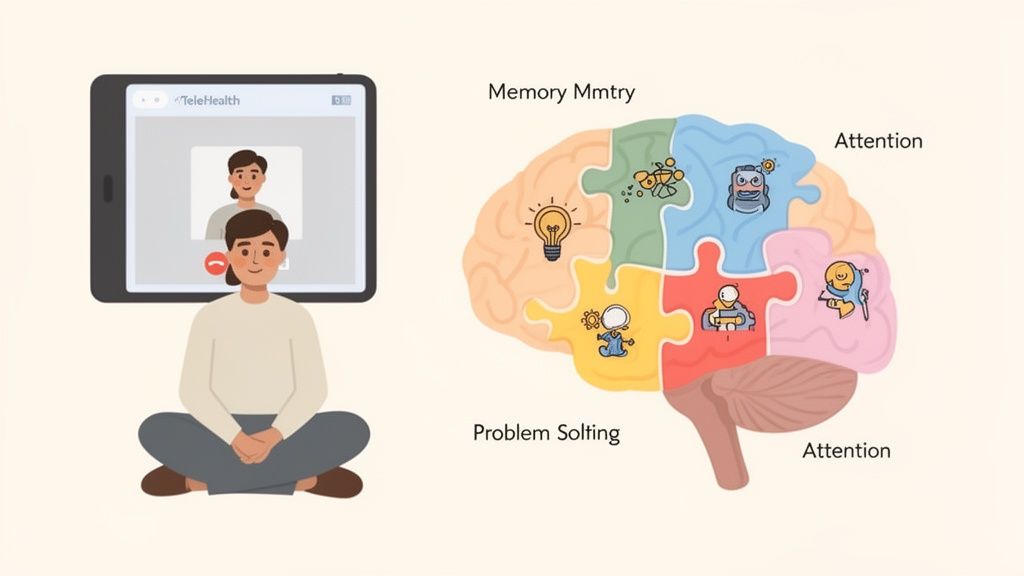
If your brain is a high-powered computer, a neuropsychological evaluation is the full diagnostic scan. It doesn't just tell you if the computer is on or off—it checks your processing speed, how much memory you have available, and how efficiently all the different programs run together. It goes way beyond a simple diagnosis to explain how your brain is wired to process information.
This in-depth analysis is incredibly helpful for adults facing a wide range of difficulties. It's important to remember this isn't about passing or failing; it's about understanding. The evaluation gives us objective data about your cognitive profile, which is invaluable in so many real-world situations.
A Deeper Look at Its Purpose
A neuropsychological evaluation for adults fills a role that standard diagnostic tests often can't. It’s specifically designed to:
- Clarify Complex Diagnoses: When symptoms of ADHD, a learning disability, and anxiety all seem to overlap, it can feel like a tangled mess. This evaluation helps sort through the confusion and pinpoint the primary source of the challenges you're facing.
- Secure Academic Accommodations: For students taking high-stakes exams like the GRE, SAT, or GMAT, a comprehensive report from a neuropsych evaluation is often the evidence needed to get crucial accommodations like extended time.
- Establish a Cognitive Baseline: After a brain injury or when dealing with a neurological illness, this evaluation creates a map of your current cognitive functioning. This baseline is essential for guiding recovery and planning effective treatments.
The need for this level of detailed assessment is on the rise. In fact, the market for adult neuropsychological assessments was valued at around $2.5 billion in 2025 and is expected to hit $4 billion by 2033. This growth reflects a greater demand for accurate diagnoses and accommodations, and thankfully, telehealth is making these vital services more accessible than ever.
How Telehealth Is Changing the Game
Traditionally, getting one of these evaluations meant multiple, time-consuming trips to an office, which was a huge barrier for busy adults. Now, providers like the Sachs Center offer comprehensive evaluations entirely through telehealth. This lets you get the same high-quality, in-depth assessment from the comfort of your own home, cutting out the stress and logistical headaches.
By using validated digital tools and virtual observation, telehealth neuropsychological testing maintains clinical rigor while offering unmatched convenience. It ensures that anyone, regardless of location, can access the detailed insights needed to thrive.
The final result is a powerful, data-driven report that acts as a blueprint for your success. Whether you're a student aiming for a top score or an adult just seeking clarity, understanding your cognitive profile is the first step. You can learn more about our approach to neuropsychological testing and see how it helps adults reach their goals.
When a Neuropsychological Evaluation Becomes Essential
Figuring out whether you need a standard diagnostic assessment or a full neuropsychological evaluation can be confusing. A targeted ADHD or Autism evaluation is great for diagnostic clarity, but some situations really call for the depth and detail that only a comprehensive neuropsychological evaluation for adults can provide.
These are the moments when you need more than just a label—you need a detailed cognitive map.
Think of it this way: a standard diagnosis is like a mechanic telling you your car has a steering problem. A neuropsychological evaluation is the full diagnostic printout that details the alignment, tire pressure, and axle integrity, explaining exactly why the car pulls to the left and giving you the precise data needed for a perfect fix.
Securing Accommodations for High-Stakes Exams
One of the most common reasons adults come to us for this kind of evaluation is to get accommodations on standardized tests. If you're taking the GRE, GMAT, LSAT, SAT, or MCAT, you’ve probably seen their strict documentation requirements. A simple doctor's note just won't cut it.
These testing boards need objective, data-driven proof of a cognitive or learning difference that genuinely impacts your ability to perform under pressure. A neuropsychological report delivers exactly that. It meticulously documents everything from your processing speed and working memory to your attention and executive functioning, building an undeniable case for accommodations like extended time or a quiet testing environment.
The detailed report from a neuropsychological evaluation acts as the official key to unlocking these necessary supports. It translates your personal challenges into the standardized, evidence-based language that academic and testing institutions require.
Solving the Complex Diagnostic Puzzle
Sometimes, what someone is going through doesn't fit neatly into one box. The symptoms of ADHD, a specific learning disability, anxiety, and depression can all overlap, creating a really murky clinical picture. For instance, you might struggle with focus (like ADHD), have trouble with reading comprehension (like a learning disability), and feel completely overwhelmed (like anxiety).
In cases like this, a standard evaluation might miss the full story. A neuropsychological evaluation is designed specifically to untangle these complex situations. By assessing a wide range of cognitive and emotional functions, a neuropsychologist can:
- Differentiate between conditions: Figure out if attention issues are really from ADHD or if they’re a side effect of anxiety.
- Identify co-occurring disorders: Uncover an underlying learning disability that might have been masked by more obvious ADHD symptoms.
- Provide an integrated understanding: Explain how different factors are interacting to create your unique profile of strengths and weaknesses.
Getting this level of clarity is crucial for creating a treatment plan that actually works because it addresses the root causes of your difficulties, not just the most obvious symptoms.
Mapping the Impact of Neurological Events
After a traumatic brain injury (TBI), concussion, or other neurological event, the cognitive fallout can be subtle but widespread. You might notice changes in your memory, find it harder to concentrate, or struggle to plan and organize things like you used to. While an MRI can show structural damage, it often doesn't capture the full picture of how these changes impact your daily life.
A neuropsychological evaluation for adults is a critical tool here. It establishes a detailed baseline of your cognitive functioning, pinpointing specific areas of impairment. This "cognitive map" is invaluable for guiding rehabilitation, tracking your recovery over time, and providing the official documentation needed for disability claims or workplace accommodations.
The precision of these evaluations is backed by decades of research. In fact, neuropsychological assessments are especially solid for adults, with 87.6% of the normative data studies focusing on adult or elderly populations. This massive amount of data ensures the tests are reliable and accurate—which is exactly why they’re trusted for securing accommodations on tests like the SAT or GRE. Here at the Sachs Center, we bring this precision to our telehealth neuropsychological testing, delivering a comprehensive 25-page report that’s perfect for these needs. You can learn more about how normative data strengthens neuropsychological findings and supports accommodation requests.
Decoding the Key Components of the Evaluation
A neuropsychological evaluation for adults can feel a bit mysterious, but it’s really just a structured way to explore your unique cognitive abilities. Think of it as a series of focused deep dives into your brain’s operating system. Each part is designed to measure a specific function, and when we put it all together, we get a detailed map of how you think.
This isn’t about passing or failing. It’s a collaborative process to understand how you learn, solve problems, and navigate the world. Let's break down the key areas we explore to make the whole thing less intimidating.
Cognitive Abilities and IQ Testing
When people hear "IQ test," they often think of a single number that defines how smart someone is. In a neuropsychological evaluation, it's so much more than that. We're less interested in judging your intelligence and more focused on understanding how you reason, tackle new problems, and process information.
These tests measure skills like:
- Verbal Comprehension: How you understand and use language.
- Perceptual Reasoning: Your ability to make sense of and organize visual information.
- Working Memory: This is your mental scratchpad—the ability to hold and work with information in your mind, like doing math in your head.
- Processing Speed: How quickly and accurately you can handle simple, straightforward information.
A task might involve finding the pattern in a series of abstract shapes or explaining what two different concepts have in common. This gives us a window into your natural problem-solving style, not just what you've learned in a classroom.
Academic Achievement Testing
While cognitive testing looks at your brain's underlying potential, academic achievement testing measures your actual skills in reading, writing, and math. This is how we can pinpoint specific learning challenges that might be holding you back.
This part of the evaluation helps answer critical questions. For instance, do you struggle to understand what you read even though you have a great vocabulary? Do you find it impossible to organize your thoughts into a coherent essay? By comparing your academic skills to your cognitive potential, we can spot disconnects that might point to a specific learning disability like dyslexia or dysgraphia.
Executive Functioning Assessment
Think of your executive functions as your brain's CEO. They're the high-level mental skills responsible for planning, organizing, managing time, and controlling impulses. You use them for everything from mapping out a big project at work to simply managing your monthly budget.
Executive functioning is the set of mental skills that includes working memory, flexible thinking, and self-control. We use these skills every day to learn, work, and manage daily life. Trouble with executive function can make it hard to focus, follow directions, and handle emotions, among other things.
During the evaluation, we assess these skills with tasks that require you to plan ahead, switch strategies on the fly, and resist automatic responses. The results give us a clear picture of why you might struggle with procrastination, disorganization, or staying on track with your goals.
Memory, Learning, and Emotional Functioning
This part of the evaluation looks at how your brain takes in, stores, and pulls out information. It tests both short-term and long-term memory, looking at how well you learn new verbal and visual information and recall it later. This is key for understanding why you might have trouble remembering conversations, study material, or important appointments.
Finally, we explore your emotional and psychological functioning using questionnaires and interviews. This adds crucial context to your cognitive profile. Conditions like anxiety and depression can have a huge impact on attention, memory, and executive functioning, so understanding your emotional landscape is a key piece of the puzzle. For professionals in the field, effective data capture during these interviews is crucial; insights on mastering qualitative research transcription can enhance the documentation and analysis of patient observations. This integrated approach ensures the final report is a true reflection of you as a whole person, not just a set of test scores.
Navigating the Evaluation Process from Start to Finish
Starting a neuropsychological evaluation for adults can feel a bit like heading into uncharted territory, but the whole process is actually very structured and designed to be as clear as possible. Think of it less like a high-stakes exam and more like a collaborative journey that unfolds in a few logical steps. Knowing the roadmap ahead of time can take the mystery out of it and help you feel much more prepared.
The entire thing kicks off with a simple—but really important—first step: an initial consultation.
The Initial Consultation: Your Starting Point
This first meeting is really just a detailed conversation with the neuropsychologist, and it's often done via telehealth to make things easier. It’s like a strategy session where you and the expert get on the same page about your history, what’s worrying you, and what you hope to achieve. The main goal is to gather a rich backstory that gives context to all the testing data to come.
To get the most out of this chat, it’s a good idea to pull together any relevant documents beforehand, such as:
- Any previous psychological or psychiatric evaluations
- Old academic records or report cards that might show patterns over time
- A list of your current medications and your general medical history
This is also your time to ask questions. You want to make sure you feel comfortable with the clinician and understand the process you're about to start.
The Testing Sessions: Mapping Your Cognitive Profile
The real heart of the evaluation happens during the testing sessions. These might take place in a single appointment or be spread out over a few, either in person or on a secure telehealth platform. While the word "testing" can sound a little intimidating, the activities are pretty varied and often feel more like puzzles, memory games, or just answering questions about your experiences.
This diagram breaks down the core areas we typically look at during the evaluation.
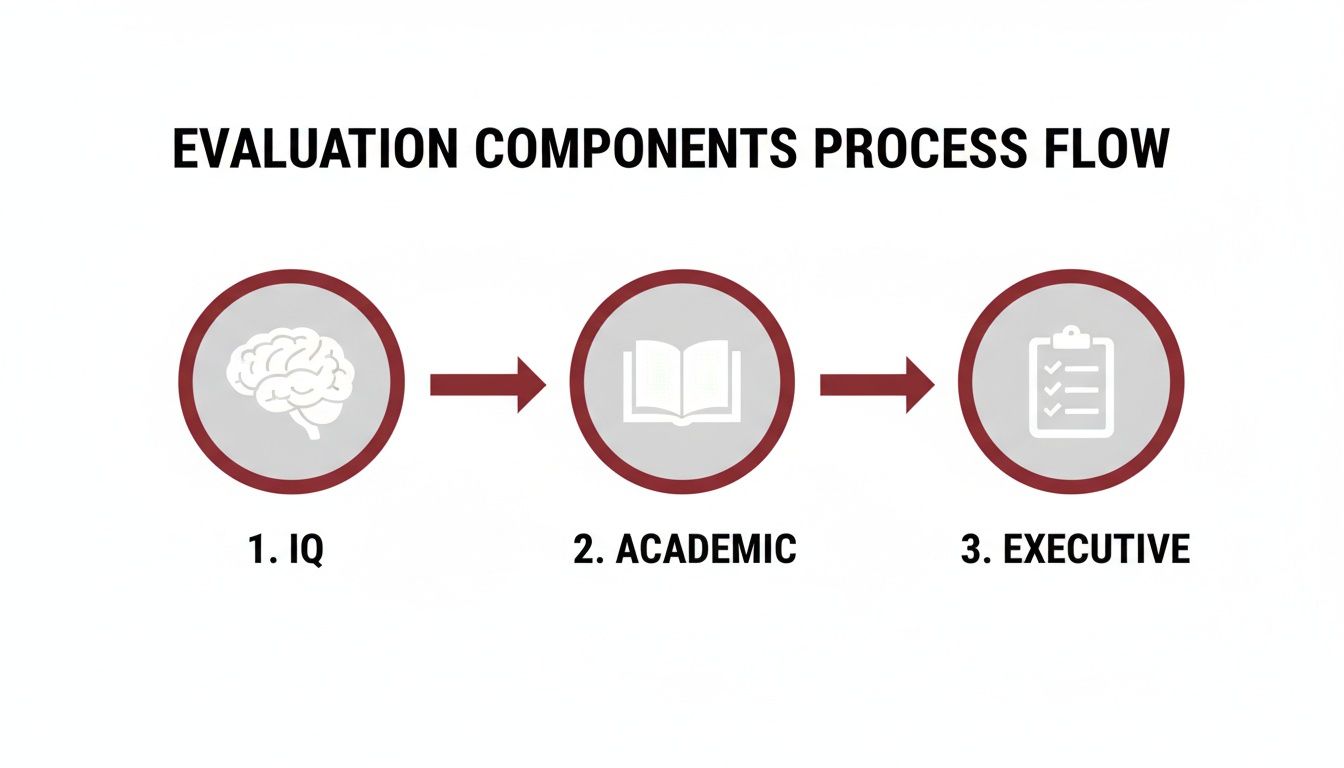
As you can see, we move methodically from foundational cognitive skills (like IQ) to how those are applied in academic settings, and finally to the complex executive functions that you use to manage daily life.
These sessions are always paced carefully, with breaks built in so you can perform at your best. A comfortable, quiet environment is key, which is a huge benefit of telehealth neuropsychological testing, since you can complete the assessment in a familiar, private space like your own home. You can learn more about our telehealth services here.
Behind the Scenes: Scoring and Analysis
Once you’ve completed the testing sessions, the neuropsychologist gets to work on the detailed scoring and interpretation. This is where the raw data from your performance gets turned into meaningful insights. Every test score is compared to normative data—which is just a fancy way of saying results from large groups of people of a similar age and educational background. This comparison helps pinpoint your unique cognitive strengths and weaknesses.
This analytical phase is really where the art and science of neuropsychology come together. The clinician doesn't just look at the numbers; they integrate your test scores with your personal history and their own observations to build a complete, nuanced picture of how your brain works.
It's an incredibly meticulous process of connecting all the dots, and it’s why the final report is so comprehensive.
The Feedback Session and Final Report
The whole journey wraps up with a feedback session. In this meeting, the neuropsychologist will walk you through all the findings, explaining what the results mean in clear, easy-to-understand language. You'll talk through any diagnosis and, most importantly, go over the personalized recommendations designed to help you reach your goals.
The demand for these evaluations is growing fast. With fewer than 6,000 clinical neuropsychologists in the US and a global mental health epidemic impacting 14% of the population, waitlists can get long. This is where telehealth is making a real difference, opening up access for people who need it.
After the feedback session, you'll receive the comprehensive written report. This document is a powerful tool you can use to secure accommodations, guide treatment, and advocate for yourself.
Your Report: An Actionable Blueprint for Success
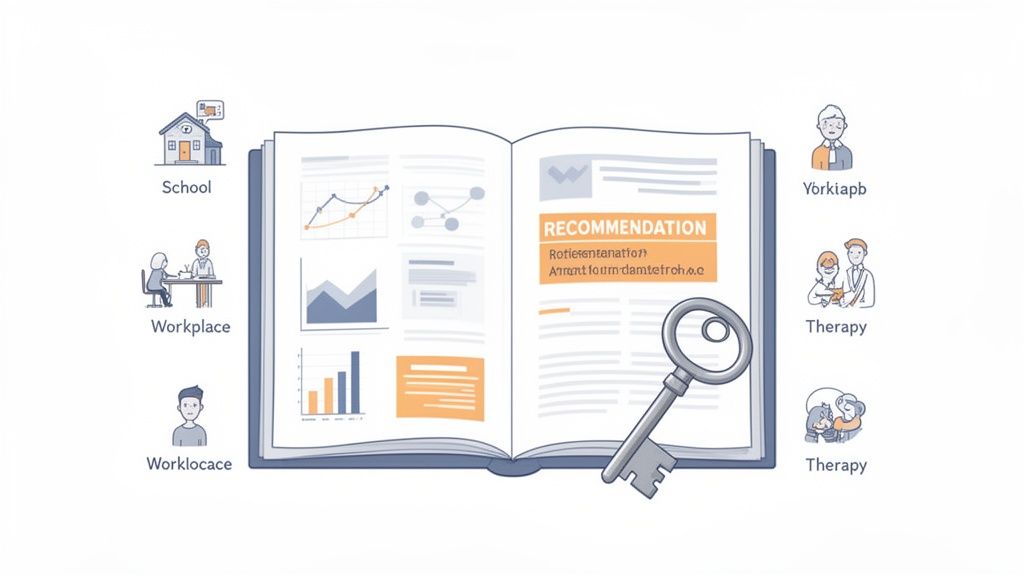
After all the testing is done, you'll receive a comprehensive report. This isn't just a collection of scores and charts; it's a personalized, actionable blueprint designed to guide you forward. Think of it as the detailed owner's manual for your brain that you've always wished you had.
This document, often around 25 pages, pulls together every piece of information we gathered during your neuropsychological evaluation for adults. It weaves your personal history, our behavioral observations during testing, and the hard data into a clear, insightful story. The goal is to give you a complete picture of who you are, not just a list of test results.
Understanding this report is empowering. It gives you the language and evidence to advocate for yourself effectively, whether you're at school, at work, or just navigating daily life.
What’s Inside Your Comprehensive Report
Every report is tailored to the individual, but they all follow a similar structure. This isn't by accident. We meticulously build a case, connecting your past experiences to your current cognitive profile, all leading up to practical, real-world recommendations.
Here's what you can expect to find inside:
- Background and History: This section lays the groundwork, summarizing your developmental, medical, academic, and social history to provide crucial context for everything that follows.
- Behavioral Observations: Here, the clinician shares their notes from the testing sessions. Did you approach problems systematically? Was your effort consistent? These observations add color to the black-and-white test scores.
- Test Results and Interpretation: This is the core of the report. We present the data from each test and explain what it all means. Your scores are compared to normative data, clearly highlighting your cognitive strengths and weaknesses.
- Summary and Diagnostic Impressions: This is where we pull it all together. You'll get a clear summary of your cognitive profile and, if warranted, a formal diagnosis based on the evidence.
This step-by-step approach ensures the report is both incredibly detailed and easy to digest. It helps you understand the "why" behind your challenges and the "what" of your unique strengths.
Turning Insights into Action
Perhaps the most valuable part of the whole process is the recommendations section. This is where the rubber meets the road—where all the data and insights are transformed into a concrete plan for moving forward. These aren't generic tips you could find online; they are specific strategies tied directly to your brain.
The recommendations are the bridge between understanding your cognitive profile and making tangible improvements in your life. They provide the specific steps needed to leverage your strengths and support your areas of challenge.
For a student, this report is the key that unlocks critical accommodations. We might recommend extended time on the SAT or GRE, access to a quiet testing room, or permission to use a specific app. And because these recommendations are backed by pages of data, they hold weight with testing boards and universities.
For an employee, the report provides the official documentation needed to request reasonable workplace accommodations under the ADA, like noise-canceling headphones, getting instructions in writing, or having a more flexible schedule.
Ultimately, this blueprint is a powerful communication tool. You can share it with therapists, academic advisors, coaches, and doctors so everyone on your support team is working from the same playbook, giving you a clear and unified path forward.
How to Prepare for a Successful Evaluation
Thinking about how to "prepare" for a neuropsychological evaluation for adults can feel a bit strange. This isn't a test you can study for, and you certainly can't fail. The real goal is to set the stage for a clear and accurate assessment—to make sure the results reflect your true abilities, not just a bad day.
Think of it as creating the best possible conditions for a candid snapshot of your cognitive functioning. It’s a collaborative process, and a few simple steps beforehand can go a long way in reducing any anxiety and helping you feel more comfortable and confident.
Your Pre-Evaluation Checklist
To get the most out of your appointment, it helps to focus on both your environment and your own well-being. A calm mind and body allow for the best performance. These straightforward steps can make a world of difference, especially if your session is via telehealth where your home environment plays a big role.
Here's a simple checklist to get you ready:
- Secure a Quiet Space: For telehealth evaluations, this is non-negotiable. Find a private room where you won’t be interrupted by family, pets, or pinging notifications. Your focus is key.
- Gather Your Documents: It's a good idea to have any previous evaluation reports, relevant medical records, or academic transcripts handy. This background gives your psychologist valuable context right from the start.
- Get a Good Night's Sleep: This might be the most important thing you can do. Fatigue can seriously impact cognitive performance, so aim for a full, restful night before your evaluation.
On the Day of Your Evaluation
When the day arrives, your main job is simply to be yourself. There’s no need to stress about how you'll perform. The tasks are designed to see how your brain naturally works through problems.
Remember, the evaluation is a tool to help you. By preparing properly, you are giving the clinician the clearest possible view, which leads to a more accurate and helpful report for you.
To be at your best, have a balanced meal before your session and try to avoid excessive caffeine, which can sometimes heighten anxiety or mess with concentration. Wear comfortable clothing and don't forget to bring your glasses or hearing aids if you use them.
Following these simple steps ensures you can walk into the evaluation with a clear and positive mindset, ready for a successful and insightful experience. You can also review information on the cost of neuropsychological testing to feel fully informed about every aspect of the process.
Common Questions About Neuropsychological Evaluations
Even with a good overview, it's completely normal to have some practical questions. A neuropsychological evaluation for adults is a big step toward understanding yourself, so getting clear on the details helps you move forward with confidence. Here are some straightforward answers to the questions we hear most often.
How Long Does the Entire Process Take?
From your first call to getting the final report in your hands, the timeline can vary a bit. The initial meeting and the testing sessions themselves usually take several hours, but we often break them up into a couple of appointments. This helps you stay fresh and perform at your best.
Once the testing is done, the real deep-dive work begins for the neuropsychologist. They have to score everything, analyze all the data, and write up a truly comprehensive report. This is the most time-intensive part of the process on our end.
You can typically expect your final report and feedback session to be ready within 3 to 4 weeks after your last testing day. This gives us the time needed for the careful, detailed analysis that makes the report so valuable.
How Much Does a Neuropsychological Evaluation Cost?
The cost of a full neuropsychological evaluation reflects the many hours of dedicated clinical time involved—from the one-on-one testing sessions to the in-depth analysis and extensive report writing. It's a highly specialized service designed to give you a deep and nuanced understanding of your cognitive and emotional world.
While the exact cost can differ, a comprehensive evaluation is a significant investment. For instance, an evaluation specifically designed to secure accommodations for standardized tests like the GRE or SAT, which results in a detailed 25-page report, is a specialized service with a price that reflects that level of detail. It’s always best to talk about the fees directly with the provider before getting started.
Is the Evaluation Covered by Insurance?
This is one of the biggest and most important questions we get. Navigating insurance for neuropsychological evaluations can be tricky, as coverage varies a lot from one plan to the next. Some plans might cover part of the cost, especially if the evaluation is considered "medically necessary" to diagnose a condition that's impacting your health.
However, it's important to know that evaluations done specifically for academic or standardized test accommodations are often not covered. Insurance companies tend to view these as educational needs rather than medical ones.
Here’s a quick guide on what to do:
- Call Your Insurance Company: Find the member services number on your card and ask them specifically about your coverage for "neuropsychological testing." It helps to have some CPT codes handy, like 96132, 96133, 96136, and 96137.
- Ask About Out-of-Network Benefits: Even if a provider isn't in your network, you might still get some of the cost reimbursed. We can provide you with a "superbill" that has all the details you need to file a claim on your own.
- Be Clear About the Purpose: Tell your insurance company exactly why you're seeking the evaluation—whether it's for a diagnosis or for academic accommodations. This will be a major factor in their decision.
Honestly, it’s a good idea to prepare for the possibility of paying out-of-pocket while you sort out your insurance options.
At Sachs Center, we specialize in providing clear, actionable insights through our telehealth neuropsychological and diagnostic evaluations. If you're ready to understand your unique cognitive profile and unlock the support you need to succeed, we're here to help. Explore our services and book your evaluation today.
