

If you've ever found yourself wondering if your lifelong struggle with feeling overwhelmed, scattered, or just different might be something more, you're not alone. For many women, taking an online ADHD test is that first, quiet step toward getting answers. It’s not a formal diagnosis, of course, but think of it as a crucial starting point—a private way to explore your symptoms before you even think about talking to a professional.
The Rise of Online ADHD Screening for Women
For decades, the textbook picture of ADHD was a hyperactive little boy who couldn't sit still in class. This narrow view left countless girls and women feeling completely invisible. Their very real struggles were often brushed off as anxiety, stress, or even character flaws.
Thankfully, that narrative is finally changing, and the accessibility of digital tools has played a huge role. An online ADHD test designed for women has become a gateway to self-discovery, offering a low-pressure way to connect with symptoms that break the old mold—things like emotional dysregulation, chronic overwhelm, and the kind of perfectionism that's really just a coping mechanism.
A Tool for Gathering Clues
A free online screener is a lot like the initial questionnaire you fill out in a doctor's waiting room. It's not the diagnosis itself, but it’s an essential first pass for gathering information and spotting patterns. The real value is in how it helps you organize your own thoughts and experiences, setting you up for a much more productive conversation with a clinician down the road.
These tools are especially powerful because they bring symptoms commonly seen in women to the forefront, such as:
- Internalized Hyperactivity: This isn't about bouncing off the walls. It’s a mind that won’t stop racing, constant rumination, or a deep-seated inability to just relax.
- Emotional Intensity: Feeling everything deeply, which can look like quick-to-rise frustration or a painful sensitivity to criticism (Rejection Sensitivity Dysphoria).
- Chronic Overwhelm: That bone-deep exhaustion from the sheer mental effort it takes to manage day-to-day life, keep a home in order, or stay on top of a demanding job.
An online screener gives you the language to describe your internal chaos. It helps transform vague feelings of "I'm not coping" into specific points like "I struggle with executive function and emotional regulation," which is a powerful step toward getting help.
The Digital Shift in ADHD Awareness
The explosion in popularity of these screeners signals a massive cultural shift. More women are actively seeking answers, and having a clear, accessible path to diagnosis, like an online ADHD assessment UK, has become essential. This isn't just about idle curiosity; it's driving real-world action.
It makes sense. You're scrolling through your phone and come across a quiz that feels like it was written just for you. It's no wonder these tools are resonating. Between 2019 and 2023, online searches for 'ADHD' shot up by an incredible 270.5% across 19 countries.
This surge in awareness is fueling a telehealth boom. Virtual visits for behavioral health jumped from 41% in early 2020 to 67% by the end of 2023. This guide will walk you through this modern path—from that very first online quiz to a formal, professional evaluation that can finally give you the clarity you've been searching for.
Why ADHD in Women Is So Often Overlooked
For years, the classic image of ADHD was a little boy bouncing off the walls, unable to sit still in class. That stereotype has done a massive disservice to countless girls and women whose experiences look nothing like that. Their struggles aren't any less real; they're just better hidden, often leading to decades of missed diagnoses and misunderstood pain.
The biggest reason ADHD in women flies under the radar comes down to one powerful survival tactic: masking. Imagine feeling like you have to perform 24/7, wearing a mask of "normalcy" to hide the chaos churning inside. This isn't a conscious choice to deceive anyone—it's a deeply ingrained coping mechanism built up over a lifetime of trying to fit in.
This constant effort to appear "put together" means the typical ADHD checklists, often designed with boys in mind, just don't work for women. They learn to compensate so incredibly well that their underlying struggles become invisible to everyone, including, sometimes, themselves.
The Invisible Symptoms of Female ADHD
While the official diagnostic criteria are the same for everyone, the way symptoms actually show up in women can be incredibly subtle and turned inward. Instead of obvious hyperactivity, a woman with ADHD might experience a relentless internal restlessness—a mind that simply refuses to switch off.
Many women with undiagnosed ADHD become masters of camouflage. This often shows up in a few key ways:
- Perfectionism as a Shield: They might develop a paralyzing fear of failure, leading them to overcompensate by becoming meticulous and hyper-organized. Their house might be spotless or their work projects flawless, but this level of perfectionism comes at the huge cost of their mental energy and constant, gnawing anxiety.
- People-Pleasing: To avoid the sting of rejection or conflict, they often learn to suppress their own needs and feelings. This can look like saying "yes" to everything, taking on way too much, and burning out while trying to keep everyone else happy.
- Emotional Dysregulation: Intense emotional reactions are common, but they're frequently turned inward. This can lead to overwhelming waves of shame, anxiety, and a painful sensitivity to criticism, a symptom known as Rejection Sensitive Dysphoria (RSD).
Think about the woman who's the "super planner" of her friend group. Her calendars are a work of art, and she never forgets a birthday. On the surface, she's the poster child for organization. But internally, she's drowning in mental to-do lists, terrified that if she drops even one ball, her entire world will implode. This is a classic example of high-functioning anxiety masking profound executive function challenges.
The High Cost of Masking
Putting on this performance, day in and day out, is completely and utterly exhausting. Women who mask their ADHD symptoms often live with a nagging feeling of being an imposter, just waiting for the day they'll be "found out." The chronic stress of keeping up this facade can lead to serious mental health issues.
It's incredibly common for women to be misdiagnosed with anxiety, depression, or even bipolar disorder long before a professional ever considers ADHD. While these conditions can certainly exist alongside ADHD, they are often secondary problems that grow from the constant strain of living with an unsupported, undiagnosed brain. The feeling of constantly failing to meet expectations, despite trying twice as hard as everyone else, just grinds away at your self-worth. To learn more, check out our detailed guide on the unique ways ADHD symptoms present in women.
Because these struggles aren't as visible, women are often left feeling totally isolated. Their challenges with organization, time management, and emotional regulation get written off as personal failings or character flaws instead of legitimate neurological symptoms. This is exactly why a generic online quiz often isn't enough. While an online ADHD test for women that asks the right questions is a good first step, a professional evaluation with someone who understands these nuances is critical. An expert can see past the carefully built mask to identify the real challenges underneath, offering the validation and support needed to finally move forward.
What an Online ADHD Screener Can and Cannot Do
Taking an online ADHD test can feel like a lightbulb finally flicking on, putting a name to struggles you’ve felt for years. It's a fantastic first step, but it’s so important to understand what these tools are actually for.
Think of an online screener like a weather app—it can give you a strong indication of what’s coming, but it isn't the storm itself.
These quizzes are self-report screeners, not clinical diagnostic tools. Their biggest strength is helping you build self-awareness. They give you the language to describe your experiences, turning those vague feelings of being overwhelmed into specific points you can bring up with a professional.
But it's just as important to know what they can't do. These tools don't have any clinical oversight, and that’s a pretty big limitation.
The Limits of a Self-Guided Quiz
One of the biggest problems with a simple online test is its inability to see the whole picture. Many symptoms of ADHD—especially the internalized kind we often see in women—look a lot like symptoms of other conditions.
For example, your screener might flag that you have a hard time focusing. But is that because of ADHD, or could it be a symptom of:
- Anxiety: Constant worrying can make it impossible to concentrate on anything else.
- Depression: The low energy and lack of motivation that come with depression can easily be mistaken for ADHD struggles.
- Trauma: Hypervigilance and emotional dysregulation are common trauma responses that can mimic ADHD symptoms.
An online quiz simply can’t tell the difference. Only a trained clinician can untangle these overlapping symptoms through a detailed interview and a comprehensive evaluation. To help you get started on your journey, the Sachs Center offers a helpful online ADHD test that serves as a solid first step.
Online Screener vs Professional Evaluation What Is the Difference
To really see why a professional assessment is the essential next step, it helps to put them side-by-side. A free quiz is a starting point for curiosity; a clinical evaluation is the path to clarity.
Here’s a breakdown of what separates a quick online screener from a formal clinical evaluation.
| Feature | Free Online Screener | Professional Clinical Evaluation |
|---|---|---|
| Purpose | To increase self-awareness and identify potential ADHD traits. | To provide a formal, accurate medical diagnosis. |
| Accuracy | Varies widely; high risk of false positives or negatives. | High, based on clinical interviews and validated assessment tools. |
| Oversight | None. Results are based entirely on self-reported information. | Conducted by a qualified psychologist or psychiatrist. |
| Outcome | An informal score that suggests the possibility of ADHD. | A diagnostic letter or report for accommodations or treatment. |
As you can see, while a screener opens the door, only a professional can walk you through what's on the other side.
This flowchart helps visualize how those internal feelings of overwhelm can show up as overlooked ADHD symptoms.
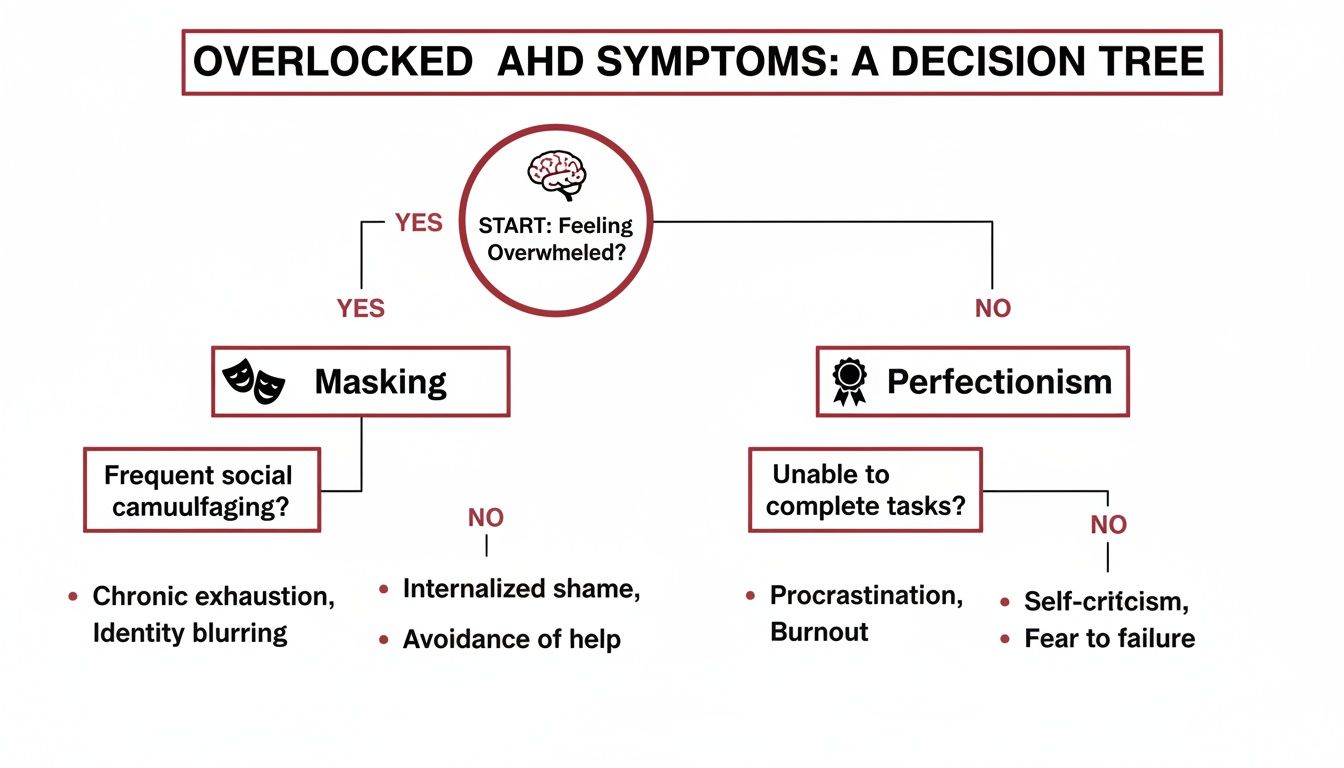
The image makes it clear that masking and perfectionism are common—but often invisible—coping strategies for women with ADHD.
Ultimately, an online screener is a powerful tool for validation. It can confirm that your struggles are real and shared by others, giving you the confidence to take the next step.
View your results not as a final answer, but as the beginning of an informed conversation with an expert who can give you the clarity you deserve.
Your Guide to a Formal Telehealth Evaluation
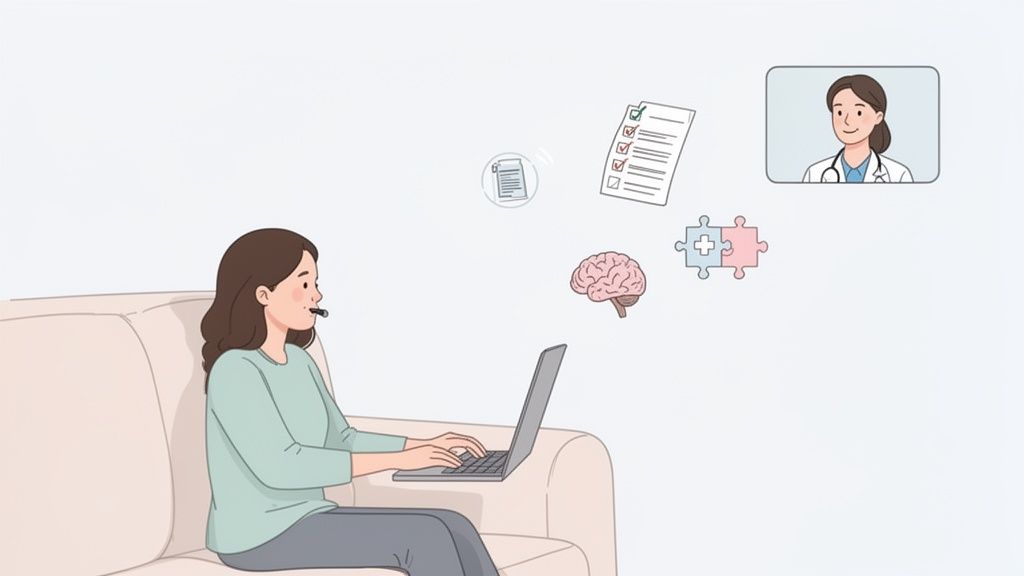
So, an online screener has confirmed what you’ve suspected for a while. That realization can bring a mix of relief and a "what now?" feeling. Taking the next step toward a professional diagnosis is a big deal, and thankfully, a telehealth assessment makes it more approachable than ever. It's a way to get real answers, right from the comfort of your own home.
Forget the idea of a test you can pass or fail. Think of it more like a collaborative conversation with an expert who finally speaks your language. The whole point is to understand the unique way your brain is wired by looking at your entire life story, not just a checklist of symptoms. A specialist trained in how ADHD shows up in women knows exactly how to look past the surface.
This approach is specifically designed to take the anxiety out of the process. Instead of a sterile, clinical office, a virtual evaluation creates a safe, private space for you to share your experiences and finally get the validation you've been searching for.
What to Expect During Your Evaluation
A formal telehealth evaluation goes so much deeper than any online quiz. It’s a comprehensive process that weaves together your personal history with clinically proven tools to build a complete picture of how you think, feel, and function day-to-day.
The journey usually has a few key parts:
The In-Depth Clinical Interview: This is really the heart of the whole evaluation. Your psychologist will guide you through a detailed conversation about your life, starting from your childhood—what you were like in school, at home—and moving through your teen years into your current adult life. They’ll ask about your career, relationships, and daily routines to spot the lifelong patterns that point toward ADHD.
Validated Assessment Tools: You’ll fill out standardized questionnaires. Unlike those quick online quizzes, these are scientifically designed and tested tools that measure the specific frequency and severity of your ADHD symptoms and executive function challenges.
Computer-Based Testing: Some evaluations might also include a few computer-based tasks. These are designed to objectively measure cognitive functions like your ability to maintain focus, control impulses, and process information quickly. This data provides another layer of insight that complements what you share in your interview.
Why a Specialist Matters for Women
For women, it's absolutely critical to work with a specialist who gets masking. A clinician experienced in female ADHD knows that a history of good grades or a successful career doesn't rule anything out. They know to look for the hidden price of that success—the constant, humming anxiety, the bone-deep exhaustion from overcompensating, and that persistent feeling of being an imposter.
A skilled evaluator acts like a detective, piecing together clues from your entire life. They connect the dots between the girl who was called "chatty" and "a daydreamer" and the woman who now struggles with managing a household, meeting work deadlines, and regulating her emotions.
The rise of telehealth has been a true game-changer for women seeking an accurate diagnosis. The virtual format breaks down so many barriers, making specialists more accessible than ever. Data shows we're in the middle of a huge shift. By 2025, it's predicted that nearly half of all adults with ADHD will be using telehealth for their assessments. We’re already seeing it happen: 46% of adults with ADHD have used virtual care, with behavioral health telehealth use jumping from 41% in early 2020 to 67% by late 2023.
This is especially good news for women, as virtual evaluations from specialized clinics are designed to spot the masked symptoms that are so often missed. Assessments like the $790-$1,270 evaluations offered at Sachs Center are built for this very purpose.
If an online screener points you toward a professional opinion, a formal telehealth evaluation is your logical next step. To get a better sense of how they work, you can explore A Patient's Guide to UK online doctor consultation services. Ultimately, this entire process is about gaining a deeper understanding of yourself. You can learn more about how a specialized telehealth ADHD assessment can provide the answers you’ve been looking for.
Choosing the Right Diagnostic Package for You
You’ve navigated the journey from self-awareness to seeking a formal evaluation. Now comes the next step: choosing an assessment that actually fits your life and your goals. It can feel like a lot to sort through, but it really just comes down to matching the right tool to the job.
This isn't a one-size-fits-all process. Whether you need documentation for work, a detailed roadmap for your treatment plan, or support for school, there's a specific evaluation designed for you. Making an informed choice now ensures you get the clarity and support you need to move forward with confidence.
Diagnostic Letter vs. Comprehensive Report
The most common decision you'll face is whether to get a diagnostic letter or a comprehensive report. Think of it like getting a doctor's note versus receiving your full medical chart. Both are official and incredibly valuable, but they serve very different purposes.
At the Sachs Center, we offer two main packages to provide this clarity.
- The Diagnostic Letter Evaluation ($790): This is a two-hour virtual assessment with a psychologist that results in a formal letter confirming your diagnosis. It’s a direct, official document perfect for specific, immediate needs.
- The Comprehensive Report Evaluation ($1170): This package includes everything from the letter evaluation, plus a detailed, four-page diagnostic report that dives deep into your history, symptoms, and personalized recommendations.
To help you decide which path is right for you, let's break down who each option is best suited for.
The Diagnostic Letter is like a key—it unlocks specific doors, such as workplace accommodations or access to medication through another provider. The Comprehensive Report is the blueprint—it shows you the entire structure of how your brain works and provides a detailed plan for building a supportive life.
Who Needs a Diagnostic Letter
A diagnostic letter is the most straightforward option. It’s ideal if your primary goal is to get formal, official recognition of your ADHD.
You should consider this option if you need to:
- Request Workplace Accommodations: A formal letter is typically all the documentation HR needs to approve accommodations like a quieter workspace, flexible hours, or deadline extensions.
- Seek Medication from Another Provider: You can take this letter to your primary care physician or a psychiatrist to discuss medication, which helps streamline the process.
- Gain Personal Clarity: For so many people, simply having a formal diagnosis from a qualified professional is the validation they’ve been searching for for years.
This evaluation is efficient and targeted, giving you exactly what you need to take those important next steps without any extra complexity.
When to Choose a Comprehensive Report
If you’re looking for a much deeper understanding of your neurotype and a holistic plan for moving forward, the comprehensive report is the better choice. It paints a complete picture of how ADHD shows up in your life.
This option is best if you:
- Want a Holistic Treatment Plan: The detailed recommendations can be shared with therapists, coaches, and other providers to make sure your care is coordinated and truly effective.
- Need to Apply for Disability Services: The thorough documentation in the report can be used to support an application for state disability services if your condition significantly impacts your ability to work.
- Desire a Deeper Self-Understanding: The report breaks down your personal history and current challenges, offering insights that go far beyond a simple diagnosis. It helps you connect the dots in your own life.
Neuropsychological Testing for Academic Needs
Finally, there's a highly specialized option: Neuropsychological Testing ($5995). It's really important to understand that this is not required for a standard ADHD diagnosis. Our virtual evaluations are more than sufficient for that.
This intensive assessment is specifically for individuals seeking academic accommodations on standardized tests like the SAT, ACT, GRE, or GMAT. It’s also what’s needed to establish an IEP or 504 plan in educational settings. The process results in an extensive, 25-page report that details cognitive abilities, academic achievement, and executive functioning. This is the right choice only if your primary goal is securing support in a formal academic or testing environment.
Life Beyond Diagnosis: Creating Your Support System
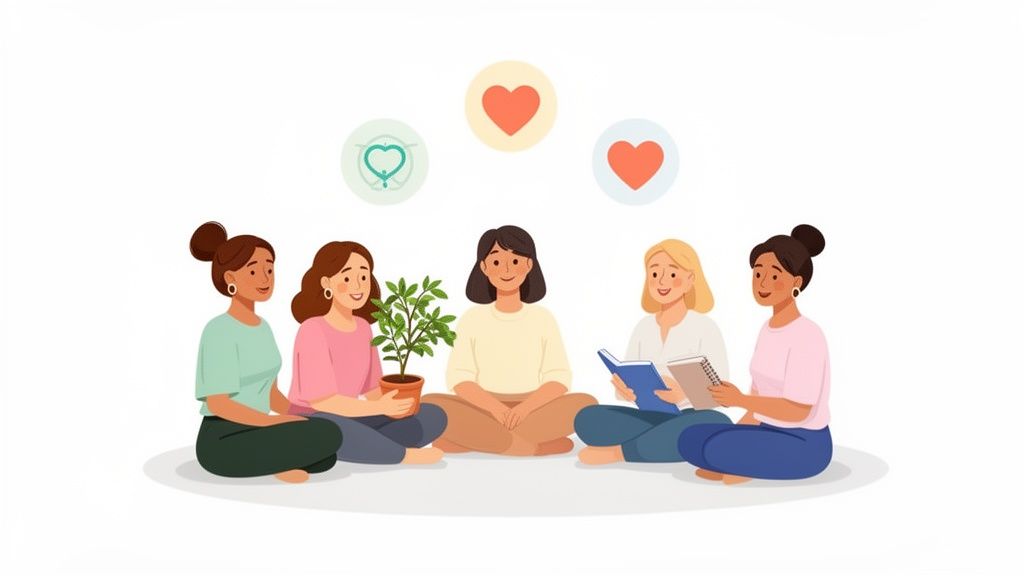
Getting an ADHD diagnosis isn’t the end of the story—it’s the beginning of a whole new chapter. Once you move past an online adhd test for women and a formal evaluation, you unlock a world of support designed specifically to help your unique brain thrive. This is where the real work, and the real relief, truly begins.
The goal isn't to "fix" you. Instead, it’s about building a framework that supports how your mind naturally functions. This approach sees neurodiversity as a strength to be understood and worked with, not a problem to be solved. It’s all about finding the right tools and people to help you navigate life with more confidence and less friction.
Building Your Personalized Toolkit
There’s no one-size-fits-all solution for managing ADHD. Real, lasting support comes from weaving together different strategies that speak to your specific challenges. Think of it like creating a personalized toolkit, where every tool has a clear purpose in helping you build a more fulfilling life.
Your support system will likely be a mix of a few key things:
- Specialized Individual Therapy: This isn’t your standard talk therapy. It focuses on evidence-based methods like cognitive behavioral therapy (CBT) that are tailored to the neurodivergent experience. It helps you reframe the negative thought patterns that can build up after years of feeling misunderstood.
- Psychoeducation: This is simply the process of learning about your own brain. Finally understanding the “why” behind your struggles with executive function, emotional regulation, or focus is incredibly empowering. It helps quiet that inner critic and reduces self-blame.
- Skills Coaching: This is a practical, hands-on approach. A coach can help you develop real-world systems for things like time management, organization, and planning. It’s all about building sustainable habits that work with your ADHD, not against it.
The Power of Community
One of the most profound parts of life after a diagnosis is finally finding your people. For years, you might have felt completely alone in your struggles. Connecting with other neurodivergent women who just get it can be an absolutely life-changing experience.
A diagnosis unlocks access to a community that understands the nuances of masking, perfectionism, and Rejection Sensitive Dysphoria without needing a lengthy explanation. This shared understanding provides a powerful sense of validation and belonging that can significantly improve mental well-being.
Support groups, whether they’re online or in person, provide a safe space to share what you’re going through, swap strategies, and celebrate wins with people on the exact same journey. This sense of community fights back against the shame that so often comes with undiagnosed ADHD in women, replacing it with acceptance and encouragement. A diagnosis is your key to unlocking this supportive world.
Your Questions, Answered
Taking the first step toward an ADHD diagnosis can feel a little confusing, and it's natural to have questions. Let's clear up some of the most common ones we hear from women who are just starting this journey.
Are Online ADHD Tests a Reliable Way to Get Diagnosed?
Think of most free online ADHD tests as a helpful first step, not the final word. While a good online adhd test for women can point you in the right direction and increase your self-awareness, it can’t give you an official diagnosis.
The biggest issue is that these quizzes aren't sophisticated enough to see through the complex masking strategies that so many women use to get by. They also can't tell the difference between ADHD and other conditions that look similar on the surface, like anxiety or even trauma. For a diagnosis you can truly trust, you need a formal evaluation with a specialist who gets the unique ways ADHD shows up in women.
What's the Difference Between a Diagnostic Letter and a Full Report?
After an evaluation, you have two options depending on what you need. They serve very different purposes.
- Diagnostic Letter ($790 Evaluation): This is a concise, formal document from your psychologist confirming your ADHD diagnosis. It's exactly what you need to get workplace accommodations or to take to another provider for medication management.
- Comprehensive Report ($1170 Evaluation): This includes the diagnostic letter, but it goes much deeper. You'll get a detailed four-page analysis of your personal history, your specific challenges, and a personalized set of recommendations. It’s a complete roadmap for your care plan.
You could say the letter is the key that unlocks immediate support, while the report is the blueprint for building a life where you can truly thrive.
Do I Need a Full Neuropsychological Test to Get an ADHD Diagnosis?
Nope, you don't. Our virtual evaluation is designed to gather all the clinical information needed for a standard ADHD diagnosis. A full neuropsychological test is a different, much more intensive process.
That kind of in-depth testing, which costs $5995, is really only necessary if you're trying to get academic accommodations for major standardized tests like the SAT, ACT, or GRE. It's also the path you'd take to set up an IEP or 504 plan within a school system.
Ready to get the clarity and validation you've been looking for? The specialists at Sachs Center are here to guide you, because we truly understand the nuances of ADHD in women. Book your telehealth evaluation today and take the next step on your neurodivergent journey.
