

When people talk about ADD vs ADHD, they're often working with old information. The bottom line is simple: ADD is an outdated term. The correct, current medical diagnosis is Attention-Deficit/Hyperactivity Disorder (ADHD), a condition that absolutely includes people who are inattentive but not physically hyperactive.
What many people still call ADD is now officially known as ADHD, Predominately Inattentive Presentation.
Understanding the Shift from ADD to ADHD
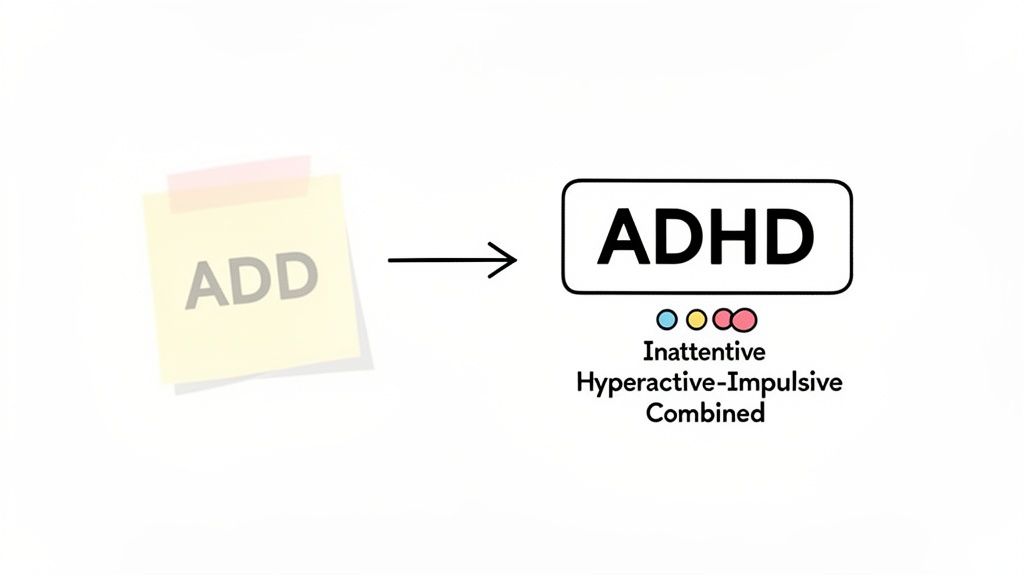
So where did all the confusion come from? It’s rooted in how our understanding of the condition has grown over time. For years, the term "ADD" was used for people—often kids—who struggled to focus and stay organized but didn't fit the classic "bouncing off the walls" stereotype. This led to a widespread belief that ADD (inattention) and ADHD (hyperactivity) were two totally different things.
But as clinical research progressed, it became clear that inattention, hyperactivity, and impulsivity are all symptoms stemming from the same neurodevelopmental root. The American Psychiatric Association recognized this and updated its official diagnostic guide, the DSM (Diagnostic and Statistical Manual of Mental Disorders).
This change wasn't just for show. Bringing everything under the single umbrella of ADHD was a crucial move. It acknowledges that even when the outward behaviors look different, the underlying brain wiring is the same. This updated framework ensures people get a more precise diagnosis that truly reflects their specific challenges. For a deeper dive, you can learn more about what is ADHD in our complete guide.
Why the Right Words Matter
Getting the terminology right is more than just being picky; it has real-world consequences for diagnosis, treatment, and even how people see themselves. Sticking with an old label like "ADD" can create some serious misunderstandings.
Think about an adult who was told they had "just ADD" as a child. They might write off their racing thoughts or chronic impatience as personal failings instead of recognizing them as symptoms of ADHD. That misunderstanding can be a major barrier to getting the right kind of support.
The move to a unified ADHD diagnosis recognizes that hyperactivity can be internal (like racing thoughts) just as much as it is external (like fidgeting). This insight is especially crucial for diagnosing girls and women, who often present with less visible, internalized symptoms.
Today's model gives clinicians a much sharper tool, allowing them to specify one of three distinct presentations of ADHD.
From Outdated Term to Official Diagnosis
To clear things up, this table shows how the old-school term 'ADD' fits into the modern, more accurate diagnostic framework from the DSM-5.
| Outdated Term (Commonly 'ADD') | Current ADHD Presentation (DSM-5) | Core Symptom Profile |
|---|---|---|
| Attention Deficit Disorder (ADD) | ADHD, Predominantly Inattentive Presentation | Difficulty sustaining attention, disorganization, forgetfulness, easily distracted. |
| Attention Deficit Hyperactivity Disorder (ADHD) | ADHD, Predominantly Hyperactive-Impulsive Presentation | Fidgeting, restlessness, interrupting others, difficulty waiting for one's turn. |
| Both sets of symptoms present | ADHD, Combined Presentation | A significant number of symptoms from both inattentive and hyperactive-impulsive categories. |
This structure makes it easy to see how the old ADD vs ADHD debate is settled. Today’s model is simply more inclusive and precise, capturing the full spectrum of experiences under a single, evidence-based diagnosis.
To really get to the bottom of the whole "ADD vs ADHD" thing, we have to take a look back at how the diagnosis came to be. Medical terms aren't set in stone; they evolve as our scientific understanding gets sharper. The journey from recognizing Attention Deficit Disorder (ADD) to today's framework of Attention-Deficit/Hyperactivity Disorder (ADHD) shows a huge shift in how clinicians see the condition.
This whole story is tracked in the Diagnostic and Statistical Manual of Mental Disorders (DSM), which is the official guidebook for clinicians. It all started back in 1980 with the DSM-III, which was the first to introduce the term Attention Deficit Disorder (ADD). At the time, this was a big deal because it acknowledged that attention problems could be a standalone issue, separate from disruptive hyperactivity.
The DSM-III actually had two subtypes: ADD with Hyperactivity and ADD without Hyperactivity. This model treated them like two sides of the same coin, but it also created the idea that inattention and hyperactivity were separate problems. This is where a lot of the lasting confusion between ADD and ADHD really began.
The Shift to a Unified Diagnosis
Fast forward to 1994, and the release of the DSM-IV marked the next big change. By then, researchers had found more and more evidence showing that inattention, hyperactivity, and impulsivity were all core symptoms of the same underlying neurodevelopmental condition. So, the manual officially brought everything under one name: Attention-Deficit/Hyperactivity Disorder (ADHD).
This was a monumental shift. It officially retired "ADD" as a clinical term and brought in the idea of three distinct "presentations" (or subtypes) to describe how the condition shows up:
- Predominantly Inattentive Presentation (This is what most people used to call ADD)
- Predominately Hyperactive-Impulsive Presentation
- Combined Presentation
This new framework was so important because it recognized that even if someone with ADHD isn't bouncing off the walls, the potential for hyperactivity and impulsivity is still a fundamental part of the disorder. It helped reframe ADHD as a spectrum, where symptoms can look very different from person to person.
Why This History Still Matters
This isn't just a boring history lesson; it has a direct impact on people trying to get help right now. Plenty of adults who got a diagnosis as kids might still think of themselves as having "ADD." They might not even realize that their internal restlessness, racing thoughts, or trouble with emotional regulation are all classic ADHD symptoms under the modern definition.
Bringing everything under the ADHD umbrella gives us a more accurate and inclusive way to see the condition. It validates the quiet, internalized experiences of so many people and helps ensure they don't get overlooked.
This unified approach also puts the global nature of the condition in perspective. ADHD isn't new or just an American thing; diagnosis rates have been climbing all over the world for decades. A massive analysis that looked at 135 countries from 1996 to 2019 confirmed that the prevalence has been steadily increasing. Here in the U.S., the CDC’s 2022 data shows that 11.4% of children aged 3-17 have been diagnosed with ADHD. You can explore more about these global trends and what they reveal about ADHD diagnosis.
Understanding how we got here makes it clear that the "ADD vs ADHD" debate is really just a matter of outdated language. It ensures that whether you're an adult looking back at an old diagnosis or a parent figuring this out for the first time, you're working with the most current clinical knowledge.
Understanding the Three Presentations of ADHD
In today's clinical world, we've moved well beyond the old "ADD vs. ADHD" debate. Instead, we now recognize three specific presentations of the condition. Think of these not as separate disorders, but as different flavors of ADHD. This updated framework is crucial because it helps clinicians, educators, and individuals themselves get a much clearer picture of the specific challenges they're facing.
So, how does a clinician determine which presentation fits? It all comes down to the number and type of symptoms a person has consistently shown over the last six months. The DSM-5 lays out clear criteria: you need to exhibit a certain number of symptoms from either the inattentive or the hyperactive-impulsive list to be diagnosed with a particular presentation.
Getting this right is vital for providing accurate and effective support. Globally, ADHD affects about 8% of children and adolescents, but how it looks can vary dramatically. Boys are diagnosed more than twice as often as girls (10% vs. 5%, respectively). Interestingly, the inattentive type is the most common presentation of all, which helps explain why that old "ADD" label stuck around for so long.
Predominantly Inattentive Presentation
This is what most people are thinking of when they use the outdated term "ADD." People with this presentation struggle with focus, staying organized, and seeing tasks through to the end. What you don't typically see are the more obvious signs of hyperactivity or impulsivity. Their struggles are often quiet and internal, which means they can be easily overlooked or misjudged as laziness or just not caring.
For instance, a child in school might be called a "daydreamer" for constantly staring out the window, when in reality, their brain is fighting a battle to filter distractions and stay engaged. In the workplace, an adult with this presentation might keep missing deadlines or forgetting important meetings—not from a lack of effort, but from deep-seated difficulties with executive functions like planning and time management.
Common signs include:
- Trouble holding attention on tasks or even during play.
- Seems not to listen when spoken to directly.
- Struggles to follow through on instructions, leaving schoolwork or chores unfinished.
- Has a hard time organizing tasks and activities.
- Often loses things needed for tasks, like keys, wallets, or school papers.
Predominantly Hyperactive-Impulsive Presentation
This presentation is defined by an almost constant need for movement and a habit of acting before thinking. We often picture young boys running and climbing, but hyperactivity shows up differently as people get older. For a teen or adult, it might feel more like an intense inner restlessness or finding it impossible to sit through a long meeting without fidgeting.
The impulsive side often creates social friction. Someone might constantly interrupt others, blurt out an answer before the question is even finished, or find it excruciatingly hard to wait their turn. These actions aren't born from a desire to be rude; they stem from a genuine struggle with self-control.
Key Insight: Hyperactivity isn't just about physical motion. In adults and girls, it can present as extreme talkativeness, racing thoughts, or a constant need to be busy with multiple projects at once. This internal restlessness is just as valid a symptom as fidgeting.
Combined Presentation
Just like it sounds, someone with the combined presentation meets the criteria for both inattentive and hyperactive-impulsive symptoms. This is a very common scenario, where a person deals with a significant mix of challenges from both sides. A child with combined type, for example, might struggle to sit still and pay attention in class, while also having a perpetually messy desk and frequently forgetting their homework.
An adult might find themselves impulsively jumping into new projects with great enthusiasm, only to find they lack the focus and organizational skills to ever finish them. This blend of symptoms can be especially tough, impacting school, work, and relationships all at once. Our guide to the types of ADHD dives deeper into how these presentations show up in daily life.
The infographic below shows how our diagnostic understanding has evolved into this clearer, three-part framework.
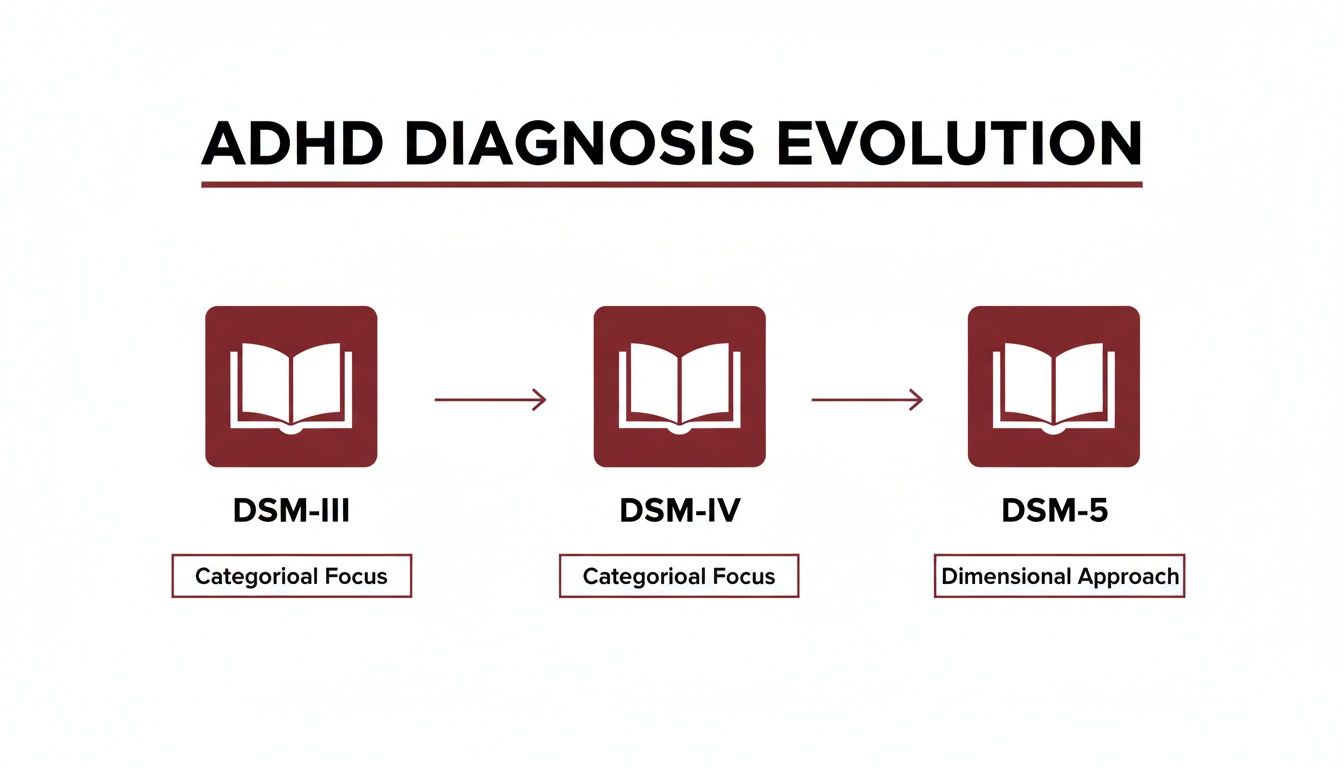
This visual tracks the journey from older, more rigid diagnostic boxes to the more nuanced and flexible approach we use today with the DSM-5.
How ADHD Symptoms Present Differently
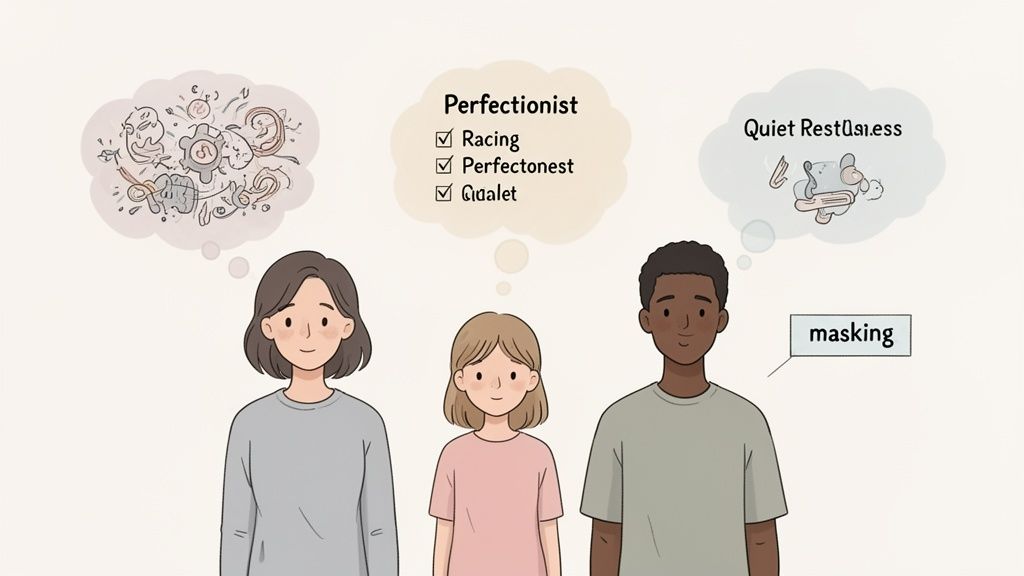
ADHD is far from a one-size-fits-all diagnosis. The classic image of a young boy bouncing off the walls barely scratches the surface of what it means to live with ADHD. While the core challenges of inattention, hyperactivity, and impulsivity are always there, how they show up can look wildly different depending on a person's age, gender, and cultural background.
Many people develop complex ways to hide their traits, a coping mechanism we call masking. This means actively working to suppress ADHD symptoms to meet neurotypical social and professional expectations. It might help someone get by, but it's mentally draining and a huge reason why so many people—especially girls, women, and BIPOC individuals—go undiagnosed for years.
Symptom Presentation in Women and Girls
For decades, almost all ADHD research centered on hyperactive young boys. This created a diagnostic blind spot, leaving generations of girls and women to struggle without answers. Instead of obvious, external hyperactivity, their symptoms are often turned inward.
This internal experience is frequently misunderstood by parents, teachers, and even clinicians, showing up in ways that don't fit the stereotype:
- Internalized Hyperactivity: The restlessness isn't in their feet; it's in their mind. This can look like racing thoughts, talking excessively, or a constant, simmering state of anxiety.
- Perfectionism and People-Pleasing: To compensate for struggles with executive function, many girls with ADHD become intense perfectionists. They pour incredible amounts of energy into seeming organized and flawless.
- Social Daydreaming: A girl who is struggling with inattention might be labeled as "shy," "quiet," or a "daydreamer," especially if she isn't causing any trouble in class.
Because their symptoms are so well masked, girls are diagnosed far less often than boys. Research shows boys are diagnosed two to three times more frequently, but this doesn't mean fewer girls have ADHD. It means their challenges are invisible, leaving them feeling overwhelmed and inadequate without knowing why.
A key differentiator is how hyperactivity is expressed. In many women and girls, it’s not about climbing the furniture; it’s an internal engine that won’t shut off, driving relentless thought patterns, anxiety, and a feeling of being constantly on edge. Recognizing this internal experience is vital for accurate diagnosis.
Cultural and Racial Disparities in Diagnosis
The diagnostic puzzle gets even more complicated when you factor in cultural expectations and systemic biases in our healthcare and educational systems. For Black, Indigenous, and People of Color (BIPOC), getting an accurate diagnosis is often an uphill battle.
Societal stereotypes can cause ADHD symptoms to be completely misread. A Black or Hispanic boy showing impulsivity might be punished for "defiance" or "bad behavior," whereas a white classmate with the exact same symptoms is more likely to be referred for a clinical evaluation. This disparity doesn't just delay a diagnosis; it can replace supportive care with a punitive record.
The Impact of Systemic Bias
For many BIPOC individuals, masking isn't just a coping mechanism—it's a survival strategy. The immense pressure to conform to majority cultural norms means suppressing any behavior that could be judged negatively. This leads to the same kind of internalized symptoms we see in women, making it even tougher for clinicians to see what's really going on.
On top of that, a lack of culturally competent clinicians can lead to outright misdiagnosis. Symptoms like emotional dysregulation or restlessness might be incorrectly blamed on conditions like oppositional defiant disorder or anxiety, cutting off access to the right kind of support.
This is why it is so crucial to seek an evaluation from specialists experienced in identifying the many faces of ADHD. A clinician who truly understands how gender and culture shape symptoms is essential for an accurate diagnosis and effective treatment. It moves the conversation beyond a simple ADD vs ADHD debate and toward a much deeper understanding of each person's unique experience.
An accurate diagnosis is the first, most critical step toward getting the right support. Once you understand the specific type of ADHD you’re dealing with—whether it’s inattentive, hyperactive-impulsive, or a combination of both—you can start building a truly personalized roadmap for success. It’s about moving past the old "ADD vs. ADHD" confusion and into actionable strategies that work for you.
With a precise diagnosis, a clinician can recommend evidence-based therapies that target your unique challenges. For someone with the inattentive presentation, for instance, cognitive behavioral therapy (CBT) might focus on creating systems to manage disorganization and time blindness. Executive function coaching can then provide concrete strategies for things like planning projects and actually meeting deadlines.
On the other hand, if you have a hyperactive-impulsive or combined presentation, therapy will likely also include techniques for emotional regulation and impulse control. The goal is always the same: to match the support to the specific symptoms causing the most disruption in your life.
Unlocking Essential Accommodations
A formal diagnosis is so much more than a label; it’s the key that unlocks necessary support in school and at work. Without that official documentation from a qualified professional, securing accommodations is nearly impossible. This formal recognition validates your struggles and gives you the leverage needed to access vital resources.
For example:
- For Students: A comprehensive neuropsychological evaluation provides the documentation needed for accommodations like extended time on tests. This can be a game-changer for high-stakes exams like the SAT, GRE, or GMAT.
- For Employees: A diagnostic report can be used to request reasonable workplace accommodations, such as a quieter workspace to minimize distractions, noise-canceling headphones, or a flexible work schedule that aligns with your peak focus hours.
A formal diagnosis transforms an invisible struggle into a recognized condition. It empowers you to advocate for yourself, shifting the narrative from "I'm not trying hard enough" to "I need specific tools to succeed," and ensures you get the support you are legally entitled to.
The Value of Professional Evaluation
While we talk a lot about ADHD in kids, it’s a major issue for adults, too. Adult ADHD affects approximately 3.1% of the global population, a rate right up there with other major mental health conditions. This is especially true for adults who may have masked their symptoms for years—a common experience for women and BIPOC individuals.
This is where specialized telehealth services prove invaluable. The Sachs Center, for instance, offers ADHD testing that provides a detailed 4-page report, which is ideal for securing workplace accommodations. For students who need support on standardized tests, our in-depth neuropsychological evaluations can unlock crucial accommodations like extended time. You can learn more about the prevalence and impact of adult ADHD from recent global studies.
Getting a professional evaluation gives you the tangible proof needed to build a support network that truly works. It’s the essential bridge between identifying your challenges and implementing real-world solutions that can dramatically improve your quality of life.
Navigating a Professional ADHD Evaluation
Recognizing potential ADHD symptoms in yourself or a loved one is a huge first step. But figuring out what to do next? That can feel pretty overwhelming. Deciding to pursue a professional evaluation is the key to gaining clarity and getting the right kind of support. The good news is the process is often more straightforward than people think, especially with options like telehealth.
If you're dealing with persistent challenges—trouble focusing, staying organized, feeling restless, or acting on impulse—and it's consistently impacting your life, work, or relationships, that's a strong sign it's time for an evaluation. We're not talking about an occasional off day. It's about a pattern of struggle that just doesn't seem to get better, no matter how hard you try.
What a Telehealth Evaluation Involves
A modern ADHD evaluation, particularly one done via telehealth, is a structured process designed to be thorough without being stressful. At the Sachs Center, our virtual assessments typically last about two hours. They’re conducted over a secure video call, so you can be in a familiar, comfortable environment.
The evaluation process generally includes two main parts:
- A Clinical Interview: This is simply a detailed conversation with a psychologist. We'll talk about your developmental history, current challenges, and the specific symptoms you're experiencing. This helps us paint a full picture of your life, from childhood to today.
- Validated Diagnostic Tools: You'll also complete standardized, evidence-based self-report measures and assessments. These are scientifically designed questionnaires that help quantify your symptoms and compare them to clinical benchmarks for a clear picture.
This combination of your personal story and objective data allows for a highly accurate diagnostic impression. It goes far beyond a simple checklist of symptoms you might find online.
Standard vs In-Depth Assessments
Not all evaluations are created equal, and it's important to choose the one that matches your goals. Understanding the difference between a standard diagnostic assessment and a full neuropsychological evaluation is a key part of the conversation around add vs adhd support.
A standard ADHD assessment is designed to provide one thing: diagnostic clarity. After this evaluation, you receive a diagnostic letter or a more detailed 4-page report. This is usually all you need to secure workplace accommodations or to share with other healthcare providers to coordinate care, like medication management.
A neuropsychological evaluation is a much more intensive and comprehensive assessment. It doesn't just diagnose ADHD; it also evaluates cognitive functions like IQ, memory, and academic achievement. This deep dive is essential for students seeking academic accommodations, such as extended time on standardized tests like the SAT, GRE, or GMAT.
Choosing the right path really depends on your specific needs. For many adults who just want confirmation and a plan to manage their symptoms, a standard evaluation is the perfect fit. For students or individuals with more complex situations, neuropsychological testing provides the detailed evidence needed for institutional support. To get a better feel for the steps involved, check out our guide on how to get tested for ADHD.
Ultimately, seeking a professional evaluation empowers you. It gives you the knowledge and the documentation to advocate for yourself and build a life where your brain can truly thrive.
A Few Common Questions About ADHD Diagnosis
Working through the diagnostic process can bring up a lot of questions, especially as we move past the old ADD vs ADHD debate. Here are some straightforward answers to the things people most often ask when they're trying to find clarity for themselves or someone they care about.
Is It Possible to Have ADHD Without Hyperactivity?
Yes, absolutely. This is what people used to call "ADD," and it's now officially known as ADHD, Predominantly Inattentive Presentation.
Someone with this subtype faces very real challenges with focus, staying organized, and seeing tasks through to the end. The difference is, they don't show the classic hyperactive or impulsive behaviors. Their hyperactivity is more of an internal experience, like having racing thoughts or a mind that just won't quiet down.
How Is ADHD Officially Diagnosed?
A formal diagnosis isn't just about ticking boxes on a checklist. It's a comprehensive evaluation done by a qualified professional, like a psychologist or a psychiatrist.
The process usually involves a few key steps:
- A detailed clinical interview to go over your developmental history and current symptoms.
- Using standardized, evidence-based rating scales and questionnaires to gather objective data.
- Looking at how your symptoms are affecting major parts of your life, such as work, school, or your relationships.
This thorough approach makes sure the diagnosis is accurate and helps rule out other conditions that might look like ADHD.
An evaluation isn’t just about getting a label. The real goal is to get a clear, detailed picture of an individual's unique neurocognitive profile. That clarity becomes the blueprint for building an effective, personalized support plan—one that tackles specific challenges while playing to inherent strengths.
Can ADHD Be Diagnosed in Adulthood?
Definitely. It's actually quite common for adults to get an ADHD diagnosis for the first time later in life.
Many adults, especially women and BIPOC individuals, have spent years developing sophisticated ways to mask their symptoms. Others were misdiagnosed with things like anxiety or depression. A proper evaluation can finally provide the right explanation for struggles they've dealt with their whole lives.
What Is the Difference Between a Diagnosis and Getting Accommodations?
Think of it this way: a diagnosis confirms that you have ADHD. Getting accommodations, like extra time on tests or specific adjustments at your job, requires showing how the condition impacts your ability to function in that environment.
Often, a standard diagnostic report is enough for workplace accommodations. For school and academic settings, though, a more in-depth neuropsychological evaluation is typically required.
And if you have other general health-related questions, you might find helpful information on a general FAQs page that covers a broader range of topics.
At the Sachs Center, we specialize in providing clear answers through expert telehealth evaluations for ADHD and Autism. If you're ready to move from uncertainty to understanding, explore our diagnostic services and book your virtual assessment today at https://sachscenter.com.
