

If you’ve found yourself wondering, "Should I get tested for ADHD?" you’re definitely not alone. Many adults are starting to connect the dots between lifelong struggles—like procrastination, disorganization, or emotional ups and downs—and the possibility of Attention-Deficit/Hyperactivity Disorder. This guide is here to give you a clear, supportive roadmap to finding answers and unlocking a more manageable life.
Is Adult ADHD Testing Right for You?
For many, the idea of getting an evaluation comes after years of feeling like they’re working twice as hard as everyone else just to stay afloat. Maybe a performance review mentioned missed deadlines, or a partner got frustrated over another forgotten promise. These aren't personal failings; they’re often just clues about how your unique brain is wired.
Getting tested for ADHD as an adult isn’t about slapping a label on yourself. Think of it more like finally getting the user manual for your own mind. Understanding your neurotype can completely reframe decades of self-criticism, turning it into self-awareness and replacing confusion with real clarity.
Common Triggers for Seeking an Evaluation
Adults often decide to get a diagnosis after a big life change, or when their old coping strategies just aren’t cutting it anymore. Some of the most common triggers include:
- Career Challenges: Feeling constantly behind on projects, being chronically late, or just feeling overwhelmed by the demands of your job can make your professional life feel like an uphill battle.
- Relationship Strain: Impulsivity, forgetfulness, or trouble managing emotions can create friction with partners and family who might misread these traits as carelessness.
- A Child's Diagnosis: It's incredibly common for parents to see their own lifelong patterns reflected in their child’s ADHD diagnosis. This can be a powerful "aha!" moment.
- Increased Awareness: Neurodiversity is finally part of the public conversation. More adults are learning that ADHD doesn’t always look like the stereotypical hyperactive kid—especially in those who were overlooked in childhood.
This growing awareness is so important. An estimated 3.1% of adults worldwide have ADHD, but a shocking number never get diagnosed. In fact, only 10-25% of adults with ADHD receive an accurate diagnosis and proper treatment, leaving the vast majority to figure things out on their own.
Ultimately, seeking an evaluation is a powerful act of self-understanding. It’s about figuring out why certain things have always felt so hard and learning new, more effective ways to thrive. If any of this sounds familiar, it might be time to look into the common signs of ADHD in adults a bit more. The journey to an answer begins the moment you realize your experiences are valid and worth exploring.
Understanding the Different Types of ADHD Evaluations
Trying to figure out ADHD testing for adults can feel like learning a new language. You'll hear a lot of different terms thrown around, and it's easy to get confused about what you actually need.
To make it simple, let's use a car analogy. A basic screening is like a warning light flashing on your dashboard—it signals a potential problem but doesn't tell you what's actually wrong. A full diagnostic evaluation is like a mechanic plugging in a computer to read the specific error codes. It gets to the root of the issue.
This step-by-step approach ensures you get the right level of insight for your situation, whether you're just starting to explore the possibility of ADHD or need official documentation for support.
This infographic gives you a great visual breakdown of the whole ADHD testing journey, from the first questions you might have to what you can expect at the end.
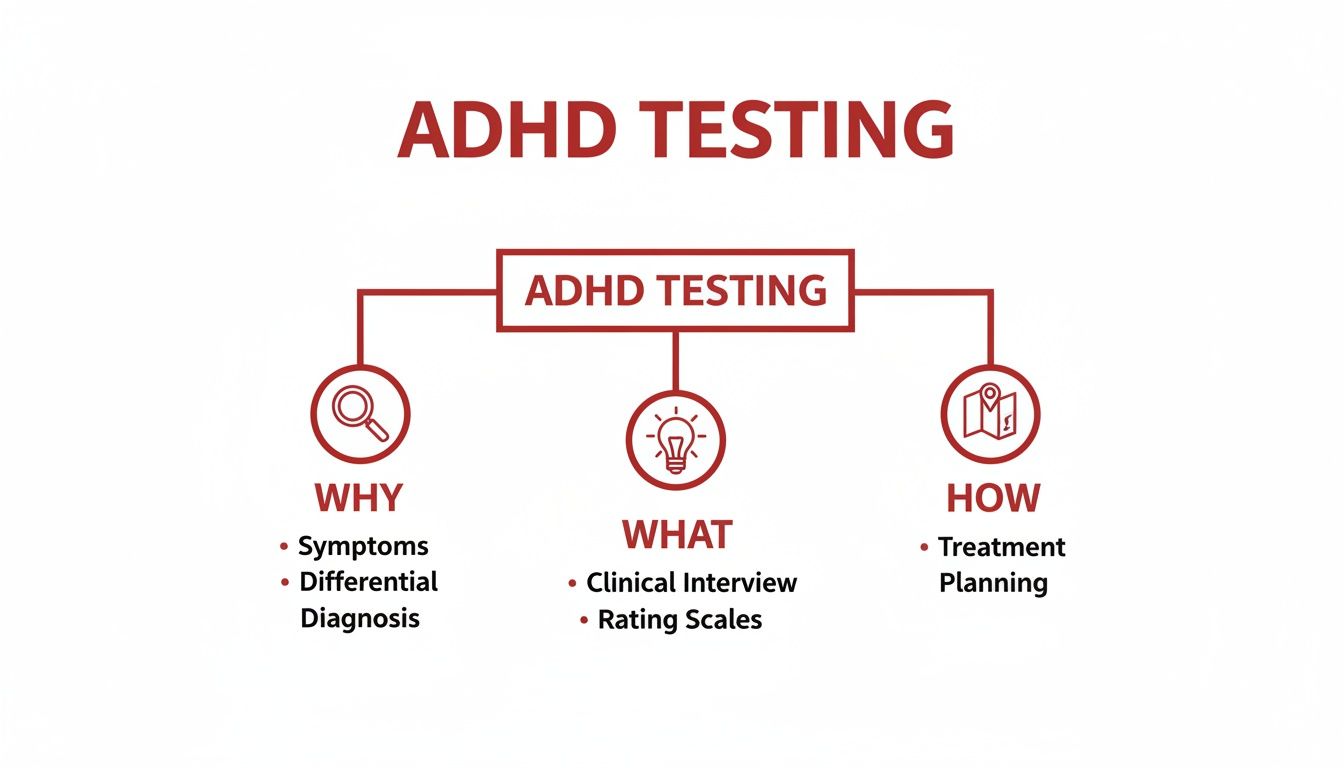
As you can see, a proper evaluation isn't just a checklist. It's about understanding why you're struggling, what the diagnostic criteria really mean, and how the assessment process works to give you clear answers.
To help you decide which path is right for you, let's break down the three main types of evaluations side-by-side.
Choosing Your Adult ADHD Evaluation
A side-by-side look at the three main types of ADHD testing to help you find the right fit for your needs and goals.
| Evaluation Type | Best For | Typical Process | Outcome |
|---|---|---|---|
| ADHD Screening | Initial self-exploration; deciding if a full evaluation is needed. | Short online or paper questionnaire (e.g., ASRS). | An indication of ADHD likelihood, not a diagnosis. |
| Diagnostic Evaluation | Getting a formal diagnosis for treatment (therapy, medication) or work/school accommodations. | Clinical interview, symptom rating scales, ruling out other conditions. | A formal diagnostic letter confirming or ruling out ADHD. |
| Neuropsychological Testing | Documenting cognitive needs for high-stakes exams (SAT, GRE, LSAT, etc.). | Hours of intensive cognitive and academic testing. | A 20-25 page detailed report for formal testing accommodations. |
Each level of testing serves a very different purpose. The key is to match the evaluation to your specific goals so you don't waste time or money on an assessment that doesn't give you what you need.
ADHD Screenings: The First Step
An ADHD screening is usually just a short questionnaire or checklist. You can often find them online or fill one out at your primary care doctor's office. Tools like the Adult ADHD Self-Report Scale (ASRS) are designed to quickly flag whether you show signs consistent with ADHD.
Think of it as a starting point. Screenings are excellent for a quick gut check and can help you decide if it's worth taking the next step toward a formal diagnosis.
But here’s the critical part: a screening is not a diagnosis. It’s just that dashboard warning light. It tells you to look deeper, but it can’t give you the full story.
Comprehensive Diagnostic Evaluations: The Gold Standard
For a formal, official ADHD diagnosis, you need a comprehensive diagnostic evaluation. This is the industry standard and a much more thorough process. It’s done by a qualified mental health professional—like a psychologist or psychiatrist—who really understands neurodiversity. This is the mechanic running the full diagnostic to pinpoint the exact issue.
This type of evaluation usually involves a few key things:
- A Detailed Clinical Interview: Your clinician will want to hear your story. They'll ask about your childhood, school experiences, and the challenges you’re facing now at work or in your relationships.
- Symptom Questionnaires: You, and sometimes a partner or parent, will complete standardized rating scales that measure how often and how severely you experience ADHD symptoms.
- Ruling Out Other Conditions: The clinician will check for other conditions that can look a lot like ADHD, such as anxiety, depression, or even sleep disorders, to make sure the diagnosis is accurate.
This is the process that gives you the clarity needed to create a real treatment plan, whether that involves medication, therapy, or both. At the Sachs Center, our virtual evaluations provide this exact level of detail, resulting in a diagnostic letter you can use to get treatment or request workplace accommodations.
A proper diagnostic evaluation is so important because ADHD symptoms are complex and often overlap with other conditions. This process ensures you get the right support by confirming not just the presence of symptoms, but also how they concretely impact your life day-to-day.
Neuropsychological Testing: The Deep Dive
If a diagnostic evaluation is like reading the car’s error codes, then a neuropsychological evaluation is like taking the entire engine apart to see how every single piece works. This is the most intensive type of ADHD testing for adults, and frankly, most people don’t need it.
This deep dive is for very specific situations, mainly when you need to document cognitive strengths and weaknesses for formal accommodations on high-stakes standardized tests. We're talking about exams like the SAT, GRE, GMAT, or professional licensing boards.
The process involves hours of one-on-one testing that measures things like:
- Cognitive Abilities (IQ)
- Executive Functioning (your brain's manager for planning, organization, and working memory)
- Processing Speed
- Attention and Concentration
- Academic Achievement
The final product is a massive, multi-page report—often 20-25 pages long—that gives a detailed cognitive profile and makes specific recommendations for accommodations, such as extended time on tests. This level of testing is a major investment of time and money, so it’s only recommended if you have those specific academic or professional testing needs.
The Modern Approach to ADHD Diagnosis via Telehealth

For so many adults, the biggest hurdle to getting an ADHD evaluation isn’t denial—it’s the sheer logistics of it all. Just the thought of finding a local specialist, getting stuck on a long waitlist, and then juggling multiple in-person appointments feels completely overwhelming.
Thankfully, technology has opened up a much more accessible path. Telehealth has completely changed how ADHD testing for adults gets done. It offers a convenient, effective, and often faster way to get answers from the comfort of your own home, removing the stress of travel and impossible scheduling.
How Online ADHD Evaluations Work
An online ADHD evaluation isn’t just some quick quiz or a casual chat. Reputable providers have built a structured process that has all the rigor of an in-person assessment, making sure the diagnosis is thorough and accurate.
While the exact steps might differ slightly between providers, a quality telehealth evaluation generally follows a clear path:
- Initial Consultation: This is usually a brief, introductory call to talk about your concerns and figure out if a full evaluation is the right next step.
- Comprehensive Digital Forms: Before your main appointment, you'll fill out detailed online questionnaires covering your history, symptoms, and life experiences. This gives your clinician a rich background to work from before you even speak.
- Live Video Interview: The heart of the evaluation is a live, face-to-face session with a qualified psychologist. This is a deep-dive clinical interview where they get into the nuances of your challenges.
This structured approach allows clinicians to gather the same depth of information they would in an office, just delivered in a more modern way.
The Benefits of Choosing Telehealth
The move toward more accessible testing couldn't be happening at a better time. ADHD diagnoses in adults have been soaring, partly because of a post-pandemic surge in awareness that has made ADHD a top mental health search term. Clinicians are seeing a major shift, with many reporting that over half their patients are now seeking evaluations for a condition that was only formally recognized in adults in the 1960s.
Choosing a telehealth evaluation comes with some clear advantages that really meet the needs of today's busy adults.
- Faster Access to Specialists: You're no longer limited by your zip code. Telehealth connects you with top ADHD specialists across the country, which can dramatically cut down on wait times.
- Unmatched Convenience: You can have your appointment from home, your office, or wherever you feel most comfortable. This gets rid of travel time, the need for childcare, and having to take a full day off work.
- Reduced Anxiety: For many people, being in a familiar environment helps lower the stress that can come with a medical appointment. This can lead to a more open and honest conversation with your clinician.
The key thing to remember is that a well-designed online evaluation is just as valid as a traditional one. By using the same diagnostic criteria and structured interview methods, telehealth providers maintain high clinical standards while offering a much more user-friendly experience.
This modern path to diagnosis is a powerful tool for adults who have spent years feeling like something was just… off. You can explore a professional and reliable telehealth ADHD diagnosis with specialists who truly understand the complexities of adult ADHD. It’s an effective way to finally get the clarity you deserve, on your own terms.
Understanding the Costs and What You Get
Let’s talk about the financial side of getting tested for adult ADHD. It’s often a big question mark, and that uncertainty can make anyone hesitate. You’re wondering what the investment looks like and, more importantly, what you actually get for it. We'll break it all down so you have a clear picture of the costs and the crucial documents you’ll receive.
Knowing the costs upfront helps you plan and pick the right evaluation without any surprises down the road. The final price tag depends on a few things: the clinician's experience, how deep the assessment goes, and the kind of report you need. For a closer look at the numbers, you can learn more about how much ADHD testing costs and the factors that shape the price.
A straightforward diagnostic evaluation is very different from a full neuropsychological workup, and the cost reflects that. The goal is to make sure your investment matches what you’re trying to achieve.
What Influences the Cost of an ADHD Evaluation
The price of an ADHD assessment isn't a one-size-fits-all fee. Several key factors come into play.
- Clinician’s Expertise: A psychologist who truly specializes in adult ADHD—especially with nuanced presentations in women or BIPOC individuals—brings a depth of knowledge that influences the cost.
- Depth of Assessment: A standard diagnostic evaluation, perfect for getting treatment or workplace accommodations, is less intensive. It's also less expensive than a full neuropsychological exam, which is what you'd need for high-stakes tests like the SAT or GRE.
- Type of Deliverable: The document you walk away with is a major factor. A simple diagnostic letter is less time-consuming to create than a detailed, multi-page report packed with personalized recommendations.
Think of it this way: are you looking for a clear diagnosis to get started with treatment, or do you need a comprehensive cognitive blueprint for something like academic accommodations? Your answer points you to the right evaluation and its associated cost.
Diagnostic Letter vs. a Comprehensive Report
After your evaluation, you'll get a formal document with the findings. But not all documents are the same. The two most common options, a diagnostic letter and a comprehensive report, are built for very different purposes.
A diagnostic letter is a concise, one-page summary. Its main job is to state the clinical findings and confirm a diagnosis, if one is made.
This letter is often the key that unlocks your next steps. It's usually all you need to show a psychiatrist or your primary doctor to begin medication, or to give your HR department to start the conversation about workplace accommodations under the Americans with Disabilities Act (ADA).
A comprehensive report, on the other hand, is a much deeper dive. This multi-page document gives you the full story behind the findings.
A full report usually includes:
- Detailed Background: A look into your developmental, medical, school, and social history.
- Clinical Findings: A summary of the diagnostic interview and the results from any rating scales used.
- Diagnostic Formulation: The clinician’s expert reasoning for the diagnosis, including how they ruled out other possible conditions.
- Personalized Recommendations: Real, actionable strategies for managing your symptoms at work, at home, and in your relationships.
This detailed report is an invaluable tool for building a complete support system with therapists, coaches, or other professionals. It’s like a user manual for your brain, explaining how and why ADHD affects you and providing a clear roadmap for moving forward with effective, targeted support.
How to Prepare for Your ADHD Evaluation
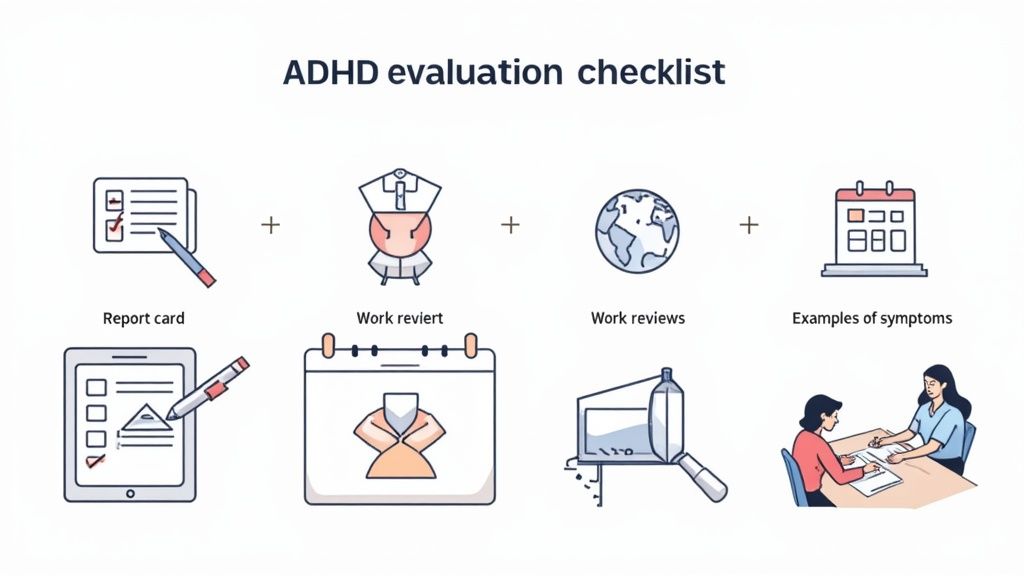
A successful ADHD testing for adults experience really comes down to one thing: the quality of the information you bring to the table. Think of your clinician as a detective trying to piece together a puzzle that spans your entire life. The more clues you provide, the clearer the final picture will be.
Getting ready for your evaluation does more than just help your doctor—it empowers you. It can help quiet some of the anxiety you might feel about the process and ensures you don't forget crucial details when you’re on the spot. A little prep work goes a long way in presenting a full, accurate history.
Ultimately, this preparation allows you to be your own best advocate. It shifts the dynamic from a passive appointment to an active collaboration, where you’re a key partner in finding the answers you've been looking for.
Gather Your Historical Evidence
Since ADHD is a lifelong neurodevelopmental condition, your clinician needs to see a pattern of symptoms stretching back to childhood. It's time to do a bit of digging into your past. These old documents often contain candid, objective observations from teachers or managers that can be incredibly revealing.
Don't stress if you can't find everything, but try to track down a few of these:
- Old School Report Cards: Look for teacher comments like "daydreams in class," "is easily distracted," "doesn't work up to potential," or "disruptive."
- Past Performance Reviews: Notes from previous jobs might touch on struggles with deadlines, organization, or time management.
- Letters or Emails: Any communication from teachers, bosses, or even family members that mentions challenges with focus or impulsivity can be a big help.
These artifacts create a timeline, showing a consistent pattern of challenges across different environments and stages of your life.
Your personal history is the most critical piece of the diagnostic puzzle. ADHD isn't just about your struggles today; it's about connecting them to a lifelong pattern. The more specific you can be, the better.
Reflect On Your Life Experiences
Beyond papers and documents, your personal story is vital. Your lived experiences provide the context that checklists and rating scales simply can't capture. Before your appointment, set aside some time to reflect and jot down specific examples of how you think ADHD symptoms have impacted different parts of your life.
Think about these key areas and try to recall examples from both childhood and your adult years:
- Work or School: How do you approach complex projects? Do you put off boring tasks until the last second? Have you had a hard time getting promotions or finishing a degree?
- Relationships: Do you find yourself interrupting people you care about? Do you forget important dates or promises? Do you have big emotional reactions to small conflicts?
- Daily Routines: What's it like managing your home? Are you in a constant battle with clutter? Is paying bills on time or sticking to a schedule a major challenge?
- Internal World: Do you feel a constant hum of restlessness inside? Do you struggle to truly relax, even when you have nothing to do?
Organizing your thoughts like this helps you communicate your struggles clearly and effectively. You’re not just telling your clinician you’re "disorganized"—you’re showing them with concrete, real-life examples that paint a vivid, accurate picture.
Life After Diagnosis and Your Next Steps
Getting an ADHD diagnosis is a huge moment. For many, it’s not an endpoint or a label, but the real starting line. It’s like finally getting the user manual for your brain after years of trying to figure it out on your own. All those past struggles suddenly have a name and a reason, which is incredibly empowering.
This new understanding helps you stop fighting against your natural wiring and start building a life that actually works with it. The diagnosis itself is a key that unlocks the door to the right kind of support, effective treatments, and strategies designed for a brain like yours. It’s the first step toward true self-advocacy.
Just getting to this point is a major win. Proper ADHD testing for adults is still hard to come by for so many. In fact, it's estimated that only 10-25% of adults with ADHD actually get an accurate diagnosis and the treatment they need. This gap is even wider for women, whose symptoms are often more internalized and don't match the old-school, hyperactive checklists. You can learn more about these ADHD prevalence and diagnostic challenges.
Creating Your Support and Treatment Plan
With a formal diagnosis in hand, you can start building a support system that makes sense for you. There’s no single magic bullet for ADHD, so the most effective approach is usually a combination of different strategies. It's all about finding what clicks for you.
Your post-diagnosis game plan could include:
- Medication Management: For a lot of adults, stimulant or non-stimulant medications are a game-changer for reducing core symptoms like inattention and impulsivity. Your diagnostic letter is what you’ll need to have a productive conversation about these options with a psychiatrist or your primary doctor.
- Therapy and Coaching: Working with a therapist who gets adult ADHD can help you unpack the emotional side of your diagnosis and build solid coping skills. An ADHD coach, on the other hand, offers more hands-on, practical support to create systems for organization, time management, and getting things done.
- Lifestyle Adjustments: Don't underestimate the power of simple changes. Things like consistent routines, regular exercise, and a balanced diet can have a surprisingly big impact on ADHD symptoms. Once you have a diagnosis, it's common to look for ways to manage daily tasks better. You might find it helpful to explore ways to improve mental clarity and sharpen your focus, which can be a huge help for making steady progress.
Using Your Report for Accommodations
One of the most powerful and immediate benefits of a formal evaluation is getting access to accommodations at work or school. Your diagnostic report is the official document you need to validate your request for support under laws like the Americans with Disabilities Act (ADA).
An accommodation isn't about getting an unfair advantage. It’s about leveling the playing field so you can perform at your best. It lets you show what you're truly capable of, without being held back by the logistical hurdles of ADHD.
Armed with your report, you can walk into a meeting with HR or your school's disability services office with confidence and have a real conversation about what you need to succeed.
Examples of common workplace accommodations include:
- A quieter workspace to cut down on distractions.
- Noise-canceling headphones to help you stay in the zone.
- Written instructions for tasks instead of just verbal ones.
- Flexible start and end times so you can work when your brain is sharpest.
- Assistive technology, like speech-to-text software or task management apps.
Your diagnosis is what unlocks these conversations, helping you turn your environment from a source of friction into a place where you can really shine.
Got Questions About Adult ADHD Testing? We Have Answers.
Thinking about getting tested for ADHD as an adult can feel like a big step, and it's totally normal to have a ton of questions swirling around. Getting clear answers is the best way to feel confident and ready for what’s next. Let's walk through some of the most common ones we hear.
This whole process is about finding clarity, not just getting a label. Answering your questions upfront helps take the mystery out of it, so you can move forward feeling informed and in control.
How Long Does the Whole ADHD Testing Process Take?
One of the biggest hurdles for busy adults is the time commitment. We get it. While traditional, in-person clinics can have waitlists that stretch on for months, a specialized telehealth provider can often get you through the entire process in just two to four weeks.
So, what does that timeline look like? It usually breaks down into a few simple steps:
- Booking your first appointment.
- Filling out some comprehensive (but straightforward) digital forms.
- Your 60-90 minute live evaluation with a psychologist.
- The psychologist preparing and delivering your final report or letter.
This focused approach makes getting a reliable diagnosis so much more achievable when you’re juggling a career, family, and everything else life throws at you.
Can I Have ADHD if I Was a Good Student?
Yes, one hundred percent. This is one of the biggest myths about adult ADHD, and it holds so many people back from getting help. Countless high-achieving adults built incredibly effective—and often exhausting—coping mechanisms to get by in school despite their underlying ADHD symptoms.
Maybe you were the king or queen of the all-nighter. Or perhaps you relied on a constant current of anxiety to push you over the finish line for every deadline. Many people with undiagnosed ADHD simply had to work twice as hard as their friends just to get the same grades.
A good clinician knows to look past the transcript. They're interested in the how—the massive effort, the internal stress, and the hidden struggles you faced to get those grades. That’s where the real story is, and it's essential for an accurate diagnosis.
Your academic success doesn't cancel out your struggles; in many cases, it’s proof of just how hard you’ve been working to manage your symptoms all along.
Will an ADHD Diagnosis Go on Some Kind of “Permanent Record”?
This is a really common fear, but you can rest easy. Your ADHD diagnosis is part of your private medical information, protected by strict privacy laws like HIPAA. It’s not public, and you have total control over who you share it with.
It won't be sent to your boss, your school, or anyone else unless you give explicit permission. The only time you’d typically share this is if you're formally requesting accommodations, and even then, you're the one who decides what information to provide. Your privacy is the top priority, and the entire process is completely confidential.
Ready to finally get the clarity you’ve been looking for? The experts at Sachs Center specialize in compassionate, in-depth telehealth evaluations for adults. Book your virtual ADHD evaluation today and take the first real step toward understanding how your brain works and unlocking your true potential.
