

When you hear people talk about ADHD vs ADD, the first thing to know is that ADD is an outdated term. What was once called ADD is now officially diagnosed as a specific type of ADHD—one of three presentations of a single, complex condition.
Untangling the Terms ADHD vs ADD
Many people still use ADD and ADHD interchangeably, which understandably creates a lot of confusion. Are they two different conditions? The short answer is no. In reality, the medical community no longer recognizes Attention Deficit Disorder (ADD) as a separate diagnosis.
This shift reflects a much deeper understanding of how attention, hyperactivity, and impulsivity are all potential facets of the same neurodevelopmental disorder.
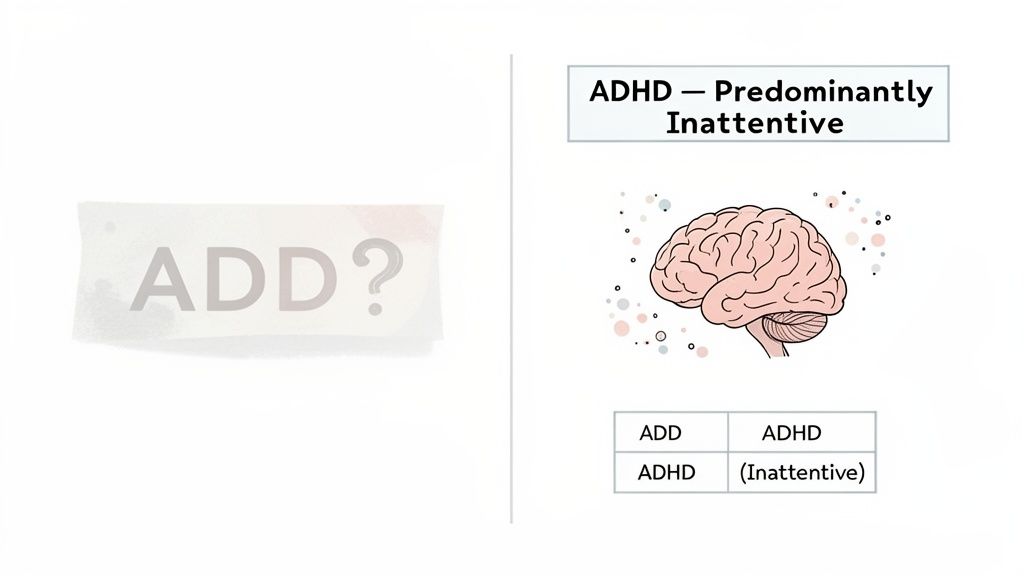
This isn’t just about semantics; it represents a major evolution in how we diagnose and understand attention-related challenges. The core difference isn't between two separate disorders, but between the different presentations of one. This modern framework helps clinicians provide a more accurate diagnosis that captures the full spectrum of an individual's experience.
From ADD to ADHD An Official Change
The transition from ADD to the umbrella term ADHD was formalized decades ago. Technically, ADD hasn’t been an official diagnosis since 1994, when the American Psychiatric Association's diagnostic manual introduced ADHD with three distinct subtypes.
This crucial update acknowledged that even people without visible hyperactivity experience challenges that stem from the same underlying neurobiology. Today, what was once called ADD is now officially known as ADHD, Predominantly Inattentive Presentation. You can explore the history of ADHD diagnostic criteria to see how our understanding has grown.
Knowing this history helps clarify why a modern evaluation looks at a wide range of symptoms, not just the stereotypical hyperactivity so often associated with the condition.
The key takeaway is simple: ADHD is the correct, current medical term. What people commonly refer to as ADD is now understood as a specific type of ADHD where inattentive symptoms are the primary challenge.
This distinction is so important because it ensures that individuals who are quiet, internally distracted, or seemingly calm on the outside receive the recognition and support they need. A proper diagnosis opens the door to effective strategies and treatments tailored to their specific presentation of ADHD.
The table below provides a clear visual map of how the old terminology corresponds to the new, official diagnostic categories used today.
Terminology Quick Guide ADD vs ADHD
This table clarifies the evolution of diagnostic terms from the outdated 'ADD' to the current ADHD subtypes recognized by the DSM-5.
| Outdated Term (Pre-1994) | Current Official Term (DSM-5) | Commonly Associated Symptoms |
|---|---|---|
| Attention Deficit Disorder (ADD) | ADHD, Predominantly Inattentive Presentation | Difficulty sustaining focus, disorganization, forgetfulness, losing things, daydreaming. |
| Attention Deficit Disorder with Hyperactivity | ADHD, Predominantly Hyperactive-Impulsive Presentation | Fidgeting, restlessness, excessive talking, interrupting others, acting impulsively. |
| (No direct equivalent) | ADHD, Combined Presentation | A significant mix of both inattentive and hyperactive-impulsive symptoms are present. |
Ultimately, using the correct terminology helps us all speak the same language, ensuring that conversations about ADHD are accurate, inclusive, and focused on getting people the right kind of help.
The Evolving Understanding of Attention Disorders
If you've ever wondered about the difference between ADD and ADHD, you're not alone. The journey from one term to the other wasn't just a simple name change—it reflects a massive shift in how we understand the condition. Getting a handle on this history is key to understanding why the terms are used the way they are today.
Decades ago, the field of psychology was still piecing together the puzzle of attention disorders. In 1980, the official diagnostic manual introduced Attention Deficit Disorder (ADD). It came in two flavors: with hyperactivity and without. This was a breakthrough because it finally gave a name to the struggles of people who were inattentive but not physically hyperactive.
But it wasn't the full picture. The separation suggested these were two entirely different conditions, rather than two sides of the same coin.
The Unification Under ADHD
As researchers dug deeper through the late 80s and early 90s, a new understanding emerged. They found that inattention, hyperactivity, and impulsivity were all deeply connected, stemming from the same neurobiological roots related to executive functions. They weren't separate issues after all, but a spectrum of symptoms.
This led to a landmark change in the diagnostic manual in 1994. The term ADD was officially retired, and Attention-Deficit/Hyperactivity Disorder (ADHD) became the one, single diagnosis for the condition.
This was a critical moment. It cemented the idea that you don't have to be bouncing off the walls to have ADHD. The focus shifted from just observable hyperactivity to identifying a person's specific presentation: primarily inattentive, primarily hyperactive-impulsive, or a combination of both.
This update was hugely important. It meant the quiet kid staring out the window, lost in thought, could get the same diagnostic consideration as the one who couldn't stay in their seat. It validated that the internal chaos of a wandering mind is just as real as the external signs of restlessness.
Why This Historical Context Matters Today
So why does a history lesson from the 90s matter now? Because it explains why a real ADHD evaluation is so much more than a simple checklist. It's not about choosing between "ADHD vs ADD"—it's about a skilled clinician figuring out how an individual's unique struggles fit into the three official presentations of ADHD we recognize today. You can get a closer look at the modern standards by reviewing the current ADHD diagnostic criteria.
This journey from ADD to ADHD leaves us with a few key takeaways:
- A Unified Condition: ADHD is the correct, medically recognized term that covers the entire spectrum of symptoms.
- Beyond Stereotypes: The "classic" hyperactive boy is just one possible presentation. Inattentive symptoms are just as important and just as valid.
- Importance of Nuance: A proper diagnosis requires a deep dive into an individual's experiences, not just a glance at their outward behavior.
Ultimately, the move from ADD to ADHD was a move toward a more accurate, inclusive understanding of this type of neurodiversity. It opened the door for better diagnoses, more personalized treatment, and finally, a sense of validation for millions of people who never quite fit the old mold.
Comparing the Three Presentations of ADHD
So, we've established that ADHD is the correct umbrella term. The next step is figuring out what it actually looks like in real life. ADHD isn't a single, uniform condition. It shows up in three distinct ways, known as "presentations," and each one comes with its own set of challenges that can look wildly different from person to person.
Getting clear on these presentations is huge. It moves us past the old, clunky "ADHD vs. ADD" debate and toward a much richer understanding of what an individual is actually going through. This clarity is everything when it comes to getting an accurate diagnosis and finding support that genuinely works.
This visual helps show the diagnostic shift from the simpler idea of ADD to the more comprehensive ADHD framework we use today.
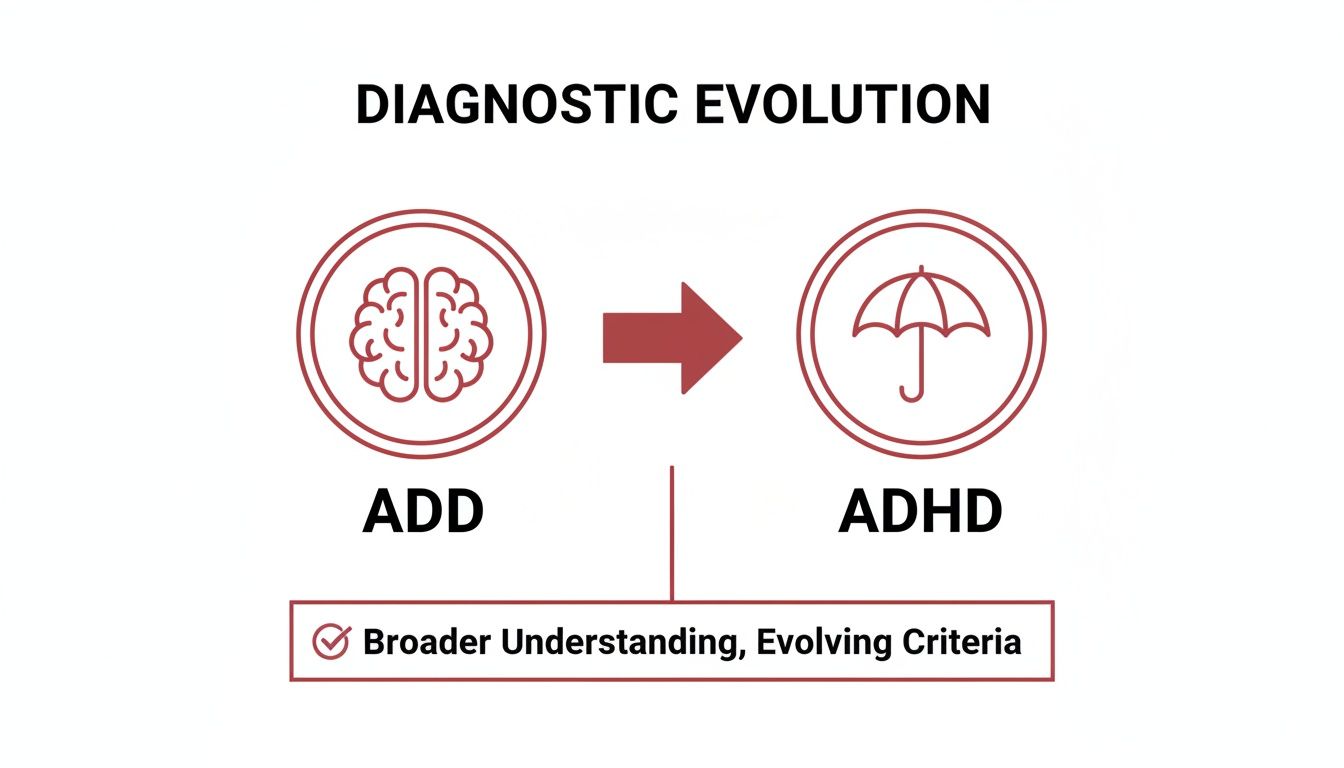
As you can see, ADHD is now the all-encompassing term that includes the traits once informally called ADD, reflecting a more complete scientific understanding of the condition.
Let’s break down what these three presentations really mean.
Predominantly Inattentive Presentation
This is what people used to call ADD. Someone with this presentation might not show the classic, bouncing-off-the-walls signs of hyperactivity. Instead, their struggles are mostly internal, which is why this type is so often missed, especially in girls and adults.
The core issues here are with executive functions—things like organizing thoughts, staying focused, and remembering details. It’s not about a lack of intelligence or effort; it's a real, biological difficulty in directing and sustaining mental energy.
- In Adults: This can look like an office desk that’s always buried under paperwork, constantly missing deadlines despite pulling long hours, or zoning out during critical meetings. An adult with inattentive ADHD might forget to pay bills or lose their keys and wallet almost daily, causing a ton of stress.
- In Children: This is the kid often labeled a "daydreamer." They might look like they're listening in class but absorb very little, consistently forget to turn in homework, and have a backpack that looks like a tornado went through it. They aren’t being defiant; their minds have just drifted somewhere else.
Predominantly Hyperactive-Impulsive Presentation
This presentation is much closer to the classic stereotype of ADHD. The defining traits are a near-constant need to be in motion and a habit of acting first and thinking later.
While the outward hyperactivity can become less obvious as people get older, that feeling of inner restlessness usually sticks around. The impulsivity can pop up in all sorts of ways, from interrupting conversations to making rash financial choices.
- In Adults: Hyperactivity might show up as restless legs, constantly clicking a pen in meetings, or just feeling a desperate need to get up and walk around. Impulsivity could mean making a huge, unplanned purchase, abruptly quitting a job, or jumping into relationships headfirst.
- In Children: This is the child who can’t stay seated at dinner, climbs on the furniture, talks a mile a minute, and butts into other kids' games. Their impulsivity can be a safety issue, like running into the street without looking.
It’s crucial to remember that hyperactivity isn’t just physical. For many, especially as they age, it becomes an internal sense of being “driven by a motor”—a mind that just won’t quiet down.
Combined Presentation
Just as it sounds, someone with a combined presentation has a significant number of symptoms from both the inattentive and hyperactive-impulsive categories. This is actually the most common presentation of ADHD.
They’re dealing with a tough mix of challenges, battling both the internal chaos of inattention and the external restlessness and impulsivity of hyperactivity. This double-whammy can be particularly draining, affecting just about every part of life, from school and work to relationships.
A person with combined-type ADHD might start a project with a huge burst of energy (hyperactivity) only to abandon it when their focus fizzles out (inattention). They can feel scattered on the inside and restless on the outside, all at the same time.
To make these differences even clearer, the table below breaks down how each presentation shows up.
Comparing the Three Presentations of ADHD
This detailed comparison illustrates how the three official ADHD presentations manifest in behavior, challenges, and internal experience.
| Presentation Type | Primary Characteristics | Common Examples in Adults | Common Examples in Children |
|---|---|---|---|
| Predominantly Inattentive | Difficulty with focus, organization, memory, and task completion. Often internal and less visible. | Losing track of conversations, missing important details in work emails, chronic procrastination on mundane tasks. | Forgetting homework assignments, being easily distracted in class, struggling to follow multi-step instructions. |
| Predominantly Hyperactive-Impulsive | External restlessness, excessive talking, fidgeting, and acting on impulse without foresight. | Feeling unable to relax, dominating conversations, making impulsive career or financial decisions. | Inability to stay seated, blurting out answers in class, difficulty waiting for their turn in games. |
| Combined | A significant number of symptoms from both the inattentive and hyperactive-impulsive categories are present. | Starting multiple projects but finishing none, feeling mentally scattered while physically fidgeting, interrupting others then losing their own train of thought. | Being both a "daydreamer" and physically restless, struggling with focus and self-control across all settings. |
Figuring out which presentation best fits someone’s experience is the foundation for getting the right kind of help. It shows exactly why a one-size-fits-all approach to ADHD just doesn’t work and why a professional evaluation is so important for uncovering the true nature of an individual's challenges.
Why ADHD Looks Different in Adults and Women
When you picture ADHD, what comes to mind? For many, it’s a young boy, bouncing off the walls, unable to sit still in class. While that stereotype holds a grain of truth, it’s a tiny piece of a much larger puzzle. It completely misses the experiences of countless adults and women whose ADHD is quieter, more internalized, and often buried under a lifetime of sophisticated coping skills.
This is a phenomenon known as masking. It’s the conscious or subconscious effort to hide ADHD symptoms in order to meet neurotypical expectations. Instead of showing obvious restlessness or disorganization, a person learns to suppress their natural traits, often at a tremendous mental and emotional cost.

Societal Pressure and Gender Roles
Girls are often socialized very differently from boys. Hyperactivity or impulsivity that might be brushed off as "boys being boys" is frequently labeled as disruptive, rude, or unfeminine in girls. This pressure forces them to turn their symptoms inward.
So, what does that look like in practice? Their hyperactivity doesn't disappear; it just changes form. Instead of running around the classroom, it might manifest internally as:
- Anxiety: A mind that is constantly racing, replaying conversations, and worrying about the future.
- Perfectionism: Overcompensating for a fear of failure by spending hours and hours on a task, aiming for flawlessness to avoid criticism.
- People-Pleasing: An intense fear of rejection that leads to masking any behavior that might seem "weird" or "too much" for others.
This internal battle is why so many women aren't diagnosed until well into adulthood. Their struggles are mislabeled as anxiety, depression, or even character flaws. They hear things like, "you're just too sensitive," or "you need to try harder," all while fighting a neurodevelopmental condition nobody else can see.
For many women, getting an ADHD diagnosis later in life feels like a revelation. It reframes a lifetime of what felt like personal failures into the symptoms of a real, treatable condition.
This delayed recognition is a major issue. The worldwide prevalence of adult ADHD is now estimated at 3.1%, and here in the United States, adult diagnoses are climbing four times faster than those in children. This isn't an epidemic; it's a correction. It reflects a growing awareness that countless cases—especially in girls—were missed, only to surface decades later. As understanding grows, telehealth services have become crucial for providing accessible, expert evaluations to this underserved group. You can discover more insights about adult ADHD prevalence on ADHDevidence.org.
Recognizing Masked ADHD in Adults
In adults who have built careers and families before getting a diagnosis, masking can be almost second nature. They've created intricate systems to hide their core executive function challenges, which makes the diagnostic process far more nuanced. Clinicians have to look past the surface-level success.
An adult who is masking their ADHD might:
- Appear incredibly organized to the outside world, but their inner life is a storm of chaos, and they pour enormous energy into keeping up that facade.
- Depend heavily on tools like digital calendars, countless reminders, and planning apps, feeling deep anxiety if one of their systems breaks down.
- Suffer from chronic burnout and exhaustion from the constant mental effort of performing "neurotypical."
Because these presentations are so far from the hyperactive child stereotype, finding a culturally competent and experienced evaluator is non-negotiable. A skilled clinician knows how to ask the right questions to peel back the layers and uncover the hidden struggles behind the mask. The conversation about ADHD vs ADD becomes less about old terminology and more about understanding the deep, often invisible ways ADHD truly impacts a person's life. This requires a diagnostic approach that values lived experience just as much as clinical criteria.
How Telehealth Is Modernizing ADHD Evaluations
Taking the first step toward a diagnosis can feel overwhelming. Many people imagine a long, complicated process, but the growth of telehealth has completely changed the game, making in-depth ADHD evaluations easier to access than ever before. This modern approach gets rid of many of the old barriers, letting you find answers from the comfort of your own home.
Instead of fighting traffic and sitting in a waiting room, a virtual assessment connects you with a specialist from a place where you feel most at ease. This isn't just about convenience; being in a familiar space can lower your anxiety, which helps you give a more genuine and accurate picture of your daily life and challenges.
What to Expect During a Virtual Assessment
A telehealth evaluation isn't just a quick quiz. It's a structured and thorough clinical exploration led by a trained psychologist, designed to get a complete picture of your neurocognitive profile.
The process usually breaks down into a few key parts:
- Initial Clinical Interview: This is a guided conversation about your personal history. We'll talk through your experiences from childhood all the way to your current struggles at work, school, or in your personal life. The goal is to see the lifelong patterns that might point to a neurodevelopmental condition.
- Validated Diagnostic Tools: Our clinicians use standardized, evidence-based self-report measures and assessments. These are the exact same powerful tools used in person, just administered digitally to collect objective data about your symptoms.
- Direct Observation: Throughout your sessions, the psychologist is observing your communication style, responses, and behavior. This provides valuable clinical insights that a simple form could never capture.
This mix of personal history, direct observation, and validated tools ensures the evaluation is both deep and precise. It moves past a surface-level discussion of ADHD vs ADD to uncover the specific way it might be showing up for you. You can learn more about how a telehealth ADHD diagnosis works and what makes it so effective.
Understanding Your Diagnostic Report
Once the evaluation is complete, all the findings are put together in a document that gives you the clarity you've been looking for. Depending on what you need it for, there are a couple of different options.
A diagnosis isn't just a label; it's a tool for understanding yourself and accessing the right support. The report is the key that unlocks the next steps on your journey.
At the Sachs Center, we offer different reports to fit your specific goals:
- Diagnostic Letter: This is a clear, concise document that confirms your diagnosis (if you have one). It's often all you need to seek medication from another provider or ask for basic accommodations at work. It's perfect for when you need official confirmation for a specific reason.
- Comprehensive Diagnostic Report: This detailed, four-page report gives you a much deeper understanding. It covers your mental health history, summarizes your current challenges, provides the formal diagnosis, and includes personalized recommendations for treatment and support. This is the best choice if you want a complete picture to share with other doctors or to better understand your own neurotype.
Ultimately, telehealth makes the whole process feel more approachable. By removing the geographical and logistical hurdles, it empowers you to take charge of your mental health and get the answers you deserve, opening the door to effective treatment and a more supported future.
Using Your Diagnosis for Support and Accommodations
Getting a formal ADHD diagnosis isn't the finish line—it's the start of a new, more informed chapter. This official documentation is more than just a piece of paper; it's a powerful tool that reframes how you see yourself and unlocks real-world support systems designed to help you succeed. It gives you the standing you need to advocate for yourself in school, at work, and in your personal life.
A diagnosis is the key to securing reasonable accommodations in the workplace, which are protected under the Americans with Disabilities Act (ADA). It opens the door to productive conversations with your employer about small adjustments that can make a huge difference, like getting a quieter workspace, having more flexible hours, or receiving instructions in writing. To get a better handle on your rights, check out our detailed guide to workplace accommodations for ADHD and Autism.
Academic and Standardized Test Support
For students, a diagnosis is just as vital. It’s the necessary first step toward creating a 504 Plan or an Individualized Education Program (IEP), both of which provide essential support in the classroom. These plans can include things like extended time on tests, preferential seating to minimize distractions, or note-taking assistance, all of which help level the playing field so students can show what they truly know.
But some high-stakes tests have a much higher bar for accommodations.
If you're looking for accommodations on standardized tests like the SAT, LSAT, GRE, or GMAT, a simple diagnostic letter often won’t cut it. These testing bodies typically require a full neuropsychological evaluation to approve requests for things like extended time.
This comprehensive assessment gives a detailed picture of your cognitive strengths and challenges, providing the robust evidence they need to see. To navigate this process, it can be incredibly helpful to consult an educational psychologist, as they specialize in identifying specific learning needs and recommending the right interventions.
Facilitating Treatment and Self-Advocacy
Beyond formal accommodations, a clear diagnosis from a trusted source like the Sachs Center makes conversations with other healthcare providers much more straightforward. It gives you a solid foundation for discussing medication management with a psychiatrist or developing targeted strategies in therapy, making sure your treatment plan is actually designed for your specific ADHD presentation.
Ultimately, a diagnosis validates what you've always known about yourself. It gives you the language and the official backing to advocate for your needs with confidence. The entire narrative shifts from, "What's wrong with me?" to "What do I need to succeed?" And that clarity is the most powerful tool of all—it allows you to build a life that works with your neurotype, not against it.
Your Questions About ADHD Diagnosis, Answered
Stepping into the world of ADHD can feel overwhelming, and it's natural to have questions. We’ve put together some straightforward answers to the things people most often ask when they're thinking about an evaluation. Our goal is to give you the clarity you need to move forward with confidence.
Is ADD the Same Thing as ADHD?
Not exactly, but they're definitely related. Think of ADD as an outdated term. While you'll still hear people use it, it's no longer an official diagnosis. The correct medical term today is ADHD, which is an umbrella term for three different presentations of the condition.
What most people used to call ADD is now officially known as ADHD, Predominantly Inattentive Presentation. This shift happened as experts realized that the core neurobiology is the same, even if someone doesn't show visible signs of hyperactivity. It's not about two different conditions, but rather, different ways that one condition—ADHD—can show up.
Can You Have Both ADHD and Autism?
Yes, absolutely. It is entirely possible to be diagnosed with both ADHD and Autism Spectrum Disorder (ASD). When these two neurodevelopmental conditions show up together, many in the community refer to it as AuDHD.
While they are distinct conditions, ADHD and autism share overlapping traits, such as challenges with executive functioning and social communication. A skilled clinician can differentiate between them and identify when both are present, which is crucial for creating an effective and holistic support plan.
Do I Need a Full Neuropsychological Evaluation for a Diagnosis?
For most common needs, like workplace accommodations or medication management, a full neuropsychological evaluation is typically not necessary. A comprehensive clinical evaluation, like the telehealth assessments we offer at Sachs Center, is usually all you need.
However, there are specific, often high-stakes situations where a full neuropsychological evaluation is required. These include:
- Requesting extended time on standardized tests (like the SAT, GRE, or LSAT)
- Seeking an IEP or 504 plan in a school setting
- Identifying co-occurring learning disabilities
The right type of evaluation really just depends on your personal goals and what you need the diagnosis to do for you.
If you're looking for clarity on your own neurotype, the expert psychologists at Sachs Center specialize in virtual ADHD and Autism evaluations that provide the answers you need. Explore our diagnostic testing services and book your evaluation today.
