
Let's be honest, how many times have you been told to "be the bigger person"? For a long time, that advice felt like a heavy cloak of obligation. It often meant you had to swallow your pride, ignore your hurt, and just let things go for the sake of "keeping the peace."
But that old-school approach often leaves you feeling resentful and drained. It makes you feel smaller, not bigger.
So, let's redefine what it actually means to be the bigger person in a way that protects your mental health. It’s not about letting others walk all over you. It's about making an empowered decision to choose your own peace over pointless conflict. You get to decide if a situation is worth your energy.
What Being the Bigger Person Actually Means
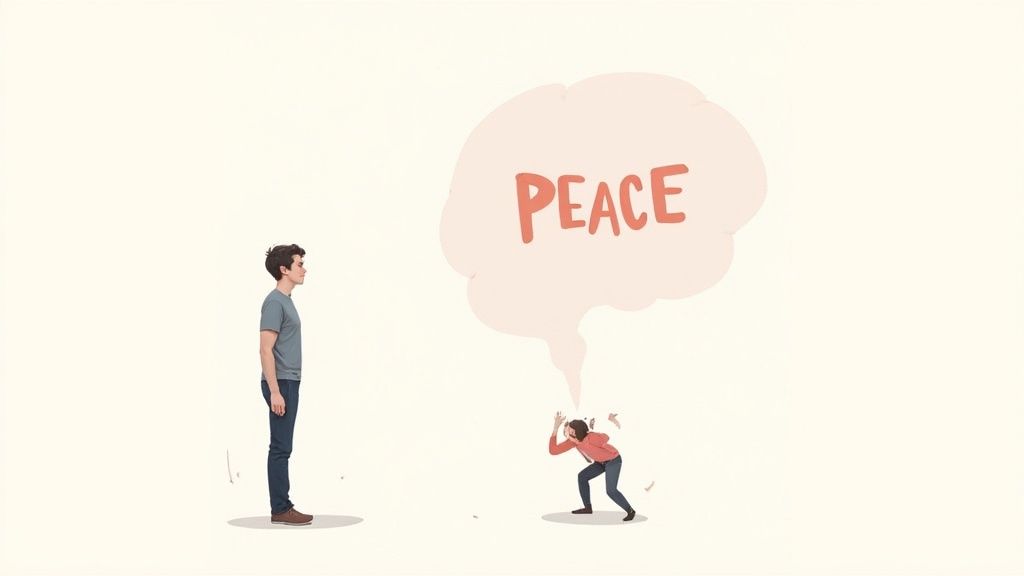
True emotional strength isn't about becoming a doormat; it's about making a conscious choice. It's the power to hit pause, really look at what's happening, and decide on a course of action that serves your well-being, not just someone else's comfort.
It's a Strategic Choice, Not a Passive Surrender
Choosing to be the bigger person is an active, strategic move. It's you, recognizing that your time and emotional energy are precious, and not every battle is worth fighting. Instead of just reacting on impulse, you're taking back control.
This mindset shift is everything. It’s the difference between feeling powerless and feeling empowered. Think of it less as "giving in" and more as "purposefully disengaging" from dynamics that drain you.
Developing this skill is fundamental to healthy relationships and mental wellness. It often starts with foundational capabilities you can build through targeted social emotional learning activities.
Being the bigger person is not about winning an argument. It's about deciding the argument isn't worth your inner peace.
Being the Bigger Person vs. Being a Doormat
It's easy to confuse taking the high road with letting people treat you poorly. They are worlds apart. The key difference lies in your intention and the outcome for your self-respect.
Let’s break it down:
| Characteristic | Being the Bigger Person (Empowered Choice) | Being a Doormat (Passive Behavior) |
|---|---|---|
| Motivation | To protect your peace and energy. | Fear of conflict or rejection. |
| Boundaries | You set and maintain clear boundaries. | Boundaries are weak or nonexistent. |
| Self-Esteem | Your self-worth remains intact. | Self-worth is diminished over time. |
| Outcome | You feel in control and emotionally regulated. | You feel resentful, used, and unheard. |
| Communication | You communicate needs calmly and assertively. | You avoid communication to keep the peace. |
Ultimately, being the bigger person is an act of self-care, while being a doormat is an act of self-abandonment. One builds you up, the other tears you down.
Real-World Examples in Action
This isn't just theory; it plays out in our lives every single day.
- At Work: A colleague makes a passive-aggressive jab about your project during a team meeting. The impulse is to fire back. Instead, you take a breath. Later, you pull them aside and calmly address the substance of their feedback, refusing to get pulled into public drama.
- With Family: That one relative brings up a political topic they know gets under your skin. Instead of taking the bait, you set a firm but polite boundary: "I'd really rather not get into this right now. How about we talk about something else?"
- With Friends: A friend keeps flaking on plans at the last minute. Being the bigger person isn’t just silently stewing. It’s having an honest conversation about how their actions impact you and what you need from the friendship moving forward.
The ripple effects of choosing restraint over retaliation are huge. Between 2023-2024, global conflicts soared to their highest point since 1946, leading to 110 million people being displaced. When individuals, and even entire communities, choose diplomacy over escalation, they are actively working to prevent these devastating outcomes. It’s a powerful reminder that choosing your peace can be a world-changing act.
Your Toolkit for Regulating Your Reactions
Before you can even think about offering a calm, measured response, you have to manage the storm brewing inside you. The moment you feel triggered, your brain's emotional hub—the amygdala—can hijack your rational mind, shoving you straight into fight, flight, or freeze mode. Learning to get a handle on that initial surge is the single most important part of being the bigger person.
This isn't about ignoring or suppressing what you feel. It's about creating just enough mental breathing room between the trigger and your response to make a conscious choice.
This internal work is what allows you to act from a place of strength, not just raw emotion. Let’s walk through some practical, mind-based techniques to help you do exactly that.
Master the Pause and Label Method
The simplest and most powerful tool you have is the pause. Seriously. When you feel that first flash of anger, hurt, or frustration, your only job is to stop. Just for a second.
In that quiet moment, give the emotion a name. Say to yourself, "This is anger," or "I'm feeling hurt right now." This simple act of labeling—a concept known as affect labeling—has been shown to dial down the intensity of an emotional response.
When you name the emotion, you're shifting the activity in your brain from the reactive amygdala to your more thoughtful prefrontal cortex. You’re no longer just being angry; you are observing the anger from a slight distance.
This small gap between feeling and reacting is where your power lies. It's the space where you can decide who you want to be in that moment.
This isn't just a nice idea; it's a neurological reset button. It hands you back the control that a knee-jerk reaction would otherwise steal.
Reframe Your Initial Negative Thoughts
Okay, so you've paused and named the feeling. The next step is to challenge the story you’re telling yourself about what just happened. This is a core practice from Cognitive Behavioral Therapy (CBT), often called cognitive reframing.
Our first thoughts are usually automatic, and they often lean negative. They sound like this:
- "They are doing this on purpose to disrespect me."
- "This is a direct attack on my character."
- "How could they be so thoughtless?"
These thoughts are like gasoline on the fire of your emotional reaction. The goal here isn't to lie to yourself or pretend you aren't upset. It's about finding a more balanced, less catastrophic way to look at the situation.
For instance, instead of thinking, "They're attacking me," you could reframe it to, "Their reaction is probably about their own stress, not about my worth." This small shift doesn’t excuse what they did, but it depersonalizes it, giving you the emotional distance you need.
Practical Reframing Examples
To make this feel more real, here’s how you can transform those initial, fiery thoughts into something more productive.
| Initial Thought (The Story) | Cognitive Reframe (The Shift) |
|---|---|
| "My boss is ignoring my ideas because they think I'm incompetent." | "My boss seems really overwhelmed today. I'll follow up when it's a better time." |
| "My partner left their mess again because they don't respect me or this home." | "My partner must have been rushing this morning. I'll bring this up calmly later." |
| "That friend's comment was a deliberate attempt to humiliate me." | "They often speak without thinking. This probably says more about their lack of a filter than how they feel about me." |
For some of us, especially those with ADHD, emotional regulation can feel like a much steeper climb. The intensity of feelings like anger can be completely overwhelming. Learning more about the unique link between anger and ADHD can offer deeper insights and specialized strategies for managing these powerful emotions.
Practicing cognitive reframing takes time, but it's a skill that gets stronger every time you use it. You're essentially training your brain to default to a more constructive viewpoint, making it easier to be the bigger person without feeling like you’re just bottling everything up. It’s an act of self-preservation that protects your peace of mind and lets you handle conflict on your own terms.
How to Set Boundaries Gracefully But Firmly
You can't be the bigger person without a strong sense of self-respect, and that respect is built on a foundation of solid boundaries. Think of boundaries not as walls to keep people out, but as clear, graceful lines you draw to protect your peace and your energy. They are simply the rules you set for how others are allowed to treat you.
Setting these limits isn't about picking a fight or being aggressive. It’s about clearly and firmly communicating your needs. This ensures your choice to rise above a conflict doesn’t come at the cost of your own well-being. It’s a skill, and just like any other, it gets stronger and feels more natural the more you practice.
The Power of “I Statements”
One of the most effective tools for setting a boundary is the "I statement." This simple communication technique is a game-changer because it focuses on your feelings and needs without pointing fingers or placing blame. When you do that, the other person is far less likely to get defensive.
An "I statement" generally follows a simple structure:
- "When you [describe the specific behavior]…"
- "…I feel [name your emotion]."
- "…and what I need is [state the specific action you want]."
This formula shifts the conversation away from accusation ("You always do this…") and toward the real-world impact their actions have on you. It's not a demand; it's an invitation for them to understand your perspective.
A boundary isn't a threat. It's a clarification of what is and is not acceptable in your presence. It’s you speaking your personal truth.
Practical Scripts for Tough Situations
Knowing the formula is one thing, but actually using it when you're feeling stressed or caught off guard is another. It helps to have a few scripts ready to go in your back pocket. You can tweak these to fit your own unique situations.
Scenario 1: The Passive-Aggressive Colleague
- Their Action: Your coworker remarks, "Must be nice to have so much free time," as you're packing up to leave at 5 PM.
- Your Script: "When you make comments about my work hours, I feel my contributions are being devalued. I need us to keep our interactions professional and supportive."
Scenario 2: The Constantly Critical Relative
- Their Action: Your aunt repeatedly offers unsolicited advice about how you're raising your kids.
- Your Script: "I know you care so much about the kids, and I appreciate that. When you critique my parenting, I feel undermined. I need you to trust my decisions as their parent."
Scenario 3: The Friend Who Dumps Without Asking
- Their Action: A friend calls and immediately launches into a long, negative rant without checking if you're in a place to listen.
- Your Script: "I want to be here for you, but I don't have the emotional bandwidth for a heavy conversation right now. Can we schedule a time to talk later when I can give you my full attention?"
Notice how each script is direct and firm, yet it centers on the speaker's needs without attacking the other person's character.
Navigating Guilt and Pushback
Let's be honest: setting a boundary for the first time can feel incredibly uncomfortable. You might be hit with a wave of guilt, worrying that you're being selfish or mean. This is a completely normal part of rewiring old people-pleasing habits. You have to remind yourself that setting a boundary is an act of self-respect, not an act of aggression.
You should also brace yourself for a little pushback. People who are used to you having weak or nonexistent boundaries may not react well initially. They might:
- Argue with your feelings ("You're just being too sensitive!").
- Try to guilt-trip you ("I was just trying to help!").
- Ignore your boundary completely.
This is where the "firmly" part comes in. Your job isn't to make them agree with your boundary. Your job is simply to uphold it. You can do this by calmly repeating your need or, if necessary, by physically removing yourself from the situation.
For some, especially those with neurodivergent traits, defining and enforcing these personal limits can feel particularly daunting. Understanding the links between poor boundaries and ADHD can offer crucial context and specialized strategies for navigating these social hurdles.
Ultimately, setting boundaries is a vital part of being the bigger person. It allows you to engage with others from a place of strength and integrity, making sure you can offer grace without sacrificing yourself in the process.
When to Engage and When to Walk Away
Choosing to be the bigger person doesn't mean you have to show up for every argument you’re invited to. Your emotional energy is a finite resource, and honestly, not every conflict is worth the investment. The real power move is learning to tell the difference between a productive discussion and a pointless drain on your well-being.
Knowing when to put in the effort and when to consciously disengage is a critical skill. A rude comment from a stranger on the internet? That’s an easy pass. A recurring, painful issue with your partner? That one deserves your thoughtful attention.
To navigate this, you need a clear way to decide where your energy is best spent. Before you jump into a difficult conversation, ask yourself three simple but powerful questions.
This decision-making flowchart can be a helpful visual guide to determine whether a conflict is worth your time and emotional effort.
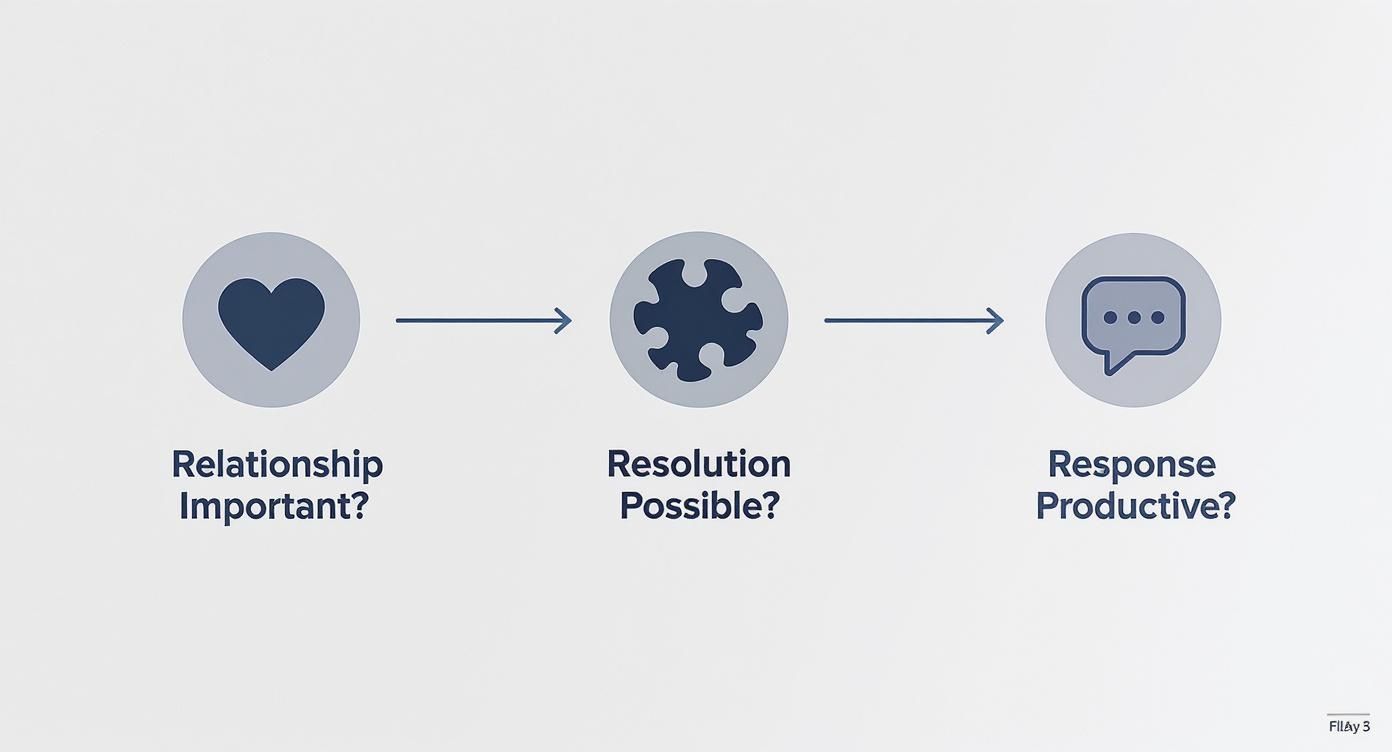
This process forces a strategic pause, making sure your actions line up with your goals for the relationship and your own mental peace.
Is the Relationship Important?
First, get honest about the value of the relationship. Is this a person whose presence in your life genuinely matters? Think about your connections with family, a long-term partner, a close friend, or a key colleague. These relationships often warrant the effort of navigating a conflict.
If the person is just a fleeting presence—like an anonymous online commenter or someone you’ll never see again—engaging is rarely a good use of your energy. Protecting your peace is way more valuable than winning a point with a stranger.
Is a Resolution Actually Possible?
Next, be realistic about what could happen. Is the other person even capable of hearing your perspective and having a good-faith discussion? If you’re dealing with someone who has repeatedly shown they aren't willing to listen, compromise, or take accountability, you might just be walking into a dead end.
Some signs that a resolution is unlikely include:
- A history of them twisting your words or gaslighting.
- Their refusal to acknowledge their role in the conflict.
- A pattern of shutting down or escalating to aggression.
In these cases, being the bigger person might mean accepting that you cannot fix the dynamic. The mature choice is to protect yourself by walking away. You simply can't force someone to meet you halfway.
True maturity isn't about forcing a resolution where one can't exist. It's about recognizing when to stop investing in a losing battle and redirecting that energy toward your own healing and peace.
Is Your Response Likely to Be Productive?
Finally, check in with your own state of mind. Are you calm enough to respond thoughtfully, or are you feeling too angry or hurt to be constructive? Responding from a place of intense emotion almost always makes things worse.
If you’re not in the right headspace, the most productive response is no response at all—at least for now. Give yourself time to process your feelings. Stepping back allows you to return to the conversation later with a clearer perspective, if you even decide it's still worth having.
This idea of strategic disengagement mirrors large-scale conflict dynamics. In 2023, the global economic cost of violence was estimated at a staggering $19.1 trillion, or $2,380 for every person on the planet. This highlights how prolonged, unproductive conflict depletes valuable resources on a massive scale. You can learn more about these findings on the economic impacts of global conflict.
On a personal level, this just reflects how walking away from pointless disputes preserves your own "economic" assets—your time, mental health, and energy. These are far too precious to waste.
Adapting Your Approach for Neurodivergent Minds
Most advice on "being the bigger person" is written by and for neurotypical people. It’s built on a foundation of shared social cues, reading between the lines, and emotional processing that just doesn’t map onto every brain. For neurodivergent folks, this kind of advice can feel like being handed a user manual for a completely different operating system—confusing, invalidating, and frankly, impossible.
The first step is giving yourself some grace. If you have ADHD or you’re autistic, your way of handling conflict isn't wrong; it just requires a different toolbox. Your path to being the bigger person has to work with your neurotype, not against it.
This means finding strategies that lean into clarity, directness, and whatever it takes to keep your brain from getting overwhelmed emotionally and cognitively.
Strategies for ADHD Brains
For the ADHD brain, disagreements can feel like an emotional high-wire act. Two of the biggest challenges are rejection sensitive dysphoria (RSD) and impulsivity. RSD can make the smallest critique feel like a catastrophic rejection, while impulsivity might have you firing back a response before you’ve even processed what was said.
To navigate this, try a few adjustments:
- Take it to Text: When things get heated, see if you can move the conversation to email or text. This creates a built-in pause button, giving you the space to ride out the initial sting of RSD and think through a response without the pressure to react instantly.
- Script Your Key Points: Before heading into a tough conversation, scribble down what you absolutely need to say. This list becomes your anchor, keeping you from getting pulled off-course by emotional reactivity and ensuring you actually communicate your intended message.
- Vent to a Neutral Party First: Get it all out with a trusted friend, partner, or therapist beforehand. Voicing those raw, immediate feelings in a safe space can diffuse the emotional bomb, letting you walk into the actual conversation with a much cooler head.
These aren't avoidance tactics. They’re about setting the stage so you can show up to the conflict as your most constructive and effective self.
Guidance for Autistic Individuals
For autistic people, conflict often gets tangled in unspoken rules and vague language. The neurotypical world runs on subtext, sarcasm, and hints that are incredibly taxing to decode. It’s hard to be the bigger person when you’re spending all your energy just trying to figure out what someone actually means.
Your most powerful tool here is to lean into your natural preference for direct, literal communication.
Your need for clarity is not a weakness; it is a communication preference. Honoring this preference is essential for navigating conflict without sacrificing your mental well-being.
One of the most effective strategies is to develop scripts for common conflict situations. This isn’t about sounding robotic; it’s about having a reliable tool in your back pocket for when your social processing power is running low.
Sample Scripts for Direct Communication:
- To Clarify Intent: "I'm having a hard time reading the subtext here. Could you please tell me directly what you mean?"
- To Set a Boundary: "When you use sarcasm, it's difficult for me to follow the conversation. It would really help if we could talk about this more literally."
- To Request Space: "I need a moment to process what you’ve said before I can respond. Can we pause this and come back to it in an hour?"
Scripts like these cut through the guesswork and put the focus back on clear, mutual understanding. Honing these abilities can be a huge step toward feeling more confident in your interactions. If you’re looking for more structured help, exploring professional communication skills training can offer targeted guidance and a safe space to practice. It's a proactive way to build out your toolkit for handling tricky social dynamics with more ease.
Knowing When Professional Support Is Needed
Choosing to be the bigger person is a powerful tool for self-regulation and navigating tough conversations, but it shouldn't feel like a constant, draining battle. If you find yourself stuck in recurring conflicts that never seem to move forward, or if the emotional effort is taking a serious toll on your mental health, it might be time to bring in professional support.
A therapist offers a neutral, trained perspective that even the most well-meaning friends or family simply can't provide. Recognizing that you need this kind of help is a sign of strength and self-awareness, not failure. It’s an acknowledgment that some relationship dynamics are just too deeply ingrained to untangle on your own.
Signs It's Time To Seek Help
Think about reaching out for professional guidance if you notice any of these patterns cropping up again and again:
- You're Stuck in Endless Cycles: The same arguments happen on a loop with no resolution. You're left feeling completely stuck, frustrated, and even hopeless.
- Your Mental Health Is Suffering: The stress from a particular conflict is causing persistent anxiety or symptoms of depression. It might be messing with your sleep, your focus at work, or your ability to enjoy daily life.
- The Dynamic Feels Abusive: The situation involves emotional, verbal, or any other form of abuse. Being the bigger person should never, ever mean you have to tolerate abuse. Period.
A good therapist can equip you with more advanced communication skills and help you heal the underlying issues that make healthy conflict resolution feel so impossible. For those considering what kind of help is out there, exploring the different careers in mental health can give you a better sense of the various types of support available.
Seeking therapy isn’t about admitting defeat in a conflict; it’s about investing in the tools you need to build a more peaceful future for yourself.
This shift toward mediated resolution actually mirrors trends in global peacemaking. According to the Global Peace Index 2024, the share of conflicts ending in a decisive victory dropped from 49% in the 1970s to less than 9% in the 2010s. This tells us that lasting peace—whether between nations or individuals—now relies far more on constructive engagement and compromise rather than one side simply winning. You can learn more about how global conflicts are resolved through measured responses.
At the Sachs Center, our specialists provide compassionate, evidence-based support to help you navigate these kinds of challenges. We offer targeted therapy that can help you build stronger, healthier boundaries and develop communication patterns that lead to lasting resolution, not just temporary cease-fires.
You Asked, We Answered: Navigating The Gray Areas
Trying to apply these ideas in the real world can feel messy, and it's totally normal to have questions. Let's tackle some of the most common dilemmas that come up when you're trying to be the bigger person.
"What If It Feels Like I'm Always The Bigger Person?"
This is probably the number one question we hear, and for good reason—it’s exhausting. If you’re constantly the one extending the olive branch while the other person makes zero effort, you’re not in a conflict, you’re in an unbalanced dynamic.
Being the bigger person isn’t a free pass for others to behave poorly. It’s about choosing your peace, not repeatedly absorbing disrespect.
When you spot this pattern, it’s time to stop compromising and start setting boundaries. You could try saying, "I'm feeling like I'm the only one trying to solve things between us. For this to work, I need us to find a solution together. Otherwise, I can't keep putting my energy into this."
"What Do I Do About Repeated Offenses?"
The first time someone crosses a line, offering a little grace while clearly explaining your boundary is a great way to be the bigger person. The second time, the conversation needs to be much firmer.
But if the behavior still continues after you’ve been crystal clear about your limits? Your focus has to shift. This is no longer about de-escalating a conflict; it's about creating distance from the source of the conflict.
Your job isn't to endlessly forgive someone who repeatedly disrespects you. Your job is to protect your own peace.
"Is This Just a Fancy Way of Giving In?"
Not at all, and this is a crucial distinction. Giving in is passive. It comes from a place of wanting to avoid conflict at all costs, and it usually leaves you feeling resentful and small.
Being the bigger person is an active, empowered choice. You are looking at the situation and making a conscious call that this specific argument just isn't worth your mental real estate. It's a strategic move to disengage from pointless drama, and you walk away with your self-respect fully intact.
If you're struggling to manage these complex dynamics—especially when neurodiversity adds another layer of challenge—getting professional guidance can be a game-changer. At the Sachs Center, we specialize in providing compassionate, expert support for ADHD and Autism. Book an evaluation with us today to get the clarity and tools you need for healthier, more fulfilling relationships.
