

An executive skills assessment is a deep-dive evaluation of the brain-based skills we rely on every day for planning, organizing, managing time, and keeping our emotions in check. Think of it as a detailed performance review for your brain's "CEO."
What Is an Executive Skills Assessment
Imagine your brain has a chief executive officer sitting in a control tower, managing every project, deadline, and social interaction you face. This "brain CEO" is responsible for directing your attention, remembering multi-step instructions, and stopping you from saying something you might later regret. This entire mental management system is what we call your executive functions.
For many people, especially individuals with ADHD and Autism, this internal CEO can face some unique and persistent challenges. An executive skills assessment is the tool we use to understand exactly how this system is working. It’s not a simple pass/fail test; instead, it’s a comprehensive look into the specific cognitive processes that govern your ability to get things done effectively.
Moving Beyond Simple Labels
A diagnosis like ADHD gives a name to a collection of challenges, but it doesn't really explain the why behind them. Why does starting a project feel impossible? Why is it so hard to switch from one task to another without losing your train of thought? The assessment answers these questions by breaking down those broad difficulties into specific, measurable skills.
This process moves beyond a generic label to uncover a detailed profile of your cognitive strengths and weaknesses. For neurodiverse individuals, understanding how SEL supports neurodiverse students can also add valuable context, highlighting support strategies that work in tandem with the insights from an assessment. The ultimate goal is to create a clear and practical roadmap for support, whether that's at home, in the classroom, or at the office.
Core Skills Under the Microscope
An executive skills assessment gives us a granular look at the control panel of your brain. To build a complete picture, it evaluates several key domains of your executive functioning. A thorough evaluation, like the one we detail in our guide to an executive functioning skills assessment, looks at a wide range of these abilities.
This screenshot shows an example of how testing options can be tailored to individual needs.

The key insight here is that different situations call for different levels of evaluation—from simply seeking diagnostic clarity to needing comprehensive testing for academic accommodations.
Let's break down the primary skills an assessment typically measures.
Core Executive Skills at a Glance
The table below outlines some of the most common executive skills that are put under the microscope during an assessment. These are the fundamental "gears" that need to work together for smooth, effective functioning in daily life.
| Executive Skill | What It Controls | Example in Daily Life |
|---|---|---|
| Working Memory | Holding and using information in your mind for short periods. | Remembering a phone number just long enough to dial it. |
| Inhibition | Resisting impulses, distractions, and old habits. | Not checking your phone every time a notification pops up. |
| Planning & Prioritization | Creating a roadmap to a goal and deciding what comes first. | Breaking down a big school project into smaller steps. |
| Task Initiation | Overcoming procrastination to begin a task. | Starting your homework instead of putting it off until later. |
| Cognitive Flexibility | Adapting your thinking to new rules or unexpected changes. | Switching gears when a meeting is suddenly canceled. |
| Emotional Regulation | Managing feelings to keep an even keel and respond appropriately. | Taking a deep breath instead of snapping when you're frustrated. |
By pinpointing exactly which of these gears aren't turning smoothly, the assessment provides the critical information needed to build effective, targeted support strategies that actually work.
How Executive Functions Develop Over Time
Your executive skills aren’t something you’re born with, fully formed. Think of them as a set of cognitive muscles that grow and strengthen over time. The most significant development happens from early childhood all the way through your mid-20s.
This long, gradual process is directly tied to the maturation of the brain's prefrontal cortex—that "CEO's office" we talked about earlier.
Understanding this developmental timeline is key. It explains why a child who seemed perfectly fine in elementary school might suddenly start struggling with organization and planning in middle school, when the academic demands ramp up. It also clarifies why a young adult just starting their career might find it tough to manage long-term projects and deadlines on their own.
These challenges usually aren't about laziness or a lack of effort. More often, they're a sign that the demands of a new environment have outpaced the current development of their executive skills.
The Brain's Construction Timeline
The growth of executive functions follows a predictable path, but it's also highly individual. It doesn’t happen all at once but in waves, with certain skills coming online before others. Foundational abilities like inhibitory control (the brain's "brakes") and working memory (the brain's "sticky note") are some of the first to emerge.
Research shows this journey starts incredibly early. The development of executive function skills begins in infancy, with core functions appearing between 7 to 12 months old. Kids then hit a major performance spurt on these tasks between ages 3 and 5.
While these skills mature rapidly through middle childhood, the prefrontal cortex continues developing well into early adulthood. You can dive deeper into the full developmental research to learn more about this progression. An assessment helps pinpoint exactly where development may have veered off track, providing the clarity needed for targeted support.
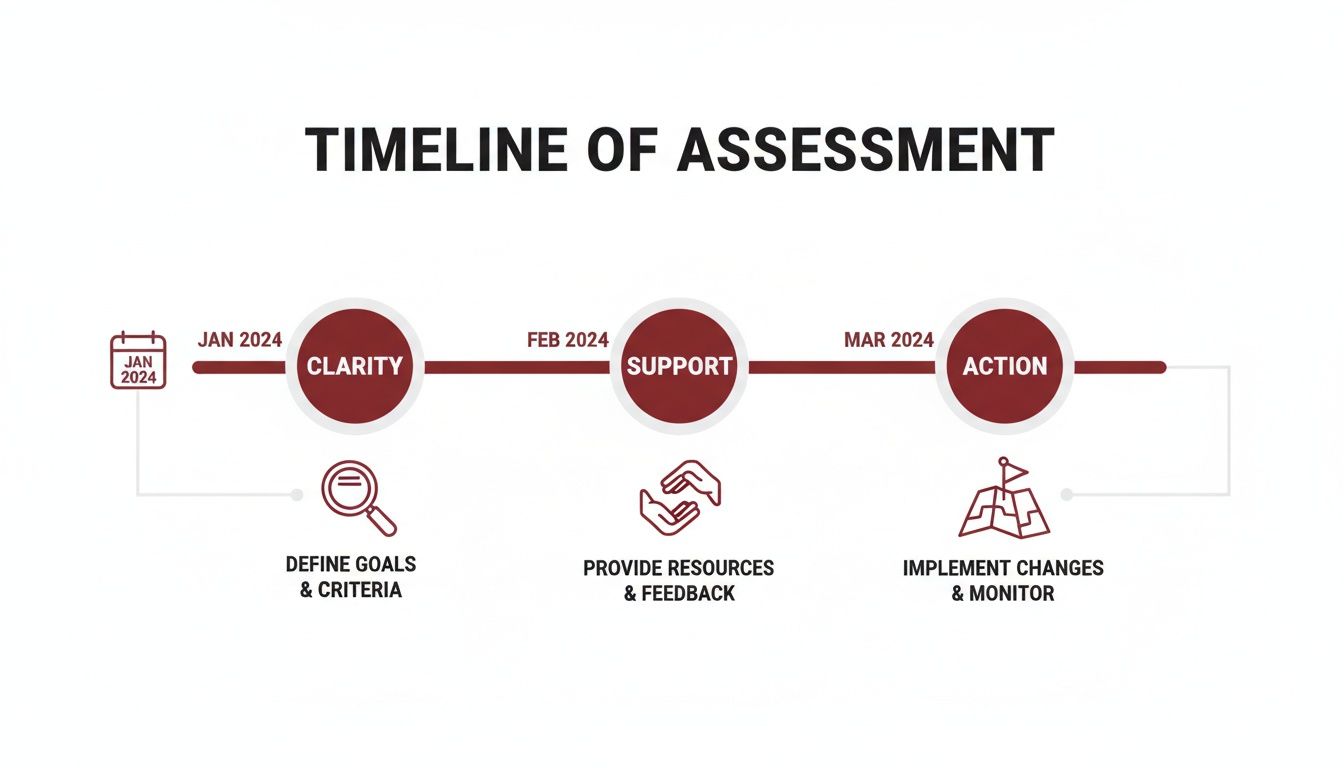
The timeline above shows the typical journey an assessment kicks off, moving from initial clarity to practical support and, finally, a clear action plan.
Key Developmental Milestones
To get a better handle on this process, let’s look at some general age-based milestones. Remember, these are just averages—every individual's timeline is unique. An executive skills assessment is designed to identify where a person is on their specific developmental path.
Early Childhood (Ages 3-5)
- Emerging Skills: Kids start to follow simple two-step directions, inhibit basic impulses (like not grabbing a toy), and use their working memory to remember the rules of a game.
- Common Challenges: Trouble waiting their turn, frequent emotional meltdowns over minor frustrations, and struggling to stay focused on one activity for more than a few minutes.
Elementary School (Ages 6-12)
- Growing Skills: The ability to plan simple projects, organize a backpack, and manage time for homework starts to solidify. They get better at filtering out distractions and thinking more flexibly.
- Common Challenges: A perpetually messy desk or room, frequently losing belongings, forgetting to turn in assignments, and having trouble starting tasks without constant reminders.
An executive skills assessment during this period can be particularly insightful. It helps distinguish between typical developmental hiccups and more persistent challenges that may require structured support or accommodations.
Adolescence (Ages 13-18)
- Refining Skills: Teens develop more advanced planning skills, allowing them to manage long-term assignments and study for multiple tests. Their ability to self-monitor and regulate emotions also becomes more sophisticated.
- Common Challenges: Severe procrastination on major projects, completely underestimating how long tasks will take, and difficulty balancing school, a social life, and other responsibilities. The intense academic pressure at this stage often exposes underlying weaknesses in executive functioning.
Recognizing that these skills are still under construction is everything. When challenges pop up, an assessment provides a blueprint of what’s working and what’s not. This allows for precise, effective interventions instead of just guesswork.
It shifts the focus from frustration to support, empowering individuals with the tools they need to navigate their own developmental journey successfully.
Key Skills Measured in an Assessment
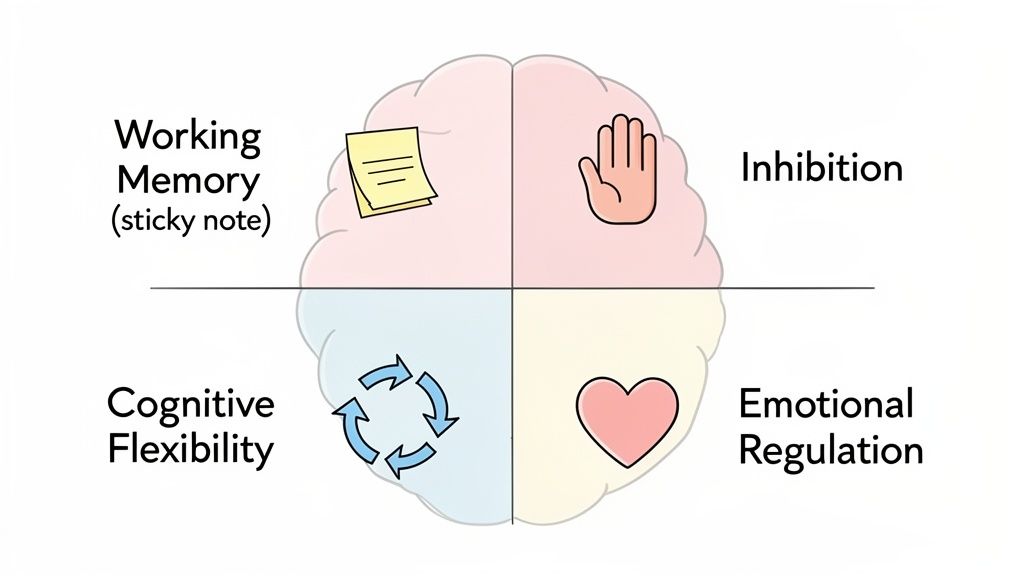
An executive skills assessment doesn’t give you a single, simple score. Think of it more like a detailed map of your brain’s command center. Instead of seeing challenges as one big, messy problem, the assessment breaks them down into specific, measurable skills.
Understanding these individual functions is the first real step. It helps us shift from a vague feeling like "I'm just so disorganized" to a concrete observation like, "My working memory gets overloaded when a project has too many steps." This insight is everything—it’s how we develop strategies that actually work.
Let’s dig into the key areas a good assessment will explore.
Working Memory: The Brain's Sticky Note
Picture working memory as the mental sticky note you use to hold onto information for a short time. It’s what you rely on to remember a phone number just long enough to dial it, follow a new recipe, or keep track of the key points someone is making in a meeting.
This isn’t the same as long-term memory, like remembering an old address. It’s an active, in-the-moment workspace. When working memory is weak, information seems to disappear almost as soon as you hear it, which can be incredibly frustrating.
How Challenges Manifest:
- For Kids: They struggle with multi-step directions. You might say, "Go put your shoes on, grab your backpack, and meet me by the door," but they only remember the first part.
- For Adults: They frequently lose their train of thought mid-sentence, have to reread the same paragraph over and over, or find it nearly impossible to do simple math in their head.
Inhibition and Self-Control: The Brain's Brakes
Inhibition, or what’s often called inhibitory control, is your brain's braking system. It’s the skill that lets you pause and think before acting. It stops you from blurting something out in a meeting or constantly checking your phone when you’re trying to focus.
A strong inhibition system allows for thoughtful responses instead of knee-jerk reactions. When this skill isn’t fully developed, it can feel like your brain has no filter, making it tough to stay on task and manage impulses.
A critical part of any executive skills assessment is measuring this ability to pause and filter. Challenges in this area are not a moral failing or a lack of willpower; they are a sign that the brain's "braking" mechanism needs specific support and training.
Cognitive Flexibility: The Brain's Gear Shifter
Cognitive flexibility is all about being able to shift gears mentally. It’s what allows you to adapt to new information, adjust when things don't go as planned, and look at a problem from a different perspective. It's the skill that helps you switch from writing an email to answering a surprise phone call, then get right back to what you were doing.
This skill is essential for problem-solving in a world that rarely sticks to the script. Without it, people can become very rigid in their thinking, getting stuck on one way of doing things or feeling deeply distressed when a routine is disrupted.
How Challenges Manifest:
- For Teens: They find it hard to transition from math class to history class, or they get extremely upset when plans with friends suddenly change.
- For Adults: They may struggle to accept constructive feedback, get stuck in black-and-white thinking, or feel completely overwhelmed by a minor change in a project’s scope at work.
Emotional Regulation: The Brain's Thermostat
Emotional regulation is the ability to manage your feelings so they fit the situation. It’s like an internal thermostat that keeps your emotional reactions from getting too hot or too cold. It’s what helps you stay calm under pressure or bounce back from a setback without falling apart.
This skill is deeply intertwined with other executive functions. For example, you need inhibition to stop yourself from making a snappy comment and cognitive flexibility to reframe a negative thought into something more productive.
It's important to know that these skills don't always develop in a straight line and can be influenced by many factors. Research shows that gaps in executive function can appear early, sometimes linked to socioeconomic status, but the brain is remarkably adaptable. As you can learn from studies on early intervention, targeted support can make a huge difference.
By looking closely at these core areas, an executive skills assessment gives you a clear and actionable profile. It pinpoints exactly where support is needed, turning confusion into a straightforward path toward building stronger cognitive skills.
The Tools and Process of a Modern Assessment
An executive skills assessment isn’t a single, one-off test. Think of it more like a detective gathering clues from different sources to build a solid, reliable case. This multi-faceted approach is critical because it ensures the final picture of your brain’s management system is complete, accurate, and truly reflective of who you are.
No single tool can capture the full complexity of your executive functions. What you report about your daily struggles, how a teacher or partner observes your behavior, and how you perform on a specific cognitive task are all vital pieces of the puzzle. When combined, they create a rich, three-dimensional view of your strengths and challenges.
Combining Different Perspectives for Accuracy
To build this comprehensive picture, a modern assessment relies on a few core components. Each one offers a unique lens for the psychologist to understand how you function—whether the evaluation is in-person or conducted conveniently via telehealth.
The primary tools include:
- Clinical Interviews: This is really just a structured conversation. The psychologist will ask detailed questions about your developmental history, your performance at school or work, and the specific challenges you're facing now. It provides the essential context that raw numbers and scores just can't capture.
- Validated Rating Scales: These are standardized questionnaires filled out by you, and often by a parent, partner, or teacher. Well-regarded tools like the Behavior Rating Inventory of Executive Function (BRIEF) or the Barkley scales compare your reported behaviors to a large, normative sample.
- Performance-Based Tasks: These are direct, often computer-based, tests that measure specific skills like working memory, processing speed, or inhibition in real-time. They’re designed to see what you can do, not just what you say you can do.
Gold-Standard Tools in a Telehealth Setting
A common question we get is whether a virtual assessment can be as good as a traditional, in-person one. The answer is a resounding yes. The key is using tools and methods that have been specifically designed and validated for remote administration. This ensures a telehealth executive skills assessment is just as rigorous and reliable.
The field of psychometrics is constantly evolving. Modern assessment instruments aren't just adapted for telehealth; they're also designed to be more culturally responsive and precise, ensuring valid results for diverse populations.
Recent validation efforts have led to advanced tools for assessing executive functions across different ages and backgrounds. For instance, a comprehensive 52-item Executive Functioning Scale was developed to identify six specific factors, including working memory, response inhibition, and emotion regulation. Critically, its validity was confirmed across various demographic groups, which helps ensure a more equitable and accurate assessment. You can dive into the psychometric properties of this modern scale to see how the science is moving forward.
The Power of Validated Questionnaires
Standardized rating scales are the cornerstone of a thorough evaluation. They provide structured, measurable data on how executive function challenges show up in everyday life. These aren’t simple quizzes; they are scientifically designed instruments that have been tested on thousands of people to ensure they are reliable.
These questionnaires are invaluable for a few key reasons:
- They Capture Real-World Behavior: They ask about tangible situations, like forgetting instructions, having emotional outbursts, or struggling to start projects.
- They Provide Multiple Viewpoints: Getting input from both the individual and someone who knows them well (like a parent or partner) helps account for blind spots in self-awareness.
- They Offer Objective Benchmarks: The results show how your patterns of behavior compare to others in your age group, which helps determine if the challenges are clinically significant.
If you’re curious about what these kinds of questions look like, you can get a firsthand feel by exploring an executive skills questionnaire similar to those used in the early stages of an evaluation. This multi-method, evidence-based process ensures that when you receive your results, you can trust they are built on a solid foundation of scientific rigor, paving the way for a clear and effective action plan.
Turning Assessment Results Into an Action Plan
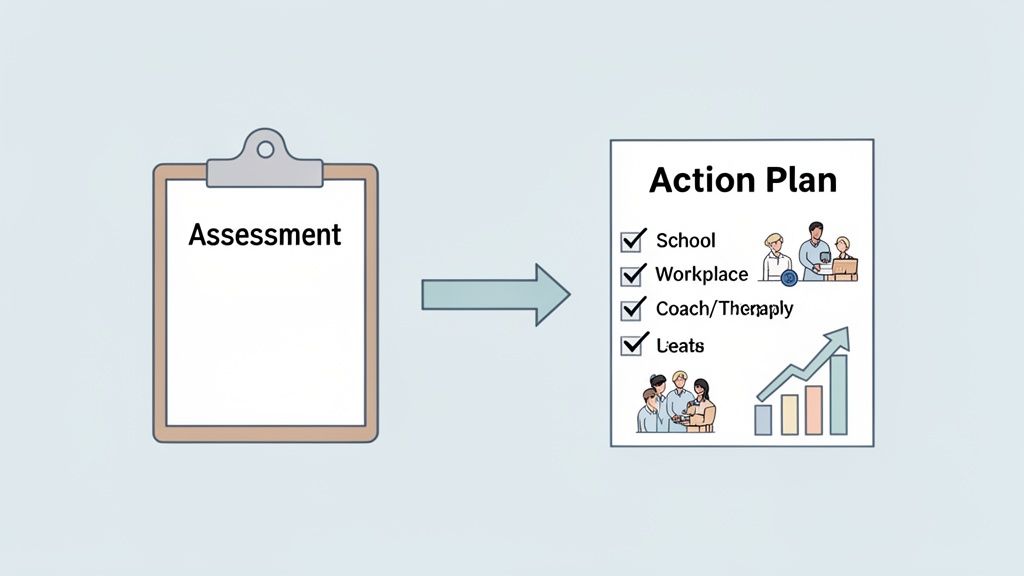
Getting an executive skills assessment report back isn't the end of the road—it’s the beginning of a new one. This document is your blueprint. The real work, and the real value, comes from translating that blueprint into a practical plan for your life.
Think of the report as a detailed map of your unique cognitive wiring. It clearly marks the well-paved superhighways (your strengths) and the trickier backroads that need a bit more navigation (your challenges). The goal now is to use that map to chart a path forward with confidence.
Decoding Your Report and Identifying Priorities
First things first: you have to understand what the report is actually saying. It might be full of specific terms and data, but a good psychologist will walk you through it, translating the clinical language into what it means for your day-to-day reality. You’ll get a clear picture of where you shine and where you could use some support.
Once you have that clarity, it's time to prioritize. You don't have to fix everything at once—that’s a recipe for burnout. Work with your psychologist to pinpoint the one or two challenges that create the most friction at school, work, or home.
For example, if task initiation is your biggest hurdle, the initial action plan might focus entirely on strategies to just get started. This targeted approach feels way more manageable and helps you build momentum from small wins.
Creating a Personalized Support System
With your priorities locked in, the next step is building a support system that fits you. This is never a one-size-fits-all solution; your plan will be tailored to the specific findings in your report.
Generally, these supports fall into three key categories:
- Accommodations: These are simple adjustments to your environment that level the playing field. They don’t change the goal, just the path to get there.
- Interventions: These are the active, hands-on strategies and therapies designed to strengthen your executive skills over the long haul.
- Coaching: This involves partnering with a specialist who provides the structure, guidance, and accountability needed to put new strategies into practice.
An effective action plan doesn't just pick one; it blends all three. Accommodations offer immediate relief, creating the space for interventions and coaching to build lasting skills and independence.
Let's break down what this can look like in the real world.
Example Accommodations
| Setting | Common Accommodation | What It Supports |
|---|---|---|
| School | Extended time on tests | Reduces anxiety and gives your brain the time it needs to process. |
| Workplace | Written instructions for tasks | Supports working memory by giving you something to refer back to. |
| Home | Using visual timers and checklists | Makes abstract concepts like time feel more concrete and breaks down overwhelming tasks. |
Evidence-Based Interventions and Therapies
While accommodations provide crucial in-the-moment support, interventions are what build the muscle for long-term change. Your executive skills assessment report will point you toward specific therapies that align with your needs.
Two of the most powerful and frequently recommended approaches are:
-
Cognitive Behavioral Therapy (CBT): CBT is incredibly effective for executive function challenges because it targets the unhelpful thought patterns that fuel procrastination, disorganization, and emotional blow-ups. A CBT therapist can help you catch and reframe a thought like, "This project is impossible," into a manageable first step you can take right now.
-
Executive Function Coaching: This is a very practical, goal-oriented approach. A coach works with you one-on-one to implement real-world strategies. If your assessment flagged issues with planning, a coach will help you break down actual projects, use a planner that works for your brain, and build organizational habits that stick. For many, this kind of specialized executive function training provides the exact structure they need.
Ultimately, turning your assessment into a plan is about empowerment. It’s the process of taking a diagnostic document and making it a living, breathing guide for your life. It gives you the tools and confidence to build on your strengths and navigate your challenges successfully. For more on building the mental toughness to stick with your plan, check out this helpful guide on building mental resilience.
Common Questions About Executive Skills Assessments
Thinking about an evaluation can bring up a lot of questions. Whether you're a parent trying to get clarity for your child or an adult looking for answers for yourself, just understanding the process is a huge first step. Here are some straightforward answers to the questions we hear most often about getting an executive skills assessment.
Our goal is to pull back the curtain on this process. We want to clear up the confusion and give you the confidence to move forward.
Diagnostic Evaluation vs. Neuropsychological Testing
One of the first things that trips people up is the different types of assessments. They can sound alike, but they're designed for very different purposes.
A diagnostic evaluation is a focused assessment that typically takes 2 to 2.5 hours. It's done virtually and is designed to determine a diagnosis of ADHD, Autism, or both (AuDHD). We do this through in-depth clinical interviews and validated self-report measures. For many people, this is all they need to secure workplace accommodations or create a treatment plan.
On the other hand, full neuropsychological testing is a much bigger undertaking, often lasting several hours. It digs deeper, assessing a wide range of cognitive abilities like IQ and memory in addition to executive functions. This level of detail is what schools and testing boards require for formal academic accommodations.
- Choose a Diagnostic Evaluation for: Getting a clear diagnosis, requesting workplace accommodations, and starting therapy or coaching.
- Choose Neuropsychological Testing for: Securing an IEP, a 504 plan, or accommodations on standardized tests like the SAT or GRE.
Can an Assessment Be Done Effectively via Telehealth?
Absolutely. The old idea that you have to be in a stuffy office for a proper evaluation is long gone. Modern assessment tools and rating scales have been specifically designed and validated for telehealth, making the virtual process just as rigorous and reliable as an in-person one.
Our psychologists conduct all evaluations online using secure, easy-to-use platforms. This means you or your child can be assessed from the comfort of your own home, which often lowers anxiety and gives us a much more accurate picture of how you function in your everyday environment.
Telehealth assessments give you the best of both worlds: scientific rigor without the stress. By blending in-depth interviews, online questionnaires, and computer-based tasks, we get a complete picture of your executive functioning without you ever having to deal with traffic or an unfamiliar setting.
This approach means that quality diagnostic care is no longer limited by your zip code.
What Is Needed for an IEP or 504 Plan?
For any kind of school-based support, like an Individualized Education Program (IEP) or a 504 plan, a comprehensive neuropsychological evaluation is the gold standard.
While our focused diagnostic evaluation can identify conditions like ADHD, schools need the detailed cognitive and academic data that only a full neuropsychological assessment provides. That in-depth report breaks down cognitive strengths and weaknesses—the specific evidence educational teams need to confirm eligibility and grant the right accommodations.
Is a Report Enough for Workplace Accommodations?
Yes, for most adults, our diagnostic testing report provides everything you need to request workplace accommodations under the Americans with Disabilities Act (ADA).
The report gives your employer a clear and professional document that includes:
- A formal diagnosis from a licensed psychologist.
- A straightforward explanation of how your executive functioning challenges impact you at work.
- Actionable, personalized recommendations for reasonable accommodations.
This gives you the tools to have a productive conversation with your employer and ask for specific supports that will help you excel, like getting instructions in writing, having a quieter workspace, or building in flexible deadlines. The whole point of the executive skills assessment is to create a clear path forward, both for your diagnosis and for real-world support.
At the Sachs Center, we specialize in providing clear answers and actionable plans through telehealth-based assessments for ADHD and Autism. If you're ready to move from uncertainty to clarity, learn more about our diagnostic services.
