

Figuring out how to talk to your doctor about ADHD really boils down to three things: jotting down your specific symptoms, making a list of questions, and being direct about wanting an evaluation. This simple prep work can turn a conversation you might be dreading into a genuinely productive one.
Why Starting the ADHD Conversation Is a Game Changer

It’s completely normal to feel a mix of hope and anxiety when you're thinking about discussing ADHD with your doctor. This isn't just another check-up; it's a huge step toward getting clarity on challenges you may have been dealing with for years. You’re definitely not alone in feeling this way—millions of people have been in your shoes.
Understanding the Urgency
For so many adults, living with undiagnosed ADHD feels like running a marathon with invisible weights tied to your ankles. The constant struggle with focus, staying organized, or acting on impulse can put a real strain on relationships and hold you back at work. That moment of realizing these challenges might come from a neurodevelopmental condition is often the first real step toward relief.
Opening up about ADHD is a game-changer, especially now. Global diagnosis rates have shot up over the last thirty years. In the US alone, an estimated 15.5 million adults (6.0%) are currently diagnosed, which just goes to show how common this is. If you're wondering where to even begin, our guide on https://sachscenter.com/how-to-know-if-you-have-adhd/ is a great starting point.
Overcoming the Hesitation
The thought of bringing up ADHD can be daunting. It's easy to worry about being dismissed or not taken seriously. But coming to the conversation prepared can make all the difference, empowering you to advocate for yourself. Even the initial patient registration forms are part of this process, helping you organize your thoughts before you even see the doctor.
The goal here is to push past the uncertainty and take charge of your well-being. And thankfully, modern healthcare has made this process more accessible than ever before.
Telehealth has completely changed the game for adult ADHD care. It offers a private, convenient way to connect with specialists. Services like the Sachs Center, for example, provide comprehensive two-hour virtual evaluations, which removes a lot of the old barriers to getting a proper diagnosis.
This shift means you can get the answers you need right from your own home, making sure the conversation happens on your terms. This guide will walk you through the practical, real-world advice you need to handle this important discussion with confidence.
Documenting Your Symptoms for a Clearer Picture
Walking into a doctor's appointment and trying to remember every single instance of frustration or distraction on the spot is a recipe for disaster. The pressure is on, and your mind can easily go blank. That's why creating a "symptom log" before you go can be a game-changer.
This isn't about diagnosing yourself. It's about giving your doctor the best possible information to work with. A log transforms a vague feeling like, "I have trouble focusing," into a concrete example: "Last Tuesday, I missed a critical deadline because I spent three hours hyper-focused on reorganizing my inbox instead of finishing the report." Those specifics are pure gold for a clinician.
What to Include in Your Symptom Log
Start jotting down moments where you feel your potential ADHD symptoms are getting in the way. Think about all the different hats you wear—at work, at home, in your relationships.
Here are the key areas you'll want to track:
- Inattention: Did you zone out during an important meeting? Struggle to follow a simple conversation? Find careless mistakes in your work after you've already submitted it? Write it down.
- Hyperactivity/Restlessness: Think about that feeling of being constantly "on the go." Maybe you fidget nonstop during quiet moments or find it physically impossible to just sit and watch a full movie without getting up.
- Impulsivity: This can show up in many ways. Note any times you've interrupted others, made a big purchase you immediately regretted, or jumped into a new project before the last one was even close to finished.
- Emotional Dysregulation: Log those moments of intense frustration over something minor. Quick, dramatic shifts in your mood or feeling completely overwhelmed by everyday tasks are important to capture.
When you're writing these things down, being clear and to the point is key. Mastering concise writing will make your notes much easier for both you and your doctor to digest quickly during the appointment.
Connecting Past and Present Experiences
Here’s a crucial piece of the puzzle: ADHD is a neurodevelopmental condition, meaning it starts in childhood. For an adult diagnosis, your doctor needs to see that signs were there before you were 12 years old. This can feel like a huge ask, especially if your memory is hazy.
Dig through old boxes for your school report cards. Were they filled with comments like "doesn't live up to potential," "daydreams in class," or "is disruptive"? Those are absolute treasures. Bring them with you.
Don't have old report cards? No problem. Talk to a parent, an older sibling, or even a childhood friend. Ask them things like, "What was I really like as a kid? Was I always losing my stuff? Did I ever sit still?" Their memories can help fill in those critical gaps.
Gathering this history adds serious weight to your conversation. To help organize your thoughts, you might also look at a tool like an Adult ADHD Self-Report Scale. You can learn more about how the Adult ADHD Self-Report Scale scoring works to get a better handle on your own patterns.
The Value of Outside Perspectives
Your own experiences are vital, but sometimes we're too close to see the full picture. If you feel comfortable, ask someone you trust—a partner, a close friend, a supportive manager—for their honest observations.
You could ask them, "Have you ever noticed that I have a hard time finishing what I start?" or "Do you feel like I interrupt you a lot when we're talking?"
This isn't about inviting criticism; it's about collecting data. Someone else might notice patterns that you've just accepted as "normal." Sharing these different viewpoints gives your doctor a 360-degree look at how your symptoms show up in the real world, which builds a much stronger case for a thorough evaluation.
What to Say and Ask During Your Appointment
Figuring out how to start the conversation with your doctor is often the biggest hurdle. You've done the hard work of tracking your experiences, and now it's about putting those notes into action. Just remember, there isn’t a single "right" way to begin—the main goal is to be clear and direct.
You could take a straightforward approach.
Simply saying, "I've been struggling with focus and organization for a long time, and I'd like to be evaluated for adult ADHD" is a great start. It's direct, it sets a clear agenda, and it tells your doctor exactly why you're there.
If that feels a bit too blunt, you can ease into it with a more exploratory opening. This can feel less confrontational if you're nervous about bringing it up.
You could try something like: "I’ve been reading about the symptoms of adult ADHD, and a lot of them really hit home for me. Could we talk about whether an evaluation might be a good next step?"
This phrasing opens the door for a collaborative discussion rather than a simple request. Both ways are perfectly fine—pick the one that feels right for you.
Key Questions to Guide the Conversation
Once you’ve broached the subject, having a few questions ready will help you leave the appointment with a sense of clarity. You’re not just looking for a diagnosis; you’re gathering the information you need to make smart decisions about your health.
Consider asking some of these to get a better handle on the process:
- What is your process for diagnosing ADHD in adults? This helps you understand their level of experience and what to expect.
- Do you typically handle these evaluations yourself, or should I get a referral to a specialist? This shows you're proactive and helps figure out the most logical next step.
- What are the different types of evaluations available? It’s good to know the options, from a simple clinical interview to more comprehensive neuropsychological testing.
- If a diagnosis is confirmed, what treatment options do you generally recommend? This starts the conversation about therapy, coaching, medication, and other supports.
Asking "How will we track progress together?" is another great question. It clarifies what follow-up looks like and how any potential treatments might be adjusted over time.
This infographic is a great summary of how to pull your documentation together to support your side of the conversation.
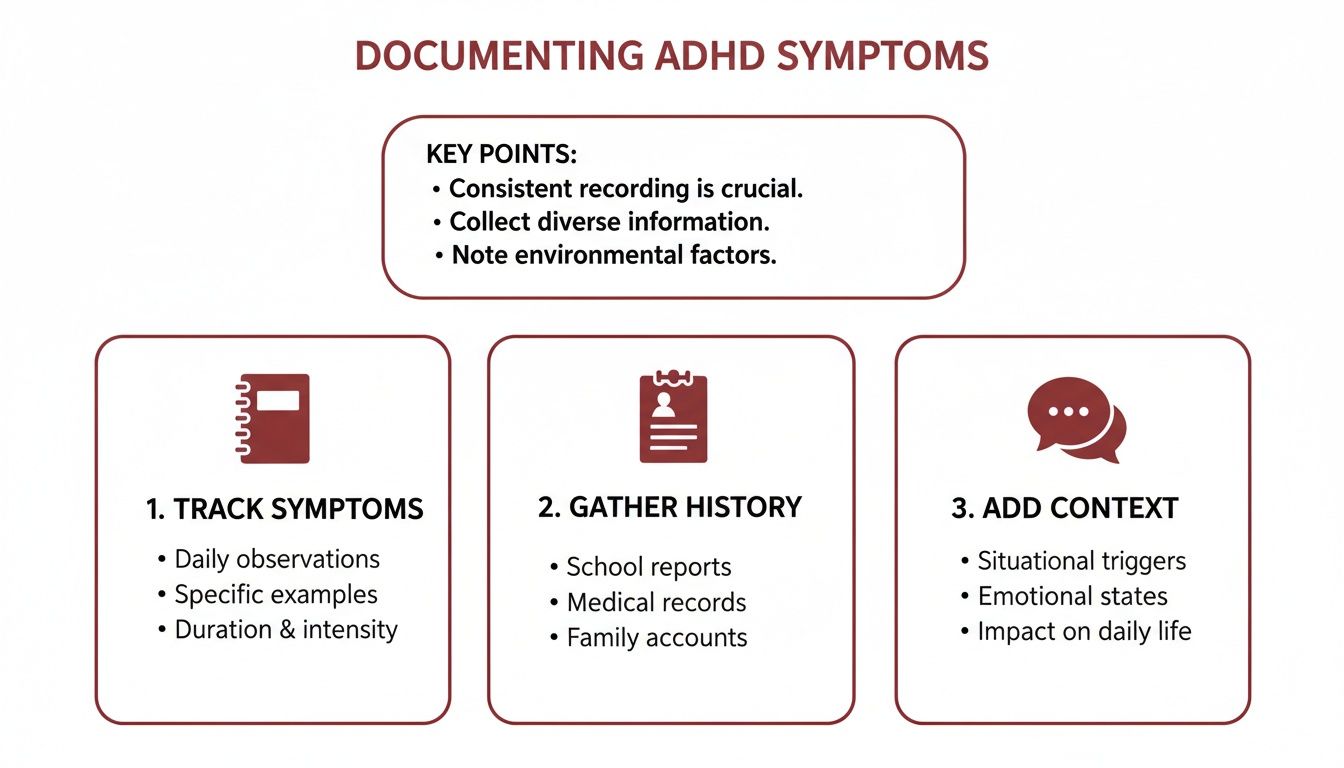
Think of it as a reminder that a strong conversation is built on a foundation of tracked symptoms, your personal history, and real-life examples.
Advocating for Yourself During the Appointment
Your voice is the most important one in the room. If you feel like your concerns are being dismissed or not taken seriously, it’s crucial to advocate for yourself calmly but firmly.
This is where your notes come in handy. Instead of saying, "I'm forgetful," provide a concrete example like, "I missed three important work deadlines last month because I couldn't stay on task." Specifics are much harder to ignore.
If your doctor still seems hesitant or unsure, don't be afraid to ask for a referral to a specialist. Professionals who focus on neurodiversity, like the team at the Sachs Center, are experts in diagnosing ADHD in adults and can provide the specialized evaluation you need.
The goal is to leave that appointment feeling heard and having a clear plan for what comes next.
Understanding Different ADHD Evaluation Options
It can be confusing to know what kind of evaluation to ask for. Here’s a quick breakdown of the common options to help you understand the differences and decide what might be best for your situation.
| Evaluation Type | Best For | Typical Components | Outcome | Example Provider Service |
|---|---|---|---|---|
| Clinical Interview | Initial screening with a primary care doctor or general therapist. | Discussion of symptoms, review of rating scales, personal and family history. | A preliminary opinion or referral for more in-depth testing. | A standard appointment with your family doctor. |
| Diagnostic Evaluation | A definitive diagnosis from a psychologist or psychiatrist. | Clinical interview, review of school/work records, multiple rating scales. | A formal ADHD diagnosis and a report with initial treatment recommendations. | The Sachs Center's ADHD Testing. |
| Neuropsychological Testing | Complex cases where other conditions (like learning disabilities) may be present. | In-depth cognitive tests for memory, processing speed, and executive function. | A comprehensive report detailing cognitive strengths/weaknesses and multiple diagnoses. | Specialized neuropsychology clinics. |
This table should give you a better idea of what to expect so you can have a more informed conversation about your next steps, whether that’s with your current doctor or a specialist.
Discussing Treatment and Workplace Accommodations
Once you've had a productive conversation and an evaluation seems likely, the focus naturally shifts to what comes next. This part of the discussion is all about turning a potential diagnosis into practical, real-world support.
It helps to go into this conversation with an open mind. Think of treatment not as a single pill or solution, but as a combination of strategies designed just for you and your specific challenges.
Exploring Your Treatment Options
When you start talking about treatment, it's best to frame it as a partnership. You're not just there to receive instructions; you're building a plan together.
A great way to kick things off is by asking, "What approaches have you seen work best for adults in my situation?"
This question opens the door to a much richer conversation that goes beyond just medication. Truly effective ADHD management usually stands on several pillars of support:
- Therapy: Cognitive Behavioral Therapy (CBT) can be a game-changer for developing coping skills, wrangling time management, and challenging the negative thought patterns that often come with ADHD.
- Coaching: An ADHD coach provides hands-on, practical strategies for getting organized, planning your days, and actually hitting your goals.
- Medication: For many, medication is an essential tool. It helps manage the core symptoms, which in turn makes it easier to use the strategies you learn in therapy and coaching.
If you're feeling alone in this, you're not. Recent data shows that half of the 15.5 million US adults diagnosed with ADHD in 2023 got that diagnosis as grown-ups. And with 46% of adults with ADHD using telehealth, getting comprehensive care is more possible than ever.
Securing Workplace and Academic Accommodations
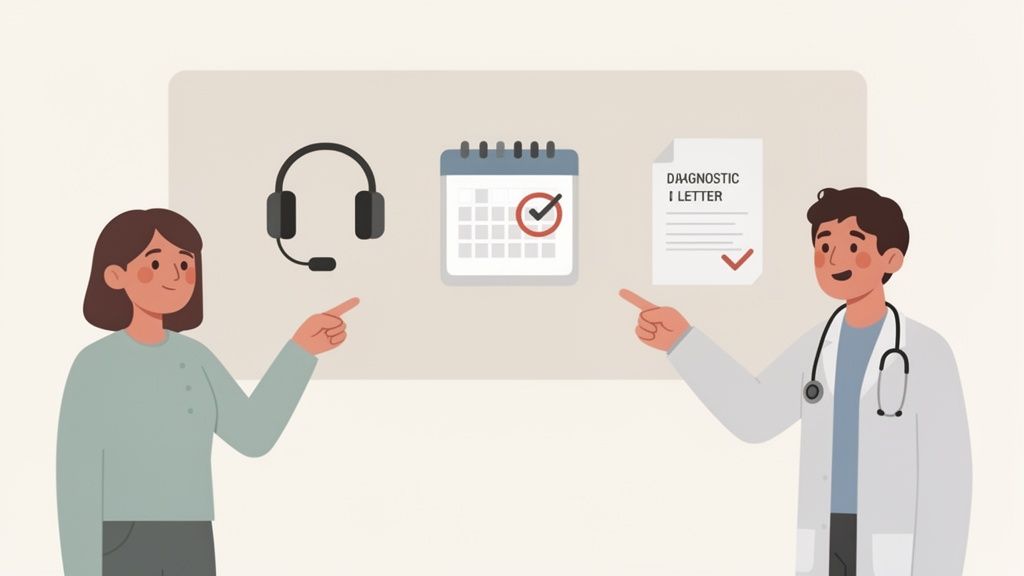
A formal diagnosis is so much more than a label—it’s the key that unlocks support systems at work or school. This support usually starts with a diagnostic letter or report from your clinician.
This official document is what you’ll need to request reasonable accommodations. It doesn't have to spill every detail of your condition, but it will confirm the diagnosis and suggest helpful measures.
Your diagnostic letter is a powerful tool for self-advocacy. It translates your diagnosis into actionable support, empowering you to request the specific adjustments you need to thrive.
Armed with this letter, you can confidently ask for practical changes. Some of the most common accommodations include:
- Getting instructions in writing
- Permission to use noise-canceling headphones
- A desk in a quieter part of the office
- More frequent check-ins on long-term projects
- Flexibility with deadlines when it makes sense
These aren't about getting "special treatment." They're about leveling the playing field so you can do your best work. For a deeper dive, check out our guide on accommodations for ADHD in the workplace. This process is how your diagnosis leads to meaningful, positive changes in your day-to-day life.
What to Do When Your Doctor Is Hesitant
It’s a tough spot to be in. You finally work up the courage to talk to your doctor about ADHD, only to feel dismissed or unheard. If you walk out of that appointment feeling brushed off, please know this: you are not at a dead end. This happens more often than you’d think, and it’s a clear sign that it’s time to find a specialist.
A primary care physician is a generalist. While many are great, they don’t always have deep training in the nuanced ways adult ADHD shows up. This is especially true for women, girls, and BIPOC individuals, whose symptoms are often "masked" or don't fit that stereotypical image of a hyperactive young boy.
The Advantage of Seeing a Specialist
When a general practitioner pumps the brakes, the best next move is to talk to a professional who lives and breathes neurodiversity. Psychologists and psychiatrists who specialize in ADHD are trained to spot symptoms that others might easily miss.
They understand the less obvious presentations, like:
- Internalized hyperactivity: This isn't always about fidgeting. It can feel like racing thoughts, inner restlessness, or constant mental chatter that just won't quit.
- Rejection sensitive dysphoria (RSD): This is an intense emotional sensitivity to perceived criticism or rejection, a common but frequently misunderstood part of the ADHD experience.
- Masking and camouflaging: This is the act of developing complex coping strategies to hide symptoms, which can make it incredibly difficult for a non-specialist to see what's really going on.
Why Specialization Matters for Diagnosis
A specialist can also untangle the wires between ADHD and other conditions with similar symptoms, like anxiety or depression. They’re trained to see how these conditions can exist together, which is crucial for getting an accurate diagnosis. After all, effective treatment has to start with a clear understanding of what’s causing your challenges.
The data backs this up. With 7 million US kids diagnosed with ADHD and global rates at 7.2%, it's obvious the condition is common. Yet only about a third of children get the recommended combination of medication and behavior therapy. This points to a huge gap in care that specialists are uniquely equipped to fill. You can read more about these ADHD statistics and see for yourself why an expert evaluation is so important.
If your doctor isn't an ADHD expert, it's like asking a general mechanic to figure out a complex electrical problem in a high-performance car. They might get lucky, but a specialist will find the issue faster and with much more precision.
Embracing Telehealth for Expert Access
Let's be real—finding a local specialist can be a headache, with long waitlists and other barriers. This is where telehealth services like the Sachs Center can be a game-changer. You can connect directly with a psychologist who specializes in adult ADHD right from your own home.
Instead of a rushed 15-minute appointment, a telehealth evaluation is a comprehensive, two-hour deep dive. This gives the clinician the space to conduct a thorough interview, review your history, use proven assessment tools, and—most importantly—give you the time you need to share your full story. The result is a level of diagnostic clarity that a brief office visit simply can't offer.
Common Questions About the ADHD Diagnosis Process
Even after doing all your research, it’s completely normal to have a few questions rattling around. The path to an adult ADHD diagnosis can feel a little murky, but clearing up some common misconceptions will help you walk into that appointment with confidence.
One of the biggest anxieties people have is about the evaluation itself. A lot of people wonder if they're going to have to go through weeks of expensive, complicated testing just to get an answer.
Do I Need a Full Neuropsychological Evaluation?
For most adults, the answer is a relieving no.
A thorough clinical interview with a psychologist who really understands ADHD, paired with some validated rating scales, is usually all it takes to get an accurate diagnosis. This process gives a clinician everything they need to understand your specific challenges and map out a treatment plan.
Full neuropsychological testing is a much bigger deal. It's typically reserved for very specific situations, like:
- Needing academic accommodations for standardized tests like the SAT, GRE, or GMAT.
- Complex cases where another condition, like a learning disability, might be in the mix and needs to be clearly identified.
So, if you're looking for clarity to get support at work or start treatment, a standard diagnostic evaluation is the most direct and appropriate route.
If your doctor isn't taking your concerns seriously, try to stay calm but be firm. You can say something like, "These symptoms are having a major impact on my life, and I would like a referral to a specialist for a formal evaluation." Remember, getting a second opinion is always an option.
Can I Get Diagnosed and Treated Entirely Online?
Yes, absolutely. Telehealth has been a game-changer, making high-quality ADHD care more accessible than ever. Gone are the days of trying to find a local specialist, which often meant long waitlists and inconvenient travel.
Today, reputable online clinics can conduct in-depth diagnostic evaluations virtually over video. After a diagnosis, they can provide the official documentation you need for medication management or to secure workplace accommodations. Many also offer ongoing online therapy and coaching, helping you manage your ADHD effectively from home. This modern approach breaks down so many of the old barriers, making it much easier for adults to finally get the answers they’ve been looking for.
At the Sachs Center, our psychologists are experts in diagnosing ADHD in adults, especially in highly masked individuals. Our comprehensive two-hour virtual evaluations provide the diagnostic clarity you need to move forward. If you're ready to get answers, you can learn more about our services and book your evaluation.
