

When we talk about nonverbal communication in autism, we're really talking about the unique ways autistic people see, process, and use unspoken social cues—things like gestures, facial expressions, and eye contact. For many, this isn't a flaw or a deficit. It’s more like a different communication dialect, where the unwritten rules that seem second nature to neurotypical people can feel like a foreign language.
Getting a handle on this difference is the first step toward building genuine connections and offering the right kind of support.
Decoding the Unspoken World of Autistic Communication
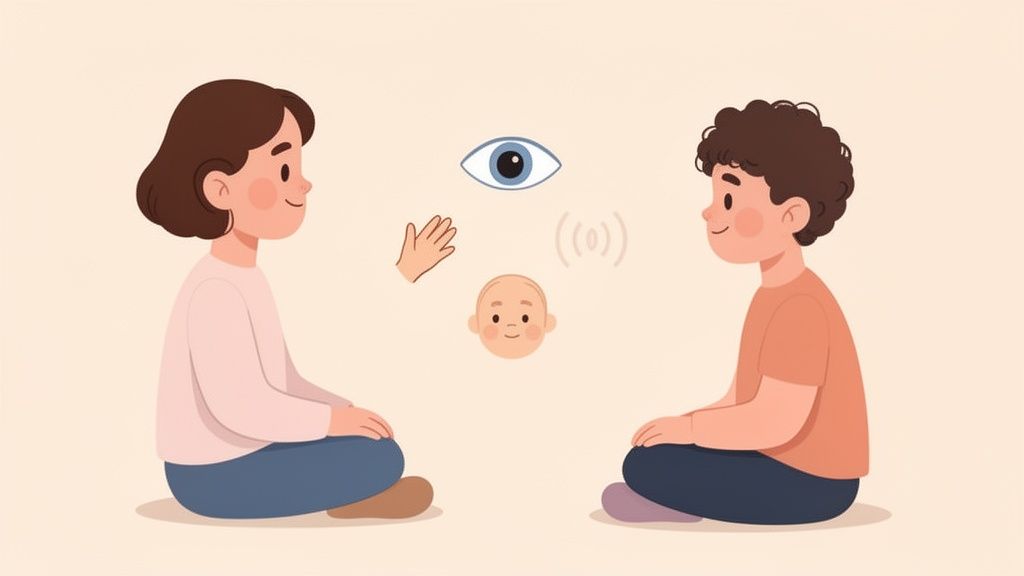
Think of a conversation like a song. The words are the lyrics, but all the nonverbal cues—tone of voice, facial expressions, body language—are the melody, rhythm, and harmony. For many neurotypical people, hearing this "music" is automatic. But for an autistic person, it can feel like trying to sight-read a complex musical score without any training.
This guide is meant to be a warm, empathetic starting point for parents, educators, and anyone navigating this intricate world. We’ll explore how nonverbal communication and autism intersect, shaping social connections and everyday life. The goal is to shift our perspective from seeing these differences as challenges to celebrating the strengths that neurodiversity brings to the table.
Why This Unspoken Language Matters
Understanding the nuances of autistic communication is vital. A huge number of people on the spectrum face significant communication hurdles. In fact, somewhere between 25% to 30% of autistic children are nonverbal or minimally verbal. Recent brain imaging studies show that these children often have delayed responses to simple sounds compared to their verbal autistic peers—a difference that also applies to how they process gestures and eye contact.
With about 1 in 100 children diagnosed with ASD across the globe, that’s millions of families navigating these communication barriers every single day. Learn more about these brain imaging findings.
This journey demands both compassion and knowledge. It’s not just about what is said, but about appreciating the different ways people communicate. Exploring the distinctions between neurotypical and neurodivergent communication can provide much-needed context. You can read our guide on neurotypical vs neurodivergent communication to deepen your understanding.
For an autistic person, the unspoken rules of social interaction can feel arbitrary and exhausting. What appears as a lack of engagement may actually be an attempt to manage overwhelming sensory input or avoid the discomfort of forced eye contact.
To help you on this journey, we've broken down some of the key elements of nonverbal communication in autism that we'll be discussing. This table gives a quick overview of what to look for and how it often presents.
Key Elements of Nonverbal Communication in Autism
| Communication Type | What It Involves | Common Autistic Presentation |
|---|---|---|
| Eye Contact | Making and holding eye contact during conversations. | Often avoided, fleeting, or feels unnatural and intense. |
| Facial Expressions | Using the face to convey emotions like joy, sadness, or confusion. | May be limited, delayed, or not match the person’s internal feelings. |
| Gestures & Body Language | Using hands, posture, and movement to add meaning to words. | Can be less frequent, atypical (e.g., hand-flapping), or seem disconnected from the conversation. |
| Tone of Voice | Using pitch, volume, and rhythm (prosody) to express emotion. | Often described as flat, monotone, or having an unusual rhythm. |
| Personal Space | Understanding and respecting the typical physical distance between people. | May stand too close or too far away from others without realizing it. |
| Interpreting Cues | Reading and understanding others’ nonverbal signals. | Difficulty interpreting sarcasm, humor, or subtle emotional shifts. |
Understanding these different facets is crucial for building a bridge of communication.
This article will guide you through this complex topic, offering clarity and practical support. We will cover:
- Early signs in toddlers and the specific presentations in teens.
- Nuanced and often-missed masked behaviors in adults.
- The role of telehealth diagnostics in providing clear answers.
Our goal is simple: to make sure every reader feels seen, understood, and equipped with the tools to foster authentic connection.
Here is the rewritten section, crafted to align with the provided human writing style and expert tone.
Understanding the Fundamentals of Nonverbal Language
Think of a conversation like a song. The words you say are the lyrics, but it's the nonverbal cues—the melody, rhythm, and harmony—that truly give it meaning and emotional depth. This unspoken language is made up of gestures, facial expressions, and tone of voice, providing the context that words alone just can't capture. For most people, this social "music" is interpreted automatically, without a second thought.
For an autistic person, however, that constant stream of unspoken information can feel like trying to sight-read a complex musical score with zero training. It takes intense, conscious effort to translate the cues that others seem to understand instinctively. This fundamental difference in processing is at the heart of nonverbal communication and autism.
This section will break down the building blocks of this unspoken language. We'll start with the basics and build up to the more complex social signals, creating a solid foundation for understanding the communication experiences of autistic people.
The Core Components of Unspoken Communication
Nonverbal language isn’t a single skill; it’s a whole collection of different channels working together at once. When these channels line up with the spoken words, communication feels clear and effective. But when they don’t match, it can lead to all sorts of confusion and misunderstanding.
Let’s explore the primary components:
- Facial Expressions: The human face is incredibly expressive, capable of conveying happiness, surprise, anger, or sadness in an instant. A simple smile or a furrowed brow can often communicate far more powerfully than a sentence.
- Gestures and Body Language: This covers everything from a quick thumbs-up to how a person holds themselves. Leaning in can show you’re interested, while crossed arms might suggest you’re feeling defensive or uncomfortable.
- Eye Contact: How we use our eyes is a huge part of social interaction. It can signal that you're paying attention, help build trust, or express intimacy. The "rules" around eye contact are often subtle, unwritten, and vary a lot between cultures.
- Tone of Voice (Prosody): This isn't about what you say, but how you say it. Pitch, volume, and rhythm can turn a simple phrase like "That's great" into a sincere compliment, a sarcastic jab, or even a question.
- Personal Space (Proxemics): Every culture has unspoken rules about how close is too close. Standing too near or too far away from someone can send unintentional social signals that make others feel uncomfortable.
For an autistic person, each of these channels can present its own unique challenge. The difficulty isn't just about producing these cues, but also about trying to interpret them from others in real-time.
Think of it like a pilot in a cockpit. A neurotypical person might intuitively know what all the blinking lights and dials mean. An autistic person may have to manually check a mental "manual" for each and every signal—a process that is exhausting and leaves a lot of room for error.
From Simple Signals to Complex Social Cues
Nonverbal communication exists on a spectrum of complexity. At one end, you have very direct, almost universal signals. A wave, for instance, almost always means "hello" or "goodbye." A thumbs-up is a clear sign of approval in many cultures. These are like the basic chords in our conversational song—simple and pretty easy to recognize.
But as you move up the scale, the cues become far more subtle and completely dependent on the context. Take sarcasm, where the tone of voice directly contradicts the literal meaning of the words. To get it, you have to completely ignore the "lyrics" and listen only to the "melody." This requires an advanced ability to process multiple, often conflicting, nonverbal signals at once.
This is where many of the biggest challenges in nonverbal communication and autism come into play. An autistic person might easily understand a direct gesture but struggle to decode the layered meanings packed into humor, flirting, or indirect requests. This isn't a failure to understand language; it's simply a different way of processing the incredibly intricate, unspoken rules that govern our social world.
Nonverbal Communication in Autistic Children and Teens
For parents, noticing differences in nonverbal communication often starts with small, puzzling moments. Maybe your toddler doesn't point at the airplane flying overhead, or your teen seems completely unaware of a friend's sarcastic tone. These aren't acts of defiance; they're windows into a unique neurodivergent way of communicating. Recognizing these signs is the first step toward building a bridge of true understanding.
The journey of nonverbal communication and autism changes dramatically from the toddler years through adolescence. What might start as subtle differences in how a young child interacts can become much more obvious as their social world gets bigger and more complicated.
Early Signs in Young Children
For toddlers and preschoolers, the world is navigated almost entirely through nonverbal cues. This is where some of the earliest signs of autism can appear, often in very distinct ways. A key early indicator is a difference in joint attention—that simple, beautiful act of sharing an experience with someone else. A neurotypical child might spot a puppy, look at their parent, and point back to the puppy, silently saying, "Hey, look at that with me!"
An autistic child, on the other hand, might be just as fascinated by the puppy but not have that same impulse to pull someone else into their world. This can show up in other ways, too:
- Atypical Pointing: They might point to ask for something they want but are less likely to point just to share something interesting.
- Delayed Response to Name: A toddler might not turn when their name is called, not because they can't hear, but because that social cue doesn't carry the same weight for them.
- Limited Use of Gestures: Waving "bye-bye" or shaking their head "no" might show up later or be used less consistently than in their peers.
Research backs up these observations. For example, one study found that autistic preschoolers use significantly fewer gestures than their peers. Even with support, this initial gap can be a core challenge, with some children developing minimal speech and relying heavily on other ways to communicate. You can read the full research about these gesture findings to dive deeper into the data.
Navigating the Teen Years
When children hit adolescence, the social landscape transforms into a minefield of unspoken rules, inside jokes, and layered meanings. For autistic teens, this is often when the pressure to "fit in" becomes exhausting. The nonverbal challenges shift from basic skills to decoding incredibly complex social dynamics.
For instance, a neurotypical teen rolls their eyes to signal they're annoyed, and their friends get it instantly. An autistic teen might miss that cue completely or take it at face value, leading to confusion and social missteps.
A classic example is a teen being seen as blunt or rude. They might honestly tell a friend they don't like their new haircut, completely missing the nonverbal signals that this is a moment for social kindness, not literal truth. This isn't malice; it's just a different way of processing the world.
Common challenges for teens often include:
- Misinterpreting Sarcasm and Humor: The deadpan tone that usually comes with sarcasm can be almost impossible to tell apart from a serious statement.
- Managing Personal Space: They might stand too close to others or feel deeply uncomfortable when their own space is invaded, struggling to sense those invisible social bubbles.
- Difficulty with Group Dynamics: Trying to keep up with the fast-paced, overlapping, and nonverbally rich flow of a group conversation can be mentally draining.
This constant need to translate social information can lead to intense social anxiety and a desire for solitude. It's so important for parents and educators to see this for what it is—cognitive overload, not a lack of interest in connecting with others. Finding new ways to build these skills can make a world of difference. For some hands-on ideas, check out our guide on 8 effective autism social skills activities.
Nonverbal Communication and Masking in Autistic Adults
For many autistic adults, especially those who grew up without a diagnosis, the social world can feel like a stage play where they're the only one without a script. To get by, they often develop an incredibly sophisticated survival strategy called masking. This is the conscious—and often exhausting—effort to imitate neurotypical social behaviors, hiding their authentic autistic traits just to fit in.
Masking is so much more than just "acting normal." It’s a deeply cognitive, moment-to-moment process of observing, analyzing, and then mimicking the nonverbal cues that seem to come so effortlessly to others. An autistic adult might spend decades learning to perform expected behaviors, like forcing uncomfortable eye contact, scripting facial expressions for work meetings, or mirroring the body language of whoever they're talking with. This performance is all designed to sidestep misunderstanding, judgment, and social rejection.
This constant performance takes a massive toll on mental energy. Imagine having to manually calculate the physics of a throw every single time you play catch, while everyone else just does it by instinct. That’s the kind of intense focus masking requires. It often leads to profound exhaustion and burnout, which can be a validating explanation for countless late-diagnosed adults who always felt different but never understood why.
The infographic below shows how these communication challenges evolve from early childhood into the teen years, often setting the stage for adult masking behaviors.
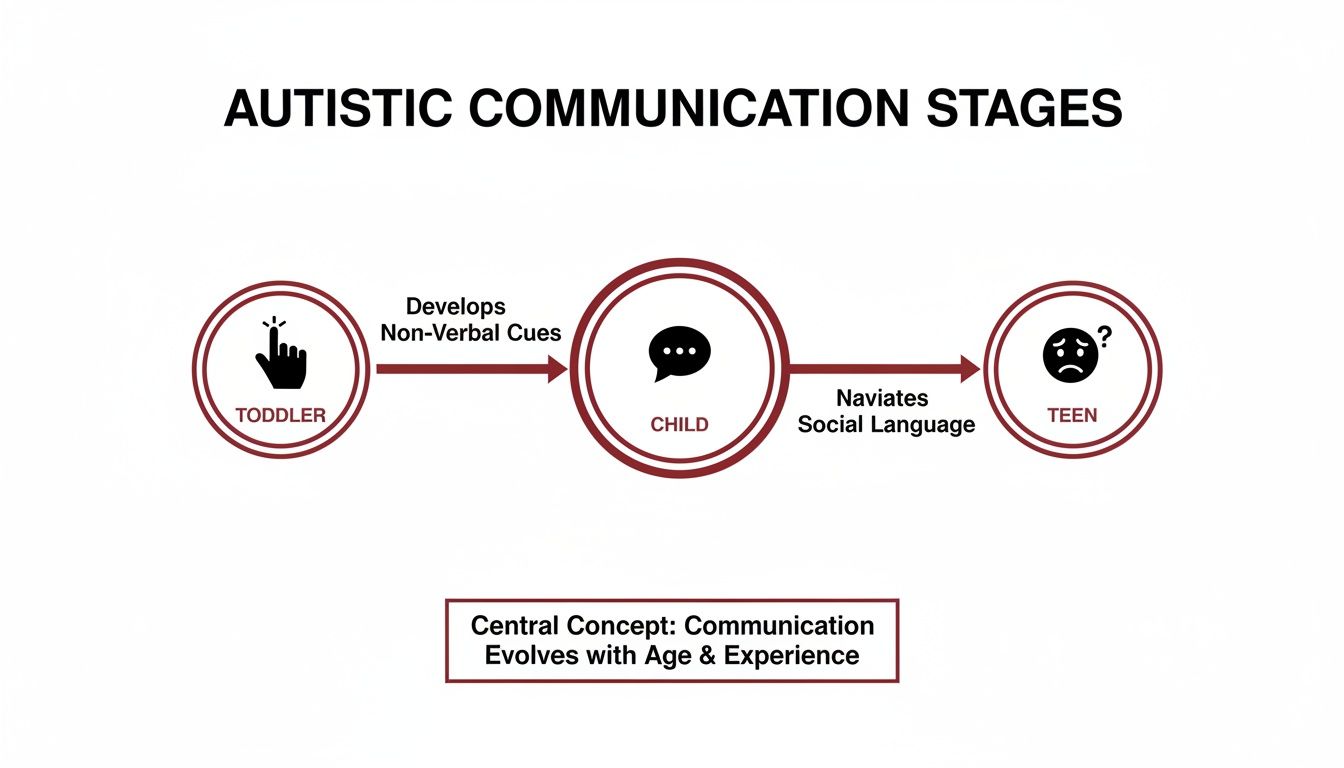
This visual journey highlights how early differences in nonverbal cues can snowball as social rules get more complicated, pushing many toward masking as a way to cope.
The Hidden Cost of Social Camouflage
While masking can help autistic individuals get through school, work, and relationships, it comes at a huge personal cost. The constant self-monitoring and suppression of natural instincts can disconnect a person from their own identity, leading to anxiety, depression, and a nagging feeling of being an imposter.
Historically, the public understanding of autism has been quite narrow, often centered on individuals with very high support needs. Decades ago, experts believed that up to 50% of autistic individuals were nonspeaking. While that number has dropped, recent CDC data on "profound autism" indicates that 26.7% of cases involve high support needs, which often includes being nonverbal or having limited speech. These numbers show the incredible breadth of the spectrum, but they can also overshadow the reality that many highly verbal autistic adults face their own profound nonverbal communication challenges, hidden behind a lifetime of masking. You can discover more insights about these autism statistics and what they mean.
Masking is like being a translator for your own brain, constantly converting your authentic thoughts and feelings into a language that neurotypical society can understand. It’s a full-time job with no breaks and immense psychological overhead.
Masking vs. Authentic Communication in Autistic Adults
The gap between masked behaviors and authentic autistic expression reveals the internal conflict many adults live with every day. Understanding these differences is a game-changer for autistic individuals seeking self-acceptance and for clinicians trying to spot masked presentations that standard evaluations often miss.
The table below contrasts some common examples, showing the effort that goes into the mask versus what might feel more natural.
| Nonverbal Cue | Common Masking Behavior | Authentic Autistic Experience |
|---|---|---|
| Eye Contact | Forcing direct, sustained eye contact, often causing physical discomfort or sensory overload. | Preferring indirect or fleeting eye contact to better focus on listening and processing information. |
| Facial Expressions | Performing a "socially appropriate" smile or look of concern, even if it feels unnatural. | Having a neutral or "flat" expression that doesn't necessarily match strong internal emotions. |
| Gestures | Consciously mirroring the hand gestures or posture of others to appear engaged and "normal." | Using self-soothing gestures (stimming) like hand-flapping or fidgeting to regulate emotions and focus. |
| Vocal Tone | Modulating voice to sound more expressive, varied, and emotionally aligned with the conversation. | Speaking in a more monotone or direct manner, prioritizing clarity and information over emotional tone. |
Recognizing these distinctions is vital. For autistic adults, it can be a liberating act of self-acceptance to start unlearning the mask and embracing more authentic ways of communicating. For friends, family, and professionals, it’s a call to look beyond surface-level behaviors and create environments where authentic nonverbal communication and autism are accepted without judgment.
How Experts Assess Nonverbal Communication in Autism Evaluations
Stepping into an autism evaluation can feel intimidating, but knowing what to expect can make all the difference. A modern, neurodiversity-affirming assessment isn’t about checking off a list of "deficits." Instead, a skilled clinician wants to understand the unique and authentic ways a person communicates—both with and without words.
The evaluation is like piecing together a detailed puzzle. It involves much more than just watching someone's behavior in a sterile office. Experts are looking at the entire communication picture, focusing on the quality and patterns of interaction, not just the presence or absence of a single cue, like eye contact.
The Comprehensive Evaluation Process
A thorough assessment for nonverbal communication and autism is built on several key pillars. Clinicians combine different sources of information to get a clear and accurate understanding of an individual's neurotype. This multi-faceted approach ensures the diagnosis isn't based on a single moment in time but on a lifetime of experiences.
The core components usually include:
- In-Depth Clinical Interviews: The process almost always starts with a detailed conversation about developmental history. For kids, this means talking to parents about early milestones, social play, and communication patterns. For adults, it’s about exploring their life experiences, relationship histories, and any long-term challenges with social understanding.
- Direct Interaction and Observation: The clinician will engage the individual in conversation and activities designed to let their natural communication style shine. They are looking at how a person uses gestures, facial expressions, and vocal tone to add meaning to their words. The focus is on how they communicate, not just if they meet a neurotypical standard.
- Validated Assessment Tools: Standardized tools are often used to add structure and objectivity. These aren't simple pass/fail tests. They are carefully designed activities and questionnaires that help a clinician see how an individual processes and responds to social information.
An expert evaluation focuses on the "why" behind the behavior. A person might make eye contact, but is it natural and comfortable, or is it a draining, manually controlled performance learned through years of masking? That distinction is everything.
The Shift to a Neurodiversity-Affirming Lens
A critical part of a modern evaluation is spotting the difference between authentic communication and masking. A skilled psychologist understands that an autistic person might have learned to perform neurotypical nonverbal cues, but this comes at a significant cognitive and emotional cost. They look for signs of this effort.
For example, a clinician might use tools that assess the ability to read subtle social cues from faces. Seeing how someone approaches this task can be very revealing. You can even explore a version of this concept yourself with resources like the Reading the Mind in the Eyes Test, which shows just how complex interpreting facial expressions can be.
The Advantage of Telehealth Evaluations
More and more, these comprehensive evaluations are happening via telehealth, and for good reason. Assessing someone in their own home often strips away the anxiety and sensory overload that can come with a visit to an unfamiliar clinic.
When a person is more comfortable, their true communication style is far more likely to emerge. This gives the clinician a much more accurate picture of their day-to-day nonverbal expression, free from the stress that can alter behavior. Telehealth makes expert, compassionate assessment more accessible and often more accurate, providing a clear path to understanding and support.
Practical Strategies to Support Autistic Communication
Understanding the nuances of nonverbal communication and autism is the first step. The next, and most important, is creating an environment where authentic communication can actually flourish. The goal isn't to force autistic individuals to conform to neurotypical standards, but to build on their unique strengths and provide the right tools for them to express themselves.
This requires a real shift in mindset—moving away from "fixing deficits" and toward fostering skills in a supportive, affirming way. For many autistic people, especially those who are nonverbal or minimally verbal, this means looking beyond spoken language. Evidence-based strategies can create a bridge between their inner world and the outside world, making communication less stressful and far more effective.
Building Communication Bridges
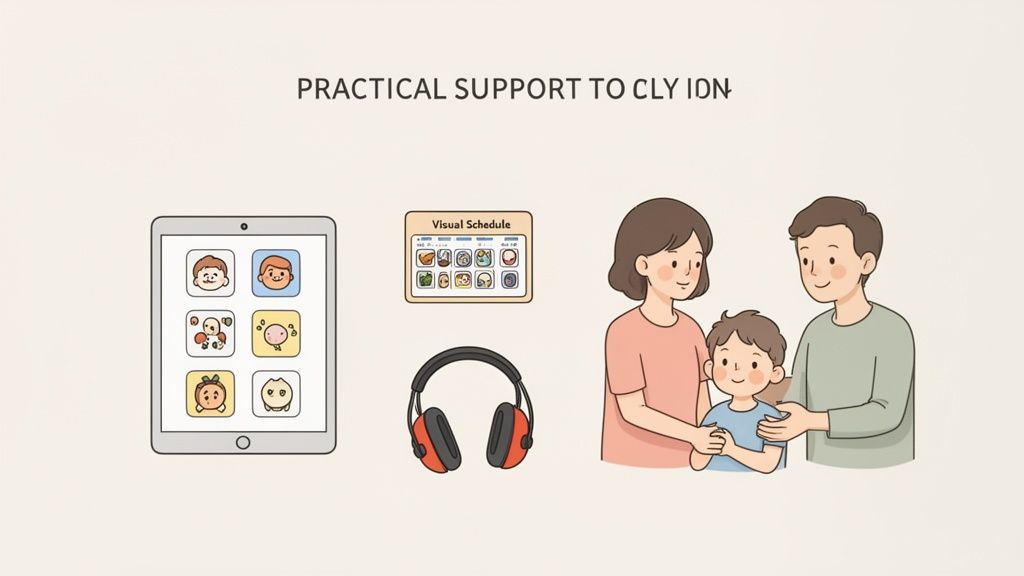
One of the most powerful tools in our arsenal is Augmentative and Alternative Communication (AAC). This is a broad term for any method that supplements or replaces speech. Think of it as providing a different "voice" that works better for the individual.
AAC isn't one-size-fits-all. It can include a range of options:
- Picture Exchange Communication System (PECS): A system where individuals use picture cards to request items, share thoughts, or express ideas.
- Speech-Generating Devices: These are often tablets or dedicated devices that speak words aloud when a specific icon is pressed.
- Sign Language: For some, using hands and body to communicate is far less overwhelming than processing and producing verbal speech.
The key is finding the system that best fits the person's needs and abilities. When they have a reliable way to communicate their thoughts, wants, and feelings, it can be life-changing.
Creating a supportive environment means presuming competence. Always assume an autistic person understands, even if they don't respond verbally. Speak to them with respect, and give them the time and tools to form a reply.
Practical Tips for Different Environments
True support has to extend across all areas of life, from home to school and into the workplace. Each setting requires tailored approaches that honor the autistic person’s communication style.
At Home
Parents can make a huge difference by modifying the home environment to reduce communication stress. Use visual schedules to make routines predictable, and offer sensory-friendly spaces where your child can decompress. It's also helpful to be explicit with your own nonverbal cues and take the time to explain idioms or sarcasm, rather than expecting them to be automatically understood.
In the Classroom
Educators can create truly inclusive classrooms by providing clear, written instructions alongside verbal ones. It's also crucial to allow the use of AAC without stigma. Neurodiversity-affirming social groups, which focus on shared interests rather than forced social scripts, can help students build genuine, meaningful connections with their peers.
In the Workplace
For autistic adults, advocating for their needs is vital. This might mean requesting accommodations like written feedback instead of verbal, or getting permission to wear noise-canceling headphones to manage sensory input. A formal diagnosis is often the key to unlocking these legal protections.
A diagnosis can open doors to essential support like an Individualized Education Program (IEP) or a 504 plan in school, as well as formal workplace adjustments. For individuals and families seeking tools to improve social understanding, there are also essential resources for social emotional learning that provide valuable frameworks and activities. Ultimately, these strategies empower autistic individuals to navigate the world on their own terms.
Common Questions About Nonverbal Communication and Autism
When you’re trying to understand nonverbal communication and autism, a lot of questions pop up. Getting clear, straightforward answers is the best way to cut through the noise, clear up common myths, and understand what's really going on.
This FAQ section tackles some of the most common questions we hear, offering clarity and practical insights.
Does Being Nonverbal Mean an Autistic Person Cannot Understand Language?
Absolutely not. This is probably one of the most persistent and damaging myths out there. The term "nonverbal" is about the ability to produce speech, not the capacity to understand language.
Many nonverbal autistic people have fantastic receptive language skills—they can understand everything being said to them. They just use different ways to express their own thoughts, like:
- Augmentative and Alternative Communication (AAC) devices
- Sign language
- Writing or typing
It's so important to always presume competence. That means speaking to a nonverbal person with the same respect and complexity you'd use with anyone else, and just as importantly, giving them the time and tools they need to respond.
A person’s inability to speak does not equal an inability to think. Assuming a nonverbal person lacks understanding is a profound underestimation of their inner world and intelligence.
Can Someone Still Be Autistic If They Make Eye Contact?
Yes, definitely. While avoiding eye contact is a classic autistic trait, it’s not the whole story. Many autistic people learn to make eye contact as a form of social masking.
This is especially true for girls, women, and other marginalized individuals who feel a ton of pressure to fit into neurotypical social norms. An autistic person might force themselves to make eye contact because they know it’s expected, even if it feels incredibly uncomfortable, overwhelming, or even physically painful.
A skilled clinician knows to look past the surface. During an autism evaluation, they’re not just checking a box for eye contact; they’re trying to understand the internal effort and cognitive load it takes, which is a much more telling sign.
How Can a Telehealth Evaluation Accurately Assess Nonverbal Cues?
It might seem counterintuitive, but telehealth evaluations are actually a highly effective way to assess nonverbal communication in autism. Using high-definition video, clinicians can observe facial expressions, gestures, posture, and vocal tone right in a person’s natural environment.
Think about it: for many people, being in their own home significantly lowers anxiety and sensory overload. This often means they're more relaxed and can present their authentic communication style, something that might not happen in a sterile, unfamiliar clinic. Psychologists who specialize in virtual assessments use validated tools specifically designed for the telehealth format to make sure the diagnosis is both comprehensive and accurate.
What Is the First Step If I Suspect Autism?
The best first step is always to seek a comprehensive diagnostic evaluation from a specialist who has deep experience with autism and neurodiversity. A formal diagnosis isn't just a label—it's the key that unlocks clarity and access to vital support, therapies, and accommodations at school or work.
At the Sachs Center, our expert psychologists specialize in compassionate, telehealth-based evaluations for autism, ADHD, and AuDHD. We get the nuances of masked presentations and are here to provide the clarity you need to move forward with confidence. Schedule your evaluation today.
