

So, what exactly is an online autism diagnosis for adults? Think of it as a formal medical evaluation, but one conducted entirely remotely by a licensed clinician using telehealth platforms. The process involves in-depth video interviews and validated digital assessment tools, making it a much more convenient and accessible route compared to traditional, in-person appointments.
Why Adults Are Seeking Autism Diagnosis Online
The whole landscape of autism diagnosis is changing, and we're seeing a huge increase in adults looking for answers later in life. For years, many have gone through the world feeling fundamentally different without ever knowing why. Getting an official diagnosis can feel like finally being handed the instruction manual to your own brain—it provides validation and a real framework for self-understanding. The shift to virtual assessments is making this personal journey more possible than ever.
The Rise in Adult Diagnosis
This isn't just a feeling; the numbers back it up. We're seeing a significant spike in adults receiving an autism diagnosis. A major study that looked at millions of medical records discovered that young adults have the highest increase in diagnosis rates out of any age group. This signals a crucial move away from the historical focus on diagnosing children. You can dig deeper into this trend and learn about the latest autism statistics.
So, what’s driving this surge? A few key things:
- Greater Awareness: The public conversation around neurodiversity and adult autism has exploded. This has led many people to see and recognize autistic traits in themselves for the first time.
- A Need for Self-Understanding: A diagnosis can bring a profound sense of relief. It can finally explain a lifetime of social hurdles, sensory sensitivities, and a unique way of processing the world.
- Access to Accommodations: To get the support you might need at work or school, a formal diagnosis is often the first and most necessary step.
Online diagnosis is a game-changer for accessibility. It completely removes geographic barriers and dramatically cuts down on the often-prohibitive wait times for specialized in-person clinics, which can sometimes stretch beyond a year.
Convenience and Comfort
The virtual format itself is a massive plus. For many autistic people, the sensory overload and social demands of a traditional clinic visit can be incredibly overwhelming. An online assessment lets you stay in your own familiar, controlled space.
This comfort can lead to a more accurate evaluation because you're able to be your true self. When you're thinking about an online diagnosis, it's useful to consider the wider picture of remote interactions, just like those detailed in guides on the remote work pros and cons. This telehealth approach puts your comfort first, making the whole diagnostic process less stressful and more focused on you.
Online vs In-Person Autism Assessments
Deciding between an online or in-person assessment can feel tricky. Both have their merits, and the right choice really depends on your individual needs, location, and comfort level. To make it clearer, here’s a straightforward comparison of the two approaches.
| Feature | Online Diagnosis | In-Person Diagnosis |
|---|---|---|
| Location | From the comfort of your own home, anywhere with an internet connection. | Requires travel to a specific clinic or office location. |
| Convenience | Highly convenient, flexible scheduling, no travel time or costs involved. | Less convenient, requires coordinating travel and taking time off work. |
| Wait Times | Generally much shorter, often weeks instead of months or even years. | Can be very long, with waitlists often exceeding 12-18 months. |
| Environment | Familiar and controlled, which can reduce anxiety and sensory overload. | Unfamiliar clinical setting that can be stressful or overstimulating. |
| Cost | Can be more affordable due to lower overhead for providers. | Often more expensive; may include additional costs like travel and lodging. |
| Clinician Interaction | Conducted via video call; some find it less personal, others more comfortable. | Face-to-face interaction, which some individuals and clinicians prefer. |
| Assessment Tools | Uses validated digital versions of standard assessments and interviews. | Uses traditional paper-based or hands-on assessment tools. |
| Accessibility | Breaks down geographical barriers, ideal for rural areas or mobility issues. | Limited by your proximity to a qualified specialist. |
Ultimately, the goal of any good assessment is accuracy and a clear path forward. While in-person evaluations have been the long-standing gold standard, modern online assessments conducted by reputable, licensed providers are now widely recognized as a valid and effective alternative for many adults.
How a Virtual Autism Assessment Works
Thinking about getting an online autism diagnosis might feel a little abstract, but the whole thing is actually a pretty structured, clinician-guided process. It’s not about passing a single test. Instead, think of it as a collaborative journey where a professional helps you connect the dots of your life experiences, all through a series of clear, manageable steps. And because it all happens remotely, it’s a much more accessible path to self-discovery for many people.
The entire assessment is designed to build a complete picture of who you are, from childhood all the way to today. It starts with some paperwork but quickly moves into direct, personal conversations with a licensed professional who really gets adult neurodiversity.
The Initial Steps: Information Gathering
Your journey kicks off with some foundational paperwork. Before you even have your first video call with a clinician, you’ll fill out some detailed intake forms and self-assessment questionnaires. These documents are a huge help, giving the evaluator a rich developmental history and a solid baseline of your current challenges and traits.
You’ll likely come across some common questionnaires, such as:
- The Ritvo Autism Asperger Diagnostic Scale-Revised (RAADS-R): This is a self-report measure specifically designed to pick up on adult autistic traits.
- The Autism-Spectrum Quotient (AQ): A questionnaire that helps measure the degree to which an adult shows traits associated with the autism spectrum.
Getting this initial groundwork done makes the later clinical interview much more focused and productive.
For many adults, the path to diagnosis starts with self-questioning long before they seek a formal evaluation.
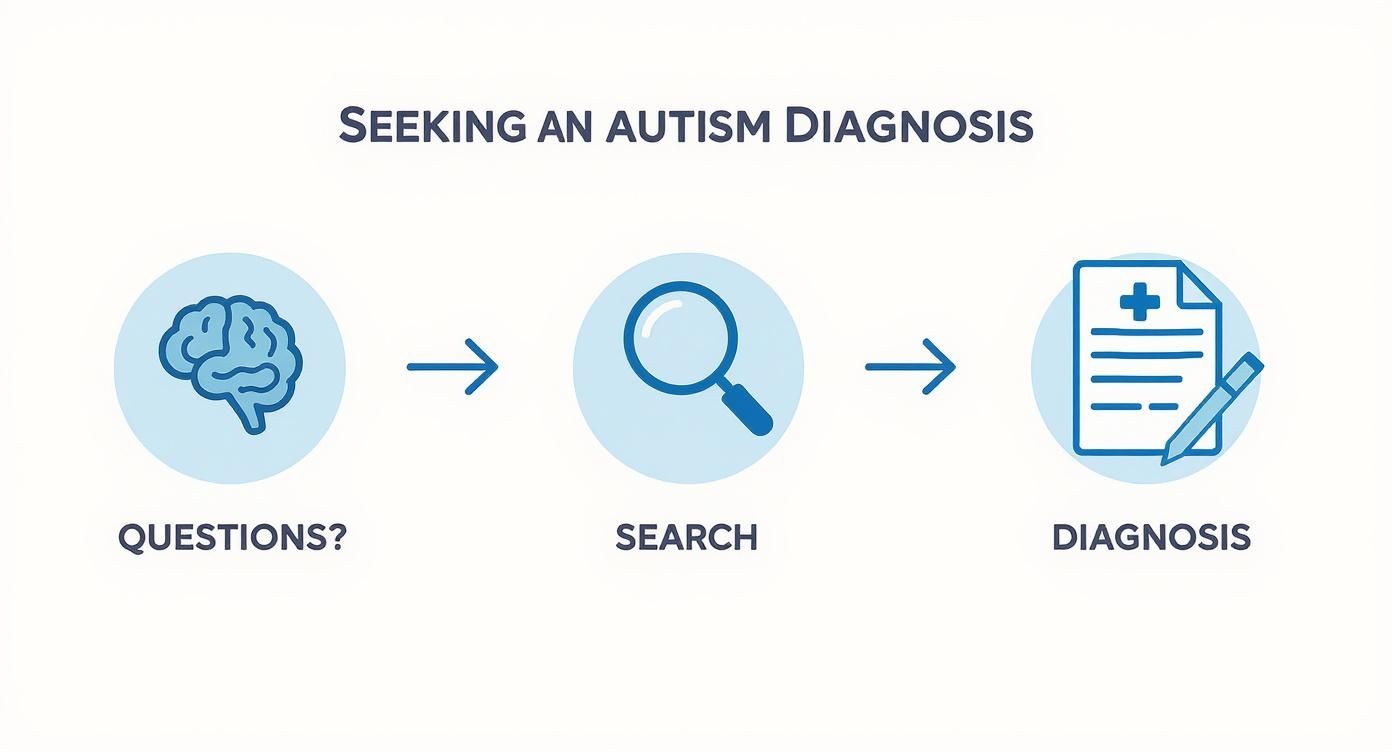
This visual really captures the typical progression many adults go through on their way to getting clarity about their neurotype.
The Core of the Assessment: The Clinical Interview
The real heart of the virtual assessment is the live clinical interview, which happens over a secure video platform like Zoom. This is a structured, deep conversation with a psychologist or another qualified clinician. It isn't a cold, impersonal test—it’s a dialogue. The clinician will explore your social communication patterns, sensory experiences, special interests, and any masking behaviors you might use.
During this session, the clinician is observing and interacting with you in real time. They may use parts of standardized tools that have been adapted for telehealth, like the MIGDAS-2, which leans on a verbal exploration of your life experiences. This direct interaction is absolutely vital for a nuanced and accurate evaluation. You can learn more about how a telehealth autism diagnosis works and what to expect from these conversations.
The goal of the interview isn't to "catch you out" but to understand your unique neurotype. Clinicians are looking for a consistent pattern of traits and experiences across your lifespan that align with the diagnostic criteria for autism.
Finalizing the Diagnosis: Feedback and Report
Once the interview is done and the clinician has reviewed all your information, they put all the pieces together. The final step is a feedback session where they’ll walk you through their conclusions. You'll find out whether you meet the criteria for Autism Spectrum Disorder and get a chance to ask any questions you have.
After this session, you’ll receive a formal document. This might be a diagnostic letter or a more detailed, multi-page report, depending on the service you chose. This document is your official record. It's the key to requesting workplace accommodations, accessing support services, and informing other healthcare providers—a clear and empowering step forward.
Is an Online Autism Diagnosis Accurate?
Let’s get right to the most important question: can you actually trust an online autism diagnosis? The answer is a clear yes—as long as the assessment is done right. When a qualified, experienced clinician uses the proper evidence-based methods, a telehealth evaluation can be just as valid and reliable as meeting in person.
Reputable providers aren't just giving you a quick online quiz. They're building a comprehensive diagnostic picture piece by piece. Think of it less like a test and more like a detailed investigation, involving multiple sessions, deep dives into your developmental history, and thorough clinical interviews. No single piece of information tells the whole story; it’s about how all the clues fit together.
How Providers Get It Right
The key to a valid online diagnosis is using the same gold-standard assessment tools that are used in person, just adapted for a virtual setting. Clinicians are specifically trained to administer these tools and lead structured interviews over video. This allows them to observe communication patterns, discuss sensory experiences, and explore a lifetime of behaviors in a focused way.
To make sure the final result is reliable, good providers will almost always:
- Gather Outside Perspectives: They might ask to speak with a trusted partner, parent, or close friend who can offer another view on your childhood and current traits. This is often called gathering "collateral information."
- Use Multiple Sessions: A real assessment is rarely a one-and-done deal. Spreading the evaluation across a few meetings gives the clinician a much more accurate and less rushed picture of who you are.
- Rely on Validated Tools: Top-tier services use assessment tools like the MIGDAS-2, which are specifically designed for these kinds of diagnostic interviews and work just as well virtually.
The rise of digital autism services is part of a much bigger picture. As awareness grows, we're learning more about the true prevalence of autism. It's estimated that 2.2%-2.4% of adults are autistic but have never been diagnosed. Online assessments are a huge step toward closing that gap and getting vital support to those who need it. You can read the full research on global autism prevalence to learn more about these trends.
Understanding the Limitations
While online diagnosis is a fantastic option for many, it’s not a perfect fit for everyone. It’s important to know the potential limitations so you can make the best choice for your own journey.
A virtual format can sometimes make it harder for a clinician to pick up on very subtle non-verbal cues. Things like fleeting facial expressions or slight shifts in body language might be easier to spot in the same room.
Online assessments may also be less suited for individuals with very complex situations. This could include people with significant co-occurring conditions, intellectual disabilities, or those who are non-verbal. In these specific cases, a comprehensive, in-person neuropsychological evaluation is often the better route to get the most accurate and detailed diagnostic picture possible.
Choosing a Reputable Online Assessment Provider
Navigating the world of online autism diagnosis for adults means learning how to spot a credible, professional service from a questionable one. As telehealth grows, it's essential to have a clear checklist to ensure you're trusting your diagnostic journey to qualified experts. Think of it like hiring a specialized contractor for your home—you wouldn't hire someone without checking their credentials, experience, and tools.
A legitimate provider will always be transparent and professional. They understand the significance of this process and prioritize your well-being and privacy above all else. This means clear communication, verifiable qualifications, and a structured, evidence-based approach from start to finish.
What to Look for in a Provider
When you're vetting a potential service, focus on a few non-negotiable elements. These are the pillars of a trustworthy and effective online assessment.
Your checklist should include:
- Proper Clinician Credentials: The evaluation should be conducted by a licensed clinical psychologist (PhD or PsyD) or another qualified professional with specific training in diagnosing adult autism. Their credentials should be easy to find on their website.
- Use of Validated Tools: Reputable services use evidence-based, standardized assessment tools. They won't rely on generic personality quizzes or unvalidated online screeners to give you a formal diagnosis.
- HIPAA Compliance: Any provider handling your sensitive health information must follow privacy regulations like HIPAA. Look for a clear privacy policy and the use of secure, encrypted video platforms for all your conversations.
- A Comprehensive Process: A real diagnosis isn't a 20-minute survey. The process should involve detailed intake forms, a thorough developmental history, and at least one live, multi-hour interview with the clinician.
Critical Red Flags to Avoid
Just as important as knowing what to look for is knowing what to run from. Some online services are more focused on making a quick buck than providing an accurate, ethical evaluation. These red flags are immediate signals to look elsewhere.
A diagnosis is a medical conclusion, not a product. Any provider that guarantees a specific outcome or makes the process sound too quick and easy is not operating ethically.
Be wary of any service that exhibits the following warning signs. This table breaks down common red flags and explains exactly why they are a major concern for anyone seeking a legitimate online autism diagnosis.
Red Flags in Online Diagnosis Services
A checklist of warning signs to watch for when selecting an online autism assessment provider to ensure you choose a legitimate and professional service.
| Red Flag | Why It's a Concern |
|---|---|
| Guaranteed Diagnosis | This is highly unethical. An assessment's purpose is to determine if you meet the criteria, not to sell you a diagnosis. |
| No Live Clinician Interaction | A diagnosis based solely on questionnaires is invalid. Direct, real-time interaction with a clinician is essential for an accurate assessment. |
| Uses Unvalidated "Quizzes" | Relying on informal or non-clinical tests is a sign of an unprofessional service that lacks scientific rigor. |
| Vague or Hidden Pricing | Trustworthy providers are transparent about their fees and what the evaluation includes right from the beginning. |
| Lack of Verifiable Credentials | If you can't easily find and verify the qualifications and licensure of the clinicians, consider it a major warning sign. |
Spotting these red flags is crucial. Your diagnostic journey is a significant step, and putting it in the hands of a qualified, ethical, and professional provider makes all the difference.
Understanding the Costs and Timeline
When you're considering an online autism diagnosis for adults, two of the biggest questions are usually "How long will this take?" and "What's the financial investment?" Let's get straight to it.
One of the most compelling reasons people choose a virtual assessment is the dramatically shorter wait time. Brick-and-mortar clinics can have waitlists that stretch out for over a year. In contrast, many online providers can guide you through the entire process in just a few weeks to a couple of months.
This speed is a game-changer. With an estimated 2.18% of adults in the U.S. on the autism spectrum, getting timely and accessible answers is more critical than ever. You can learn more about autism prevalence in adults on motivity.net.
Breaking Down the Financial Investment
A private online autism assessment typically costs between $800 and $2,000. The final price tag can shift based on the psychologist's location and credentials, and how in-depth the evaluation is. It's an investment in your well-being, so it’s important to know exactly what you’re paying for.
A standard assessment package usually includes:
- Initial Intake and Questionnaires: This is the preliminary paperwork and self-report forms that get the ball rolling.
- The Clinical Interview: The main event—a live, one-on-one session with a licensed psychologist.
- A Diagnostic Letter or Report: The official document that summarizes the findings and provides a diagnosis, if applicable.
Some practices offer different tiers. A basic diagnostic letter might be the standard, with a more comprehensive, multi-page report available for an additional fee. When you're comparing your options, always look for clear, transparent pricing. For a more detailed look at what to expect financially, check out our guide on the cost of autism diagnosis.
The Value of Your Diagnostic Report
The document you receive at the end is so much more than just a piece of paper. It’s the key to unlocking support that can genuinely improve your daily life. It formally validates your experiences and gives you the proof you need to access accommodations.
Think of your diagnostic report as a tool for advocacy. It translates your personal experience into a language that institutions like workplaces and universities can understand and act upon, ensuring you get the support you are entitled to.
This is the official paperwork you’ll use to request reasonable accommodations at your job, like a quieter desk or noise-canceling headphones. It’s also what you’ll need to get academic support in college. Ultimately, the investment in a proper diagnosis pays for itself by giving you the tools for self-advocacy and formal support.
Life After an Adult Autism Diagnosis
Getting an online autism diagnosis for adults isn’t the finish line—it’s the beginning of a whole new chapter. That moment often brings a rush of complicated feelings. For a lot of people, the biggest one is just pure relief. Finally, a lifetime of feeling different, of struggling to understand why you are the way you are, has a name. It validates everything.
But that validation can come tangled up with feeling totally overwhelmed. You suddenly have this new lens to look at your entire life through, from childhood memories to current habits, and that can be a pretty intense process. Give yourself permission to feel it all—the joy, the grief, the confusion—as you start to settle into this new understanding of yourself.

Forging Your Path Forward
With a formal diagnosis in your hands, you now have a powerful tool for self-advocacy and deeper self-understanding. The next steps are all about using that knowledge to build a life that feels more authentic and supportive. Your focus can shift from wondering to doing.
Think about exploring some of these pathways:
- Neurodiversity-Affirming Therapy: Look for a therapist who gets adult autism. They can help you unpack what the diagnosis means for you, find strategies for things like sensory overload, and learn how to navigate social settings without feeling like you have to mask who you are.
- Workplace or School Accommodations: That diagnostic report is your ticket to getting reasonable accommodations under laws like the Americans with Disabilities Act (ADA). This could be as simple as asking for noise-canceling headphones, a quieter desk, or getting instructions in writing instead of verbally.
- Connecting with Community: This is a big one. Finding autistic-led support groups, either online or in person, can be life-changing. There’s an incredible power in connecting with people who just get it, reducing that feeling of isolation and offering a space for genuine support.
Think of your diagnosis as a roadmap, not a label. It offers the clarity you need to navigate your world more effectively, honor your needs, and truly celebrate your unique strengths.
Learning what to expect after an autism diagnosis is a personal journey, and the right support system changes everything. Since ADHD and autism often go hand-in-hand, checking out resources on assistive technology for ADHD can also provide some great ideas for managing daily tasks and boosting your independence.
Ultimately, this new chapter is about designing a life that truly works for you.
Your Questions, Answered
If you're considering an online autism diagnosis, you probably have a lot of questions. That’s completely normal. Let's walk through some of the most common ones to help you feel more prepared and confident about the process.
Is an Online Diagnosis "Official"?
This is a big one. The short answer is yes, as long as it's done right. Most employers and schools will accept a telehealth diagnosis, provided the clinician is properly licensed and the final report meets the requirements of the Americans with Disabilities Act (ADA). A thorough, professionally conducted online evaluation can absolutely be the key to unlocking accommodations like noise-canceling headphones, a quieter workspace, or more flexible deadlines.
How Can I Prepare for My Sessions?
A little bit of prep work goes a long way. The goal is to create a situation where you can focus entirely on the conversation without worrying about technical glitches or distractions.
- Gather your history: Pull together any documents you have, like old school reports, past psychological assessments, or even just some notes on your developmental history.
- Find your space: Choose a quiet, private, and well-lit spot for your video calls. The fewer distractions, the better.
- Do a tech check: Test your internet connection, camera, and microphone well before your appointment time.
Getting these small things out of the way beforehand means you can be fully present and share your experiences without any added stress.
What if the Assessment Says I'm Not Autistic?
It's natural to wonder about this. An assessment that concludes you are not autistic is not a dead end. In fact, it’s incredibly valuable. A good evaluation doesn't just look for one thing; it helps you understand your unique profile of strengths and challenges, which is useful information no matter the outcome. Your clinician can then point you toward other possible explanations for what you're experiencing, like anxiety or ADHD.
When performed by a qualified, experienced clinician using validated tools, a virtual assessment can be just as accurate as one done in person.
What Happens After the Assessment?
Whether you receive a diagnosis or not, the report is just the beginning. It's a roadmap for what comes next.
- Dive into your report: Your diagnostic report will be full of detailed insights and personalized recommendations. Take time to read and digest it.
- Explore accommodations: Based on the report, you can begin requesting accommodations at work or school that are protected under ADA guidelines.
- Find your support system: Ask for referrals to therapists, life coaches, or peer support groups who specialize in working with neurodivergent adults.
These next steps are all about taking what you've learned and using it to build a life that works better for you.
What’s the Timeline and Cost?
An online autism diagnosis typically involves two main appointments, totaling two to three hours, spread out over two to four weeks.
You can usually schedule your initial consultation within a few days of booking. Once the assessment is complete, your final diagnostic report is delivered securely, either through email or during a follow-up video call to review the findings.
Ready to take the next step? You can learn more about our assessment process at the Sachs Center. https://sachscenter.com
