

If you're staring at the search bar and wondering, "Should I take an online autism test?" the simple answer is yes—but think of it as a first step, not the final word. An online autism test is a valuable initial screener, a tool designed to help you explore whether you or a loved one might have traits associated with autism spectrum disorder (ASD). It is not a formal diagnosis.
Your First Step in Understanding Neurodiversity
For so many adults and parents, the path to understanding neurodiversity starts with a quiet, late-night search online. The thought of a formal evaluation can feel overwhelming—it sounds expensive, complicated, and time-consuming. An online autism test cuts through that anxiety, offering a private, low-pressure way to start gathering information and make sense of questions you’ve had for years about social interactions, sensory sensitivities, or communication styles.
Think of it like using a home weather station. It gives you immediate data about the conditions right outside your door—temperature, humidity, air pressure. That’s incredibly useful for deciding what to wear today. If it shows a sudden drop in pressure and dark clouds rolling in, you know a storm might be coming. But it can’t give you the detailed forecast, storm tracking, and official warnings that a professional meteorologist provides.
In the same way, an online screener offers instant, accessible insights. It can put a name to feelings or observations you’ve had for a long time, giving you a new vocabulary and framework to understand your own experiences.
Why Screeners Are a Reassuring Starting Point
The best thing about these screeners is how accessible they are. You can complete one from your own couch, on your own time, without the pressure that can come with a clinical setting. Taking this first step can feel incredibly empowering, turning a vague sense of being "different" into something more concrete. For many people, just seeing their own experiences reflected in the questions is a profoundly validating moment.
An online screener is more than just a quiz; it's a tool for self-discovery. It helps translate a lifetime of feeling 'different' into a structured set of traits that you can then explore further with a professional.
This initial process is useful for a few key reasons:
- It Provides Clarity: The questions help organize your thoughts and experiences, making it easier to spot patterns you might have overlooked before.
- It Reduces Uncertainty: It gives you a tangible next step, moving you from a state of just wondering to actively seeking answers.
- It Builds Confidence: When you have some preliminary results, you can approach a conversation with a healthcare provider with more specific information and focused questions.
Ultimately, an online autism test is a bridge. It connects your personal intuition with the possibility of a formal, professional evaluation. It isn't the destination, but for many, it’s the most important first step on a journey toward greater self-awareness and acceptance.
How Reliable Are Online Autism Screeners?
So, you've taken an online autism test, and now you're staring at the results, wondering: Can I trust this? It's the biggest question on your mind, and the answer isn't a simple yes or no.
While many of the quick quizzes you find online are more for curiosity than anything else, some scientifically validated screeners are actually quite good at flagging potential autistic traits. The key is knowing what they're for—they are a fantastic starting point, but they are absolutely not the final word.
Think of a good screener like a smoke detector. Its job is to be extra sensitive to the earliest signs of trouble. When it goes off, it doesn't automatically mean the house is on fire, but it’s a loud, clear signal that you need to investigate further. That's exactly what an online screener does: it alerts you that a closer look by a professional is a good idea.
To really get this, we need to touch on two important ideas from the world of psychological testing: sensitivity and specificity. Don't worry, we'll skip the jargon.
Sensitivity and Specificity Explained
Imagine you're fishing. Sensitivity is like using a huge, wide net. You're trying to catch as many fish as possible, and a sensitive test is great at correctly identifying people who do have a particular condition. It rarely misses a true case, which means it helps avoid "false negatives."
Specificity, on the other hand, is like a very precise filter. It's excellent at correctly identifying people who do not have the condition. A test with high specificity is great at preventing false alarms, or "false positives." The best screeners try to balance both, but many lean toward being more sensitive, just to make sure no one who might need support slips through the cracks.
A reliable online autism test gives you an initial piece of data, not a diagnosis. Its real value is in flagging potential traits with enough accuracy to empower you to have a meaningful conversation with a clinical expert.
The infographic below shows why so many people find these screeners to be a helpful first step.
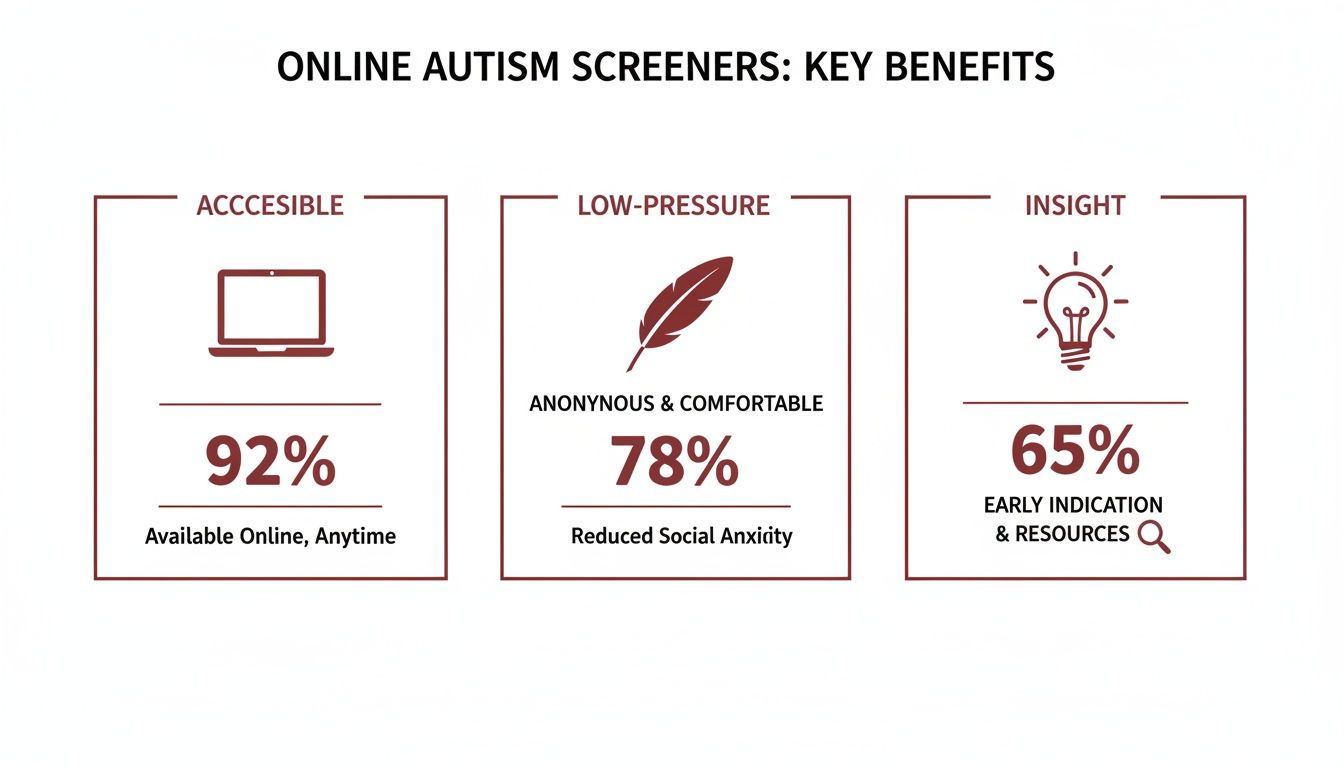
As you can see, these tools make the initial journey of self-discovery much more accessible and a lot less intimidating for a lot of people.
The Limits of Automated Tools
Even the most statistically sound screener has its limits. No automated tool can ever replace the insight and understanding of a trained psychologist. An online test can't see your body language, it doesn't know the context of your life, and it can't ask follow-up questions to dig deeper into your unique experiences.
This is especially true when it comes to masked autism, which we see more often in women, girls, and BIPOC individuals. Many have spent a lifetime learning to hide or camouflage their autistic traits just to fit in with neurotypical expectations. A simple questionnaire can easily miss these subtle signs, but an experienced clinician is trained to see beyond the surface.
For instance, a screener might ask if you struggle with eye contact. Someone who masks might answer "no" because they've forced themselves to do it for years, even if it feels incredibly stressful or draining. A clinician can pick up on the enormous effort behind that seemingly simple action.
That said, the accuracy of some of these tools is impressive. The RAADS-R screener, for example, has 97% sensitivity and 100% specificity, which means it almost never misses a true case or raises a false alarm. And we know from research that comprehensive telehealth assessments can match the accuracy of in-person evaluations 80-91% of the time.
Ultimately, an online autism test is best used as a tool for gathering evidence. It can help you organize your thoughts, see patterns in your experiences, and build the confidence you need to take the next step. If you're curious to try a validated screener for yourself, you can learn more about the RAADS-R autism test and what your score might mean.
Why More People Are Exploring an Autism Diagnosis
It feels like conversations about autism are happening everywhere these days—on social media, in the news, and even with friends. This isn't just some passing trend; we're in the middle of a major cultural shift. More people than ever are starting to wonder if an autism diagnosis might fit them or someone they love, and the huge popularity of the online autism test is a clear sign of this growing curiosity.
This wave of interest comes from a powerful mix of rising public awareness and a much broader, more inclusive understanding of what autism actually looks like. For decades, the public image of autism was incredibly narrow, usually just focusing on young boys with very specific, obvious traits. Thankfully, that picture is finally getting bigger and more accurate.
Society is starting to catch up to the fact that autism looks different in women, girls, and BIPOC individuals—groups that have been historically overlooked. Because of this, more and more people are seeing their own lifelong experiences reflected in others' stories. This often sparks a journey of self-discovery that kicks off with a simple online search.
A Clearer Picture of Autism Prevalence
It’s easy to look at the numbers and think there’s some kind of sudden "epidemic," but the data tells a very different story. The global rise in diagnoses isn't about something new happening; it’s a direct result of better detection methods and more refined diagnostic criteria. We’re not seeing more autistic people; we’re just getting much better at recognizing them.
The statistics back this up. Recent studies show the median global prevalence of autism has hit 100 per 10,000 children, which is about 1% of the population. Here in the United States, rates have jumped significantly, a change that experts largely attribute to updated diagnostic guidelines that do a better job of capturing the full spectrum of autistic experiences. You can dive deeper into the research on global prevalence rates and find more detailed statistics on this topic.
This growing recognition has created a real demand for easier ways to get a diagnosis. People are no longer content with just feeling "different" without knowing why. They're actively looking for answers, and telehealth services have become a crucial resource for meeting this need.
The Positive Shift Toward Self-Discovery
This whole movement is overwhelmingly positive. It's a collective step away from stigma and toward a place of acceptance and real understanding. For an adult who has spent a lifetime feeling out of sync with the world, finding out they are autistic can be a profound, life-changing moment. It provides a framework that finally makes sense of a lifetime of experiences, from social struggles to sensory sensitivities.
A diagnosis isn’t a label; it’s a lens. It can reframe a person's entire life story from one of personal failing to one of neurological difference, opening the door to self-compassion and targeted support.
This journey validates the feelings of anyone who has ever felt they just don't fit the neurotypical mold. It empowers them to:
- Seek Appropriate Support: Understanding your neurotype is the first step to finding strategies and accommodations that actually work for you.
- Build Community: Connecting with other autistic people creates a powerful sense of belonging and shared understanding that can be incredibly affirming.
- Advocate for Their Needs: A formal diagnosis can be a critical tool for getting the accommodations you need at work or in school.
Ultimately, the rise in people exploring an autism diagnosis is a sign of a healthier, more informed society—one that’s finally starting to embrace neurodiversity not as a deficit, but as a natural and valuable part of what it means to be human.
When to Seek a Professional Evaluation
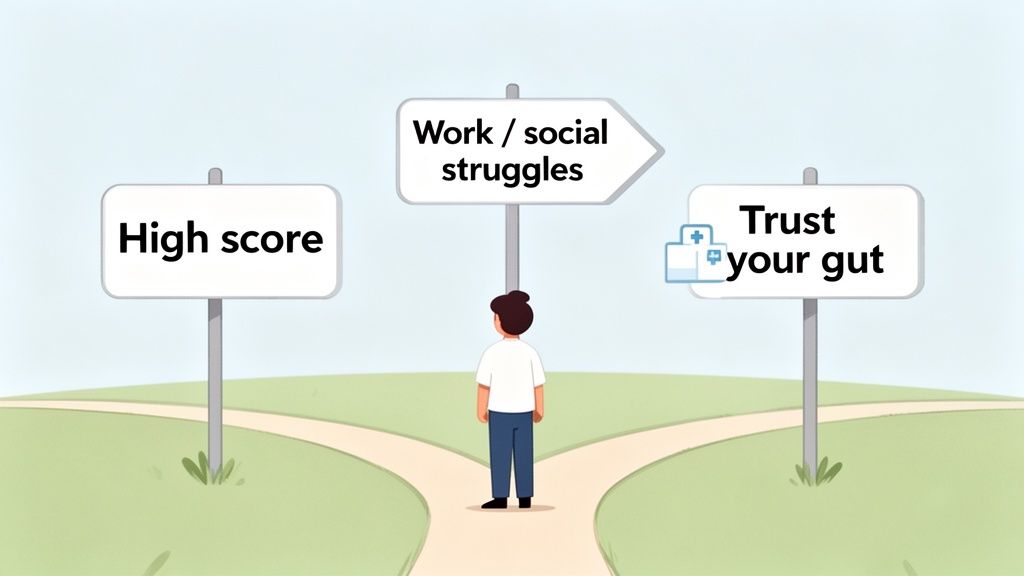
So, you've taken an online autism test. The results are in, and now you’re standing at a crossroads, wondering what to do next. On one path, you can just hold onto this new piece of information. On the other, you can move toward professional clarity. It’s a deeply personal choice, but certain signals can tell you it's time to seek a formal evaluation.
Think of an online screener as a first look, a preliminary survey of the land. If that survey comes back with a high-risk score—especially from a well-regarded tool—it’s a strong sign that you need a more detailed map. This is often the first and most obvious reason to reach out to a specialist.
Signs It Is Time for a Formal Assessment
Beyond the score itself, your own life experiences are the most powerful evidence. Do the descriptions of autism you read online hit close to home? Maybe you’ve always felt a beat behind in conversations, struggled to read the room, or felt drained from the sheer effort of fitting in at work or school.
These kinds of persistent challenges are huge clues. See if any of these common situations feel familiar:
- Social and Work Difficulties: You find small talk at work completely exhausting or you struggle to keep friendships going, no matter how hard you try.
- Sensory Sensitivities: Bright lights, loud environments, or even the texture of your clothes feel overwhelming in a way that others don’t seem to notice.
- Communication Differences: You’re a direct, literal communicator and often feel like everyone else is speaking in a code you were never taught.
If these examples sound like your daily reality, a professional evaluation can offer the context and validation you’ve been looking for.
Trusting Your Intuition and Seeking Answers
Sometimes, the strongest signal is just a gut feeling you can't shake. You might have felt your whole life that your brain is simply wired differently. For many people, learning about autism feels like finally finding the missing piece that explains decades of personal experiences. That feeling of, “Oh, that’s me,” is a perfectly valid reason to pursue a formal diagnosis.
Online screeners have made taking that first step more accessible than ever, especially when in-person appointments are a challenge. For instance, some tools have even been adapted to help screen toddlers from home. One study used an online version of the Q-CHAT-24 to screen 313 toddlers and found 23.12% scored at or above the cutoff for autism risk. This shows how an online autism test can act as a crucial bridge, providing reliable initial insights that guide families toward professional support. You can learn more about the study's findings on remote autism screening.
A formal diagnosis isn't about getting a label. It's about gaining a deeper understanding of your own neurotype. This knowledge empowers you to find the right support, build self-compassion, and advocate for your needs with confidence.
Ultimately, if the screener results, your life experiences, and your gut feeling are all pointing in the same direction, it’s a clear sign that a professional evaluation is the right next step. This journey from self-screening to a formal diagnosis is a logical path toward getting the clarity you deserve. For a deeper look into what comes next, check out our guide on how to get tested for autism.
What to Expect from a Virtual Autism Evaluation
Taking an online screener can be an eye-opening first step, but a formal diagnosis is where you find real answers. If you’ve decided to seek a professional assessment, you might be picturing a sterile, intimidating office. The good news is that modern telehealth allows for a thorough, compassionate evaluation right from the comfort of your home.
A professional virtual assessment isn’t just another online quiz. It's a comprehensive, human-centered conversation with an expert who truly gets it.
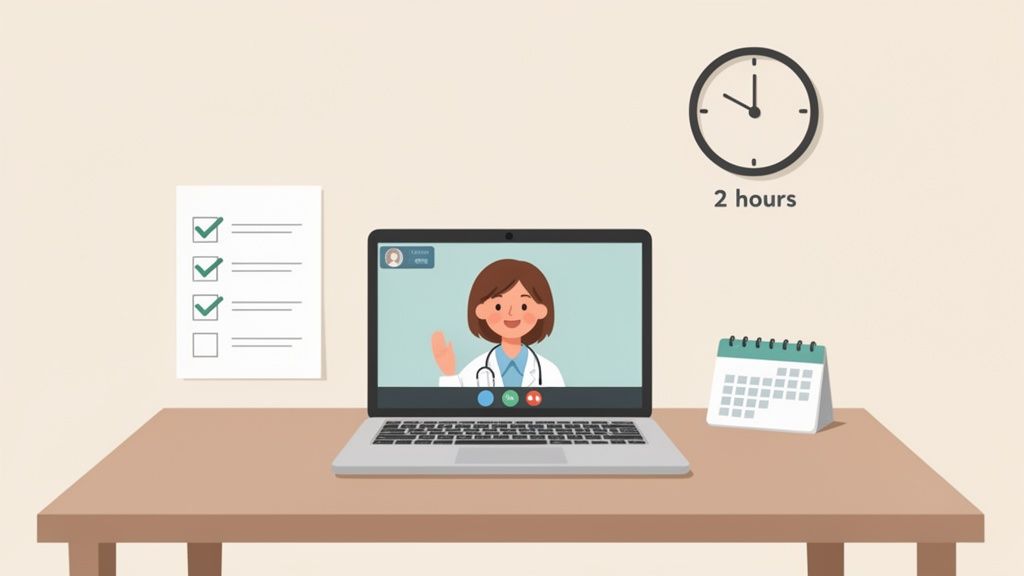
Think of the evaluation less like a test and more like a guided conversation. This is your chance to finally share your story with someone who understands the nuances of neurodiversity—a space to explore your experiences without judgment and get expert feedback.
The Two-Hour Virtual Evaluation: A Step-by-Step Guide
At the Sachs Center, our virtual evaluation typically lasts between two and two-and-a-half hours. It’s conducted securely over a platform like Zoom or Google Meet and is structured to be both in-depth and respectful of your energy.
The process is broken down into two main parts:
- The Clinical Interview: This is the heart of the evaluation. You’ll talk one-on-one with an expert psychologist who specializes in neurodiversity. They’ll ask about your developmental history, your experiences in childhood, and any current challenges you're facing at work, school, or in social situations. This is where you get to share your story in your own words.
- Validated Computer-Based Assessments: After the interview, you’ll complete a few scientifically validated assessments online. These tools give the psychologist objective data to help them build a complete and accurate picture, refining the clinical impression from your conversation.
This blended approach means your diagnosis is based on both your lived experience and solid, evidence-based measures. The psychologist isn’t just checking off boxes; they're listening to understand the full context of your life.
Choosing the Right Evaluation for Your Needs
Before you start, it’s helpful to know what you want to get out of a diagnosis. Not everyone needs the same level of documentation, so we offer a few different options to fit your goals and budget.
1. Diagnostic Testing with a Letter
- Cost: $790
- What You Get: A formal diagnostic letter from your psychologist that confirms a diagnosis, if one is made.
- Best For: This is the perfect choice if you need official documentation for workplace accommodations or want to share a diagnosis with another provider for medication management. It’s clear, concise, and official.
2. Diagnostic Testing with a Comprehensive Report
- Cost: $1170
- What You Get: You get everything in the letter option, plus a detailed, four-page report. This document will outline your mental health history, current challenges, and personalized recommendations.
- Best For: Choose this if you want a deeper dive. The comprehensive report is great for sharing with other healthcare providers for coordinated care or for seeking state disability services.
A formal diagnosis offers more than just a label; it provides a roadmap. It helps you understand your own mind, access the right support, and advocate for yourself with confidence in professional and personal settings.
This tiered structure ensures you get exactly what you need. If you want to learn more, you can explore the options for an adult autism assessment online to see which one feels like the right fit for you.
When Is a Full Neuropsychological Test Necessary?
For most adults seeking an autism diagnosis for work, personal understanding, or accommodations, our two-hour virtual evaluation is more than enough. However, for certain high-stakes situations, a more intensive option is available.
Neuropsychological Testing
- Cost: $5995
- What It Is: This is a much deeper assessment that evaluates cognitive abilities (IQ), academic achievement, executive functioning, and memory. It culminates in a very detailed report, typically around 25 pages.
- Who Needs It: This level of testing is specifically required for individuals seeking accommodations on standardized tests like the SAT, ACT, GRE, or GMAT. It is also the standard for securing an IEP or 504 plan for students in educational settings.
This top-tier assessment is a specialized tool for very specific academic and testing environments. For the vast majority of adults, our standard diagnostic evaluations provide all the necessary information and documentation to move forward with clarity and support. By offering these different paths, you can invest in the exact level of assessment that matches your personal, professional, or academic goals.
Common Questions About Autism Testing
The path to understanding yourself or a loved one better is often full of questions. If you’ve taken an online screener or are just starting to consider a professional evaluation, getting clear, straightforward answers is the most important next step.
Let's walk through some of the most common questions we hear. We'll clear up the confusion around different assessments and reports, explain what a telehealth evaluation is really like, and give you the information you need to move forward with confidence.
Are Free Online Autism Tests a Real Diagnosis?
This is the biggest question we get, and the answer is a simple, firm no. Free online autism tests are informal screeners, not diagnostic tools.
Think of them like a home blood pressure cuff. It's a great tool for flagging a potential issue, but it can't replace a full workup from a doctor to actually diagnose a medical condition. A formal diagnosis requires a comprehensive evaluation by a qualified clinician who can understand your unique life experiences.
A simple online quiz can't possibly capture the nuances of your developmental history, social communication patterns, or the ways you might have learned to camouflage your traits. For a real, official diagnosis, a professional evaluation is the only way.
These screeners are absolutely valuable for raising self-awareness and helping you decide if a formal assessment is the right move. But they aren't scientifically validated to provide an official diagnosis on their own.
What Is the Difference Between a Diagnostic Letter and a Full Report?
After a professional evaluation, you have choices for the kind of documentation you receive. Knowing the difference is key to getting exactly what you need.
A diagnostic letter is a concise, official document from a psychologist that confirms your diagnosis. It’s the essential proof you might need for specific, practical purposes.
- Primary Use: A diagnostic letter is what people typically use to request workplace accommodations, like a quieter workspace or more flexible hours. It can also be used to get medication from another provider, such as a primary care doctor or psychiatrist.
A comprehensive report is much more detailed. It gives you everything in the diagnostic letter, plus an in-depth analysis of your history, current challenges, and a set of personalized recommendations.
- Primary Use: This detailed report is perfect for sharing with other healthcare providers to make sure your care is coordinated. It’s also stronger documentation if you’re seeking state disability services or simply want a deeper understanding of your own neurotype.
Basically, the letter is the official verdict. The report is the entire case file, offering a complete picture for you and your support team.
Do I Need Full Neuropsychological Testing for an Autism Diagnosis?
For most adults, the answer is no. A standard telehealth evaluation, like the two-hour assessment we offer, is completely sufficient for receiving an official diagnosis of Autism Spectrum Disorder (ASD). It’s also the right level of documentation for requesting most workplace accommodations.
So, when is a full neuropsychological test necessary? It’s usually only required for certain high-stakes academic situations.
You would need a full neuropsychological evaluation if you are seeking:
- Accommodations on Standardized Tests: This includes tests like the SAT, ACT, GRE, GMAT, or MCAT. The testing organizations have very strict documentation rules that only this level of assessment can meet.
- An IEP or 504 Plan for a Student: Schools require this kind of in-depth evaluation to create formal academic support plans.
A neuropsychological evaluation is a much bigger undertaking, often taking many hours and resulting in a long report (around 25 pages). It looks at a wide range of cognitive functions that go beyond what’s needed for a standard ASD diagnosis. For the vast majority of adults, our diagnostic evaluation provides everything you need for personal clarity and professional support.
How Does a Telehealth Autism Evaluation Work?
A lot of people wonder what a virtual evaluation is actually like. It’s designed to be just as thorough as an in-person assessment, but you can do it from the comfort of your own home. For many, this helps reduce the stress and anxiety that can come with clinical appointments.
Our evaluations are held online using a secure video platform like Zoom or Google Meet and typically last for 2 to 2.5 hours.
The process starts with an in-depth clinical interview with one of our expert psychologists. This is a real conversation where you’ll discuss your developmental history, childhood experiences, and any current challenges you're facing. It's your space to share your story with someone who gets it.
After the interview, you’ll complete a series of validated, computer-based assessments. These aren't simple quizzes; they are evidence-based tools that give us objective data to go along with the insights from your conversation. This mix of personal narrative and scientific data allows the psychologist to build a complete and accurate picture.
At the Sachs Center, we specialize in providing clear answers and a supportive path toward diagnosis. If you're ready to move beyond screeners and get the clarity a professional evaluation offers, we are here to help. https://sachscenter.com
