

The signs of ADHD in teenagers are a lot more complex than just restlessness or daydreaming. We're looking for a persistent pattern of inattention—think chronic disorganization and forgetting schoolwork—and hyperactivity-impulsivity, which can show up as constant fidgeting, interrupting others, or making risky choices on a whim.
While these symptoms can be more subtle than they were in childhood, their impact on a teen's academic, social, and family life is often much bigger.
Understanding the Core Signs of ADHD in Teenagers
The teenage years are a whirlwind. For any teen, it’s a time of intense social, academic, and emotional growth. For a teenager with ADHD, it can feel like trying to navigate a storm without a compass. The classic signs of ADHD don’t just vanish after childhood; they evolve, often becoming more internalized and much harder to spot.
It's time we moved past the old stereotypes. The hyperactive kid who couldn't sit still might now be the teenager who can't stop tapping their foot, doodling intensely through an entire lecture, or just feeling an unshakable inner restlessness that makes it impossible to relax. This isn't just "teen energy"—it's a neurological drive searching for an outlet.
Likewise, inattention isn't a sign of laziness or a lack of intelligence. It’s a genuine struggle with executive functions—the brain's "air traffic control system" that manages planning, organizing, and holding focus. This is exactly why a brilliant teen can ace a complex physics problem but completely forget to turn in a simple three-page essay.
The Three Faces of Teen ADHD
ADHD isn't a one-size-fits-all diagnosis. It shows up in three distinct ways, known as presentations, each with its own unique set of challenges. Understanding which presentation a teen has is the first step toward getting them the right support.
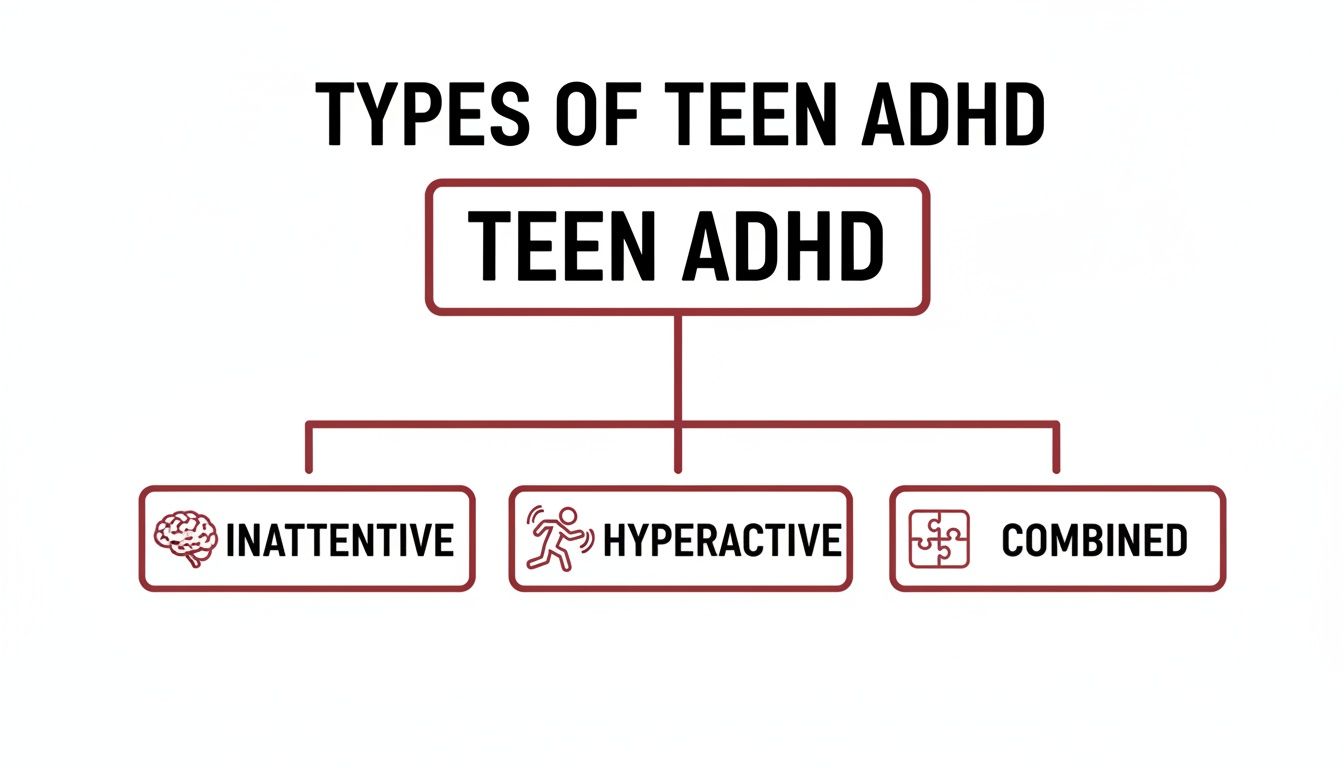
As the diagram shows, a teen can have a presentation that is primarily Inattentive, Hyperactive-Impulsive, or a Combination of both.
How Each ADHD Presentation Shows Up
So, what does this look like in the real world? Recognizing these specific signs is key to telling the difference between ADHD and typical teenage behavior.
Here’s a breakdown that contrasts how the core symptoms of ADHD often appear in teenagers.
How ADHD Presents in Teenagers
| ADHD Presentation | Common Signs in Teenagers |
|---|---|
| Predominantly Inattentive | Often described as "spacey" or "living in their own world." They lose track of personal items constantly (keys, phone, homework) and make careless mistakes on assignments despite knowing the material. Their backpack might be a black hole of crumpled papers and forgotten permission slips. |
| Predominantly Hyperactive-Impulsive | This teen feels "driven by a motor." They may talk excessively, interrupt conversations, and struggle to wait their turn. Impulsivity can lead to blurting out inappropriate comments, making rash decisions with friends, or engaging in risky behaviors without thinking through the consequences. |
| Combined | As the name implies, these teens show significant symptoms of both inattention and hyperactivity-impulsivity. They might be forgetful and disorganized while also being restless and impulsive, creating a complex and often challenging set of behaviors to manage. |
This distinction is more than just a label; it's a roadmap that helps guide effective strategies for support at home and in school.
The reality is that ADHD is far more common in adolescents than many realize. It's not a phase or a character flaw but a legitimate neurodevelopmental condition that requires understanding and intervention.
There's a reason the prevalence of ADHD seems to spike during the teenage years. Recent data shows that ADHD affects about 14.2% of U.S. adolescents aged 12-17, a rate nearly double that of younger children. This increase lines up perfectly with the escalating academic and social demands of middle and high school. More complex homework, long-term projects, and the nuanced world of teen friendships all heavily tax the executive functions that are already a challenge for the ADHD brain. You can explore more of the data behind these adolescent ADHD statistics and trends on ContemporaryPediatrics.com.
Looking Beyond the Obvious: Hidden Signs of Teen ADHD
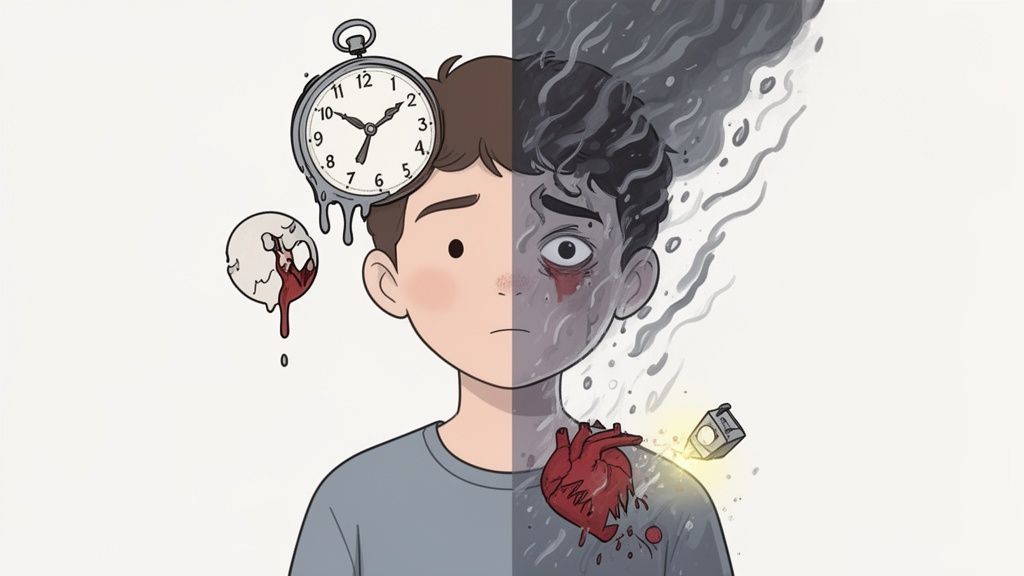
Some of the toughest signs of ADHD in teenagers are completely invisible to the outside world. They’re quiet, internal battles often dismissed as typical teenage moodiness or defiance. But these hidden symptoms can take a serious toll on a teen’s self-esteem and day-to-day life.
To really get what your teen is going through, you have to look past the messy room and the missed deadlines and try to understand their inner experience. It’s in that internal world where the most subtle, and most significant, signs of ADHD show up.
The Emotional Rollercoaster of Dysregulation
If your teen's moods seem to swing from one extreme to the other with no warning, you're probably seeing emotional dysregulation in action. This isn’t just run-of-the-mill teen angst; it’s a core, but frequently overlooked, feature of ADHD. It’s like the brain’s emotional brake pedal isn't working correctly.
This can look like:
- A very short fuse: Small frustrations, like a video buffering or not being able to find their keys, can set off a surprisingly huge burst of anger.
- Sudden mood swings: They might go from being happy and chatty to completely withdrawn and sullen in just a few minutes, for no apparent reason.
- Overwhelming feelings: Emotions—whether sadness, excitement, or frustration—can feel all-consuming, as if there’s no way to dial them down.
These emotional storms happen because the prefrontal cortex, the brain's center for impulse control, is already working overtime during the teenage years. ADHD makes that job even tougher, wearing a teen’s tolerance for frustration down to almost nothing. The National Comorbidity Survey-Adolescent Supplement found that ADHD has a lifetime prevalence of 8.7% among teens, with almost half facing severe impairment. This really highlights how intense these struggles can be. You can learn more about ADHD prevalence and its impact at NIMH.gov.
The Crushing Weight of Rejection Sensitive Dysphoria
Can you imagine feeling intense, almost physical pain from the thought of being rejected or criticized? That’s the reality for many teens with Rejection Sensitive Dysphoria (RSD), a common but unofficial symptom tied to ADHD. It's an extreme emotional sensitivity that can make a minor social slip-up feel like a catastrophe.
A teen with RSD might see a friend not texting back right away as proof they’ve been completely abandoned. Or they might hear a teacher's helpful feedback as a harsh judgment on their worth. This isn't them being "too sensitive"; it’s a neurological response that can trigger the brain's fight-or-flight system over perceived social threats.
For a teen with RSD, the fear of not being liked or of making a mistake can be paralyzing. It can lead them to become people-pleasers, avoid trying new things, or have sudden, angry outbursts to mask their hurt.
When Time Moves Differently
Is your teen always late, no matter how many alarms they set or how much you nag them? This isn't necessarily a sign of laziness or disrespect—it could be time blindness. For a brain with ADHD, time isn't a straight line. It’s a much more abstract concept that often feels like it only exists in two states: "now" and "not now."
This explains why a teen struggles to guess how long a project will take, which leads to constant procrastination and last-minute panic. An essay that seems like it should only take 30 minutes can suddenly stretch into three hours, causing a mountain of stress for everyone.
The Hyperfocus Paradox
And then there's hyperfocus—the so-called "superpower" of ADHD. This is the ability to become completely absorbed in something interesting, tuning out the entire world for hours at a time. A teen might spend a whole weekend coding a game, learning a new song on the guitar, or diving deep into a niche historical rabbit hole.
While this intense focus can fuel incredible creativity, it’s a double-edged sword. The same brain that can lock onto a passion project for ten hours straight might not be able to focus for ten minutes on a math worksheet. This creates a huge imbalance, where schoolwork, chores, and even friendships can be neglected because the teen's focus has been completely captured, making it one of the most misunderstood signs of ADHD in teenagers.
Recognizing Masked ADHD in Girls and BIPOC Teens
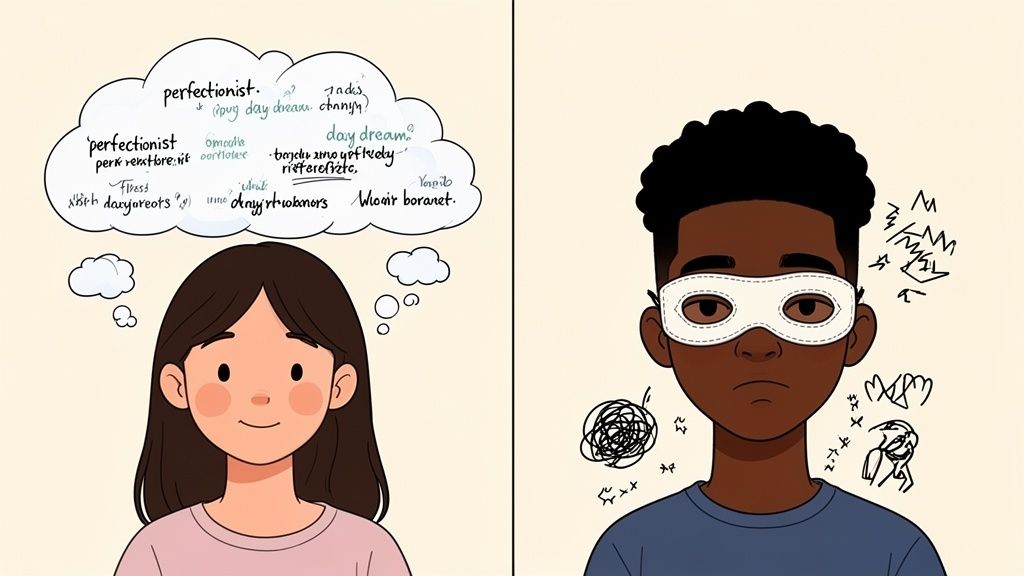
ADHD doesn't fit into one neat box, especially when you factor in societal expectations and cultural biases. For decades, the classic image of ADHD has been a hyperactive young boy, an outdated stereotype that has caused countless girls and BIPOC teens to be overlooked. Their symptoms are often misinterpreted or missed entirely because they just don't fit that mold.
This leads to a process called masking, which is often an unconscious strategy to hide ADHD traits and blend in. For these teens, the constant effort to appear “normal” is mentally and emotionally draining. It can lead to burnout, anxiety, and a deep-seated feeling of being misunderstood. Recognizing the subtle ways ADHD shows up in these groups is the first step in getting them the support they deserve.
How ADHD Is Internalized in Girls
With teenage girls, ADHD symptoms often turn inward. Instead of the disruptive behaviors that might catch a teacher’s eye, their struggles play out as intense internal turmoil. They learn from a young age how to compensate for their challenges, but this comes at a huge personal cost.
This internal presentation often includes things like:
- Debilitating perfectionism: A girl with ADHD might spend hours on an assignment that should take 30 minutes, all driven by a powerful fear of making a mistake that might expose her struggles.
- Intense daydreaming: Rather than blurting out answers, her inattention might look like she’s just "in her own world." This quiet escape is easily dismissed as shyness or a lack of interest.
- People-pleasing: To avoid rejection or criticism, she might become hyper-aware of what others need, completely exhausting herself to keep up friendships and meet everyone's expectations.
Because these signs of ADHD in teenagers are less disruptive, they are frequently misdiagnosed as anxiety or depression. The underlying executive function challenges go unaddressed, leaving the teen feeling like a failure without knowing why.
When looking for masked ADHD, it's crucial to understand how symptoms can be overshadowed by other conditions. For a comprehensive overview, exploring resources on understanding anxiety disorders can provide valuable context. It helps differentiate between conditions that can look very similar on the surface. For a deeper dive, you can also explore these overlooked ADHD symptoms in women and girls on sachscenter.com.
Systemic Biases and BIPOC Teens
For Black, Indigenous, and People of Color (BIPOC) teens, the road to an accurate ADHD diagnosis is often blocked by systemic biases and cultural misunderstandings. Behaviors that would be seen as potential ADHD in a white peer are frequently mislabeled in a BIPOC teen, leading to discipline instead of support.
This misinterpretation can look like:
- Hyperactivity seen as defiance: A Black teen’s restlessness or impulsivity might be viewed by school staff as oppositional or disrespectful, rather than a neurological symptom.
- Inattention dismissed as laziness: A Latine teen who is struggling to focus due to inattentive ADHD may be unfairly labeled as unmotivated or unintelligent.
- Emotional dysregulation viewed as aggression: The intense emotions common with ADHD can be perceived as threatening, resulting in harsher consequences that completely ignore the underlying need for help.
These biases create enormous barriers to getting a diagnosis and proper care. BIPOC teens are less likely to be referred for evaluation and more likely to face punishment, which only makes their academic and emotional struggles worse. Understanding and actively challenging these biases is essential to ensure all teens with ADHD are truly seen and supported.
How ADHD Impacts School and Social Connections
For many parents, the alarm bells for teen ADHD don’t start ringing because of one specific symptom. It’s the fallout that gets their attention. It’s the slipping grades from a kid who used to thrive, or the painful social isolation of a teen who just wants to have friends. More often than not, the signs of ADHD in teenagers first show up as friction—academically and socially—where their neurological wiring collides with the ever-increasing demands of being a teen.
Think of executive functions as the project manager in your teen's brain. This internal manager is in charge of organizing tasks, planning for the future, managing time, and keeping all the moving parts in order. In an ADHD brain, this project manager is often brilliant but completely overwhelmed, easily distracted, and struggles to figure out what's most important. This has a direct, and often devastating, impact on their performance at school.
The Academic Downslide
It’s a frustratingly common story: a teen who is clearly bright and capable, but their report card tells a completely different story. This isn't about a lack of effort or not caring. It's a direct result of executive function deficits sabotaging their academic potential. These challenges are persistent and can quickly snowball as schoolwork gets more complicated.
This academic struggle often looks like:
- Chronic Disorganization: Their backpack is a black hole of crumpled papers, their locker is a disaster zone, and they can never seem to find the one worksheet they actually need.
- Poor Time Management: An essay assigned a month ago gets started the night before it's due. This isn't defiance; it's "time blindness"—a genuine inability to gauge how long a task will actually take.
- Forgotten Assignments: They might do the homework perfectly but completely forget to turn it in, leading to a zero that doesn’t reflect what they know.
- Difficulty with Sustained Focus: Reading a chapter in a history textbook or just sitting through a long lecture can feel like a monumental task, leading to missed information and careless mistakes on tests.
For students with ADHD, taking good notes and remembering what they've learned is a constant battle. That’s why strategies to improve note-taking skills and retain information are so crucial for their success. Understanding these struggles is the first step toward getting them the right support. You can read our guide on how to get the right school accommodations for ADHD on sachscenter.com to help your teen succeed.
The Social Disconnect
The same impulsivity and inattention that disrupt schoolwork can also wreak havoc on a teen’s social life. Friendships in the teenage years are built on a complex dance of social cues, shared secrets, and mutual respect—all areas where the ADHD brain can easily stumble. Your teen might desperately want to connect, but their symptoms can unintentionally push other kids away.
Social struggles aren't a reflection of your teen's character. They are often a direct consequence of ADHD symptoms like impulsivity, emotional dysregulation, and difficulty reading nonverbal cues, which can make navigating the teen social world feel like walking through a minefield.
These challenges often show up in very specific ways:
- Interrupting Conversations: Driven by impulsivity, they might cut friends off mid-sentence or blurt out thoughts without thinking, leaving others feeling like they weren't heard.
- Missing Social Cues: Because of inattention, they can miss the subtle shifts in body language or tone of voice that communicate so much, leading to misunderstandings or just plain awkward moments.
- Emotional Overreactions: A minor disagreement can trigger a huge emotional response, leaving friends confused, hurt, and a little bit wary.
- Social Exhaustion: The mental effort of constantly trying to "act normal" in social situations is draining. This can cause them to pull back and isolate themselves simply because they're tired.
The Amplifying Effect of Co-occurring Conditions
The academic and social impact of ADHD is often intensified by co-occurring conditions. School performance can crumble as classes get tougher, with learning disabilities affecting 20-60% of cases and up to 50% battling issues with written expression.
The latest data reveals that while 10.5% of U.S. children aged 3-17 have a current ADHD diagnosis, adolescents aged 12-17 are diagnosed at nearly double the rate of younger kids (14.2% vs. 7.5%). These numbers highlight how symptoms become more impairing as academic pressures mount. Recognizing this broader picture is critical for getting your teen the comprehensive support they need to thrive.
Finding Clarity Through a Professional Evaluation
Recognizing the signs of ADHD in your teenager is the first step. But figuring out what to do next can feel overwhelming. The single most important move is to get a clear, accurate, and professional diagnosis. This process isn't as intimidating as it might sound—a modern evaluation is designed to be insightful and accessible, giving your family the clarity you need to move forward.
Think of a good evaluation less like a test and more like putting a puzzle together. It’s not just about a checklist of symptoms. It's a comprehensive process that pieces together the full story of your teen's experiences, strengths, and challenges to see the complete picture.
What to Expect from a Modern Evaluation
These days, high-quality ADHD evaluations can be done effectively through telehealth, which saves busy families a lot of time and stress. This virtual process combines a deep dive into your teen’s history with objective data to make sure the diagnosis is accurate.
A thorough evaluation really boils down to two key parts:
- The Clinical Interview: This is simply a guided conversation with an experienced psychologist. You'll talk through your teen's developmental history, their journey through school, social experiences, and the specific challenges you’ve been seeing. This conversation provides the essential "why" and "how" behind the behaviors.
- Validated Self-Report Tools: These are research-backed, computer-based assessments that your teen completes. They give us objective data on things like executive functioning, attention, and emotional regulation. This hard data helps the psychologist spot patterns that might not come up in a conversation alone.
By combining the personal story from the interview with the objective data from the assessments, a psychologist can confidently tell the difference between typical teen growing pains and the consistent patterns that point to ADHD. To get a better feel for what this looks like in practice, you can learn more about how to get tested for ADHD on sachscenter.com.
Choosing the Right Evaluation for Your Teen
Not every teen needs the same kind of assessment. The right choice really depends on your family's goals. Are you just seeking diagnostic clarity? Do you need documentation for school accommodations? Or are you preparing for standardized tests like the SAT?
An accurate diagnosis is not a label; it’s an instruction manual. It provides the "why" behind your teen's struggles and unlocks the door to targeted, effective support that builds on their strengths.
At the Sachs Center, we’ve structured our evaluations to meet these different needs, ensuring you get clear answers and practical next steps.
To help you decide, we've created a simple guide to our different evaluation options. This table breaks down what each one offers so you can choose the best fit for your teen.
Choosing the Right Sachs Center Evaluation for Your Teen
| Evaluation Type | Best For | What You Receive | Price |
|---|---|---|---|
| Diagnostic Testing | Formal diagnostic clarity, workplace/school accommodations, obtaining medication. | A 2-2.5 hour virtual evaluation and a formal diagnostic letter. | $790 |
| Diagnostic Testing (+ Report) | A holistic picture of challenges, sharing with other providers, state disability services. | Everything in the basic evaluation, plus a detailed 4-page diagnostic report. | $1170 |
| Neuropsychological Testing | Securing extended time on standardized tests (SAT, ACT, GRE), or obtaining an IEP/504 plan. | A comprehensive evaluation of cognitive abilities and a detailed ~25-page report. | $5995 |
Let's break that down a bit more.
The most common starting point for families is our Diagnostic Testing evaluation ($790). This focused, 2.5-hour virtual session is perfect if your main goal is getting a confirmed diagnosis and the formal letter you need for basic school or workplace accommodations.
If you need a more detailed narrative to share with therapists, doctors, or school counselors, the Diagnostic Testing with a 4-page report ($1170) is a great option. That extra detail can be incredibly helpful for coordinating care and making sure everyone is on the same page.
Finally, for teens needing support for high-stakes exams, our Neuropsychological Testing ($5995) is the gold standard. The extensive ~25-page report is specifically designed to meet the strict requirements for accommodations like extended time on the SAT or ACT, or for establishing an IEP or 504 plan.
Taking the step to pursue a professional evaluation is how you turn confusion into clarity and help your teen get the resources they need to truly thrive.
Life After Diagnosis: Support for a Thriving Teen
An ADHD diagnosis isn't a life sentence or a label for your teen. Think of it as finally getting the right map. It's the starting point for a more empowered journey, where you can finally navigate your teen’s world with clarity, compassion, and strategies that actually work for their unique brain.
The goal completely shifts from just managing difficult behaviors to truly nurturing a unique neurotype. This new perspective helps your teen move past feelings of being "broken" or "not good enough" and start to see their own strengths—like intense creativity and hyperfocus—as assets for building a confident future.
The Power of Psychoeducation: It Starts with Understanding
One of the most powerful first steps you can take is psychoeducation for the whole family. It's a fancy term for a simple concept: learning what ADHD is, and just as importantly, what it isn't. This process is an absolute game-changer.
Suddenly, challenging behaviors are reframed—not as defiance or laziness, but as symptoms of a neurological difference. When everyone understands the "why" behind the forgotten homework or the emotional meltdowns, blame gets replaced with empathy. This creates a supportive home environment where your teen feels seen and accepted, which is the bedrock of self-esteem.
A diagnosis provides a new lens to see your teen through. It’s not an excuse for their behavior, but it’s the explanation that opens the door to effective, compassionate solutions that build skills instead of shame.
Building Real-World Skills with Therapy and Coaching
Understanding is the foundation, but practical skills are what your teen will use to build a successful life. Evidence-based therapies give them the tools to manage their time, emotions, and focus in a world that wasn't really designed for their brain.
Cognitive Behavioral Therapy (CBT) is a go-to approach because it's incredibly effective. It helps teens catch and change the negative thought patterns that hold them back. For instance, a therapist can help a teen dismantle an overwhelming thought like, "I'll never finish this essay," by breaking it down into small, concrete steps. This teaches them how to fight procrastination and build momentum.
Specialized support can offer even more targeted help:
Life Skills Coaching: This is all about the practical stuff—creating organizational systems for school, learning how to manage a budget, or developing healthy routines for sleep and self-care. It's where the rubber meets the road.
Specialized Protocols: At the Sachs Center, we developed our proprietary Sachs Protocol, a method that blends CBT with psychoeducation to specifically address the challenges of neurodiversity while celebrating its strengths.
Teletherapy: Modern life is busy. Teletherapy makes consistent support accessible and convenient, allowing teens to connect with specialists from the comfort of home.
This blend of family education, individual therapy, and hands-on coaching is what helps a teen move beyond just surviving with ADHD to truly thriving with it.
Of course. Here is the rewritten section, crafted to sound completely human-written and natural, following the provided style guide and examples.
Common Questions About ADHD in Teenagers
Trying to figure out what's going on with your teen can bring up a lot of questions. As a parent, it’s incredibly difficult to tell the difference between typical teenage moodiness and behaviors that might point to an underlying neurological difference. Getting clear, expert answers is the first step toward getting them the right support.
One of the most common things I hear from parents is, "Is my teen just being lazy, or is this inattentive ADHD?" It's a fair question. The key difference really comes down to consistency and impairment. All teenagers procrastinate sometimes, but inattentive ADHD is a persistent pattern that shows up everywhere.
If you see your teen consistently struggling with focus, organization, and follow-through—and it's hurting their grades, friendships, and self-esteem despite genuine effort—you're looking at something more than laziness.
Can Smart Teens with Good Grades Have ADHD?
Yes, absolutely. In fact, it’s one of the most common ways ADHD gets missed. Many bright teenagers use their intelligence as a powerful tool to compensate for their ADHD symptoms, but it almost always comes at a steep price. This is a classic example of masked ADHD, something we see a lot, especially in girls.
These teens might look successful on the outside, but underneath the surface, they are often:
- Spending four hours on homework that should only take one.
- Struggling with intense anxiety about falling behind or failing.
- Developing a debilitating perfectionism to avoid making any mistakes.
Good grades can easily hide a significant internal struggle. Their success isn't proof that ADHD is absent; it's a testament to how incredibly hard they're working just to keep up. A proper evaluation can bring these hidden challenges to light.
It's a huge misconception that ADHD is a barrier to intelligence. The truth is, many of the brightest, most creative people I've met have ADHD. The challenge isn't a lack of ability, but a brain that struggles to apply that ability in the ways school and society demand.
How Does a Telehealth ADHD Evaluation Work?
We've designed our telehealth evaluation to be both thorough and convenient. The entire process is a 2 to 2.5-hour virtual session done from the comfort of your home.
It starts with an in-depth clinical interview, where one of our psychologists will talk with you and your teen. We'll go over their history, explore their unique strengths, and discuss the specific challenges they're facing right now.
After that, your teen will complete a few validated, computer-based assessments. These tools give us objective data on their executive functioning and emotional regulation. This combination of conversation and data allows our specialists to form an accurate, nuanced diagnosis and give your family the clarity you've been looking for.
If you're ready to stop guessing and get clear answers for your teen, the Sachs Center can help. Our specialized telehealth evaluations are designed to be thorough, compassionate, and accessible. Schedule a professional ADHD evaluation today and help your teen get the support they deserve.
