

Have you ever felt like the CEO of your own life is on an unscheduled vacation? You know what you need to do, but getting started, staying organized, and managing your own internal "staff" (like your emotions and focus) feels impossible. If that sounds familiar, you might be dealing with challenges related to executive function.
Executive function disorder, often called executive dysfunction, isn't a formal diagnosis you'll find in a manual. Instead, it’s a way of describing persistent struggles with the brain's "management system." These are the critical skills we all rely on for things like planning, organization, emotional regulation, and just starting a task. When these skills aren't working as they should, it can throw a wrench into every part of daily life.
Understanding Executive Function Disorder
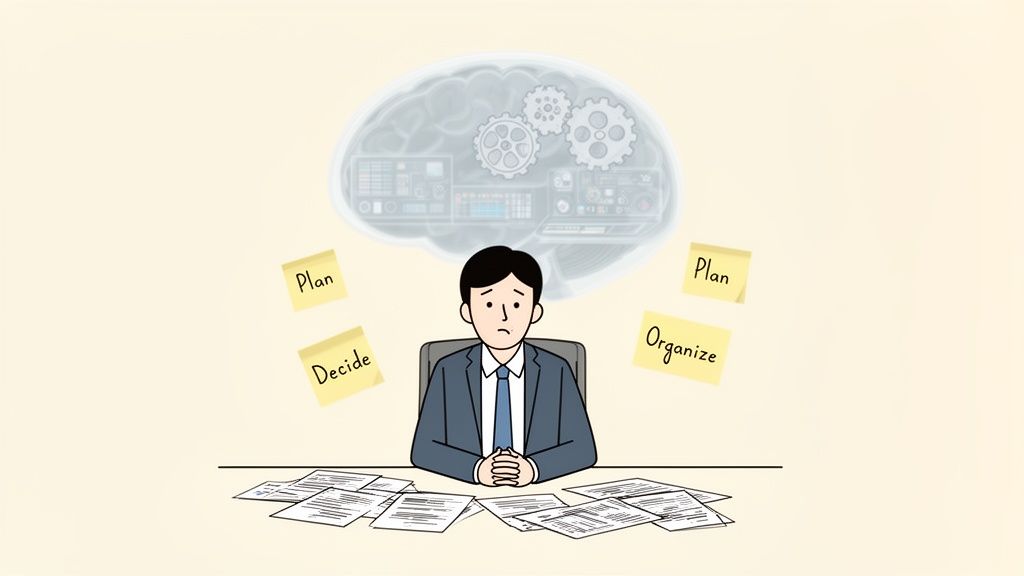
Think of your brain as the command center for "You, Inc." It's responsible for setting goals, creating long-term strategies, managing different departments (like memory and emotions), and making sure all projects get finished on time. When this system is running smoothly, you feel in control.
But what if the command center was in chaos? Projects wouldn't get planned, deadlines would be missed, and decisions would feel paralyzing. That's a great way to picture what executive dysfunction feels like. It’s a breakdown in the brain's core management abilities, making it incredibly difficult to navigate the business of everyday life.
What It Is and What It Is Not
It’s really important to get this part right: executive function disorder isn't an official, standalone diagnosis listed in the Diagnostic and Statistical Manual of Mental Disorders (DSM-5). It’s a term clinicians and experts use to describe a specific pattern of cognitive and behavioral challenges.
These struggles are brain-based and biological. They are not character flaws, a sign of laziness, or a simple lack of willpower. Grasping this distinction is often the first step toward self-compassion and finding the right kind of support. For many people, identifying these executive function weaknesses is a crucial stop on the journey to an accurate ADHD or Autism diagnosis, as these challenges are core features of both conditions.
Executive dysfunction is considered a “transdiagnostic” issue, which just means it shows up across many different conditions. For example, studies have found that about 25% of hospitalized older adults in rehabilitation settings show significant executive dysfunction. You can learn more about how this pattern appears across various mental health conditions at elementspsych.com.
Breaking Down the Core Skills
Executive functions aren't just one single skill; they're a whole suite of interconnected mental processes that work together. Think of them as the different roles on your brain's management team, all collaborating to help you regulate your behavior and achieve your goals.
"Executive function skills are the mental processes that enable us to plan, focus attention, remember instructions, and juggle multiple tasks successfully. Just as an air traffic control system at a busy airport safely manages the arrivals and departures of many aircraft on multiple runways, the brain needs this skill set to filter distractions, prioritize tasks, and control impulses."
When this internal "air traffic control" system is overwhelmed or underdeveloped, it leads to the challenges we associate with executive function disorder.
To make this a bit clearer, here’s a breakdown of the core domains where these difficulties tend to show up.
The Core Domains of Executive Function
This table highlights the key cognitive skills that fall under the executive function umbrella, making the whole concept a bit easier to digest.
| Executive Function Skill | What It Controls | Example of a Challenge |
|---|---|---|
| Working Memory | Holding and using information temporarily | Forgetting multi-step instructions seconds after hearing them. |
| Cognitive Flexibility | Adapting to new rules or situations | Becoming extremely frustrated when plans change unexpectedly. |
| Inhibitory Control | Resisting impulses and managing focus | Blurting out answers in class or struggling to ignore distractions. |
| Planning & Prioritization | Organizing steps to reach a goal | Feeling overwhelmed by a large project and not knowing where to start. |
| Task Initiation | Starting a non-preferred task | Procrastinating on homework or chores, even with looming deadlines. |
| Emotional Regulation | Managing feelings and emotional responses | Having intense emotional reactions to minor setbacks. |
Seeing these skills laid out like this often helps people pinpoint exactly where their own "management team" might be struggling. Each of these domains is a piece of a much larger puzzle, and weakness in one area can easily impact all the others.
How Your Brain Manages Executive Functions
To really get what executive function disorder is, we have to look under the hood at the brain’s command center. These critical skills aren't just abstract ideas—they're real processes run by specific parts of your brain, mainly the frontal lobes, located right behind your forehead. This area is like the CEO of your brain, coordinating all the complex operations that let you set and achieve goals.
When this part of the brain is wired differently—as we often see in conditions like ADHD and Autism—it directly impacts your ability to manage day-to-day life. It’s crucial to understand that these challenges are rooted in neurology, not a lack of effort. Getting a handle on the brain's role is the first step toward replacing self-blame with effective, brain-based strategies.
The Brain's Core Management Team
Think of your executive functions as a small, specialized team working together in your frontal lobe. Each member has a unique job, but they need to communicate perfectly for you to navigate your day. The three most important players on this team are Working Memory, Cognitive Flexibility, and Inhibitory Control.
-
Working Memory: This is your brain's temporary sticky note. It’s the mental space where you hold on to information while you're actively using it—like remembering a phone number just long enough to dial it or keeping track of the steps in a recipe while you're cooking.
-
Cognitive Flexibility: This is your brain’s ability to be a quick-change artist. It’s what allows you to shift your thinking, adapt to new information or rules, and look at a problem from different angles. It’s what lets you pivot when a plan falls apart without getting completely stuck.
-
Inhibitory Control: Think of this as the brain's internal filter or brake pedal. It’s the skill that helps you resist distractions, manage impulsive reactions, and stay focused on what you're doing. It’s what stops you from checking your phone every two minutes when you're trying to finish a report.
When even one of these core functions isn't working at its best, it creates a ripple effect, impacting the others and making even simple tasks feel completely overwhelming.
How Brain Wiring Impacts Daily Life
The heart of executive function disorder lies in differences in brain development and connectivity. For neurodivergent individuals, the neural pathways that support these skills might be less efficient or simply develop at a different pace. This isn't a defect; it's a variation in wiring that calls for a different set of management tools.
For someone with executive dysfunction, being told to "just try harder" is like telling someone with poor eyesight to "just see better." The issue isn't a lack of willpower; it's a difference in the biological equipment being used to perform the task.
For instance, someone with a weaker working memory might constantly lose their train of thought mid-sentence or forget why they walked into a room. A person who struggles with cognitive flexibility might feel intense distress when their routine is disrupted. And someone with weaker inhibitory control might have a hard time with emotional regulation, leading to outbursts that seem way out of proportion to the situation.
These real-world examples show how brain-based differences translate directly into the daily frustrations that come with executive dysfunction. Recognizing this neurological foundation is essential because it validates the experience of those who struggle. It confirms that these challenges are real, measurable, and deserve compassion and specialized support—not judgment. Understanding this connection shifts the focus from blaming the person to empowering them with the right strategies.
Recognizing the Signs of Executive Dysfunction
Executive function disorder doesn't present the same way in everyone. Think of it like a chameleon—its challenges shift and adapt based on the demands of different life stages, often hiding in plain sight. What might look like a simple behavioral issue is frequently a sign that the brain’s management system is struggling to keep up.
It's crucial to understand that these challenges are not a reflection of a person's character, intelligence, or effort. Recognizing the patterns is the first step toward empathy and finding the right support, whether for yourself or someone you care about.
The diagram below illustrates the three core executive functions that are at the heart of these behaviors: working memory, cognitive flexibility, and self-control.
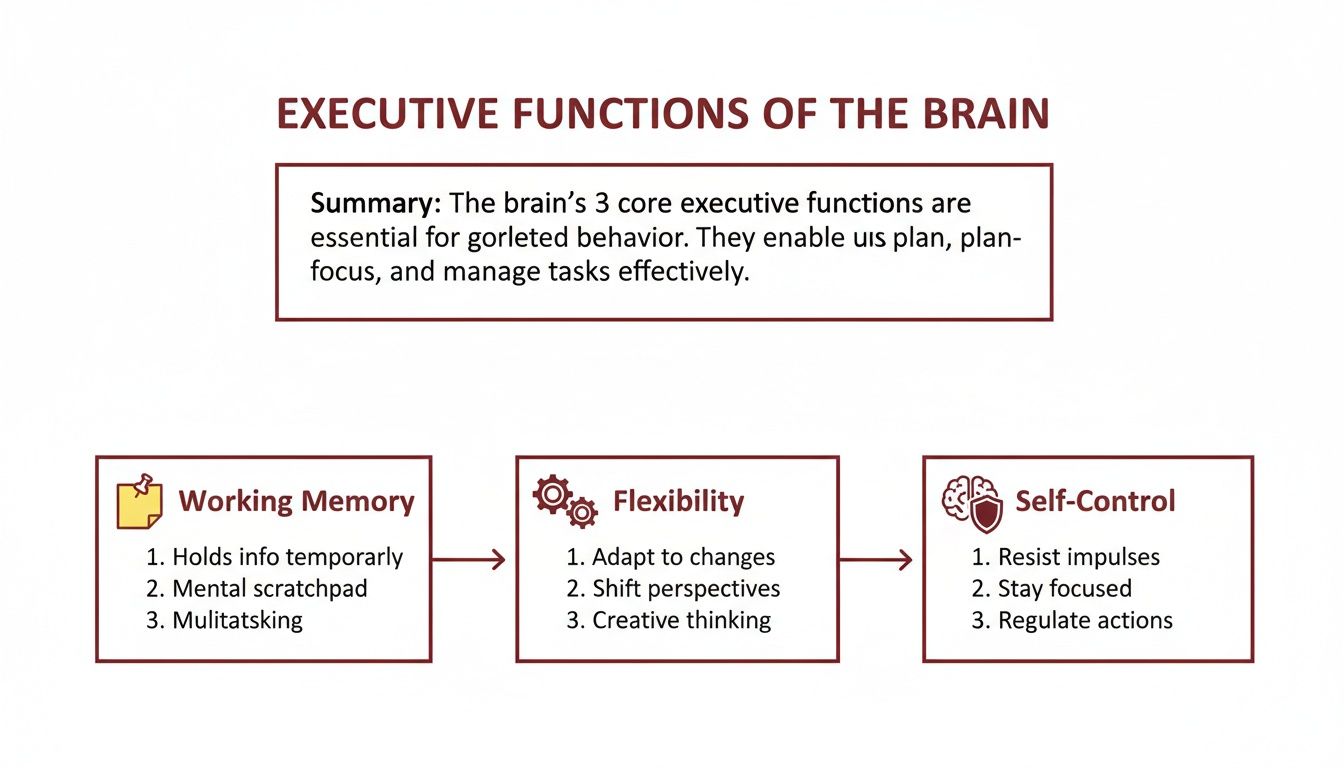
As you can see, a weakness in any one of these fundamental skills can throw a wrench in a person's ability to plan, focus, and manage daily life effectively, no matter their age.
How these struggles appear can look very different in a six-year-old compared to a sixteen-year-old or a forty-six-year-old. The table below breaks down some of the common signs you might see across the lifespan.
Signs of Executive Dysfunction Across the Lifespan
| Challenge Area | In Children | In Teenagers | In Adults |
|---|---|---|---|
| Task Initiation | Trouble starting homework or chores without constant reminders. | Extreme procrastination on long-term projects and assignments. | Difficulty starting work tasks; putting off important calls or emails. |
| Organization | Chronically messy bedroom, backpack, or desk. | Disorganized notes, lost assignments, messy locker. | A constantly cluttered workspace, car, or home; difficulty managing files. |
| Time Management | Difficulty following routines; struggles with transitions between activities. | Consistently underestimates how long tasks will take; always rushing. | Frequently late for appointments; misses deadlines at work. |
| Emotional Control | Frequent, intense emotional outbursts over small frustrations. | Mood swings; overreacts to criticism or minor setbacks. | Prone to irritability and frustration; difficulty managing stress. |
| Working Memory | Forgets multi-step instructions almost immediately. | Struggles to remember details for tests; loses track of conversations. | Forgets names, dates, and appointments; frequently misplaces items. |
| Flexible Thinking | Becomes very upset by unexpected changes in plans or routines. | Gets stuck on one way of solving a problem; resists feedback. | Has trouble adapting to change at work; struggles with shifting priorities. |
It's important to remember that everyone experiences some of these challenges from time to time. With executive dysfunction, however, these issues are persistent and create significant barriers in daily life, causing ongoing frustration and stress.
Common Signs in Children
In young children, executive dysfunction often shows up as difficulty following rules and routines. These kids might seem defiant, but the real issue is often a struggle with working memory or self-control.
For example, a child might forget a three-step instruction ("Go upstairs, put on your pajamas, and brush your teeth") just seconds after hearing it. Their bedroom might be in a constant state of chaos, not because they don't care, but because a command like "clean your room" is too massive and undefined for their brain to process.
Other common signs include:
- Frequent emotional outbursts: They struggle to manage frustration over minor setbacks.
- Trouble starting tasks: They can’t seem to begin chores or homework without constant reminders.
- Difficulty with transitions: Switching from one activity to another can cause significant distress.
These behaviors are so often misunderstood by parents and teachers, which leads to a frustrating cycle for everyone. The key is to see that the child isn't choosing to be difficult; their brain is struggling to execute the commands they're given.
Challenges Faced by Teenagers
As school and social pressures intensify, the signs of executive function disorder often become much more obvious during the teenage years. The need for independent planning, organization, and time management suddenly skyrockets, exposing weaknesses that might have gone unnoticed before.
Procrastination becomes a huge problem. A teen might wait until the night before a major project is due, not out of laziness, but because they're paralyzed by the task of breaking it down into smaller, manageable steps. Their backpack might be a black hole of crumpled papers and forgotten assignments, and they may consistently underestimate how long things will actually take.
The teenage years are a critical period for executive function development. When these skills lag, it can significantly impact not just grades, but also mental health and decision-making.
Recent research highlights this connection. A 2022 analysis found that while about 1 in 8 U.S. adolescents self-reported executive dysfunction, that number jumped to nearly 1 in 3 when a stricter cutoff was used. This suggests many teens don't fully recognize the extent of their own challenges, which are linked to poorer quality of life and riskier behaviors. You can explore the full study on adolescent executive function on the National Library of Medicine website.
How Dysfunction Appears in Adults
In adulthood, the consequences of executive dysfunction can feel even heavier, impacting careers, relationships, and financial well-being. Adults with these challenges often feel like they are constantly failing to "get it together," despite knowing they are smart and capable.
Workplace struggles are common. An adult might miss important deadlines, have a perpetually cluttered desk, or find it nearly impossible to prioritize tasks in a busy environment. At home, they may struggle with household management—paying bills on time, keeping the house organized, or even planning meals for the week.
Many adults with undiagnosed executive function issues, particularly women who have learned to mask their symptoms, carry a deep sense of shame. They have spent a lifetime being told they are lazy or not living up to their potential, never realizing their brain is simply wired differently. Recognizing these lifelong patterns is often the first, most powerful step toward self-acceptance and seeking a formal evaluation.
The Link Between Executive Function, ADHD, and Autism
It’s easy to get tangled up trying to understand the differences between executive function disorder, ADHD, and Autism. So many of their signs overlap, which can create a confusing picture for anyone trying to find answers for themselves or a loved one. Figuring out how these conditions relate to each other is the key, because their connection runs much deeper than just a few shared behaviors.
Think of it like this: executive dysfunction is a core feature of both ADHD and Autism, but it shows up in very different ways. It’s like two different apps running on the same computer operating system—both use the system's core processes to function, but they produce completely different user experiences. This is exactly why a thorough, professional evaluation is so critical to untangle the threads and see the whole picture.
Differentiating ADHD and Executive Dysfunction
The relationship between ADHD and executive function is incredibly close. In fact, many experts now see ADHD as, fundamentally, a disorder of the brain’s executive functions. While not everyone with a weak executive function system has ADHD, virtually everyone with ADHD has significant challenges with executive function.
This is because the classic symptoms of ADHD—inattention, hyperactivity, and impulsivity—are the direct result of a breakdown in the brain's management system.
- Inattention is often a problem with sustained focus, getting started on tasks, and holding information in mind (working memory).
- Hyperactivity and Impulsivity are directly tied to poor self-control and difficulty managing emotional responses.
So, while "executive function disorder" isn't a standalone diagnosis, it gives us the "why" behind so many of the daily struggles of ADHD. For a deeper look at this specific relationship, you can learn more about executive functioning and ADHD and how deeply one impacts the other. Understanding this helps clarify that ADHD is the clinical diagnosis, and executive dysfunction is the cognitive engine driving it.
One of the biggest misconceptions is that ADHD and executive function disorder are the same thing. The truth is, executive dysfunction is a key part of ADHD, but thinking about it as a separate set of skills helps explain why strategies focused on building those skills are so vital for managing ADHD effectively.
How Autism Involves Executive Function Challenges
Executive function challenges are also a central part of Autism Spectrum Disorder (ASD), but they tend to look quite different than they do in ADHD. For autistic individuals, these difficulties are a big part of what drives core autistic traits, especially those related to social communication and the need for routine.
For instance, an autistic person's preference for sameness and the intense distress they feel when plans change is closely linked to weak cognitive flexibility. The brain simply struggles to "shift gears" when things don't go as expected. In the same way, challenges with planning and organization can make navigating the fast-paced, unwritten rules of social situations feel next to impossible.
Here’s how these challenges can shape an autistic person's experience:
- Difficulty with Transitions: A struggle with cognitive flexibility makes it incredibly hard to move from one activity to another without a predictable, structured process.
- Social Planning: Problems with planning and working memory can make it tough to start a conversation, interpret unspoken social rules, or guess how others might react.
- Managing Routines: A deep reliance on strict routines is often a coping mechanism for an overwhelmed executive function system that can't easily plan and adapt on the fly.
The Importance of a Specialized Evaluation
Because of this huge overlap, self-diagnosis can easily lead you down the wrong path. Someone might see their struggles with organization and time management and assume it’s ADHD, when the root cause is actually an autistic neurotype. It's also very common for people to have both ADHD and Autism, a combination often called AuDHD.
A comprehensive evaluation from a specialist is the only way to get true diagnostic clarity. This is especially important for people whose struggles have been historically missed or misunderstood, like women who mask their traits or BIPOC individuals. A skilled clinician looks beyond the surface-level symptoms to understand your unique brain wiring, providing an accurate diagnosis that finally opens the door to the right kind of support. This clarity is the first step toward self-understanding and building a life that works with your brain, not against it.
The Path to a Clear Diagnosis
If you’re starting to suspect that executive function challenges are getting in your way, just figuring out where to begin can feel like a huge hurdle. The good news? Getting answers is more straightforward and accessible than you might think, especially with modern telehealth options.
A good evaluation isn't just about ticking boxes on a questionnaire. It starts with a real conversation—a clinical interview where a psychologist gets to know your story. They’ll ask about your childhood, your school experiences, and the specific struggles you're facing now at work or home to look for those lifelong patterns that point to executive dysfunction.
After that, you'll likely work through some validated self-report forms and assessments. These are carefully designed screening tools and questionnaires that zero in on specific executive function skills, like your ability to organize, manage emotions, or just get started on a task. Putting your personal history together with this objective data gives us a complete picture of your unique cognitive profile.
The Power of Telehealth Evaluations
One of the biggest game-changers in getting a diagnosis has been the rise of telehealth. You can now go through a complete, thorough assessment from the comfort of your own home over a secure video call. This takes away so much of the stress and logistical headaches of trying to schedule in-person appointments, making it a lifeline for busy adults and families who need support.
An accurate diagnosis isn’t about getting a label. It’s about getting a user manual for your own brain. It gives you the clarity to stop blaming yourself and start building effective, personalized strategies that actually work.
A virtual executive functioning skills assessment delivers the same diagnostic accuracy as a traditional, in-office one. In fact, it often gives specialists a better window into your world, letting them see how these challenges pop up in your natural environment. It's an accessible path that's helping more people than ever finally get the answers they’ve been looking for.
Standard Evaluations vs. Neuropsychological Testing
It's also important to know that not all evaluations are created equal. The right assessment for you really depends on what you need it for.
-
Standard Diagnostic Evaluation: This is the right choice for most people looking for clarity on ADHD, Autism, or both (AuDHD). It's what you need to understand your neurotype, get access to workplace accommodations, or receive a letter for a medication provider. This evaluation typically takes a few hours and focuses specifically on diagnostic criteria.
-
Neuropsychological Evaluation: This is a much deeper, more intensive dive. It involves a wide battery of tests that measure things like IQ, academic achievement, memory, and multiple executive function domains. This comprehensive evaluation is mainly for students who need academic accommodations for standardized tests like the SAT, ACT, GRE, or GMAT, or to get an IEP or 504 plan set up in school.
Understanding this difference is key. For most adults who just want answers about their day-to-day struggles, a standard evaluation is exactly what they need. But if formal academic accommodations are the main goal, then a full neuropsychological evaluation is the way to go. Knowing which one you need helps you invest your time and resources wisely so you can move forward with confidence.
Practical Strategies for Managing Daily Life
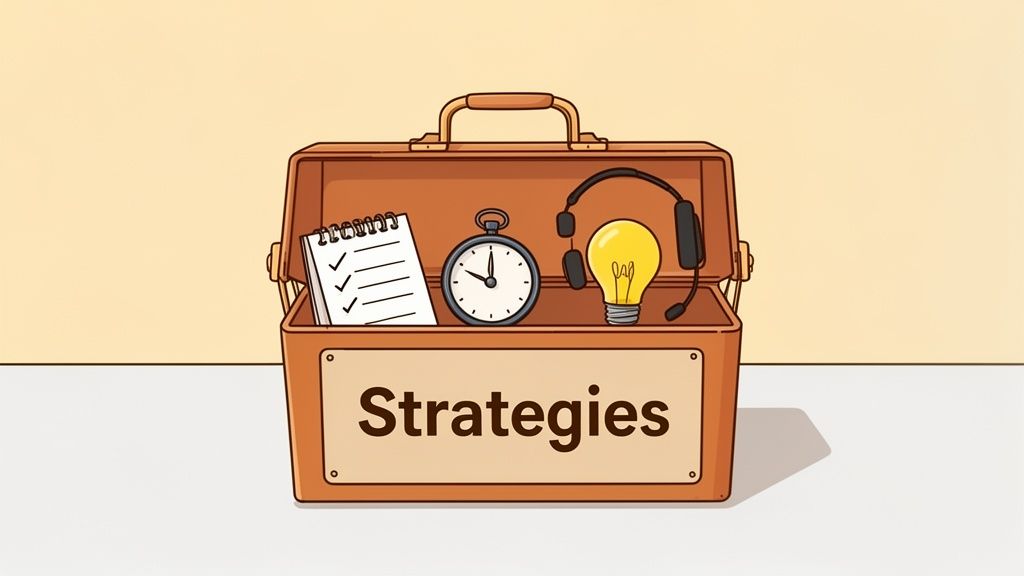
Getting an executive function disorder diagnosis isn't the end of the road. In fact, it's the starting line for a much more informed and empowered journey. The goal isn't to "fix" your brain but to learn practical, evidence-based strategies that work with its unique wiring. This is all about building a personalized toolkit of skills and systems that smooth out the friction in your daily life.
Two of the most effective ways to build this toolkit are Cognitive Behavioral Therapy (CBT) and specialized executive function coaching. They each offer a distinct, yet complementary, path toward managing life with greater ease.
Therapeutic and Coaching Approaches
Cognitive Behavioral Therapy (CBT) is a powerful tool that helps people see the connection between their thoughts, feelings, and actions. For someone with executive dysfunction, CBT is fantastic for challenging the negative self-talk that piles up after years of struggling with organization and procrastination. It offers concrete ways to reframe thoughts like "I'm lazy" into something more accurate, like "Starting this is hard for my brain, so I need a specific strategy to get going."
Executive function coaching, on the other hand, is all about practical, real-world skills. A coach works with you to build tangible systems for managing time, planning projects, and organizing your space. It's less about digging into past feelings and more about creating actionable, forward-looking solutions. To get a better feel for how this works, exploring executive function help for adults can offer some great insights into building habits that actually stick.
The most successful strategies do not force a neurodivergent brain to operate like a neurotypical one. Instead, they create external structures and supports that compensate for internal challenges, allowing an individual's natural talents to shine.
Building Systems That Work For You
The core idea here is to externalize your brain's management system. Think of it this way: if your internal "CEO" is overwhelmed, you need to build an external support team.
This can be a mix of high-tech and low-tech tools that do the heavy lifting for you:
- Visual Timers: Tools like the Time Timer are game-changers. They make the abstract concept of time concrete and visible, which is a huge help for "time blindness."
- Digital Calendars and Reminders: Let your phone's apps carry the mental load. Using customizable alerts for every appointment and task frees up your working memory for other things.
- Checklists for Routines: Break down multi-step processes like "getting ready for work" or "making dinner" into simple, checkable steps. This instantly makes them feel less overwhelming.
- Body Doubling: This one is surprisingly effective. Just working alongside another person, whether in the same room or on a video call, provides a sense of accountability that makes it easier to start a task and stay on it.
For kids, the key is to make these strategies feel like a game, not a chore. When it comes to time management, resources with practical time management activities can offer play-based support that works.
Unlocking Accommodations at School and Work
A formal diagnosis does more than just provide an explanation; it's a key that unlocks legally protected support. These accommodations aren't about getting an unfair advantage. They are necessary adjustments that level the playing field, allowing someone to show what they're truly capable of.
In School Settings:
A diagnosis can be used to get an IEP (Individualized Education Program) or a 504 Plan. These plans make essential accommodations possible, such as:
- Extended Time: Getting more time on tests and big assignments.
- Note-Taking Assistance: Having access to a teacher's or another student's notes.
- Chunking Assignments: Breaking down large projects into smaller, more manageable parts, each with its own deadline.
In the Workplace:
Under laws like the Americans with Disabilities Act (ADA), adults can request reasonable accommodations. This might look like:
- Getting instructions in writing instead of just verbally.
- Permission to wear noise-canceling headphones to block out distractions.
- Being moved to a quieter workspace, away from high-traffic areas.
These strategies create a hopeful path forward, showing that with the right tools and supports, building a more organized, successful, and fulfilling life is absolutely possible.
Got Questions About Executive Function Disorder?
It’s natural to have questions when you’re trying to make sense of executive function. Let's clear up a few of the most common ones to help you figure out what’s next.
Is Executive Function Disorder the Same as ADHD?
No, but they're incredibly close cousins. Think of it this way: executive dysfunction is a core, defining feature of ADHD. Almost everyone with ADHD struggles with executive functions, but you can also have these challenges for other reasons, like autism or even just chronic stress.
Since the symptoms overlap so much, a professional evaluation is really the only way to get to the root cause. Getting that clarity is the most important step toward finding the right kind of support and treatment that will actually work for you.
Can You Actually Improve Executive Function Skills?
Yes, absolutely. While you might not change the fundamental wiring of your brain, you can definitely strengthen the skills themselves with targeted practice and the right strategies. Your brain is fantastic at building new pathways and habits.
The goal isn't to force a neurodivergent brain to operate like a neurotypical one. The goal is to build a personalized toolkit of strategies—like therapy, coaching, and skills training—that helps you create practical systems for organization, planning, and time management.
These approaches are all about learning how to work with your brain, compensating for weaker areas by playing to your strengths.
Do I Need a Full Neuropsychological Evaluation?
Probably not. For most adults who are just looking for clarity, need workplace accommodations, or want a letter for a medication provider, a comprehensive clinical evaluation is exactly what you need. It’s a focused assessment that gives you the diagnostic answers you’re looking for without the time and expense of a massive testing battery.
A full neuropsychological evaluation is a much more intense process. It's usually only required for students who need to secure academic accommodations for high-stakes standardized tests like the SAT, GRE, or GMAT, which have very strict documentation requirements.
If you're ready to get clear answers about your own brain's wiring, Sachs Center specializes in telehealth-based diagnostic assessments for ADHD and Autism. Our virtual evaluations provide the clarity you need from the comfort of your home. Learn more about our services and book your evaluation today.
