
It's a common misconception to see executive dysfunction as a character flaw or a sign of laziness. The truth is, it’s a brain-based challenge that affects how you manage, organize, and get things done.
Think of it like having an overwhelmed air traffic controller in your brain. When the controller struggles to coordinate all the incoming and outgoing flights, it leads to delays, mix-ups, and a whole lot of confusion. This difficulty is rooted in cognitive processes, not a lack of willpower.
Understanding Your Brain's Air Traffic Controller

Let's stick with that airport analogy. Imagine your brain is a bustling international airport. For everything to run smoothly—planes taking off on time, luggage arriving at the right carousel, passengers making their connections—you need a highly skilled air traffic control tower.
This tower is your brain's executive function system. It’s the CEO of your mind, managing everything from planning your day and organizing your thoughts to controlling impulses and shifting your attention between different tasks.
When this system is working well, life feels manageable. You can plan a project, break it down into smaller steps, and actually see it through. You remember to pay your bills, you can resist the urge to check social media during a meeting, and you can adapt when plans suddenly change. It's the silent, powerful force that helps you navigate the complexities of daily life.
When the Control Tower Is Overwhelmed
So, what is executive dysfunction? It’s what happens when that air traffic control tower becomes understaffed or its equipment starts to glitch.
Flights get delayed (procrastination). Planes are sent to the wrong gates (disorganization). Communication breaks down (trouble focusing). It’s not about being incapable; it’s about the management system itself facing significant, neurologically-based challenges.
This can show up in all sorts of ways, making everyday activities feel like monumental efforts. You might find it nearly impossible to start a simple chore, constantly lose track of important deadlines, or feel emotionally flooded by a long to-do list.
Executive dysfunction is a transdiagnostic cognitive syndrome, meaning it appears across many different conditions. It’s characterized by impairments in core skills like planning, working memory, and impulse control.
This is why understanding the concept is so critical. It reframes the struggle from a personal failing to a neurological reality that can be understood and supported.
A Common Neurological Challenge
Executive dysfunction isn't rare; it’s a core feature in many neurodevelopmental and psychiatric conditions. For instance, it is highly prevalent in Attention-Deficit/Hyperactivity Disorder (ADHD), a condition that systematic reviews estimate affects roughly 3–9.5% of the global population, depending on the age group and diagnostic criteria used.
This highlights just how many people are navigating the world with an overtaxed internal air traffic controller. You can read the full research on the prevalence of executive dysfunction to learn more.
The Building Blocks of Executive Functioning
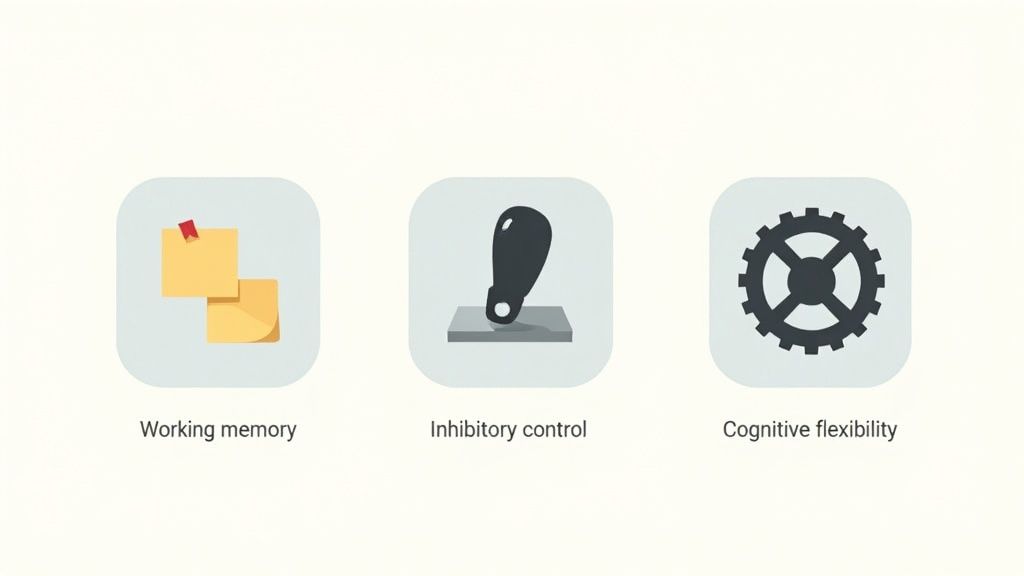
To really get what executive dysfunction is, we have to look past the label and into the core mental skills that are supposed to be running the show. Think of your executive functions not as one big on/off switch, but as a team of specialists who need to work together flawlessly. When even one of them is struggling, the whole operation can feel like it's grinding to a halt.
Let's break down the three most critical players: working memory, inhibitory control, and cognitive flexibility. Understanding how each one works—and how they can fall short—is the first real step toward finding targeted support. It’s how you go from feeling "all over the place" to pinpointing exactly where the breakdown is happening.
Working Memory: Your Brain's Sticky Note
Working memory is your ability to hold and juggle information in your mind for a short time. It's the mental notepad you use to remember a phone number just long enough to dial it, follow a recipe with multiple steps, or hold the beginning of a sentence in your head while you listen to the end. It's an active, temporary workspace.
When working memory is weak, life gets messy. You might:
- Walk into a room and have no idea what you came for.
- Lose the thread of a conversation because you can't keep track of the main point.
- Find it almost impossible to do simple math in your head.
- Forget the details of an assignment you were just given at work.
This isn't an issue with your long-term memory or your intelligence. It's a very specific challenge with the brain's capacity to hold onto new information long enough to actually use it. It's like trying to use a sticky note that keeps falling off the wall before you're done with it.
Inhibitory Control: The Brain's Braking System
Next is inhibitory control, which is basically your brain's braking system. This skill lets you manage your impulses, tune out distractions, and stop yourself from acting on the very first thought or feeling that pops into your head. It’s what helps you slog through a boring report instead of checking your phone and keeps you from blurting out something you'll regret in a meeting.
When this braking system isn't working at full strength, you might see:
- Impulsivity: Making snap decisions without thinking about the fallout.
- Distractibility: Getting pulled off task by every notification, noise, or random thought.
- Emotional Dysregulation: Reacting with huge emotions that feel way out of proportion to the situation.
Without strong inhibitory control, your attention and actions get hijacked easily. It feels like driving a car with bad brakes—you know you need to stop, but you just keep rolling forward.
Understanding these individual components is key. When you can name the specific skill that's causing trouble, like poor inhibitory control, you can seek out targeted strategies. For many, this is where specialized support, such as learning new techniques through executive function training, can make a significant difference.
Cognitive Flexibility: Shifting Gears with Ease
Finally, we have cognitive flexibility, which is your brain’s knack for "shifting gears." It’s the ability to adapt your thinking and behavior when things change or new information comes in. It lets you see a problem from different angles, switch between tasks without getting flustered, and pivot when your original plan hits a snag.
Challenges with cognitive flexibility can make you feel rigid or just plain stuck. You might find yourself:
- Struggling to transition from one activity to another (like stopping work to make dinner).
- Feeling intense frustration or anxiety when plans change out of the blue.
- Getting stuck on one way of solving a problem, even when it’s clearly not working.
- Having a hard time seeing someone else's point of view in an argument.
When these three building blocks—working memory, inhibitory control, and cognitive flexibility—aren't working in harmony, the whole system struggles. That's the core of executive dysfunction. Figuring out which of these areas is your biggest hurdle is the first crucial step toward building a more manageable, successful life.
Unpacking the Causes and Neurological Roots
Let’s get one thing straight: executive dysfunction isn’t a sign of laziness or a lack of willpower. It’s a brain-based challenge with clear neurological origins. Understanding why these difficulties happen is the first step in moving away from self-blame and toward effective, compassionate solutions.
At its core, these challenges are tied to the brain's prefrontal cortex. This area, right behind your forehead, is the command center for your executive functions. When its development, chemistry, or structure is different, it directly impacts your ability to plan, focus, and manage impulses.
Neurodevelopmental Differences
For many people, executive dysfunction is a core feature of a neurodevelopmental condition. This simply means their brain developed differently from the start. It's not a defect—it's a variation in wiring that comes with its own set of strengths and challenges.
Two of the most common conditions linked to executive dysfunction are:
- Attention-Deficit/Hyperactivity Disorder (ADHD): This is probably the most well-known connection. In an ADHD brain, differences in neurotransmitter systems—particularly dopamine and norepinephrine—affect how different brain regions talk to each other. This can make it much harder to sustain attention, regulate impulses, and organize complex tasks.
- Autism Spectrum Disorder (ASD): Individuals on the autism spectrum often experience significant challenges with cognitive flexibility. The autistic brain tends to excel at systemizing and focusing deeply on specific interests, but may struggle with abruptly shifting gears or adapting to unexpected changes in routine.
These aren't diseases to be cured; they are inherent neurological profiles. Recognizing this reframes the whole conversation from "what's wrong with me?" to "how is my brain wired, and how can I best support it?"
Acquired Brain Injuries and Health Conditions
Executive functions aren't just shaped by development—they can also be disrupted by events that happen later in life. The brain’s delicate management system is vulnerable to physical injury and other health issues that affect its structure and chemistry.
An acquired brain injury (ABI), for instance, is a common cause. This could be from a traumatic event like a concussion from a car accident or a non-traumatic one like a stroke. The damage to the prefrontal cortex can suddenly impair skills that were once effortless, leading to new struggles with memory, organization, and emotional control.
Beyond injuries, a whole range of medical conditions can affect executive functioning. The impact here goes far beyond daily inconvenience; in fact, executive dysfunction can substantially increase health burdens. Poorer executive skills are linked to risky behaviors like smoking, poor dietary choices, and not sticking with medical treatments, which can even contribute to premature mortality. We even saw this with COVID-19, which led to a surge in cognitive complaints often described as “brain fog.” You can explore more research on the broad health impacts of executive dysfunction.
The Influence of Mental Health
The link between mental health and executive function is a two-way street. Conditions like anxiety and depression don’t just affect your mood; they can seriously drain the cognitive resources you need for effective self-management.
When your brain is dedicating immense energy to managing persistent worry, intrusive thoughts, or overwhelming sadness, there is simply less capacity available for planning, organizing, and initiating tasks.
Think of it like trying to run complex software on a computer that has dozens of other programs hogging all the memory—everything slows down and becomes prone to crashing.
Here’s how it can play out:
- Depression often leads to a state of low motivation and mental fatigue that makes it feel impossible to start even the simplest tasks.
- Anxiety can trigger "analysis paralysis," where the fear of making the wrong choice makes it difficult to make any decision at all.
In these cases, the executive dysfunction may be temporary and can improve as the underlying mental health condition is treated. By understanding these neurological roots, we can approach these challenges with more clarity and empathy, seeing them for what they are: tangible, brain-based issues that deserve real support.
What Executive Dysfunction Looks Like in Daily Life

It’s one thing to understand the building blocks of executive function, but it's something else entirely to see how those challenges show up in the real world. Executive dysfunction isn't some abstract theory; it's the invisible force that can turn a simple to-do list into an insurmountable mountain.
These daily struggles are so often mistaken—by others and even by ourselves—for laziness or a simple lack of willpower. By walking through some vivid, relatable scenarios, you can start to see your own experiences reflected, which is the first step in moving from self-criticism to self-compassion.
And this is far from a niche problem. A significant portion of the population grapples with these issues. For example, recent research found that mild executive dysfunction symptoms were reported by 24.17% of younger adult participants, with another 25.42% reporting moderate symptoms. You can discover more about the prevalence of these symptoms in community samples on Wikipedia.
At Home Where Chaos Can Reign
For many, home is where the weight of executive dysfunction feels the heaviest. It's where external structures, like a boss looking over your shoulder or a fixed schedule, simply fall away. You’re left to generate your own momentum, which is incredibly difficult when your brain’s “get up and go” system is struggling.
The results often look a lot like this:
- The "Doom Pile": This is that infamous stack of unopened mail, miscellaneous papers, and random items that takes up residence on a counter or desk. You know you need to sort through it, but the mental energy required just to start feels completely out of reach.
- Chore Paralysis: Looking at a sink full of dishes or a mountain of unfolded laundry can trigger a complete mental shutdown. It’s not that you don’t want a clean space; it’s that your brain can't sequence the steps or muster the activation energy to begin.
- Time Blindness: You might genuinely believe a task will only take five minutes, only to look up and realize an hour has vanished. This makes planning your day, getting to appointments on time, or even knowing when to start dinner a constant, frustrating challenge.
These aren't signs of a messy person; they are the external proof of an internal cognitive struggle. The desire for order is there, but the mental tools needed to create and maintain it are being pushed to their limits.
At Work Where Demands Collide
In the workplace, the demands for organization, prioritization, and time management are incredibly high. This can make it a minefield for someone with executive dysfunction. The fast-paced nature of many jobs just amplifies that constant feeling of being behind, no matter how hard you’re working.
Common work-related scenarios include:
- The Overwhelming Inbox: An inbox overflowing with hundreds of messages can feel like a direct assault. The cognitive load required to read, categorize, prioritize, and respond to each one leads to avoidance, which, of course, only makes the problem worse.
- Deadline Struggles: Even when you know a deadline is looming, starting the project can feel impossible until the eleventh hour. This isn't about thriving under pressure; it's a painful cycle of procrastination fueled by challenges with planning and task initiation, leading to frantic, high-stress work.
- Difficulty with Prioritization: When every single task feels equally urgent and important, how can you possibly know where to start? This often leads to spending hours on low-impact activities while the most critical projects get pushed to the side.
These struggles look different for everyone. For one person, it’s the inability to start writing a report. For another, it’s the constant distraction of a new idea derailing their focus. By recognizing these patterns in yourself, you can begin to identify your specific challenges and seek the right kind of support.
Actionable Strategies to Support Your Brain
Once you understand what executive dysfunction is, you can start taking real, meaningful action. This isn't about "trying harder" or relying on willpower, which often feels like an empty tank. Instead, the goal is to implement practical, evidence-based strategies that work with your brain's unique wiring, not against it.
Making this shift from awareness to action means building external support systems that help strengthen your internal habits. It’s all about creating a structured environment that takes the load off your executive functions, letting you operate more effectively and with way less stress.
Reframing Your Mindset with CBT
A huge piece of the puzzle is tackling the negative thought patterns that have built up over time. Years of struggling with procrastination and disorganization often create a harsh inner critic that whispers things like, "I'm just lazy," or "I'll never get this right."
This is where Cognitive Behavioral Therapy (CBT) can be a game-changer. CBT is a therapeutic approach that helps you catch, challenge, and reframe these unhelpful thoughts.
Instead of seeing a messy room as more proof of your failure, a CBT approach helps you see it for what it is: a sign that your current system isn't working and needs a tweak. This simple shift moves you from self-blame to problem-solving, which is a much healthier and more productive headspace.
Building Skills Through Coaching and Structure
While therapy helps with the emotional side, structured coaching provides the practical scaffolding to help you actually get things done. Executive function coaching is all about teaching concrete skills and building routines that stick.
Think of a coach as a personal trainer for your brain's management system. They can help you:
- Break Down Big Tasks: A monster project like "clean the garage" becomes a series of tiny, manageable steps, like "take out one bag of trash" or "sort tools for 15 minutes."
- Externalize Your Memory: Instead of trying to hold everything in your head (a recipe for disaster), you learn to effectively use tools like digital calendars, task managers, and visual planners.
- Use Proven Time Management Methods: Techniques like the Pomodoro Technique—working in focused 25-minute sprints—make time feel less like an abstract enemy and more like a manageable resource.
One structured method we use is the Sachs Protocol, which combines psychoeducation (the "why") with practical skills training (the "how"). It helps you understand the reasons behind your challenges while giving you the tools to manage them. For adults feeling completely swamped, you can find more great methods in a step-by-step guide for executive function repair in overwhelmed adults.
The goal of any good strategy is not to force you to become a different person. It's to create an environment and a set of tools that allow your unique brain to thrive, reducing daily friction and building a sense of competence and control.
For many people, medication can also be a crucial part of a complete support plan.
Comparing Strategies for Managing Executive Dysfunction
It can be tough to know where to start. This table breaks down the common therapeutic and coaching approaches to help you see which strategy might be the best fit for your needs.
| Strategy | Primary Focus | Best For |
|---|---|---|
| Cognitive Behavioral Therapy (CBT) | Identifying and reframing negative thought patterns and beliefs. | Addressing the anxiety, self-blame, and emotional toll of executive dysfunction. |
| Executive Function Coaching | Building practical skills, habits, and external support systems. | Learning concrete strategies for organization, time management, and task initiation. |
| The Sachs Protocol | A blended approach combining education and skills training. | Individuals who want to understand the "why" behind their struggles while learning the "how." |
| Medication Management | Regulating brain chemistry to improve focus and impulse control. | Individuals with conditions like ADHD, where neurobiology is a primary factor. |
Ultimately, the most effective plans often combine a few of these approaches. Therapy might help you get out of a negative spiral, while coaching gives you the tools to start moving forward.
Considering Medication as a Tool
For conditions like ADHD, medication can be a critical piece of the puzzle. It helps regulate the brain's neurochemistry, particularly dopamine and norepinephrine, which can make it significantly easier to focus, control impulses, and just get started on a task.
It’s important to see medication not as a "magic fix" but as a foundation. The right medication can make other strategies, like CBT and coaching, much more effective by clearing away some of the mental fog, allowing you to engage more fully with the skill-building process. A thorough evaluation with a professional is the only way to know if this is a suitable option for you.
The key takeaway is that you have options. Finding the right mix of therapeutic support, practical skills, and, if appropriate, medication can make a world of difference. To start this journey, you can find comprehensive resources and professional guidance on getting help for executive dysfunction and find a path that truly works for you.
Finding Clarity Through Assessment and Diagnosis
Recognizing the signs of executive dysfunction in yourself is a huge first step. But what comes next? If the daily struggles with organization, focus, and follow-through feel overwhelming, a formal assessment can bring the clarity you need to finally move forward. This isn't about getting a label—it's about understanding your brain's unique wiring so you can get the right kind of support.
The journey usually begins with a conversation. Speaking with a qualified professional, like a psychologist who specializes in neurodiversity, gives you a safe, non-judgmental space to share what you've been going through. This initial clinical interview is essential for piecing together your history, current challenges, and how these issues are impacting your life.
The Assessment Process Demystified
A comprehensive evaluation is more than just a chat. To get an accurate picture, professionals use a combination of validated self-report measures and clinical assessments. This structured approach helps pinpoint specific areas of difficulty, whether it’s your working memory that's getting overloaded or your inhibitory control that's offline.
At the Sachs Center, our virtual evaluations for ADHD and Autism are designed to be thorough but accessible, typically lasting around two hours. The process helps us determine if a formal diagnosis makes sense and gives us a solid foundation for mapping out your next steps. You can even get a preliminary look at your own skills by taking our free Executive Skills Questionnaire.
What a Diagnosis Can Do for You
A formal diagnosis does more than just give you an explanation—it opens doors. With a diagnostic letter or report, you can advocate for the accommodations you need to level the playing field.
These accommodations might look like:
- At Work: Asking for flexible deadlines, getting instructions in writing, or securing a quieter workspace.
- At School: Getting extended time on tests, having a note-taker in class, or requesting preferential seating.
This process is all about moving from identification to practical application.
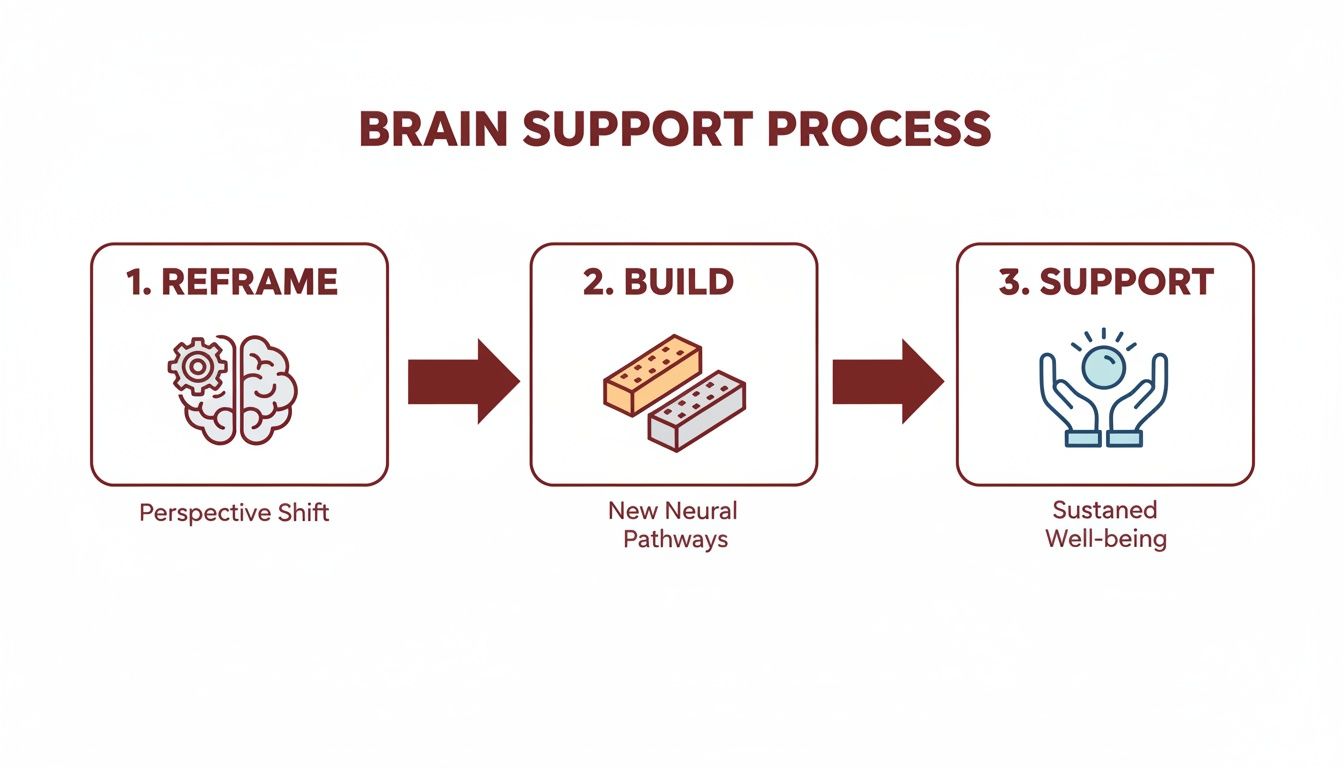
As this visual shows, it's about reframing your understanding, building new skills, and putting supportive systems in place.
For students who need accommodations on standardized tests like the SAT, GRE, or GMAT, a more in-depth neuropsychological evaluation is often the next step. This provides the detailed documentation required to secure tools like extended time, ensuring your performance reflects what you know—not your executive function challenges.
Ultimately, seeking an assessment is an act of self-advocacy. It’s about trading confusion and self-blame for clarity and a concrete plan for success. This path demystifies your struggles and opens the door to the right kind of support.
Common Questions About Executive Dysfunction
As you learn more about executive dysfunction, it's totally normal for questions to pop up. We’ve covered a lot, from thinking about it as the brain's air traffic control system to finding real-world strategies that help. Let's tackle some of the most common questions we hear to clear up any lingering confusion.
Is Executive Dysfunction Just Laziness or a Lack of Willpower?
This is the most persistent—and most damaging—myth out there. The answer is a hard no.
Laziness is choosing not to do something even when you have the ability. Executive dysfunction is a brain-based challenge that makes it incredibly difficult to start, organize, and see a task through to the end. It's a neurological traffic jam in the prefrontal cortex, not a moral failing or a character flaw.
The struggle isn't with the "want to," it's with the "how to." Most people with executive dysfunction genuinely want to be productive, but the mental machinery required to get going just isn't cooperating.
Can Executive Dysfunction Be Cured?
Executive dysfunction isn't a disease you can "cure." For people with neurodevelopmental conditions like ADHD or Autism, it’s a fundamental part of how their brain is wired for life.
But that doesn't mean you're stuck. It can be significantly improved and supported with the right combination of tools and strategies. Think of it less like a cure and more like learning to manage a chronic condition. Effective approaches include:
- Skills Training: Actively learning new systems for organizing your life, managing your time, and planning ahead.
- Therapy (CBT): Working to challenge and change the negative thought patterns that often come with years of struggling with these challenges.
- Medication: For conditions like ADHD, medication can help regulate the brain's chemistry, which often makes all the other strategies far more effective.
- Accommodations: Making smart adjustments to your environment at home, school, or work to play to your brain's strengths instead of fighting against its weaknesses.
Does Everyone with ADHD Have Executive Dysfunction?
Executive dysfunction is a hallmark of ADHD, so it's safe to say that nearly everyone with an ADHD diagnosis will experience challenges in this area. In fact, it's right at the core of the diagnostic criteria for the condition.
However, it doesn't look the same for everyone. The severity and specific areas of difficulty can vary wildly. One person with ADHD might have major trouble with emotional regulation and impulse control, while another's biggest hurdles are working memory and just getting started on a task. The key is to figure out your unique profile so you can get support that's actually tailored to your needs.
If these questions hit close to home and you're ready to get some real clarity, the Sachs Center offers specialized telehealth evaluations for ADHD and Autism. Our expert psychologists are here to help you make sense of your unique neurotype and map out a clear path forward. Book your virtual diagnostic assessment today.
