

If you've typed "adhd test online" into a search bar, you're in good company. Many people start their journey there, and while those quick online quizzes can be a great first step for self-reflection, they aren't the whole story. A credible diagnosis—the kind that opens doors to medication, accommodations, and a real path forward—requires a comprehensive virtual evaluation from a licensed psychologist.
The Shift to Online ADHD Assessments
The search for an ADHD diagnosis has increasingly moved online, and for good reason. As public awareness has grown, so has the demand for mental healthcare that fits into our busy lives. Telehealth has stepped up to fill that gap, making expert evaluations more accessible than ever.
This shift is a huge relief for countless people who have long suspected they might have ADHD but were held back by the barriers of traditional, in-person testing. The online format eliminates hurdles like travel, long clinic waitlists, and the stress of a sterile, unfamiliar office. It finally allows people to get answers from the comfort of their own homes.
From Self-Doubt to Diagnostic Clarity
Most people's journey starts with a free online quiz. These tools can be useful for spotting patterns of inattention or impulsivity, but they can't give you a diagnosis. Think of them like a weather app that warns you a storm might be coming—it’s a signal to get more reliable information, not the final forecast.
A credible, professional adhd test online is a completely different animal. It's a structured clinical process led by an expert to provide a formal diagnosis. This distinction is critical because a legitimate evaluation is what you need to unlock access to:
- Medication and Treatment: A formal diagnosis is required before any medical professional can prescribe and manage ADHD medication.
- Workplace Accommodations: An official diagnostic report is the key to requesting reasonable adjustments at your job.
- Academic Support: Students can use their diagnosis to get the resources and accommodations they need to succeed in school.
Global interest in ADHD has skyrocketed, with online searches jumping in 19 out of 20 countries between 2019 and 2023. This has fueled a booming market for online ADHD testing, valued at $1.3 billion in 2025 and projected to hit $3.1 billion by 2033. Learn more about the market growth for ADHD assessments.
Our goal is to help you cut through the noise of all those informal screeners and understand what a real, professional evaluation actually involves.
Free Quizzes vs. Clinical Evaluations
If you search for an "ADHD test online," you'll be met with a flood of free quizzes and self-assessments. For many people, these tools provide that first "aha!" moment where lifelong struggles suddenly start to click into place. But it's so important to understand what these quizzes are—and what they are not.
Think of a free online quiz like a home thermometer. It can tell you that you have a fever, signaling that something is off. But it can’t tell you why you have a fever or what the underlying illness is. It's a useful starting point, an indicator, but it’s definitely not a diagnosis. Many of these informal screeners are created with simple tools like open-source form builders and aren't built for clinical use.
What is a Clinical Evaluation, Really?
A professional clinical evaluation, on the other hand, is the full diagnostic workup with a doctor. This is a comprehensive process led by a licensed psychologist who specializes in neurodiversity. It's a structured, deep-dive assessment designed to provide a formal, legitimate diagnosis that opens the door to actual treatment and support.
A quick quiz just can't replace this level of expert analysis. The evaluation goes far beyond a simple symptom checklist. It's a multi-faceted process that includes things like:
- In-Depth Clinical Interviews: Your psychologist will spend significant time talking with you about your personal history, from your childhood experiences to your current challenges at work, home, and in your relationships.
- Validated Self-Report Measures: These are standardized, research-backed questionnaires that are far more detailed and nuanced than any free online screener you'll find.
- Review of Personal History: The clinician's job is to piece together a complete picture of how your symptoms have shown up throughout your entire life, which is critical since ADHD is a lifelong neurotype.
The table below breaks down the key differences between these two approaches.
Online ADHD Screeners vs. Clinical Evaluations
| Feature | Free Online Screener/Quiz | Professional Clinical Evaluation (e.g., Sachs Center) |
|---|---|---|
| Purpose | Informal self-assessment, initial exploration. | Formal diagnosis for medical, academic, and workplace use. |
| Conducted By | Automated online tool, no professional involved. | Licensed psychologist specializing in ADHD. |
| Process | Brief, multiple-choice questionnaire (5-20 questions). | Comprehensive, multi-hour process including interviews and validated measures. |
| Accuracy | Low; high potential for false positives/negatives. | High; based on established clinical standards (DSM-5). |
| Outcome | Unofficial score or "likelihood" of having ADHD. | Official diagnostic report and personalized recommendations. |
| Legitimacy | Not recognized for accommodations, medication, or treatment. | The official documentation needed for support and treatment. |
Ultimately, a free quiz offers a starting point for self-discovery, but a professional evaluation provides the legitimate diagnosis required for real-world support.
A formal diagnosis is not just a label; it is the key to unlocking real-world support. It provides the official documentation needed for medication, workplace accommodations, and academic assistance, offering a clear and legitimate path forward.
Why the Difference Matters for Your Next Steps
At the end of the day, the distinction between a quiz and an evaluation comes down to legitimacy and usefulness. A free quiz can empower you with self-knowledge, and that’s a great first step. But it stops there.
You can’t take your quiz results to a psychiatrist to get medication or to your HR department to request accommodations. For that, you absolutely need a formal diagnosis from a qualified professional. The investment in a proper evaluation provides the clarity and official standing required to truly move forward. Understanding the cost of ADHD testing is a practical next step in planning for that formal evaluation.
How Accurate Are Virtual ADHD Evaluations?
It’s one of the biggest questions we hear: can an online ADHD test really be trusted? It makes sense to wonder if a diagnosis delivered through a screen carries the same weight as one from a traditional, in-person appointment.
The answer, which is backed by a growing mountain of evidence, is a clear and confident yes—as long as it’s conducted by a qualified, experienced professional.
The key to an accurate diagnosis isn’t about being in the same room. It’s about the clinical expertise of the psychologist and the thoroughness of the evaluation process itself. A comprehensive virtual assessment uses the very same validated tools and structured clinical interview methods you’d find in a traditional office visit. The only thing that changes is the medium.
The Power of Professional Interpretation
Think of it this way: a simple online quiz or an automated algorithm can only count symptoms. It’s like a checklist—it can tell you if the boxes are ticked, but it can’t understand the story behind them. It has no way of grasping context, nuance, or the complex tapestry of a person's life.
A skilled clinician, on the other hand, is trained to look much deeper.
During a live telehealth ADHD diagnosis, a psychologist can pick up on non-verbal cues, ask clarifying questions in the moment, and really dig into how your experiences fit—or perhaps don't fit—the standard criteria. They can tell the difference between ADHD and other conditions that often look similar, like anxiety or trauma. That's something a free online quiz could never do. This human element is what makes a professional virtual diagnosis both accurate and reliable.
An accurate diagnosis hinges on a clinician's ability to interpret the nuances of your unique experience. It’s about understanding your personal story, not just checking boxes on a symptom list.
Recent research has consistently backed up this approach. Professionally conducted online ADHD assessments are proving to be remarkably accurate, correctly identifying over 80% of positive cases. They also tend to be more conservative than some traditional clinician interviews, showing a false-positive rate of just 11.7% compared to a staggering 55.9% for certain in-person methods. Another study found a 78% agreement between virtual and in-person diagnoses and an impressive 94.9% positive predictive value, highlighting just how reliable virtual methods have become. You can find more insights on the validity of these assessments over at psychiatrist.com.
Technology Actually Enhances the Process
Far from being a lesser alternative, telehealth technology can often improve the diagnostic process. Many people, especially those with ADHD, find they are more relaxed and open when they are in the familiar, comfortable setting of their own home.
This often leads to a more authentic and transparent conversation with the psychologist, giving them a much clearer picture of your day-to-day challenges. By removing the stress, travel time, and sensory overload that can come with a clinical setting, a virtual evaluation creates an environment where you can share your experiences more honestly. The result is a more precise and legitimate diagnosis, giving you the clarity you need to move forward with confidence.
Navigating Your Virtual ADHD Evaluation Process
Knowing what to expect from a professional virtual ADHD evaluation can turn a lot of that pre-assessment anxiety into confidence. A real ADHD test online isn't some quick, five-minute quiz. It’s a carefully structured process with multiple parts, all designed to build a complete and accurate picture of your unique brain. The entire experience is meant to be clear and supportive, helping you finally get the answers you’ve been looking for.
The journey kicks off with an in-depth clinical interview. This is simply a guided, one-on-one conversation with a licensed psychologist, held securely over a video call. Think of it as your chance to share your story—your personal history, the challenges you're currently facing at work or home, and what prompted you to seek an evaluation in the first place. The psychologist’s main goal is just to understand your lived experience from your perspective.
The Components of a Thorough Evaluation
After the interview, you'll move on to a series of computer-based assessments. These are not pass-or-fail tests by any means. Instead, they are scientifically validated tools that help us gather objective data on cognitive functions, especially things like attention and executive functioning. We combine the personal story you share in the interview with the objective data from these assessments to create a highly accurate and comprehensive diagnostic picture. To make the whole process smoother, many clinics are now using tools like AI virtual receptionists streamlining mental health operations to simplify scheduling and improve access for patients.
The infographic below gives you a clear visual of how a professional virtual ADHD assessment typically flows.
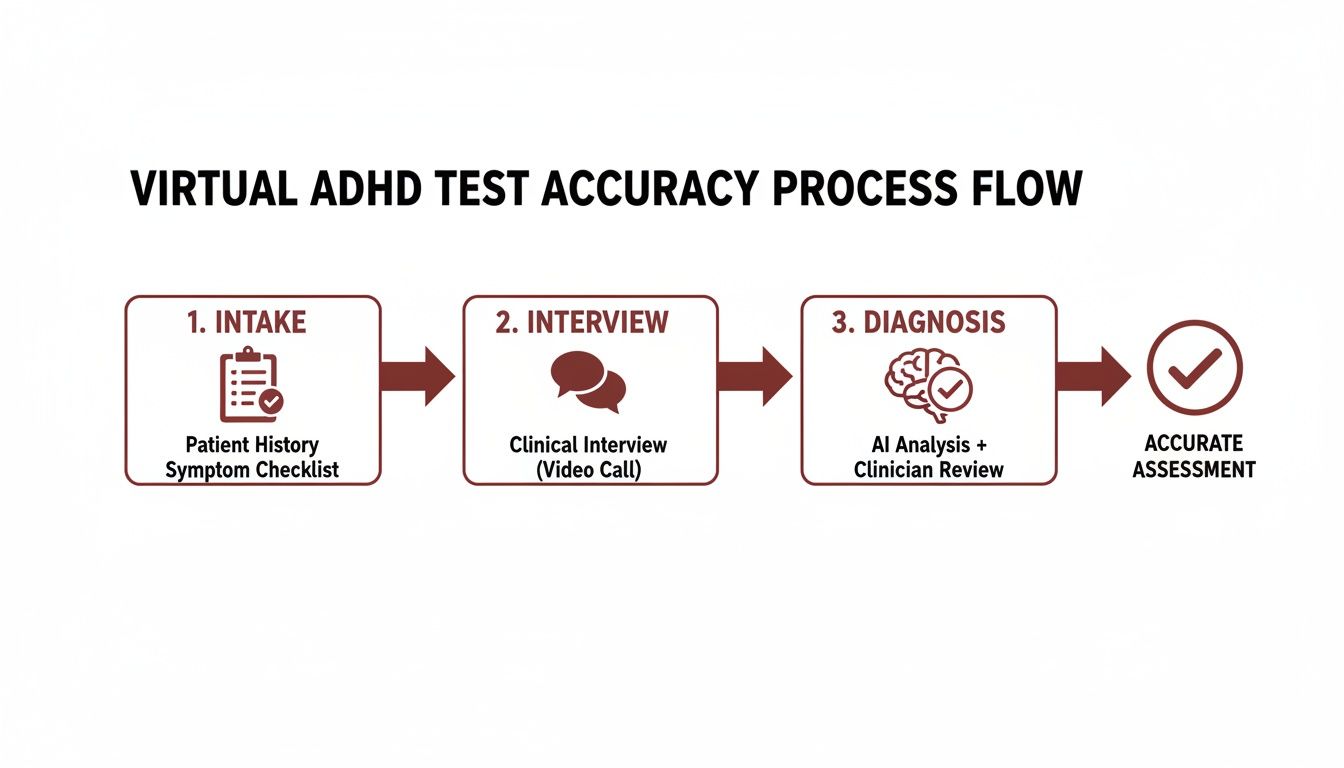
As you can see, the process moves logically from gathering your personal history at the start, to the expert analysis during the interview, and finally culminates in a formal diagnosis.
Understanding Your Diagnostic Results
Once your evaluation is complete, you'll receive official documentation explaining the findings. Depending on what you need it for, there are generally two main options.
- Diagnostic Letter: This is a straightforward, official document that confirms your diagnosis. It’s often exactly what you need for getting medication from your doctor or securing common accommodations at work.
- Comprehensive Diagnostic Report: For those who want a deeper dive, a full report is available. This four-page document includes your history, a complete summary of the findings, and personalized recommendations. It's perfect for sharing with other healthcare providers or your support team.
A formal evaluation is so much more than just a diagnosis; it's a roadmap. The results give you the official paperwork and personalized insights needed to access treatment, ask for support, and start building a life that works with your brain, not against it.
Both of these documents provide the legitimacy required for whatever next steps you plan to take. The Sachs Center offers a clear, two-hour virtual process for ADHD testing online that is specifically designed to provide you with diagnostic clarity and a clear path forward. This transparent approach means you know exactly what to expect, every step of the way.
Using Your Diagnosis to Move Forward
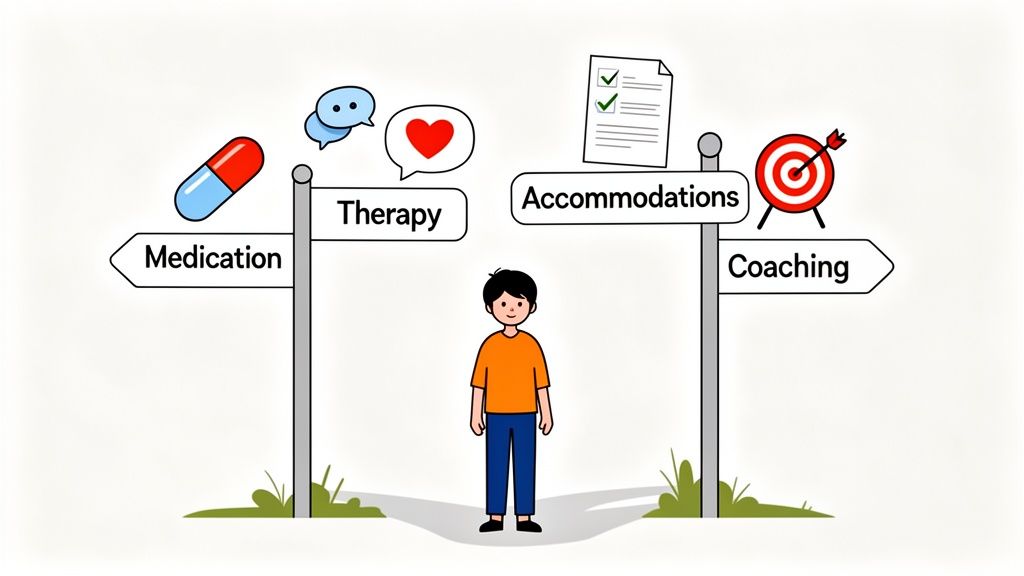
Getting a formal ADHD diagnosis isn’t the finish line; it’s the starting block for a new, more informed chapter of your life. It provides a framework for finally making sense of past experiences and, more importantly, gives you a clear path to accessing real-world support.
With an official diagnosis from a credible adhd test online, you now hold the key to unlocking resources that can make a genuine difference. This formal documentation is exactly what you need to start conversations about medication with a psychiatrist or to secure accommodations at work or school. It’s what turns your invisible struggles into recognized needs.
Accessing Accommodations and Treatment
A diagnosis empowers you to advocate for yourself in concrete ways. The diagnostic letter or report you receive is the official proof required for many types of support.
This includes things like:
- Workplace Accommodations: You can request reasonable adjustments like flexible hours, a quieter workspace, or noise-canceling headphones to help you do your best work.
- Academic Support: Students can use their diagnosis to get access to resources like extended time on exams or assistance with note-taking.
- Medication Management: A formal diagnosis is the first step toward working with a medical provider to explore whether medication is a good fit for you.
This boom in accessible support is reflected in the market's growth. The global demand for online ADHD tests is expanding quickly, with a market valued at around $500 million in 2025 and projected to skyrocket to $1.5 billion by 2033. This trend is being driven by the need for validated, convenient assessments that can be done from home, especially for underserved groups who often mask their symptoms. You can discover more insights about this growing demand for online ADHD testing.
An ADHD diagnosis is more than just a label—it's leverage. It gives you the validation and official documentation needed to build a support system that works with your brain, not against it.
Exploring Targeted Support Options
Beyond medication and formal accommodations, a diagnosis opens up a world of specialized support designed for the neurodivergent brain. Understanding your specific profile lets you find strategies that actually resonate with your needs.
Many people find immense value in therapies like Cognitive Behavioral Therapy (CBT), which can be adapted to target ADHD-specific challenges like procrastination and emotional regulation. Others thrive with specialized ADHD coaching, which focuses on building practical skills for organization, time management, and setting goals. Support groups also offer a powerful sense of community and shared understanding.
For those needing significant academic support, like for standardized tests such as the SAT or GRE, a more in-depth neuropsychological evaluation might be the next step. This comprehensive assessment provides the detailed analysis required for major accommodations, ensuring you have every tool available for your unique journey.
Common Questions About Online ADHD Testing
Even after learning about how it all works, it’s completely normal to have a few more questions before taking the next step. Pursuing an ADHD test online is a big decision, and you deserve to feel confident and fully informed. Let’s tackle some of the most common practical concerns we hear from people just like you.
Our goal here is to clear up any lingering uncertainties so you can move forward on your journey with clarity.
Can I Get a Formal Diagnosis for Medication Online?
Yes, absolutely. A comprehensive clinical evaluation done online by a licensed psychologist can provide a formal, legitimate diagnosis. This is a world away from a free, automated quiz. The process involves a live, in-depth interview and validated assessment tools to ensure the result is both thorough and accurate.
The diagnostic letter you receive after your evaluation is an official medical document. You can take this letter to your primary care doctor or a psychiatrist to discuss medication, since it’s based on a rigorous, professional assessment that meets all established clinical standards.
How Does a Virtual Test Account for Masked ADHD?
This is such an important question. Many adults—especially women and BIPOC individuals—have spent a lifetime becoming experts at masking their ADHD traits. Clinicians who specialize in neurodiversity are trained to see beyond a simple symptom checklist. They know that masking is a common and complex coping strategy.
During the live clinical interview, the psychologist’s job isn't just to check boxes; it's to explore your personal history, your unique coping mechanisms, and your life experiences in detail. They’re trained to spot the subtle but significant ways ADHD can show up atypically. This person-centered approach is crucial for accurately diagnosing highly masked individuals who are so often overlooked in traditional settings.
An experienced clinician understands that ADHD is not a one-size-fits-all condition. They are skilled at recognizing the nuanced, often internalized, symptoms of masked ADHD, ensuring a diagnosis that truly reflects your lived experience.
What Is the Difference Between an ADHD and Neuropsychological Evaluation?
This is a key distinction, and the right choice really comes down to what you need the diagnosis for.
- A Standard ADHD Evaluation is laser-focused on one question: do you meet the criteria for an ADHD diagnosis? This is the type of assessment you’ll typically need to access medication or request common workplace accommodations. It’s an efficient process, like the two-hour evaluation we offer at the Sachs Center.
- A Neuropsychological Evaluation is a much more extensive and in-depth assessment. It’s generally required for individuals seeking major accommodations on big standardized tests like the SAT, GRE, or LSAT. This kind of testing provides a deep dive into various cognitive functions, IQ, and academic skills, resulting in a detailed report used for formal academic plans like an IEP or 504.
While both are valid, choosing the right one depends entirely on your specific goals.
Is the Entire ADHD Assessment Process Virtual?
Yes, the whole process is designed to be completed virtually, right from the comfort of your own home. Using secure telehealth platforms, we can conduct every step of the assessment online, from the initial clinical interview to the computer-based measures.
You’ll even receive your final diagnostic letter or report electronically. We’ve designed it this way for maximum convenience and accessibility, removing the stress and logistical headaches of traveling to an in-person appointment so you can focus on getting the clarity you need.
At Sachs Center, our expert psychologists are specialists in neurodiversity. They are trained to see the person behind the symptoms. If you're ready for a clear diagnosis from a team that truly understands, we're here to help.
Learn more about our virtual ADHD evaluations and book your appointment today.
