

If you've found yourself searching for "autism and ADHD testing near me," you're taking a huge, courageous step toward getting clarity for yourself or someone you love. I know the path to a diagnosis can feel overwhelming, but modern options like telehealth are making it more accessible than ever to finally get some answers.
This guide is here to walk you through the entire process, step by step.
Your Guide to Navigating Neurodivergent Testing
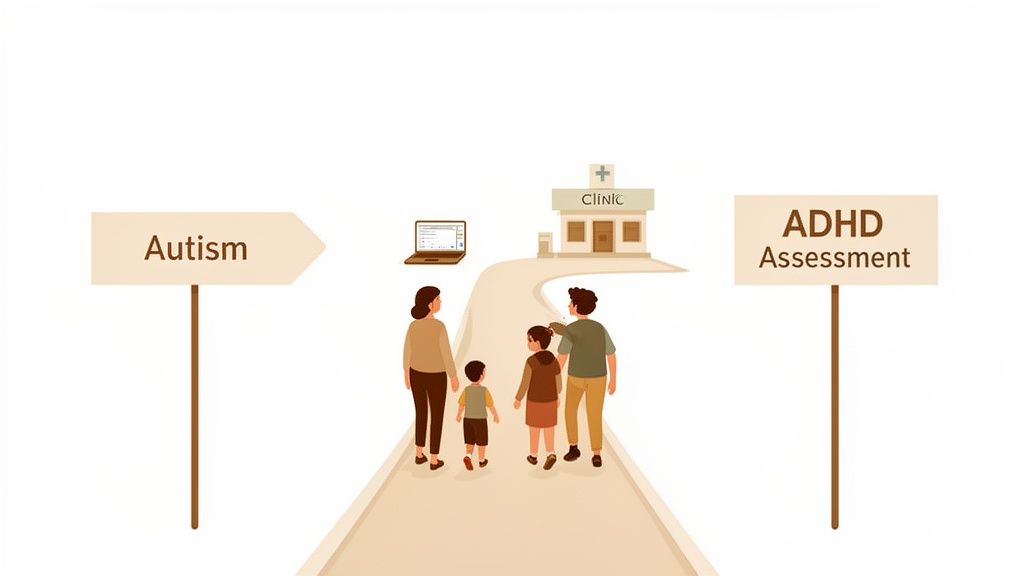
Starting the journey toward an Autism or ADHD evaluation is a big deal. For many adults, it’s the end of a long road of feeling "different." For parents, it's a proactive move to better understand and support their child's unique brain. The demand for autism and ADHD testing near me has shot up recently, mostly thanks to a growing public awareness around neurodiversity.
This shift means we now have a much better handle on how these neurotypes show up differently across genders and backgrounds.
Why More People Are Seeking Evaluations
The old idea of a "typical" presentation for Autism or ADHD is completely outdated. Clinicians now understand that masking—consciously or subconsciously hiding your natural traits to fit in—is incredibly common. This is especially true for women, girls, and BIPOC individuals.
Because of this, many people are now seeking evaluations in adulthood after spending years feeling misunderstood or even getting misdiagnosed with something else.
Some of the biggest reasons people pursue a diagnosis include:
- Seeking Clarity: Finally putting a name to lifelong experiences can be incredibly validating. It's that "aha!" moment.
- Accessing Support: A formal diagnosis is often the key that unlocks workplace accommodations, school support (like an IEP or 504 plan), and the right kind of therapy.
- Understanding Self: A diagnosis gives you a new lens through which to view your past challenges with self-compassion and understanding.
This process isn't about finding something 'wrong' with you. It’s about discovering how your brain is wired. It’s the first real step toward playing to your strengths and getting the right support for your challenges.
The Modern Approach to Testing
Thankfully, you no longer have to live in a major city to find a qualified specialist. Telehealth has completely changed the game for diagnostic testing. Virtual evaluations, done through secure video calls, offer a comfortable, low-stress alternative to traditional in-person appointments.
This approach is a game-changer for neurodivergent individuals who might find new, clinical environments overwhelming or anxiety-inducing. Getting tested from the comfort of your own home often leads to a more accurate reflection of who you truly are.
To get a better sense of what the actual steps involve, you can learn more about how to get tested for autism and what to expect. This guide will walk you through all of it, from picking the right kind of evaluation to making sense of your results.
Choosing the Right Evaluation for Your Needs
When you start searching for "autism and ADHD testing near me," you’ll quickly find that not all evaluations are created equal. The type of assessment you choose has a huge impact on the answers you get and the support you can unlock. Making an informed choice from the get-go can save you a ton of time, money, and frustration down the road.
The most important thing to consider is your goal. Are you looking for personal validation and some basic help at work? Or do you need comprehensive documentation to access university accommodations or state disability services? Let's break down the options so you can align the evaluation with what you actually need.
Diagnostic Evaluation with a Letter
Think of this as the most direct route to getting diagnostic clarity. A Diagnostic Evaluation with a Letter is a focused assessment designed to confirm whether you meet the criteria for Autism, ADHD, or both (AuDHD). It’s efficient and gets straight to the point.
This evaluation is a great fit for adults who need a formal diagnosis for a few specific reasons:
- Workplace Accommodations: Often, a simple diagnostic letter is all you need to request reasonable accommodations under the Americans with Disabilities Act (ADA), like getting a quieter desk or more flexible hours.
- Medication Management: If you're planning to see a psychiatrist for medication, this letter gives them the official diagnostic confirmation they need to start treatment.
- Personal Validation: For many of us, the main goal is simply to have a professional confirm what we've suspected for years. This letter provides that powerful, official validation.
The process usually involves a detailed clinical interview and some standardized self-report forms. It’s typically wrapped up in a single session that lasts a few hours, and you walk away with a concise, official letter stating the diagnosis.
Diagnostic Evaluation with a Full Report
While a letter is great for specific purposes, sometimes you need a much bigger picture. A Diagnostic Evaluation with a Full Report offers a deeper dive into your unique neurotype. It includes everything from the letter-based evaluation but goes much further in explaining the findings.
You’ll get a multi-page document detailing your developmental history, current challenges, the diagnostic results, and—most importantly—a list of personalized recommendations. This comprehensive view is incredibly useful.
This is probably the right path for you if you're dealing with:
- State Disability Services: Applying for state-level support often requires detailed proof of how your condition impacts your day-to-day life. A full report provides exactly that.
- Coordinated Care: When you have a team of therapists, coaches, and doctors, sharing a detailed report ensures everyone is on the same page and working from the same playbook.
- A Holistic Blueprint: The recommendations can serve as a roadmap, suggesting specific therapeutic approaches, coping strategies, or skills to build on.
A full report moves beyond just the "what" (the diagnosis) and explores the "how" and "why." It explains how your neurodivergent traits show up in your life and gives you a clear, actionable plan for moving forward.
Neuropsychological Testing
This is the most intensive and comprehensive evaluation you can get. Neuropsychological Testing is a deep, data-driven assessment that goes far beyond a standard diagnostic interview. It’s the gold standard when you need objective, hard evidence of cognitive strengths and weaknesses.
This type of testing uses a whole battery of standardized tests to measure things like:
- Cognitive abilities (IQ)
- Academic achievement
- Executive functioning skills (planning, organization, etc.)
- Memory and attention
- Emotional functioning
So, who really needs this level of detail? A full neuropsychological evaluation is usually reserved for accessing high-stakes accommodations. You can learn more about what a neuropsychological evaluation for adults involves to see if it’s the right fit.
This is the choice for you if you're seeking:
- Standardized Test Accommodations: To get extended time on exams like the SAT, ACT, GRE, or GMAT, testing boards require the robust data from a full neuropsychological report.
- IEP or 504 Plans: Schools need this kind of in-depth assessment to create an Individualized Education Program (IEP) or a 504 plan for students.
- Complex Diagnostic Questions: If there’s a chance of co-occurring learning disabilities or other complex neurological factors, this evaluation can provide the most definitive answers.
The process is much longer, often taking place over several sessions, and results in a very long, detailed report—sometimes 20 pages or more. While it’s a big investment, the documentation it provides is absolutely essential for unlocking certain types of crucial support.
To make this all a bit clearer, here's a quick comparison of the three main types of evaluations.
Comparing Evaluation Types at a Glance
| Evaluation Type | Best For | What You Receive | Example Cost |
|---|---|---|---|
| Diagnostic (Letter) | Personal validation, workplace accommodations, medication management. | A 1-2 page letter confirming the diagnosis. | $1,000 – $1,500 |
| Diagnostic (Full Report) | State disability services, creating a holistic treatment plan, sharing with a care team. | A 5-10 page report with history, findings, and personalized recommendations. | $2,000 – $3,000 |
| Neuropsychological Testing | High-stakes academic accommodations (SAT, GRE), IEP/504 plans, complex diagnostic questions. | A 20+ page report with comprehensive data on cognitive and functional abilities. | $5,000 – $10,000+ |
Choosing the right evaluation from the start ensures your journey toward understanding and accommodation is as smooth as possible. By matching the assessment to your specific needs, you're setting yourself up for success from day one.
How Telehealth Transforms the Testing Experience
Let's be honest: the idea of traveling to a sterile, unfamiliar clinic can be a huge barrier, especially when you're already feeling anxious about an evaluation. Telehealth completely changes the game. With virtual assessments done over secure platforms like Zoom or Google Meet, you or your child can get tested in the comfort and safety of your own home.
This isn't just about convenience—it’s a critical accommodation. For many neurodivergent people with sensory sensitivities, being in a familiar environment dramatically cuts down on stress and anxiety. It allows for a more authentic and accurate assessment because you're less likely to be masking your natural traits in a high-stress setting.
The practical benefits are huge, too. No travel time, no navigating unfamiliar places, and no sitting in a waiting room. This flexibility makes finding "autism and ADHD testing near me" a real possibility for everyone, whether you're in a remote area or just have a packed schedule.
How a Virtual Evaluation Works
You might be wondering if a remote test can really be as thorough as an in-person one. The answer is a resounding yes. The process is just as rigorous, and we use the same validated assessment tools and clinical interview techniques.
A typical virtual evaluation will include things like:
- An In-Depth Clinical Interview: The psychologist will spend time with you, talking through your developmental history, current challenges, and specific examples from your life.
- Standardized Self-Report Measures: You'll complete validated questionnaires online, which give us quantitative data about your traits and experiences.
- Computer-Based Assessments: Some evaluations may include interactive, computer-based tasks that help us get a clearer picture of cognitive and executive functioning.
To make this all work smoothly and securely, we rely on tools like HIPAA compliant texting apps that ensure your data is protected and communication is secure throughout the remote evaluation process.
The core of a good diagnosis isn't about the room you're in—it's about the expertise of the clinician and the quality of the conversation. Telehealth lets that expert connection happen wherever you feel most comfortable.
With the rising awareness of neurodiversity, we've seen a surge in demand for accessible testing. This decision tree can help you visualize which type of evaluation best fits your goals, whether it’s for work, school, or standardized tests.
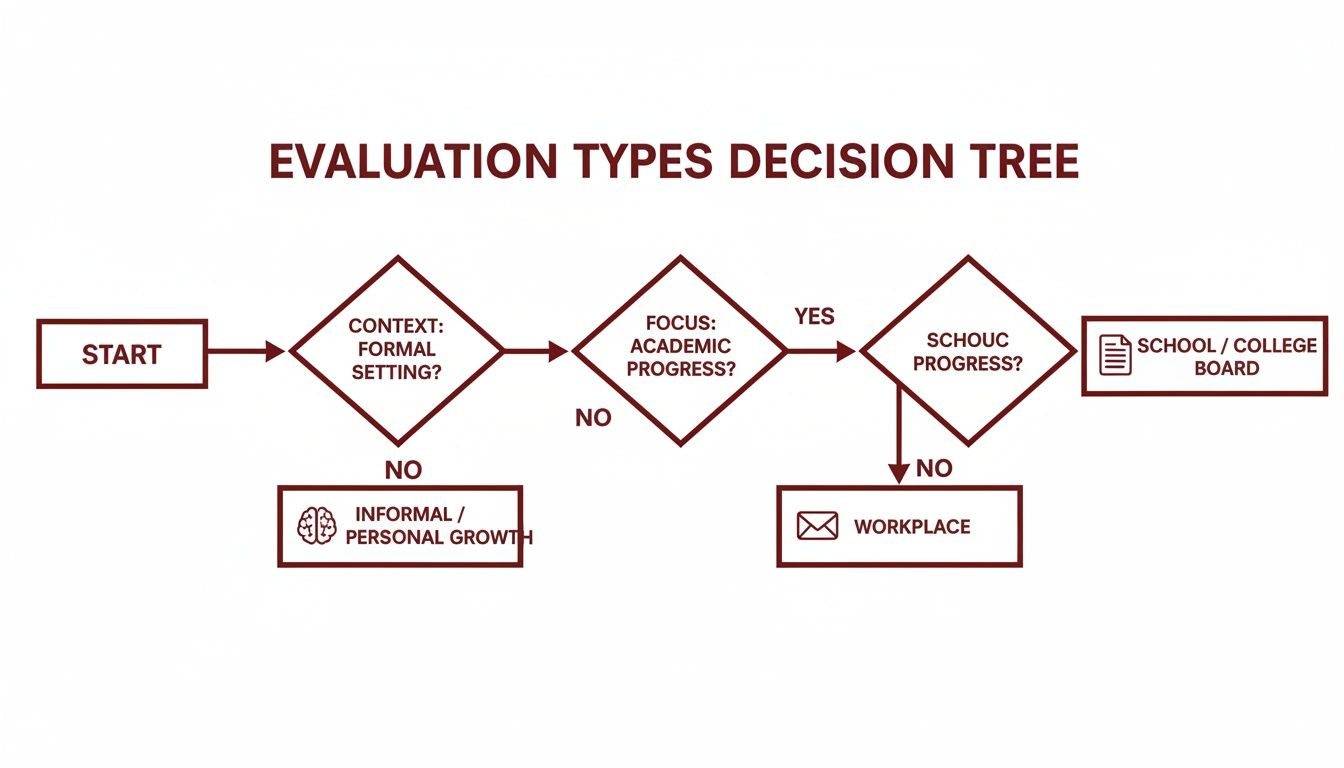
As you can see, the right evaluation really just depends on what kind of documentation your specific situation requires.
Meeting the Growing Demand for Answers
The need for efficient, accurate testing has never been more pressing. By late 2023, an estimated 15.5 million US adults had an ADHD diagnosis, with about half of those diagnoses happening in adulthood. This just goes to show that neurodivergence isn't only a childhood issue.
Telehealth services are perfectly positioned to meet this demand. We offer virtual 2-hour evaluations that help you bypass the long waitlists that are so common at traditional clinics.
This online approach is particularly powerful for identifying masked symptoms in women, girls, and BIPOC individuals—groups that have been historically underdiagnosed. By providing a safe, accessible space, telehealth empowers more people to seek and receive the validation and support they need. The ability to connect with a specialist right from home removes huge barriers, turning what can feel like a daunting process into a manageable step toward self-understanding.
You can learn more about our specific approach to telehealth neuropsychological testing to see how we make the process comfortable and effective.
How to Prepare for Your Diagnostic Evaluation
Walking into a diagnostic evaluation can feel intimidating, but a little prep work can make a world of difference. When you come prepared, it helps calm your nerves and gives the psychologist a complete and accurate picture of your life.
This isn't about studying for a test. It's about gathering the threads of your life story so the clinician can help you weave them together into a clear picture. Putting in this time beforehand leads to a smoother, more productive session, which is a key step when you’re looking for autism and ADHD testing near me.
Dig Up Your Historical Documents
Your past holds important clues. Clinicians are looking for lifelong patterns, so digging up old documents provides objective evidence of challenges that existed long before you even considered an evaluation. Think of yourself as a detective piecing together your own history.
What should you look for? Start here:
- School Report Cards: Look for comments from teachers about being "daydreamy," "disruptive," "socially quiet," or "not living up to potential." These are classic, often-overlooked signs.
- Work Performance Reviews: Do any reviews mention struggles with deadlines, organizational skills, or "soft skills" in communication? For adult evaluations, these can be incredibly telling.
- Notes from Previous Therapists: If you've seen other mental health professionals, any notes or summaries they provided can offer valuable context for the evaluator.
Even finding just a few items can back up your own memories and experiences, making them powerful tools in the diagnostic process.
"Your life is the data. The more of it you can bring to the table, the clearer the picture becomes. Old report cards aren't just paper; they're puzzle pieces that help build a complete and accurate diagnostic profile."
Create a "Life Examples" List
It’s completely normal for your mind to go blank under pressure. To make sure you don't forget key details, spend some time before your appointment jotting down specific, real-world examples of the challenges that led you here. A vague statement like "I'm disorganized" is far less helpful than a concrete example.
Try organizing your notes into different life categories. This structure makes it much easier to recall specific instances during your interview.
At Home
- Forgetting to pay bills, even when you have the money in your account.
- Feeling completely overwhelmed by household chores, leading to "doom piles" of laundry or mail.
- Misplacing important items like your keys or wallet multiple times a week.
At Work or School
- Putting off big projects until the absolute last minute, causing intense stress and late nights.
- Finding it impossible to follow along in long meetings or lectures.
- Struggling to navigate the social dynamics with coworkers or peers.
In Social Situations
- Feeling utterly drained after social gatherings, even ones you enjoyed.
- Rehearsing conversations in your head over and over before they happen.
- Frequently misunderstanding sarcasm, idioms, or non-literal language.
If you’re a parent preparing for your child's evaluation, try to focus on developmental milestones and specific behavioral patterns you’ve noticed. Jot down when they started talking, any sensory sensitivities (like to loud noises or clothing tags), and how they play with other children. Bringing these detailed notes ensures you won’t forget critical information when you’re in the moment.
So You Have a Diagnosis. Now What?
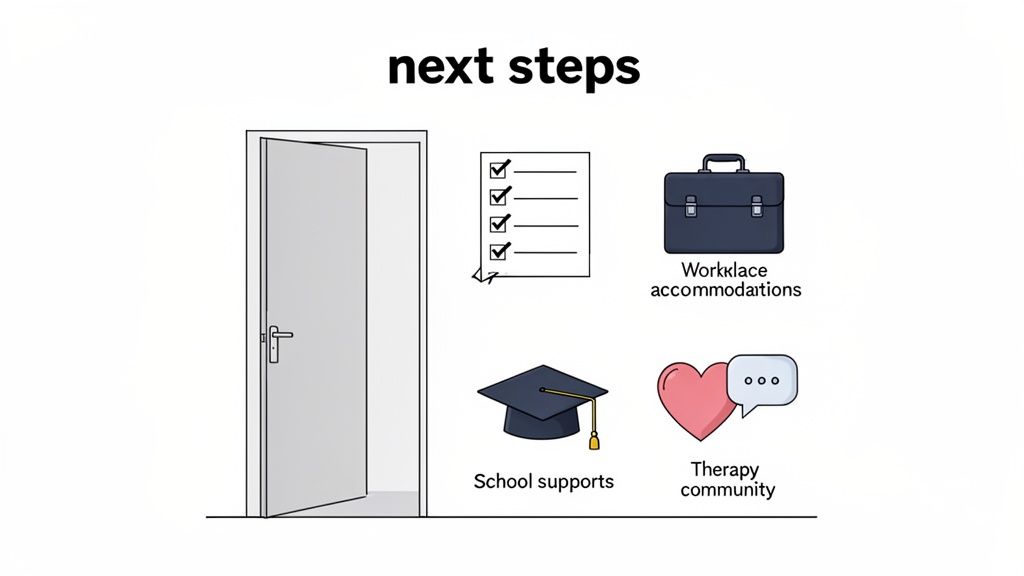
Getting a diagnosis of Autism, ADHD, or both (AuDHD) is a huge moment. For many, it's not an end point but a beginning—a doorway to a new way of understanding yourself with more compassion and clarity. Think of this formal confirmation as the key that unlocks supports designed to help you actually thrive, not just survive.
That diagnostic letter or report is far more than a piece of paper. It's your tool. With this documentation in hand, you can finally access services and accommodations that might have been out of reach before. It validates your lived experiences and gives you the official standing to ask for what you need.
This is especially true today, as awareness and diagnosis rates continue to climb. The number of autism diagnoses has jumped over 300% in the last two decades in the U.S. alone. In fact, new 2025 data estimates 1 in 31 children are autistic, a massive leap from the 1 in 150 figure from just 22 years ago. You can learn more about how better screening contributes to these numbers in recent public health research.
Turning Your Diagnosis Into Action
The first step is figuring out how to use your diagnostic documentation. Depending on your goals, this could mean a few different things. For many adults, it’s about making immediate, practical changes at work or with their healthcare.
For instance, you can bring your diagnostic letter to your primary care doctor or a psychiatrist to discuss medication for ADHD. The letter provides the clinical confirmation they need to feel confident in prescribing and managing treatment.
It also empowers you to request workplace accommodations under the Americans with Disabilities Act (ADA). These aren't special favors; they're reasonable adjustments meant to level the playing field so you can do your best work.
Common accommodations might include:
- A flexible work schedule to manage energy fluctuations or appointments.
- Noise-canceling headphones or a desk in a quieter spot to handle sensory input.
- Written instructions and checklists to support executive functioning.
- Permission to work from home a few days a week to create a more predictable environment.
For parents, a full diagnostic report is your most powerful tool for advocating for your child at school. It’s the primary document you'll use to request an Individualized Education Program (IEP) or a 504 plan, both of which legally require the school to provide specific supports.
"A diagnosis is not a label that limits you. It's a lens that clarifies your past, explains your present, and empowers you to build a future that aligns with how your brain actually works."
Moving Toward a Strengths-Based Mindset
Beyond the logistics of accommodations, a diagnosis is an invitation to reframe your entire perspective. This isn't about "fixing" deficits. It's about understanding your unique cognitive wiring and learning to work with it, not against it. That’s the heart of a strengths-based approach.
This mindset shift is often best supported by finding the right kind of therapy. Many neurodivergent people find that traditional talk therapy just doesn't click. Instead, more structured, educational, and skills-based approaches can be life-changing.
Finding Therapy That Actually Fits
Look for therapies designed with neurodivergent brains in mind. These services focus on giving you practical skills and a deeper understanding of yourself, rather than just talking about feelings.
Here are a few highly effective options to look into:
- Cognitive Behavioral Therapy (CBT): A therapist who is trained in neurodiversity can adapt CBT to help you build real-world strategies for things like executive dysfunction, emotional regulation, and social anxiety.
- Psychoeducation: This is simply the process of learning about your neurotype. Understanding the why behind your behaviors—why you get overwhelmed in crowds or can’t seem to start a task—is incredibly validating and helps dissolve years of self-blame.
- Specialized Groups and Coaching: There's nothing quite like connecting with people who just get it. Neurodivergent-led social groups, community forums like neurotribes, or life skills coaching provide both community and practical guidance in a setting where you don't have to explain yourself.
The search for "autism and ADHD testing near me" was the first step on a new path. Your diagnosis is the map. Now, armed with new knowledge and powerful tools, you get to decide where to go next.
Your Questions About Autism and ADHD Testing, Answered
Deciding to get an evaluation for yourself or your child brings up a ton of questions. That’s completely normal. You deserve clear, straightforward answers to feel confident about taking the next step.
This section is all about tackling the most common concerns we hear from people looking for autism and ADHD testing near me. We'll walk through everything from how virtual testing works to the nitty-gritty of insurance and what our reports actually look like.
Are Virtual ADHD and Autism Tests Accurate?
Yes, absolutely. When a qualified specialist conducts a virtual evaluation for ADHD and autism, it is just as accurate and valid as an in-person one. We use the same evidence-based, gold-standard tools, like clinical interviews and self-report measures, that you'd find in a traditional office setting.
The biggest difference is the environment, and honestly, that’s often a huge plus. For many neurodivergent people, being in a familiar, comfortable space like home reduces the anxiety that can trigger "masking" — the tendency to hide your natural traits. This can lead to a more authentic and honest picture of your experiences.
Our psychologists are experts at administering these tests remotely. They know how to maintain the integrity of the diagnostic process and ensure the results are precise and reliable.
Will My Insurance Cover the Cost of an Evaluation?
Figuring out insurance can feel like one of the most confusing parts of this journey. We are an out-of-network provider, which means we don't bill insurance companies directly. But that doesn't mean you're out of options for getting reimbursed.
Here’s how it usually works:
- You pay for the service upfront. This lets us secure your appointment and get started right away.
- We give you a "superbill." Think of this as a detailed, itemized receipt with all the specific diagnostic and service codes your insurance company needs to process a claim.
- You submit the superbill to your insurer. From there, you can seek reimbursement directly from them, depending on your plan’s out-of-network benefits for psychological testing.
We always suggest being proactive. Before you book anything, give your insurance provider a call and ask specifically about your "out-of-network coverage for psychological or neuropsychological assessments." Taking this one simple step can save you a lot of headaches and give you a clear idea of what to expect financially.
What Is the Difference Between a Diagnostic Letter and a Full Report?
Knowing the difference between a diagnostic letter and a full report is crucial for picking the right evaluation. Both confirm a diagnosis, but they’re designed for different purposes and offer very different levels of detail.
A diagnostic letter is a concise, one- or two-page document. Its main job is to officially state your diagnosis. This is often all you need for goals like:
- Getting medication from a psychiatrist or your primary doctor.
- Requesting basic workplace accommodations under the ADA.
- Simply getting personal validation and clarity.
On the other hand, a full diagnostic report is a much more comprehensive, multi-page document. It paints a complete picture of you as a whole person, detailing your personal history, current struggles, the specific diagnostic findings, and a list of personalized recommendations for treatment and support. This robust report is the better choice for:
- Securing an IEP/504 plan for a student.
- Applying for state-level disability services.
- Sharing with other healthcare providers to make sure your care is coordinated and well-informed.
How Do You Test for Masked Autism or ADHD?
This is one of the most important questions we get, especially from women and BIPOC individuals who have felt invisible to the healthcare system for years. Outdated checklists and rigid diagnostic models just don't capture the nuanced ways neurodiversity can present when it's been masked.
Our clinicians are specifically trained to look beyond the surface. We understand that years of camouflaging traits to fit in requires a more investigative and compassionate approach.
Our evaluation goes deeper by:
- Focusing on the Clinical Interview: We use this in-depth conversation to explore your early childhood, social dynamics, and the sheer amount of energy it takes to "perform" neurotypicality.
- Using Sensitive Assessment Tools: We carefully select validated measures that are better at picking up on the internal experiences and subtle traits tied to masking.
- Creating a Safe Space: Most importantly, we cultivate a non-judgmental environment where you can feel comfortable sharing your true, unmasked self without fear of being dismissed or disbelieved.
This blend of human conversation and clinical data allows us to arrive at an accurate diagnosis that truly honors your lived experience.
At the Sachs Center, we specialize in providing clear answers and compassionate support through telehealth testing for Autism and ADHD. If you're ready to take the next step toward understanding yourself or your child, we invite you to book an evaluation with our expert team.
Book Your Evaluation at sachscenter.com
