

ADHD and anxiety are two different conditions, but for many people, they're tangled together in a way that can feel confusing and overwhelming. The constant stress of managing ADHD—the disorganization, the missed deadlines, the impulsivity—can easily spin off into persistent worry and unease. Getting a handle on this connection is the first real step toward managing both effectively.
The Overlapping Worlds of ADHD and Anxiety
Living with both ADHD and anxiety is like trying to listen to a specific radio station while a powerful static feedback loop keeps cutting in. One part of your mind is desperately trying to focus, get organized, and just get things done. At the same time, another part is constantly scanning for threats, replaying past mistakes, and panicking about what might go wrong next. It’s a state of non-stop mental noise that is utterly exhausting.
This isn't a coincidence; it's a well-documented relationship. Research consistently shows that up to 47% of adults with ADHD also have an anxiety disorder. This makes it one of the most common co-occurring conditions in mental health. In fact, anxiety shows up in people with ADHD at more than double the rate of the general population. For a deeper dive into this data, CHADD offers some excellent resources on this significant overlap.
How ADHD Fuels Anxiety
The daily experience of an ADHD brain can create the perfect storm for anxiety to take hold. The core challenges of ADHD don’t just happen in a vacuum—they have real-world consequences that generate stress, self-doubt, and fear.
- Chronic Stress from Executive Function Challenges: When you’re constantly missing deadlines, forgetting important appointments, or struggling to keep your thoughts straight, life feels persistently stressful. This isn't a rare event; it's a daily grind that keeps your body’s "fight or flight" response on high alert.
- Negative Feedback and Self-Esteem: After years of being told to "just try harder" or feeling like you're constantly letting people down, your self-esteem can take a serious hit. This can build a core belief that you are simply not capable, which can lead to social anxiety or a paralyzing fear of failure.
- The Rejection Sensitive Dysphoria (RSD) Connection: Many people with ADHD experience an intense, painful emotional reaction to perceived criticism or rejection. This heightened sensitivity can make social interactions feel like walking through a minefield, naturally creating avoidance and anxious anticipation.
"Think of it this way: ADHD provides the dry kindling—the missed appointments, the social missteps, the unfinished projects. Anxiety is the spark that ignites it, turning everyday challenges into a bonfire of worry and dread."
Recognizing the Cycle
This relationship often locks people into a difficult cycle. The executive dysfunction from ADHD creates situations that cause anxiety. Then, the overwhelming feelings of anxiety make ADHD symptoms like inattention and task paralysis even worse. For example, the fear of failing a test (anxiety) can make it impossible to even start studying—a task that was already tough to begin with because of ADHD.
Breaking this cycle starts with understanding that you aren't just "bad at life" or a "natural worrier." You're managing two powerful, interconnected conditions. This isn't about making excuses; it's about gaining clarity. With this insight, you can finally start to untangle the knot and find strategies that address both the static and the tuning, allowing you to find your frequency and feel in control.
Decoding Your Symptoms: Is It ADHD, Anxiety, Or Both?
At a glance, ADHD and anxiety can feel indistinguishable. Both can leave you feeling restless, on edge, and completely overwhelmed, making it a real challenge to figure out what’s actually going on. The secret to untangling this knot lies in understanding why these symptoms are happening.
Think of it this way: imagine two people sitting at a desk, unable to focus on their work. The person with ADHD is distracted because their brain is desperately seeking stimulation—a bird flying by, a new email notification, literally anything more interesting than the task at hand. The person with anxiety is also distracted, but their mind is caught in a worry loop, replaying a mistake from yesterday or catastrophizing about what might happen tomorrow.
The outward behavior looks the same, but the internal experience couldn't be more different.
This is a common dynamic. The day-to-day stress of managing ADHD—like forgotten appointments or missed deadlines—can easily snowball, creating the perfect conditions for an anxiety disorder to take root.

This flowchart shows how untreated ADHD isn't just about focus; it's a chronic stressor that can build over time and manifest as a completely separate, co-occurring anxiety disorder.
Unpacking the Symptom Overlap
To really get to the bottom of things, we need to look under the hood. Let's break down some of the most common overlapping symptoms and see how they show up differently in ADHD versus anxiety. This is a crucial distinction because a strategy that helps an under-stimulated ADHD brain often falls flat for an over-stimulated, anxious one.
Restlessness is another big point of confusion. For someone with ADHD, that constant need to move—fidgeting, tapping their foot, pacing—is often a way to self-regulate and even improve focus. For a person with anxiety, restlessness feels more like a wound-up, jittery tension. It’s the body’s alarm system stuck in the "on" position.
One is an engine that needs to run; the other is a fire alarm that won’t shut off.
Symptom Overlap: ADHD vs. Anxiety
The table below offers a clearer picture of how these shared symptoms present differently depending on what’s driving them. Recognizing these nuances can be the first step toward getting an accurate evaluation—which is absolutely essential for effective treatment.
| Symptom | How It Looks in ADHD | How It Looks in Anxiety |
|---|---|---|
| Difficulty Concentrating | The mind drifts toward more interesting thoughts or gets pulled away by external distractions. It’s a battle for stimulation. | The mind is hijacked by worry, fear, or "what if" scenarios, making it impossible to focus on the present. |
| Restlessness & Fidgeting | Stems from hyperactivity—a physical need for movement to feel regulated and maintain focus (e.g., foot-tapping, pacing). | A physical sign of internal tension; feeling "on edge" or unable to relax because the nervous system is on high alert. |
| Task Avoidance | Procrastination kicks in because a task is boring, overwhelming, or lacks an immediate reward. The brain simply resists engaging. | Avoidance is driven by a fear of failure, judgment, or making a mistake. The anxiety about the outcome prevents starting. |
| Poor Sleep | The classic "busy brain" at night. Difficulty shutting off a mind that’s buzzing with ideas, plans, and random thoughts. | Trouble sleeping is caused by persistent worry, ruminating on past events, or feeling anxious about the next day. |
| Irritability | Often comes from frustration with executive function struggles, feeling misunderstood, sensory overload, or just plain boredom. | Stems from feeling constantly overwhelmed, stressed, or on guard against perceived threats and worries. |
This comparison makes it clear why a one-size-fits-all approach just doesn't work. If you only treat the anxiety when underlying ADHD is the primary source of stress, you're bound to feel stuck and frustrated.
Ultimately, trying to figure this out on your own can only get you so far. The relationship between ADHD and anxiety is incredibly complex, and very often, people are genuinely dealing with both at the same time. This is where a professional evaluation, like those we offer at the Sachs Center, becomes invaluable. A thorough diagnostic process can pinpoint the true source of your symptoms, creating a clear path toward a treatment plan that addresses your unique needs.
Why an Accurate Diagnosis Is Your First Step to Relief
Trying to manage your symptoms without a clear diagnosis is a lot like trying to find your way through a new city without a map. You might get lucky and make a few right turns, but more often than not, you'll just end up lost, frustrated, and completely exhausted. When it comes to the tricky relationship between ADHD and anxiety, getting an accurate, professional diagnosis isn’t just a formality—it’s the only way to find real, lasting relief.
A common pitfall is treating only the anxiety when undiagnosed ADHD is the real engine driving the stress. It’s like frantically mopping up a flooded floor without ever fixing the leaky pipe. You might feel like you're making progress for a little while, but the underlying issue keeps creating chaos, leading to a frustrating cycle and the feeling that "nothing works."
The Dangers of an Incomplete Picture
Without a proper evaluation, you risk using the wrong tools for the job. A therapist, for example, might use classic anxiety techniques to address why you're avoiding a task, not realizing the root cause is ADHD-related executive dysfunction—not a fear of failure. This mismatch can make you feel like you're the one failing, when in reality, the strategy was simply wrong for your brain's wiring.
This is especially critical for kids and teens. While research shows about 18% of children with ADHD also have an anxiety disorder, some surveys suggest that number is closer to 33%. This overlap can turn school and home life into a daily battleground. It also significantly increases the risk of misdiagnosis for families, especially for girls, whose ADHD symptoms are often mistaken for anxiety. You can explore more data on how these conditions coexist in children.
What a High-Quality Evaluation Involves
A quick online quiz or a short chat with your doctor simply isn't enough to untangle the knot of ADHD and anxiety. A truly effective diagnostic process is a deep dive into your personal history and the challenges you're facing right now. At the Sachs Center, we believe a proper evaluation is the foundation for any successful treatment plan.
A thorough assessment should always include:
- A Detailed Clinical Interview: This isn't just a Q&A session. It's a comprehensive conversation about your developmental history, your experiences in school and work, your relationships, and your family background. It helps the clinician see the full picture of how your symptoms have shown up over your lifetime.
- Validated Assessment Tools: These are standardized, research-backed questionnaires and scales that you (and sometimes family members or partners) complete. They give us objective data that helps tell the difference between ADHD, anxiety, and other conditions.
- A Holistic Review of Your Life: A skilled clinician looks beyond a simple checklist. They want to understand how symptoms actually play out in your day-to-day life—at your job, at home, and in your relationships—to grasp their unique impact on you.
"An accurate diagnosis is your personalized roadmap. It doesn't just give you a label; it gives you direction, explaining why you struggle and illuminating the most effective path forward."
Investing in a high-quality evaluation brings clarity and validation. It shifts you from a place of confusion and self-blame to one of understanding and empowerment. This clear diagnostic picture is the only way to build a targeted, effective treatment plan that addresses the true source of your challenges, setting you up for genuine progress and a calmer, more controlled life.
Practical Strategies for Managing Both Conditions
Tackling both ADHD and anxiety at the same time feels like a juggling act. It’s not just about treating one or the other; it’s about understanding how they feed into each other and finding strategies that address the whole picture. Think of it like gardening: you can’t just pull the weeds (anxiety) without also enriching the soil (addressing the underlying ADHD). A single solution rarely works. Instead, combining a few evidence-based methods gives you a solid foundation for long-term well-being.
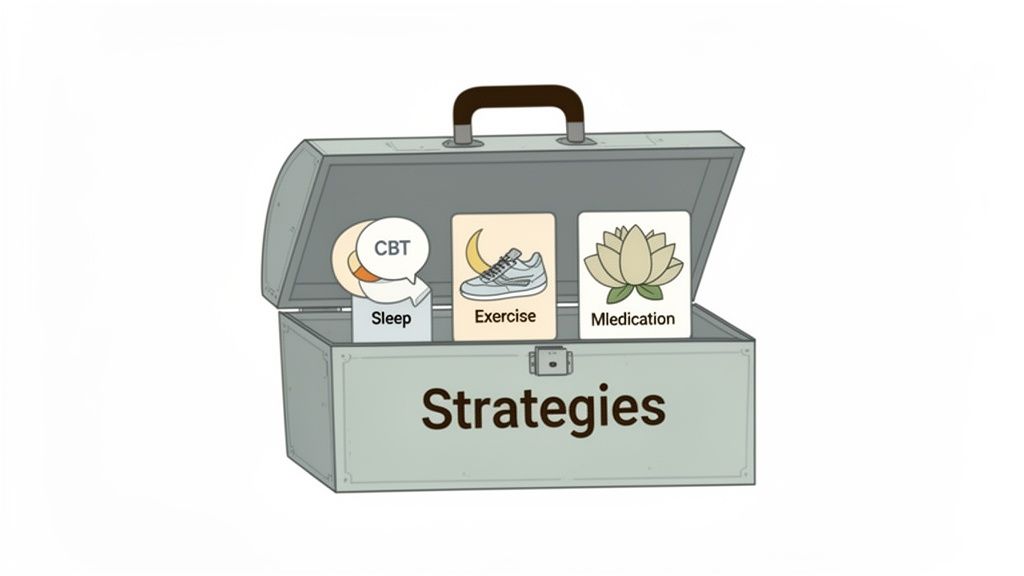
This is an active process. It’s about figuring out which tools are right for you and learning how to use them effectively. Let's walk through some of the most powerful strategies we use with our clients.
Cognitive Behavioral Therapy: A Powerful Dual-Action Tool
Cognitive Behavioral Therapy (CBT) is a game-changer for both ADHD and anxiety, but it needs a specific twist. Standard CBT for anxiety is great at helping you challenge those spiraling, negative thoughts. But when ADHD is part of the equation, the therapy also has to get to the root of why those anxious thoughts are happening in the first place—often, it’s the executive function struggles.
An adapted form of CBT helps you do two things:
- Reframe Anxious Thoughts: It gives you the tools to catch and challenge that catastrophic "what if" thinking that anxiety loves. Instead of thinking, "I'm going to get fired because I missed this deadline," you learn to reframe it: "I missed a deadline, and that's a problem. What is one small, practical thing I can do right now to start fixing it?"
- Build Executive Functioning Skills: CBT for ADHD isn't just talk therapy; it’s about building practical skills. You'll learn concrete strategies for organizing your day, managing your time, and just getting started on tasks. It helps you break down overwhelming projects into tiny, manageable steps, which cuts down on the paralysis that fuels both procrastination and anxiety.
If you're looking to try these techniques on your own, a structured guide is a fantastic starting point. You can get a feel for the process by downloading our free CBT workbook PDF, which is packed with practical exercises to get you started.
Medication Considerations: Finding the Right Balance
Medication is often a key piece of the puzzle, but it gets tricky when ADHD and anxiety are living side-by-side. Stimulants are incredibly effective for ADHD, but for some people, they can ramp up feelings of jitteriness or anxiety. For many others, however, treating the ADHD actually calms everything down, because life becomes less chaotic and stressful.
A good clinician won't just hand you a prescription; they'll work with you to find the right balance. This might involve:
- Stimulants: Usually the first thing to try for ADHD. They can dramatically improve focus, which in turn reduces the daily chaos that so often triggers anxiety.
- Non-Stimulants: A great alternative if stimulants make your anxiety worse. They work differently in the brain to provide steadier, all-day symptom control without the "kick."
- SSRIs or other Anti-Anxiety Medications: Sometimes, the best approach is a combination—an ADHD medication to help with executive function and an SSRI to directly target the anxiety.
It's also helpful to be aware of other options that can help with the physical symptoms of anxiety. For example, learning about medications like can offer another avenue for relief.
The Sachs Protocol: A Strengths-Based Approach
Here at the Sachs Center, we developed an integrated method we call the Sachs Protocol. This isn't about "fixing" deficits. It’s a strengths-based approach that helps you build resilience by leaning into what makes you unique. We recognize that a neurodivergent brain comes with incredible talents and perspectives.
The heart of this protocol is simple: we combine proven therapies like CBT with psychoeducation. We want to empower you to understand exactly how your brain works. This cuts down on the self-blame and helps you advocate for what you need. When you get the "why" behind your challenges, the strategies just work better.
This method is all about building a life that fits your brain, not forcing your brain to fit into a neurotypical world. It's about creating systems and routines that play to your strengths, which naturally leads to more confidence and less anxiety.
Foundational Lifestyle Supports
Therapy and medication are the heavy lifters, but they need a strong foundation to work best. Simple, daily habits can act as a powerful buffer against both ADHD and anxiety symptoms.
- Consistent Exercise: Physical activity is one of the best things you can do. It boosts dopamine and norepinephrine (which help with focus) while also giving all that anxious energy somewhere to go.
- Mindfulness and Meditation: We know—for a brain that’s always “on,” sitting still to meditate can feel impossible. But even a few minutes a day helps train your attention, stop the endless loop of worries, and lower your overall stress.
- Prioritizing Sleep Hygiene: ADHD and anxiety both love to mess with sleep. A consistent, calming bedtime routine is non-negotiable. Think no screens, a dark room, and a set schedule. Good sleep is crucial for emotional regulation and clear thinking.
By weaving these targeted treatments and foundational supports together, you create a complete plan that honors the complexity of having both ADHD and anxiety. It’s a path toward a calmer, more focused, and more authentic life.
Securing Accommodations at School and Work
Navigating school or your career with both ADHD and anxiety can feel like an uphill battle, but you absolutely don't have to go it alone. Securing accommodations isn't about getting an unfair advantage; it’s about leveling the playing field so you have a fair shot at showing what you can do.
Think of it this way: if you needed glasses to see clearly, no one would tell you to just "try harder" to read the board. Accommodations are the exact same principle. They are simply tools that help bridge the gap between your natural abilities and the demands of a neurotypical environment.
Understanding Your Rights and Options
Accommodations can look different depending on your specific needs and the setting, whether it's a classroom or an office. They are practical adjustments designed to minimize how your symptoms impact your performance. The whole point is to create an environment where you can actually thrive.
Some common and highly effective examples include:
- Extended Time on Tests and Deadlines: This simple change can dramatically reduce the anxiety that comes from feeling rushed, giving your ADHD brain the processing time it needs to perform well.
- A Quiet Workspace: Minimizing auditory and visual distractions is a game-changer for focus. It helps quiet both the noise in the room and the anxious chatter in your head.
- Use of Noise-Canceling Headphones: This allows you to create your own bubble of concentration, which is especially helpful in a busy open-plan office or a chaotic classroom.
- Written Instructions: When tasks are provided in writing, it helps bypass working memory challenges and gives you a clear reference point, which can reduce the fear of forgetting a crucial detail.
These supports are designed to target the very real challenges that pop up at the intersection of ADHD and anxiety. For a much deeper dive into what's possible, check out our guide on accommodations for ADHD and autism in the workplace.
How a Formal Diagnosis Unlocks Support
To get access to these kinds of accommodations, you need official documentation. This is where a formal diagnostic report from a qualified professional becomes your most powerful tool for self-advocacy. It provides the proof that institutions need to see that your request is based on a legitimate, diagnosed medical need.
But it's important to know that not all diagnostic reports are created equal. The type of documentation you'll need depends entirely on what you're trying to achieve.
For most workplace accommodations, a standard diagnostic letter or a brief report—like those we offer at the Sachs Center—is often all that's required. It clearly states your diagnosis and validates your request for reasonable adjustments.
When You Need Comprehensive Testing
The rules change for high-stakes situations, especially standardized tests like the SAT, GRE, GMAT, or ACT. In these cases, a simple diagnostic letter almost never cuts it. These testing organizations demand a much more in-depth level of proof to grant accommodations like extended time.
This is where comprehensive neuropsychological testing is essential. This in-depth evaluation goes far beyond just a diagnosis; it measures specific cognitive and executive function deficits. It provides the detailed, objective data that testing boards require to justify your accommodations.
The reality is, over 80% of adults with ADHD have at least one co-occurring condition, and anxiety disorders are incredibly common among them. This combination significantly increases impairment, making robust support systems even more critical. For students facing major exams, neuropsychological testing is the key to documenting this impairment and securing the support they need to perform at their true potential.
Ultimately, whether you need a straightforward diagnostic report or a full neuropsychological workup, having the right documentation is the first, most important step toward building a supportive environment where you can truly succeed.
How to Begin Your Evaluation at The Sachs Center
Taking that first step toward getting clarity on your symptoms can feel like a huge hurdle, especially when anxiety is in the mix. We get it. That’s why we’ve designed our entire evaluation process to be as straightforward and stress-free as possible. The Sachs Center is a telehealth-first practice, which means every assessment for ADHD and anxiety happens virtually.
This approach lets you connect with one of our expert psychologists right from the comfort of your own home. No stressful commutes, no unfamiliar waiting rooms. A virtual evaluation provides a calm, controlled setting where you can feel more relaxed and share your experiences openly.

Finding the Right Evaluation for You
We offer a couple of different evaluation options to meet your specific needs. This way, you get exactly the level of detail and documentation you need for your unique goals. We believe in being completely transparent, so our process and pricing are simple and clear.
Our evaluation options include:
- Diagnostic Testing + Letter: This two-hour virtual evaluation provides a formal diagnosis for ADHD, Autism, or both. It’s perfect for individuals who need diagnostic clarity to move forward with medication management through their doctor or to secure workplace accommodations. The cost is $790 for a single diagnosis.
- Diagnostic Testing + Comprehensive Report: This option includes the full evaluation plus a detailed, four-page report. This is the best choice if you want a much deeper understanding of how your symptoms impact your life and need a robust document to share with other healthcare providers. The cost is $1190 for a single diagnosis.
Our specialized psychologists are experts in neurodiversity. We focus on person-centered care, recognizing the unique strengths that come with your brain's wiring while providing a clear path to managing your challenges.
Ready to Take the Next Step?
Getting an accurate diagnosis is a powerful act of self-advocacy. It's the first real step toward building a life that works for your brain, not against it. We’ve made our process supportive and simple from the moment you reach out.
If you’re ready to move forward and get the clarity you deserve, you can schedule your evaluation directly on our website. Our team is here to guide you, answer your questions, and provide the expertise you need to finally understand the connection between your ADHD and anxiety.
Common Questions About ADHD and Anxiety
When you're trying to make sense of ADHD and anxiety, it's natural to have a lot of questions. Here are some clear, straightforward answers to the questions we hear most often, designed to give you some practical guidance as you figure out your next steps.
Can ADHD Medication Make My Anxiety Worse?
That's a really common and valid concern. The honest answer is: it depends on the person.
For many people, stimulant medication is a game-changer. By improving focus and quieting the mental chaos, it actually reduces the overwhelm that often fuels anxiety. When you can finally complete tasks and manage your life with less friction, that relief can be a powerful antidote to constant worry.
However, for some, stimulants can ramp up physical tension or a jittery feeling, which can feel a lot like anxiety or even make it worse. This is where working with a skilled clinician is crucial. They will watch your response closely. If stimulants aren't a good fit, they might suggest non-stimulant medications or add another treatment to help manage both conditions effectively.
Is It Possible to Have Anxiety Without ADHD?
Absolutely. Anxiety disorders are incredibly common and very often stand on their own. Countless people navigate generalized anxiety, social anxiety, or panic disorders without any of the underlying signs of ADHD.
The real question is about the bigger picture. If you're dealing with chronic anxiety but also recognize a lifelong pattern of struggling with focus, organization, impulsivity, or restlessness, it’s a good idea to explore whether undiagnosed ADHD might be part of the equation. Getting an accurate diagnosis is the only way to be sure you're using the right tools for the right problem.
An accurate diagnosis is everything. Trying to treat only the anxiety when ADHD is the engine driving the stress often leads to limited progress and a ton of frustration. It’s like mopping up a puddle without fixing the leaky pipe.
What Is the First Step if I Think I Have Both?
If you suspect you might be dealing with both ADHD and anxiety, the single most important first step is to get a comprehensive evaluation.
You'll want to find a professional who has deep experience in diagnosing co-occurring conditions, especially in the world of neurodiversity. They have the expertise to untangle the overlapping symptoms, figure out what's driving your challenges, and create a personalized plan that addresses both issues at the same time.
If you're ready for clear answers, the Sachs Center provides expert evaluations for ADHD and anxiety through telehealth. Schedule your evaluation today and start your journey toward understanding and relief.
