

When we talk about ADHD executive function, we're referring to a set of brain-based skills that essentially act as your mind's management system. For those with ADHD, these skills—things like focus, planning, and emotional control—often work a bit differently. This can make everyday tasks that require organization and follow-through feel surprisingly difficult.
What Is ADHD Executive Function Anyway?
Think of your brain as having an air traffic controller in the tower of a bustling airport. This controller is in charge of guiding, scheduling, and managing every single flight coming in and going out. It has to juggle priorities, shift focus between different runways, and always keep the big picture in mind, even while handling the smallest details. This air traffic controller is a perfect stand-in for your executive functions.
For someone with ADHD, that controller is brilliant and totally capable. The problem is, they're working in a tower with flimsy soundproofing, a radar screen that keeps flickering, and a constant stream of non-urgent but fascinating things happening just outside the window. The core ability is absolutely there, but the whole system is easily thrown off by interference.
This gets to the heart of the ADHD executive function challenge. It’s not about a lack of skill; it's about the struggle to consistently apply those skills right when you need them.
The Brain's Management Team
Executive functions aren't just one skill but a whole team of cognitive processes working in sync. Each one has a specific job, and if one team member is struggling, it can throw off the entire operation.
Let's break down the key players:
- Working Memory: This is your brain's temporary sticky note. It holds onto information you need in the immediate moment, like a phone number you're about to dial or the next step in a recipe you're following.
- Task Initiation: This is the ability to just start. It's about overcoming that inertia, especially when a task feels boring, overwhelming, or just plain uninteresting.
- Emotional Regulation: This involves managing your feelings so that an emotional response doesn't completely derail your actions or decisions. It's what keeps you from snapping when frustrated or giving up when you feel overwhelmed.
- Flexible Thinking: This skill is all about being able to pivot. It lets you adapt when plans change unexpectedly or helps you see a problem from a few different angles to find a solution.
The term you'll often hear for these difficulties is executive dysfunction, which perfectly describes that frustrating gap between what you know you should do and what you can actually get done.
Executive function challenges are rooted in brain wiring, not a lack of effort, willpower, or intelligence. Recognizing this is the first step toward finding effective strategies and building self-compassion.
This isn't a new idea. The connection between ADHD and these executive skills has been on the radar for decades. The diagnosis has evolved since it was first described in 1968 as 'Hyperkinetic Reaction of Childhood.' By 1987, it was officially named Attention-Deficit Hyperactivity Disorder, zeroing in on the core issues of inattention and impulsivity that are so tightly linked to these management skills. Today's research just keeps confirming it: people with ADHD show significant struggles across all areas of executive function, especially with working memory and inhibition.
To help visualize this, here’s a quick summary of the main executive functions and how ADHD typically impacts them.
Core Executive Functions and Their ADHD Impact
| Executive Function | What It Does | Common ADHD Challenge |
|---|---|---|
| Working Memory | Holding and manipulating information for short-term tasks. | Forgetting multi-step instructions or losing track of thoughts mid-sentence. |
| Inhibition | Controlling impulses and resisting distractions. | Acting without thinking, interrupting others, or getting easily sidetracked. |
| Task Initiation | Getting started on non-preferred or complex tasks. | Chronic procrastination, especially on boring or overwhelming projects. |
| Planning/Prioritizing | Organizing tasks and ideas to achieve a goal. | Difficulty breaking down large projects or deciding what to do first. |
| Emotional Regulation | Managing and controlling emotional responses. | Quick frustration, mood swings, and feeling easily overwhelmed by emotions. |
| Flexible Thinking | Adapting to new information or changing circumstances. | Getting "stuck" on one way of doing things or having trouble with transitions. |
As you can see, a challenge in one area often has a ripple effect on the others, making daily life feel like a constant uphill battle.
This concept map breaks down how the core components of executive function—focus, planning, and memory—are all interconnected.
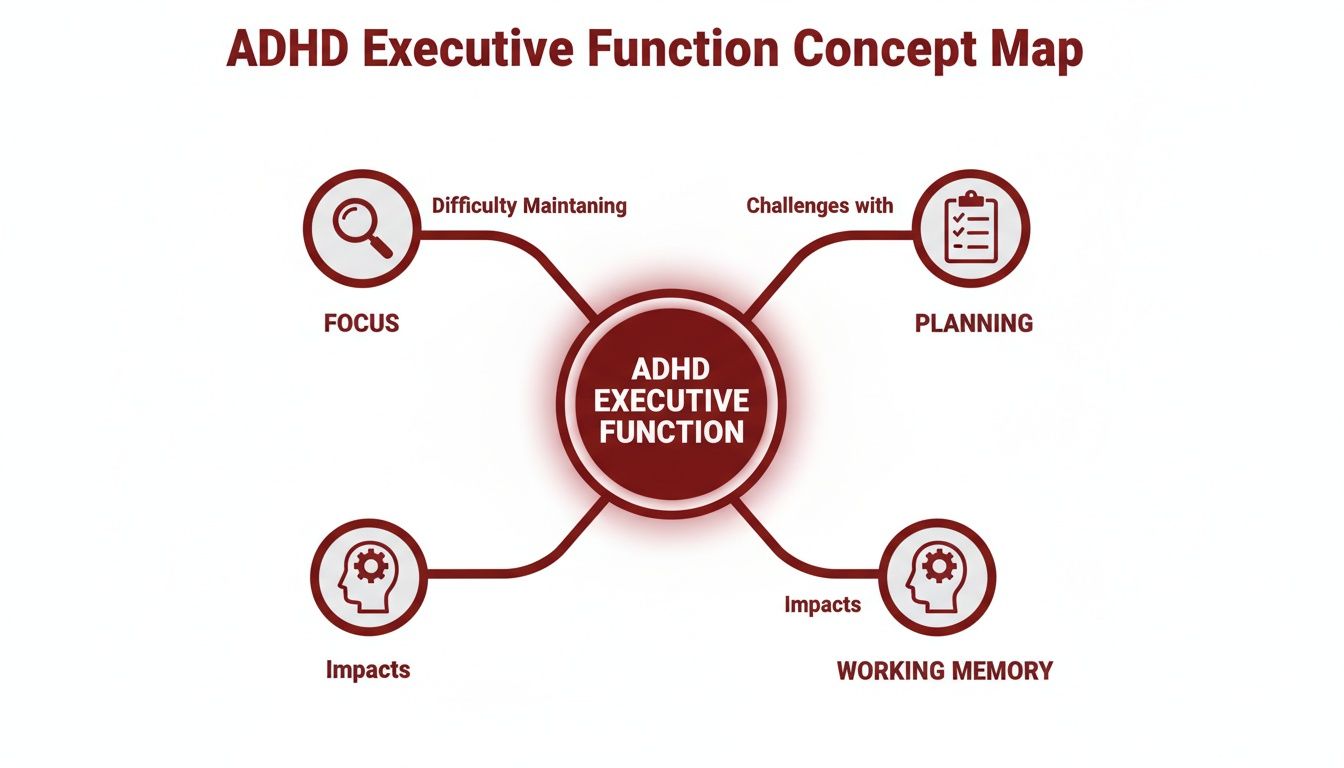
The visualization really highlights how these skills depend on one another. A weakness in one spot, like planning, is going to directly impact your ability to focus and remember what you're supposed to be doing.
How Executive Function Challenges Appear at Different Ages
The core struggles of ADHD executive function don’t just disappear as a person gets older—they evolve. The underlying difficulties with things like working memory, starting tasks, and managing emotions stick around, but they show up in different ways depending on the demands of life. What looks like a child not wanting to share their toys can later become an adult’s struggle to manage a complex project at work.
Understanding this progression is crucial. It helps us see the common thread running through a person's life, connecting early frustrations to later challenges. This isn't just a single chapter; it's a continuous story that unfolds over a lifetime.

Childhood: The Foundation of Challenges
In early childhood, the demands on executive functions are pretty basic, but they’re foundational. This is often where the first signs appear, though they can easily be mistaken for typical kid behavior. The problem isn't laziness or defiance; it's a brain working overtime just to keep up with simple instructions and social cues.
A young child with ADHD executive function difficulties might:
- Struggle with multi-step directions: Being told, "Go to your room, put your toys in the bin, and then wash your hands for dinner" can feel like being asked to solve a complex puzzle. Their working memory might only hang onto the first or last instruction.
- Have intense emotional outbursts: When emotional regulation is a challenge, minor frustrations—like a block tower falling over or losing a game—can turn into overwhelming meltdowns.
- Find it hard to wait their turn: Impulse control is what allows a child to wait to speak or take their turn in a game. When this skill is lagging, they may seem to constantly interrupt or act impatiently.
These early difficulties are more than just isolated incidents. The prevalence of ADHD in children is 7.2% worldwide, which is about 129 million children. Executive dysfunction is present in 80-90% of these cases, leading to higher rates of academic struggle. You can discover more insights about the global impact of childhood executive dysfunction and its link to academic outcomes.
The Teen Years: Increasing Complexity
Adolescence dramatically raises the stakes. The simple structures of childhood give way to a complicated maze of school deadlines, shifting social dynamics, and the first real steps toward independence. The brain's "air traffic controller" suddenly has to manage a fleet of jumbo jets instead of a few small planes.
For teenagers, the same underlying issues now look like this:
- Chronic procrastination on long-term projects: A research paper due in three weeks feels abstract and overwhelming. Without strong planning and task initiation skills, they might not start until the night before, leading to a ton of stress and a poor grade.
- A messy room and backpack: Organization and prioritization are essential for keeping track of assignments, textbooks, and personal belongings. A perpetually chaotic space is often a direct reflection of an overwhelmed internal management system.
- Social missteps and misunderstandings: Navigating tricky teen social dynamics requires flexible thinking and impulse control. A teen with ADHD might miss social cues, speak out of turn, or react too intensely, making it harder to maintain friendships.
For a teenager with ADHD, the world can feel like it's moving too fast. The expectation is to juggle school, friends, and future plans, but their executive functions are still under construction, making it hard to keep all the balls in the air.
Adulthood: The High-Stakes Balancing Act
By adulthood, the training wheels are off. Society expects a fully functional "air traffic controller" who can manage careers, finances, households, and relationships all at once. For adults with ADHD, this is where the lifelong impact of executive function challenges can become most apparent and distressing.
Common signs in adults include:
- Difficulty meeting work deadlines: The professional world runs on planning, prioritizing, and time management. An adult with ADHD might be brilliant and creative but consistently struggle to turn in work on time, which can hold back their career.
- Financial impulsivity and disorganization: Managing a budget, paying bills on time, and saving for the future all rely heavily on executive skills. Challenges here can lead to late fees, debt, and chronic financial stress.
- Relationship friction: Forgetting important dates, struggling to manage household chores, or having a hard time regulating emotions during disagreements can strain a partnership. These issues stem from executive function deficits, not a lack of love or care.
From childhood frustrations to adult responsibilities, the expression of ADHD executive function difficulties changes, but the core challenge remains the same—bridging the gap between what you intend to do and what you actually get done.
Navigating the Path to a Clear Diagnosis
Realizing you or a loved one might be struggling with executive dysfunction is the first big step. The next, and most crucial one, is getting a clear and accurate diagnosis. The thought of an evaluation can feel a little intimidating, but its real purpose is to bring clarity, not just to stick on a label. Think of it less as a test and more like creating a personalized roadmap to help you navigate your unique brain.
A proper diagnosis for challenges with ADHD executive function gives you a detailed picture of your brain's wiring. It finally explains why some tasks feel impossible and confirms that these struggles are very real and rooted in neurobiology. This understanding is incredibly empowering and becomes the bedrock for building strategies that actually work.
The goal here is to trade confusion for confidence, giving you the knowledge to find a qualified professional who truly gets the nuances of ADHD.
What to Expect in a Comprehensive Evaluation
A thorough diagnostic process isn't just a quick online quiz. It's a deep dive meant to understand your personal history, current challenges, and specific cognitive profile. While the exact steps can vary, a high-quality evaluation will almost always include a few key pieces to make sure the outcome is accurate and truly helpful.
A standard evaluation typically involves:
- Clinical Interviews: This is really just a guided conversation with a psychologist. You’ll talk through your developmental history, what things were like in childhood, your experiences at school and work, and what specific struggles led you to seek help. For kids, parents are obviously a huge part of this conversation.
- Rating Scales and Questionnaires: These are standardized forms that help put numbers to your experiences. You, and often a partner or family member, will rate how often you deal with different symptoms of inattention, hyperactivity, and executive function issues.
- Review of Records: Your evaluator might ask to look at old report cards, work performance reviews, or past medical records. These documents can offer objective proof of long-standing patterns, which is a key part of an ADHD diagnosis.
These steps work together to create a full, 360-degree view of your challenges. This ensures the final diagnosis is built on a complete picture, not just one piece of information. You can learn more about the specifics of how ADHD is diagnosed and what each of these steps involves.
Advanced Testing for Deeper Insights
For many people, a standard diagnostic evaluation is all that's needed. But sometimes, especially when things are more complex, we need to dig a bit deeper to get the full picture or to secure specific accommodations. This is where neuropsychological testing comes into play.
A neuropsychological evaluation goes beyond simply asking if you have ADHD. It measures how it impacts your cognitive abilities like processing speed, working memory, and attention. This data is priceless for creating a truly personalized support plan.
This kind of in-depth assessment is especially critical for:
- Students seeking academic accommodations for standardized tests like the SAT, ACT, GRE, or GMAT.
- Individuals with a complex profile where other conditions, like learning disabilities, might be part of the picture.
- Clarifying a diagnosis when past evaluations have been unclear or inconclusive.
The Rise of Accessible Telehealth Evaluations
The good news is that getting a high-quality evaluation is more accessible than ever. Reputable providers like the Sachs Center now offer comprehensive telehealth diagnostic services, which let you complete the entire assessment from the comfort of your own home.
This virtual approach breaks down huge barriers like travel time and tricky scheduling, making it so much easier for busy adults and families to get the answers they’ve been looking for. These online evaluations use the exact same validated clinical interviews and assessment tools as in-person appointments, so you can be confident you're getting a reliable and accurate diagnosis. A clear diagnosis is the first and most important step on the path to effectively managing ADHD executive function.
Evidence-Based Treatments That Make a Real Difference
Knowing how ADHD executive functions work is the first step. The next, and often bigger step, is finding what actually helps. Thankfully, decades of research point to powerful, evidence-based treatments that can genuinely change your life for the better. The goal isn't to "cure" ADHD—it's to give your brain the right support and tools to build up its executive skills.
Think of it this way: if your brain's "air traffic controller" is struggling to manage a busy airport, you don't fire the controller. You upgrade their equipment, give them a skilled co-pilot, and clear unnecessary distractions from the control tower. Treating executive dysfunction is the same idea. It’s all about providing support so the brain can do its best work.
Medication: The Control Tower Upgrade
For a lot of people with ADHD, medication is the bedrock of their treatment plan. It’s often the single most effective way to get a handle on core executive function skills right from the start. Both stimulant and non-stimulant medications work by adjusting the levels of key neurotransmitters—mainly dopamine and norepinephrine.
These brain chemicals are the messengers that allow neurons to communicate, and they play a massive role in attention, motivation, and impulse control.
- Stimulant Medications (e.g., Adderall, Ritalin): These are the most common and work by making more dopamine and norepinephrine available in the brain. The result? Better focus, less impulsivity, and an easier time starting and finishing tasks.
- Non-Stimulant Medications (e.g., Strattera, Qelbree): These take a different route, usually regulating norepinephrine more slowly over time. They can be a fantastic option for people who don't respond well to stimulants or deal with unwanted side effects.
Medication essentially helps turn up the volume on the important signals your brain needs, while tuning out the background static. This allows the brain's executive functions to run more smoothly—like giving that air traffic controller a clearer, high-definition radar screen. Research consistently shows that medication leads to big improvements, with 70-80% of children and adults with ADHD seeing a real reduction in their core symptoms.
Cognitive Behavioral Therapy: Building a Better Flight Plan
Medication can clear the runway, but it doesn't teach you how to fly the plane. That's where a hands-on approach like Cognitive Behavioral Therapy (CBT) comes in. CBT is a practical, goal-focused therapy that gives you the tools to build better habits, manage tough emotions, and challenge the unhelpful thought patterns that come with executive dysfunction.
Instead of getting bogged down in the past, CBT for ADHD zeros in on the real-world problems you're facing today.
CBT helps you connect the dots between your thoughts, feelings, and actions. It’s about building a practical toolkit of strategies to navigate the daily challenges of ADHD, from procrastination to emotional overwhelm.
A CBT therapist who specializes in ADHD can help you:
- Break Down Overwhelming Tasks: Learn structured ways to slice up big projects into small, doable steps, so you can finally get past that "stuck" feeling.
- Develop Organizational Systems: Create personalized systems for managing your time, paperwork, and digital life that actually work with your ADHD brain, not against it.
- Reframe Negative Self-Talk: Challenge those automatic thoughts like "I'm so lazy" or "I always mess up" that build up after a lifetime of executive function struggles.
- Improve Emotional Regulation: Learn to spot the triggers for frustration or overwhelm and develop proactive strategies to manage those feelings before they hijack your day.
This approach is so effective because it delivers concrete skills you can put into practice right away, helping you build a sense of competence and take back control.
Integrated Strategies: The Holistic Approach
Often, the most powerful way to manage ADHD executive function is to combine treatments. This means creating a support system that addresses your unique needs from every angle. At the Sachs Center, this holistic philosophy is at the core of how we help people.
An integrated plan, like the Sachs Protocol, might bring together medication management and specialized CBT to tackle both the biological and behavioral sides of ADHD. This synergy is key. While medication helps the brain's hardware function better, therapy is installing the "software"—the skills and strategies you need for lasting success. By weaving these evidence-based methods together, people can achieve much stronger and more sustainable improvements in their daily lives.
Actionable Strategies for Daily Life and Work
Knowing the theory behind ADHD executive function is one thing, but turning that knowledge into real-world action is where the magic happens. Think of this section as your toolbox, filled with practical, tangible strategies you can start using today to manage challenges at home, school, and work.
These techniques are designed to support your brain's unique wiring, not fight against it. Instead of trying to force your way through with sheer willpower—which we all know is exhausting—these strategies create external structure. They’re like scaffolding that helps your brain's "air traffic controller" manage tasks, time, and emotions more effectively. The goal here is to build a life that feels more manageable and less overwhelming.

Taming the Chaos of Disorganization
A major pain point for anyone with executive function challenges is clutter, both physical and mental. When your working memory is already stretched thin, a disorganized space can feel completely chaotic, making it almost impossible to focus. The trick is to create simple, visual systems that do the heavy lifting for you.
- Implement the 'Everything Has a Home' Method: It sounds almost too simple, but it’s incredibly powerful. Designate a specific, permanent spot for your essentials—keys, wallet, phone, glasses. Use labeled bins or clear containers so you can see what you have at a glance. This cuts down on the mental energy you waste just looking for things.
- Break Down Overwhelming Projects: A goal like "clean the garage" is just too big and vague. Instead, break it into tiny, concrete steps: "take out the trash," "sort one box of tools," or "sweep the floor." This approach, sometimes called task chunking, makes it much easier to get started and actually see your progress.
Many people with executive function challenges feel buried under their to-do lists. Learning how to stop being overwhelmed by tasks can be a huge step toward regaining control.
Conquering Time Blindness
"Time blindness" is that frustrating struggle to feel the passage of time. Five minutes can feel like an hour, and an hour can vanish in what feels like five minutes. This makes managing deadlines and just showing up on time a constant battle. The key is to externalize time—make it something you can see and hear.
Use Visual and Auditory Timers: Don't just rely on the clock on your phone. Try tools like the Pomodoro Technique—working in focused 25-minute bursts with short breaks—to give your work some structure. Visual timers that show time physically disappearing are a game-changer for making time feel more concrete and real.
Managing Emotional Regulation
Emotional impulsivity and getting frustrated in a flash are hallmarks of ADHD executive function struggles. A critical skill to build is the ability to create a deliberate pause between a feeling and your reaction. This isn't about suppressing your emotions, but about managing your response to them.
Create a "pause plan" for when emotions run high. It could be as simple as stepping away from a situation for five minutes, taking a few deep breaths, or having a go-to phrase like, "I need a minute to think about that." That small gap gives your prefrontal cortex time to catch up with your emotional brain.
Advocating for Yourself at Work and School
Understanding what you need is the first step, but communicating those needs effectively is the next. Advocating for accommodations isn't about asking for an unfair advantage; it's about leveling the playing field so you can do your best work.
Examples of reasonable accommodations include:
- At Work: Requesting a quieter workspace, using noise-canceling headphones, asking for instructions in writing, or using project management software to track tasks.
- At School: Asking for extended time on tests, getting copies of lecture notes, or using assistive technology for writing assignments.
By implementing targeted tools, you can build confidence and reduce the friction in your daily life. To keep building your personal support system, explore more of our recommended executive function strategies.
Your Questions About ADHD Executive Function Answered
Once you start connecting the dots between ADHD and executive function, it's totally normal for more questions to pop up. It’s a complex topic, and the more you learn, the more you realize there is to know. Let’s clear up some of the most common uncertainties to help you find that final piece of clarity and move forward with confidence.
Can You Have Executive Dysfunction Without ADHD?
Yes, absolutely. Think of executive function as a set of skills, much like playing a sport. Anyone can have a bad game if they’re injured, out of practice, or just under a lot of stress. Similarly, conditions like anxiety, depression, autism, or even just chronic sleep deprivation can throw these cognitive skills for a loop.
The real difference with ADHD executive function challenges is that they are neurodevelopmental. They’re rooted in the brain's wiring and have been a consistent part of a person's life since childhood. It's a chronic, lifelong pattern, not just a temporary slump. A thorough evaluation is the only way to get to the bottom of it and find the most effective support.
What Is the Difference Between Executive Function and IQ?
This is a fantastic question because it gets right to the heart of why so many incredibly bright people with ADHD struggle. It's a massive source of frustration, both for the person with ADHD and for the people who care about them.
Imagine a high-performance sports car. The raw power of its engine, its top speed, and its brilliant engineering are like your IQ—it represents your intellectual horsepower, your ability to reason, and your potential to solve complex problems.
Executive function, on the other hand, is everything else: the driver, the GPS, the steering wheel, and the brakes. It's the entire control system that allows you to actually use that powerful engine to get where you want to go.
Someone with ADHD can have a brilliant, high-performance engine (a high IQ) but struggle with the 'driving' skills needed to start a journey, stay on the road without getting distracted, and successfully reach their destination. It’s the gap between knowing what to do and actually being able to do it.
This explains why someone can ace a difficult exam or dream up a game-changing idea but still struggle to manage their daily schedule or pay bills on time. The intellectual capacity is there in spades, but the ability to direct and manage that capacity is the missing piece.
Are There Non-Medication Ways to Improve Executive Function?
Definitely. While medication can be a powerful and often essential tool for many, it’s just one part of a much bigger picture. A strong support plan for ADHD is never about a single fix; it's about building a comprehensive system that works for your unique brain.
Proven non-medication strategies can make a huge impact on strengthening your executive function. Here are some of the most effective approaches:
- Regular Exercise: Think of physical activity as a natural brain-booster. It gets blood flowing and ramps up key neurotransmitters like dopamine and norepinephrine, which directly helps with focus and mood.
- Mindfulness and Meditation: These practices are like strength training for your attention "muscle." Consistent practice helps you become more aware of your thoughts and better at redirecting your focus when it wanders.
- Good Nutrition and Sleep: Your brain needs the right fuel and rest to work properly. A balanced diet and a consistent sleep schedule are the absolute foundation for your executive functions to operate at their best.
- Therapy and Coaching: Specialized approaches like CBT and ADHD coaching give you structured techniques, accountability, and personalized strategies to build skills that last a lifetime.
How Can I Support a Loved One with These Challenges?
Supporting someone with executive function difficulties starts with empathy and a real willingness to learn. The most important first step is to truly understand that their struggles are not about laziness, a lack of willpower, or not caring. Blame and judgment only make things worse.
Instead, shift your mindset to becoming a collaborative problem-solver.
For a child, this might look like:
- Creating predictable daily routines to reduce their cognitive load.
- Using visual charts and checklists for chores and homework.
- Breaking down requests into single, simple steps ("Put on your shoes" instead of "Get ready to go").
For a partner or adult friend, it could involve:
- Setting up systems that work for both of you, like a shared digital calendar for appointments.
- Dividing up household tasks based on each person's strengths and weaknesses.
- Practicing open, non-judgmental communication to tackle issues as a team.
Ultimately, effective support is about shifting from, "Why can't you just do this?" to "How can we work together to make this easier?" This team-based approach reduces shame, builds trust, and creates the foundation you both need to navigate the challenges of ADHD together.
If you're ready to get clear answers about ADHD or Autism for yourself or a loved one, the Sachs Center can help. Our specialized telehealth evaluations provide accurate diagnoses from the comfort of your home, giving you the clarity needed to take the next step. Book your evaluation today.
