

For many autistic women, life feels like being a method actor in a play where you never got the script. This constant, exhausting performance is known as autism masking—a survival strategy developed to hide autistic traits and fit into a world that wasn't built for you.
It’s an unconscious performance, but it comes at a huge personal cost, often leading to burnout, anxiety, and misdiagnosis. Understanding what masking is and why it happens is the first real step toward self-acceptance and living a more authentic life.
What Is Autism Masking in Women?
Masking isn't a conscious choice or a form of deception. It's a deeply ingrained, often subconscious, survival mechanism learned from a young age to navigate a neurotypical world. It's a full-time job you never applied for.
This performance involves constantly studying and mimicking the social behaviors of others. You might force uncomfortable eye contact, mentally rehearse conversations before they happen, or suppress natural self-soothing behaviors (known as stimming).
For women, societal pressures to be agreeable, empathetic, and socially graceful are especially intense. This pressure is a key reason autism masking in women is so widespread and so effective at hiding their true selves.
How Autistic Traits Can Present Differently in Women and Men
The classic understanding of autism was built largely on observations of boys and men. This has created a diagnostic blind spot, as autistic girls and women often present very differently, in large part due to masking.
This table shows just how different those presentations can be.
| Autistic Trait | Common Male Presentation (Stereotypical) | Common Female Presentation (Often Masked) |
|---|---|---|
| Social Interaction | Appears withdrawn, avoids social contact, struggles with direct conversation. | Appears socially capable but feels exhausted afterward; may mimic others' social behaviors. |
| Special Interests | Intense focus on topics like trains, technology, or statistics. | Deep, passionate interests in more "socially acceptable" areas like literature, animals, art, or psychology. |
| Communication | Monotone speech, direct or blunt communication style. | Uses varied intonation (often practiced), focuses on appearing polite and agreeable. |
| Stimming | Obvious repetitive movements like hand-flapping or rocking. | Subtle, less noticeable stims like fidgeting with jewelry, hair twirling, or leg bouncing. |
| Eye Contact | Avoids eye contact completely. | Forces eye contact, even if it feels painful or intense, to appear "normal." |
| Friendships | May have few friends or prefer solitary activities. | May have a small, intense circle of friends or desire friendships but struggle to maintain them. |
As you can see, the very traits that diagnosticians have been trained to look for are often the ones that autistic women have learned to hide. This is why so many women go decades without a proper diagnosis, often collecting misdiagnoses like anxiety, depression, or BPD along the way.
The Cycle of Performance and Exhaustion
Maintaining this facade takes a monumental amount of energy. It consumes vast mental and emotional resources, creating a vicious cycle of social performance followed by deep, bone-crushing exhaustion. This relentless effort is often the root cause of mental health struggles that get mistaken for the primary problem.
Living this way almost always leads to a few common outcomes:
- Chronic Fatigue: A constant feeling of being physically and mentally drained, not from a lack of sleep, but from the non-stop effort of performing.
- Anxiety and Depression: The stress of constantly monitoring every action and fearing every social misstep is a perfect recipe for anxiety disorders and deep depression.
- Loss of Identity: After years, or even decades, of suppressing your true self, it's common to feel completely disconnected from who you are beneath the mask.
This concept map shows the direct link between the external pressure to conform, the internal act of masking, and the inevitable burnout that follows.
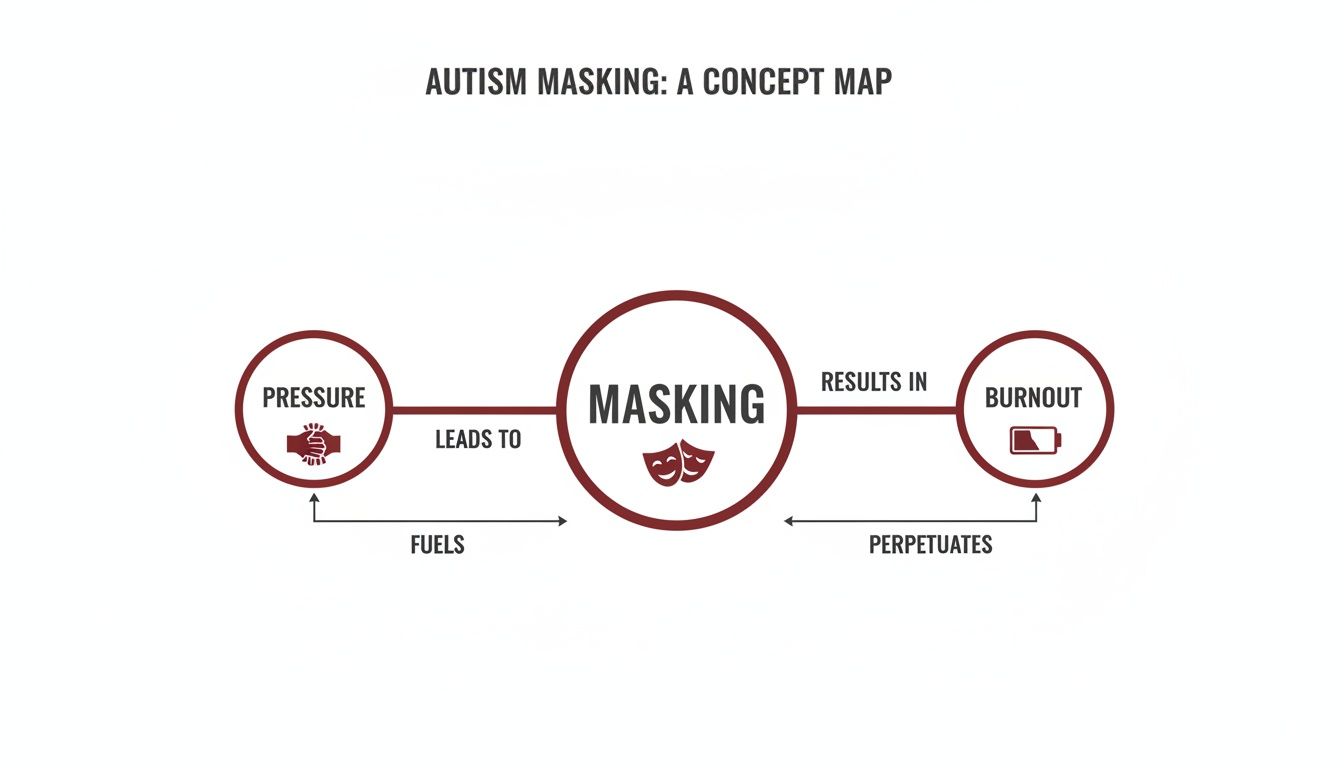
As the visual makes clear, societal pressure directly triggers masking. This act drains your personal energy and resources, leading straight to burnout, which only reinforces the feeling that you need to hide your true self.
Moving From Performance to Authenticity
Recognizing this pattern can be a life-changing moment. It helps reframe a lifetime of feeling misunderstood, anxious, or just "different." Those feelings aren't personal failings—they are the logical result of navigating a world that isn't set up for your neurotype.
Learning about masking is the beginning of a journey. It’s about peeling back the layers of performance to rediscover the authentic person underneath. This process is the foundation for seeking an accurate diagnosis, finding a supportive community, and finally building a life that honors your needs instead of hiding them.
Why So Many Women Learn to Mask Their Autistic Traits
Autism masking isn't a conscious choice to be deceptive. For many women, it's a survival skill they started learning almost as soon as they could talk. It’s a necessary adaptation to a world that wasn't built for them, honed to near perfection because of intense societal pressures that start in childhood.
Think back to the playground. From a very young age, girls are often socially programmed to be agreeable, to smooth over conflict, and to put the comfort of others first. These unwritten social rules can feel like a minefield for an autistic girl who might communicate more directly or simply have different social needs.
To dodge labels like "weird," "rude," or "bossy," they learn to watch. They observe their neurotypical peers, mimic their behaviors, and build a persona. This becomes the very foundation of autism masking in women—a lifelong performance put on just to find social acceptance.
The Power of Social Expectations
Our culture generally expects women to be socially intuitive, to just get the subtle cues in a conversation. This puts an enormous weight on autistic women, whose brains are wired to process those cues differently. Masking becomes the tool they use to bridge that perceived gap.
It’s a lot like being forced to learn a foreign language you have to speak flawlessly every single day. You memorize phrases (scripts for small talk), study the grammar (unspoken social rules), and practice your accent (mimicking tone and body language). It’s an exhausting, intellectually demanding task that requires constant, vigilant effort.
A common and damaging myth is that autistic people lack empathy. In reality, many autistic women experience empathy so intensely it can be overwhelming. They might even learn to mask this deep sensitivity to avoid being labeled "too emotional" or "dramatic," adding yet another layer to the performance.
This continuous effort is fueled by two powerful motivators: a deep human need for connection and a desire to avoid the negative consequences of being different.
External Pressures and Internal Motivations
The reasons for masking are a powerful combination of outside pressures and internal drives, reinforcing the behavior over decades.
External pressures often include:
- Avoiding Bullying: Kids can be ruthless in singling out anyone who stands out. Masking can feel like a necessary shield against teasing, social exclusion, and outright bullying.
- Pleasing Others: Girls are frequently praised for being cooperative and easygoing. By masking, they learn to meet the expectations of parents, teachers, and friends, which earns them positive feedback.
- Professional and Academic Success: In the classroom and the workplace, appearing socially adept is often incorrectly tied to being seen as competent and capable.
But the internal drive is just as strong. Many autistic women have a profound desire for deep, meaningful connections. They don't mask to be fake; they mask because they truly believe it's the only way to build the friendships and relationships they crave.
The tragic irony is that the very strategy used to connect with others often leads to a profound sense of isolation, leaving them feeling like no one truly knows the person behind the mask.
The Long-Term Impact on Mental Health
This constant self-monitoring—suppressing natural instincts and performing a role—is mentally and emotionally draining. The sheer cognitive load it takes to maintain the mask is a major contributor to co-occurring mental health conditions.
- Anxiety: Living in perpetual fear of a social misstep or having the mask "slip" can easily lead to chronic, high-functioning anxiety.
- Depression: After years of feeling misunderstood and disconnected from your authentic self, a deep depression and a lost sense of identity can set in.
- Autistic Burnout: Eventually, the energy reserves just run out. This can trigger autistic burnout, a state of profound exhaustion where even basic daily functioning becomes incredibly difficult.
Ultimately, masking is an intelligent and logical response to an environment that penalizes being different. While it serves a protective function for a time, it comes at a steep price. This highlights the urgent need for a world with far greater understanding and acceptance of the many different ways women experience and express autism.
Recognizing the Common Signs of Masking
Spotting the signs of autism masking in women can feel like trying to unmask a master of disguise. These behaviors aren't character flaws; they're incredibly sophisticated strategies learned over a lifetime to navigate a neurotypical world. Because they’re designed to help a person blend in, they often fly under the radar, leaving the woman feeling exhausted, isolated, and completely unseen.
Masking isn’t just one single action. Think of it as an internal computer running countless complex social programs in the background, all at once. Each program is designed to monitor, analyze, and mimic neurotypical behavior in real-time. This mental juggling act requires a staggering amount of energy.
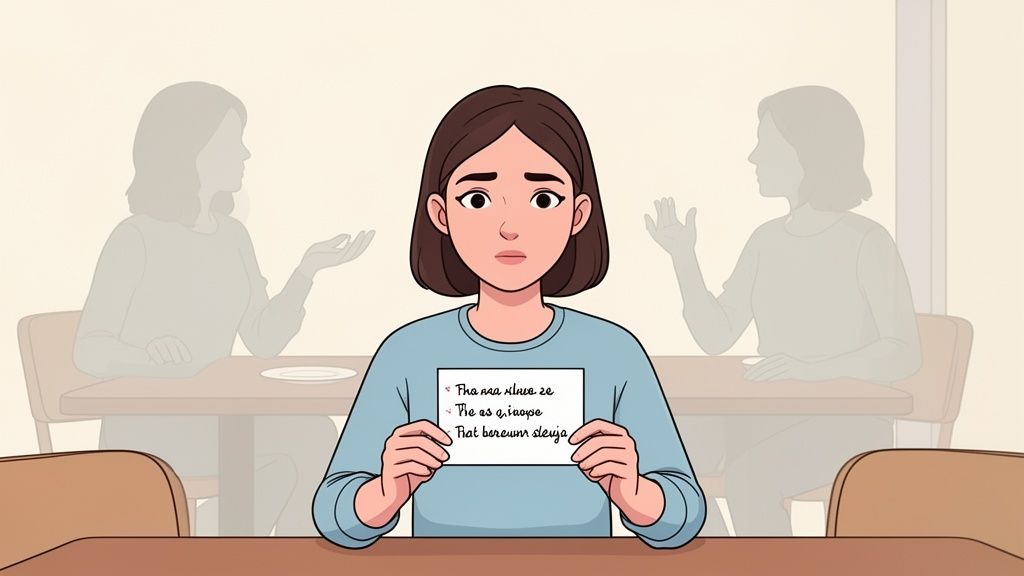
Creating Detailed Social Scripts
One of the most common masking techniques is scripting. This is the practice of mentally rehearsing entire conversations before they even happen. An autistic woman might spend hours preparing for a simple phone call, mapping out every potential question and crafting the "perfect," socially acceptable response for each scenario.
This isn't just about being prepared—it's a critical tool for managing the intense anxiety that comes with unpredictable social interactions. The script is a safety net, there to reduce the chance of saying the "wrong" thing or simply freezing up. The downside? It makes genuine, spontaneous conversation feel incredibly draining.
For instance, before a parent-teacher conference, she might write out not just her questions but also a few small-talk openers, some friendly-sounding phrases to sprinkle in, and a polite way to wrap things up. To everyone else, she seems articulate and on the ball. Internally, she’s just reading from a script.
Mirroring and Social Observation
Another key strategy is mirroring—consciously imitating the body language, tone of voice, and even facial expressions of the people around her. Out of necessity, autistic women often become sharp observers of human behavior, studying their peers like anthropologists to decode the unspoken rules of social engagement.
They might adopt a friend’s signature laugh, copy a coworker's hand gestures during meetings, or mimic the speech patterns of a beloved TV character. This performance makes them appear socially skilled, but it demands constant, unwavering focus. One moment of distraction is all it takes for the mask to slip.
This chameleon-like ability to hide autistic traits is a primary reason why so many women are diagnosed late in life. Research shows women are three times more likely to be diagnosed later than men. In fact, the CDC estimates that only 1 in 189 girls gets an autism diagnosis—a much lower figure than for boys, largely because girls master masking from a young age to meet social expectations. You can find more insights about masking and diagnosis on linksaba.com.
This constant performance isn't just about fitting in; it’s a deeply ingrained survival mechanism.
Forcing Neurotypical Norms
Many social behaviors that are second nature to neurotypical people can feel deeply uncomfortable, or even painful, for autistic women. Masking means pushing through that discomfort to perform these behaviors anyway.
Common examples include:
- Forcing Eye Contact: Many autistic individuals find direct eye contact overwhelmingly intense or distracting. To mask, a woman might force herself to maintain it, sometimes overcompensating by staring a bit too long, all while her brain is struggling to process what's actually being said.
- Suppressing Stims: Stimming (self-stimulatory behaviors like rocking, hand-flapping, or fidgeting) is a natural way for autistic people to regulate their sensory systems and emotions. Women often learn to suppress obvious stims, replacing them with smaller, more socially acceptable movements like twirling a ring, doodling, or subtly bouncing a foot.
- Feigning Interest: She may become an expert at asking reciprocal questions and pretending to be fascinated by small talk or topics she finds mind-numbingly boring, all in the service of keeping the social peace.
Becoming a Social Chameleon
Over the years, these strategies can merge into what’s known as being a social chameleon—the ability to adopt entirely different personas for different social situations. She might have a work personality, a friend group personality, and a completely different one for family gatherings.
Each persona is carefully constructed based on her keen observations of that group's unique dynamics and expectations. While this makes her highly adaptable, it can also lead to a profound loss of self. After years of playing so many different parts, she may genuinely not know who she is underneath all the masks.
The result is a feeling of deep disconnection—from others, who never get to see her authentic self, and ultimately, from herself. This is the hidden cost of a lifetime of camouflaging, a reality that highlights just how important it is to recognize these signs for what they are: not personality quirks, but a desperate need for understanding and acceptance.
The Hidden Cost of Constant Camouflaging
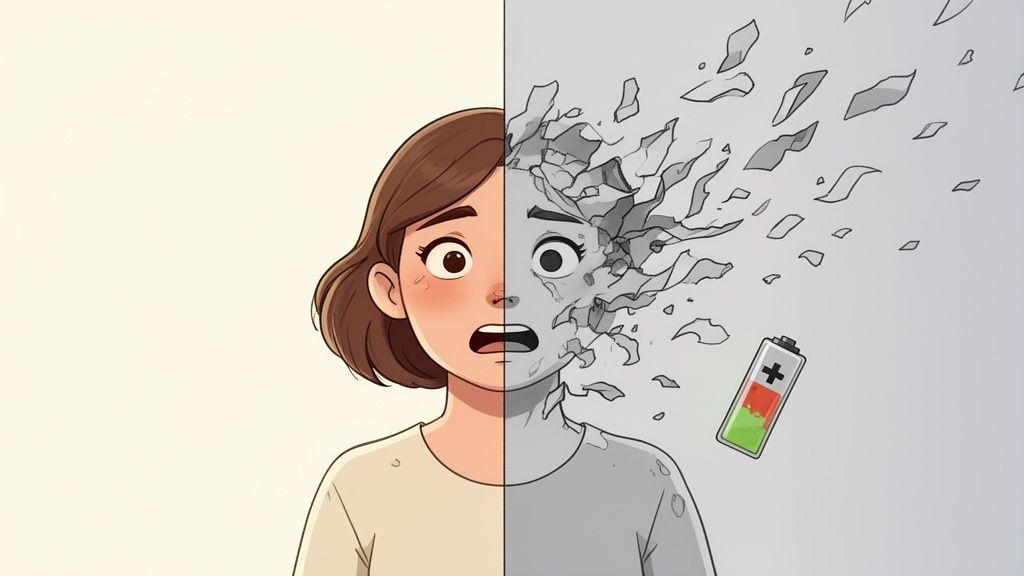
Imagine running a marathon every single day, but instead of using your legs, you're using your mind. That’s what autism masking in women often feels like. It might look like a successful coping strategy from the outside, but this relentless performance is anything but harmless. It carries a profound, hidden cost that slowly drains your mental, emotional, and even physical batteries.
This constant act of suppressing your true, authentic self simply isn't sustainable. The cognitive load required to constantly monitor your words, mimic social cues, and fight against your natural instincts is immense. Eventually, it burns through all your energy reserves, leading straight to a state of profound exhaustion known as autistic burnout. In this state, even the most basic daily tasks can feel completely impossible.
The Toll on Mental and Emotional Health
The link between masking and serious mental health struggles is impossible to ignore. When you spend your entire life pretending to be someone you aren't, feelings of anxiety and depression are almost inevitable. The constant fear of the mask slipping or being “found out” creates a state of hypervigilance that feeds chronic anxiety.
At the same time, this creates a deep sense of isolation—being surrounded by people who don't actually know the real you. This can easily spiral into profound depression. After years of camouflaging, many women look in the mirror and experience a jarring loss of identity, genuinely unsure of who they are beneath all the layers they’ve perfected since childhood. It's an incredibly heavy burden to carry.
Masking isn't just a social strategy; it's a major risk factor for mental health crises. The ongoing internal battle between your authentic self and the person you present to the world creates fertile ground for anxiety disorders, major depressive episodes, and overwhelming feelings of worthlessness.
This mental strain is often made worse when masking leads to the wrong diagnosis.
The Damage of Misdiagnosis
Because autism masking in women can be so effective, many clinicians who aren't trained to see beyond the surface completely miss the root cause of a woman's difficulties. They end up diagnosing the symptoms of masking—the anxiety, the depression, the emotional dysregulation—without ever identifying the underlying neurotype.
Some of the most common misdiagnoses for autistic women include:
- Generalized Anxiety Disorder (GAD): The constant worry about social performance is easily mistaken for a primary anxiety disorder.
- Major Depressive Disorder (MDD): The exhaustion and identity loss from years of masking looks a lot like classic depression.
- Borderline Personality Disorder (BPD): Intense emotions and relationship struggles, often stemming from sensory overload and social confusion, can be mislabeled as BPD.
These misdiagnoses are incredibly damaging. They result in treatments that only target the symptoms, leaving the core issue unaddressed. This often leaves the woman feeling invalidated and misunderstood, deepening the feeling that something is fundamentally "wrong" with her and reinforcing the need to mask even harder.
The Inevitable Path to Burnout
The intense effort it takes to camouflage autistic traits is a primary driver behind the high rates of burnout reported by autistic women. This constant performance consumes a staggering amount of energy, leaving little for anything else. For many, it's a direct path to a state of complete shutdown. If this sounds familiar, you can learn more about autistic burnout and shutdown in our detailed guide.
The pressure to perform is relentless. Research consistently shows that women on the spectrum engage in more camouflaging behaviors than their male counterparts. This heightened effort to hide traits—from meticulously scripting conversations to forcing painful eye contact—is directly linked to higher rates of stress, anxiety, and depression. The longer a woman goes without a correct diagnosis, the more entrenched these masking habits become.
Ultimately, the hidden cost of camouflaging is a life lived in a state of high alert, disconnected from one's true self. It highlights just how critical it is to get an accurate diagnosis from specialists who understand these masked presentations. It's the first step toward self-acceptance and finding a more authentic, sustainable way of living.
How to Navigate the Path to an Accurate Diagnosis
Trying to get diagnostic clarity when you suspect you have autism can feel incredibly overwhelming, especially if you’ve spent a lifetime perfecting a mask. The real challenge is finding clinicians who truly understand the subtle, nuanced ways autism can present in women—professionals who can see past the surface-level performance.
The truth is, traditional diagnostic models were often built around male traits. This has historically left women who camouflage their struggles feeling unseen and misunderstood. That’s why finding the right specialist is the single most critical step in this journey. A thorough and sensitive evaluation should feel less like an interrogation and more like a collaborative exploration of your life experiences. The goal isn't just to check boxes on a form, but to understand the complete picture of who you are, both with and without the mask.
What a Sensitive Evaluation Looks Like
A proper diagnostic process for masked autism goes way beyond simple checklists. It should be a comprehensive process that prioritizes your comfort and validates your lived experiences. A skilled psychologist will be interested in your developmental history, your internal world, and the immense effort it has taken you to navigate social situations throughout your life.
The evaluation process usually involves:
- A Detailed Clinical Interview: This is your space to share your story. The clinician should ask about your childhood, friendships, sensory sensitivities, special interests, and the sheer mental energy you pour into social settings.
- Specialized Assessment Tools: While standard tools might be used, an expert will interpret them through the specific lens of autism masking in women. They’ll know how your answers might reflect camouflaging rather than a true absence of autistic traits.
- Focus on Internal Experience: The clinician should be far more interested in how you manage daily life than just whether you appear to be "functioning" on the outside.
The Benefits of Telehealth Evaluations
For many women, just the idea of an assessment in a cold, unfamiliar office is a source of major anxiety. Modern telehealth evaluations completely remove this barrier, letting you be assessed in the comfort and safety of your own home. Being in a familiar environment can dramatically reduce stress, making it easier to be open and authentic—which is key to an accurate outcome.
Gender stereotypes and biased assessment tools have created a significant diagnostic gap. Research highlights that while males are diagnosed 3-4 times more often globally, up to 80% of autistic females may remain undiagnosed by age 18, contributing to severe mental health challenges. Read more about these diagnostic disparities and how specialized centers are addressing them.
Choosing a virtual evaluation can make the entire process feel more accessible and less intimidating, ultimately allowing for a much clearer diagnostic picture.
Finding the Right Professional
The most important factor in your diagnostic journey is the clinician you choose. You need someone who is an expert not just in autism, but specifically in how it presents in adult women who have learned to mask their traits so well. They get that a woman can make eye contact, hold a conversation, and still be autistic.
At the Sachs Center, our psychologists are experts in identifying these masked presentations of autism. We recognize the tell-tale signs of burnout and the hidden cognitive effort that defines the experience for so many women. If you're ready to explore your neurotype, you can learn more about our adult autism screening process. Our virtual evaluations are designed to be a supportive, validating experience, helping you finally find the clarity you deserve.
Life After Diagnosis: Finding Support and Thriving
Getting an autism diagnosis as an adult isn't the end of the road; it's the start of a new, more honest chapter in your life. For so many women who’ve spent years masking, this moment of clarity can be profoundly liberating. It takes a lifetime of feeling "different" and reframes it into a clear, understandable neurotype. You can finally put down the heavy weight of performance and just… be.
The first step on this path is always self-compassion. The process of “unmasking” isn’t about becoming someone new. It’s about rediscovering the person you were before you learned you had to hide parts of yourself to fit in. It's a gentle, personal journey of letting yourself stim, honoring your sensory needs, and diving into your passions without feeling like you need to apologize for them.
Building Your Neurodivergent Community
One of the most powerful things you can do is connect with other neurodivergent women. Finding your people provides a sense of belonging and validation that is often life-changing. For the first time, you can share your experiences with people who just get it—no long, exhausting explanations needed.
This shared understanding is the perfect antidote to the deep-seated isolation that masking creates. Talking with peers who have walked a similar path can offer practical advice, emotional support, and a powerful reminder that you are not alone. There are tons of excellent online communities where you can make these connections. Exploring autism support groups online is a fantastic way to start building your network in a safe, welcoming space.
Leveraging Your Diagnosis for a Better Life
A formal diagnosis is far more than just a label—it's a practical tool for building a life that truly supports your needs. It gives you the language and the confidence to advocate for yourself in environments that were once draining or completely inaccessible.
With that official diagnosis in hand, you can secure accommodations that make a real, tangible difference in your day-to-day life.
- At Work: This could mean asking for instructions in writing instead of verbally, getting a quieter workspace to minimize sensory overload, or having the flexibility to work from home.
- At School: Accommodations might include extended time on tests, access to a note-taker, or a reduced course load, leveling the playing field so you can truly succeed.
A diagnosis validates your struggles as real and provides the official documentation needed to request support. It shifts the focus from "trying harder" to creating an environment where you can thrive.
Ultimately, a diagnosis gives you permission to stop trying to force yourself into a neurotypical world and instead start shaping your world to fit you. It’s the key to unlocking a more sustainable, authentic, and fulfilling life.
Your Questions About Autism Masking, Answered
As you explore the possibility of autism masking in your own life, a lot of questions are bound to come up. Finding clear, direct answers can be incredibly validating, helping you make sense of your experiences and figure out what to do next.
How Is Masking Different From Just Being Shy?
This is a fantastic question, and the difference is huge. Shyness is a personality trait—it’s that feeling of discomfort or awkwardness in new social situations. Masking, on the other hand, is a full-blown survival strategy. It’s the conscious, and often exhausting, effort of studying, mimicking, and performing neurotypical social behaviors to hide your autistic traits.
Let’s put it this way: a shy person at a party might prefer to stand in the corner. Someone who is masking is also at that party, but they're actively running complex mental scripts, forcing eye contact, and mirroring everyone’s body language just to seem like they're engaged. One is a natural disposition; the other is a draining, unpaid, full-time job.
What Should I Do If I Recognize These Signs in Myself?
If you're reading this and it feels like I'm describing your life, the very first step is to just take a breath and acknowledge the immense effort you've put in for so long. Be kind to yourself.
From there, the most important next step is to seek a professional evaluation. You'll want to find a psychologist who truly specializes in the nuances of masked autism, particularly in adult women.
It's vital to find a clinician who gets it—someone who understands that years of camouflaging can hide the very traits that traditional diagnostic checklists look for. A real expert can see beyond the performance to your authentic internal experience.
Is It Too Late to Get Diagnosed as an Adult?
Not at all. It is never too late.
Receiving a diagnosis as an adult can be one of the most profoundly validating experiences of your life. It gives you a brand-new framework for understanding your past, reframing lifelong struggles not as personal failings, but as the logical outcome of navigating a world that wasn't built for your brain.
This new clarity can dramatically improve your mental health, empower you to find the right support, and finally give you permission to take off the mask. For many, it’s the true beginning of building a more authentic, sustainable, and compassionate life.
At Sachs Center, our specialists are experts in identifying masked autism in women. We offer compassionate, virtual evaluations to provide the clarity you deserve. Book your telehealth evaluation today.
