

Group therapy is a powerful form of psychotherapy where a small group of people, usually around 5 to 15, meet regularly to talk through their challenges with one or more trained therapists. It’s a confidential and supportive space where you can build self-awareness, learn new coping skills, and most importantly, realize you’re not alone.
Understanding How Group Therapy Works
Think of group therapy less like a clinical procedure and more like a guided expedition. You're with a small group of fellow travelers, each with a unique map but heading toward a similar destination. A professional therapist acts as the expert guide, making sure the journey is safe, productive, and focused on shared growth.
This structured space is so effective because it’s built on a few core principles. The first is universality—the powerful and often immediate relief that comes from discovering others share your feelings and experiences. This simple realization helps tear down the walls of isolation and shame that so often come with mental health struggles.
The Group as a Learning Lab
Another key element is interpersonal learning. The group itself becomes a kind of social microcosm, a safe laboratory where you can explore your patterns of relating to others. You get honest, constructive feedback from your peers and the facilitator, giving you a chance to practice new communication skills and behaviors in a supportive setting before taking them out into your daily life.
The therapist’s role isn’t to lecture but to facilitate. They establish ground rules for respect and confidentiality, guide the conversation to keep it productive, and make sure every member has a chance to contribute. This creates the secure foundation needed for vulnerability and genuine connection to flourish.
Group therapy offers a unique synergy where you not only receive support but also gain confidence by giving it. Witnessing a peer's breakthrough can inspire hope, while offering your own perspective can reinforce your sense of competence and self-worth.
Below is a quick breakdown of what makes group therapy tick.
Core Components of Group Therapy at a Glance
| Component | What It Means for You | Why It Matters |
|---|---|---|
| Universality | Realizing you're not the only one feeling or experiencing this. | It immediately reduces feelings of isolation and shame. |
| Interpersonal Learning | Practicing new ways of interacting with people in a safe space. | You can get real feedback and build social confidence. |
| Guided Facilitation | A trained therapist leads the group, ensuring safety and focus. | It keeps conversations productive and emotionally secure for everyone. |
| Mutual Support | You both give and receive support from other group members. | Helping others builds your own self-esteem and sense of capability. |
| Confidentiality | What's shared in the group stays in the group. | This creates the trust needed for honest, open sharing. |
These elements work together to create a dynamic environment for personal growth and healing that you just can't get in one-on-one therapy.
A Proven and Structured Approach
The effectiveness of group therapy for adults is well-documented, especially for conditions like depression and anxiety. Its history as a therapeutic model grew significantly after WWII to meet the needs of veterans, and its benefits have been studied ever since. Research shows that about 78% of patients see improvements within just 2 to 8 therapy sessions, a timeline that fits well with many structured group programs. You can discover more insights about therapy effectiveness and mental health trends.
Understanding how group therapy works often involves seeing how goals and strategies are formalized. These frameworks are frequently outlined in a client's journey, as seen in practical treatment plan examples used across various therapeutic modalities.
Exploring Different Types of Therapy Groups
Group therapy isn't a one-size-fits-all experience. Just like there are different tools for different jobs, therapy groups come in various flavors, each designed to meet specific needs and goals. Getting a sense of the landscape is the first step toward finding a style that clicks with what you’re hoping to accomplish.
You can think of it like picking an exercise class. Some people are looking for a high-intensity workout to build specific muscles, while others might prefer a restorative yoga class to find balance and connect with a community. In the same way, therapy groups can be anything from highly structured, skill-building workshops to more free-flowing, open-ended discussions.
This infographic breaks down the core foundation of any successful therapy group: a skilled therapist, the feeling of universality (realizing you're not alone), and strict confidentiality.
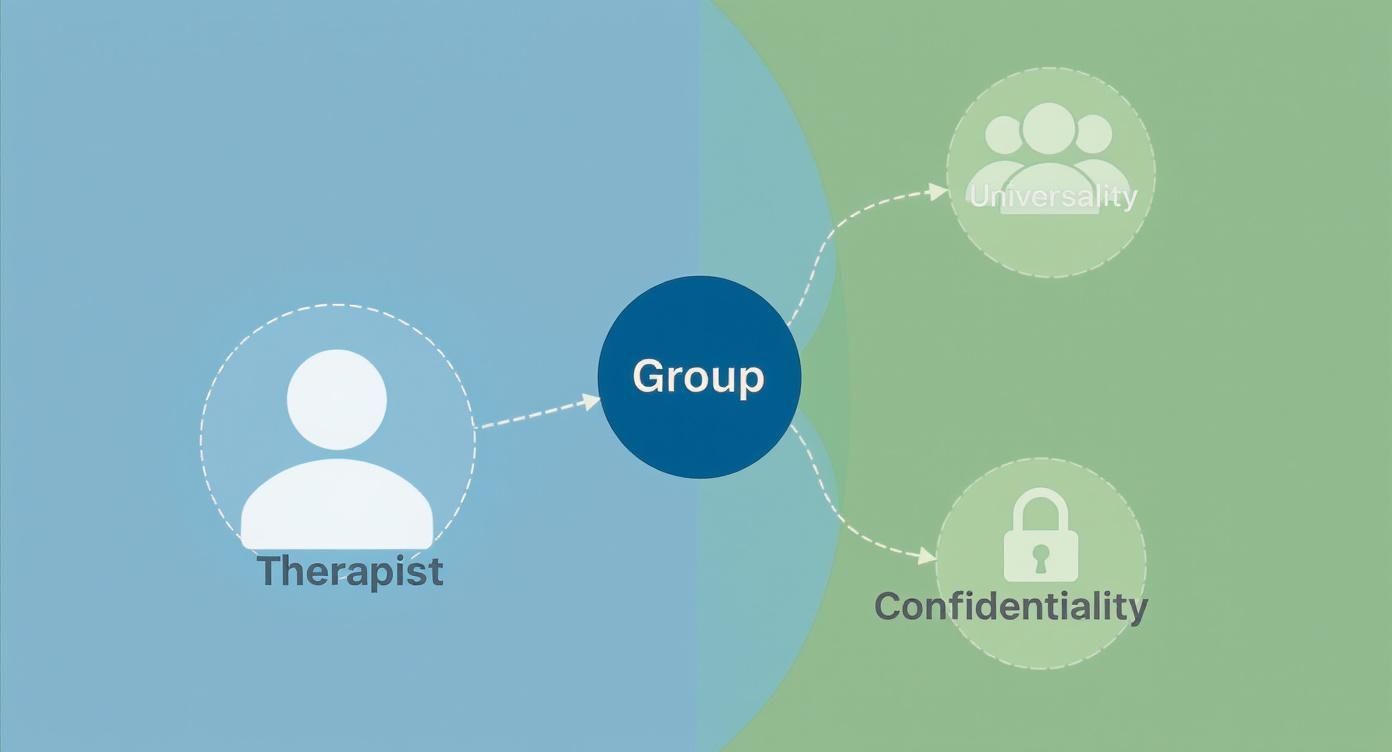
When these three elements come together, they create the safe, supportive space needed for real growth and healing to happen.
Skills-Based and CBT Groups
Skills-based groups are all about practical, hands-on learning. Think of them as training sessions for your mind, where you learn concrete techniques to manage your emotions, thoughts, and behaviors. One of the most common and effective types is the Cognitive Behavioral Therapy (CBT) group.
In a CBT group, the work involves learning how to spot, challenge, and reframe the unhelpful thought patterns that fuel things like anxiety or depression. For instance, you might practice recognizing "all-or-nothing" thinking and actively work on finding more balanced ways to talk to yourself.
Another powerful skills-based model is Dialectical Behavior Therapy (DBT). DBT groups are especially helpful for people who feel their emotions are often intense and overwhelming. The curriculum usually zeroes in on four key areas:
- Mindfulness: Learning how to stay grounded in the present moment without judgment.
- Distress Tolerance: Building skills to survive a crisis without making it worse.
- Emotion Regulation: Gaining control over your emotional responses and understanding what drives them.
- Interpersonal Effectiveness: Learning to communicate your needs and set healthy boundaries with others.
The point of a skills-based group isn’t just to talk about your problems—it's to actively build a toolkit of strategies you can pull out and use in your day-to-day life. It’s empowerment through action.
For many people, particularly neurodivergent adults, learning these strategies in an explicit way can be a total game-changer. This is a core focus of many social skills groups for adults, which offer a structured environment to practice and build confidence.
Support Groups and Process Groups
People often use these terms interchangeably, but support groups and process groups actually serve very different purposes. Support groups are built around a shared life experience—like grief, chronic illness, or addiction. The main goal here is mutual validation and encouragement. It creates a profound sense of community among people who truly get it.
Process-oriented groups (sometimes called interpersonal groups), on the other hand, are much less structured. The focus isn't on a specific topic but on the relationships and dynamics that are happening between the group members, right there in the room.
A process group is like a "social microcosm." The therapist guides the members as they explore how they relate to one another, which helps uncover patterns that likely show up in their relationships outside of therapy. It’s an incredibly powerful way to get real-time feedback and gain awareness about your communication style, emotional triggers, and relational habits. This direct exploration can lead to major breakthroughs in how you connect with the people in your life.
Discovering the Unique Benefits of a Group Setting

While individual therapy provides a focused, one-on-one space for growth, group therapy for adults offers a set of powerful advantages that simply can’t be replicated. It creates a dynamic environment where the very presence of others becomes a catalyst for healing and provides something many of us are missing: a genuine community.
One of the first things people notice is the profound sense of relief that comes from a shared experience. In a group, you quickly realize your struggles, fears, and insecurities aren't yours alone. This realization chips away at the isolation that so often comes with mental health challenges, replacing shame with a feeling of belonging.
A Safe Space for Social Practice
A therapy group acts as a 'social microcosm'—think of it as a safe and confidential lab where you can try out new ways of relating to others. It’s a place to practice setting boundaries, clearly expressing your needs, or offering empathy, all with a therapist's guidance and the backing of your peers.
The feedback you get is direct, honest, and compassionate. This kind of interpersonal learning is invaluable because the communication skills you build inside the group are immediately transferable to your relationships with family, friends, and colleagues.
The act of both giving and receiving support is uniquely empowering. Witnessing someone else's breakthrough can ignite hope for your own progress, while offering encouragement to a peer reinforces your own strength and boosts self-esteem.
The Power of Shared Healing
That sense of connection in a group is a powerful antidote to loneliness. This is more important today than ever. Globally, nearly 1 in 8 people were dealing with mental health disorders before the pandemic, and that figure jumped by 25% due to COVID-19. With many countries spending just 2% of their health budget on mental health, group therapy offers a vital, effective way to meet this growing need.
This shared journey also fosters accountability and motivation. Other benefits include:
- Gaining New Perspectives: Hearing how others have navigated similar problems can give you fresh ideas and strategies you hadn't considered.
- Building Confidence: The consistent support from the group acts as a safety net, encouraging you to take healthy emotional risks.
- Self-Discovery: Seeing yourself through the eyes of others can reveal personal blind spots and unlock new avenues for growth.
Beyond traditional talk therapy, exploring other creative approaches can deepen the healing process. For instance, you might want to learn about the profound benefits of art therapy for mental health as another powerful tool for expression.
Deciding if Group Therapy Is Right for You
Choosing to start therapy is a big deal, and picking the right format is just as important as finding the right therapist. For a lot of people, the thought of opening up to a group of strangers can feel pretty daunting. Worries about social anxiety or whether your story will stay in the room are completely normal.
But those fears shouldn't automatically rule out what can be an incredibly powerful way to heal.
The trick is matching the therapy environment to where you are right now. Group therapy isn't the perfect fit for everyone, all the time. But for the right person at the right moment, it offers a kind of support and connection that you just can't get in one-on-one sessions.
Who Tends to Thrive in a Group Setting?
Some challenges and personal goals are practically tailor-made for a group dynamic. If you’re trying to work on how you relate to other people, a group is like a real-time lab where you can safely explore and practice new ways of connecting.
You might be a great candidate for group therapy for adults if you:
- See the same relationship patterns over and over. You want to figure out why you keep hitting the same walls with partners, family, or coworkers.
- Feel alone or like no one understands. You're navigating something specific—grief, a chronic illness, a big life change—and crave connection with people who just get it.
- Want to build social confidence. You're tired of social anxiety holding you back and need a structured, supportive space to practice communication.
- Need a little push from your peers. You know that being part of a team, where everyone is cheering each other on, helps you stick to your goals.
The need for mental health support is undeniable. While a striking 48% of Americans say they plan to seek therapy, data from 2021 showed that only 21.6% of adults actually received treatment. Group therapy is a vital, accessible option that can help bridge that gap.
When Individual Therapy Might Be a Better First Step
On the flip side, some situations really call for the focused attention of one-on-one therapy, at least to start. To get the most out of a group, you need to be in a stable enough place to engage with others without feeling completely overwhelmed.
You should probably start with individual therapy if you are:
- In crisis. If you're dealing with active suicidal thoughts, intense self-harm urges, or the immediate aftermath of a trauma, the dedicated focus of a single therapist is critical.
- Working through deep-seated trauma. Many trauma survivors find immense value in groups down the line, but the initial, heavy work often requires the privacy and safety of a one-on-one relationship.
- Struggling with severe social phobia. If the very idea of sitting in a room with others sends you into a panic, individual therapy can help you build the foundational skills to feel ready for a group later on.
A Place for Neurodivergent Adults to Connect
It's also worth noting how powerful specialized groups can be. For neurodivergent adults with ADHD or Autism, a general therapy group might feel like one more place they have to "fit in." But a group made up of other neurodivergent peers? That can be a game-changer.
These groups become a space where you don't have to mask your traits or spend energy explaining your brain. The conversation immediately shifts to sharing real-world strategies and building skills with people who have a shared understanding of your experience. For many, this is a huge step in developing better communication, something that is also a focus in targeted programs like social skills coaching for adults.
Finding and Preparing for Your First Session

Taking that first step toward joining a therapy group can feel like the biggest hurdle, but breaking it down into a clear plan makes the whole process much more approachable. The main goal here is to find a space where you feel safe and understood, and that starts with knowing where to look.
Professional directories from organizations like the American Psychological Association are a great place to start. Many online therapy platforms also let you search specifically for group therapy for adults, with filters for things like anxiety, grief, or neurodiversity. For more specialized care, talking with neurodiversity-affirming therapists can point you toward groups designed for your unique needs.
The Importance of the Initial Screening
Once you've found a group that looks promising, you’ll typically have an initial screening call with the therapist. Don't worry—this isn't a test. Think of it as a two-way interview to make sure it’s a good fit for everyone. The therapist is checking if the group’s focus aligns with your needs, and you get a feel for their style and the group’s dynamic.
This is your chance to ask some key questions:
- Group structure: Is it open, where members can join at any time, or closed, where the same group meets for a set period?
- Expectations for participation: What are the ground rules for sharing and communicating with others?
- The therapist’s approach: How do they handle conflict or help quieter members feel included?
This conversation is vital for building a foundation of trust before you even walk through the door (or log on).
Think of the screening as a fitting session for a new pair of shoes. You want to make sure the style, size, and support are right for the journey ahead. A good fit ensures you can walk into the group with confidence.
Easing Into Your First Session
It’s completely normal to feel nervous before your first meeting. Instead of letting that anxiety take over, try to focus on small, concrete steps to get ready. This isn’t about performing; it's just about showing up for yourself.
Maybe set a small, personal goal for that first session. It could be as simple as introducing yourself or sharing one brief thought. And remember, it is perfectly okay to just listen at first. You can jump in when you feel ready.
For telehealth groups, a little prep goes a long way. Test your camera and mic beforehand to avoid any last-minute technical stress. Find a quiet, private space where you won’t be interrupted, so you can be fully present. Having a glass of water or a notebook nearby can also help you feel more grounded and ready to engage at your own pace.
Finding the right group is a process of discovery. To help you navigate it, we've put together a simple checklist to guide you from initial search to final decision.
Your Checklist for Finding a Therapy Group
| Step | Action Item | What to Look For |
|---|---|---|
| 1. Define Your Goals | Write down what you hope to gain from group therapy. | Clarity on your needs (e.g., social skills, anxiety management, grief support). |
| 2. Initial Research | Explore directories, online platforms, and get recommendations. | Groups that specialize in your area of focus and are led by licensed therapists. |
| 3. Vet Potential Groups | Shortlist 2-3 groups and review their websites or materials. | Information on the therapist's approach, group rules, cost, and logistics. |
| 4. Schedule a Screening | Reach out to the group facilitator for an initial consultation. | A therapist who is responsive, professional, and makes you feel comfortable. |
| 5. Ask Key Questions | Prepare questions about group structure, dynamics, and expectations. | A clear understanding of how the group operates and what is expected of members. |
| 6. Assess the Fit | Reflect on your conversation with the therapist. | A sense of safety, trust, and alignment between your goals and the group's purpose. |
| 7. Make Your Decision | Choose the group that feels like the best match for you. | Confidence that you've found a supportive environment for your growth. |
Use this checklist to stay organized and ensure you're making an informed choice. Taking these thoughtful steps now will pay off when you find a group where you truly feel you belong.
Got Questions About Group Therapy? We’ve Got Answers.
Even after learning about the benefits and different styles of group therapy, it's completely normal to have some practical questions pop up. Feeling a bit hesitant or having specific worries before jumping into something as personal as therapy is part of the process.
Let's clear the air and tackle some of the most common concerns we hear from adults thinking about joining a group for the first time.
How Is Confidentiality Handled in a Group Setting?
This is usually the first question on everyone's mind, and for a very good reason. Confidentiality is the absolute cornerstone of a successful therapy group.
From day one, the therapist lays down a non-negotiable ground rule: what’s said in the group, stays in the group. Everyone has to verbally agree to this pact of privacy before the real work can begin.
While the therapist is legally and ethically bound to confidentiality, it's this shared agreement between members that creates the safe "container" for people to open up. Think of it as a mutual vow of respect. Breaching that trust is a serious issue and is almost always grounds for being removed from the group.
What if I’m Too Anxious to Talk?
This is such a common fear, and it's something group facilitators are completely prepared for. A good therapist knows how to create a warm, low-pressure environment where you can participate at your own pace.
You will never be forced to share before you're ready. It's perfectly fine to just listen and observe for the first few sessions. Honestly, just hearing other people put words to feelings so similar to your own can be incredibly healing all by itself.
The group is a place to practice vulnerability at your own pace, not perform. As you see how supportive others are and start to build trust, you'll likely find yourself feeling more comfortable chiming in when the moment feels right. Small steps are always celebrated.
How Long Does Group Therapy Usually Last?
The timeline for group therapy can vary a lot, depending entirely on the group's specific goals and format. When you're looking for group therapy for adults, you'll generally find two main structures:
- Closed, Time-Limited Groups: These groups run for a fixed number of weeks—often 8, 12, or 16—with the same members from start to finish. This is really common for skills-based groups like CBT or DBT, where you're working through a set curriculum together.
- Open, Ongoing Groups: These groups don't have a set end date, and new members can join as others leave. This format is great for support or process-oriented groups, where the focus is on long-term personal growth and continuous encouragement.
The therapist will always lay out the format and time commitment during your initial screening call, so you can pick a group that fits your life and what you're hoping to achieve.
How Is Group Therapy Different From a Support Group?
This is a fantastic question because people often use the terms interchangeably. While both offer a valuable sense of connection, they have fundamentally different goals. The main difference comes down to the person leading the group and its core purpose.
| Feature | Group Therapy | Support Group |
|---|---|---|
| Leader | Led by a licensed mental health professional (like a psychologist or social worker). | Usually peer-led by someone with firsthand experience in the group's focus. |
| Focus | To treat mental health conditions using evidence-based therapeutic methods. | To provide mutual validation, share coping skills, and offer emotional support. |
| Structure | A formal type of clinical treatment designed to create lasting change and healing. | A non-clinical community gathering for shared understanding and encouragement. |
Here’s an easy way to think about it: group therapy is a form of psychotherapy, a structured treatment meant to get at the root of psychological patterns. A support group is a powerful community resource for encouragement. Both are incredibly helpful, but only group therapy is considered a clinical intervention.
At the Sachs Center, we know that navigating neurodiversity comes with its own unique challenges and strengths. Our specialized telehealth services, including diagnostic testing and group therapy for adults with ADHD and Autism, are designed to provide clarity and support from the comfort of your home. If you're ready to gain a deeper understanding of yourself and connect with a community that gets it, explore our offerings and book your evaluation today at https://sachscenter.com.
