
So, how much does autism testing actually cost? The short answer is it can range anywhere from $790 to over $5,000, but that wide gap depends entirely on the depth of the evaluation you need. The final price tag is shaped by the type of assessment, your insurance plan, and the provider you work with.
Understanding the Cost of an Autism Diagnosis
Trying to figure out the financial side of an autism evaluation can feel like a maze. But once you understand the different tiers of testing, it all starts to make sense. Not every evaluation is created equal, and the price usually reflects what the assessment is designed to do.
For some, a basic diagnostic evaluation is all that’s needed to get clarity and documentation for things like workplace accommodations. For others, a much more in-depth neuropsychological evaluation is necessary to secure academic support or accommodations on standardized tests.
To get a clearer picture, it’s helpful to see how these services and their prices stack up. Each level of testing serves a very distinct need, from a straightforward confirmation of a diagnosis to a detailed map of cognitive strengths and challenges.
Autism Evaluation Costs at a Glance
Here’s a quick comparison of the different types of autism evaluations to help you find the right fit for your needs and budget.
| Evaluation Type | Typical Cost Range | Best For |
|---|---|---|
| Diagnostic Evaluation | $790 – $1,290 | Individuals seeking diagnostic clarity and documentation for workplace accommodations. |
| Developmental Evaluation | $250 – $2,500 | Children and adults needing an assessment of overall cognitive, social, and emotional skills. |
| Neuropsychological Testing | $3,000 – $5,995+ | Students needing accommodations for standardized tests (SAT, GRE, etc.) or an IEP/504 plan. |
This table should give you a starting point, but let’s dig into why those prices can be so different.
Why Prices Vary So Widely
The huge price jump between a standard diagnostic letter and a full-blown neuropsychological report really boils down to one thing: time and detail.
A basic assessment usually involves a clinical interview and a series of validated measures to arrive at a diagnosis. It’s focused and efficient.
A full neuropsychological evaluation, on the other hand, is a much heavier lift. It includes everything from the standard evaluation but adds extensive cognitive and academic testing. This process can take many hours to administer, score, and interpret before it's all compiled into a comprehensive report.
The goal of a neuropsychological evaluation isn't just to provide a diagnosis but to create a detailed cognitive blueprint. This level of detail is necessary to justify specific accommodations, like extended time on exams, which requires thorough documentation of processing speed or other learning differences.
This is why it's so important to match the type of evaluation to your specific goals. You can learn more about what goes into these assessments by exploring the cost of neuropsychological testing and seeing how it differs from a standard diagnostic assessment.
Remember, a major factor in your out-of-pocket expenses will be your insurance plan's deductible. Before you move forward, it's a good idea to understand What Does Health Insurance Deductible Mean so you can get an accurate estimate of what you’ll need to pay upfront.
The Different Tiers of Autism Testing Explained
Trying to figure out "how much does autism testing cost?" can feel overwhelming, mostly because not all evaluations are created equal. It’s a bit like choosing a car: a scooter is perfect for zipping around town, a sedan is reliable for daily commutes, and an RV is what you need for a cross-country adventure. Each has a different purpose and a different price tag. The same goes for autism testing.
You don't always need the most complex or expensive option. The right choice comes down to what you need the diagnosis for. Are you seeking a formal diagnosis for work, trying to understand your child's unique learning profile, or aiming to secure accommodations for major exams?
Let's break down the three main tiers to help you decide.
Tier 1: Standard Diagnostic Evaluation
This is the most direct and affordable path to getting diagnostic clarity. The Standard Diagnostic Evaluation is designed to answer one key question: "Does this person meet the criteria for Autism Spectrum Disorder?"
Typically, this involves a thorough clinical interview with a psychologist, along with validated self-report measures and assessments. The entire process is straightforward and often done via telehealth, usually taking about two to two-and-a-half hours.
After the evaluation, you receive a formal diagnostic letter. This single document is surprisingly powerful and can be used for several key purposes:
- Workplace Accommodations: You can give it to your employer to request reasonable adjustments under the Americans with Disabilities Act (ADA).
- Seeking Medication: It can be shared with other providers, like a psychiatrist, to explore medication options.
- Personal Understanding: It gives you official confirmation, which for many is incredibly validating and helps unlock community resources and support.
At the Sachs Center, this focused evaluation costs $790. It’s the perfect choice for adults who need an official diagnosis without the need for a lengthy, multi-page report.
Tier 2: Diagnostic Evaluation with a Full Report
The next level up is the Diagnostic Evaluation with a Full Report. This includes everything from the standard evaluation—the clinical interview, the assessments—but delivers a much more detailed final document.
Instead of a simple letter, you get a comprehensive, four-page diagnostic report. This document does more than just give a diagnosis; it paints a rich picture of your experience. It details your mental health history, current challenges, and provides personalized recommendations. It offers a holistic view that is incredibly helpful for coordinating care with other professionals like therapists or primary care doctors.
This report is also highly effective for securing workplace accommodations and can be used to apply for state disability services if your condition significantly impacts your ability to work. At the Sachs Center, this option is priced at $1190, reflecting the extra clinical time needed to synthesize all the information and write the detailed report.
Key Takeaway: The main difference between Tier 1 and Tier 2 is the depth of the paperwork you walk away with. Both give you a formal diagnosis, but the full report provides a much deeper narrative and more extensive, personalized recommendations.
Tier 3: Comprehensive Neuropsychological Testing
Finally, we have the most in-depth option: the Comprehensive Neuropsychological Evaluation. This is the top tier of assessment, built for very specific, high-stakes situations—most often academic and standardized testing accommodations.
This type of testing is a huge step up in complexity. It includes all the elements of a diagnostic evaluation but adds a whole battery of additional tests. We’re talking about assessing cognitive abilities (like IQ), academic achievement, executive functioning, memory, and emotional processing. For many institutions, a simple diagnosis just isn't enough to grant significant accommodations.
Neuropsychological or psychoeducational testing isn't necessary for a simple diagnosis of ASD or ADHD. It is necessary, however, if you want to receive accommodations in school or get extra time on a standardized test. We have successfully helped our clients get extra time accommodations on the SAT, ACT, GRE, GMAT, MCAT, and more. This kind of testing is also helpful for figuring out if your child has a learning disorder.
The result is an approximately 25-page report that creates a detailed cognitive blueprint of an individual. This provides the robust evidence needed for an IEP, a 504 plan, or extra time on major exams. Because it's so extensive, this evaluation costs $5995.
The infographic below shows how the cost of autism testing increases with the depth of the evaluation.
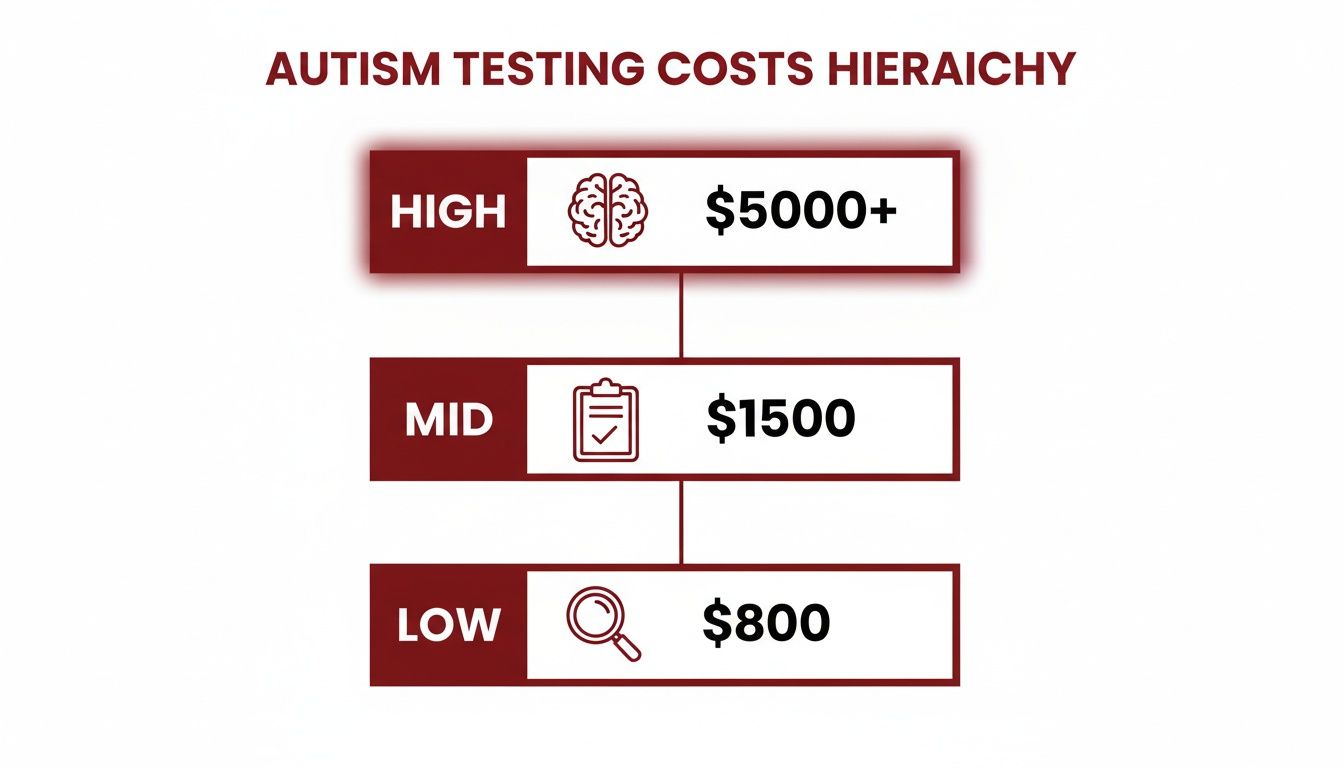
As you can see, the price jumps significantly from a basic evaluation to a full neuropsychological assessment. That leap reflects the immense difference in clinical time, complexity, and the sheer scope of the testing involved.
Key Factors That Drive the Final Price Tag
If you’ve started looking into autism testing, you’ve probably noticed the massive range in prices. It can be confusing. One clinic might quote a price that’s hundreds, or even thousands, of dollars different from another for what sounds like the exact same service.
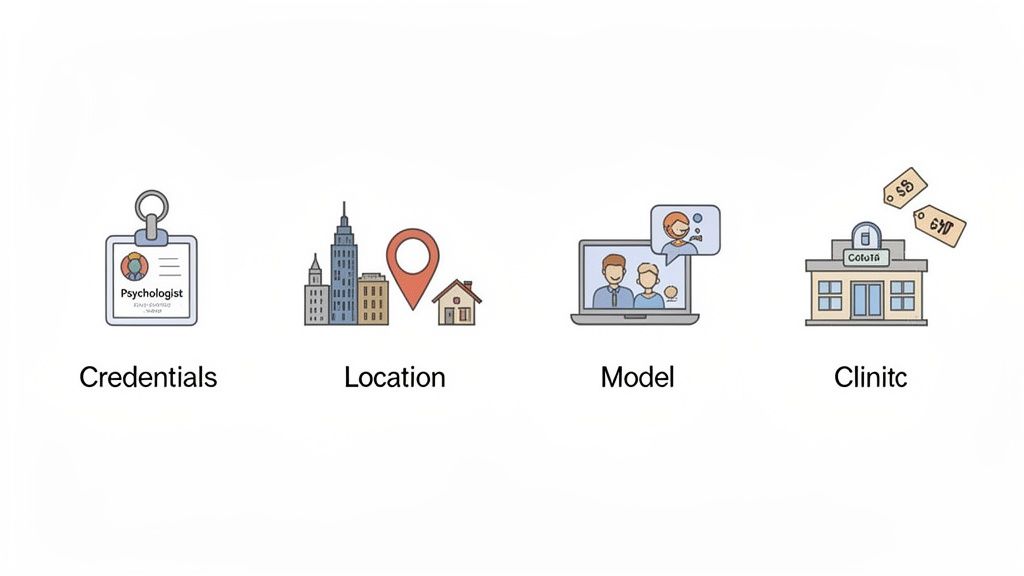
This isn’t random. Think of it like hiring a contractor to fix your kitchen. The final bill will depend on their experience, your zip code, and the quality of the materials they use. The same logic applies here. The cost of an autism evaluation is shaped by the clinician's credentials, where they're located, whether they use telehealth, and just how deep the assessment goes.
Getting a handle on these variables is the key to comparing quotes and finding a provider that offers both quality and value.
The Role of Professional Expertise
The first big piece of the cost puzzle is who is doing the evaluation. A few different types of licensed clinicians can perform a diagnostic assessment, and their training and billing rates vary quite a bit.
- Psychologists (Ph.D. or Psy.D.): These are often the go-to experts for a really thorough autism or ADHD evaluation. They specialize in psychological testing, and that deep training means their fee structure is typically higher.
- Psychiatrists (M.D.): As medical doctors, psychiatrists can not only diagnose autism but also prescribe medication if needed. Because of their extensive medical training, their rates are usually among the highest.
- Licensed Clinical Social Workers (LCSW) or Therapists (LMFT): Some licensed therapists are qualified to conduct diagnostic assessments, often at a more accessible price point. The one thing to keep in mind is that their reports might not always be accepted for certain high-stakes accommodations, like at some universities or for specific workplace supports.
As a general rule, the more specialized the provider is in neuropsychology and diagnostics, the higher the cost. That expertise is what you're paying for, and it can be critical for getting an accurate diagnosis, especially when autism presents in complex or "masked" ways.
Geographic Location and Overhead Costs
Where the clinic is physically located has a surprisingly big impact on what you’ll pay. A practice in a major city like New York or Los Angeles is dealing with much higher overhead—think rent, utilities, and staff salaries—than a clinic in a small town.
Those operational costs have to get passed on to the client.
It’s not uncommon for an in-person neuropsychological evaluation in a big city to be 20-30% more expensive than the exact same service in a more suburban or rural area. This is one of the main reasons you'll see such a wide range of quotes when you start calling around.
A clinic's physical footprint directly impacts its pricing model. High commercial rent and local economic factors mean that an evaluation in a big city will almost always cost more than one in a less populated area, even if the clinical service is identical.
In-Person vs. Telehealth Evaluations
The way the testing is delivered—in a traditional office or remotely through telehealth—is another huge factor. In-person testing means the provider has to maintain a physical office, which adds to all those overhead costs we just talked about.
A telehealth-first practice like the Sachs Center, on the other hand, has dramatically lower overhead. We don't have an expensive commercial lease for multiple testing rooms, and those savings are passed directly to our clients.
This modern approach makes high-quality, expert-led evaluations more accessible and affordable for everyone. By cutting out the costs tied to a brick-and-mortar clinic, telehealth providers can offer competitive pricing without ever compromising the quality of the assessment. It also removes barriers like travel time and costs, allowing you to get the clarity you need right from home. It's a big reason why more budget-friendly options are finally starting to appear in the diagnostic space.
How to Navigate Insurance and Reduce Your Costs
Seeing the price tag for an autism evaluation can feel overwhelming, but don't let it stop you. There are practical, real-world steps you can take to manage these expenses. The key is learning how to work with your insurance benefits, handle claims, and explore other payment options to make an evaluation affordable.
The very first thing you should do—before you even book an appointment—is call your insurance provider directly. This one phone call can save you a world of headaches and unexpected bills down the line. It’s your chance to get a clear picture of what’s actually covered.
Understanding Your Insurance Benefits
When you get an insurance representative on the phone, you’ll need to cut through the jargon to figure out your true out-of-pocket costs. Your main goal is to clarify the difference between in-network and out-of-network providers. An in-network provider has a contract with your insurance company, which almost always means lower costs for you. Out-of-network providers don’t, so you'll likely pay more.
Use this checklist of questions when you call:
- Is diagnostic testing for Autism Spectrum Disorder a covered benefit under my plan? (It helps to mention the CPT codes: 96130, 96131, 96136, 96137).
- Do I have both in-network and out-of-network benefits for these services?
- What is my annual deductible, and how much of it have I already met this year?
- Once my deductible is met, what is my coinsurance? (This is the percentage of the cost you'll still be responsible for).
Getting these answers upfront empowers you to pick a provider and an evaluation that works for your budget. As you navigate the process, it can also be incredibly helpful to look into resources that focus specifically on health insurance options for individuals with disabilities.
Exploring Other Ways to Pay
Even with decent insurance, you might still face a hefty out-of-pocket bill. The good news is there are other smart ways to bring that number down and make the cost more manageable.
One of the best strategies is to use a pre-tax health account. If you have a Health Savings Account (HSA) or a Flexible Spending Account (FSA), you can use that money to pay for the evaluation. Because the money in these accounts isn’t taxed, you’re essentially getting an automatic discount of 20-30%, depending on your tax bracket.
A lot of people don't realize they can use their HSA or FSA for diagnostic services. It's a savvy financial move that directly lowers what you pay out of pocket for an autism evaluation.
Don't be shy about asking providers if they offer payment plans. Many clinics understand the financial strain and are happy to break the total cost into smaller, monthly installments. For more ideas, our guide on finding an affordable autism diagnosis offers even more tips.
Finally, check out local university psychology clinics or non-profit organizations. They sometimes offer evaluations on a sliding scale based on your income, which can be a game-changer for many families. Costs for testing can swing wildly, but in major markets like North America, families often face out-of-pocket expenses from $790 for a basic evaluation to nearly $6,000 for a full neuropsychological workup. With the North American market projected to hit USD 5.62 billion by 2034, partly due to better insurance support, knowing all your options is more important than ever.
Why a Specialized Telehealth Approach Matters

When you’re asking, "how much does autism testing cost," you’ll quickly find that the provider’s approach is a huge part of the answer. Choosing the right clinician goes way beyond just their credentials or location; it’s about finding genuine expertise in neurodiversity and a testing model that actually works for your life. A specialized approach, especially one using telehealth, can make a world of difference in both the cost and the quality of your experience.
Specialists who live and breathe neurodiversity are simply better at spotting the subtle, often-missed signs of autism. This is a game-changer for women, girls, and BIPOC individuals, who may have spent years developing sophisticated masking techniques just to fit in. A general practitioner might miss these nuances, but an expert knows exactly what to look for, leading to a much more accurate and compassionate assessment.
The Comfort and Convenience of Testing from Home
Think about the traditional model of in-person testing. It often means navigating an unfamiliar building, dealing with the sensory overload of a waiting room, and interacting face-to-face with strangers—all things that can be incredibly draining for someone who might be autistic. That stress can easily affect how you present, potentially skewing the results.
A telehealth-first model completely flips the script. By letting you complete your evaluation from the comfort of your own home, it gets rid of many of those environmental stressors. This creates a more relaxed, authentic setting where you can just be yourself, which is exactly what’s needed for an accurate diagnostic picture.
The goal of a good evaluation is to see the real you, not the version of you that's stressed out by a clinical setting. Testing from home provides a calmer, more controlled environment that allows for a much clearer and more genuine assessment.
The practical perks are huge, too. A virtual evaluation means no travel time, no gas money, and no need to take a full day off work. It offers far more scheduling flexibility, making it easier to fit into a packed life. Our guide on the specifics of a telehealth autism diagnosis explains how this modern approach maintains the highest clinical standards while putting your comfort first.
A Modern Evaluation Process
So, what does a specialized telehealth evaluation actually look like? It’s a thoughtfully structured process that blends a real human connection with validated technology.
It kicks off with a detailed virtual clinical interview. This is a one-on-one conversation with an experienced psychologist who truly understands neurodiversity. They'll ask about your developmental history, current challenges, and unique strengths, creating a supportive space for you to share your story.
After the interview, you’ll complete a series of validated, computer-based assessments. These are the same gold-standard tools used in traditional clinics, just carefully adapted for a virtual format. This mix of a person-centered interview and objective data ensures the final diagnosis is both accurate and thorough.
This efficient, tech-driven approach is a big reason why telehealth can be more affordable. It cuts down on administrative overhead and streamlines the process without ever sacrificing clinical quality.
Your Next Steps Toward Diagnostic Clarity
Hopefully, you now have a much clearer picture of what goes into the cost of an autism evaluation. It can feel like a complex process, but once you understand the different tiers of testing and what drives the price, it all starts to make a lot more sense.
The main thing to remember is that an autism diagnosis is a worthwhile investment in yourself. It's about gaining understanding. And with the right information, you can take practical steps to make it manageable.
Think of this guide as your starting point. Now it’s time to turn that knowledge into a real plan. Finding diagnostic clarity isn't just about picking any provider—it's about finding the right one for you and knowing what to ask.
Prepare for Your First Conversation
Before you start making calls or sending emails, it pays to do a little prep work. Having a solid list of questions ready will help you cut through the confusion and compare different clinics more effectively. This ensures you find a service that fits both your needs and your budget.
Here’s a quick checklist to guide those initial conversations:
- What specific types of autism evaluations do you offer? (For example, a simple diagnostic letter, a full in-depth report, or comprehensive neuropsychological testing.)
- What is the total out-of-pocket cost for each option?
- Do you offer payment plans, or can I use my HSA/FSA?
- How much experience do your clinicians have with diagnosing autism in adults, women, or other specific groups?
- What’s the typical timeline from the first appointment to getting the final report?
These questions will get you the essential information you need to make a good decision. A transparent provider will have no problem answering them clearly and directly.
A diagnosis can be a powerful tool for self-understanding and advocacy. It’s not just a label but a key that can unlock access to the right support, accommodations, and a community of peers who share similar experiences.
Take Action and Find Clarity
Now that you're armed with this information, you’re ready to move forward. Pursuing an evaluation is a proactive step toward understanding yourself or a loved one on a much deeper level. It’s about replacing uncertainty with clarity, which can be the first step toward a new chapter of personal growth and support.
If you think a telehealth evaluation might be a good fit, consider booking a consultation. At the Sachs Center, we offer specialized, virtual evaluations designed to be both clear and convenient. Whether you need a straightforward diagnostic letter for work or school accommodations or a more detailed report, our team is here to guide you. Taking this step can provide the answers you’ve been looking for, empowering you on your neurodivergent journey.
Frequently Asked Questions About Autism Testing
Even after breaking everything down, it’s completely normal to have a few questions still swirling around. Deciding to pursue an autism evaluation is a big step, and you want to feel sure about the details before you move forward. We get it.
This section is here to give you direct, clear answers to the most common questions we hear. Think of it as the final few puzzle pieces to help you see the whole picture with confidence.
Do I Need a Doctor's Referral for an Evaluation?
This is a great question, and the answer is usually no. For a private practice like the Sachs Center, you do not need a referral from your doctor to book an autism evaluation. You can refer yourself, which removes a huge hurdle and lets you seek clarity on your own terms.
The main exception is if you plan to use insurance, especially an HMO plan. Your insurance company might require a doctor's referral before they'll agree to cover the cost. The best first step is always to call them and ask about their specific rules.
How Long Does the Entire Process Take?
The timeline can vary, but a specialized telehealth practice is often able to make the process much more efficient. From start to finish, here’s what you can generally expect:
- The Evaluation Itself: The main diagnostic appointment usually takes about two to two-and-a-half hours.
- Scoring and Analysis: After your session, the psychologist gets to work scoring the assessments and pulling all the information together.
- Getting Your Report: You’ll typically receive your diagnostic letter or the full report within one to two weeks after your evaluation.
This streamlined timeline means you get the answers you’re looking for without the long wait times you often find elsewhere. It’s one of the biggest benefits of a focused, virtual assessment.
Is a Virtual Assessment as Accurate as an In-Person One?
Absolutely. It’s a common myth that virtual assessments are somehow less accurate, but that’s just not the case. Modern telehealth evaluations use the exact same gold-standard, validated assessment tools that are used in traditional clinics. These tools have been carefully tested and adapted for remote use.
A clinical interview with a specialist who truly understands neurodiversity is just as effective over video as it is in an office. In fact, many people find they’re more relaxed and can be more themselves in their own home, which can actually lead to a more accurate picture of who they are.
The core of a great evaluation isn't the physical room—it's the clinical expertise of the psychologist and the quality of the assessment tools. A well-structured telehealth assessment delivers on both fronts, providing a reliable and valid diagnosis from the comfort of your home.
Diagnosis vs. Neuropsychological Evaluation: What Is the Difference?
This is a critical distinction, and it’s one of the biggest factors affecting how much autism testing costs.
A standard autism diagnosis has one clear goal: to determine if you meet the criteria for Autism Spectrum Disorder. The result is a formal diagnosis, usually in a letter or brief report. This is often all you need for things like workplace accommodations or simply for your own personal understanding.
A full neuropsychological evaluation is a much deeper dive. It doesn’t just provide a diagnosis; it creates a detailed map of your cognitive profile. It looks at things like IQ, processing speed, memory, and executive functioning. This kind of in-depth analysis is what’s required for things like securing accommodations on standardized tests (like the SAT, GRE, or GMAT) or getting an IEP/504 plan set up in a school.
At Sachs Center, we specialize in providing clear, accessible, and expert-led telehealth evaluations for autism and ADHD. If you're ready to take the next step toward understanding, we're here to help.
Learn more about our diagnostic services and book your evaluation today.
