

The road to an autism diagnosis rarely starts with a big, dramatic event. More often, it begins with a quiet feeling—a sense you get when you notice a pattern of behaviors, social hiccups, or sensory quirks that just feel different.
Getting an official diagnosis is about taking that gut feeling and channeling it into a structured process. It involves recognizing the signs, writing them down, and then finding a qualified professional, like a psychologist or developmental pediatrician, to help you find some clarity.
Recognizing the Need for an Autism Evaluation
Long before you’re sitting in a clinician’s office, the journey has already begun. It starts the moment you begin noticing patterns that suggest a unique way of processing the world.
For parents, it might be observing that your toddler isn’t hitting certain communication milestones or seems to exist in their own little world. For an adult, it could be the culmination of a lifetime of feeling misunderstood, socially exhausted, or like you're operating on a different wavelength than everyone else.
These initial observations are the bedrock of the entire diagnostic process. The goal isn't to diagnose yourself or your child, but simply to gather enough information to decide if a professional evaluation makes sense.
What to Look For Across Different Ages
Autism looks different depending on someone's age, personality, and life experiences. What’s obvious in a two-year-old can be incredibly subtle in a teenager or an adult who has spent years learning how to blend in.
Here are a few real-world examples of what you might see:
-
In Young Children: You might notice differences in social communication, like limited eye contact, not responding to their name, or speech delays. Repetitive behaviors are also common—things like flapping hands, meticulously lining up toys, or having an incredibly intense interest in something specific, like dinosaurs or fans.
-
In Teenagers: Social struggles often become more pronounced as friendships get more complex. A teen might have a hard time picking up on sarcasm, navigating unspoken social rules, or dealing with drama. To cope with the stress of school and social pressures, they might retreat into their highly focused special interests.
-
In Adults: Many adults come to this realization after years of feeling out of sync with the world. They might struggle to understand workplace politics, find small talk physically draining, or feel completely overwhelmed by the sensory input of a busy grocery store. It's also very common for an adult to start recognizing their own traits only after their own child is diagnosed.
The Importance of Documenting Your Observations
Once you start noticing these patterns, the single most powerful thing you can do is write them down. Clinicians really depend on your real-world examples to get a clear picture. A vague sense that "something feels off" is hard to work with, but a list of specific, dated observations is invaluable.
Your detailed notes are not just stories; they are crucial data points for a diagnostic professional. This documentation bridges the gap between your lived experience and the clinical criteria for an autism diagnosis.
Understanding the Rise in Autism Awareness
If it feels like you're hearing about autism more often these days, you are. It’s not because there's a sudden epidemic, but because awareness and diagnostic tools have gotten so much better.
The CDC’s data shows a pretty staggering shift, from 1 in 150 children back in 2000 to 1 in 31 eight-year-olds in 2022. This change really reflects better screening, a broader understanding of how autism presents (especially in girls and adults), and a greater willingness to seek answers.
Getting an early and accurate identification is the key to unlocking the right support and interventions. If you're looking for more in-depth numbers, you can find some great comprehensive statistics about autism from Abacus Therapies.
Exploring Your Diagnostic Evaluation Options
Once you've decided to pursue an autism diagnosis, the next big question is how. This isn't a one-size-fits-all process. You have choices, from the traditional route of getting a doctor's referral to more direct, specialized approaches. Understanding these different pathways is the key to picking the one that feels right for you or your family.
Each option comes with its own timeline, cost, and overall experience. It can feel like a lot to sort through, but knowing the landscape ahead of time puts you back in the driver's seat.
This flowchart gives you a bird's-eye view of the journey, from those first observations to getting a clear path forward.

As you can see, the process always starts with you—your observations and notes—before you even connect with a professional. This groundwork is invaluable.
To help you decide which path is the best fit, let's compare the three main options side-by-side.
Comparing Autism Evaluation Options
| Evaluation Type | Best For | Typical Process | Potential Cost | Outcome |
|---|---|---|---|---|
| Traditional Referral | Those who need to use insurance and are not in a rush for answers. | Visit a PCP/pediatrician, get a referral to a specialist, and then face a potentially long wait for an appointment. | Often covered by insurance, but with co-pays and deductibles. | A formal diagnosis, but the process can take many months or even years. |
| Direct-to-Specialist | Individuals or families seeking faster answers, specialized expertise (especially for adults or girls), and the convenience of telehealth. | Contacting a specialized center directly, scheduling an evaluation (often via telehealth), and receiving results much quicker. | Can be an out-of-pocket expense, but financing and affordable options may be available. | A formal diagnosis and report, typically delivered in weeks, not years. |
| Neuropsych Testing | Students needing specific, high-stakes academic accommodations for standardized tests (SAT, GRE, etc.) or an IEP. | A lengthy, multi-session assessment of cognitive functions like IQ and processing speed. This is not for a standard autism diagnosis. | The most expensive option, often costing several thousand dollars. | A detailed, 25+ page report with data to justify specific academic supports. |
Each pathway serves a different purpose. Your choice will depend entirely on your specific goals, timeline, and financial situation.
The Traditional Referral Pathway
For many people, the journey begins at their primary care physician's (PCP) or pediatrician's office. You'll bring your notes and share your concerns, and the doctor will typically write a referral to a specialist like a developmental pediatrician, neurologist, or psychologist.
This is the classic, well-worn path, and it's often a necessary step if you plan to use your health insurance. The major trade-off? The wait times. It’s not an exaggeration to say you could be waiting months—or in some areas, over a year—just to get that first appointment with the specialist. That long delay can be a huge source of stress when you're looking for clarity and support.
Direct-to-Specialist Evaluations Including Telehealth
There's a more modern alternative that is often much faster: going straight to a psychologist or a specialized center that focuses on neurodivergent assessments. These clinicians are experts in identifying autism, especially in presentations that are frequently missed by generalists, such as masked autism in adult women.
Many of these expert providers, including the Sachs Center, now offer telehealth evaluations. This approach has some serious advantages:
- Get Answers Sooner: Wait times are dramatically shorter. You can often get the clarity you need in a matter of weeks, not months or years.
- Comfort is Key: Being assessed from your own home can lower anxiety, allowing for a more natural and authentic evaluation.
- Access to Experts: Your location no longer limits you. You can connect with a top specialist in the field, no matter where you live.
When you look at the cost, it's important to see the whole picture. While paying directly might seem like a bigger initial expense, it's worth exploring options for an affordable autism diagnosis to understand how you can manage this important investment.
Understanding Neuropsychological Testing
This is where things can get confusing, so it’s critical to know the difference here. A standard diagnostic evaluation and neuropsychological testing are two completely different things.
A standard evaluation has one clear goal: to determine if an individual meets the criteria for Autism Spectrum Disorder (ASD). The process involves a deep dive into your developmental history, a clinical interview, and the use of gold-standard assessment tools. For most people who need a diagnosis for self-understanding, workplace accommodations, or therapy, this is exactly what's needed.
A standard clinical evaluation provides a formal autism diagnosis. Neuropsychological testing is a separate, more intensive assessment required for specific academic accommodations, not for the diagnosis itself.
Neuropsychological testing, in contrast, is a far more extensive and expensive process. It is not required to get an autism diagnosis. Instead, it’s a deep cognitive assessment that measures things like IQ, memory, processing speed, and executive functioning.
This level of in-depth testing is really only necessary for specific, high-stakes situations, like requesting accommodations on standardized tests (think SAT, GRE, or GMAT) or for securing an Individualized Education Program (IEP) at school. The final report from a neuropsych test is a beast—often around 25 pages long—and is packed with the hard data needed to justify those specific academic supports.
Choosing your path comes down to your ultimate goal. If you need clarity for yourself or support at work, a specialized telehealth evaluation is an efficient and effective choice. If the main goal is getting accommodations for the LSAT, then neuropsychological testing is the specific tool for that job.
How to Prepare for the Diagnostic Assessment
Going into a diagnostic assessment can feel pretty intimidating, but a little bit of prep work can make a world of difference. Think of it less like studying for a test and more like gathering the evidence that tells your—or your child's—unique story. The whole point is to give the clinician a clear, detailed window into your world so they can make an accurate assessment.

Getting organized beforehand helps you collect your thoughts and ensures you don’t forget important details when you're in the moment. For adults, this is a chance to look back on a lifetime of experiences. For parents, it's about piecing together a history that paints a complete picture of your child.
Gather and Organize Your Documentation
Before your appointment, spend some time collecting any relevant documents. Having everything together in a physical folder or a digital one can be a game-changer. You are the expert on your own life, and these materials just provide the backup and context for the clinician.
It’s helpful to pull together things like:
- Medical and Developmental Records: This includes notes from pediatricians, therapists (like speech or occupational), or any previous psychological evaluations. These documents help establish a timeline of developmental milestones and when certain concerns first popped up.
- School Reports and Teacher Feedback: Think report cards, IEPs, and any emails or notes from teachers. This stuff offers an outside perspective on social interactions, learning styles, and behavioral patterns in a totally different environment.
- Your Personal Notes: Honestly, this is your most important contribution. Go back to those detailed observations you've been making about behaviors, social challenges, sensory sensitivities, and communication styles. Specific, real-world examples are incredibly powerful.
Reflect on Key Life Experiences and Questions
The clinical interview is a huge part of the diagnostic process. The psychologist will ask a lot of questions to get a handle on your developmental history and current challenges. Thinking about these topics ahead of time means you can give more thorough, confident answers.
Clinicians are typically interested in:
- Early Development: They’ll likely ask about your first words, how you played as a kid (were you a solo player or did you join in?), and if there were any developmental delays.
- Social Relationships: Reflect on making and keeping friends throughout your life. Did you feel like you were guessing the social rules? Did you ever feel like you were "performing" or acting in social situations?
- Sensory Experiences: Think about your relationship with the world around you—sounds, lights, textures, or even tastes. Are there certain sensory inputs you can't stand or, conversely, that you actively seek out?
- Special Interests: What about those intense, focused interests you've had over the years? How much time did you pour into them? How did they make you feel?
This isn't an interrogation; it's a collaborative conversation. Your honest reflections on these areas provide crucial insights that a simple questionnaire could never capture.
Preparing Children and Adults for the Appointment
The way you frame the evaluation can have a big impact on the experience, especially for kids. It’s just as important for adults, who might be feeling a mix of anxiety and hope about the whole thing.
For Parents
Talk to your child in a way that feels positive and supportive. You could explain it as a visit with a "feelings doctor" or a "helper" who wants to understand how their brain works. Frame it as a way to learn more about their unique strengths and figure out how to make things like school and friendships a little bit easier.
For Adults
Give yourself permission to be completely open. Many adults, particularly women, have spent decades masking—consciously or subconsciously hiding autistic traits just to fit in. This evaluation is a safe space to finally lower that mask. Take time to think about all the times you felt drained after socializing, confused by unwritten social rules, or deeply comforted by a predictable routine. Your internal experience is just as important as your outward behavior.
What Happens During an Autism Evaluation
Walking into an autism evaluation can feel nerve-wracking, but knowing what’s ahead can make all the difference. Think of it less like a test with right or wrong answers and more like a collaborative conversation. The whole point is to give a trained clinician a clear, complete picture of your unique life experiences.
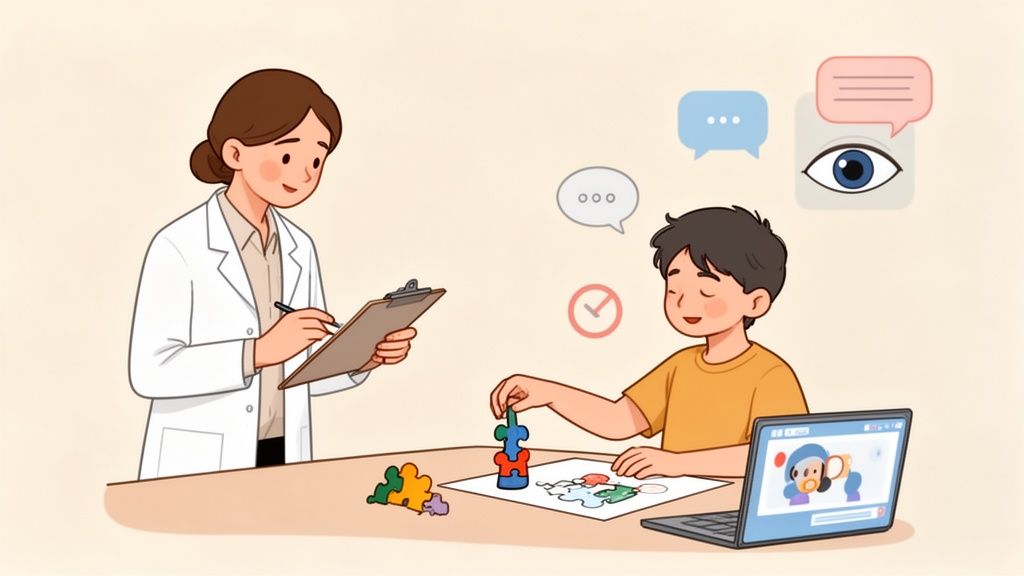
A modern evaluation is a person-centered process that looks far beyond outdated stereotypes. A good psychologist knows autism presents differently in everyone and is trained to spot the more subtle traits, especially in people who have spent a lifetime masking their true selves. The goal is to understand your neurotype, not to squeeze you into a rigid box.
The Clinical Interview: Your Story Matters
The heart of any solid autism assessment is the clinical interview. This is really just a guided conversation where the psychologist gets to know your developmental history and what you're struggling with now. It's your chance to tell your story, with an expert there to help connect the dots.
You’ll likely talk about a wide range of topics, including:
- Early Childhood: Your milestones, how you used to play, and what your first social interactions were like.
- Friendships and Relationships: How you’ve navigated making and keeping friends over the years.
- Sensory Experiences: Your sensitivities or seeking behaviors related to sounds, textures, lights, and smells.
- Routines and Interests: Your need for predictability and the nature of your special interests or passions.
This conversation is so important because it provides the context that checklists and questionnaires just can't capture. It lets the clinician see the patterns that have shaped your life, creating a rich, qualitative backdrop for the rest of the assessment.
Assessment Tools: Beyond the Checklist
While the interview is central, clinicians also use validated assessment tools to gather more structured information. Don't worry, this isn't a pop quiz. It's a multi-faceted approach to make sure the evaluation is accurate and thorough.
These tools often include:
- Self-Report Questionnaires: You might fill out forms that ask about your traits, sensory profile, and social communication style.
- Interactive Observation: For kids, this often looks like structured play. For adults, it's usually woven right into the clinical interview, as the psychologist observes your communication patterns and interaction style in a natural way.
The diagnostic process involves a comprehensive assessment by specialists using tools like the DSM-5 criteria, developmental history interviews, and standardized tests. To address historical diagnostic disparities, many modern practices employ experts trained in recognizing masked autism in women, girls, and BIPOC adults, often using telehealth to reduce barriers to access.
An autism evaluation is a dynamic process that combines your lived experience with clinical expertise. It’s about creating a complete picture, not just checking boxes on a form.
The Telehealth Evaluation Experience
Today, many assessments are done via telehealth, which can be a comfortable and accessible alternative to going into an office. Being in your own familiar space can lower your stress levels, which often leads to a more authentic and open conversation.
A virtual evaluation follows the same rigorous standards as an in-person one. The clinical interview and questionnaires work just as well over video. For many people, this format feels less intimidating and makes it easier to find specialists who truly understand adult and masked autism, no matter where you live. If you're considering this option, learning more about a guide to telehealth autism diagnosis can help you prepare for a smooth and effective virtual assessment.
The whole process, from the first conversation to the final feedback session, is designed to be supportive and clarifying. The clinician is your partner on this journey of self-discovery, there to help you make sense of your experiences. The ultimate goal is to give you the answers and validation you need to better understand yourself and thrive.
Making Sense of Your Diagnosis and Next Steps
Getting a formal diagnosis is rarely the end of the road. In my experience, it's a powerful beginning—a key that unlocks a new level of self-understanding and gives you access to the right kinds of support. The paperwork you get isn't just a confirmation; it’s a practical tool for building a life that finally works with your neurotype, not against it.
Figuring out what this documentation means and how to use it is your first real step forward. This isn't just about having a label. It's about having the right language and proof to advocate for what you need.
Diagnostic Letter vs. Comprehensive Report
After an evaluation, you'll typically get one of two documents. It’s so important to know the difference, because they serve completely different purposes.
-
A Diagnostic Letter is a concise, one-page document. It officially states the diagnosis, is signed by a licensed psychologist, and is generally what you'd use for specific, immediate needs like requesting workplace accommodations or sharing with another doctor for medication management.
-
A Comprehensive Report is a much more detailed document, often around four pages long. It goes deep into your personal history, the assessment results, the formal diagnosis, and—most importantly—a set of personalized recommendations for therapy, coaching, or other supports.
When you receive your diagnosis, the full report can feel like a lot to take in. To make it more manageable, you might find it helpful to explore strategies for converting complex diagnostic reports into manageable notes to pull out the key takeaways.
Your diagnostic report is a personalized roadmap. It translates clinical findings into actionable steps, guiding you toward resources and strategies that align with your specific strengths and challenges.
So, which one is right for you? The table below breaks down the key differences to help you decide which document best fits your goals.
Diagnostic Letter vs. Comprehensive Report
| Feature | Diagnostic Letter | Comprehensive Report (4-Page) |
|---|---|---|
| Primary Use | Workplace accommodations, medication management, basic proof of diagnosis. | Coordinated care with therapists, school supports, disability services, personal insight. |
| Level of Detail | Minimal; states the diagnosis and clinician’s credentials. | In-depth; includes personal history, assessment details, and tailored recommendations. |
| Best For | Individuals who need quick, formal verification for a specific purpose. | Those seeking a holistic plan for support and a deeper understanding of their neurotype. |
Ultimately, the comprehensive report offers a much richer, more holistic view, while the letter is designed for quick, official verification.
Using Your Diagnosis for Accommodations and Support
With your formal documentation in hand, you now have a powerful tool for self-advocacy. It provides the official validation needed to request accommodations that can make work, school, and daily life feel less like an uphill battle.
For instance, an adult with a diagnostic letter can officially request things like:
- Written instructions instead of verbal ones.
- Permission to use noise-canceling headphones in an open-plan office.
- A more predictable work schedule to help manage energy levels.
The comprehensive report is invaluable for creating a coordinated support system. You can share it with therapists, coaches, or school officials to give them a complete picture of your needs, saving you the emotional labor of explaining your experiences over and over again. You can also dive deeper into what the data reveals by learning more about how to interpret autism test scores and what they say about your unique cognitive profile.
Finding Your Community and Resources
A diagnosis also opens the door to a community of people who just get it. Finding your "neurotribe" can be one of the most validating parts of the journey. It helps reduce feelings of isolation and provides a space to share coping strategies and celebrate neurodivergent strengths.
Here are a few places to start looking for resources:
- Therapy or Coaching: Find professionals who specialize in adult autism and take a neurodiversity-affirming approach.
- Online Support Groups: Connect with other autistic adults in moderated forums or on social media.
- Skill-Building Programs: Explore workshops focused on areas like executive functioning or social communication.
Think of your diagnosis as the start of a new chapter. It empowers you with the language, documentation, and community to move forward with confidence and build a life that truly fits.
Common Questions About the Autism Diagnosis Process
As you start looking into an autism diagnosis, you’re bound to have questions. It can feel like a complicated world to step into, and it's completely normal to wonder about the costs, what the evaluations are actually like, and whether a diagnosis is even possible for adults who have spent a lifetime masking their traits.
Let's walk through some of the most common questions we hear from individuals and families. The goal here is to give you clear, straightforward answers to help you move forward with more confidence.
How Much Does an Autism Diagnosis Cost?
The financial side of a diagnosis can vary quite a bit, depending on the kind of evaluation you’re looking for. A specialized virtual evaluation focused purely on an autism diagnosis, for example, might be around $790 for a diagnostic letter or $1170 for a more detailed 4-page report.
This is a world away from the cost of intensive neuropsychological testing, which is a much more expensive process often required for specific academic accommodations. While many specialized providers don't accept insurance directly, they can often give you a "superbill"—basically, an itemized receipt. You can then submit this to your insurance company to seek potential reimbursement for out-of-network services.
It’s always a good idea to call your insurance provider beforehand to get a clear picture of what your specific benefits are for psychological testing.
What Is the Difference Between a Standard Evaluation and Neuropsychological Testing?
This is one of the most important things to get straight when you're figuring out your path. A standard diagnostic evaluation is laser-focused on one question: does this person meet the clinical criteria for Autism Spectrum Disorder (ASD)?
This process usually involves:
- In-depth clinical interviews about your life and experiences.
- Validated questionnaires and self-report measures.
- A thorough review of your developmental history.
For most people, this kind of evaluation is all you need to get a formal diagnosis and unlock the majority of workplace or therapeutic supports.
On the other hand, neuropsychological testing is a much broader, more time-consuming assessment. It isn't required for an ASD diagnosis itself. Instead, it looks at a wide range of cognitive functions, like IQ, memory, processing speed, and executive functioning. This is the kind of testing you'd need to secure certain academic accommodations for standardized tests (like the SAT, GRE, or GMAT) or to build a case for an Individualized Education Program (IEP) in a school setting.
Think of it this way: a standard evaluation answers the "what" (do I have autism?), while neuropsychological testing answers the "how" (how does my brain process information, and what specific academic supports do I need?).
Can a Telehealth Evaluation Accurately Diagnose Masked Autism in Adults?
Yes, absolutely. In fact, for many, a telehealth evaluation with a skilled clinician can be an incredibly effective way to diagnose masked autism. Psychologists who specialize in adult autism are trained to see beyond the surface and recognize the subtle signs of masking—a common coping strategy where autistic individuals learn to suppress their natural traits to navigate neurotypical social worlds.
A good diagnostic process isn't just a checklist. It's a deep, conversational dive into your life experiences, your social history, and your internal world. The clinician is looking for underlying patterns that point to your neurotype, even if your outward behaviors have been carefully polished over many years.
For many adults, being assessed from the comfort of their own home actually lowers anxiety. This familiar setting makes it easier to be open and authentic, giving the clinician a much clearer and more accurate picture. When you combine a comfortable environment, validated assessment tools, and a clinician's specialized expertise, telehealth becomes a powerful and reliable method for diagnosing masked autism. The focus is on your lived experience, not just what someone can observe in an office.
At the Sachs Center, we specialize in providing clear answers and compassionate support throughout your diagnostic journey. Our telehealth evaluations are designed to be accessible and affirming, ensuring you feel seen and understood from the comfort of your home. If you're ready to take the next step toward clarity, explore our diagnostic services at https://sachscenter.com.
