

Getting a diagnostic report packed with numbers, acronyms, and scores can feel like trying to read a foreign language. It's easy to get overwhelmed. But the first thing to know is that autism test scores aren't a simple pass/fail grade. Think of them as individual data points that help a clinician piece together a person’s unique neurodevelopmental profile.
These scores are just one tool in a much bigger, more comprehensive evaluation.
What Do Autism Test Scores Actually Mean?

When you receive that detailed report after an evaluation, your eyes might jump straight to the numbers. That’s natural. But it’s crucial to understand what they’re for. An autism test score is not a final label or some kind of judgment on a person's worth.
A better way to think of them is as coordinates on a map. They help clinicians navigate an individual's specific cognitive and behavioral landscape, pointing out areas of strength and areas where support might be needed.
These numbers come from standardized assessments, but they never tell the whole story on their own. A skilled diagnostician’s real work is to synthesize these scores with other critical information to build a complete, nuanced picture.
The Bigger Picture Beyond the Numbers
The score itself is just one piece of a much larger puzzle. To arrive at an accurate and genuinely helpful diagnosis, a clinician looks at several sources of information right alongside the quantitative data from the tests.
This holistic approach is what makes the final understanding so much more nuanced and person-centered. Key components always include:
- Clinical Observations: What does the professional see firsthand? They’re looking at social communication, interaction styles, and any restricted or repetitive behaviors during the assessment itself.
- In-depth Interviews: This means having real conversations with the individual (and often parents or caregivers) to hear about their lived experiences, challenges, and personal strengths in their own words.
- Developmental History: A deep dive into early life milestones, how social skills developed over time, and behavioral patterns from childhood all the way to the present.
Putting all of this together provides the rich context needed to interpret what the test scores truly mean for that specific person.
A score is a tool for understanding, not a definition of a person. It’s like a weather forecast: it provides valuable data and probabilities to help you prepare, but it doesn’t define the entire climate of who you are.
Ultimately, the goal is to translate all this complex assessment data into clear, practical insights. This process empowers you and your family to really understand the findings, identify strengths, and figure out what kinds of support or accommodations could be most beneficial. The numbers don't define the journey, but they can definitely help chart the course.
Screeners vs Diagnostic Tools Explained
When you start looking into autism evaluations, one of the first and most important things to wrap your head around is the difference between a screening tool and a diagnostic tool. They aren't the same thing, not by a long shot, and they serve completely different purposes. Mixing them up can cause a lot of unnecessary worry and confusion about what the results really mean.
Think of a screening tool like a smoke detector. Its job is to be quick, easy to use, and sensitive enough to let you know there might be a fire. It can't tell you if it's just burnt toast or something more serious, but it does its job by flagging that something needs a closer look. Screeners are designed for broad use, like in a pediatrician's office or as a first step for curious adults.
A diagnostic tool, on the other hand, is the full-blown fire department investigation. These are the deep, comprehensive assessments run by highly trained clinicians. Their job is to find the source of the smoke, figure out exactly what’s going on, and gather the specific evidence needed to make a formal diagnosis.
The Role of Initial Screeners
Screening tools are usually short questionnaires or checklists filled out by a parent, a teacher, or the person themselves. Their goal isn't to diagnose anyone. It’s simply to identify people who have a higher likelihood of being autistic and who should probably get a full diagnostic evaluation.
Because they’re designed to cast a wide net, they’re very sensitive, which means they can sometimes produce false positives. It's part of how they work.
For example, the Modified Checklist for Autism in Toddlers, Revised with Follow-Up (M-CHAT-R/F) is a very common screener for young kids. While it's a great tool, studies show that in practice, only about 14–50% of children who screen positive on it are ultimately diagnosed with ASD after a complete evaluation. For more on how these stats are interpreted, check out this guide on autism facts and figures from AbacusTherapies.com.
A positive result on a screener is just a signal for more information, not a final answer. It’s an essential first step that says, "Hey, let's look into this," not "This is a definite yes."
Diagnostic Tools: The Gold Standard
If a screener flags a potential concern, the next move is a full diagnostic assessment using what clinicians call "gold-standard" tools. These are far from simple checklists. They involve structured, in-person observations and detailed interviews conducted by a psychologist or another qualified specialist.
To make it crystal clear, let's break down the key differences between these two types of tools.
Screening Tools vs Diagnostic Assessments At a Glance
The table below highlights the fundamental distinctions in purpose, administration, and what you can expect from each.
| Feature | Screening Tools (e.g., M-CHAT-R) | Diagnostic Assessments (e.g., ADOS-2) |
|---|---|---|
| Purpose | To identify potential risk or traits needing further investigation. | To provide a definitive, formal diagnosis. |
| Who Administers It | Often parents, teachers, pediatricians, or self-administered online. | A highly trained clinician (e.g., psychologist, psychiatrist). |
| Time Commitment | Very brief—usually 5-20 minutes. | Extensive—can take several hours over one or more sessions. |
| What It Involves | Answering a series of questions on a checklist or questionnaire. | Direct observation, structured activities, and in-depth interviews. |
| Outcome | A score that suggests whether a full evaluation is recommended. | A comprehensive diagnostic report with findings and recommendations. |
| Cost | Usually free or very low-cost. | Can be expensive, though sometimes covered by insurance. |
Ultimately, understanding this distinction is crucial, whether you’re a parent worried about your young child or an adult who is starting to question your own neurotype. For adults, the journey often begins with self-screeners before deciding to pursue a formal evaluation. You can learn more about what that process looks like in our overview of autism screening for adults.
How to Interpret Common Autism Test Scores
Getting a diagnostic report packed with acronyms and numbers can feel overwhelming. But learning to understand what these autism test scores actually mean is the first step toward unlocking the value of the evaluation. Think of it like being handed a detailed map of a new city—once you learn what the symbols on the key represent, the entire landscape opens up.
Different assessments use their own scoring systems, but they all share the same goal: to translate behaviors, experiences, and developmental history into measurable data. This data helps a clinician spot the patterns consistent with an Autism Spectrum Disorder (ASD) diagnosis.
This flowchart shows the typical journey, starting with initial screeners and moving toward a comprehensive evaluation with a medical professional.
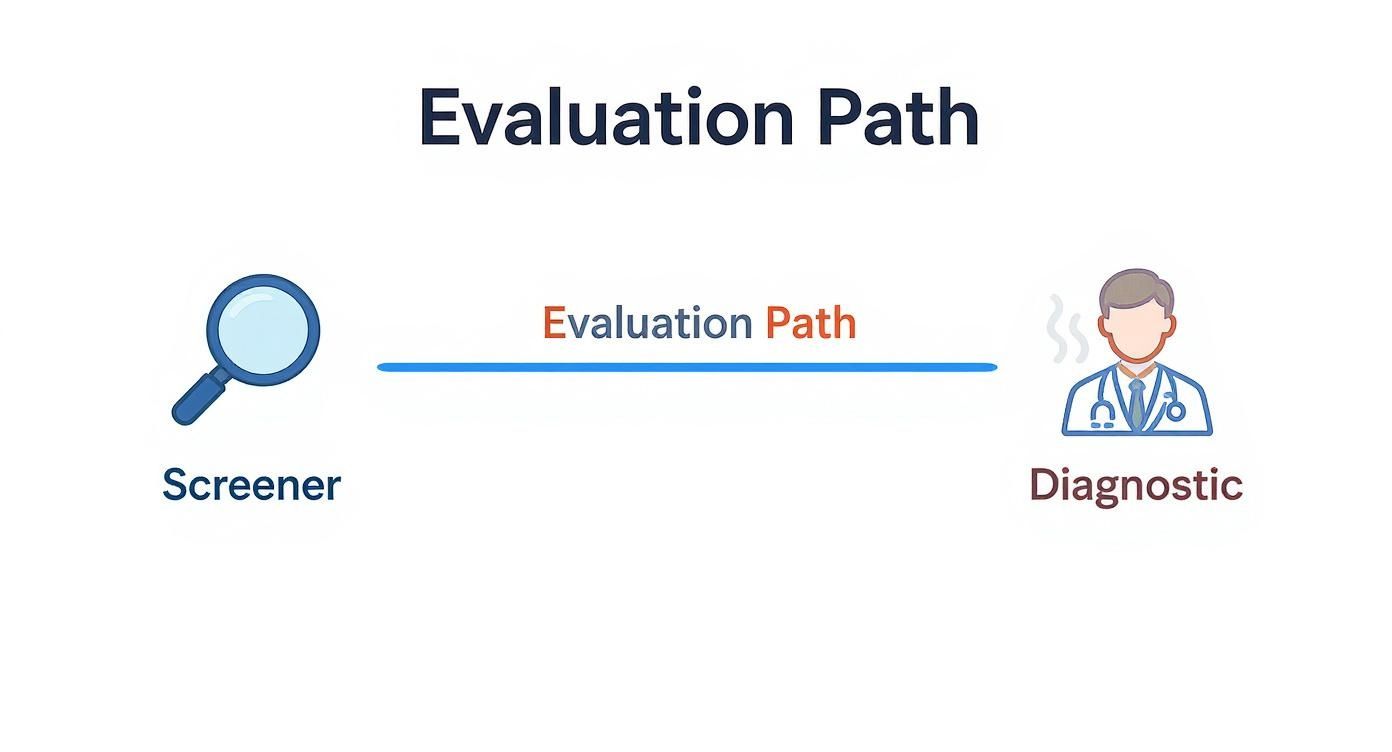
As you can see, screeners are like an initial alert system. They signal that a closer look is needed, while the in-depth diagnostic tools provide the detailed analysis required for a formal diagnosis.
Understanding ADOS-2 Scores
The Autism Diagnostic Observation Schedule, Second Edition (ADOS-2) is a cornerstone for many autism evaluations. It’s an interactive assessment that generates scores based on a clinician’s direct observations. One of its most important metrics is the Calibrated Severity Score (CSS).
The CSS is a scale from 1 to 10 that allows clinicians to compare ADOS-2 results fairly across people of different ages and language abilities. It’s not a rating of "how autistic" someone is. Instead, it measures the level of observable, autism-related characteristics present during the assessment itself.
Here’s a general breakdown:
- Scores 1-3: These scores usually fall below the clinical cutoff for an autism spectrum classification.
- Scores 4-5: This range is typically considered within the "autism spectrum" category.
- Scores 6-10: This higher range is classified as "autism" and suggests a greater number or intensity of observed traits.
A higher score simply means more pronounced characteristics were observed during the session, giving the clinician a vital piece of the overall diagnostic puzzle.
Decoding Cutoffs and Percentiles
Other tools use different scoring methods, like cutoffs or percentiles. It’s important to know how to read these, too.
The Autism Diagnostic Interview-Revised (ADI-R), for instance, is a detailed interview with a parent or caregiver that relies on cutoff scores. The clinician asks questions about developmental history and assigns numbers to the answers. If the total scores in key areas—like social interaction or communication—hit or exceed a certain number, it suggests the criteria for ASD have been met in that area.
Rating scales like the Childhood Autism Rating Scale, Second Edition (CARS2) or the RAADS-R often report scores as percentiles. Percentiles are a powerful way to see how an individual’s results compare to a standardized group of their peers.
For example, scoring in the 95th percentile doesn’t mean you got a 95% on a test. It means that the traits and behaviors observed were more significant than those seen in 95 out of 100 people in the comparison group.
Understanding these different scoring languages is key. For adults who start their journey with self-administered screeners, learning the nuances of a specific tool can be incredibly helpful. For a closer look at one of the most common adult screeners, our guide on the RAADS-R score meaning offers some great context.
At the end of the day, these numbers are just data points. When a skilled clinician combines them with their own expertise and a person’s lived experiences, they create a complete, meaningful, and accurate picture.
Why Test Scores Don't Tell the Whole Story
While numbers and data are a key part of any good clinical evaluation, it’s so important to remember that autism test scores aren't the final word. Think of them as clinical tools—snapshots taken on a specific day, under very specific conditions. A person is so much more than a data point, and a score on a report can never capture the richness and complexity of someone’s actual life.
Relying only on scores for a diagnosis is like trying to understand a person's entire personality from their height and weight. Sure, it gives you some information, but it misses almost everything that truly makes them who they are. A skilled diagnostician knows their real expertise lies in weaving those scores together with all the qualitative information to build a complete, human picture.
Factors That Influence Test Results
Lots of different things can affect how someone does during an assessment, and that can skew the results. How comfortable a person feels, their state of mind that day, and their personal background all play a huge role. Standardized tests are designed to be consistent, but people simply aren't.
Just think about these common variables:
- Co-occurring Conditions: Many autistic people also have conditions like ADHD, anxiety, or sensory processing differences. If someone is feeling anxious during a test, for example, it can make it much harder for them to engage socially. That might artificially inflate scores related to social challenges, even if it's the anxiety, not autism, driving the behavior in that moment.
- The Testing Environment: An unfamiliar office with bright lights and the pressure of being watched can be incredibly stressful. This kind of discomfort can lead to behaviors that an evaluator might misinterpret if they aren't considering the context.
- Cultural and Personal Background: A person's cultural upbringing, life experiences, and learned coping mechanisms (like masking) all shape how they present themselves to the world and in an evaluation.
The most accurate diagnosis comes from looking beyond the page. It requires weaving together the numbers from the autism test scores with family stories, personal history, and real-world observations. Context is everything.
Missing Nuance in Girls and Women
It's also a known issue that traditional diagnostic tools were historically developed based on how autism presents in boys. This has led to a well-documented problem where autism in girls and women is frequently missed.
Many autistic girls and women become incredibly skilled at masking—consciously or unconsciously copying neurotypical social behaviors to try and fit in. They might force themselves to make eye contact even when it’s deeply uncomfortable or rehearse social scripts before they even walk into a room. These coping strategies can effectively hide the underlying autistic traits during a standardized assessment, leading to scores that just don't match their internal experience. A clinician has to be trained to see past that surface-level performance to recognize these more subtle, nuanced presentations.
Turning an Evaluation into a Roadmap for Support

Getting a diagnostic report isn't the finish line; it’s actually the starting point for a new, better-informed chapter. That collection of autism test scores and clinical notes is so much more than a label. Think of it as a personalized map, showing an individual's unique strengths while also pointing out the areas where a little support could make all the difference.
This deep understanding is what unlocks the door to real help. A good report gives you the specific, evidence-based language you need to advocate for resources in different settings, turning vague struggles into a clear plan of action. For many people, this is the most empowering part of the whole journey.
From Diagnosis to Daily Life
The real power of a thorough evaluation comes alive when you apply it to the real world. The detailed findings directly shape the support systems tailored to that person’s specific profile of needs and abilities. It's about building a foundation for them to succeed on their own terms.
This roadmap can lead to several vital forms of support:
- Educational Accommodations: For kids and teens, the diagnostic report is the key to creating an Individualized Education Program (IEP) or a 504 plan at school. These plans open up access to things like preferential seating, extra time on tests, or social skills groups.
- Workplace Adjustments: For adults, a diagnosis provides the validation needed to ask for reasonable accommodations at work. This could mean getting a quieter workspace, having more flexible hours, or being able to use noise-canceling headphones to handle sensory issues.
- Therapeutic Guidance: The report gives therapists a clear direction. If social communication was a challenge, it might recommend speech therapy. If sensory processing or motor skills need a boost, it would point toward occupational therapy.
Once you have the evaluation, building that support is everything. For parents trying to navigate the school system, a great next step is learning how to develop strategies for children with special educational needs by looking at examples of Individualized Education Plans (IEPs).
The whole point of testing isn’t just to get a label—it's to gain the deep understanding needed for someone to truly thrive. Every score and observation helps paint a clearer picture of what works for them and what doesn't.
A Focus on Strengths and Growth
While any good report will outline challenges, it should also shine a bright light on an individual's strengths. It might point out exceptional pattern recognition skills, a deep and passionate knowledge of a specific interest, or a wonderfully logical way of thinking. This balanced perspective is so important.
Building a support system isn't about "fixing" someone. It's about nurturing their strengths while giving them the tools to navigate their challenges. The evaluation provides the blueprint for this balanced approach, making sure the path forward is one of empowerment, understanding, and authentic growth.
How to Get an Autism Evaluation Today
Let's be honest: just finding a qualified, accessible person to evaluate you or a loved one can feel like the biggest challenge. Historically, getting an evaluation has been a stressful process, full of long waitlists and geographical roadblocks.
The good news? Modern approaches like telehealth have made high-quality, comprehensive assessments more available than ever.
Think of a telehealth evaluation not as a shortcut, but as a valid and proven pathway to a thorough diagnosis. These assessments are conducted over secure video calls, allowing you to connect with a specialist from an environment where you already feel comfortable and safe. This is a game-changer, especially for reducing the anxiety that often comes with sterile, clinical settings.
What Is the Modern Evaluation Experience Like?
The benefits of a virtual assessment are huge. You can forget about the stress of travel, taking huge chunks of time off work, or trying to navigate an unfamiliar office. Instead, you get access to top-tier specialists who really understand the nuanced ways autism can present, no matter where you live.
A typical telehealth process is designed to be straightforward and supportive:
- Initial Online Consultation: This is your first meeting with the clinician. It’s a chance to discuss your concerns, ask questions, and get a feel for the process.
- Digital Questionnaires: You'll fill out validated self-report forms and developmental histories online, all at your own pace.
- Interactive Sessions: The real evaluation happens over video. This involves structured interviews and observational tasks designed to get a clear picture.
- Feedback and Report: The final step is a meeting to go over the findings. Your clinician will explain your scores in plain language and discuss the next steps.
Telehealth simply removes the physical barriers to expert care. It makes a comprehensive evaluation accessible from the comfort of home, ensuring that the diagnosis is based on your true self, not your reaction to a stressful new environment.
This approach gives a clear, actionable path forward for anyone looking for answers. For a detailed look at what this journey actually involves, The Sachs Center offers a complete guide on their autism diagnosis process. High-quality assessment is finally within reach.
Common Questions About Autism Test Scores
When you get the results of an autism evaluation, it’s natural to have a lot of questions. Let's walk through some of the most common things people ask after an assessment.
Can You Pass or Fail an Autism Test?
First things first: you absolutely cannot pass or fail an autism test. Assessments like the ADOS-2 aren't like a quiz in school with right or wrong answers.
Think of them more like a guided conversation or a set of observed activities. They're designed to help a professional understand a person's unique way of communicating, interacting with others, and behaving. The scores that come out of it are simply a way to measure these characteristics—not to give a pass/fail grade.
What Does a High Score on the ADOS-2 Mean?
On an assessment like the ADOS-2, a higher score—specifically the Calibrated Severity Score (CSS)—points to a greater number of or more intense autism-related characteristics being observed. Typically, a score of 6 or above suggests more significant characteristics, while the 4-5 range is often considered within the "autism spectrum" classification.
But a score is never the whole story. It's just one piece of the puzzle. A good clinician will look at that number in the much larger context of a person’s entire life, their developmental history, and how they navigate the real world every day.
Do Autism Test Scores Change Over Time?
Yes, they can, and often do. Autism itself is a lifelong neurotype, but the specific behaviors and skills that these tests measure can definitely evolve.
As a person grows, learns new coping strategies, or gets support that's right for them, their test scores might look different. That's why re-evaluations can be helpful at big life transitions, like starting college or a new job. It helps make sure that any support or accommodations are still a good fit for who they are right now.
It's so important to remember that online autism quizzes are not a substitute for a real, professional evaluation. They aren't standardized or validated, and they absolutely cannot provide a diagnosis. Only a qualified professional using gold-standard tools can do that.
If you’re looking for a clear, compassionate, and professional evaluation, Sachs Center offers telehealth-based diagnostic assessments for children, teens, and adults. You can learn more about our approach at https://sachscenter.com.
