

Yes, you absolutely can get an ADHD diagnosis without insurance. The path isn't always straightforward, but with a bit of research into community health centers, university clinics, and specific telehealth providers, you can find an affordable and credible evaluation. The most important first step is preparing a thorough history of your experiences.
Why Pursue an ADHD Diagnosis Without Insurance

Trying to get any kind of healthcare without insurance can feel like hitting a wall, especially for mental health. When you see that a private ADHD evaluation can easily cost over $2,000, it’s easy to feel defeated before you even start.
But the drive to finally understand your own brain is a powerful one.
A formal diagnosis isn't just a label—it’s a key. It unlocks a real understanding of why you think, feel, and struggle with the things you do. For many, that validation alone is life-changing, putting an end to years of feeling confused or blaming yourself.
The Practical Power of a Formal Diagnosis
Beyond that personal "aha!" moment, an official diagnosis opens doors to practical support that can make a huge difference in your daily life.
- Academic Accommodations: A diagnostic report is often the ticket to getting support in college, like extended time on exams, a note-taker, or a quiet room for tests.
- Workplace Adjustments: It gives you the documentation needed to request reasonable accommodations under the Americans with Disabilities Act (ADA). This could mean a more flexible schedule, noise-canceling headphones to help you focus, or getting instructions in writing.
- Foundation for Treatment: Even if you're paying out-of-pocket, a diagnosis helps you find the right kind of low-cost support, from ADHD-specific therapy and coaching to support groups that actually get what you're going through.
Overcoming the Financial Hurdles
Let’s be real: being uninsured makes getting care harder. The statistics back this up. Nearly half (48.8%) of uninsured kids with diagnosed ADHD get no mental health services at all. That's a huge jump compared to the 28.9% of all children with ADHD, regardless of insurance. This gap is exactly why finding other, more affordable routes is so important. You can dig into the full findings of these healthcare disparities to see the bigger picture.
This guide is here to help you cross that gap. We're going to walk through real, affordable strategies for getting a credible ADHD assessment. Your bank account shouldn't be the final say on your well-being.
We'll break down your best options, step-by-step. From learning how to document your symptoms to finding the right community clinic or telehealth service, you’ll get the information you need to move forward with confidence. The path is there—and it’s more accessible than you might think.
Key Pathways for an ADHD Diagnosis Without Insurance
When you're uninsured, knowing where to even start can be overwhelming. Here’s a quick rundown of your most viable options to help you decide which path makes the most sense for you.
| Option | Average Cost Range (Out-of-Pocket) | Best For | Potential Wait Time |
|---|---|---|---|
| Community Mental Health Centers | $0 – $150 (Sliding Scale) | Those with very limited income looking for comprehensive local care. | Weeks to several months |
| University Training Clinics | $25 – $500 (Sliding Scale) | People near a university who want a thorough, affordable assessment. | Weeks to a few months |
| Telehealth Platforms | $150 – $600 (Flat Fee) | Individuals needing a fast, convenient diagnosis and treatment plan. | Days to a few weeks |
| Private Practice (Sliding Scale) | $500 – $1,500+ | Those who find a specific practitioner they want to work with. | Varies widely |
Each of these pathways has its own set of pros and cons, but they all offer a way forward that doesn't involve a $2,000 price tag. Your best bet is to research the options in your specific area and see which one aligns with your budget and timeline.
Building Your Case: How to Document Your History
Before you even think about booking an appointment, the most powerful thing you can do is get prepared. A detailed, well-documented personal history isn't just helpful—it's the absolute foundation of an accurate ADHD diagnosis. Clinicians need to see a clear pattern of symptoms stretching from childhood into your adult life, so showing up with everything organized makes their job easier and your evaluation far more effective.
Think of yourself as a detective putting together a case file on your own life. Your mission is to gather all the clues—big and small—that tell the story of your challenges. This prep work is especially critical when you're looking for an affordable diagnosis, as it ensures every minute with the provider is spent productively.
Digging Up Clues from Childhood
A key piece of the puzzle for any ADHD diagnosis is showing that symptoms were present before you were 12 years old. For most adults, remembering the specifics of grade school can be a bit fuzzy. This is where you'll need to do some real digging for artifacts from your past.
Start by hunting down old documents that might hold some revealing details. You'd be surprised how powerful these can be.
- Report Cards: Look past the letter grades. Teacher comments are gold here. Phrases like “doesn't work up to potential,” “is easily distracted,” “talks out of turn,” or “needs to apply himself” are classic ADHD flags.
- Detention Slips or Disciplinary Notes: These can be direct evidence of struggles with impulsivity or following classroom rules.
- Parent-Teacher Conference Notes: If your parents are the type to have saved these, they can offer unfiltered observations about your focus, behavior, and social skills at the time.
Don't ever dismiss the small stuff. A simple comment from a third-grade teacher like, "Johnny is a bright boy but often daydreams in class," can be a surprisingly significant piece of your diagnostic story.
Connecting the Dots to Your Adult Life
Next, you’ll want to shift focus to your life as a teenager and adult. ADHD doesn’t just vanish after childhood; it just puts on a different outfit. The disorganization that led to a messy backpack in school might now show up as a chaotic home office or a constant battle with household chores.
Create a timeline or even just a simple list of the challenges you've faced in different parts of your life. The key is to be specific.
- Work History: Have you bounced between jobs a lot? Ever gotten feedback about missed deadlines, careless mistakes, or being disorganized? Pull specific examples from performance reviews if you have them.
- Relationships: Think about the patterns in your friendships and romantic partnerships. Do you find emotional regulation difficult? Do you interrupt people without meaning to, or forget important dates and promises?
- Financial Health: Chronic issues like late fees from forgotten bills, impulse spending, or just never being able to manage a budget can be strongly linked to ADHD.
- Daily Life: Write down the everyday frustrations. Are you always losing your keys? Do you have five projects started and none finished? Is that "doom pile" of laundry a permanent fixture in your room?
To get a clearer picture of what clinicians are looking for, it's a good idea to review the official ADHD diagnostic criteria. This will help you understand the specific symptoms of inattention and hyperactivity/impulsivity.
Bringing in an Outside Perspective
Getting an outside point of view is invaluable. We get so used to our own struggles that we often don't see them as clearly as others do. A parent, an older sibling, or a friend who has known you forever can provide crucial insights, especially about your childhood.
When you ask them for help, be prepared for them to be a little hesitant or even dismissive at first. It helps to frame your questions in a way that feels curious, not accusatory.
Sample Questions to Ask a Family Member:
- "I'm trying to figure some things out about myself. Do you remember what I was like as a kid in school? Did teachers ever say anything about me being distracted or antsy?"
- "Thinking back, do you remember me having a way harder time finishing homework or keeping my room clean compared to my siblings?"
- "As an adult, have you ever noticed that I tend to interrupt people or have a tough time waiting my turn in a conversation?"
Their answers can fill in critical gaps in your personal narrative. When you combine this outside feedback with your own documented history, you create a complete and compelling picture for your evaluator. This makes the path to an accurate—and affordable—diagnosis much, much clearer.
Finding Affordable In-Person Assessments
While telehealth has its perks, sometimes you just need—or want—an in-person evaluation. The good news is, you don't need expensive private practice fees to make that happen. Several types of community-focused clinics offer comprehensive ADHD assessments for a fraction of the cost, making a diagnosis possible even without insurance.
It takes a little legwork, but tapping into these resources can save you a ton of money. These clinics are often the unsung heroes of community healthcare, built to serve people who might otherwise fall through the cracks.
Tapping Into Community Mental Health Centers
Community Mental Health Centers (CMHCs) are a fantastic starting point. These are state or locally-funded organizations designed to provide mental health services to residents in a specific area, no matter their ability to pay. They are a true cornerstone of public health.
Because they're publicly funded, CMHCs almost always offer services on a sliding-scale fee basis. This just means your cost is tied directly to your income. If you have very low or no income, the services could even be free. You'll likely need to bring proof of income (like recent pay stubs) and residency to qualify.
Locating Federally Qualified Health Centers
Another incredible resource is the Federally Qualified Health Center (FQHC). These are community-based health centers that get federal funding to provide primary care in underserved areas. The great thing about FQHCs is their focus on integrated care, meaning they often have mental health specialists right there on-site.
Just like CMHCs, FQHCs serve everyone, regardless of insurance status, and use a sliding-scale fee schedule. The Health Resources and Services Administration (HRSA) has a simple online tool to help you find one nearby.
At an FQHC, you might start with a primary care doctor who then refers you to their in-house mental health team for the full ADHD workup. This is super helpful for ruling out other medical issues that can sometimes look like ADHD.
To help you decide which local clinic might be the best fit, here’s a quick breakdown of your main options.
Comparing Low-Cost ADHD Assessment Options
| Clinic Type | How It Works | Primary Advantage | Potential Downside |
|---|---|---|---|
| Community Mental Health Center (CMHC) | State/locally funded clinics providing mental health care to area residents on a sliding scale. | Often specialized in mental health; deeply integrated into local support systems. | Services and wait times can vary significantly depending on local funding and demand. |
| Federally Qualified Health Center (FQHC) | Federally funded centers offering integrated primary and behavioral healthcare in underserved areas. | Integrated care—can rule out physical health issues alongside mental health assessment. | May start with a primary care referral, adding an extra step to the process. |
| University Clinic | Training clinics associated with university psychology or psychiatry departments. Services provided by supervised graduate students. | Extremely low cost and often very thorough, using the latest assessment tools for training purposes. | Can have long waitlists due to high demand and limited student availability. |
Each of these paths offers a legitimate and affordable route to an assessment. The best choice often comes down to what's available in your area and how quickly you need an appointment.
Exploring University Training Clinics
If you live near a college with a psychology or psychiatry department, you might have hit the jackpot. University training clinics provide low-cost mental health services, including full psychological assessments, to the public.
Don't let the word "student" scare you. The evaluations are done by doctoral students who are closely supervised by experienced, licensed faculty members. Because the clinic's mission is education, not profit, the fees are drastically lower than what you'd find anywhere else. If you're curious about how costs can vary, our guide on the typical cost of ADHD testing breaks it down.
The quality of assessment at these clinics is often top-notch. They are incredibly thorough, as students are being trained on the most current and comprehensive tools. The main trade-off? The waitlists can be long.
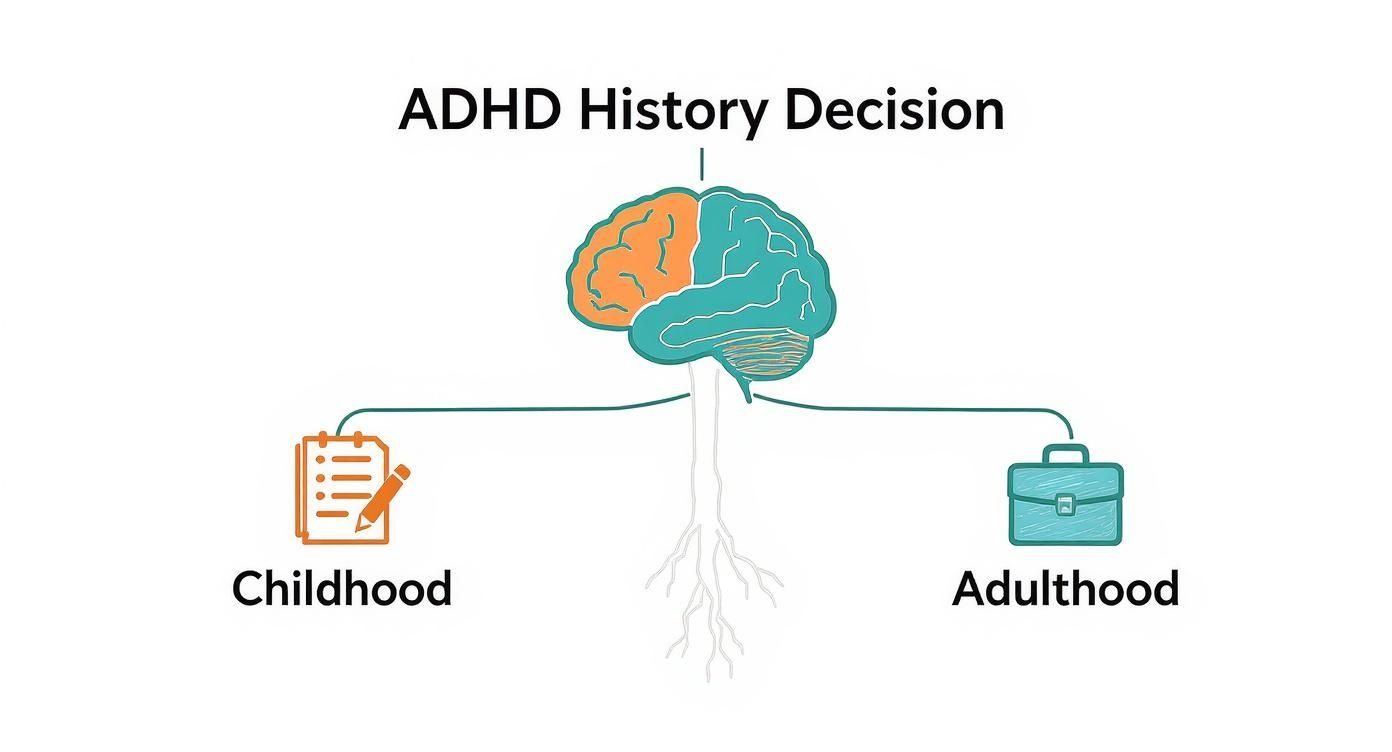
Regardless of where you go, a good diagnosis depends on showing a consistent pattern of symptoms, from struggles in your school days to the challenges you're facing now.
Preparing for Your First Call
Once you have a short list of potential clinics, it's time to pick up the phone. A little preparation can make this call go much more smoothly.
Have a few key questions ready:
- Do you provide ADHD assessments for adults?
- I don't have insurance. What are my options for low-cost services, like a sliding scale?
- What documents will I need to bring to qualify for a reduced fee?
- What's the current wait time for a new patient assessment?
- Can you briefly walk me through your evaluation process?
This first conversation is all about gathering the info you need to decide if a clinic is right for you. By using these community resources, you can find a path to a quality, in-person diagnosis without breaking the bank.
Using Telehealth for an Online ADHD Diagnosis
For a lot of people trying to get an ADHD diagnosis without insurance, telehealth seems like the most straightforward path. Online platforms have blown the doors open on mental healthcare access, getting rid of geographic hurdles and offering a process that's often way faster and more convenient than a traditional clinic.
The ability to connect with a licensed professional from your own home can be a game-changer, especially when it comes to dialing down the anxiety that often comes with seeking a diagnosis in the first place.
Cost is another huge plus. While it’s not free, you can find reputable telehealth services offering full ADHD evaluations for a flat fee, usually somewhere between $150 and $600. That’s a world away from the thousands you might pay a private psychologist, making it a much more realistic option when you're paying out-of-pocket.
But you have to be careful. The online world is crowded, and it's on you to sort the legitimate clinical providers from the ones just looking to sell you a rubber-stamp diagnosis.
Full Diagnostic Report vs. Simple Medication Letter
This is probably the single most important thing to get right when you're choosing an online provider. The kind of paperwork you walk away with determines how useful your diagnosis will be for anything beyond just getting a prescription. Getting this wrong can mean wasting hundreds of dollars on a diagnosis that won't be accepted where you need it to be.
- Simple Medication Letter: Some online services are built for one thing: getting you on medication. They’ll give you a short letter confirming your diagnosis that you can take to a doctor. It’s fast and cheap, but that letter is almost always useless for getting academic or workplace accommodations.
- Comprehensive Diagnostic Report: A real, thorough evaluation ends with a detailed, multi-page report. This is the document that lays out your history, the specific diagnostic tools used (like clinical interviews and rating scales), the clinician's findings, and the official diagnosis. This is what you need to apply for accommodations under the Americans with Disabilities Act (ADA).
Before you sign up for anything, your first question should be this: "Will I get a comprehensive diagnostic report that I can give to my school or employer for accommodations?" If they can't give you a straight "yes," it's not the right service for you.
How to Vet an Online ADHD Assessment Service
To make sure you’re putting your money into a credible service that gives you a diagnosis that's actually recognized, you need to do a little homework. Think of it like you're interviewing them for a job. Having a good grasp of what a proper telehealth ADHD diagnosis involves will help you ask the right questions and spot any red flags.
Here are the key things to check for:
- Licensed Clinicians: Who is actually doing the evaluation? The platform should be using licensed psychologists, psychiatrists, or other qualified mental health professionals. Their credentials should be easy to find.
- The Evaluation Process: What does the assessment actually look like? A proper evaluation needs an in-depth clinical interview (often an hour or more) and standardized ADHD symptom checklists. If it’s just a quick questionnaire, walk away.
- State Licensing: Is the clinician licensed to practice in your state? This is a legal requirement—the provider must be licensed where the patient is located.
- Report Details: Ask for a sample report or at least a detailed breakdown of what it includes. You want to confirm it will have your full history and the clinical reasoning behind the diagnosis.
- Follow-Up Care: What happens after you get the report? Do they help with treatment planning and therapy, or is their service over once the diagnosis is delivered?
Putting in a little time on due diligence upfront will ensure the money you spend results in a diagnosis that's actually valuable and usable. This is a critical step for anyone navigating this process without insurance, as it protects you from wasting your limited funds.
What to Do After Your Diagnosis
Getting an ADHD diagnosis is a massive, often emotional, moment of validation. But it’s really just the first page of a new chapter. The big question quickly becomes, what now? With your official report in hand, you can start building a life that actually works for your brain—and your budget—even without insurance.
This next phase is all about turning that piece of paper into real-world support. It’s about getting the accommodations you need, finding treatment options that don't break the bank, and learning how to work with your neurotype instead of constantly fighting it.
Using Your Diagnosis for Accommodations
One of the most powerful things you can do with your diagnostic report is secure formal accommodations at school or work. This isn't about getting a special advantage; it's about leveling the playing field so you can truly show what you're capable of. The Americans with Disabilities Act (ADA) is on your side here, protecting your right to request these reasonable adjustments.
Your comprehensive report is the key that unlocks these supports.
- For Students: Your first stop should be the school's disability services office. Bring your report, and they'll help you create an official accommodation plan. This could look like getting extended time on tests, having a quiet space to take exams, using a note-taker in class, or getting more flexibility with deadlines.
- For Employees: Set up a private meeting with your manager or someone in HR. You don’t have to share every last detail of your diagnosis. Simply provide a letter from your clinician along with your report to request specific adjustments. Common examples include noise-canceling headphones, getting instructions in writing, or arranging a more flexible work schedule.
You have to be your own best advocate. A formal diagnosis gives you the standing to ask for what you need. It changes the conversation from "I'm having a hard time" to "Here is the documented reason why, and here are the proven supports that will help me succeed."
Exploring Non-Medication Treatment Paths
Treatment is so much more than just medication. There are tons of effective, low-cost strategies that can help you manage ADHD symptoms day-to-day. Since you likely found a low-cost clinic for your diagnosis, that's the perfect place to start asking about ongoing support.
Once diagnosed, many people look for ways to manage the daily challenges that come with ADHD. Learning about the factors that contribute to common issues like managing brain fog and fatigue can be a really helpful part of your overall wellness strategy.
Here are a few of the most accessible options out there:
- Behavioral Therapy: Ask the community health center or university clinic that diagnosed you if they offer low-cost cognitive behavioral therapy (CBT). CBT is incredibly effective for ADHD, as it focuses on building practical skills for organization, time management, and emotional regulation.
- Support Groups: Organizations like Children and Adults with Attention-Deficit/Hyperactivity Disorder (CHADD) and the Attention Deficit Disorder Association (ADDA) host free or low-cost virtual support groups. There is something incredibly validating about connecting with other people who just get it.
- ADHD Coaching: While coaching can be pricey, some organizations and training programs offer free or sliding-scale services. Unlike therapy, coaching is very action-oriented, helping you set concrete goals and build the real-world skills to achieve them.
Navigating Medication Without Insurance
If you and your provider agree that medication might be a good path forward, the cost can feel like a massive roadblock. This is especially true for adults who got their diagnosis without insurance, a group that is already significantly underserved. While CDC data shows 6.0% of U.S. adults have a current ADHD diagnosis, many experts believe the real number is much higher, leaving countless people without support. You can learn more about the ADHD treatment gap in adults and its impact.
The good news is, there are ways to make medication more affordable.
- Ask for Generics: This is the first and easiest step. Always ask your provider at the FQHC or community clinic for a generic version. For instance, generic Adderall (amphetamine-dextroamphetamine) can cost just a fraction of the brand-name price.
- Use Prescription Discount Cards: Services like GoodRx or SingleCare are completely free and can save you a surprising amount of money. You can check prices at different local pharmacies right from your phone to find the best deal.
- Look into Patient Assistance Programs (PAPs): Most big pharmaceutical companies have PAPs that provide free or very low-cost medication to people who are uninsured or have a low income. It usually requires some paperwork from you and your doctor, but the savings can be huge.
Think of your diagnosis as a tool. By using it to get accommodations, find the right therapy, and access affordable medication, you can finally start building a life that truly supports your neurodivergent brain.
Still Have Questions About Getting Diagnosed Without Insurance?
Even after laying out all the options, I know you probably have a few specific questions swirling around. Getting to a diagnosis can feel complicated, and it's totally normal to have some lingering uncertainties. Let's tackle some of the most common ones I hear.
Can I Just Use a Free Online ADHD Quiz for a Diagnosis?
No, and this is a really important distinction. A free online quiz is not a real diagnosis. Tools like the Adult ADHD Self-Report Scale (ASRS) are fantastic starting points. They can help you organize your thoughts and see if your symptoms line up with common ADHD traits.
But think of them as a compass, not the destination. They can't be used for official accommodations or to get medication. A formal diagnosis requires a deep dive with a qualified clinician who can rule out other potential causes for your symptoms and look at your entire life history.
What’s the Real Cost of an ADHD Assessment Without Insurance?
This is where the numbers can get scary, but they don't have to be. The cost of an uninsured ADHD diagnosis varies wildly. A full workup with a private psychologist can easily run you $1,000 to over $3,000.
Thankfully, the options we've covered are much more realistic.
- Sliding-scale clinics adjust the fee to your income, so you might pay anywhere from $20 to a few hundred dollars.
- University training clinics are often the most affordable route, sometimes charging under $200 for a very thorough, high-quality assessment.
- Telehealth services usually land somewhere in the middle, with evaluations costing between $150 and $600.
Will My School or Job Actually Accept a Telehealth Diagnosis?
Most of the time, yes—but there’s a big catch. They won't accept a simple one-page letter saying you have ADHD. You need a full, comprehensive diagnostic report from a licensed clinician.
Before you commit to any online service, you have to confirm they provide this detailed report. It's also a smart move to check with your school's disability services or your HR department to see their specific documentation requirements. Getting this sorted out ahead of time saves a massive headache later.
A detailed report is your key to unlocking accommodations. It provides the necessary evidence and clinical reasoning that institutions require, making your request legitimate and actionable.
Can My Primary Care Doctor Diagnose Me with ADHD?
It's possible, but it’s not always the most direct path. Some primary care physicians (PCPs) are comfortable diagnosing and treating adult ADHD, especially those at a Federally Qualified Health Center (FQHC) where they are often the front line for mental healthcare.
However, many PCPs prefer to refer you to a specialist like a psychiatrist or psychologist for a formal evaluation. This is especially true if your situation seems complex or if they think other conditions might be at play. It never hurts to ask your doctor, but just be prepared for a potential referral.
At the Sachs Center, we specialize in providing clear, credible, and compassionate telehealth evaluations for ADHD and Autism. Our licensed psychologists understand the nuances of neurodiversity and provide comprehensive diagnostic reports that you can use for work, school, or treatment planning. Find out how we can help you get the answers you deserve by visiting us at https://sachscenter.com.
