

For many adults, the journey toward recognizing you might be autistic doesn't start with a checklist. It often begins with a quiet, persistent feeling of being just a little out of sync with the world. The path forward means looking past the old, outdated stereotypes from childhood and exploring what autism actually feels like for a grown-up.
This can mean having deep, all-consuming passions, finding unspoken social rules confusing, or feeling overwhelmed by sensory input. It also involves learning about things like autistic masking—the exhausting, often unconscious, effort to hide your natural traits just to fit in.
A Journey of Adult Self Discovery
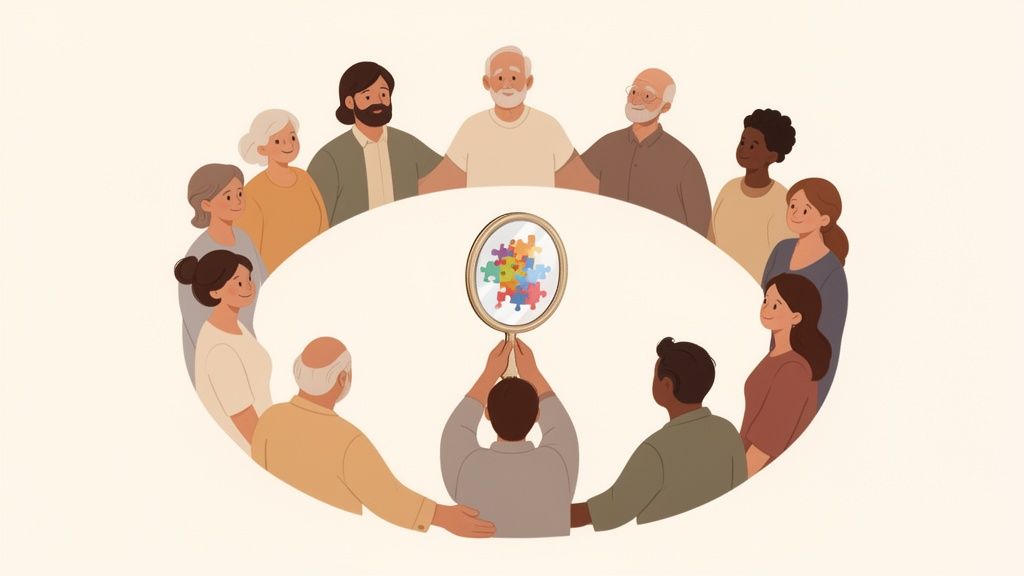
If you're asking yourself, "Could I be autistic?" you are far from alone. More and more adults are seeing their own lifelong experiences mirrored in online neurodivergent communities or even in a younger family member's recent diagnosis. This guide is here to help you move beyond those old perceptions and dig into the reality of autism in adulthood.
Think of this as a journey of self-discovery. Our goal is to create a supportive, validating space for you to explore these questions. We'll offer practical information and clear next steps to make a potentially overwhelming process feel much more manageable.
Why Adult Recognition Is Different
For decades, the picture of autism was incredibly narrow, based almost entirely on observations of young, white boys. This meant that countless people—girls, people of color, and anyone who didn't fit that specific mold—were completely missed.
As a result, many adults are now connecting the dots themselves. They're realizing that a lifetime of social burnout, sensory overload, or feeling "too much" might have a clear neurological reason behind it.
This late-in-life realization is especially common for:
- Women: Who are often socialized to hide their difficulties and tend to have more internalized autistic traits.
- BIPOC Individuals: Whose traits may be dismissed or misinterpreted because of cultural and racial biases.
- Older Adults: Who grew up long before adult autism was even part of the conversation.
Considering you might be autistic as an adult is really about finding a new framework for your own life story. It gives you a language for experiences you may have never known how to describe. Exploring the power of autism can help reframe these differences not as flaws, but as a core part of who you've always been.
This shift in perspective is profound. It’s not about finding something 'wrong' with you; it’s about discovering a fundamental aspect of your identity that has been there all along, offering a new lens for self-compassion and understanding.
Understanding Key Concepts
Before we jump into specific signs, a few core ideas are helpful to know. A huge part of the adult autistic experience is the sheer amount of energy it takes to exist in a world that wasn't designed for you. This constant effort is draining.
For instance, learning about autism burnout can be a real lightbulb moment. It's a state of complete mental, emotional, and physical exhaustion that comes from the accumulated stress of trying to cope and mask. Recognizing these patterns is a vital first step toward living a more sustainable and authentic life.
Exploring the Core Traits of Adult Autism
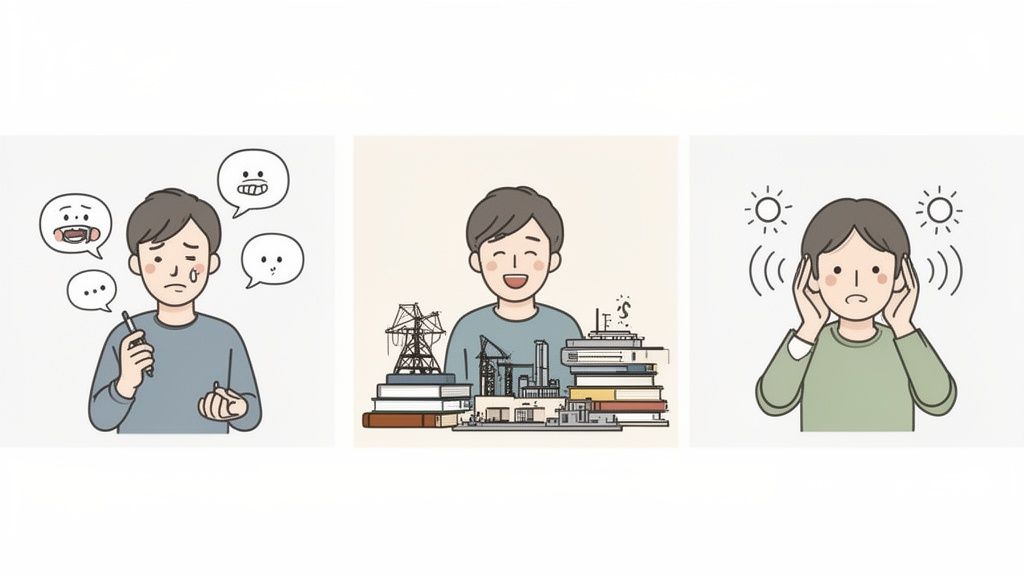
Realizing you might be autistic as an adult isn't about checking boxes on a list. It’s about looking at your life through a new lens and seeing how a differently wired brain has shaped your experiences in a world mostly built for neurotypical people.
This journey of self-discovery usually starts by looking at a few key areas: social communication, intense interests, and sensory processing. Think of these not as separate issues, but as interconnected parts of a whole. Many people find that once one area clicks into place, the others suddenly make a lot more sense.
Navigating Social Communication and Interaction
For many autistic adults, social interaction feels less like an intuitive dance and more like a complicated piece of machinery you have to operate manually. You're constantly running a complex mental program just to keep up with conversations that seem to come naturally to everyone else.
This isn't about a lack of desire to connect; it’s a fundamental difference in how your brain processes social information.
This can show up in a few common ways:
- Scripting conversations: Do you find yourself mentally rehearsing conversations before they happen? This could be planning what to say in a meeting, practicing a phone call, or running through potential small talk before you even walk into a party.
- The "social hangover": Even after a fun social event, you might feel completely wiped out. This isn't just being tired—it's a deep-seated exhaustion that requires a lot of quiet, alone time to recover from.
- Missing the unwritten rules: Neurotypical communication is full of hints, sarcasm, and things left unsaid. You might take things very literally or feel like you’re always a step behind, leading to frequent misunderstandings.
It's a huge misconception that autistic people aren't empathetic. Often, it's the opposite—they feel empathy so intensely it becomes overwhelming. The real challenge isn't a lack of feeling, but figuring out how to express it in a way that fits neurotypical social expectations.
This constant effort to navigate a neurotypical world is a big reason why so many autistic adults were missed as kids. The Global Burden of Disease Study 2021 estimated that around 61.8 million people worldwide were autistic. That's roughly one in every 127 people. These numbers highlight a massive diagnostic gap, since efforts have historically focused on children, leaving many adults—especially women and people of color—to figure things out on their own. You can explore the latest analysis of global autism rates00118-0/fulltext) to see the full scale of the issue.
The Power of Passionate Interests
From the outside, it might look like an "obsession." But for an autistic person, these deep, passionate interests are a source of immense joy, comfort, and expertise. They're far more than hobbies; they provide structure and predictability in what can feel like a chaotic world.
In an adult, this might look like:
- Having an encyclopedic knowledge of a very specific historical period, a particular TV show, or a musician's entire discography.
- Dedicating time to collecting and meticulously organizing items, whether it's vintage comic books, rare houseplants, or vinyl records.
- An intense drive to master a specific skill, like learning a coding language, perfecting a craft, or diving deep into scientific research papers just for fun.
These interests are often a core part of an autistic person's identity and one of the primary ways they recharge their batteries.
Understanding Sensory Processing Differences
Living with autistic sensory processing is like having the volume dials on the world set all wrong. Some senses might be turned up to 11 (hypersensitivity), while others are dialed way down (hyposensitivity). This isn't a preference—it’s a neurological reality.
To get a clearer picture of how these traits might appear in daily life, take a look at this table. It breaks down some common experiences across the different domains we've discussed.
Common Signs of Autism in Adults At a Glance
| Domain | Potential Signs and Experiences |
|---|---|
| Social & Communication | – Feeling like you're "acting" or "performing" in social situations (masking) – Finding small talk confusing, preferring deep conversations – Difficulty making or keeping friends, despite wanting to – Taking things very literally and missing sarcasm or subtext – Needing to rehearse conversations beforehand |
| Passionate Interests & Routines | – Having deep, specialized knowledge in specific topics – Finding immense comfort in routines; feeling distressed by unexpected changes – Arranging or organizing objects in a particular way – Interests are a primary source of joy and stress relief |
| Sensory Processing | – Overwhelmed by bright lights, loud noises, or strong smells (hypersensitivity) – Finding certain clothing textures (like tags or wool) physically unbearable – Craving deep pressure, like tight hugs or weighted blankets (hyposensitivity) – Having a high pain tolerance or not noticing injuries right away – "Stimming" (repetitive movements like rocking, fidgeting, or hand-flapping) to self-soothe |
| Emotional & Executive Function | – Difficulty identifying or describing your own emotions (alexithymia) – Experiencing intense, sometimes overwhelming emotions – Challenges with planning, organization, and starting tasks (executive dysfunction) – A strong sense of justice and fairness |
Seeing your own experiences reflected here can be a powerful first step. Many people find that what they always thought were just personal quirks are actually part of a recognizable, shared neurotype.
Hypersensitivity vs. Hyposensitivity
Here’s a closer look at what over- and under-responsiveness can feel like day-to-day.
Common Signs of Hypersensitivity (Over-Responsive)
- The fluorescent lights and constant background chatter in a supermarket feel like a physical assault on your senses.
- You can't stand the feeling of certain fabrics, like a scratchy sweater or the tag on a shirt.
- An unexpected loud noise can make you jump out of your skin, and you might have strong reactions to specific food textures.
Common Signs of Hyposensitivity (Under-Responsive)
- You crave deep pressure and find things like weighted blankets or firm hugs incredibly calming.
- You might have a high tolerance for pain, maybe not even noticing a cut or bruise until much later.
- You need intense flavors or crunchy textures to really feel satisfied when you eat.
It's also completely possible to be both hyper- and hyposensitive. You might be extremely sensitive to sound but need strong flavors to really taste your food. Learning about these sensory needs is a critical part of understanding how to recognize autism in adults and, more importantly, how to create a life that feels comfortable and safe, not constantly overwhelming.
The Hidden Experience of Autistic Masking

For a lot of adults wondering if they might be autistic, the biggest roadblock isn't a lack of traits—it's that they've spent a lifetime becoming experts at hiding them. This is called autistic masking or camouflaging, and it's one of the most critical, yet frequently missed, parts of the adult autistic experience.
It’s an exhausting, often subconscious strategy of suppressing natural autistic behaviors just to blend into a neurotypical world. Masking is so much more than just being polite; it’s a full-time performance where you’re constantly overriding your own instincts to meet social expectations. This is a huge reason why figuring out how to recognize autism in adults is so tough, both for the person themselves and for those around them.
The effort is immense. Imagine having to speak a second language all day, every day, with no breaks. That's what masking can feel like. It’s no wonder so many undiagnosed autistic adults feel completely drained, anxious, and disconnected from who they really are, without ever knowing why.
What Autistic Masking Actually Looks Like
Masking isn't just one thing. It's a whole collection of complex behaviors learned over years of social trial and error. These strategies become so deeply ingrained they can feel like they're just part of your personality.
Here are a few real-world examples of what masking can involve:
- Forcing eye contact: For many autistic people, direct eye contact feels overwhelming, distracting, or even physically uncomfortable. Masking means forcing yourself to do it anyway to seem engaged, even if it makes it impossible to actually process what the other person is saying.
- Mimicking social behaviors: This is about playing the part. You might carefully watch your neurotypical peers and copy their hand gestures, facial expressions, and common phrases. It often involves creating "social scripts" for everyday things like ordering coffee or making small talk, rehearsing the lines in your head to get them right.
- Suppressing self-soothing behaviors (stims): Natural, repetitive movements like hand-flapping, rocking, or fidgeting—known as stimming—are essential self-regulation tools for autistic people. Masking means clamping down on these urges in public, maybe swapping them for tiny, "socially acceptable" fidgets like tapping a foot or clicking a pen.
This constant performance just isn't sustainable. The mental and emotional energy it takes to keep the mask on can lead to serious consequences, draining the very resources needed for daily life.
The real tragedy of masking is that it forces you to hide the very things that bring you comfort and help you regulate, all for the sake of fitting in. The result is often profound burnout, anxiety, and a nagging feeling that you don't even know who you are underneath it all.
The Overwhelming Cost of Constant Camouflaging
Living behind a mask takes a staggering toll. When all your energy goes into performing, there’s very little left for anything else. This is a primary driver of autistic burnout—a state of intense physical, mental, and emotional exhaustion that is far more severe than just feeling tired.
The long-term costs of masking often include:
- Severe Anxiety and Depression: Constantly policing your own behavior and worrying about social missteps is a recipe for serious mental health challenges.
- Identity Confusion: After decades of masking, it can be almost impossible to tell where the persona ends and your authentic self begins. Many late-diagnosed adults talk about "not knowing who I really am."
- Delayed Diagnosis: Masking is so effective at hiding core autistic traits that it can prevent individuals, their families, and even doctors from seeing the underlying neurotype for years, sometimes decades.
This is especially true for people socialized as women, who often face intense societal pressure to be agreeable and socially skilled.
How Masking Presents Differently
While masking is a near-universal autistic experience, it doesn't look the same on everyone. How you were raised—including gender norms and cultural background—plays a massive role in how you learn to camouflage your traits.
For many women, masking tends to be more subtle and internalized. Their passionate interests might be in subjects seen as more "socially acceptable," like literature, psychology, or animals, so they don't get flagged as unusual. They often become intense observers of human behavior, studying social dynamics so they can mimic them better. To explore this further, our guide on autism in women provides deeper insights into why so many go undiagnosed.
For Black, Indigenous, and People of Color (BIPOC), the pressure to mask can be even more profound. On top of autistic masking, there's often an extra layer of "code-switching" needed to navigate racial bias and stereotypes. In BIPOC individuals, autistic traits might be wrongly chalked up to personality flaws or attitude problems, making the path to recognition and support that much harder.
A Guide to Self-Reflection
Starting a journey of self-reflection can feel like a huge, intimidating step, but it’s one of the most powerful things you can do to understand yourself better. This isn't about diagnosing yourself. Think of it as a gentle, structured way to explore your own life experiences before you even think about getting a professional opinion.
By asking yourself the right questions, you can start connecting the dots between your day-to-day life and the core traits of autism. This process can arm you with the language and clarity you need to decide if a formal evaluation feels like the right next step for you.
Exploring Your Social World
Let's start by thinking about your social battery and how you handle interactions with others. For a lot of autistic adults, socializing isn't something that just happens—it’s a skill that takes a ton of conscious effort and a significant amount of energy.
Ask yourself these questions about your social life:
- Do I feel completely wiped out after social events, even the fun ones? This is more than just feeling a little tired. We're talking about a deep "social hangover" that might demand a full day (or more) of quiet and solitude to recover from because you've spent hours manually decoding social cues.
- Do I mentally script conversations before they even happen? Many autistic people create detailed scripts for all sorts of common interactions, from ordering coffee to navigating a work meeting. It’s a way to manage the anxiety of the unknown and feel prepared.
- Does small talk feel confusing, pointless, or just plain weird? You might be the kind of person who would much rather dive straight into deep, meaningful conversations, finding all the superficial chatter to be a frustrating and bizarre social ritual.
Answering "yes" to these doesn't automatically mean you're autistic. But, it does point to a pattern of social processing that is incredibly common within the autistic community. It’s all about the "why" behind your social habits.
Understanding Your Passions and Routines
Next, let's turn to your interests and the way you structure your day. What might look like stubbornness or rigidity to an outsider can be a vital source of comfort and stability for an autistic person.
Think about the role that passions and structure play in your life:
- Do my passions feel way more intense and all-consuming than a typical hobby? These are often called "special interests." They’re deep wells of joy, focus, and expertise. Engaging with them might be one of the primary ways you recharge your batteries.
- Do unexpected changes to my plans or routines cause me real distress? Predictability is a powerful tool for managing anxiety. A last-minute change of plans isn't just a minor annoyance; for you, it might feel genuinely destabilizing and throw your whole day off kilter.
The need for routine isn't about being inflexible. It's about creating a predictable foundation in a world that often feels chaotic and overwhelming, freeing up mental energy for other tasks.
Tuning Into Your Sensory Experiences
Finally, take a moment to consider your sensory world. Autistic people often process sensory information—sights, sounds, textures, smells—very differently than neurotypical people. This can lead to both intense discomfort and unique sources of pleasure.
Ask yourself about how you react to sensory input:
- Do I have intense negative reactions to certain sounds, textures, or lights? Maybe the hum of fluorescent lights is physically painful, the tag on a shirt feels unbearable, or the sound of someone chewing triggers a visceral, can't-stand-it response.
- Do I find myself actively seeking out specific sensory experiences to feel calm? This could look like craving the deep pressure from a weighted blanket, the repetitive motion of rocking or fidgeting (stimming), or listening to the same song on a loop.
This kind of honest self-reflection can uncover valuable insights. For a more structured approach, many people find it helpful to see these kinds of questions laid out in a different format. Taking a preliminary online screening, like an Am I Autistic quiz, can be another way to organize your thoughts and see how your experiences line up with common autistic traits. Again, this isn’t for diagnosis—it's purely for your own personal exploration. Recognizing these sensory patterns is a key part of learning how to recognize autism in adults.
So, after all that self-reflection, you might be wondering what's next. For many, pursuing a formal diagnosis is a huge, validating step. It's not just about getting a label; it's about gaining a framework for your entire life's experience and finally unlocking support you might not have even known was available.
The reasons for seeking a diagnosis are deeply personal. For some, it’s the profound relief of finally having a name for a lifetime of feeling different. For others, it's a practical step toward getting workplace accommodations or finding the right kind of therapy.
What Does an Evaluation Look Like These Days?
Getting an adult autism diagnosis isn't as intimidating as it once was. Telehealth has been a game-changer, breaking down so many barriers. You can now connect with specialists from the comfort of your home, which can make the whole process feel much less stressful.
This flowchart is a nice visual recap of the kinds of things you've likely been thinking about that can point toward an autism evaluation.
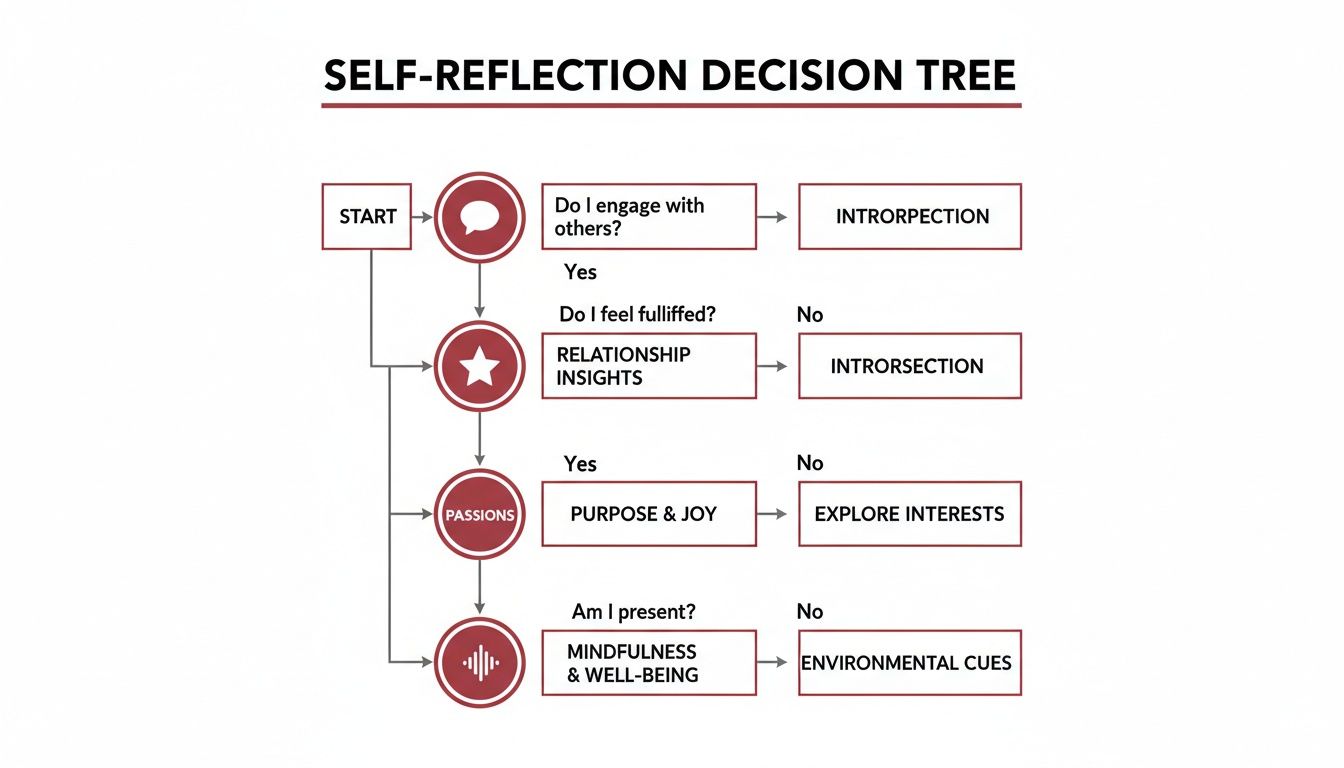
As the chart shows, patterns across social experiences, intense passions, and sensory sensitivities often connect the dots.
A modern telehealth evaluation is really a guided conversation. It typically includes:
- A Clinical Interview: You’ll talk with a psychologist who specializes in neurodiversity about your childhood, your current struggles, and your experiences over the years.
- Validated Assessments: These are self-report questionnaires specifically designed to measure autistic traits.
- A Collaborative Discussion: The psychologist puts all the pieces together—your history, the assessments, the interview—to see if you meet the criteria for Autism Spectrum Disorder.
Think of it as a space to share your story with a professional who gets the nuances of how autism shows up in adults, not as some scary test.
What Kind of Paperwork Do You Get?
After the evaluation, you'll receive official documentation. Knowing the difference between the types can help you figure out what you need.
- Diagnostic Letter: This is a simple, one-page document confirming your diagnosis. It’s usually all you need for requesting workplace accommodations or sharing with your doctor.
- Full Diagnostic Report: This is a much more detailed, multi-page report. It dives into your history, assessment results, and personalized recommendations. It offers a really rich picture for you and any therapists or coaches you work with.
For many adults, the letter is enough. But the full report can be an incredible tool for deeper self-understanding.
A diagnosis isn't an endpoint; it's a new beginning. It provides a roadmap for building a life that honors your neurotype instead of forcing you to conform to a world not built for you.
When a Full Neuropsychological Evaluation Is Needed
While a standard telehealth evaluation works for most adults, some situations call for a more extensive assessment, known as a neuropsychological evaluation.
This deep dive is usually only necessary if you're seeking accommodations for standardized tests, like getting extra time on the SAT, GRE, or GMAT. These testing boards often require the kind of detailed diagnostic data that comes from a full neuropsych eval. Telehealth has been crucial in making these evaluations more accessible, especially for adults without local specialists. You can learn more about the impact of telehealth on adult autism diagnosis and how it helps in securing accommodations.
Talking to Loved Ones and Finding Your People
Bringing family and friends into your journey can feel daunting. A good way to start is by leading with your own experience. Explain how this new understanding helps make sense of your life, framing it as a positive move toward self-acceptance.
Just as important is connecting with the autistic community. It's a game-changer. Online forums, local meetups, and neurodivergent creators on social media can offer a sense of belonging that is incredibly powerful. You’re not alone on this path.
Common Questions About Adult Autism Evaluation
Taking the first step toward an evaluation is a big deal, and it’s completely normal to have a lot of questions. What does the process actually look like? What kind of paperwork will I get? What if I think I have ADHD, too?
Let's walk through some of the most common questions we hear from adults. Getting clear, direct answers can help you feel much more confident about the path ahead.
Do I Need a Full Neuropsychological Evaluation?
Probably not. For most adults who are looking for clarity, need workplace accommodations, or want guidance for therapy, a comprehensive diagnostic evaluation is exactly what you need. This is a modern, focused approach—often done via telehealth—designed specifically to identify autism in adults.
So, when is a full neuropsychological evaluation necessary? This is a much more intensive and time-consuming process. It's generally only required if you’re trying to get specific academic accommodations, like extra time on standardized tests like the SAT, ACT, or GRE. For almost everything else, the standard diagnostic evaluation is the way to go.
What Is a Diagnostic Letter vs. a Full Report?
After your assessment, you'll receive paperwork that summarizes everything. It’s good to know the difference between the two main types.
- A diagnostic letter is short and sweet—usually just one page. It simply confirms your diagnosis. This is often all you need to request accommodations at work or to share with other providers, like a psychiatrist for medication management.
- A full diagnostic report is more in-depth, typically around four pages long. It breaks down your history, current challenges, the diagnosis itself, and provides personalized recommendations. It gives you and your care team a much more holistic picture.
Can an Adult Be Diagnosed with Autism and ADHD?
Yes, absolutely. In fact, it's very common for autism and ADHD to show up together. This is often called AuDHD. A skilled clinician who specializes in neurodiversity can identify and differentiate the traits of both conditions during a single, comprehensive evaluation.
Getting an accurate diagnosis for co-occurring conditions is so important. It ensures that your support plan is built around the unique strengths and challenges that come with your specific neurotype, instead of treating each condition like it exists in a vacuum.
A dual diagnosis means you can find more tailored approaches to therapy, coaching, and self-management that truly honor the complete picture of how your brain works.
At the Sachs Center, our psychologists are experts in diagnosing neurodiversity in adults, including highly masked presentations that are often missed. We offer telehealth evaluations for Autism, ADHD, and AuDHD, providing the clarity you need from the comfort of your home. If you're ready to take the next step, learn more about our diagnostic services.
