

IEP accommodations for ADHD can transform a frustrating day at school into a series of small wins. Extended time on assignments and tests offers a cushion against the racing clock. Behavior cues work like a personal GPS, gently rerouting attention when it drifts. And assistive technology—from speech-to-text apps to digital timers—becomes a steady learning companion.
Quick Overview Of Key IEP Accommodations
Here’s a snapshot of the most common supports you’ll see in classrooms and testing situations. Each one tackles a specific hurdle, making academic tasks more approachable.
Think of these accommodations as a custom toolkit designed around how your student learns best.
Some strategies reduce anxiety under the clock; others reinforce focus without drawing attention. Together, they lay the groundwork for confidence and success.
- Extended time on tests gives students space to process questions and articulate answers fully.
- Subtle behavior cue signals (a tap on the desk, a coded gesture) steer attention back to the lesson discreetly.
- Assistive tech tools—like digital organizers and voice-to-text programs—keep thoughts and deadlines in order.
- Preferential seating places learners near the teacher or away from high-traffic areas to limit distractions.
- Scheduled movement breaks let restless energy discharge in short bursts, restoring mental clarity.
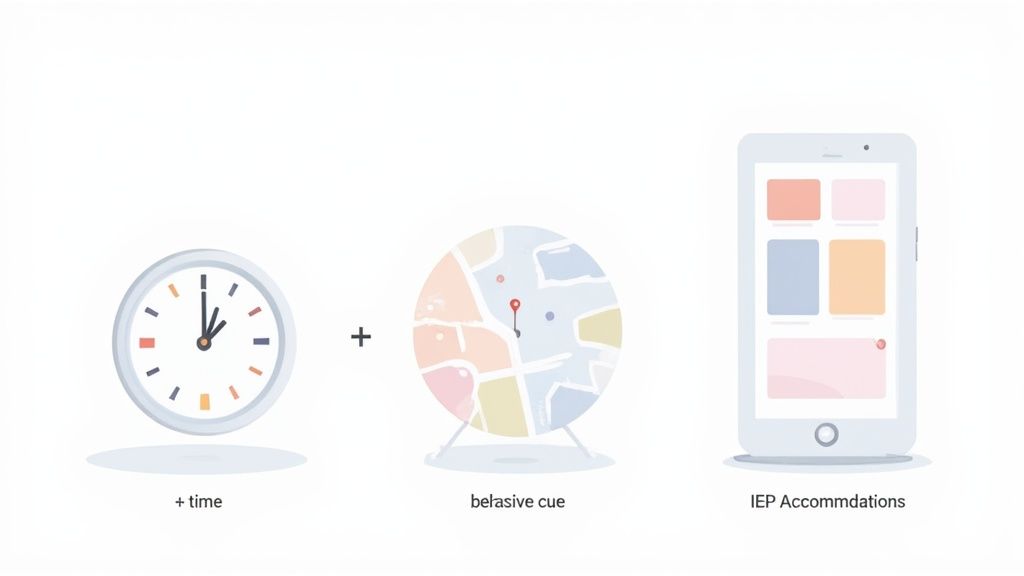
This visual lines up each accommodation with common ADHD struggles, highlighting the most frequently requested supports.
Summary Of Key IEP Accommodations
Below is a quick-reference table outlining each accommodation, its main goal, and the advantages it offers in both classroom and test settings.
| Accommodation | Purpose | Benefit |
|---|---|---|
| Extended time | Provides extra minutes | Reduces pressure, boosts accuracy |
| Behavior cues | Delivers discreet prompts | Maintains focus, limits interruptions |
| Assistive technology | Offers digital support | Enhances organization, aids expression |
| Preferential seating | Lowers visual/auditory distractions | Improves concentration |
| Movement breaks | Allows controlled activity | Restores attention, eases restlessness |
Keeping this summary at hand can streamline IEP discussions, ensuring you address the precise needs of the student.
Key Takeaways
- A clear snapshot helps match challenges to solutions quickly.
- Everyday analogies (like a GPS or companion) make supports relatable.
- Having examples on hand builds confidence in meetings with school teams.
- Parents and educators can use this toolkit to focus conversations and secure essential supports.
In U.S. studies, extended time appears in more than 25% of IEPs for ADHD, underlining its widespread impact. Research also shows that personalized cues and digital supports boost classroom engagement by up to 30%.
Refer back to this table whenever you need a concise guide during IEP planning. Keep it handy to turn common hurdles into manageable steps today.
Understanding IEP Accommodations For ADHD
An Individualized Education Program feels more like a tailored roadmap than a one-size-fits-all plan. It lays out supports, goals, and services designed to tackle the unique attention, hyperactivity, and executive-function hurdles each student faces. Everything kicks off with a deep-dive evaluation, pinpointing both strengths and challenges.
An IEP isn’t a generic checklist. Instead, it zeroes in on how a learner processes information—much like fine-tuning a radio dial until the signal is crystal clear. Teachers, therapists, and families come together, selecting accommodations that sharpen focus, ease anxiety, and set the stage for real progress.
How Eligibility Shapes Support
Determining IEP eligibility depends on solid proof that ADHD is affecting a child’s school performance. A multidisciplinary team reviews cognitive tests, teacher notes, and behavior logs. Once everyone agrees that criteria are met, the group crafts measurable goals.
Key evaluation areas include:
- Inattention patterns that derail task completion
- Hyperactivity that disrupts routines
- Executive-function skills like planning, time management, and organization
These insights guide which accommodations will make the biggest difference.
National data reveal that 42.9% of children with ADHD received IEPs, while 13.6% held Section 504 plans. Together, 54.4% had formal supports—but that leaves 45.6% without. Even more startling, 69.3% accessed at least one school service, yet one in five received none despite clear impairment. Read the full findings on PMC.
Tailored Supports Through Concrete Examples
Think of accommodations as knobs on that radio dial—each tweak solves a specific challenge. Extended time, for example, gives students the breathing room to process questions without racing the clock. Discreet cues act like a friendly tap on the shoulder, gently steering focus back to the task.
- Visual schedules that break the day into bite-sized segments
- Assistive tech tools—like text-to-speech or graphic organizers—that stay by a student’s side
Effective accommodations are like training wheels—they keep learning stable until confidence and skills kick in.
In practice, a teacher might provide written, step-by-step instructions for a multi-part assignment. This simple change clears up confusion and prevents overwhelm.
Steps For Selecting Supports:
- Gather evaluation reports (neuropsych tests, cognitive assessments)
- Translate data into specific learning targets
- Draft accommodations and weave them into the IEP document
Viewed as a cohesive toolkit, accommodations evolve alongside the student, turning daily lessons into achievable milestones and long-term growth into a realistic journey.
Planning A Successful IEP Meeting
Preparation is key. Parents and educators should collect every piece of evaluation paperwork. This often includes a detailed Sachs Center neuropsychological report that highlights executive-function strengths and challenges.
- A four-page diagnostic report outlining the ADHD profile
- Teacher observations that illustrate day-to-day hurdles
- Sample accommodation language tied directly to IEP goals
A clear, concise report becomes your anchor in any IEP discussion.
By treating the IEP as a living document, families and schools can revisit and tweak accommodations over time. That keeps the roadmap fresh—and students firmly on track for success.
Common Classroom And Testing Accommodations
Kids with ADHD often shine when classroom routines and test conditions shift just a bit. Small tweaks can ease stress and help students zero in on the task.
Evidence Based Supports
Giving extra minutes for tests isn’t a luxury—it’s a necessity for some. Extended Test Time lets students ponder without rushing.
Scheduling brief check-ins—known as progress monitoring—alerts teachers to hiccups before they become roadblocks. Stretching deadlines on assignments reduces the scramble and usually improves the end result.
Providing alternate formats—like audio clips instead of essays—lets learners play to their strengths. Behavior management plans lay out clear goals, rewards, and check-ins so everyone knows what to expect.
- Extended Test Time: Adds room to think and reduces time-related pressure.
- Regular Feedback Sessions: Offers real-time guidance and course correction.
- Shortened Assignments: Divides larger tasks into manageable chunks.
- Calculator Use: Frees up working memory for higher-order thinking.
- Behavior Management Plans: Sets clear benchmarks and positive reinforcements.
To explore the data further, see the PMC research summary on accommodations and ADHD.
Real World Illustrations
Think of a color-coded checklist as a GPS for multi-step activities—just one misstep and your arrow reroutes attention. Or picture an essay broken into phases: brainstorming on a graphic organizer, drafting, then revising—each step with its own checkpoint. Some classrooms even use gentle audio cues to remind students when it’s time for a quick stretch or a refocus.
- A student refers to a checklist during science experiments.
- A writer sketches ideas on a mind map before drafting.
- A soft voice prompt signals a five-minute movement break.
Prevalence Of Common Accommodations
Here’s a snapshot from major U.S. studies: the percentage of students with ADHD who receive key IEP accommodations.
Prevalence Of Common Accommodations
| Accommodation | Percentage of Students |
|---|---|
| Extended Time | 35% |
| Progress Monitoring | 32% |
| Additional Assignment Time | 28% |
| Shortened Assignments | 25% |
| Frequent Feedback | 24% |
| Behavior Management Plans | 22% |
| Calculator Use | 20% |
These figures underscore that extended time and progress monitoring top many IEPs, highlighting their central role in boosting focus and task completion.
Testing Adjustments
Beyond extra minutes, the test environment itself can make or break performance. Offering a separate room or small-group setting cuts down on chatter and visual distractions.
Visual timers operate like a pacer in a race—students can see exactly how much time they have left. Allowing word processors or recorded responses shifts the focus from handwriting or spelling to the substance of ideas. Scheduled breaks between sections act like pit stops, reviving concentration and easing mental fatigue.
- Separate testing rooms limit noise and peer disruptions.
- Brief intermissions restore energy and calm.
- Visual timers provide clear pacing cues.
- Assistive tech—like approved calculators—evens the playing field.
Next Steps For Implementation
Rolling out and refining accommodations works best as a team effort—teachers, parents, and specialists aligned on goals. Start by gathering concrete examples of challenges and pairing them with neuropsychological findings, such as those from the Sachs Center, to build a clear case.
At the IEP meeting, propose specific goals and sample accommodation language that fit your child’s profile. Plan regular progress reviews. If something isn’t working, adjust swiftly.
At the same time, weave in skill-building—organization strategies, time-management practices, and self-monitoring techniques—to help students grow more independent.
Check out our guide on ADHD test accommodations at the Sachs Center to explore testing-specific strategies.
Choosing Between IEP and 504 Plans
Choosing the right support plan for a child with ADHD can feel like deciding between a custom-tailored suit and an off-the-rack jacket. An Individualized Education Program (IEP) sketches out a step-by-step instructional map with measurable goals. A Section 504 plan, on the other hand, focuses on civil rights protections and basic accommodations to level the playing field.
Ultimately, the choice comes down to eligibility and the intensity of support needed. An IEP falls under IDEA and demands evidence of a qualifying disability that affects educational performance. A 504 plan is grounded in the Rehabilitation Act, aiming to remove barriers rather than prescribe specialized instruction.
Key Eligibility Differences
-
IEP
- Evaluation by a multidisciplinary team
- Formal assessments of academic and functional performance
-
504 Plan
- Medical or psychological documentation showing limits in major life activities
- Focus on removing barriers with accommodations
-
IEP Services
- Clearly defined, measurable goals
- Ongoing progress monitoring
-
504 Accommodations
- Preferential seating, extended time, verbal prompts
- Flexible adjustments across classrooms and testing
Worldwide, about 7.2% of children and adolescents receive an ADHD diagnosis. Rates tend to be higher in North America and Europe, and lower in South Asia and Sub-Saharan Africa—differences driven by diagnostic practices and policy emphasis. Discover more on global ADHD policy frameworks in this study here.
Meanwhile, 504 plans often roll out faster and with less paperwork. They excel at quick fixes but don’t include the specialized instruction and detailed progress checks you get with an IEP.
Key Insight
IDEA’s procedural safeguards give families rights like prior written notice, parental consent, mediation, and due process options.
504 plans rely on civil rights enforcement and complaints to the Office for Civil Rights.
Comparing IEP and 504 Processes
| Aspect | IEP | 504 Plan |
|---|---|---|
| Legal Basis | IDEA | Section 504 of the Rehabilitation Act |
| Evaluation Timeline | Strict timelines (60 days typically) | Flexible scheduling |
| Support Type | Specialized instruction, goals, services | Accommodations only |
| Parent Rights | Extensive procedural safeguards | Fewer formal protections |
Parents often start with a 504 plan to remove immediate barriers. If academic gaps persist, they can shift to an IEP for more structured support.
Early exploration pays off. Check out our guide on 504 accommodations for ADHD at the Sachs Center for real-world examples.
When detailed goals and therapeutic services are essential, an IEP delivers a robust framework. Yet a 504 plan can offer relief almost overnight with minimal red tape.
- Gather evaluation reports and medical documentation.
- Talk with your child’s teachers and school psychologist.
- Request formal assessments if exploring an IEP.
- Draft desired accommodations or goals in writing.
- Schedule a team meeting and advocate for the right plan.
Knowing both pathways empowers families to advocate confidently. Whether you lean on the goal-driven blueprint of an IEP or the inclusive policy of a 504 plan, the aim is the same: help students with ADHD thrive.
Next Steps To Secure Support
- Contact your school’s special education coordinator to request an evaluation or a 504 review meeting.
- Prepare documentation including Sachs Center reports and teacher observations to support your plan request.
- Review procedural safeguards and timelines.
Requesting IEP Accommodations With Diagnostic Reports
Turning piles of test data into concrete support ideas can feel a bit like solving a complex puzzle. Yet following a clear roadmap helps parents transform diagnostic findings into IEP accommodations for ADHD that respect IDEA’s timelines.
This section walks you through gathering evaluation materials, drafting your referral, preparing your meeting strategy, and keeping momentum after everyone packs up.
This infographic outlines the process flow from evaluation through weighing options and selecting the right plan.
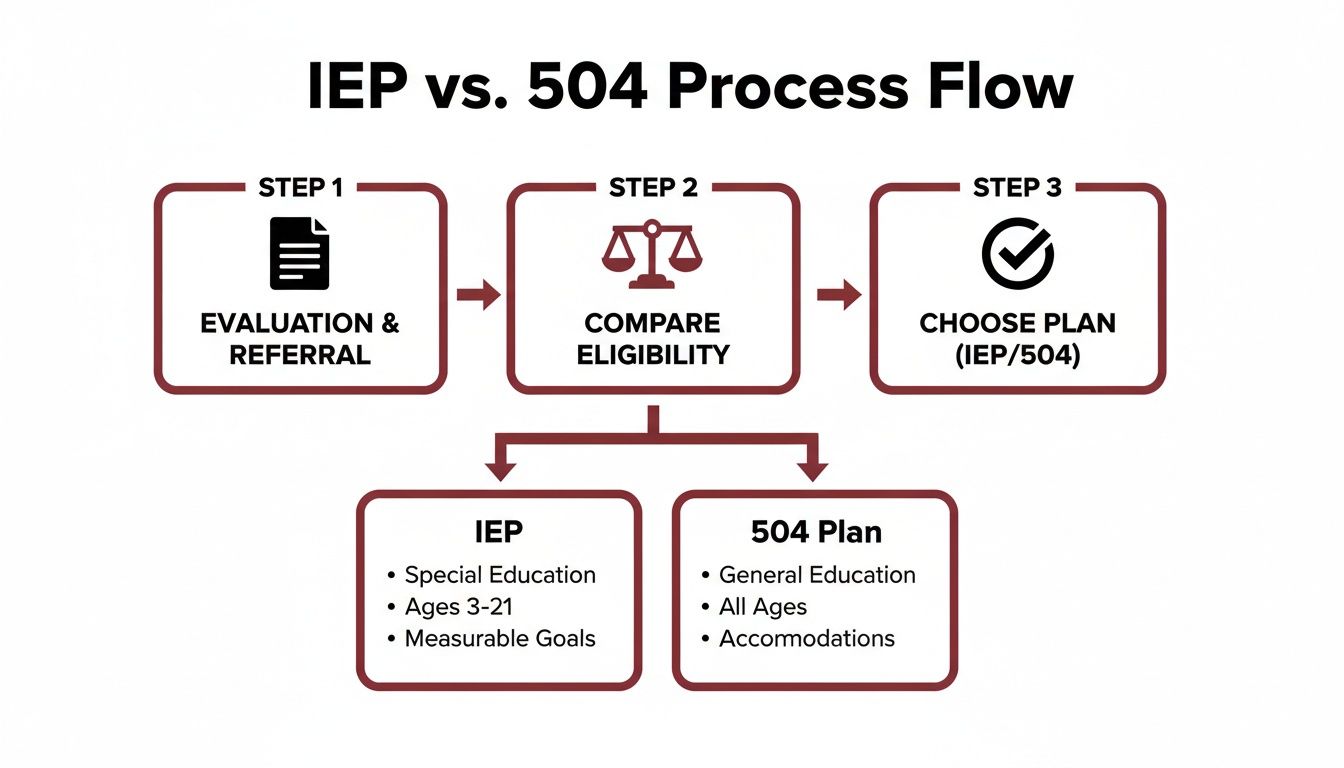
The chart breaks the journey into three main phases—evaluation, legal comparisons, and making the final plan choice—so you can advocate confidently.
Gathering Assessment Evidence
Think of diagnostic reports as the GPS coordinates for your advocacy. You’ll want:
- Cognitive battery results that reveal strengths and struggles
- Behavioral checklists capturing day-to-day patterns
- Academic scores highlighting where support is truly needed
- Observations from teachers and therapists to ground the data
The Sachs Center’s neuropsychological testing delivers a four-page report packed with narrative insights and standard scores for attention, memory, and processing speed.
Translating Findings Into Goals
Once your evidence is assembled, the next step is turning raw data into clear educational targets. Picture your student’s working memory score sitting two standard deviations below the norm. A goal might read: “Break multi-step tasks into chunks no longer than three items.”
| Report Type | Content Highlights | Use Case |
|---|---|---|
| Sachs Center Letter | Diagnosis summary, recommendations | Quick school or workplace requests |
| Sachs Center 4-Page Report | Cognitive, behavioral, academic scores | Detailed IEP referral and goals |
| Neuropsych Testing Report | In-depth executive function profiles | Extended test accommodations (SAT, ACT) |
Crafting Referral Notes
A strong referral note reads like a short story—complete with characters, conflicts, and clear resolutions. Collaborate with school psychologists, therapists, and teachers to draft notes reflecting both data and daily challenges.
- Review reports together to build a shared understanding
- Highlight examples like “struggles to follow multi-part instructions”
- Attach standard scores to quantify the impact
- Use the school’s referral template and gather signatures
Preparing For IEP Meetings
Imagine your binder as a flight plan for the IEP meeting—it keeps you on course. Organize documents into tabs for reports, observations, and draft goals. Then:
- Respect IDEA’s 60-day evaluation window
- Send an agenda to the team at least one week before the meeting
- Prepare concise talking points to stay on track
- Request the school’s draft IEP in advance for review
“A well-organized binder is your compass—without it, you risk getting off course.”
— Special Education Advocate
Advocating And Follow Up
When the meeting begins, start by sharing the student’s strengths. Then tie each requested accommodation to data. Make sure every support is listed in the IEP with clear frequency and responsible staff.
- Request the finalized IEP in writing within 30 days of agreement
- Schedule progress reviews every 60 days or at the next annual meeting
- Use plain language so the team understands the supports
- If conflicts arise, refer to procedural safeguards or request mediation
After the meeting, distribute the final IEP to all teachers and therapists so everyone is on the same page.
Consistent follow-up ensures IEP accommodations for ADHD stay effective and adapt as needs evolve.
Monitoring Progress And Adjustments
Implementing accommodations is just the starting block. Track progress with behavior charts, work samples, and teacher checklists.
- Log weekly data on targets like on-task behavior percentage
- Hold a three-month mid-point review to gauge effectiveness
- Tweak time allowances or add visual timers if challenges persist
- Introduce new supports, such as sensory breaks, based on emerging needs
Ongoing assessment ensures IEP accommodations for ADHD evolve alongside student growth.
Handling Disputes And Safeguards
Disagreements can happen, but IDEA’s procedural safeguards lay out clear remedies. You can request an independent educational evaluation (IEE) at public expense if you question the school’s findings.
- Review the Notice of Procedural Safeguards provided by the school
- File a written request for mediation within the district’s timeline
- Consider due process hearings for major disputes
- Engage a parent advocate or attorney to strengthen your case
For example, one family used a Sachs Center report to secure extended breaks when the school hesitated, leading to a successful mediation and improved day-to-day supports.
Next Steps And Resources
Maintain a paper trail for all communications and chart every deadline. Reach out to the Sachs Center if you need updated diagnostic letters when your student’s profile shifts.
- Sachs Center telehealth evaluations for refreshed ADHD assessments
- Sample IEP templates available on state education websites
- Parent advocacy groups offering workshops on IEP meetings
- Online forums for sharing effective IEP accommodations for ADHD
With organized evidence and diligent follow-through, you’ll transform your child’s IEP into a living document that adapts as they grow.
Sample IEP Goals and Accommodation Language
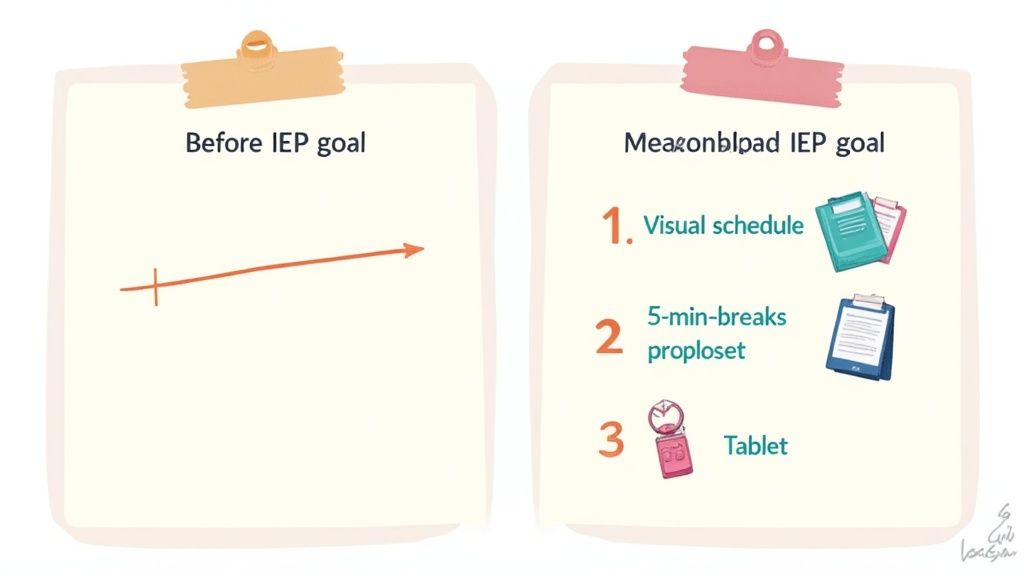
Think of crafting IEP goals like plotting a GPS route for a road trip. Each goal points the entire team in the right direction. With precise wording, teachers and aides know exactly what steps to follow.
Below are sample goals tailored to common ADHD hurdles. You can tweak them later to match your student’s unique profile.
Attention Goals
- When provided with a visual schedule, the student will complete a four-step morning routine in the classroom with no more than one prompt per step in 4 out of 5 opportunities.
- During independent work, the student will stay on task for 15 consecutive minutes as measured by a timer and teacher log in 8 of 10 sessions.
- Given a written checklist, the student will finish multi-step assignments with at least 80% accuracy in three consecutive weeks.
Notice how these targets convert vague hopes into clear benchmarks.
Measurable goals help teams track progress and adjust supports without guessing.
Organization Goals
Students with ADHD often benefit from a reliable structure. These goals pair strategy instruction with self-monitoring:
- With teacher support, the student will organize homework in a binder using color-coded folders, showing 0 missing materials in 4 out of 5 weekly checks.
- The student will record assignments and due dates in a daily planner with 90% accuracy over four consecutive weeks.
- When faced with a complex task, the student will break it into three steps on a graphic organizer in 9 out of 10 trials.
Think of these as training wheels—gradually faded as independence grows.
Sample Accommodation Language
Below are phrases you can slot directly into the accommodations section:
- Provide visual schedules for routines and transitions, with prompts faded over time
- Allow a digital timer visible to the student during independent work
- Offer preferential seating near the teacher and away from high-traffic areas
- Permit short movement breaks every 20 minutes as needed
- Supply a graphic organizer for multi-step writing tasks and math problems
Assistive Technology And Cueing
Integrating tech feels like adding a dependable teammate. Here’s how to describe it:
- Student may use a speech-to-text device for written assignments, with teacher monitoring usage
- Student will receive discreet auditory or tactile cues to refocus after two minutes off-task
- Student allowed to use a handheld digital organizer to record reminders and deadlines
- Provide access to a calculator and word-prediction software during math and writing tasks
These samples form an actionable blueprint for support. Learn how to tailor them further by exploring our detailed IEP samples at the Sachs Center Read our IEP for ADHD example
Before And After Examples
Use this side-by-side view to spark discussion and clarify your intent:
| Before | After |
|---|---|
| Student needs breaks. | Student will receive two 5-minute movement breaks daily after check-in. |
Showing these contrasts in a meeting helps everyone see why precise language matters. Each entry links a support to a clear measure, turning accommodations into reliable tools.
Next Steps For Customization
-
Choose two to three goals and accommodations that align with your child’s needs
-
Adapt terminology to reflect your district’s language and forms
-
Review progress quarterly and adjust targets as needed
-
Start with one accommodation and track its impact
-
Involve the student in choosing supports that feel motivating
Effective accommodations evolve alongside the student’s developing skills. Keep records, celebrate milestones, and watch confidence grow every day.
FAQ
These questions tackle common hurdles around IEP accommodations for ADHD. They guide parents and educators step by step, keeping everyone on the same page and within legal requirements.
How Does a Child Qualify for an IEP?
You need concrete evidence that ADHD symptoms are disrupting learning. Start by gathering:
- Cognitive and behavioral assessments in writing
- Teacher observations and recent report cards
- A formal evaluation request through the special education office
Once submitted, a school’s multidisciplinary team reviews the information and determines eligibility. Don’t forget to track meeting dates and district timelines as you go.
Can I Adjust Accommodations Mid-Year if Needs Change?
Yes. Think of the IEP as a living document. Send a written request for an IEP review, outline what you’ve observed, and the team will reconvene to analyze progress data and fine-tune supports.
Reviewing And Updating IEP
What If the School Denies My Request for Specific Accommodations?
Under IDEA procedural safeguards, you still have options. Document every email, call, and meeting. Then consider:
- Requesting an independent educational evaluation (IEE) at public expense
- Reviewing IEP meeting notes and prior written notices
- Filing for mediation or a due process hearing
Choosing 504 As An Alternative
Is a 504 Plan a Good Fit for Mild ADHD?
A 504 Plan can offer civil rights protections and basic supports like extra time or preferential seating. It’s often faster to set up, but it doesn’t include measurable goals or specialized instruction.
“A 504 plan can provide fast relief, but an IEP delivers detailed services and progress checks,” notes a special education advocate.
Use this FAQ to navigate eligibility questions, mid-year changes, disputes, and alternative options with confidence.
Ready to secure support? Consider Sachs Center for telehealth evaluations and detailed reports. Visit Sachs Center to begin today.
