

Getting an ADHD diagnosis can be a huge relief, finally putting a name to a lifetime of struggles. But what happens when that name is wrong? Being misdiagnosed with ADHD is like a mechanic fixing the transmission when the engine is smoking—you’re spending time and money on the wrong problem, and the real issue just keeps getting worse.
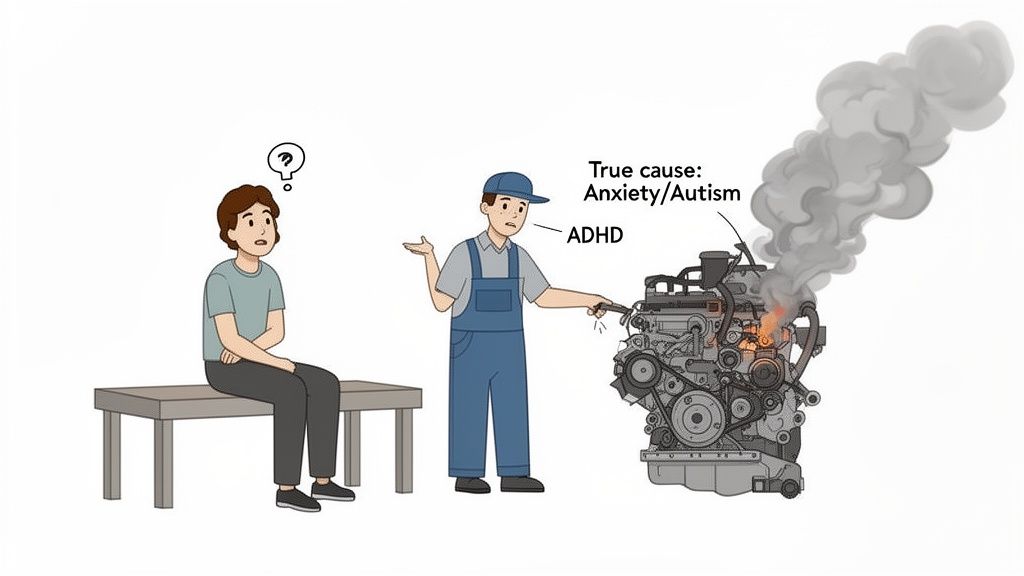
The High Stakes of an Inaccurate ADHD Diagnosis
An ADHD diagnosis is much more than a simple label. It's supposed to be a roadmap that guides your treatment, support systems, and even your self-understanding. When that map is wrong, it can lead you completely off course, making life harder, not easier.
The fallout isn't just about taking the wrong medication. It seeps into your mental health, your performance at work or school, and the very way you see yourself.
Think about it like this: if you're given glasses for nearsightedness when you're actually farsighted, the world just gets blurrier. In the same way, an incorrect ADHD diagnosis can mask the real challenges you're facing, preventing you from ever getting the tools you genuinely need to feel and function better.
Why an Accurate ADHD Diagnosis Is Crucial
Understanding what’s at stake really drives home why a comprehensive, careful evaluation is non-negotiable. Getting the diagnosis right is the foundation for everything that comes next.
Here’s a quick breakdown of why precision matters so much.
Why an Accurate ADHD Diagnosis Is Crucial
| Area of Impact | Consequence of Misdiagnosis |
|---|---|
| Treatment and Medication | You might end up on medications that are ineffective or even harmful, dealing with side effects while the actual condition goes untreated. |
| Mental and Emotional Health | When treatments don't work, it's easy to spiral into frustration, self-doubt, and anxiety, all while internalizing the stigma of the wrong label. |
| Workplace and School Support | You could get accommodations that don't address your real challenges, which only hurts your performance and holds you back. |
| Self-Understanding | Building your identity around a misunderstanding of your own brain can seriously block personal growth and true self-acceptance. |
Getting it right can truly change everything.
This guide is here to help you sort through the confusion of a potential ADHD misdiagnosis. We'll dig into why it happens so frequently, explore how conditions like anxiety, autism, or trauma can look a lot like ADHD, and give you a clear path forward to get the right answers. With solid information, you can move from a place of doubt to one of clarity, making sure you get support that actually fits you.
Why ADHD Is So Often Misdiagnosed
Getting an ADHD diagnosis wrong isn't usually the result of one single mistake. It’s more often a tangled web of factors, from a busy doctor’s office to the simple fact that so many other conditions look just like ADHD on the surface. It's a systemic problem, not just an isolated error.
One of the biggest culprits is something called the “relative age effect.” This happens when the youngest, most developmentally immature kids in a classroom are judged against their older classmates. Their natural fidgeting, shorter attention spans, and boundless energy can easily get flagged as ADHD symptoms, leading to a diagnosis that's both premature and incorrect.
This isn't just a small-scale issue. A study from Michigan State University suggested that nearly 1 million children in the U.S. might have been misdiagnosed with ADHD for this exact reason—they were simply the youngest in their grade. When you see how diagnosis rates have climbed, you realize how often rushed evaluations overlook crucial context like a child's age.
Rushed Evaluations and Checklist Diagnoses
In today's fast-paced clinical world, there's immense pressure to find answers quickly. This can lead to clinicians relying too heavily on simplified symptom checklists instead of doing the deep, investigative work a proper diagnosis requires.
A thorough evaluation should feel more like a detailed interview about your life, not a quick questionnaire. It involves gathering history from multiple sources—like parents and teachers for kids—and digging into a person's entire developmental story. When a diagnosis is handed out after a 15-minute chat and a single form, the risk of getting it wrong skyrockets.
A diagnosis that doesn’t account for your life story, environment, and other potential health factors is built on a shaky foundation. True diagnostic clarity comes from a comprehensive, multi-faceted assessment that looks at the whole person.
Overlooking Other Conditions
Another major reason for ADHD misdiagnosis is the incredible symptom overlap with other conditions. A whole host of issues can cause problems with attention, impulsivity, and executive function. It's easy to see how one gets mistaken for the other.
For example:
- Sleep-Disordered Breathing (SDB): If you're chronically exhausted from a condition like sleep apnea, of course you'll be irritable and unable to concentrate. It looks and feels just like ADHD.
- Anxiety and Trauma: A brain stuck in "fight or flight" mode is constantly scanning for threats, which makes focus and emotional regulation nearly impossible. On the surface, this can be indistinguishable from ADHD.
- Learning Disabilities: Imagine the frustration and mental effort it takes to navigate school with an undiagnosed learning disability. The resulting behavioral issues are often mislabeled as ADHD.
Without a clinician trained to look deeper and rule out these mimics, the ADHD label becomes a convenient—but often wrong—explanation. It’s essential to understand the official ADHD diagnostic criteria and how a skilled professional should apply them. This careful, methodical approach is the only way to separate ADHD from its lookalikes and make sure you get the right support.
Untangling the Symptoms of Overlapping Conditions
So many people are misdiagnosed with ADHD because a whole host of other conditions can look remarkably similar on the surface. It’s like trying to identify a specific bird when several different species share almost identical feather patterns. To figure out the real cause of your struggles, we have to look past the obvious symptoms and dig into the unique motivations and internal experiences that are driving them.
This symptom overlap is a huge reason for diagnostic errors. In fact, it's so common that diagnosed ADHD rates in the US, which range from 7.5% to 11.1%, often overshoot the established benchmark of 5%. A big part of the problem? Rushed or superficial evaluations. Only about half of US pediatricians say they use information from more than one setting (like home and school), yet a staggering 93% prescribe medication—potentially treating the wrong condition entirely.
Getting an accurate diagnosis means you have to become a bit of a symptom detective and learn to spot the subtle but critical differences.
Anxiety vs ADHD Driven Inattention
At first glance, the inattention from anxiety and ADHD can look identical. You’ve got a wandering mind, unfinished tasks, and trouble concentrating in conversations. But the why behind the distraction is what really separates them.
- ADHD Inattention: Think of this as an "outward pull." The brain is constantly on the hunt for something more stimulating and gets easily pulled away by sights, sounds, or even more interesting daydreams. The struggle is to sustain focus on anything that isn't naturally engaging.
- Anxiety Inattention: This is more of an "inward pull." The mind gets hijacked by a relentless loop of worries, fears, and "what-if" scenarios. The person isn't distracted by a bird outside; they're completely preoccupied with an internal dialogue of anxiety, making it impossible to focus on the present.
The image below breaks down how these overlapping symptoms, combined with other factors, create a perfect storm for misdiagnosis.
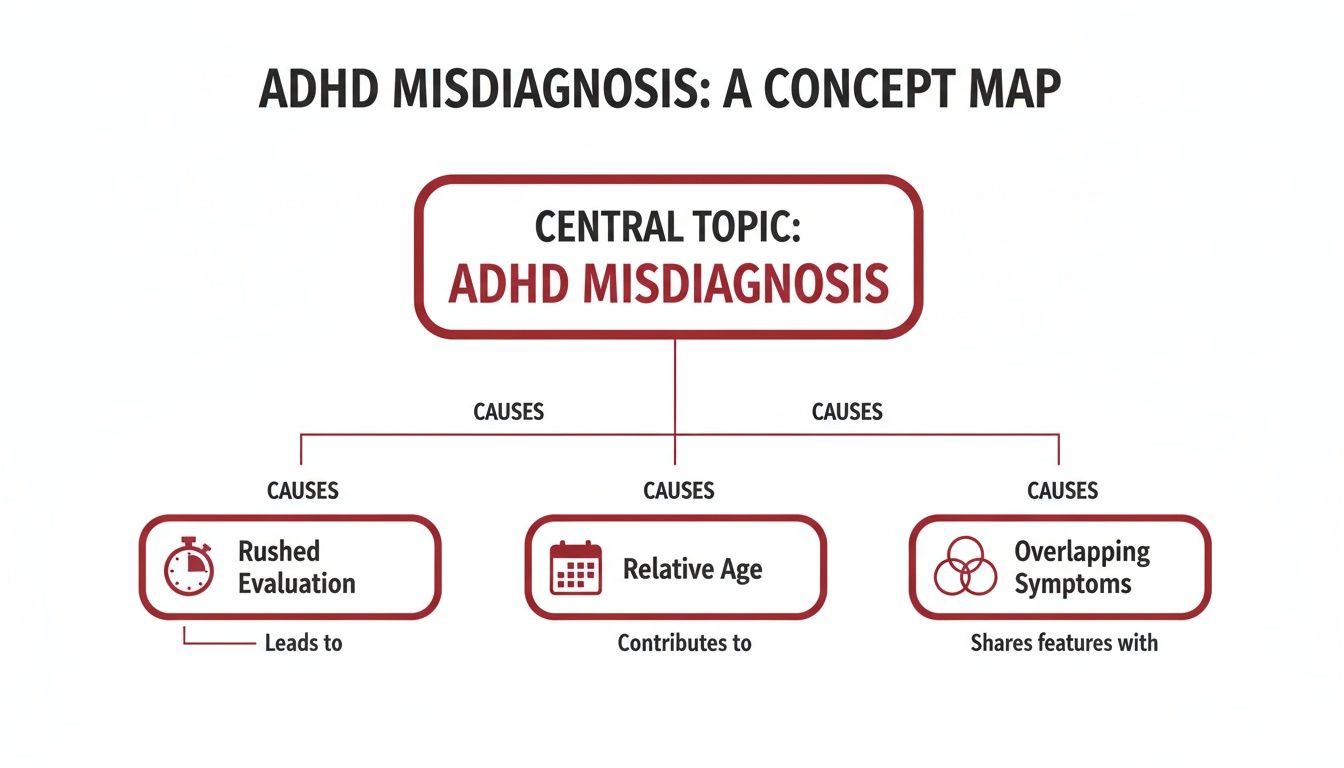
As you can see, a mix of rushed evaluations and similar-looking symptoms makes it crucial for both patients and clinicians to dig deeper.
The Social Puzzle of Autism and ADHD
Both Autism and ADHD can create challenges in social situations, but they come from fundamentally different neurotypes. Nailing this distinction is one of the most important parts of a differential diagnosis, especially if you suspect a misdiagnosis.
Someone with ADHD might struggle socially because they interrupt people, miss social cues because their attention drifted, or overshare due to impulsivity. Their desire to connect is usually strong, but their executive function challenges constantly get in the way.
On the other hand, an autistic individual’s social difficulties might stem from differences in how they process social information, a genuine struggle to interpret non-verbal cues, or feeling completely overwhelmed by sensory input in social settings. The entire approach to social interaction is just wired differently. For a deeper look at these nuances, check out our detailed guide on comparing Autism vs ADHD.
Trauma and Depression A Masquerade of Symptoms
Trauma, especially Complex PTSD (C-PTSD), is another powerful ADHD mimic. A brain stuck in a state of hypervigilance is too busy scanning for threats to manage executive functions like planning or staying organized. This constant "survival mode" directly torpedoes attention, emotional regulation, and impulse control.
Depression can do something similar by shutting down the brain’s motivation circuits. The resulting apathy and low energy make initiating tasks or sustaining focus feel impossible. This isn’t the restless, stimulation-seeking inattention of ADHD; it’s an inability to engage that comes from deep emotional exhaustion and a lack of dopamine.
ADHD vs Overlapping Conditions A Symptom Comparison
To make these distinctions clearer, let's look at how a single symptom can present differently depending on the underlying cause. This side-by-side comparison can help you start to parse your own experiences.
| Symptom | How It Looks in ADHD | How It Might Look in an Overlapping Condition |
|---|---|---|
| Difficulty Focusing | The brain is pulled away by external distractions or more interesting thoughts. Focus is hard to sustain on "boring" tasks. | Anxiety: Focus is hijacked by internal worries and "what-if" scenarios. Depression: A lack of energy and motivation makes it impossible to engage. |
| Social Challenges | Interrupting, missing cues due to inattention, or impulsively oversharing despite a desire to connect. | Autism: Difficulty interpreting non-verbal cues, sensory overload in social settings, or different social communication styles. |
| Emotional Outbursts | Often tied to frustration, impatience, and low tolerance for boredom (rejection sensitivity dysphoria is common). | Trauma (C-PTSD): Triggered responses to perceived threats; a state of hypervigilance leading to sudden emotional shifts. |
| Task Paralysis | Overwhelm from not knowing where to start or being unable to break a large project down into smaller steps. | Depression: A complete lack of motivation and energy (anhedonia) prevents task initiation. |
| Restlessness/Fidgeting | A need for physical movement to help maintain focus and burn off excess energy. | Anxiety: Physical expression of internal tension, like leg bouncing or nail-biting, to self-soothe. |
This table isn't a diagnostic tool, but it highlights why a symptom on its own isn't enough for a diagnosis. The why behind the behavior is what matters.
Understanding these distinctions is the first step toward advocating for yourself. It ensures that the support you get is aimed at the true root of your challenges. Without that clarity, treatment can feel like you're trying to unlock a door with the wrong key.
Red Flags Your ADHD Diagnosis Might Be Wrong
Trusting your gut is a powerful first step. If you're questioning your ADHD diagnosis, there's probably a good reason. A diagnosis should feel like a key that unlocks understanding, not a label that just doesn't quite fit. If you have those persistent doubts, it’s worth paying attention to the evidence in your daily life.
Several clear red flags can signal that your diagnosis might be off-track. These signs often show up in how you respond to treatment, how you relate to the ADHD community, and even the quality of the diagnostic process you went through.
Your Treatment Isn't Working
One of the biggest clues that something is amiss is a poor response to treatment, especially medication. While ADHD medication isn’t a magic bullet for everyone, it typically provides noticeable improvements in focus, impulsivity, or executive function for the majority of people with ADHD.
Consider these warning signs:
- Medication is completely ineffective. You’ve tried different types or dosages of stimulant or non-stimulant medication with zero positive impact on your core symptoms.
- Side effects are severe and outweigh any benefits. Instead of feeling more focused, you feel a constant, heightened sense of anxiety, agitation, or emotional flatness that makes daily life even harder.
This isn't to say that finding the right medication is always easy. But if multiple attempts bring no benefits—or only negative side effects—it might suggest the medication is targeting the wrong neurochemical pathways because the underlying issue isn't ADHD.
A Disconnect with Lived Experiences
Another powerful sign is feeling like an outsider when you engage with the ADHD community. When you read articles, watch videos, or listen to podcasts from people with ADHD, their stories should resonate with you on a deep level.
If you consistently find yourself thinking, "That doesn't sound like me at all," it’s a major red flag. A correct diagnosis often brings a profound sense of recognition and validation, not a feeling of confusion or disconnect.
This is especially relevant for adults getting diagnosed for the first time. While you hear a lot about overdiagnosis in children, underdiagnosis is a much bigger problem for adults. In fact, less than 20% of the estimated 15 million US adults with ADHD actually receive proper care. Many adults—especially women and minorities—have had their symptoms overlooked for years. It's crucial to distinguish between a late-but-correct diagnosis and a genuine misdiagnosis. You can explore the nuances of adult ADHD diagnosis to learn more about this complex issue.
Finally, think back on the evaluation process itself. Was it rushed? Did the clinician rely only on a brief checklist without digging deep into your personal, medical, and developmental history? A thorough assessment is absolutely critical, and a superficial one is just a breeding ground for error.
Your Step-by-Step Guide to Getting a Reassessment
Taking the first step toward diagnostic clarity is a huge act of self-advocacy. If you have a nagging feeling that your ADHD diagnosis doesn't quite fit, pursuing a reassessment is the single most important thing you can do to get the right support. This process is all about trading uncertainty for confidence and making sure the help you get actually lines up with your unique brain.
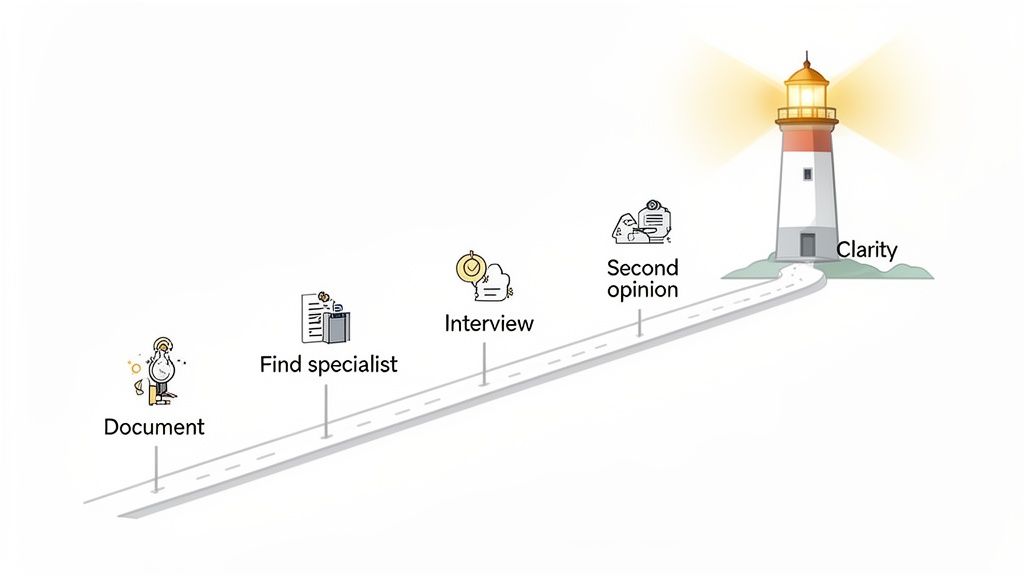
It can feel like a big journey, but it’s much more manageable when you break it down into clear, actionable steps.
Prepare Your Personal Evidence
Before you even think about booking an appointment, your first job is to become a detective in your own life. A simple list of symptoms is a good start, but what a specialist really needs is the rich context of your real-world experiences.
Start documenting specific times you’ve struggled. Instead of just writing down "I'm disorganized," describe that time you missed a critical work deadline because you just couldn’t figure out how to break the project into smaller pieces. Talk about the daily stress of trying to manage household chores that feel impossible.
Think about these key areas:
- Work or School Challenges: Make a note of specific projects, interactions, or tasks that have been unusually difficult.
- Social and Relationship Patterns: Think about misunderstandings, social burnout, or recurring conflicts that seem to follow a pattern.
- Emotional Experiences: When do you feel totally overwhelmed, anxious, or frustrated? What seems to trigger these feelings?
This detailed log gives your evaluator concrete data to work with. It helps them move beyond a generic checklist and into a much deeper, more nuanced understanding of your lived experience.
Find the Right Specialist
Here’s the thing: not all clinicians have deep expertise in neurodiversity, especially when it comes to masked presentations or conditions that overlap. When you're searching for a provider, you need someone who truly understands the subtle differences between ADHD, Autism, anxiety, and trauma.
Look for specialists who:
- Explicitly mention neurodiversity or specific conditions like Autism in their practice description.
- Have experience with adult diagnostics, particularly with masked presentations in women and BIPOC individuals, which often look different.
- Offer comprehensive evaluations that go way beyond a quick 15-minute screening.
As you look for the right professional, remember that telehealth has opened up a lot of new, accessible options. The growing field of remote psychiatry jobs is a good indicator of how many qualified specialists are now available online.
Understand What a Good Evaluation Looks Like
Knowing what to expect can help you feel confident that you’re getting a quality assessment. A thorough, modern evaluation isn’t just a conversation; it’s a structured process designed to gather a complete picture of who you are and how you function. At Sachs Center, our telehealth evaluations are designed for this exact purpose.
A trustworthy reassessment should always involve a deep clinical interview paired with validated assessment tools. The interview explores your developmental history, while the tools provide objective data to support a diagnostic conclusion.
This combination is absolutely critical. The interview provides the "why," and the assessments provide the "what." You need both for an accurate diagnosis. You can learn more about what this looks like by reading about how to get tested for ADHD. This will show you what a high-quality process involves, whether you just need a diagnostic letter for accommodations or a detailed report for your whole care team.
Remember, seeking a second opinion is not a sign of failure. It’s an act of taking control of your health.
Life Beyond the Label: How a Correct Diagnosis Changes Everything
Getting an accurate diagnosis is so much more than just swapping one label for another. It’s the key that unlocks a new, more authentic path forward. That moment of clarity—whether it confirms ADHD or points to something else entirely, like Autism or C-PTSD—is life-changing.
Imagine the relief of finally understanding the real "why" behind struggles you've lived with for years. It’s like you’ve been navigating with a blurry, confusing map, and suddenly someone hands you a crystal-clear, high-definition guide to your own brain.
This newfound clarity is the first, most critical step toward finding support that actually works. It opens the door to targeted treatments, from the right medication and therapy to coaching strategies that address your specific challenges, not just a set of assumed symptoms.
Embracing Your True Neurotype
Once you move past the frustration of being misdiagnosed with ADHD, a deeper journey of self-acceptance can finally begin. Instead of constantly trying to force yourself into strategies that just don’t fit, you can start learning how your brain is truly wired and what it needs to thrive. This shift is incredibly powerful.
The goal of a diagnosis isn't to fit you into a box. It's to give you the right toolkit to build a life that honors your unique neurotype, allowing you to work with your strengths instead of constantly fighting against your challenges.
It’s about leaving behind the exhaustion of mismatched support and stepping into a future defined by genuine self-knowledge and empowerment.
The Path to Effective Support
With an accurate diagnosis in hand, you can finally build a support system that aligns with your real needs. This might look like:
- Therapies that get to the root of the issue, like trauma-informed care for C-PTSD or sensory integration strategies for Autism.
- Accommodations at work or school that provide meaningful, practical support instead of generic solutions.
- Community connections with others who share your lived experience, which fosters a true, validating sense of belonging.
This final step is all about empowerment. It’s about using your diagnostic clarity to advocate for yourself and create an environment where you can not only function but truly flourish.
Answering Your ADHD Diagnosis Questions
Figuring out the world of neurodivergent diagnoses can feel overwhelming, and it's natural to have a lot of questions. Let's clear up some of the most common ones about the evaluation process so you can move forward with confidence.
How Long Should a Proper Evaluation Take?
A thorough evaluation for ADHD, Autism, or both (AuDHD) should never feel like a quick chat. You're unpacking a lifetime of experiences, after all.
A quality assessment typically takes around 2 to 2.5 hours. This gives a specialist enough time to conduct a deep clinical interview, go through your full history, and use validated self-report measures to get an accurate picture. If an evaluation is over in 15 minutes, that’s a major red flag for a superficial diagnosis.
When Do I Need a Letter Versus a Full Report?
A diagnostic letter is a short, to-the-point document that confirms your diagnosis. It’s often all you need for things like requesting workplace accommodations or starting a conversation about medication. A full report is much more detailed, offering a deep analysis and personalized recommendations. This is what you’ll want for sharing with other providers for coordinated care or applying for disability services.
Is a Full Neuropsychological Evaluation Required?
For most adults, the answer is no—a comprehensive clinical assessment is more than enough to get the clarity you need.
A full neuropsychological evaluation is usually only necessary if you're a student seeking specific academic accommodations. These are typically required for things like getting extended time on standardized tests (like the SAT or GRE) or for securing an IEP or 504 plan in school.
At Sachs Center, we specialize in providing clear, accurate, and compassionate telehealth evaluations for ADHD and Autism. Our expert psychologists understand the nuances of masked presentations and provide the in-depth assessment needed for true diagnostic clarity. Learn more and book your evaluation today.
