

The RAADS autism test, officially known as the Ritvo Autism Asperger Diagnostic Scale, is a questionnaire that helps adults explore potential autistic traits they might have. It's not a formal diagnostic tool, but it's an incredibly powerful screener, especially for adults who have spent years unknowingly "masking" their traits to fit in.
What Is the RAADS Autism Test?
Have you ever felt like you're just operating on a different wavelength than everyone else? Maybe you find social cues to be a bit like a foreign language, or perhaps you find immense comfort in your routines and highly specific interests. For a lot of adults, these feelings have been a lifelong puzzle, and the RAADS test can be a way to start putting the pieces together.
It's important to know this isn't a test you can pass or fail. A better way to think of it is as a detailed mirror, one that reflects your life experiences across social interactions, sensory perceptions, and personal interests. It was developed specifically for adults with average or above-average IQ, and its questions are designed to pick up on the more subtle ways autism can show up later in life.
Understanding the Different Versions
You’ll likely come across two main versions of the RAADS test, and each one has a slightly different job. Knowing the difference can help you figure out the best starting point for your own self-discovery.
- RAADS-R: This is the complete, 80-question version. It’s comprehensive, offering a deep dive into traits related to social relatedness, sensory-motor experiences, personal interests, and language. This is often the version used in clinical settings as part of a much larger evaluation.
- RAADS-14 Screen: This is a much shorter, 14-question screening tool pulled from the full test. It’s designed to quickly flag potential autistic traits, making it a fast and accessible first step if you're just starting to explore this part of yourself.
RAADS-R vs. RAADS-14 Screen at a Glance
To make it even clearer, here's a quick side-by-side comparison of the two versions. This can help you decide which one might be more useful for you right now.
| Feature | RAADS-R | RAADS-14 Screen |
|---|---|---|
| Number of Questions | 80 questions | 14 questions |
| Purpose | Comprehensive screening | Quick initial screening |
| Time to Complete | 30-45 minutes | 5-10 minutes |
| Best For | In-depth self-exploration, clinical pre-assessment | Fast, preliminary insight |
Ultimately, both tests point in the same direction—they provide a starting point. The RAADS-14 is great for a quick check-in, while the RAADS-R offers a more detailed picture.
It's crucial to remember that both versions are screeners, not diagnostic instruments. A high score is a signal to investigate further with a qualified professional, not a definitive conclusion.
A Starting Point for Self-Discovery
At its core, the RAADS test is all about providing personal insight. It offers a structured way to look back at your life experiences through the lens of neurodiversity. For many people, taking an online RAADS-R can be an incredibly validating moment, finally giving them the vocabulary to describe feelings of being "different" that they've had their whole lives.
Think of it as gathering evidence before a big conversation. A high score doesn't diagnose you, but it does arm you with valuable information to bring to a formal evaluation with a professional. This data gives clinicians a window into your personal experience and is a fantastic first step toward getting official diagnostic clarity. If you're curious, you can explore a detailed breakdown of the RAADS-R.
How the RAADS Tests Work and What Scores Indicate
So, how does a test like the RAADS actually translate a lifetime of complex experiences into a number? Think of it as a detailed survey designed to map out how your personal history aligns with common autistic traits. The questions dig into your social world, sensory experiences, and the specific, passionate interests that make you who you are.
The full RAADS-R, with its 80 questions, goes a step further than a simple "yes" or "no." It uses a four-point scale that asks if a statement is:
- True now and when you were young
- True only now
- True only when you were younger than 16
- Never true
This is a really thoughtful way to capture the full picture. It acknowledges that many adults develop sophisticated coping strategies over the years, and it looks for patterns that have been present throughout life. The goal isn't to judge your answers but simply to gather data that, when put together, can reveal a consistent story.
Interpreting Your Score
It’s so important to remember that a RAADS score is not a pass-or-fail grade on being "normal." A higher score, especially one that meets or exceeds the common benchmark of 65 on the RAADS-R, simply suggests that your self-reported traits line up with those of many adults who have been formally diagnosed with autism. You can get a much deeper look into the RAADS-R score range and what different numbers might mean.
This concept map helps visualize the RAADS test’s true role in the journey toward self-understanding and potential diagnosis.
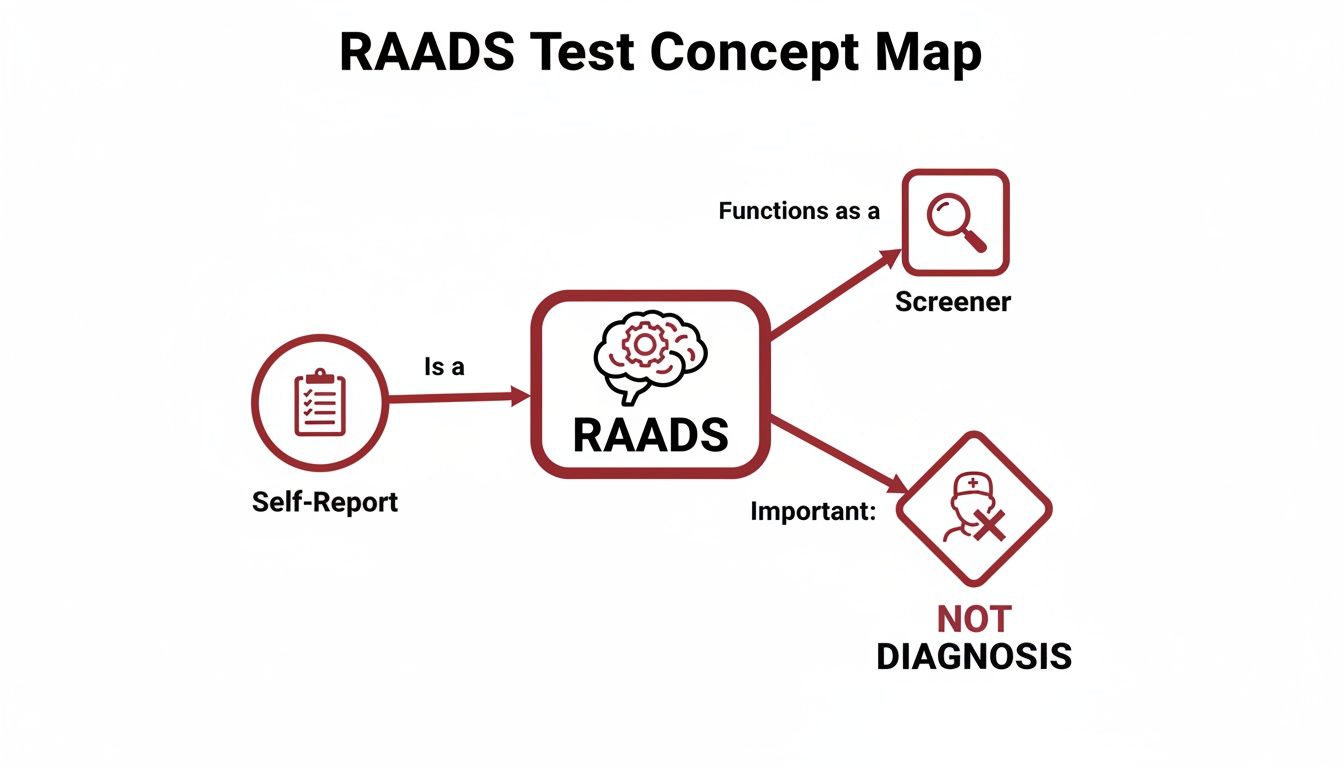
As the image shows, the RAADS is a self-report screening tool—a starting point. It’s designed to flag the need for a more formal, in-depth investigation with a qualified professional, not to replace one.
Key Dimensions Measured by RAADS-14
The shorter RAADS-14 Screen is incredibly efficient because it hones in on three core areas that often point to autistic traits in adults. Understanding these can help connect the clinical terms to real, lived experiences.
- Mentalizing Deficits: This doesn't mean you lack empathy. Far from it. It's more about the challenge of intuitively guessing what someone else is thinking or feeling without them saying it directly.
- Social Anxiety: This is about the very real stress and discomfort that can come with social situations, often stemming from the difficulty of navigating unwritten social rules that seem to come naturally to others.
- Sensory Reactivity: This relates to being either hypersensitive (feeling overwhelmed by bright lights, loud noises, or certain textures) or hyposensitive (needing more intense sensory input to feel regulated).
The RAADS-14 has proven to be a surprisingly powerful tool for quickly identifying adults who may have been overlooked. One major study found that adults with ASD had a median score of 32, which was significantly higher than the median of 15 for those with ADHD or 11 for those with other conditions.
By setting a cutoff score of just 14, the test correctly identifies 97% of adults who do have ASD. That makes it a highly sensitive and reliable first step. The data makes it clear: while not a diagnostic instrument, the RAADS-14 is extremely effective at flagging individuals whose experiences warrant a professional evaluation, which is exactly what a good screener should do.
Understanding the Strengths and Limitations of RAADS
No screening tool is perfect, and it’s important to have a balanced view when considering the RAADS autism test. To really get a feel for its value, think of it like a smoke detector. A smoke detector’s main job is to be incredibly sensitive—it’s designed to go off at the slightest hint of smoke so you never, ever miss a real fire.
This is the greatest strength of the RAADS test.
Its high sensitivity makes it fantastic at flagging individuals who might be autistic. For so many adults who have gone undiagnosed for years, this sensitivity can be validating. It often provides that crucial first step toward self-understanding and prevents them from falling through the diagnostic cracks.
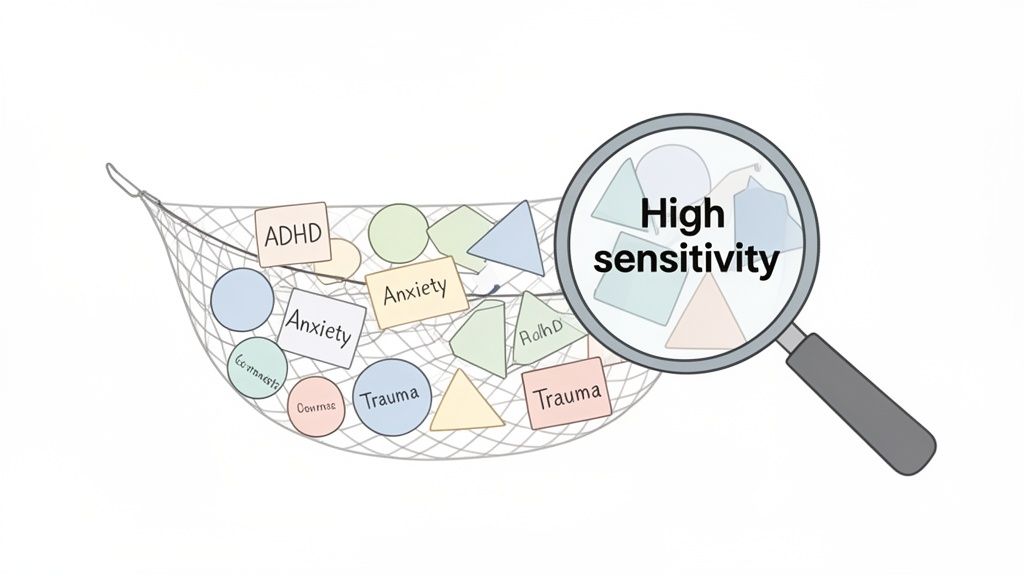
The Challenge of Low Specificity
But there’s a trade-off to all that sensitivity: low specificity. If your smoke detector is too sensitive, it might go off every time you toast a piece of bread. In the same way, the RAADS test sometimes casts too wide a net, producing high scores in people who are not, in fact, autistic.
This happens because many of the traits it measures aren't exclusive to autism. Experiences like social anxiety, sensory processing issues, and challenges with executive function are common across other conditions, including:
- Attention-Deficit/Hyperactivity Disorder (ADHD)
- Social Anxiety Disorder
- Complex Trauma (C-PTSD)
- Obsessive-Compulsive Disorder (OCD)
The RAADS test, on its own, can’t always tell these conditions apart from autism. It’s great at flagging the “smoke” (the traits), but it can’t definitively identify the “fire” (the underlying cause).
A 2021 UK study highlighted this perfectly. It found the RAADS-R had 100% sensitivity—every single person who was clinically diagnosed as autistic scored above the threshold. But its specificity was just 3.03%. Nearly everyone in the study scored high, meaning a high score gave less than a one-in-three chance of an actual diagnosis.
Why Professional Expertise Is Essential
This is exactly why a professional's expertise is non-negotiable for an accurate diagnosis. A skilled clinician acts as the firefighter who investigates the alarm to figure out if it's just burnt toast or a real fire. Understanding the principles of statistical hypothesis testing is fundamental to creating and validating assessments like RAADS, and it’s this scientific rigor that clinicians bring to the table.
They use their clinical experience to look far beyond the score. During a formal evaluation, a diagnostician will conduct a detailed interview about your life history, rule out other potential reasons for your traits, and use a variety of tools to build a complete, nuanced picture.
The RAADS score is a valuable piece of data, but it’s just one piece of a much larger puzzle. And it takes an expert to put that puzzle together correctly.
Who Should Consider Taking the RAADS Test
Have you ever felt like you're standing on the outside of a party, peering through the window, trying to figure out the secret social rules everyone else just seems to know? This feeling of being fundamentally different is a lifelong companion for many adults who have never had the words to explain it.
The RAADS autism test is a self-assessment designed for people in this exact situation. It’s particularly helpful for those who suspect they’ve been masking—or camouflaging—their natural instincts just to get by. This constant performance of neurotypical behaviors is exhausting and a fast track to burnout. The RAADS test offers a structured way to peel back that mask and look at your real, lifelong internal experiences.
A Tool for Self-Exploration
This self-assessment can be especially clarifying for certain groups whose experiences were often missed by older diagnostic models. If any of the following sound familiar, the RAADS test might offer you some powerful insights:
- Women and Non-Binary Individuals: Autism often looks different in women, with more internalized traits and a strong tendency to mask social challenges. The test's questions are designed to help validate these more subtle experiences.
- People of Color (BIPOC): Systemic biases and cultural factors can cause autistic traits in BIPOC individuals to be misinterpreted or overlooked entirely.
- Those with Co-occurring Conditions: If you already have a diagnosis like ADHD but feel like there's still a missing piece to your puzzle, the RAADS test can help you explore the possibility of being AuDHD (autistic and ADHD).
The RAADS test isn’t about putting you in a box. It’s about handing you a key that might just unlock a much deeper understanding of yourself and your unique neurotype.
At its core, this test is for anyone who is simply looking for clarity. Think of it as a personal data-gathering tool, helping you organize your own thoughts and experiences before you decide whether a professional evaluation is the right next step. For many, it's an empowering first move on the journey toward self-acceptance and living a more authentic life.
What to Do After a High RAADS Score
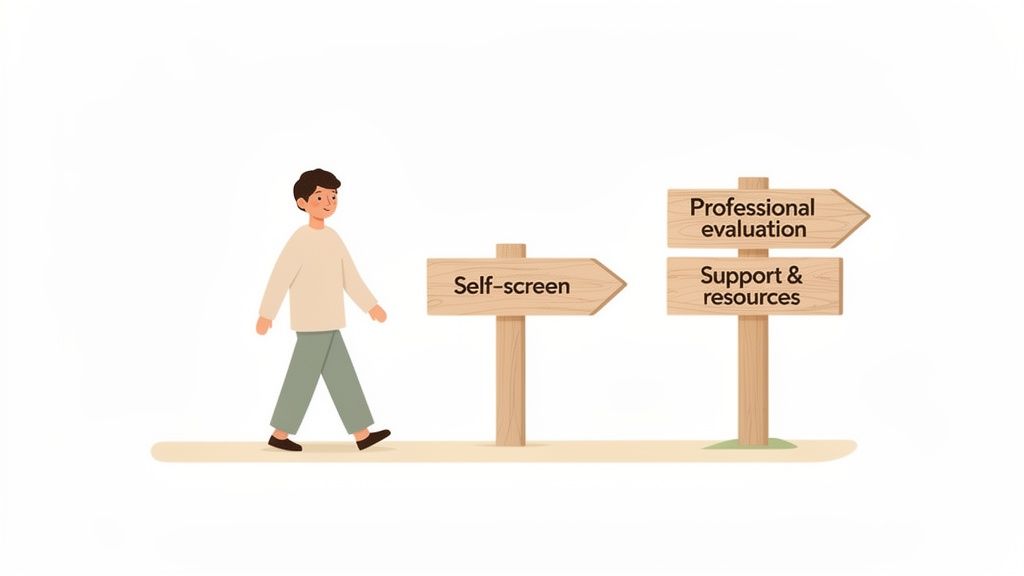
Getting a high score on a RAADS test can be a really big moment. For a lot of people, it’s a wave of validation—a feeling that your lifelong experiences finally have a name. But it also raises a huge question: What now? Think of this score not as a final destination, but as a signpost pointing you toward getting real clarity.
The most important next step you can take is to seek a formal diagnostic evaluation from a qualified professional who specializes in adult neurodiversity. A high RAADS score is kind of like a warning light on your car's dashboard; it tells you something important needs a closer look, but it can't give you the full mechanic's report.
Why a Formal Evaluation is So Important
A self-report screener, even a really detailed one like the RAADS test, is just one piece of the puzzle. It perfectly captures your personal perspective, but it's missing the clinical context needed for an accurate diagnosis. A formal assessment is a collaborative process that goes so much deeper.
It's your chance to sit down and have a real conversation with an expert who can help connect the dots of your entire life. This process is specifically designed to figure out if your traits are from autism or other conditions that can look similar, like ADHD or social anxiety—something a screener just can't do on its own.
A formal diagnosis is about more than just a label. It's about gaining access to a new level of self-understanding, personalized support strategies, and any necessary accommodations that can fundamentally improve your quality of life.
This kind of clarity can be life-changing. It gives you a solid foundation to build a life that actually honors your neurotype instead of forcing you to fit into neurotypical expectations.
What to Expect From a Professional Assessment
A professional evaluation isn't some sterile, impersonal test. At the Sachs Center, for example, the whole process is a human-centered, two-hour virtual meeting done via telehealth for your comfort and convenience. It’s a deep-dive conversation, not just a checklist.
Here’s what a quality evaluation usually involves:
- Detailed Clinical Interview: A psychologist will talk with you about your developmental history, childhood experiences, social relationships, sensory sensitivities, and current challenges. Your story provides the crucial context that a simple score can never capture.
- Use of Validated Tools: Along with the interview, clinicians use a range of other validated assessments to build a complete and accurate picture.
- Holistic Interpretation: The professional then brings together your self-reported experiences with their clinical expertise to arrive at a thoughtful and accurate conclusion.
Your RAADS score has brought you to an important crossroads. Now, it's time to channel that insight into action. By pursuing a formal adult autism assessment, you're moving from self-screening to diagnostic certainty—and that's the most powerful step you can take on your journey of self-discovery.
Common Questions About the RAADS Test and Diagnosis
So, you’ve learned about the RAADS test—what it is, how it’s scored, and where its limits lie. It’s totally normal to have questions about what to do with this information. Let's walk through some of the most common ones to give you a clearer path forward.
Can a High RAADS Score Serve as a Self-Diagnosis?
No, a high score on the RAADS test isn't an official diagnosis. The best way to think about it is as a powerful signal that getting a professional evaluation is a really good next step.
A high score can be incredibly validating. It suggests that your personal experiences line up with those of many autistic adults. But it can’t take the place of a full clinical assessment. While self-realization is a vital part of understanding yourself, an official diagnosis from a qualified clinician is what you need for things like workplace or academic accommodations. A clinician’s job is to look at your entire life story, not just a questionnaire score, to piece together the full picture.
Are There Other Autism Screeners Besides RAADS?
Yes, there are several other self-report screeners out there, and each one has a slightly different angle. The Autism-Spectrum Quotient (AQ) is another popular one you might have heard of.
However, the RAADS-R is often preferred for adults because it was built specifically to pick up on the more subtle traits common in people who’ve gone undiagnosed for years. Its questions often feel more relatable to adult life, especially for those who have a lifetime of practice camouflaging or masking their traits. During a formal evaluation, a psychologist won't just lean on one screener. They use a combination of validated tools to build a complete and accurate picture.
Key Takeaway: While different screeners can offer clues, they are all designed to be starting points. A professional evaluation is what synthesizes information from multiple sources—especially your own lived experience—to provide true diagnostic clarity.
What Happens During a Formal Autism Evaluation?
A formal evaluation isn't a scary, impersonal exam. It’s a comprehensive, collaborative conversation designed to be a supportive space where you can finally share your story and have your experiences heard by an expert.
At a telehealth-focused practice like the Sachs Center, this is usually a two-hour virtual meeting you can do from the comfort of your own home. The process typically looks like this:
- A Detailed Clinical Interview: This is the heart of the assessment. Your psychologist will ask about your childhood, social life, sensory sensitivities, intense interests, and any current challenges.
- Validated Self-Report Measures: You’ll likely fill out a few questionnaires, but these are just used to add context to the information you share during the interview.
- A Holistic Conclusion: The psychologist brings everything together to provide an accurate diagnostic conclusion and personalized recommendations for how you can move forward.
Why Does the RAADS Test Flag Non-Autistic People?
The RAADS test often flags people who aren't autistic because it's built for high sensitivity—its primary job is to make sure it doesn't miss anyone who might be on the spectrum. Think of it like casting a very wide net. The problem is that many human experiences, like social anxiety or sensory differences, aren't exclusive to autism.
These traits can be a major part of other conditions, like ADHD, anxiety disorders, or trauma. If you want to learn more about conditions often linked with autism, such as sensory differences, you might find explanations of Sensory Processing Disorder (SPD) helpful. This overlap is exactly why an experienced clinician is so important. They have the training to tell these conditions apart and figure out the root cause of your experiences, something a simple screening tool just can't do on its own.
At the Sachs Center, our telehealth-based diagnostic assessments for Autism and ADHD are designed to give you the clarity you deserve. Our expert psychologists specialize in adult neurodiversity and understand the nuanced ways traits appear, especially in masked individuals. If you’re ready to move beyond screeners and toward a definitive understanding of who you are, we invite you to book a two-hour virtual evaluation with us today. Learn more at https://sachscenter.com.
