

The life of a student is a constant balancing act. Juggling classes, looming assignment deadlines, a social life, and personal well-being often feels like an impossible task, making it seem like there simply aren't enough hours in the day. But what if the problem isn't a lack of time, but a lack of strategy? Mastering effective time management tips for students is more than just a useful skill; it's a strategic advantage that significantly reduces stress, prevents academic burnout, and ultimately unlocks your full potential.
This guide moves beyond generic advice like "use a planner." Instead, we will dive into ten powerful, evidence-informed frameworks specifically designed to help you regain control of your schedule and focus your energy where it matters most. You will learn actionable techniques like the Pomodoro Technique, Time Blocking, and the Eisenhower Matrix, which are designed to bring clarity and structure to your workload.
We will explore the practical, step-by-step application of each method, providing concrete examples and neurodivergent-friendly adaptations for students with ADHD or Autism. Our goal is to equip you with the tools to build a personalized system that works for your unique brain and learning style. We'll also briefly touch on when and how to seek formal accommodations, such as those identified through neuropsychological testing, to ensure you have the structural support needed to succeed. To truly stop juggling academic demands and personal life, and start thriving, consider additional strategies and time hacks for busy learners that complement these techniques. Prepare to transform your relationship with time and build a more balanced, productive, and successful student life.
1. Tip #1: Master Focus with The Pomodoro Technique
The Pomodoro Technique is a powerful time management method designed to combat procrastination and mental fatigue. It breaks down study sessions into short, focused intervals, making it one of the most effective time management tips for students dealing with overwhelming workloads. The core idea is to work in 25-minute sprints of pure focus, called a "pomodoro," followed by a short break.
This approach creates a sustainable rhythm that prevents burnout while maximizing concentration. It’s particularly effective for neurodivergent students, as it provides a clear, structured system for initiating and sustaining effort on tasks that might otherwise feel insurmountable.
How to Implement the Pomodoro Technique
Getting started is simple. All you need is a timer.
- Choose a Single Task: Decide what you will work on for the next 25 minutes. Be specific (e.g., "draft the introduction for my history essay" instead of just "work on history").
- Set Your Timer: Set a timer for 25 minutes and work on that single task without interruption. Put your phone on silent and close unrelated browser tabs.
- Take a Short Break: When the timer rings, take a mandatory 5-minute break. Step away from your desk, stretch, or grab a glass of water.
- Repeat and Take a Longer Break: After completing four pomodoros (about two hours of work), take a longer break of 15-30 minutes. This longer rest is crucial for helping your brain consolidate information and recharge.
For example, a student studying for a biology exam could dedicate one pomodoro to reviewing lecture notes on cellular respiration, a second to creating flashcards for key terms, and a third to answering practice questions. The structured breaks prevent the marathon study session from becoming a draining experience.
Key Insight: The Pomodoro Technique is not just about working; it's about training your brain to focus intently for short periods. The mandatory breaks are as important as the work intervals for maintaining high-quality concentration.
This method transforms large, intimidating projects into a series of manageable, 25-minute steps. For an even deeper dive into this method, you can learn more about how to maximize productivity with the Pomodoro Technique. It offers a practical framework for anyone looking to build better study habits and overcome the initial friction of starting work.
2. Tip #2: Prioritize Like a Pro with The Eisenhower Matrix
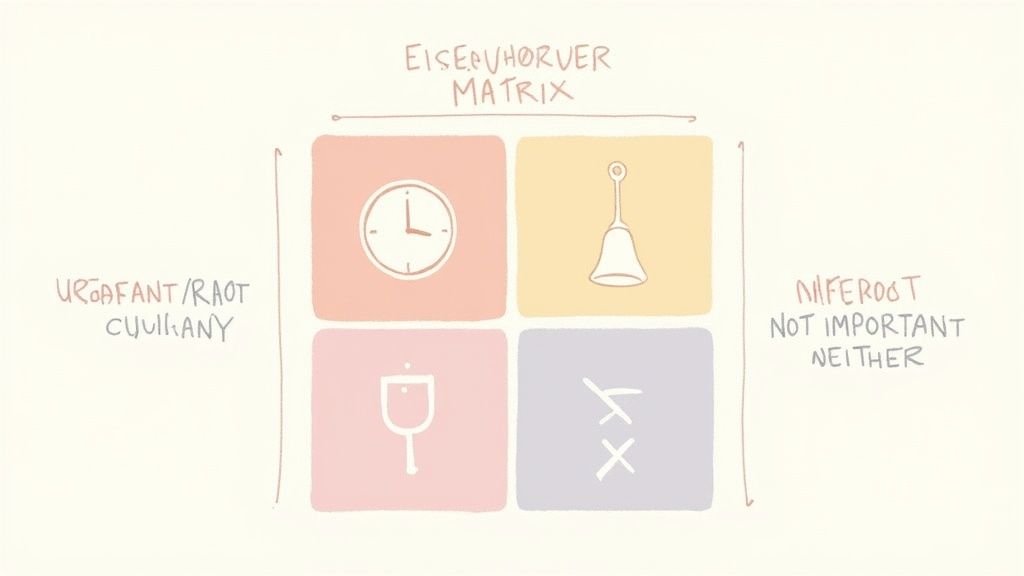
The Eisenhower Matrix, also known as the Urgent-Important Matrix, is a decision-making tool that helps you prioritize tasks by categorizing them based on urgency and importance. This framework is one of the most essential time management tips for students because it forces you to distinguish between what feels urgent and what truly matters for your long-term academic success. It was famously used by Dwight D. Eisenhower and later popularized by Stephen Covey.
This method helps you move beyond simply reacting to deadlines and instead encourages strategic planning. It is especially beneficial for students juggling multiple courses, extracurricular activities, and personal commitments, providing a clear visual guide to where your energy should be focused.
How to Implement The Eisenhower Matrix
To use the matrix, you evaluate each task on your to-do list and place it into one of four quadrants:
- Quadrant 1: Urgent & Important (Do First): These are tasks with immediate deadlines and significant consequences. Examples include studying for an exam that is tomorrow or finishing an essay due by midnight.
- Quadrant 2: Not Urgent & Important (Schedule): This is the quadrant for long-term strategic growth. Tasks here include planning a research paper, reviewing lecture notes weekly, or working on scholarship applications. This is where you should aim to spend most of your time.
- Quadrant 3: Urgent & Not Important (Delegate or Minimize): These are interruptions that demand immediate attention but don't contribute to your goals. Think of some emails, non-critical group chat notifications, or minor requests from peers.
- Quadrant 4: Not Urgent & Not Important (Eliminate): These are time-wasting activities that should be avoided. Examples include aimlessly scrolling through social media or watching TV for hours when you have pending assignments.
For instance, a student using the matrix would place "Study for midterm exam next week" in Quadrant 2 and schedule specific times for it. In contrast, "Respond to a non-essential club email" would go into Quadrant 3 to be handled quickly, while "Binge-watching a new series" falls squarely into Quadrant 4.
Key Insight: The goal of the Eisenhower Matrix is to actively spend more time in Quadrant 2 (Important, Not Urgent). Proactively working on these tasks reduces the number of crises that end up in Quadrant 1, leading to less stress and better quality work.
This framework empowers you to take control of your schedule rather than letting it control you. By regularly categorizing your tasks, you can make conscious, goal-oriented decisions about how to invest your most valuable resource: your time.
3. Tip #3: Schedule Your Day with Time Blocking
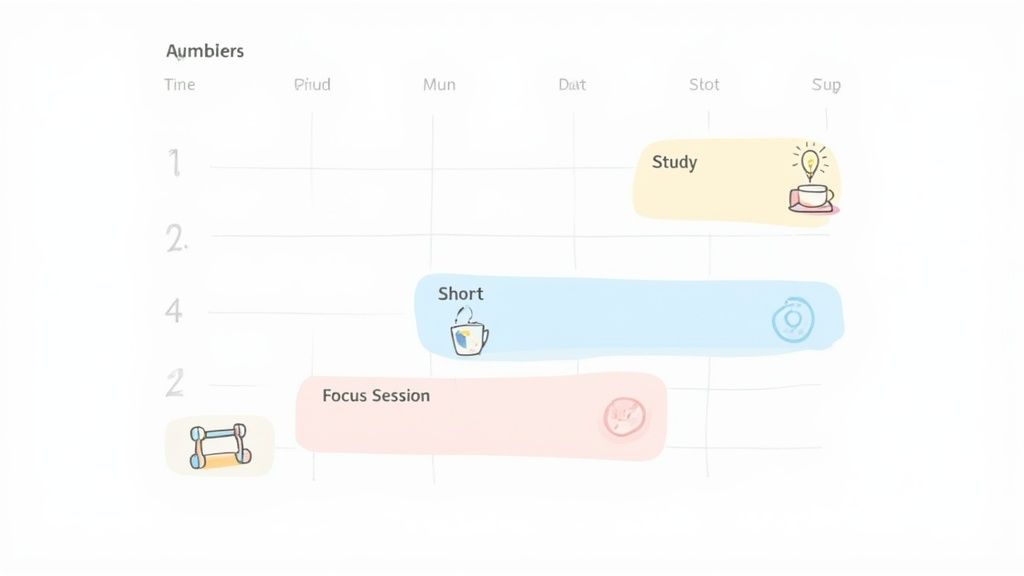
Time blocking is a powerful scheduling technique where you divide your entire day into specific blocks of time, with each block dedicated to a particular task or activity. Championed by authors like Cal Newport, this method replaces a simple to-do list with a concrete schedule, providing a clear roadmap for your day and making it one of the most effective time management tips for students aiming to conquer a demanding courseload.
By assigning every hour a job, you eliminate the mental energy wasted on deciding what to do next. This structured approach is especially beneficial for students managing multiple subjects, extracurriculars, and personal commitments, creating a predictable and productive daily rhythm.
How to Implement Time Blocking
To get started, you can use a digital tool like Google Calendar or a physical planner. The key is to be intentional with your time.
- Plan Your Priorities: At the beginning of the week or each evening, list all the tasks you need to accomplish, including classes, studying, assignments, meals, and breaks.
- Allocate Time Blocks: Drag and drop these tasks into specific time slots on your calendar. Be realistic about how long each task will take. An engineering student might block 3-5 PM on Tuesdays for their project lab, while a medical student might schedule 9-11 AM for anatomy review.
- Include Buffers and Breaks: Schedule short 10-15 minute buffers between tasks to allow for transitions. Don’t forget to block out time for meals, exercise, and relaxation to prevent burnout.
- Adapt and Refine: Your initial schedule is a template, not a rigid rule. If a task takes longer than expected, adjust the rest of your day accordingly. The goal is to create a structure that serves you.
For example, an honors student could use a color-coded system: blue blocks for chemistry lectures, green for English essay writing, and yellow for calculus problem sets. This visual organization makes it easy to see how their time is allocated and ensures a balanced focus across all subjects.
Key Insight: Time blocking transforms your intentions into a concrete plan. By giving every minute a purpose, you proactively manage your day instead of reactively responding to it, significantly reducing procrastination and decision fatigue.
This method gives you control over your schedule, ensuring that your most important work gets the time it deserves. Because it provides such clear structure, you can find a deeper analysis of how time blocking helps with focus in these study strategies for students with ADHD on sachscenter.com. It's a proactive approach that builds discipline and ensures consistent progress toward your academic goals.
4. Tip #4: Overcome Inertia with The Two-Minute Rule
The Two-Minute Rule is a simple yet profound productivity principle designed to eliminate procrastination on small tasks. Popularized by David Allen in his book Getting Things Done, the rule states: if a task takes less than two minutes to complete, do it immediately instead of deferring it. This is one of the most effective time management tips for students for preventing small to-dos from accumulating into a source of overwhelming mental clutter.
This strategy builds momentum and creates a habit of action, which is particularly beneficial for students who struggle with executive functions like task initiation. By quickly clearing minor responsibilities, you free up mental energy to concentrate on more significant, deep-work projects without the nagging distraction of an ever-growing to-do list.
How to Implement The Two-Minute Rule
Adopting this rule requires a shift in mindset from “I’ll do it later” to “I’ll do it now.” It’s about recognizing and acting on opportunities to be productive in the moment.
- Identify the Task: As a task arises, ask yourself, "Can this be done in two minutes or less?"
- Act Immediately: If the answer is yes, complete it right away. Do not add it to a list or schedule it for another time.
- Move On: Once done, you can return to your primary task with a clearer mind and one less thing to worry about.
For instance, a student could use this rule to immediately reply to a professor's quick email, file a graded paper in the correct folder, or tidy a small section of their desk. Instead of letting these minor items pile up, each is handled instantly, maintaining a sense of order and control over your environment and workload. Another great use is cleaning up your digital workspace by closing unused tabs or saving a document with a proper file name.
Key Insight: The Two-Minute Rule is less about the time saved and more about building the habit of starting. It reduces the friction of getting things done and helps you maintain a continuous state of productivity and momentum.
This rule is a powerful tool against procrastination that transforms your relationship with small, everyday tasks. To explore the origins of this concept further, you can learn more about David Allen's Getting Things Done (GTD) methodology. It provides a robust framework for managing commitments and reducing stress.
5. Prioritize with The 80/20 Rule (The Pareto Principle)
The 80/20 Rule, also known as the Pareto Principle, suggests that roughly 80% of outcomes result from only 20% of the effort. For students, this principle is a game-changer; it encourages you to identify and focus on the high-impact activities that yield the most significant academic returns. This is one of the most strategic time management tips for students because it shifts the focus from being busy to being effective.
Instead of trying to do everything, you learn to prioritize the tasks that truly matter. This approach is especially helpful for neurodivergent students who may feel overwhelmed by long to-do lists, as it provides a clear framework for allocating limited energy to what will make the biggest difference.
How to Implement The 80/20 Rule
Applying this principle requires you to become an analyst of your own study habits and course materials. The goal is to identify your "vital few" tasks.
- Identify High-Impact Topics: Review your syllabus and past exams to find which topics or concepts carry the most weight. Professors often emphasize core themes that are more likely to appear on major assignments and finals.
- Analyze Your Study Methods: Track which study activities lead to the best results. You might discover that active recall methods like completing practice problems are far more effective than passively re-reading a textbook.
- Focus Your Efforts: Dedicate the majority of your study time to that critical 20% of material and methods. This doesn’t mean ignoring everything else, but it does mean prioritizing intelligently.
- Evaluate and Adjust: Regularly assess whether your priorities are correct. If a new topic becomes central to the course, adjust your focus accordingly.
For instance, a computer science student might find that 80% of their exam grade comes from understanding 20% of the core algorithms. By mastering those key algorithms through focused practice, they can achieve a high grade more efficiently than if they tried to memorize every minor detail of the course.
Key Insight: The 80/20 Rule is not about studying less; it's about studying smarter. It empowers you to direct your energy toward the activities that disproportionately contribute to your academic success, preventing wasted effort on low-impact tasks.
This principle transforms your approach to studying from a quantitative game of hours logged to a qualitative one of targeted, effective work. It provides a powerful lens for making strategic decisions about where to invest your most valuable resource: your time.
6. Eat the Frog (Tackling Hardest Tasks First)
The "Eat the Frog" method is a powerful anti-procrastination strategy based on a simple idea: complete your most challenging or important task first thing in your study session. Popularized by author Brian Tracy, this approach tackles the one task you are most likely to avoid (the "frog"), making it a cornerstone among time management tips for students looking to build momentum and reduce anxiety.
By addressing your biggest task when your energy and focus are at their peak, you ensure that critical work gets done effectively. This strategy is particularly helpful for neurodivergent students, as it provides a clear, high-impact starting point that cuts through decision fatigue and the overwhelming feeling of a long to-do list.
How to Implement the Eat the Frog Method
The key to this method is discipline and pre-planning. You identify and commit to your "frog" ahead of time.
- Identify Your Frog: The night before, determine the single most important task for the next day. This is your "frog." It should be the task that will have the greatest positive impact on your progress.
- Schedule It First: Block out time at the very beginning of your study period to work on it. Commit to starting immediately without getting sidetracked by easier, less important tasks like checking emails.
- Tackle It Relentlessly: Work on your frog without interruption until it is complete. If the frog is too large for one session (like writing a 10-page paper), your task is to complete a significant, pre-defined chunk of it.
- Reward Your Effort: Once you've "eaten the frog," acknowledge your accomplishment. The sense of relief and achievement is often its own reward, but a small break or treat can reinforce the positive habit.
For example, a student with a difficult calculus problem set and a simple reading assignment would "eat the frog" by tackling the calculus problems first. Even if they only solve a few problems, they have made meaningful progress on their most demanding work, making the rest of the day's tasks feel much easier.
Key Insight: The primary benefit of "Eating the Frog" is psychological. By accomplishing your most dreaded task first, you create a powerful sense of momentum and accomplishment that carries you through the rest of your day with less stress and more confidence.
This approach transforms your relationship with difficult work, turning procrastination into proactive achievement. For more on the original concept, Brian Tracy's book, Eat That Frog!, provides a deeper exploration of this powerful principle.
7. The Getting Things Done (GTD) System
The Getting Things Done (GTD) method is a comprehensive organizational framework designed to manage commitments, tasks, and information. Developed by David Allen, it helps you offload mental clutter into a trusted external system, freeing up cognitive resources to focus on execution rather than remembering. This makes it one of the most powerful time management tips for students juggling complex academic, social, and personal responsibilities.
GTD's core principle is that your mind is for having ideas, not holding them. By capturing everything that has your attention, from a major research paper to buying more notebooks, you can process it methodically. This approach is particularly beneficial for neurodivergent students, as it provides a structured way to handle executive functions like planning, organizing, and task initiation.
How to Implement the Getting Things Done (GTD) System
Getting started with GTD involves five core steps to build your trusted system. You can use a digital tool like Todoist, OmniFocus, or a simple notebook.
- Capture: Collect everything that has your attention. Write down every task, idea, deadline, and to-do, big or small, in an "inbox." This could be a physical tray, a digital list, or an email folder.
- Clarify/Process: Go through your inbox and decide what each item is. Is it actionable? If not, trash it, file it as reference, or put it on a "Someday/Maybe" list. If it is actionable and takes less than two minutes, do it immediately.
- Organize: Put your actionable items where they belong. Assign due dates to calendar items, delegate tasks, or add them to specific "Next Actions" lists. Organize these lists by context (e.g., @Library, @Computer, @Dorm).
- Review: Regularly review your system to stay current. The most crucial part is the "Weekly Review," where you get clear, get current, and get creative to ensure your system is trustworthy and up to date.
- Engage: Confidently choose your next action based on context, time available, energy level, and priority.
For example, a student managing a group project could capture all related tasks. "Email Professor" is a quick action, while "Draft Project Outline" goes on the @Computer list. "Schedule team meeting" goes on the calendar. The Weekly Review ensures they don't miss any deadlines.
Key Insight: GTD is not just a to-do list; it’s a complete life management system. Its power comes from the consistent Weekly Review, which builds trust in your system and eliminates the anxiety of forgetting something important.
This method transforms overwhelming chaos into a clear, manageable workflow. By externalizing all your commitments, you can focus your mental energy on the task at hand, knowing that nothing will fall through the cracks.
8. Prioritize Smartly with Decision Frameworks (RICE, MoSCoW, ABCDE)
When every assignment feels urgent, decision-making itself can drain your mental energy. Prioritization frameworks are structured systems that replace guesswork with objective criteria, making them one of the most powerful time management tips for students facing competing deadlines. Methods like RICE, MoSCoW, and ABCDE provide a clear lens for evaluating and ranking tasks.
These frameworks are especially helpful for students who struggle with executive functions, such as organizing and prioritizing. By providing an external, logical structure, they reduce the anxiety of choosing what to work on next and ensure your effort is directed toward what truly matters most.
How to Implement Prioritization Frameworks
Choosing the right framework depends on the complexity of your tasks. Here are three popular methods:
- ABCDE Method: A straightforward system for daily task management. Categorize every task on your to-do list:
- A: Very important tasks you must do today (e.g., submit an essay due at midnight).
- B: Important tasks you should do, but with minor consequences if delayed (e.g., start research for next week's paper).
- C: Tasks that are nice to do but have no negative consequences if not done (e.g., organize lecture notes).
- D: Tasks you can delegate.
- E: Tasks you can eliminate.
- MoSCoW Method: Ideal for group projects or complex assignments with multiple components. It helps prioritize features or efforts:
- Must Have: Non-negotiable requirements for completion (e.g., the core thesis statement in a capstone project).
- Should Have: Important but not vital; the project is still a success without them (e.g., adding an extra data visualization).
- Could Have: Desirable but non-essential improvements (e.g., custom formatting for a presentation).
- Won't Have: Items explicitly out of scope for now.
- RICE Method: A more analytical framework for bigger decisions, like choosing between studying for an exam or starting a major project. You score each task on four factors: Reach (how many goals does it affect?), Impact (how much will it contribute to your grade?), Confidence (how sure are you of the estimates?), and Effort (how much time will it take?).
For example, a student using the ABCDE method would immediately identify a same-day assignment as an "A" task, while planning for a future test is a "B" task. The rule is to never work on a B task when an A task is left undone.
Key Insight: Prioritization frameworks transform subjective stress ("Everything is important!") into an objective process. They provide a reliable system for allocating your limited time and energy to the tasks with the highest return, ensuring you're always working on what matters most.
Instead of switching between systems, choose one that fits your needs and master it. Use it for significant weekly planning rather than every minor daily task to avoid getting bogged down. These methods empower you to make strategic choices, not just reactive ones.
9. Tip #9: Minimize Context Switching to Deepen Focus
Context switching is the mental cost of shifting your attention from one unrelated task to another. This practice, often disguised as multitasking, fragments your focus and drains cognitive resources. For students, minimizing context switching is one of the most impactful time management tips for students because it allows for "deep work," a state of intense, distraction-free concentration that produces high-quality results.
Research by experts like Gloria Mark shows that every time you switch tasks, it takes a significant amount of time to regain your original level of focus. By batching similar activities together, you reduce this cognitive overhead, conserve mental energy, and improve both the speed and quality of your work. This is especially beneficial for neurodivergent students who may find task initiation and re-engagement particularly challenging.
How to Minimize Context Switching
The goal is to create dedicated, uninterrupted blocks of time for a single type of cognitive work.
- Batch Similar Tasks: Group related activities together. Instead of alternating between writing an essay, answering emails, and doing math problems, dedicate a specific block of time solely to writing.
- Block Your Time: Use a calendar or planner to schedule "deep work" sessions for specific subjects. For example, block out Tuesday from 2-4 PM for "Chemistry Lab Report Only."
- Eliminate Distractions: Before starting a focused session, silence your phone, close irrelevant browser tabs, and disable notifications. Create a barrier between you and potential interruptions.
- Take True Breaks: When you finish a block of focused work on one subject, take a genuine break before switching to a different cognitive context. Step away from your desk to reset your mind.
For instance, a student could dedicate a 90-minute block to completing all their math homework for the week. Another block could be reserved for responding to all emails and discussion board posts for their online courses. This prevents the constant mental whiplash of jumping between analytical thinking and communication.
Key Insight: True productivity isn't about being busy; it's about making meaningful progress. Minimizing context switching allows you to move from shallow, fragmented work to deep, impactful learning and creation.
By adopting this strategy, you train your brain to sustain concentration, leading to more efficient studying and better retention. For those looking for more strategies to maintain focus, you can find further productivity tips for students with ADHD that complement this approach. This method helps you take control of your attention and direct it where it matters most.
10. Calendar-Based Planning and Backward Planning
Calendar-based planning, also known as backward planning, is a strategic method for managing long-term deadlines and preventing last-minute stress. It involves mapping out your entire semester on a calendar and working backward from major due dates to create a realistic timeline. This approach is one of the most proactive time management tips for students because it shifts the focus from daily tasks to the bigger academic picture.
This technique transforms overwhelming projects and exam periods into a series of smaller, scheduled steps. It's particularly beneficial for students who struggle with executive functions, as it provides a visual roadmap that clearly defines when to start working on major assignments, long before the deadline pressure mounts.
How to Implement Calendar-Based and Backward Planning
A digital calendar is your best tool for this method, but a large wall planner works too.
- Map Out Your Semester: As soon as you get your syllabi, enter every major deadline into your calendar. This includes final exams, midterms, project due dates, and paper submissions. Use different colors for each course.
- Identify Key Milestones: For large projects, break them down into smaller phases. A research paper might have milestones like "Complete Outline," "Finish First Draft," and "Finalize Citations."
- Work Backward and Set Start Dates: Starting from the final due date, plan backward. For a major paper, you might set a "Start Research" deadline four weeks prior. For a final exam, you could schedule your first review session three weeks in advance.
- Build in Buffer Time: Always add a buffer of 20-30% to your timeline. If you think a draft will take five days, schedule seven. This accounts for unexpected delays, illness, or other commitments.
For instance, if a history paper is due on December 10th, you would work backward: set the final proofreading for December 8-9, the final draft completion for December 5, the first draft for November 28, and the research and outline phase to begin by November 14. This turns a massive task into a manageable, month-long process.
Key Insight: Backward planning eliminates the question of "When should I start?" by providing a clear, data-driven answer. It prevents the panic that comes from realizing a major deadline is just a week away.
This method provides a bird's-eye view of your semester, empowering you to allocate your time and energy effectively. For those looking for more structured systems, you can explore various ADHD time management tools that complement calendar-based planning. This approach ensures that no deadline can sneak up on you again.
Comparison of 10 Student Time-Management Techniques
| Method | Implementation complexity 🔄 | Resource requirements ⚡ | Expected outcomes ⭐📊 | Ideal use cases 💡 | Key advantages ⭐ |
|---|---|---|---|---|---|
| The Pomodoro Technique | Low (🔄) — simple timer rules | Minimal (⚡) — timer or app | ⭐⭐⭐ — improved sustained focus, reduced fatigue | Short study sessions, preventing burnout | Easy to adopt; enforces regular breaks |
| Eisenhower Matrix (Urgent‑Important) | Low–Medium (🔄🔄) — quick categorization | Minimal (⚡) — paper or chart | ⭐⭐ — clearer priorities, less wasted time | Sorting many tasks or deadline triage | Clarifies urgency vs importance |
| Time Blocking | Medium (🔄🔄) — requires planning | Moderate (⚡⚡) — calendar app or planner | ⭐⭐⭐ — predictable schedule, balanced progress | Managing daily/weekly coursework and routines | Reduces decision fatigue; enforces consistency |
| Two‑Minute Rule | Low (🔄) — simple decision threshold | Minimal (⚡) — none or timer | ⭐⭐ — clears small tasks, builds momentum | Short admin tasks, quick emails, minor chores | Creates quick wins; reduces list clutter |
| The 80/20 Rule (Pareto) | Medium (🔄🔄) — needs analysis | Moderate (⚡⚡) — tracking data or outcomes | ⭐⭐⭐ — higher efficiency by focusing on high‑impact work | Exam prep, identifying high‑yield study activities | Concentrates effort where it yields most results |
| Eat the Frog | Low (🔄) — behavioral priority shift | Minimal (⚡) — planning to identify frog | ⭐⭐⭐ — reduces procrastination, boosts momentum | Tackling hardest/most important tasks first | Ensures critical tasks get peak-energy attention |
| Getting Things Done (GTD) | High (🔄🔄🔄) — multi-step system | Moderate–High (⚡⚡⚡) — apps, lists, reviews | ⭐⭐⭐ — comprehensive visibility; lower cognitive load | Complex schedules, research projects, multi‑role students | Robust system for capture, review, and execution |
| Prioritization Frameworks (RICE, MoSCoW, ABCDE) | Medium (🔄🔄) — requires scoring setup | Moderate (⚡⚡) — templates or spreadsheets | ⭐⭐ — objective task ranking, defensible choices | Major project decisions or team prioritization | Reduces bias; provides repeatable criteria |
| Minimizing Context Switching | Medium (🔄🔄) — habit and environment changes | Low–Moderate (⚡⚡) — blocking tools, environment control | ⭐⭐⭐ — deeper focus, fewer errors, faster completion | Deep work, long problem sets, writing sessions | Improves flow and quality by reducing interruptions |
| Calendar‑Based & Backward Planning | Medium (🔄🔄) — reverse‑timeline work | Moderate (⚡⚡) — calendar, syllabus, planning time | ⭐⭐⭐ — avoids cramming; realistic timelines | Semester planning, long papers, group projects | Prevents last‑minute rush; balances workload over term |
Building Your Personalized Time Management System
You have just explored a comprehensive toolkit of ten distinct and powerful strategies, each offering a unique approach to mastering your schedule and maximizing your academic potential. From the focused, high-intensity sprints of the Pomodoro Technique to the strategic, big-picture clarity of Backward Planning, these methods are more than just abstract concepts; they are practical frameworks for transforming how you work. We have delved into prioritizing with the Eisenhower Matrix, structuring your day with Time Blocking, and conquering procrastination by ‘Eating the Frog’ first thing in the morning.
The ultimate goal, however, is not to flawlessly implement every single technique mentioned. To do so would be overwhelming and counterproductive. Instead, the real power lies in mindful experimentation and personalization. This article is your menu of options, not a rigid prescription. The journey to effective time management is deeply personal, especially for neurodivergent students whose brains may process tasks, deadlines, and priorities differently. What works brilliantly for one person might feel restrictive to another.
Forging Your Unique Path Forward
The key takeaway is this: the most effective time management system is the one you can consistently use. Your task now is to select one or two strategies that resonate with your specific challenges and learning style.
Consider these potential combinations as starting points:
- For the Overwhelmed Procrastinator: Try combining Eat the Frog with Time Blocking. Identify your most dreaded task for the next day and schedule a specific, non-negotiable block of time to tackle it first. This creates structure and removes the mental burden of deciding what to do.
- For the Easily Distracted Thinker: A pairing of the Pomodoro Technique and Minimizing Context Switching can be revolutionary. Use the 25-minute Pomodoro sprints to dedicate your focus to a single subject, and actively silence notifications and close unrelated tabs to protect that focus.
- For the Big-Picture Planner: Use Backward Planning to map out your semester-long projects and then apply the Eisenhower Matrix on a weekly basis to sort your immediate tasks. This ensures your daily actions align with your long-term academic goals.
The essence of these time management tips for students is not about finding more hours in the day, but about making the hours you have more intentional, focused, and productive. It is about reducing the stress that comes from feeling perpetually behind and replacing it with the confidence that comes from being in control of your commitments.
When Strategies Are Not Enough
It is also crucial to acknowledge that sometimes, even the best strategies can feel insufficient. If you consistently struggle with executive functions like planning, initiating tasks, and managing your time despite your best efforts, it may not be a matter of willpower or finding the right app. It could be a sign that your brain is wired differently.
For many students, especially those with ADHD, Autism, or AuDHD, challenges with time management are a core feature of their neurotype. In these cases, understanding the "why" behind the struggle is the most critical first step. A comprehensive neuropsychological evaluation can provide profound clarity, identifying specific cognitive strengths and weaknesses. This knowledge is not just diagnostic; it is empowering. It unlocks access to formal academic accommodations, such as extended time on tests or flexible deadlines, that level the playing field and allow your true abilities to shine through. It provides a personalized roadmap for success, validating your experience and equipping you with targeted support.
Ultimately, mastering your time is an investment in your well-being, your academic success, and your future. It is a skill that will serve you far beyond the classroom, in your career and personal life. Begin today by choosing one small, actionable step. Experiment, adapt, and build a system that honors the way your mind works. Your time is your most valuable asset; start managing it with the intention and respect it deserves.
If you suspect that underlying executive functioning challenges are hindering your academic success, a professional evaluation can provide the answers and support you need. The Sachs Center specializes in comprehensive diagnostic testing for ADHD and Autism, offering clarity and a path toward effective accommodations and strategies. Visit the Sachs Center to learn how a personalized evaluation can unlock your full potential.
