
When you hear "504 plan," it might sound like complicated school jargon, but it's actually a straightforward, formal blueprint that gives students with ADHD the accommodations they need to succeed in a typical classroom. Think of it as a tool designed to level the playing field, removing learning barriers so your child has the same access to their education as everyone else.
Understanding the 504 Plan for ADHD
Let's cut through the legal-speak. A 504 plan is not about labeling your child or moving them into a special education track. It's an advocacy tool that comes from Section 504 of the Rehabilitation Act of 1973. This is a federal civil rights law, and it requires public schools to provide the right supports for students with disabilities so they aren't shut out of school activities.
For a student with ADHD, this can be a total game-changer. ADHD often shows up as much more than just an inability to sit still; it can create very real hurdles in a classroom setting.
How ADHD Creates Barriers to Learning
Common ADHD traits like executive dysfunction, inattention, and impulsivity have a direct impact on a student’s ability to learn. It’s like trying to listen to one radio station while dozens of others are blasting at full volume—it's overwhelming and makes it nearly impossible to focus.
In the classroom, this can look like:
- Difficulty keeping track of homework, books, and assignments
- Struggling to follow instructions with multiple steps
- Challenges with managing time and hitting deadlines
- Trouble staying focused during lectures or independent work
A 504 plan for ADHD is designed to tackle these specific challenges head-on by providing personalized accommodations. It's a formal acknowledgment that these struggles aren't behavioral issues or a lack of trying, but symptoms of a neurodevelopmental condition that requires real support.
A 504 plan provides the necessary accommodations to remove academic barriers, giving your child an equitable chance at success. It's about access, not advantage.
The Growing Need for 504 Support
The need for these plans is more critical than ever, especially when you look at the rising prevalence of ADHD. Since the 1990s, diagnoses have climbed significantly across 135 countries.
Here in the United States, a 2022 CDC survey found that 7 million children (11.4%) aged 3-17 had been diagnosed. What's more concerning is that nearly 30% of them received no treatment or support. These numbers show a huge gap where school-based accommodations can make a massive difference.
Ultimately, a 504 plan is like a contract with the school. It clearly outlines the specific tools and strategies that will be used to help your child thrive. For parents, the first step is simply understanding your child's rights under Section 504. By getting a plan in place, you ensure your child’s unique needs are officially recognized and consistently met, setting them up for a much more positive and productive school experience.
Determining If Your Child Is Eligible
Figuring out if your child qualifies for a 504 plan for ADHD can feel a bit like navigating a maze, but it really boils down to two key things. First, you need proof of a diagnosed physical or mental impairment. Second, you have to show that this impairment “substantially limits” one or more major life activities.
It’s not enough to just have an ADHD diagnosis on paper. The school needs to see a clear, undeniable line connecting that diagnosis to the real-world struggles your child is facing in their ability to learn and function at school.
Proving a "Substantial Limitation"
That phrase—substantial limitation—is where many parents get stuck. It sounds intimidating, but it doesn't mean your child has to be failing all their classes.
Think about it this way: a student might be pulling B's and C's, but to get those grades, they're spending three hours on homework that takes their peers one hour. That immense extra effort, along with the stress and anxiety that comes with it, absolutely counts as a substantial limitation.
In a school environment, "major life activities" often include things like:
- Concentrating: The ability to stay focused during a lesson or while doing independent work.
- Learning: The actual process of taking in and understanding new information.
- Reading: Being able to comprehend written material.
- Thinking: Skills like organizing thoughts, solving problems, and planning.
Your mission is to collect evidence that shows exactly how ADHD gets in the way of these activities. Look for comments on report cards like "easily distracted" or "rushes through assignments." Save emails from teachers that describe your child's difficulty staying on task. Each one of these is a piece of the puzzle that builds a strong case for needing accommodations.
The Power of a Formal Evaluation
While observations from teachers and your own notes are helpful, nothing speaks louder than a comprehensive diagnostic evaluation. This is the hard data that school districts need to see.
For instance, while global research shows an 8.0% prevalence of ADHD, proving its specific impact on your child requires a detailed, professional assessment. This is where something like the neuropsychological testing we offer at the Sachs Center becomes invaluable. The detailed reports from these evaluations leave no room for doubt and are often the deciding factor in securing the right support. You can explore the full scope of this research to better understand the importance of early and accurate identification.
A neuropsychological report is like a translator. It takes your child's daily struggles and converts them into the clinical language and objective data that schools understand and act on.
When you present a well-documented case that clearly links the ADHD diagnosis to a substantial limitation, you’re no longer just asking for help—you’re presenting an undeniable argument for eligibility. You're not trying to prove your child is "failing," but rather showing why they need specific supports to get a fair shot at their education. This groundwork is the foundation of a successful 504 for ADHD request.
504 Plan vs IEP: What’s the Difference?
Parents often hear "504 Plan" and "IEP" used together and can get confused about which path is right for their child. While both provide support, they are governed by different laws and serve different purposes. Understanding the distinction is the first step in advocating effectively.
Here’s a breakdown of the key differences:
| Feature | 504 Plan | IEP (Individualized Education Program) |
|---|---|---|
| Governing Law | Section 504 of the Rehabilitation Act of 1973, a civil rights law. | Individuals with Disabilities Education Act (IDEA), a special education law. |
| Primary Purpose | To provide accommodations and ensure equal access to the learning environment. | To provide specialized instruction and related services to meet a child's unique educational needs. |
| Who is Eligible | Students with a disability that substantially limits one or more major life activities. | Students with one of 13 specific disability categories who need specialized instruction. |
| What It Provides | Accommodations, modifications, and related services (e.g., preferential seating, extended time on tests). | A detailed plan including specialized instruction, goals, services, and progress monitoring. |
| Parental Consent | Consent is required for evaluation but not necessarily for the plan itself (though it's best practice). | Written parental consent is required for evaluation and implementation of the initial IEP. |
| Formal Document | The plan is often less formal and detailed than an IEP. | A comprehensive, legally binding written document with specific required components. |
In short, a 504 plan is about access, removing barriers so a student can learn within the general education curriculum. An IEP is about providing specialized educational services when a disability impacts a child's ability to make academic progress, even with accommodations. For many children with ADHD who don't require specialized instruction but need support to succeed, the 504 plan is the perfect fit.
How to Formally Request a 504 Plan
Kicking off the process for a 504 plan for ADHD starts with a formal, written request. While a quick chat with a teacher is a great first step, putting your request in writing creates an official paper trail and legally requires the school to respond.
Think of your letter as the opening statement in your case for support. It doesn't need to be an epic, but it has to be professional, clear, and direct.
Drafting Your Written Request
First things first, make sure you're sending the letter to the right person. This is often the school principal, but some districts have a dedicated 504 coordinator or a lead school counselor who handles these requests. A quick call to the school's front office will clear up who should receive it.
In the letter, get straight to the point. You are formally requesting an evaluation for your child to determine their eligibility under Section 504.
Make sure you include these key details:
- Your Child's Full Name and Grade: This helps get your request to the right people without any mix-ups.
- A Statement of Diagnosis: Simply state that your child has been diagnosed with ADHD. You don't need to attach the full medical report just yet, but mention that you have it.
- Specific Examples of Struggles: This part is critical. Instead of saying "he can't focus," give concrete examples. Try something like, "He consistently loses track of instructions during multi-step math problems," or "She has received multiple teacher comments about missing homework deadlines, even though she understands the material."
This visual guide breaks down the core elements you'll need to establish 504 eligibility for ADHD.
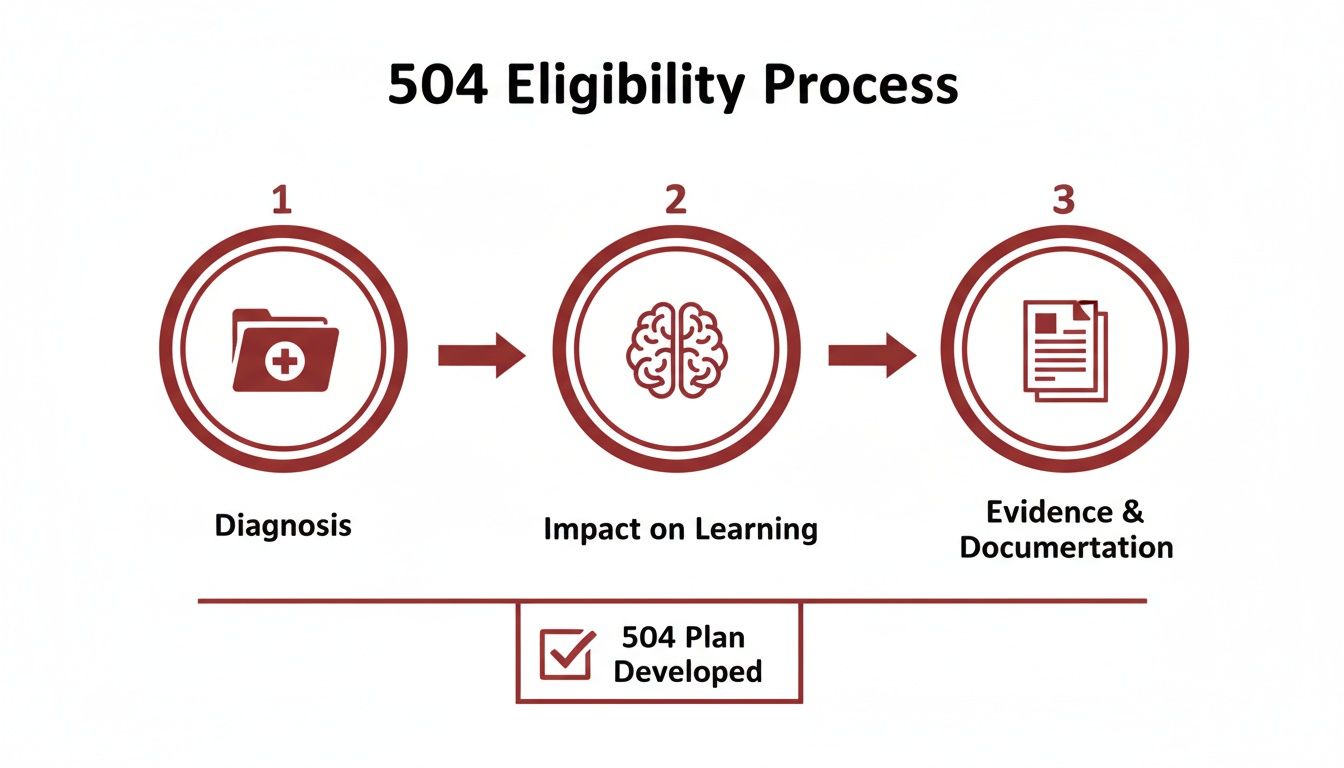
As you can see, a strong case connects a formal diagnosis to its real-world impact on learning, all backed by solid evidence.
What Happens After You Send the Request
Once the school gets your letter, federal law requires them to respond within a "reasonable" amount of time. This window can vary by district but is usually somewhere between 30 to 60 days. Their response will typically outline the next steps, which will involve an evaluation.
The school's evaluation might look like this:
- Classroom observations by a school psychologist or counselor.
- A review of your child’s academic records, from report cards to test scores.
- Interviews with you, your child, and their teachers.
- A review of the medical documents you provide.
Your initial request letter really sets the tone. Approach it as a concerned parent looking to partner with the school to help your child thrive.
Preparing for the First Meeting
The school will schedule a meeting to go over the evaluation and decide on eligibility. Before you go, get all your documents organized in one place. This means your child’s formal diagnosis, any reports from therapists or tutors, and copies of your emails with teachers.
It’s also a great idea to come prepared with a list of potential accommodations you think would help. Think about your child's specific struggles and what supports could directly address them. This level of preparation shows you are an engaged, informed advocate for your child.
Navigating this can feel complex, and knowing the ins and outs of special education advocacy can give you the confidence you need for these important conversations. Your goal is to walk into that meeting ready to build a strong, supportive plan together.
Choosing Effective Accommodations for ADHD
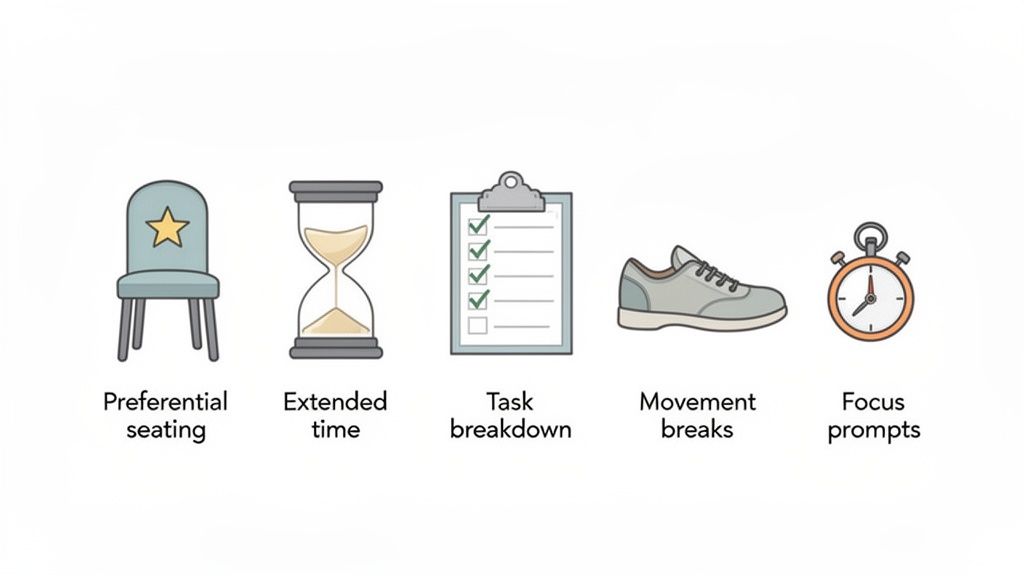
A 504 plan for ADHD is only as good as the supports written into it. The goal is to pick accommodations that directly address your child's specific struggles, turning that document from a piece of paper into a practical, day-to-day toolkit.
It's a common misconception that accommodations give a child an unfair edge. They don't. They are essential tools that level the playing field, giving students with ADHD the same shot at showing what they know as their peers.
Supports for Inattention and Distractibility
When a student's brain feels like it has way too many tabs open at once, creating a focused learning environment is a game-changer. Accommodations here are all about minimizing outside noise and offering gentle nudges back to the task at hand.
Here are a few practical options to consider:
- Preferential Seating: Simply moving a student's seat near the teacher—and away from high-traffic zones like the door or pencil sharpener—can make a world of difference.
- Verbal or Non-Verbal Cues: A pre-arranged, discreet signal from the teacher, like a light tap on the desk, can gently pull a student's attention back without singling them out.
- Reduced Visual Clutter: A clean desk and worksheets with fewer problems on each page can immediately lower the feeling of being overwhelmed.
Addressing Hyperactivity and Impulsivity
Kids with hyperactive or impulsive ADHD often need structured ways to move. Forcing them to sit perfectly still for long periods is usually counterproductive; it drains the very mental energy they need for learning.
An effective 504 plan works with the ADHD brain, not against it. Planned movement breaks aren't a reward; they're a neurological necessity that can improve focus for the rest of the school day.
A few powerful accommodations include:
- Planned Movement Breaks: Allowing the child to take a short walk, stretch, or even run an errand for the teacher helps regulate their energy and reset their focus.
- Use of Fidget Tools: A quiet, non-distracting fidget tool (like therapy putty or a stress ball) can be a fantastic outlet for channeling that excess energy so their brain can concentrate.
- Alternative Seating: Options like wobble chairs or standing desks provide the sensory input and movement a child needs to stay engaged with the lesson.
Scaffolding for Executive Function Deficits
Executive functions—the brain's management system for things like organization, planning, and time management—are often a major hurdle for kids with ADHD. Applying strategies like scaffolding in child development can be incredibly helpful in teaching students how to tackle complex tasks.
Accommodations in this area focus on breaking down overwhelming assignments into bite-sized, manageable pieces:
- Assignment Chunking: Breaking large projects into smaller parts, each with its own mini-deadline.
- Extended Time on Tests: Giving the student more time to process information and organize their thoughts without the intense pressure of a ticking clock.
- Written Instructions and Checklists: Backing up verbal directions with clear, written instructions gives the student a concrete reference they can check as they work.
Below is a table with more ideas, matching common ADHD challenges to potential 504 accommodations.
Sample 504 Accommodations for Common ADHD Challenges
| Challenge Area | Example Accommodations |
|---|---|
| Difficulty Starting Tasks | – Use of a visual timer – First/Then visual schedule – Teacher check-in at the start of independent work |
| Impulsive Blurting | – Non-verbal cue from teacher – Provide a small whiteboard for student to write down thoughts – Seat away from distractions |
| Losing Materials | – Extra set of textbooks for home – Color-coded folders for each subject – Daily or weekly check of assignment planner by teacher |
| Trouble with Multi-Step Directions | – Provide directions one or two at a time – Use of checklists – Ask student to repeat directions back |
| Sensory Overload | – Access to noise-canceling headphones – Option to work in a quiet area of the classroom – Allow sunglasses or a hat under fluorescent lights |
Remember, this isn't an exhaustive list, but a starting point for a conversation with your school's 504 team.
In the US, where 11.4% of kids aged 3-17 have an ADHD diagnosis, these plans are a vital tool. A strong diagnostic report from a qualified professional is your best foundation for building a collaborative relationship with the school and ensuring the supports truly fit your child's needs. For more ideas and a framework, check out our guide on a 504 plan template for ADHD.
Navigating the 504 Meeting and Beyond
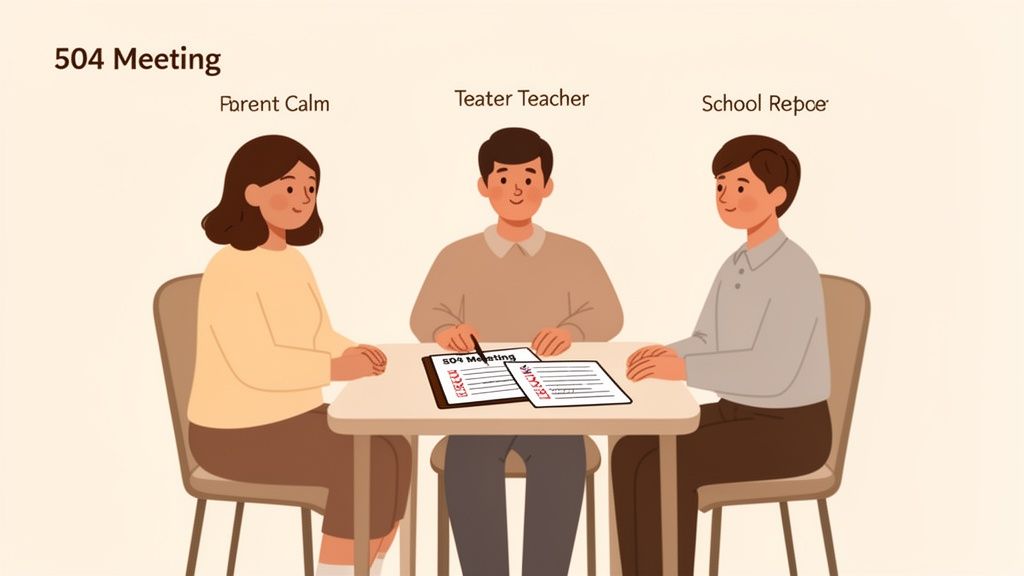
The 504 meeting can feel like the final boss battle in a long video game, but with the right preparation, it's really just a strategic conversation. The single most important key to success is approaching this meeting with a collaborative mindset, not a confrontational one.
You and the school staff are on the same team. You both want to see your child succeed.
Remember, you are the leading expert on your child. The school staff are the experts in education. Your job is to build a bridge between those two worlds. Come ready to share your child's story, but also be prepared to listen to the school's perspective, including their professional insights and any resource limitations they might have.
During the 504 Meeting
When it's your turn to speak, calmly present the documentation and evidence you've gathered. Walk the team through your child's diagnostic report, making clear connections between the clinical findings and the specific struggles you see in the classroom.
Use real-world examples to make everything crystal clear.
For instance, instead of saying, "His executive dysfunction is a problem," try something more specific. You could say, "The report notes challenges with working memory. We see this play out when he can't recall multi-step instructions for a math problem, even moments after they're given." This makes the issue tangible and relatable for everyone in the room.
Treat the 504 meeting as a problem-solving session, not a negotiation. Your tone should communicate, "How can we work together to support my child?" not "Here is a list of my demands."
After you've presented your case, get ready to talk about potential accommodations. It's fantastic to have a list of ideas, but stay open to the team's suggestions. They’ve been down this road before and might have creative solutions that have worked wonders for other students.
After the Plan Is Approved
Getting the 504 plan for ADHD is a huge win, but the work doesn't stop there. This next phase is all about implementation and communication. Think of the plan as a living document, not a piece of paper to be filed and forgotten.
Here’s what to do next:
- Confirm Distribution: Gently make sure every one of your child’s teachers and relevant staff members has a copy of the 504 plan. It's crucial they understand their role in putting it into action.
- Keep Communication Open: Set up brief, regular check-ins with the primary teacher or a school counselor. A quick weekly email can be an amazing tool for staying on top of what’s working and what isn't.
- Monitor and Document: Keep notes on how the accommodations are affecting your child. Are they helping? Do they need to be tweaked? This firsthand data will be priceless for future review meetings.
Most 504 plans are reviewed annually. However, you can request a meeting to review or amend the plan at any time if you feel it's not working effectively.
What to Do If Your Request Is Denied
Hearing "no" is tough, but it's not the end of the road. If the school denies your request for a 504 plan, they are required to give you a written explanation for their decision.
They also must inform you of your right to an impartial hearing to appeal the decision. This is a critical part of your procedural safeguards under Section 504.
Common Questions About 504 Plans for ADHD
Navigating the world of school supports can feel like learning a whole new language. As you start the process of getting a 504 plan for ADHD, you're bound to run into questions that feel specific to your child and your school. Let’s clear up some of the most common ones parents ask.
How Long Does It Take to Get a 504 Plan?
This is the big question, and the answer can vary quite a bit between school districts. Generally, once you put your request for an evaluation in writing, the school district has to respond within a "reasonable" amount of time. Legally, that's a bit vague, but most districts interpret it as 30 to 60 days.
That window gives the school time to do its own evaluation, pull together records, and get the first meeting on the calendar. But here’s a pro tip: you can often speed things up by giving them a comprehensive diagnostic report right from the start. When the school already has the medical proof it needs, it checks a major box on their to-do list and can move the process along much faster.
Do 504 Plans Follow Students to College?
Yes, they do—sort of. The protections under Section 504 apply to any school that gets federal funding, which includes almost all colleges and universities. The critical difference is that the plan doesn't just transfer automatically.
Once in college, it’s up to the student to take the lead. They will need to:
- Self-disclose their disability to the college’s disability services office.
- Provide current documentation, which usually means an evaluation done within the last few years.
- Formally request the specific accommodations they need for a college environment.
This shift in responsibility is exactly why teaching your teen self-advocacy skills before they leave high school is so important.
Can My Child Get a 504 Plan Without a Formal Diagnosis?
Technically, yes. A school can decide a student is eligible based on its own observations, academic records, and teacher feedback. A formal medical diagnosis isn't a strict legal requirement.
But—and this is a big but—it’s much, much harder. Proving that a condition substantially limits a major life activity without a professional assessment is an uphill battle. A formal diagnosis from a qualified expert gives you the objective, data-driven evidence that makes your case undeniable and leaves very little room for debate.
One of the biggest myths out there is that good grades automatically disqualify a student from a 504 plan. That’s simply not true. Eligibility is about the impact of a disability on a major life activity—like focus or organization—not the final letter on a report card. A student pulling A's while spending three times as long on homework as their peers is a perfect example of a substantial limitation.
At Sachs Center, we specialize in providing the comprehensive evaluations needed to build a strong case for a 504 plan or college accommodations. Our telehealth-based testing ensures your child can be assessed in the comfort of their own home. Learn more about our diagnostic services.
