

When we talk about communication skills training for neurodivergent individuals, we’re not talking about forcing anyone to conform. It's about building confidence and handing you the tools to navigate social situations that might otherwise feel draining or confusing. The goal is simple: empowerment and less anxiety, not changing the core of who you are.
What Is Neurodivergent-Affirming Communication Training?
Imagine trying to play a complicated board game, but you're the only one who wasn't given the rulebook. That’s often what socializing can feel like for neurodivergent people, including those with Autism (ASD) or ADHD. The unwritten rules of conversation, turn-taking, and body language can be completely baffling.
Neurodivergent-affirming communication skills training is like having a friendly, experienced player sit down and explain the game to you.
This isn't about memorizing scripts or "acting normal." It’s about adding practical strategies to your personal toolkit so you can engage with the world more comfortably and authentically. We focus on approaches that work with your unique brain wiring, not against it.
Building Skills on Your Own Terms
The whole point is to demystify the subtle parts of human interaction that don’t always come naturally. It’s a process of learning practical skills that can reduce the guesswork and social anxiety that so often come with communication. For a more detailed look at the fundamentals of communication development, this comprehensive guide to speech and language therapy can be a helpful resource.
This type of training helps you:
- Express thoughts and needs clearly: Find structured ways to get your point across, which helps cut down on misunderstandings and frustration.
- Interpret social cues: Gain real insight into non-verbal signals like body language and tone of voice, making interactions feel more predictable.
- Build stronger relationships: Develop the skills to start conversations, keep connections going, and navigate friendships or workplace dynamics with more ease.
- Boost self-confidence: When you master new strategies, you can walk into social situations with less fear and a much greater sense of control.
The ultimate goal isn't to create a "neurotypical" mask. It's to give you the choice and flexibility to communicate in a way that feels both effective and true to yourself, helping you feel more understood and connected in every part of your life.
An Approach Centered on You
Unlike old-school social skills classes that pushed conformity, a neurodivergent-affirming approach is all about you. It starts from the understanding that there’s no single “right” way to communicate. A good program will always begin by listening to your personal goals, recognizing your strengths, and understanding your specific challenges.
Whether you want to feel more at ease in team meetings, find it easier to make new friends, or simply reduce the mental energy it takes to get through a social event, the training is shaped to fit your needs. It validates different communication styles and focuses on building bridges between them.
The result is a way of engaging with the world that is more sustainable and far less draining, allowing your true personality to shine through. It’s a framework that gives you the skills to build meaningful connections without ever having to sacrifice your identity.
Evidence-Based Approaches That Actually Work
Real communication skills training isn’t about vague advice or abstract theories. It’s built on structured, research-backed methods designed to get tangible results. These approaches give you a safe, predictable framework for learning, practicing, and mastering new social tools.
Think of it like learning to cook. You wouldn't just be told to "make a good meal." You'd get specific recipes, be shown how to use different kitchen tools, and have a chance to practice before serving anyone. In the same way, evidence-based training takes the mystery out of communication by breaking it down into manageable, learnable parts.
The core goal of this training, especially from a neurodiversity-affirming perspective, is to empower you to communicate in a way that feels authentic.
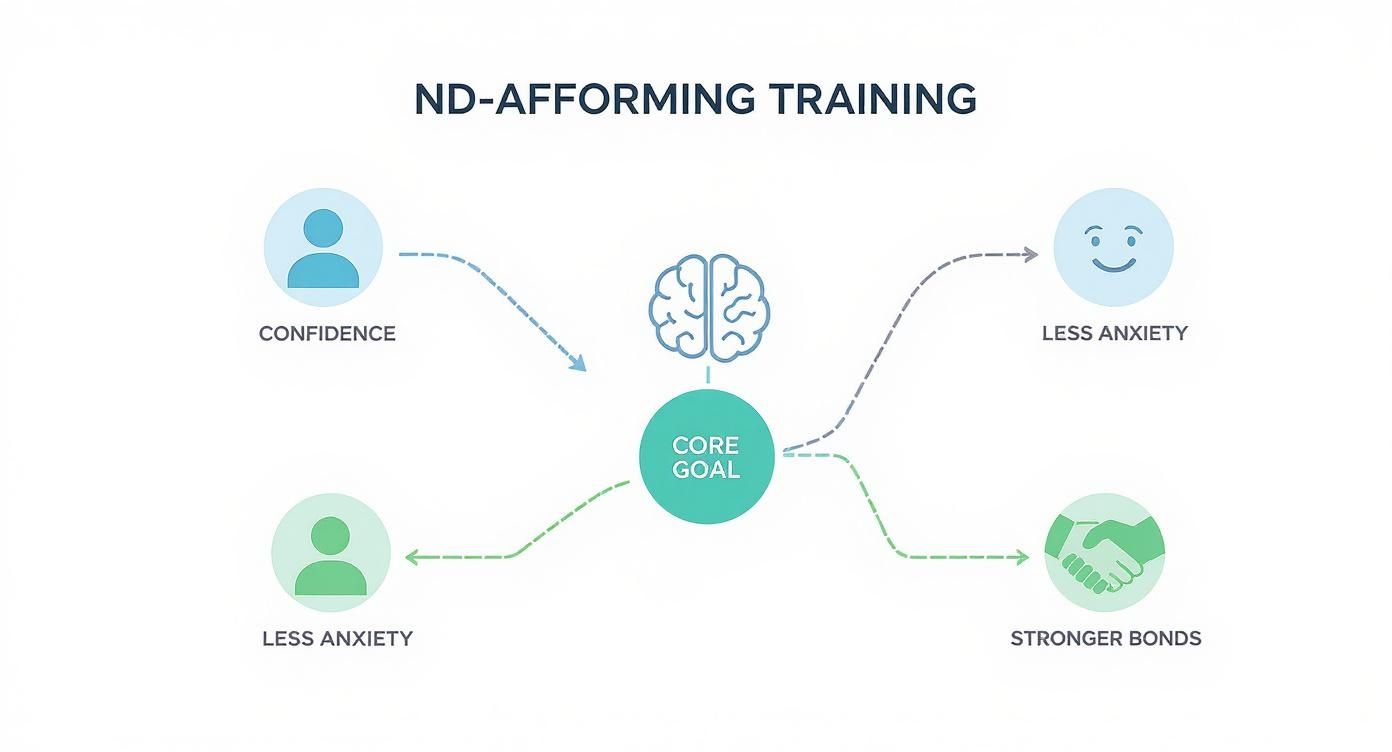
As you can see, it’s all about building confidence, lowering social anxiety, and creating stronger bonds—both personally and professionally.
To help you understand how this works, here's a quick look at the most common techniques we use.
Comparing Communication Training Techniques
| Technique | Primary Focus | Best For |
|---|---|---|
| Role-Playing | Practicing specific social scenarios in a safe, controlled setting. | Building confidence for real-life situations like job interviews, small talk, or conflict resolution. |
| Cognitive Behavioral Therapy (CBT) | Identifying and changing negative thought patterns that fuel social anxiety. | Individuals who overthink social interactions or struggle with self-criticism. |
| Video Modeling | Learning through visual examples of effective communication skills in action. | Visual learners who benefit from seeing concrete, repeatable examples of social behaviors. |
| Social Skills Groups | Practicing skills in a supportive, peer-based environment with shared understanding. | Building connections, reducing isolation, and getting real-time feedback from peers. |
Each of these methods offers a different path toward the same goal: more confident and comfortable communication. Let's dig into what makes each one so effective.
Practice Makes Progress with Role-Playing Scenarios
One of the most powerful tools in our kit is role-playing. It gives you a safe, low-stakes space to walk through the exact social situations that cause you stress, from asking for a raise to making small talk at a party. Think of it as a dress rehearsal for real life.
For example, if you find it hard to speak up for yourself at work, you can practice that exact conversation with a therapist. You get to try out different phrases, learn to manage the anxious feelings that pop up, and get immediate, helpful feedback. This repetition builds a kind of "muscle memory," which makes the real thing feel far less intimidating when it happens.
Rewiring Your Thoughts with Cognitive Behavioral Therapy
Communication isn't just about the words you use; it's also about the thoughts and feelings running in the background. Cognitive Behavioral Therapy (CBT) is a technique that helps you pinpoint and challenge the unhelpful thought patterns that so often lead to social anxiety.
Maybe you find yourself automatically assuming people are judging you, or you blow a minor conversational mistake way out of proportion. CBT gives you the tools to catch those negative thoughts, check the evidence, and reframe them in a way that’s more realistic and balanced.
By changing your underlying thoughts about social interactions, you can change your emotional response. This shift makes it easier to engage confidently and authentically, freeing up mental energy that was previously spent on worry.
This process helps break the cycle of anxiety that can make communication feel like walking through a minefield. Over time, you build a more resilient and self-assured mindset, which is the bedrock of any healthy interaction.
Learning Through Observation with Video Modeling
For many neurodivergent people, learning visually is incredibly powerful. Video modeling taps into this strength by using short video clips to show specific communication skills in action. Instead of just hearing someone explain it, you actually get to see and hear how a skill is used in a real-world context.
This could be watching a video of someone successfully joining a group conversation, using inviting body language, or handling a disagreement calmly. The visual examples are clear, concrete, and you can watch them as many times as you need. This clarity helps remove the ambiguity that often makes unspoken social rules so confusing.
Building Skills Together in Social Skills Groups
There’s something invaluable about practicing new skills in a supportive group of peers. Social skills groups bring together people with similar goals and challenges, creating a space where everyone just "gets it." That shared understanding dramatically lowers the fear of judgment that can hold so many people back.
In a group setting, members can:
- Practice new skills in real time with peers who are also learning.
- Get feedback not just from a facilitator but from others who truly understand their perspective.
- Build connections and feel less isolated, realizing they aren't the only ones with these experiences.
These groups, like the ones we offer at the Sachs Center, are more than just classes—they're communities. They provide a unique opportunity to build both social skills and social connections at the same time. For adults looking for this kind of environment, learning more about our social skills training for adults is a great next step. This kind of structured practice helps skills learned in therapy actually stick in everyday life.
Why This Training Is a Game-Changer for Neurodivergent Minds

For many people with Autism (ASD) or ADHD, it can often feel like the rest of the world is operating on a completely different frequency. Social interactions that seem effortless for others can take a massive amount of mental energy, leading to constant misunderstandings, frustration, and even burnout.
This is where specialized communication skills training becomes more than just helpful—it's essential for a thriving life. This isn't about generic advice; it's about providing specific, actionable strategies for navigating a world that often wasn't built with neurodiversity in mind.
Bridging the Communication Gap
Many neurodivergent people find it tough to interpret non-verbal cues, like subtle shifts in someone's tone of voice or body language. A simple conversation can feel like trying to solve a complex puzzle with half the pieces missing, which creates a constant state of uncertainty.
Then there’s the challenge of managing executive functions during a conversation. For those with ADHD, trying to organize thoughts, stay focused, and regulate impulses is a significant hurdle. The brain's wiring can make it hard to follow a conversational thread or wait for a turn to speak, which can easily be misinterpreted by others.
Specialized training provides those missing puzzle pieces and offers a framework for managing these executive function demands. It gives you concrete tools to decode social situations, leading to real results:
- Fewer Misunderstandings: By learning to spot and interpret social patterns, you can engage with more confidence and clarity.
- Reduced Social Anxiety: When interactions start to feel more predictable, that fear of saying or doing the "wrong" thing begins to fade away.
- Greater Self-Advocacy: You develop the language and confidence to clearly state your needs, boundaries, and perspective—at school, at work, and in your relationships.
Moving Beyond the Mask
For many neurodivergent individuals—especially women and those from marginalized communities—masking (or camouflaging) becomes a core survival strategy. It involves constantly monitoring yourself and mimicking neurotypical behaviors just to fit in. While it might work in the short term, it is incredibly draining.
Masking uses up a tremendous amount of cognitive energy, leaving little left for anything else. It can also create a profound sense of disconnection from your true self, contributing to burnout and other mental health challenges.
Communication skills training offers a sustainable alternative to masking. Instead of learning to perform a version of yourself that feels inauthentic, you learn to communicate your authentic self more effectively.
This shift is fundamental. It’s about building a bridge between your internal world and the external one, not putting up a wall to hide behind. It empowers you to navigate social settings without having to sacrifice your own identity.
Unlocking Potential and Building Connections
Ultimately, the goal of this training is validation and empowerment. It starts from a place of acceptance, acknowledging that the neurodivergent way of experiencing the world is valid, and then provides the tools to share that experience with others successfully.
When communication becomes a source of connection instead of stress, the benefits ripple out into every area of life. It fosters stronger, more meaningful relationships built on genuine understanding. It opens doors to academic and professional opportunities, as you become better able to advocate for your needs and showcase your unique strengths with clarity.
This is what makes neurodivergent-affirming communication skills training such a powerful force for change. The goal isn't to "fix" anyone. It's to equip them with the skills to be more fully and confidently themselves in a world that is finally starting to listen.
How Communication Skills Drive Success in the Modern World
Strong communication used to be considered a nice "soft skill" to have on a resume. Not anymore. In a world of remote work, digital teams, and constant change, the ability to connect with others and express your ideas clearly is one of the most valuable assets you can have.
It’s a fundamental shift. Communication has moved from the “nice-to-have” column squarely into the “absolutely essential” one. The ability to listen, articulate your thoughts, and build rapport is now directly tied to real-world success, whether you're leading a project or building a meaningful friendship.
The Economic Engine of Effective Communication
Businesses are catching on, and they're putting their money where their mouth is. This isn't just about creating a friendly office vibe; it's a cold, hard financial decision. Poor communication creates missed deadlines, confused teams, and unhappy clients—all of which hit the bottom line.
The proof is in the numbers. The global market for soft skills training, with communication at its core, hit USD 33.4 billion in 2024. It’s projected to nearly triple to a staggering USD 92.6 billion by 2033. Read the full research about this growing market.
This massive investment highlights a simple truth: companies know that employees who communicate well are more productive, more innovative, and better leaders. Investing in communication skills training is now seen as a direct investment in the company's future.
Why This Matters for Your Career and Personal Growth
Seeing this global trend helps reframe what communication training is really about. It’s not just about getting over social awkwardness or feeling more comfortable at parties. It’s a strategic move to build a foundational skill that unlocks your potential in every part of your life.
For neurodivergent individuals, this is especially empowering. The skills you build in targeted training aren't just for navigating tricky social situations; they are the exact same skills that employers are actively looking for and rewarding.
Getting a handle on these abilities can give you a significant edge:
- Enhanced Career Prospects: Strong communicators are often the first people considered for promotions and leadership roles.
- Greater Leadership Potential: Inspiring a team and getting everyone on the same page is impossible without excellent communication.
- Improved Collaboration: Today’s work is all about teamwork. Clear, empathetic communication is the glue that holds it all together.
- Stronger Personal Relationships: The same skills that make you a great colleague—active listening, empathy, clarity—are what you need to build deep, lasting connections with friends and family.
To dig deeper into how you can apply these skills for professional growth, exploring a professional development blog focused on career advancement can offer practical, real-world advice.
Ultimately, choosing to work on your communication skills is a powerful act of self-investment. You’re building a toolkit that not only helps you navigate social complexities with more confidence but also sets you up for greater success in a world that values human connection and clarity more than ever.
Choosing the Right Communication Skills Program for You
Finding the right communication skills program can feel like a huge decision, especially when you need support that actually gets neurodiversity. The best fit isn't just about a provider's credentials; it's about finding a safe, affirming space where you can build skills without being pressured to change who you are at your core.
And you’re not alone in looking. The global market for this kind of training hit about $4.5 billion in 2024 and is on track to nearly double to $9.2 billion by 2033. This explosion in growth shows just how many people are realizing these skills are essential for life. You can find more details on this growing market at marketintelo.com.
This trend just reinforces that investing your time and energy into finding a high-quality program that fits your specific needs is absolutely worth it.
What to Look for in a Provider
When you start vetting programs or therapists, you need to look past the generic promises. A truly effective, neurodiversity-affirming provider understands the unique communication styles and challenges that come with ASD and ADHD. They won’t see your neurotype as a deficit to be fixed, but as a difference to be understood and worked with.
Here are the key things that set a great provider apart:
- Real Expertise in Neurodiversity: They should have specific, hands-on experience working with neurodivergent people and understand concepts like masking and social burnout.
- Use of Proven Methods: Look for programs that use evidence-based techniques like Cognitive Behavioral Therapy (CBT), role-playing, and structured social practice.
- Personalized, Goal-Oriented Plans: A one-size-fits-all approach is a major red flag. A good provider will work with you to set meaningful goals that reflect what you actually want to achieve.
- Focus on Empowerment, Not Conformity: Pay attention to their language. Is it about building your skills and confidence, or is it about teaching you to "act neurotypical"?
The right program doesn't try to change you. It empowers you to build a bridge between your inner world and the outside one, giving you the tools to express your authentic self more clearly and confidently.
Finding someone who embodies these principles is the first step. Next, you’ll want to ask some specific questions to get to the heart of their approach.
Key Questions to Ask a Potential Provider
Don't be shy during a consultation or initial call—this is your chance to see if a provider is the right fit. A good therapist will welcome your questions and give you clear, thoughtful answers.
Try asking questions like these:
- How do you adapt your training for different neurotypes, like ASD versus ADHD? This shows you if they get that "neurodivergent" isn't a monolith.
- Can you walk me through your process for setting and measuring goals? This reveals if their approach is truly collaborative and focused on outcomes that you care about.
- What does a typical session actually look like? This gives you a practical feel for their methods and whether they’ll click with your learning style.
- How do you create a safe and affirming environment for your clients? This might be the most important question of all. Feeling psychologically safe is non-negotiable for growth.
The answers you get will tell you everything you need to know about their commitment to providing genuinely supportive care. It's crucial to find professionals who are not just skilled but also deeply compassionate. To get a better sense of what to look for, exploring the qualities of neurodiversity-affirming therapists can give you valuable context and help you pinpoint a provider who truly aligns with your values.
What to Expect on Your Training Journey
Starting something new, especially when it’s as personal as communication skills, can feel a little intimidating. It’s natural to wonder what the process actually looks like. So, let’s pull back the curtain and walk through the typical journey, step by step. This is a collaborative process, designed to build your skills and confidence at a pace that feels right for you.
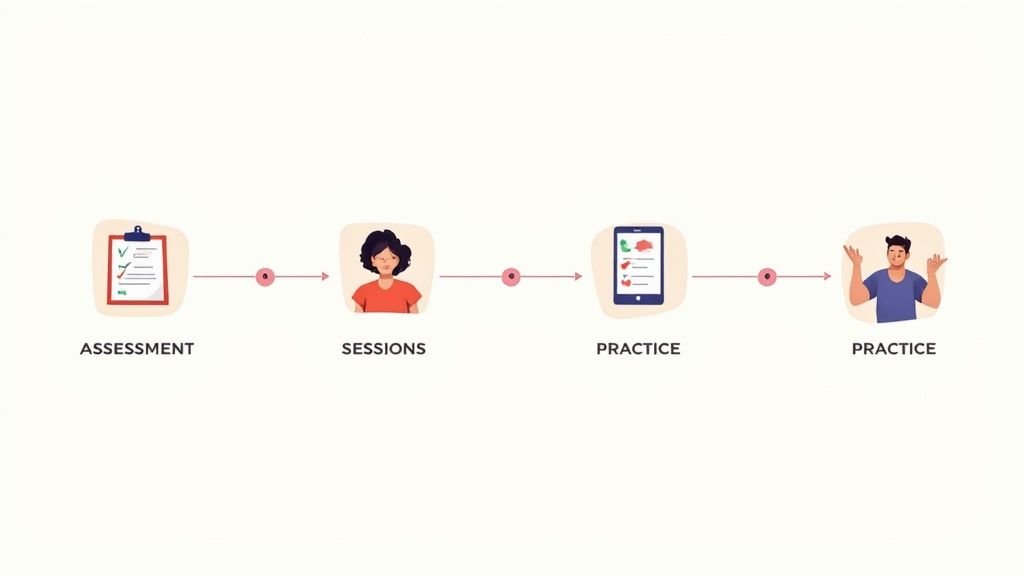
It all kicks off with an initial assessment. Don't worry, this isn't a test—it's more like a conversation. You'll work with your therapist or coach to figure out your personal communication goals. What do you want to work on? What situations feel the most challenging? This first step ensures the whole program is shaped around what matters most to you.
The Structure of Your Sessions
Once your goals are clear, the real work begins. Each session is carefully structured, blending different proven techniques to make learning feel natural and effective, not overwhelming. Here’s a taste of what you can expect:
- Direct Instruction: Your coach will break down a specific skill, like how to start a casual conversation or read body language, into simple, easy-to-follow steps.
- Visual Modeling: You might watch short video clips or see your therapist act out a scenario. This gives you a clear visual blueprint of the skill in action.
- Supportive Role-Playing: This is your chance to practice in a completely safe, judgment-free zone. Think of it as a dress rehearsal for real life—it’s crucial for building the muscle memory and confidence you need to take these skills out into the world.
And it’s not just us—people everywhere are seeing the value in this kind of guided practice. In the UK, for instance, there were thousands of Google searches in 2022 for terms like “communication courses” and “communication skills training.” It’s clear there’s a growing demand for this kind of expert support.
From Practice to Real-World Progress
Of course, the real magic happens between sessions when you start applying what you’ve learned. Your coach will give you small, manageable "homework" assignments—things like practicing a conversation starter with a barista or trying an active listening technique with a family member. It’s this real-world practice that truly makes the skills stick.
Progress isn't about passing a test. It’s measured by your growing confidence, the positive reactions you get from others, and your ability to finally hit those personal communication goals you set for yourself on day one.
This roadmap helps demystify the process, turning the unknown into a clear, predictable path forward. For those who want to practice in a supportive peer environment, our social skills groups for adults provide the perfect place to put these new skills into action. The entire journey is designed to be empowering, setting you up for success from the very beginning.
Still Have Questions About Communication Training?
It’s completely normal to have a few questions, even after learning about all the benefits and methods. Getting clear, straightforward answers is the best way to feel confident about taking the next step. Let's tackle some of the most common things people wonder about.
How Long Does This Actually Take?
There’s really no one-size-fits-all timeline. How long training takes is deeply personal and depends entirely on what you want to achieve. Some people feel a huge boost in confidence after just a few months. Others find long-term support more helpful as they move through different phases of life, like starting a new career or building closer friendships.
The real focus is on making meaningful progress, not rushing to a finish line. A good program moves at your pace, making sure you feel solid and ready before introducing new skills. Think of it as a marathon, not a sprint—we're building skills that are meant to last a lifetime.
Is This Just Another Social Skills Class?
Not at all, and this is a really important distinction to make. Old-school social skills classes often pushed neurodivergent people to simply copy neurotypical behavior. That approach often leads straight to masking and burnout.
We do things differently. Neurodivergent-affirming communication training starts with a foundation of acceptance. It celebrates your unique way of communicating. The goal isn't to change who you are but to give you more tools for your toolbox, so you can handle social situations with more confidence and less anxiety, all while being your authentic self.
What if I Struggle With Social Anxiety?
This is one of the most common concerns we hear, and it’s something a quality program is built to address. Many of the techniques we use, especially Cognitive Behavioral Therapy (CBT), are proven ways to help manage and reduce anxiety.
The whole process is gradual and supportive. You’ll start by practicing skills in a safe, low-stakes environment to build your confidence. You only move on to applying them in the real world when you feel ready. Every step is designed to feel manageable, helping you stack up positive experiences that, over time, begin to dial down the anxiety.
At the Sachs Center, we know that starting this journey is a big step. Our telehealth services, including our social skills groups and life-skills coaching, are designed to offer expert, neurodiversity-affirming support right from the comfort of your home. If you're ready to build confidence and connect more authentically, take a look at our services at https://sachscenter.com.
