

Navigating the world of autism and education can feel like trying to solve a complex puzzle where some of the most important pieces are missing. To build a truly supportive learning environment, it’s crucial for families and educators to understand how an autistic neurotype interacts with a traditional classroom. This means moving beyond old stereotypes to see both the unique challenges and the incredible strengths each child brings to their educational journey.
How Autism Shapes the Learning Experience
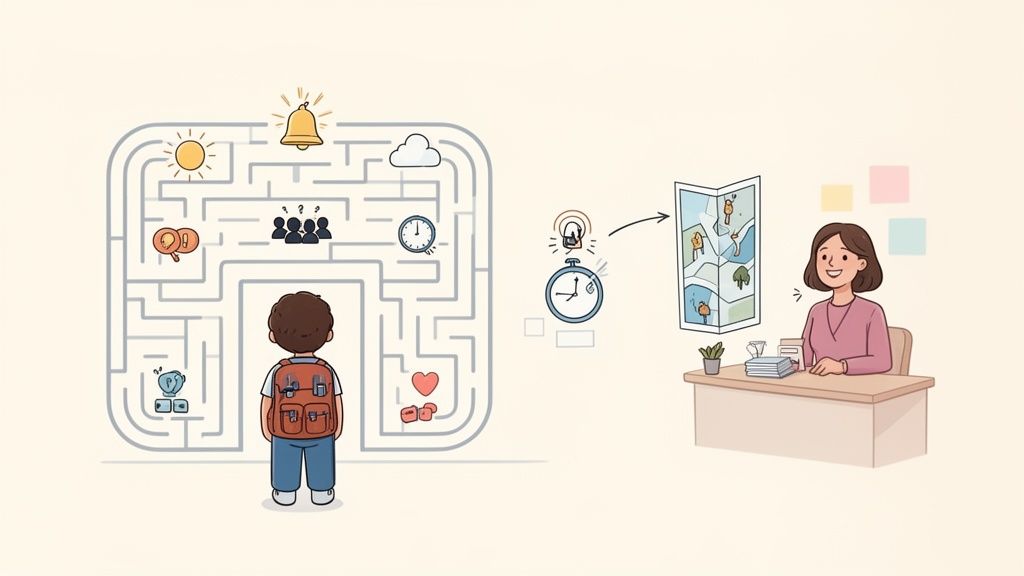
Think of a standardized curriculum as a confusing maze. For a neurotypical student, the path forward might seem reasonably clear. But for an autistic student, that same maze is filled with unexpected obstacles—blaring lights, baffling social cues, and instructions that sound like riddles. The right support acts as a personalized map, providing clear guideposts that help them navigate this complex world with confidence.
Understanding this dynamic is more critical than ever. The number of autistic students in our schools has risen dramatically, jumping from 1 in 150 US children in 2000 to a projected 1 in 31 by 2025. That’s a staggering 382% increase, highlighting the urgent need for our educational systems to adapt. Globally, the WHO estimates about 1 in 100 children are autistic, with boys diagnosed 3.4 times more often than girls—a statistic that often fails to capture the masked presentations common in females and BIPOC communities. You can explore the full CDC report to better understand these trends.
The Classroom Through an Autistic Lens
For an autistic learner, the average classroom can feel like a sensory minefield. Stimuli that others might easily ignore can be intensely distracting or even painful.
- Sensory Overload: The constant hum of fluorescent lights, the unexpected scrape of a chair, or the layered chatter of classmates can quickly become overwhelming, making it nearly impossible to focus on a lesson.
- Social Navigation: Unstructured times like recess or group projects demand an intuitive grasp of unwritten social rules. For many autistic students, trying to interpret these ever-shifting expectations is confusing and utterly exhausting.
- Executive Functioning Hurdles: Skills like organizing a binder, keeping track of homework, or managing time often don't develop automatically. This isn't about a lack of effort; it's a fundamental difference in cognitive processing.
For many autistic students, the real challenge isn't learning the material; it's managing the environment in which they are expected to learn. Creating a predictable and sensory-friendly space is foundational to their success.
To put these interactions into context, here’s a quick overview of how autism can present in an educational setting.
Autism's Impact in the Classroom At a Glance
| Area of Impact | Common Challenges | Potential Strengths |
|---|---|---|
| Social Interaction | Difficulty with group work, reading nonverbal cues, and navigating unstructured social time. | Honest and direct communication style, loyalty, and deep connections with peers who share interests. |
| Communication | Literal interpretation of language (idioms, sarcasm), may prefer non-verbal communication. | Precise and detailed communication, strong vocabulary in areas of interest, honesty. |
| Sensory Processing | Overwhelmed by noise, light, or touch; or under-sensitive and seeking sensory input. | A heightened sense of detail, ability to notice things others miss, creativity inspired by sensory experiences. |
| Executive Function | Struggles with organization, planning, time management, and transitioning between tasks. | Excellent long-term memory, methodical approach to tasks, ability to follow clear rules and processes. |
| Learning Style | Difficulty with abstract concepts, may require direct instruction and concrete examples. | Intense focus (hyperfocus) on topics of interest, exceptional pattern recognition, and strong logical reasoning. |
This table shows that for every challenge, there's often a corresponding strength waiting to be discovered and supported.
Celebrating Neurodivergent Strengths
It’s a huge mistake to view autism in education only through a lens of deficits. Autistic students bring remarkable strengths to the classroom that can enrich the entire learning community. These aren't just "quirks"—they are powerful assets when they're properly nurtured.
- Deep Focus: Many autistic individuals can concentrate on a topic they're passionate about with an intensity that leads to true expertise.
- Pattern Recognition: A natural talent for seeing patterns and systems often translates into a high aptitude for subjects like math, music, or coding.
- Strong Sense of Fairness: A deep-seated commitment to rules and justice can make them powerful and articulate advocates for themselves and for others.
When parents and educators understand both sides of this coin—the environmental challenges and the inherent strengths—they can build a truly effective partnership. This collaboration is what transforms the educational maze from a source of frustration into a navigable path where every student has the tools and support they need to thrive.
Securing a Clear and Formal Diagnosis
Recognizing that your child might be autistic is the first, most important step. The signs often go way beyond the stereotypes we see on TV and can be incredibly subtle—especially if your child has become an expert at masking their true self to fit in.
For example, a difference in social communication might not mean your child avoids others entirely. It could look like a kid who's more comfortable watching from the sidelines, finds small talk utterly baffling, or communicates with a directness that others misinterpret as rude. Their deep, passionate interests in certain topics might get brushed off as obsessions instead of being seen for what they are: a core part of how they connect with the world.
These traits are so often misread. A child who’s overwhelmed by the sensory chaos of a classroom might be labeled "defiant" for not wanting to join an activity. A student who needs a moment longer to process spoken instructions might be seen as "inattentive." The key is shifting our perspective from seeing a “behavior problem” to recognizing a genuine need for support.
The Power of Diagnostic Clarity
Let's be clear: a formal diagnosis is so much more than a label. It's the key that unlocks crucial educational supports and accommodations. Without it, getting an Individualized Education Program (IEP) or a 504 Plan can feel like an impossible, uphill battle. A diagnosis provides the official documentation schools need to understand your child's learning profile and legally obligates them to provide the right support.
This clarity also helps differentiate or identify co-occurring conditions. Autism and ADHD, for instance, share a ton of overlapping traits. It’s not at all uncommon for a person to be both autistic and have ADHD (sometimes called AuDHD). A thorough evaluation can pinpoint the specific nature of your child’s challenges, making sure the strategies put in place are actually hitting the right targets.
A formal diagnosis is like a roadmap. It explains the "why" behind your child's experiences and gives educators, therapists, and you a clear, evidence-based direction to follow. It gets everyone on the same page, working together.
Navigating the Evaluation Process
The thought of a diagnostic evaluation can feel overwhelming, but modern approaches have made the process much more accessible. At the Sachs Center, for example, we conduct comprehensive evaluations virtually via telehealth. This allows your child to be assessed in the comfort of their own home, which dramatically reduces the anxiety that often comes with visiting a clinical setting.
A typical virtual evaluation takes a multi-faceted approach to get a complete picture of your child. The process usually includes:
- Clinical Interviews: We have in-depth conversations with you to go over developmental history, current challenges, and your child’s unique strengths. This context is invaluable.
- Validated Assessments: We use standardized, evidence-based self-report measures and interactive assessments designed to look at social communication, sensory processing, and behavioral patterns.
- Direct Observation: A trained psychologist interacts with your child, paying close attention to communication styles, social give-and-take, and other autistic traits that may come up during the session.
This careful, structured process is all about ensuring a reliable and accurate outcome. The goal is to move past the uncertainty and give your family the clear answers you need to advocate effectively.
If you’re interested, you can learn more about what a comprehensive autism diagnosis process entails and see how it can pave the way for a more supportive learning environment. Securing this formal understanding is the most powerful step you can take in your journey of autism and education.
Understanding Your Child's Legal Rights With IEPs and 504 Plans
Trying to navigate educational accommodations can feel like learning a foreign language filled with legal jargon. But here’s the thing: understanding your child’s rights is the single most powerful tool you have as a parent. Two key federal laws are the foundation for all student support: the Individuals with Disabilities Education Act (IDEA) and Section 504 of the Rehabilitation Act.
These laws create two different but equally important pathways for support: the Individualized Education Program (IEP) and the 504 Plan. While both are designed to help students succeed, they work in very different ways.
The Core Difference Between an IEP and a 504 Plan
Let’s break it down simply. Think of an IEP as a customized curriculum, while a 504 Plan is about providing fair access to the standard curriculum.
An IEP is for students whose disability, like autism, directly and negatively impacts their academic performance. It provides specialized instruction and related services. This means the school actively changes what your child learns or how they are taught to meet their specific needs.
A 504 Plan, on the other hand, is for students who can learn the general curriculum but need accommodations to access it equally. It’s all about leveling the playing field so they can participate right alongside their neurotypical peers.
A formal diagnostic report is the foundational document for securing either plan. It provides the school with the objective, clinical data needed to understand your child's specific challenges and build a legally sound support system.
Here's how this looks in a real classroom:
- IEP in Action: An autistic student who has trouble with expressive language might get weekly speech therapy sessions written into their IEP. That’s a specialized service meant to build a specific skill.
- 504 in Action: A student who gets overwhelmed by sensory input in a noisy classroom could have preferential seating near the door or permission to wear noise-canceling headphones. These are accommodations that grant access to learning without changing the curriculum itself.
For a deeper dive, you can explore our detailed guide that further explains the difference between a 504 Plan vs. an IEP.
This infographic offers a simplified look at the path from an initial gut feeling to seeking a formal diagnosis—the first step toward getting these legal protections in place.
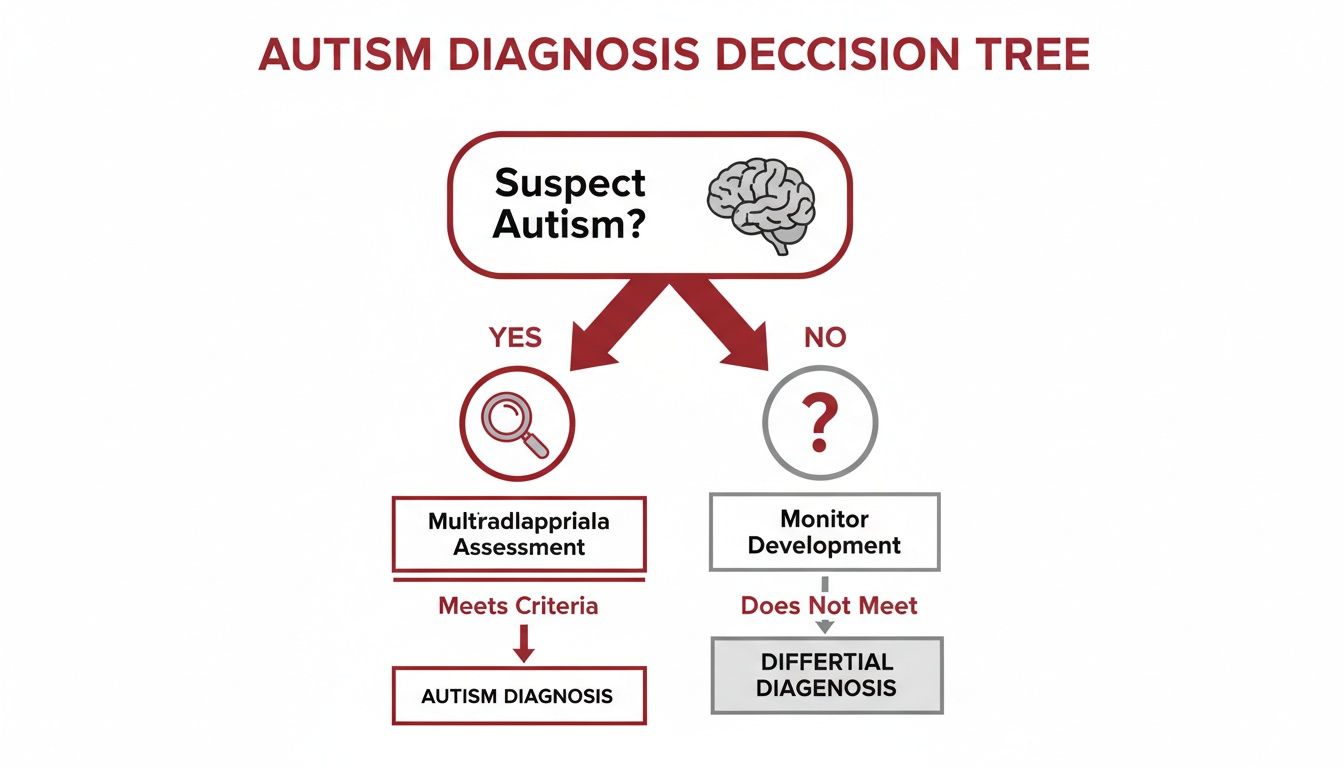
As the decision tree shows, whether you just have a suspicion or are unsure what's going on, the next move involves careful observation. If those concerns persist, a professional assessment is the way to get real clarity.
Why These Protections Are So Critical
Without the right supports, the classroom can become a place of silent struggle for incredibly bright kids with autism. This isn't just a "what if" scenario; it has real-world consequences.
In the US, about 73.6% of autistic students earn a high school diploma. Meanwhile, 19% receive a certificate of completion, and nearly 8% drop out entirely.
These numbers aren't just statistics; they represent kids whose needs weren't fully met. They highlight the vital role that IEPs and 504 Plans play in creating a school environment where autistic students can not only stay but truly thrive. It’s also helpful to understand the broader historical context, like the impact of past education policies like No Child Left Behind, which sheds light on the ongoing fight for equitable education.
By understanding and using these legal frameworks, you become your child’s most effective advocate, making sure their right to a fair and appropriate education is fully honored.
Getting Accommodations for Standardized Tests
For most students, standardized tests like the SAT, ACT, or GRE are high-stakes hurdles on their academic journey. But for an autistic student, these exams can feel more like insurmountable walls. The intense focus, rigid timing, and unfamiliar sensory environment create massive barriers that have little to do with what a student actually knows.
This is where accommodations step in. They aren’t about creating an unfair advantage—they’re about leveling the playing field. The goal is simple: make sure the test measures a student's knowledge, not their struggles with processing speed or executive function. But getting these supports isn't always as simple as handing over a diagnostic letter.
Why a Standard Diagnostic Letter Is Often Not Enough
Testing boards like the College Board (which runs the SAT) and the ACT have incredibly strict documentation requirements. They need to see objective, data-driven proof that a student’s neurotype directly impacts their ability to perform under standard testing conditions. A basic letter confirming an autism diagnosis just doesn't cut it.
Think of it this way: a diagnosis tells the testing board what the condition is. But what they really need to know is how it affects the specific cognitive skills required to take their test. This is exactly why a much deeper evaluation is almost always required.
The whole point of an accommodation request is to build an undeniable case that connects a student's neurodivergent profile to the specific barriers they face on a standardized test. Comprehensive testing provides the irrefutable evidence needed for approval.
The Role of Neuropsychological Testing
This is where Neuropsychological Testing becomes an indispensable tool. While it may not be necessary for an initial ASD or ADHD diagnosis, it’s often the key to unlocking accommodations at school or extra time on standardized tests. This kind of evaluation goes beyond a simple label to create a detailed map of a student’s cognitive landscape—their unique strengths and weaknesses.
It measures very specific domains that testing boards care about, including:
- Processing Speed: How quickly can a student take in, understand, and respond to information?
- Executive Functioning: How well do they manage planning, organization, time management, and focus?
- Working Memory: Can they hold and manipulate information in their head for short periods?
- Academic Fluency: What is their speed and accuracy in core skills like reading, writing, and math?
The detailed, multi-page report from a neuropsychological evaluation provides the hard data that testing boards need to see. It can show, for instance, that a student’s processing speed is in the 15th percentile, which builds a crystal-clear argument for why they need 1.5x extended time.
This kind of robust evidence shifts the request from a subjective plea to an objective, data-backed case. With this powerful documentation, you’re in a much stronger position to get the accommodations your child needs to have a fair shot. For a closer look at the process for a specific test, check out our guide on how to get extra time on the SAT.
Building a Bridge Between School and Home
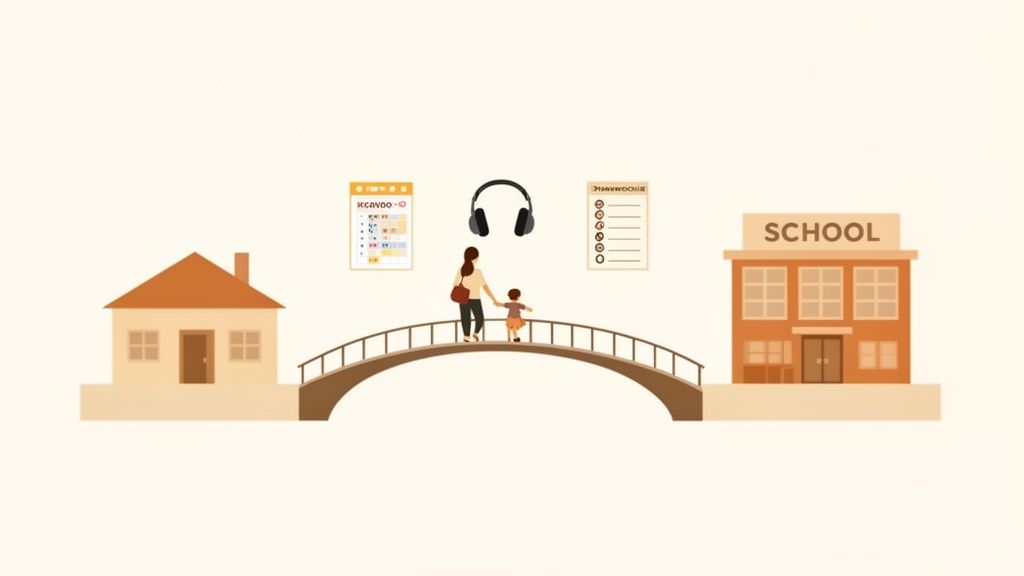
Legal documents like IEPs and 504 Plans are the blueprint for your child's educational support, but the real work happens day-to-day. True success in autism and education is built on a strong, consistent bridge connecting the classroom and home. This consistency helps create a predictable world where your child feels safe, understood, and ready to learn.
When everyone is on the same page, your child isn't forced to constantly adapt to different rules, expectations, or communication styles. This lowers their cognitive load and anxiety, freeing up precious mental energy for what truly matters—learning, growing, and building confidence. This partnership ensures that skills learned at school are reinforced and carried over into real life.
Essential Classroom Strategies
The right tools can dramatically transform the classroom from a source of stress into a supportive learning environment. The goal should always be to create predictability and accommodate sensory needs before they become overwhelming.
Effective classroom supports often include:
- Visual Schedules: Using pictures or words to outline the day’s activities provides a clear roadmap. Knowing what comes next is incredibly grounding for many autistic students and helps ease anxiety around transitions.
- Sensory-Friendly Tools: Simple items can make a world of difference. Noise-canceling headphones can block out overwhelming classroom chatter during independent work, while wiggle seats or fidget tools provide necessary sensory input without disrupting others.
- Clear, Concrete Instructions: Teachers who avoid sarcasm, idioms, and long strings of verbal commands make sure their message gets across. Breaking down tasks into smaller, manageable steps is key.
These aren't just "nice-to-have" strategies; they are essential for creating an accessible learning space where your child can thrive.
Building a truly supportive educational environment is like constructing a bridge. The school provides materials for one side and the home for the other, but they only connect when both teams communicate and build toward the center together.
Reinforcing Skills at Home
The support structure you build at home is just as critical. This is where your child decompresses from the demands of the school day and can practice skills in a safe, low-stakes environment. A consistent home routine reinforces the predictability that is so crucial for success.
Start by focusing on common challenges, like homework and organization, which are often tied to differences in executive functioning.
Creating an Effective Homework Routine
"Just do your homework" is a vague command that can feel paralyzing for a child struggling with executive dysfunction. A structured routine provides the scaffolding they need to get started and see tasks through to the end.
- Designate a Time and Space: Pick a consistent time each day and a quiet, distraction-free spot for homework. This simple step signals to the brain that it's time to focus.
- Use a Visual Timer: A timer makes the abstract concept of "time" concrete. It shows exactly how long a work period will last and when a break is coming, which can be incredibly reassuring.
- Break Down Assignments: Instead of staring at a whole worksheet, cover all but the first problem. This "chunking" method makes big tasks feel much less overwhelming.
Beyond academics, home is the primary training ground for one of the most important skills your child will ever learn: self-advocacy. Encouraging them to identify what they need and practice asking for it—like requesting a break or explaining they don’t understand—builds the foundation for independence at school and for the rest of their lives.
Strong communication and record-keeping are vital. Seeing how specialized programs and tutoring centers organize student records in one place can offer great ideas for managing your child's educational journey. By creating this seamless support system, you set your child up for success, no matter the environment.
Planning for Life After High School
The jump from the familiar structure of high school to the wide-open world of college or work is a huge moment for any young adult. For autistic students, making this leap successfully means starting the conversation early and planning thoughtfully to connect where they are now with where they want to go. The goal is to build a solid bridge to their future long before they toss their graduation cap in the air.
This whole process starts with a real look at the student’s unique strengths, passions, and support needs. Is their knack for spotting patterns a perfect fit for a career in data or coding? Does their careful, methodical way of working make them a natural for a skilled trade program? The idea is to find a path—whether it's a four-year university, community college, or a hands-on vocational program—that truly aligns with who they are.
Exploring Post-Secondary Pathways
Every path after high school offers a different environment and its own way of doing things. It's so important to dig into what each option really looks like and how it matches up with the student’s learning style and long-term goals.
- Four-Year Universities: These bigger schools demand strong self-advocacy skills. Getting in touch with their disability services office from the get-go is a must. This is how you'll figure out the process for getting accommodations like priority registration or a quiet space for exams.
- Community Colleges: Often a great stepping stone, community colleges offer a more flexible pace. They give students a chance to explore different subjects and build crucial life skills in a setting that feels less overwhelming, with the option to transfer to a larger university later on.
- Vocational and Trade Programs: These programs are all about direct, hands-on training for specific jobs. For students who learn best by doing and want a clear path to employment, this can be an incredibly powerful choice.
The transition to adulthood isn't just about picking a direction; it's about building the skills to walk that path. This means everything from managing time and money to knowing how to ask a professor or a boss for what you need.
Linking Education to a Fulfilling Future
A strong educational foundation is the best tool an autistic individual has for building a successful adult life. But the unfortunate reality is that without the right support during their school years, many face huge roadblocks when it comes to finding work. The statistics are pretty stark.
In the U.S., a shocking 75% of autistic adults are underemployed or unemployed, a number that often traces back to a shaky educational experience. This can start in high school, where nearly 7% of autistic students in special education end up dropping out. And while about 80% of eligible autistic individuals enroll in vocational programs, only about 50% actually land a job afterward, which points to a major gap between training and real-world employment. You can discover more insights about these employment statistics on Motivity.net.
This is exactly why proactive transition planning is so critical. By making a conscious effort to build academic, vocational, and independent living skills throughout high school, we can start to turn those numbers around. When we treat the final years of K-12 education as a launchpad, we give every autistic student a better shot at building a life that isn't just stable, but one that is genuinely meaningful and plays to their unique talents.
Common Questions About Autism and Education
Trying to figure out the world of autism and education can feel like learning a new language. You're going to have questions, and getting clear, straightforward answers is key to being the best advocate for your child. Let's walk through some of the most common questions we hear from parents.
What Is the Difference Between a School Evaluation and a Private One?
This is a big one, and the distinction is crucial. When a school district conducts an evaluation, they have one main goal: to figure out if your child is eligible for special education services under an IEP. Their focus is purely on the educational impact. Does your child's neurotype affect their ability to learn in a typical classroom setting?
A private evaluation from a specialist, on the other hand, gives you a comprehensive clinical diagnosis. It’s a much deeper and broader look. This detailed report is incredibly powerful for advocating for school services (both IEPs and 504s), but it doesn't stop there. A private diagnosis is what you’ll need for things like medical treatments, future workplace accommodations, and, most importantly, for truly understanding your child's complete neurotype—including any co-occurring conditions.
Think of it this way: a school evaluation asks, "Does this child need school services?" A private evaluation asks, "What is this child's complete neurocognitive profile, and what support do they need in all areas of life?"
How Do I Know if My Child Has Autism or Is Just Shy?
This is such an important question, especially with the rise in understanding of masked autism. It’s easy to confuse the two from the outside. But shyness is a personality trait, often rooted in social anxiety, while autism is a fundamental difference in how the brain is wired.
These differences show up in a few key areas:
- Social Communication: It's not just about talking to people, but how an autistic person interacts and processes verbal and non-verbal cues.
- Sensory Processing: How they experience the world through their senses. A shy child might not like crowds, but an autistic child might find the noise and light of a crowd physically painful.
- Focused Interests: The presence of deep, passionate interests and a strong preference for routine or repetitive behaviors for comfort and regulation.
A thorough evaluation by specialists who really get masking is the only way to tell the difference. They can also figure out if anxiety is a separate, co-occurring condition or if it's a direct result of the immense stress of trying to navigate a neurotypical world as an autistic person.
Are Childhood Diagnoses Valid for College Accommodations?
Usually, no. Colleges and universities almost always require more recent documentation to approve accommodations. They typically want to see a report from the last 3-5 years. An evaluation from when your child was young just won't be considered current enough.
Most schools require a diagnostic or neuropsychological report that was completed when the student was an adult (or at least a late teen). Getting this updated assessment is the key to unlocking essential disability services like extended time on exams, note-taking assistance, or a reduced course load. It’s a necessary step in setting them up for success in higher education.
At Sachs Center, we see beyond the labels. Our telehealth approach to Autism & ADHD testing and treatment is centered on the person, viewing neurodiversity as a unique and valuable way of being. We know that both Autism and ADHD can come with real challenges, but our mission is to provide clarity and support right from the comfort of your home. Learn more about our holistic, online services and how we can help your family.
