
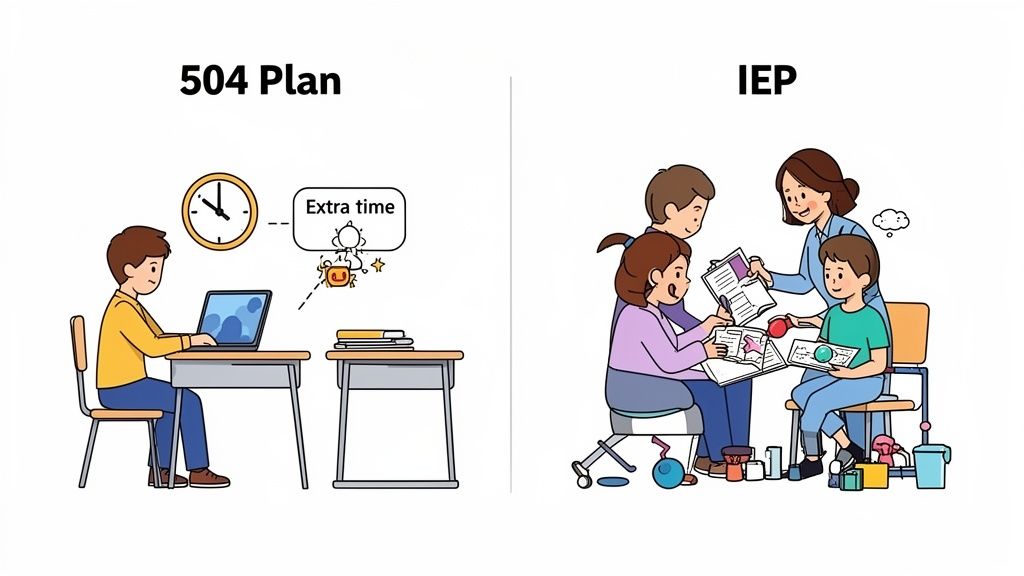
When you get down to it, the difference between a 504 Plan and an IEP is simple: a 504 Plan is about giving a student equal access to their education, while an IEP provides specialized educational services to help them make academic progress.
Think of it this way: a 504 Plan provides accommodations within the general classroom, but an IEP creates a modified educational program with direct, specialized instruction.
Decoding the Difference Between a 504 Plan and an IEP
Navigating the world of educational supports can feel like learning a new language. But understanding the core purpose of each plan makes the path forward much clearer. The choice really boils down to one critical question: does your child need adjustments to access the standard curriculum, or do they need a fundamentally different instructional approach to learn?
Core Purpose and Legal Frameworks
A 504 Plan is rooted in Section 504 of the Rehabilitation Act of 1973, a federal civil rights law. Its main job is to prevent discrimination and make sure a student with a disability has the same opportunity to learn as their peers. This is done through accommodations—small changes to the learning environment.
On the other hand, an Individualized Education Program (IEP) is governed by the Individuals with Disabilities Education Act (IDEA). This is a special education law, specifically for students whose disability negatively impacts their academic performance. An IEP is a legally binding document outlining specialized instruction, related services (like speech or occupational therapy), and specific, measurable goals.
The key distinction lies in focus: a 504 Plan levels the playing field, while an IEP changes the game plan. One is about access, the other is about specialized intervention.
To make this even clearer, let's break down the essential differences in a quick-glance table. This summary cuts right to the chase, focusing on the legal basis, primary goals, and scope of support for each plan.
At a Glance Comparison of 504 Plans and IEPs
| Feature | 504 Plan | IEP (Individualized Education Program) |
|---|---|---|
| Legal Basis | Section 504 of the Rehabilitation Act of 1973 (Civil Rights Law) | Individuals with Disabilities Education Act (IDEA) (Special Education Law) |
| Primary Goal | Provides access to general education via accommodations. | Provides specialized instruction and related services to ensure educational progress. |
| Who Qualifies | Student with a disability that substantially limits a major life activity. | Student with one of 13 specific disabilities that adversely impacts academic performance. |
| What It Provides | Accommodations (e.g., extra time, preferential seating). | Specialized instruction, accommodations, modifications, and related services (e.g., speech therapy). |
Ultimately, this table shows that while both plans are designed to help students succeed, they operate under different laws, serve different purposes, and provide very different types of support. Understanding this framework is the first step in advocating for the right plan for your child.
Navigating Eligibility and Legal Foundations
Getting a 504 Plan or an IEP starts with understanding where they come from and who they’re for. These aren't just technical details; they shape the entire process, from the evaluations needed to the final plan your child receives. The biggest difference comes down to the laws that created them.
A 504 Plan is rooted in Section 504 of the Rehabilitation Act of 1973, a civil rights law designed to stop discrimination against people with disabilities. Because of this, its definition of disability is broad. It covers any student with a physical or mental impairment that substantially limits one or more major life activities—things like learning, reading, concentrating, or thinking.
The Broader Scope of a 504 Plan
Thanks to its wide-ranging criteria, a 504 Plan is often the right fit for students whose disabilities get in the way at school but who don’t necessarily need a whole new way of learning. The central question for a 504 is simple: Does the student have an impairment that creates a barrier to their education? If so, the school provides accommodations to knock down that barrier.
Think of a student with severe anxiety. They might understand all the material, but their anxiety makes it nearly impossible to finish a test in the allotted time. This student doesn’t need a different curriculum; they just need an accommodation, like extended time, to show what they know. That's a textbook 504 scenario.
The Specific Criteria for an IEP
On the other hand, an Individualized Education Program (IEP) is governed by the Individuals with Disabilities Education Act (IDEA). This isn’t a civil rights law—it’s a special education law, which makes it much more specific. To qualify, a student’s disability must fit into one of 13 specific categories laid out by the federal government.
Some of these categories include:
- Specific Learning Disability (like dyslexia or dysgraphia)
- Autism Spectrum Disorder
- Other Health Impairment (where ADHD often falls)
- Emotional Disturbance
- Speech or Language Impairment
But just having a qualifying diagnosis isn’t enough. The school also has to find that the disability adversely affects the student's educational performance so much that they need specialized instruction to make real progress. For instance, a student with dyslexia who is reading years below their grade level would almost certainly need an IEP, because they require direct, specialized reading instruction, not just a few accommodations.
The legal threshold for an IEP is significantly higher. It’s not just about giving a student access; it’s about providing a fundamentally different educational program so they can truly succeed.
The numbers really show this difference. School districts typically report that around 14-16% of students have an IEP, while only 2-3% have a 504 Plan. This gap speaks volumes about the tougher criteria under IDEA. For a deeper dive into the legal distinctions, this comparison chart from the Michigan Alliance for Families is a fantastic resource. It makes perfect sense why the road to an IEP is often much more formal and demanding.
Comparing Services: Accommodations and Modifications
The real daylight between a 504 plan and an IEP shows up in the day-to-day support a student actually gets. While both are designed to help students succeed, they pull from different toolkits. The key difference really boils down to accommodations versus modifications.
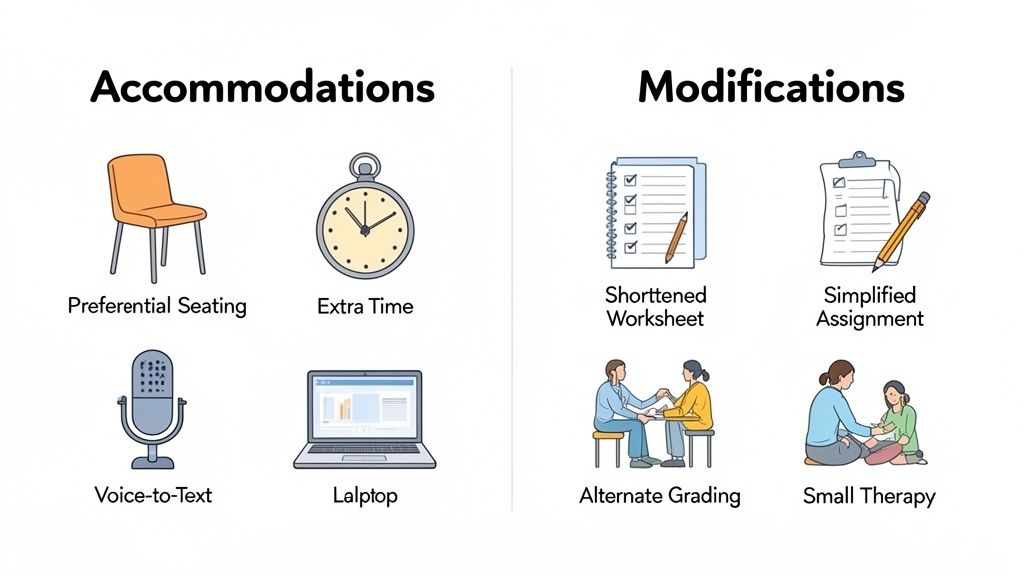
A 504 Plan is built almost entirely on accommodations. Think of these as adjustments to the learning environment that give a student an equal shot at the general education curriculum. Accommodations change how a student learns, not what they learn.
On the other hand, an IEP can include both accommodations and modifications. Modifications are fundamental changes to the curriculum itself. They alter what a student is expected to learn because their disability prevents them from mastering the grade-level material, even with supports.
Accommodations: The Heart of a 504 Plan
Accommodations are all about leveling the playing field with practical tools. For students with physical disabilities, for instance, a 504 or IEP might address mobility support. Understanding the various considerations for wheelchair ramps is often a critical piece of that planning puzzle.
Some common 504 accommodations include:
- Environmental Tweaks: Preferential seating to minimize distractions.
- Instructional Support: Getting copies of the teacher’s notes or using more visual aids.
- Assessment Tools: Being allowed extra time on tests or using voice-to-text software for essays.
These supports help a student navigate their challenges within the standard classroom. For a much deeper dive, you can check out our guide to 504 accommodations for ADHD.
Modifications and Specialized Services: The Power of an IEP
This is where an IEP really sets itself apart. It goes beyond accommodations to offer modifications and specialized services that a 504 simply can't provide.
For example, a student with dysgraphia might get to type an essay under a 504 Plan (an accommodation). But an IEP could go further, reducing the required length of that essay or allowing an alternative project altogether (a modification).
To see how these supports play out in real life, let's look at some common examples. The table below breaks down the kind of support you'd typically see under a 504 Plan versus what's possible with an IEP.
Accommodation vs. Modification Real-World Examples
| Support Type | Typical 504 Plan Example | Typical IEP Example |
|---|---|---|
| Testing | Extra time on tests; a quiet, separate testing room. | Alternate test format (e.g., verbal instead of written); grading based on modified criteria. |
| Assignments | Using a keyboard for written work; breaking down large projects into smaller chunks. | Shortened assignments; reduced number of homework problems; curriculum at a lower grade level. |
| Reading | Access to audiobooks; use of a text highlighter or reading guide. | Being assigned a different, simpler text than the rest of the class. |
| Physical Access | Ramps and elevators; an extra set of textbooks to keep at home. | Adapted physical education class with different activities and goals. |
Notice how the 504 examples help the student access the same material as their peers, while the IEP examples often change the material itself to make it accessible.
IEPs are also the only plans that provide specialized, related services from trained professionals. These aren't just classroom tweaks; they are direct therapeutic interventions.
These services can include:
- Speech-Language Pathology: To address communication disorders.
- Occupational or Physical Therapy: To help with fine motor skills or mobility.
- Direct Special Education Instruction: One-on-one or small group sessions with a special ed teacher to work on specific academic skills.
The intensity of these services is why IEPs are reserved for students with more significant needs. For example, one study on ADHD found that students with IEPs received individual support like counseling 44% more often than those with 504s. With around 7.5 million students on IEPs nationwide, this level of support is made possible by dedicated federal funding under IDEA—something 504 plans don't receive.
Understanding the Evaluation Process and Parental Rights
Getting the right support for your child means knowing how the system works. The paths to getting a 504 plan versus an IEP are completely different, and so are the legal rights that protect you and your child along the way. Understanding these differences is the first step to becoming your child's best advocate.
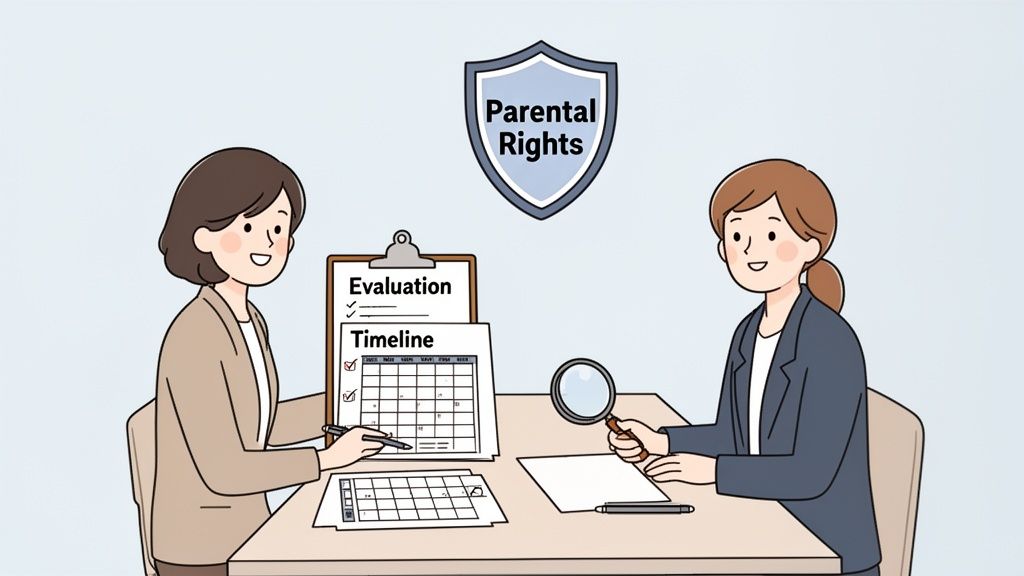
The road to an IEP is carefully mapped out by federal law under IDEA. It all starts with a formal request for an evaluation. Once you make that request, a federal clock starts ticking—the school typically has 60 days to complete a comprehensive assessment. This isn't just one test; it’s a deep dive by a multidisciplinary team that might include psychologists, special education teachers, and therapists.
The 504 evaluation process, on the other hand, is a lot more flexible and really depends on your local school district's policies. An evaluation is still required, but it’s often much less formal. Instead of conducting extensive new testing, a 504 team might simply review existing school records, reports from teachers, and medical diagnoses you provide.
Parental Rights and Procedural Safeguards
One of the biggest distinctions between the two plans is your rights as a parent. IDEA gives parents a powerful set of procedural safeguards, which are essentially your legal protections designed to ensure you have an equal voice in the entire IEP process.
Key parental rights under IDEA include:
- The right to give written consent before the school can begin any evaluations or services.
- The right to be a full and equal member of your child’s IEP team.
- The right to see and review all of your child’s educational records.
- The right to challenge school decisions through formal channels like mediation or a due process hearing.
Perhaps the most powerful tool you have under IDEA is the right to request an Independent Educational Evaluation (IEE) at the public's expense if you disagree with the school’s assessment. This lets you get a second opinion from an outside expert, ensuring the evaluation is fair and truly comprehensive.
Due Process for 504 Plans
Section 504 also gives parents due process rights, but they just aren't as extensive as those under IDEA. You have the right to be notified of decisions, look over records, and use a grievance procedure if you disagree with the school's conclusions. The catch is that the specific procedures are set by the local district and don't have the same level of detailed federal oversight that defines the IEP process.
This difference in process and protection often reflects the intensity of the needs being addressed. One study of middle schoolers with ADHD found that 61.9% had IEPs, and these students consistently showed lower cognitive and academic scores than their peers with 504 plans. The stronger parental rights and more intensive evaluation under IDEA are built to support students facing more significant hurdles in their education. You can dive deeper into the data from this study on support plans for students with ADHD.
Securing the Right Plan With a Comprehensive Evaluation
When you’re trying to decide between a 504 plan and an IEP, a strong, objective evaluation is your most powerful tool. While the school's assessment is the official starting point, a private diagnostic or neuropsychological report gives you the detailed, data-driven evidence you need to advocate effectively. It essentially translates a diagnosis into a clear, actionable picture of your child’s specific needs in the classroom.
Think of this documentation as your roadmap. It moves the conversation beyond subjective observations ("my child is struggling") and grounds it in concrete data, which is everything when you're making your case to the school.
Translating Data Into Actionable Support
A comprehensive evaluation does more than just confirm a diagnosis. Its real value is in identifying the functional impact of a student’s disability on their education. The report might pinpoint specific cognitive or academic deficits that require the kind of specialized instruction only an IEP can provide. For instance, it could reveal a significant gap in reading fluency that calls for direct, targeted intervention from a specialist.
On the other hand, the report might document how a condition like ADHD profoundly impacts executive functioning—things like planning, organization, and emotional regulation. This kind of evidence is perfect for justifying specific accommodations under a 504 plan, like breaking down assignments into smaller chunks or providing visual checklists.
An evaluation transforms a child’s struggles into a clear set of needs. It provides personalized, evidence-based recommendations that become the building blocks for the goals, services, and supports in either an IEP or a 504 plan.
For students whose struggles aren't immediately obvious—like girls with inattentive ADHD or high-achieving autistic students—this objective data is even more critical. Their challenges might fly under the radar in a busy classroom, but a thorough assessment can uncover the underlying processing or social-emotional difficulties that are getting in the way of their learning.
Building a Data-Driven Case for the School
When you walk into a meeting armed with a detailed report, you become a much more effective partner in the process. Instead of just stating that your child is having a hard time, you can point to specific metrics and expert recommendations to back it up.
This approach is especially valuable during eligibility meetings or if you find yourself needing to appeal a school’s decision. The report provides a third-party, professional analysis that can validate your concerns and steer the team toward the most appropriate supports.
A robust evaluation gives you several key advantages:
- Objective Evidence: It provides standardized scores and clinical observations that are hard to argue with.
- Specific Recommendations: It offers tailored suggestions for accommodations or instructional strategies that are directly linked to your child’s unique profile.
- Clarity for All: It helps teachers and administrators understand the "why" behind a student's behavior or academic struggles.
Ultimately, investing in a proper evaluation is an investment in your child's educational future. It ensures that the plan you land on—whether it's a 504 or an IEP—is a truly personalized strategy for success, not just a generic template. To get a better handle on this, you can learn more about what goes into a psychoeducational testing report and see how it can strengthen your advocacy efforts.
Choosing the Best Path Forward for Your Child
Deciding between a 504 plan and an IEP really boils down to the specific nature of your child’s challenges. It's not about which plan is "better," but which one is the right match. A comprehensive diagnostic report is your roadmap here, translating a diagnosis into a clear path forward.
Think of it this way to simplify the choice:
- Choose a 504 Plan if: Your child is generally keeping up with their peers but a diagnosed condition, like ADHD or anxiety, is getting in the way. Maybe they know the material but can’t finish tests on time due to anxiety. Accommodations like extended time simply remove that barrier. A 504 plan is all about providing access.
- Choose an IEP if: Your child’s disability, like a specific learning disability or Autism, is causing them to fall significantly behind academically. They don’t just need access; they need direct, specialized instruction to learn fundamental skills in reading or math. An IEP provides that educational intervention.
Making a Data-Driven Decision
This is where a thorough evaluation becomes your most powerful tool. It gives you the objective evidence needed to justify either plan, turning a diagnosis into a concrete list of your child's functional limitations and the exact supports they need.
The core difference is simple: A 504 plan offers accommodations to help a child access the existing curriculum. An IEP provides modifications and specialized services, which can actually change the curriculum itself.
This flowchart shows exactly how an evaluation report drives the decision-making process.
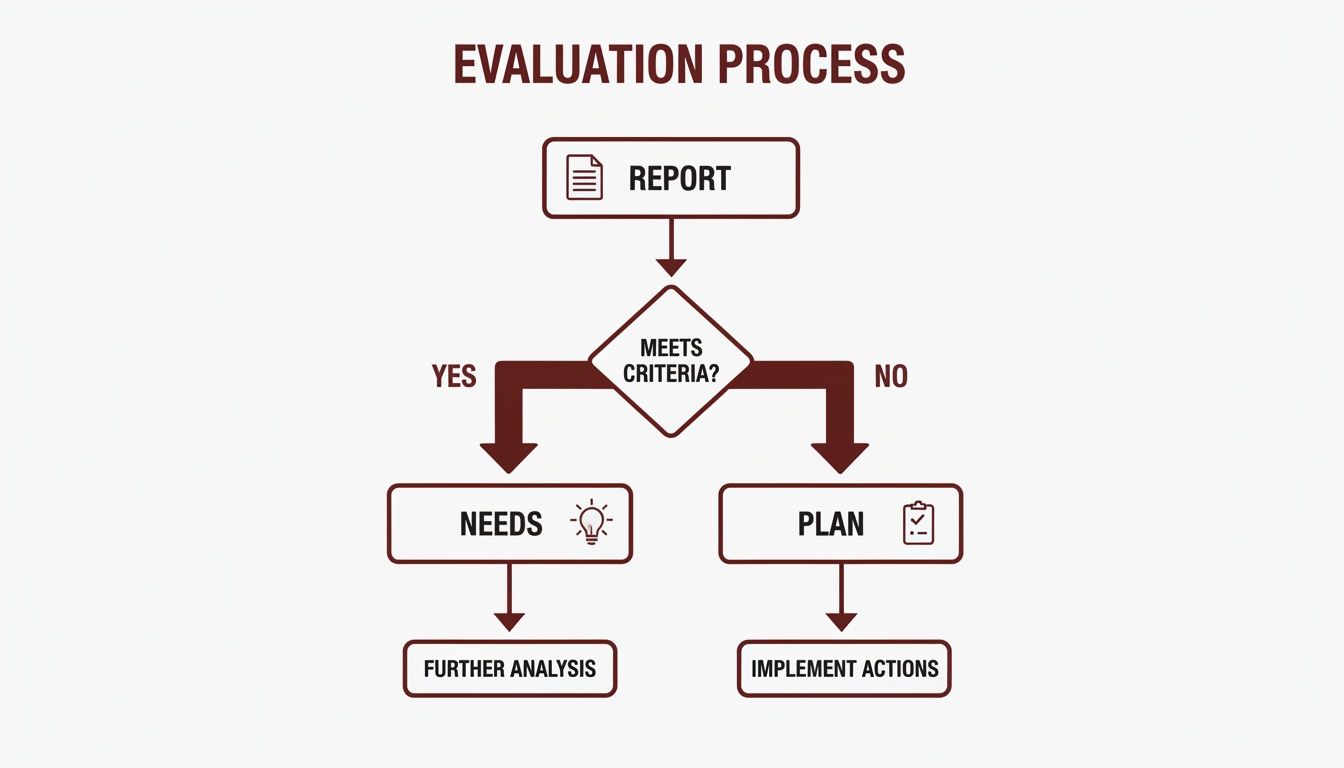
As you can see, the whole process hinges on whether the data points to a need for curriculum access or for fundamental changes to how your child is taught. For parents navigating this journey, knowing how to advocate effectively is critical. You can find more information in our resources on special education advocacy to help you build the strongest possible case for your child.
Your Top Questions About 504 Plans and IEPs Answered
When you're navigating the world of school supports, it's natural to have a lot of questions. Let's clear up a few of the most common ones parents ask about the difference between a 504 plan vs. an IEP.
Can My Child Have Both a 504 Plan and an IEP?
Simply put, no. A student can’t have both plans at the same time. Think of an IEP as the more extensive of the two; it covers all the accommodations you’d find in a 504 plan plus specialized instruction and related services. If a child qualifies for an IEP, that plan takes precedence.
It is possible, however, for a student to move from an IEP to a 504 plan. This usually happens when they’ve made great progress and no longer need specialized instruction, but still benefit from accommodations to access the curriculum.
Does a Medical Diagnosis Automatically Qualify My Child for a Plan?
A medical diagnosis is a crucial piece of the puzzle, but it doesn't automatically unlock eligibility. The school's team makes the final call based on how the disability impacts a student’s ability to learn and function at school.
- For a 504 Plan: The key is showing that the disability substantially limits a major life activity, like learning, reading, or concentrating.
- For an IEP: You need to demonstrate that the disability adversely affects academic performance so significantly that specialized instruction is necessary.
A comprehensive evaluation report is your most powerful tool. It translates the diagnosis into the specific educational evidence the school needs to see.
What Happens to These Plans After High School?
This is where the paths for 504s and IEPs really diverge. An IEP is tied to the K-12 public school system under the Individuals with Disabilities Education Act (IDEA). It officially ends when a student graduates with a regular high school diploma.
A 504 Plan, on the other hand, has a much longer reach. Because it’s based on Section 504, a federal civil rights law, its protections extend to any institution receiving federal money—which includes most colleges, universities, and even workplaces. Students must self-disclose to their college's disability services office to set up new accommodations, and their high school 504 or IEP paperwork serves as powerful evidence to support that request.
Navigating the evaluation and advocacy process can feel overwhelming. The experts at the Sachs Center specialize in comprehensive neuropsychological and psychoeducational evaluations that provide the clear, actionable data needed to secure the right school supports for your child. Learn more about our diagnostic and testing services today.
