
Securing extra time on the SAT isn't a matter of simply asking for it. The whole process hinges on having a documented disability that genuinely impacts your ability to take the test, backed up by a history of getting similar help in school. You'll generally need an official diagnosis for a condition like ADHD or dyslexia and solid proof, like an IEP or 504 Plan, showing you've been using these supports all along.
Do You Qualify for Extra Time on the SAT

So, let's get straight to it: who actually gets approved for extended time? It's about more than just having a diagnosis on paper. The College Board’s decision really comes down to one core principle: proving that a documented disability directly interferes with your ability to perform on a timed, high-stakes exam like the SAT.
Just wanting more time won't cut it. Your request has to be built on a solid foundation of medical and educational history that clearly points to a functional limitation.
The Two Pillars of a Successful Request
Think of your application as having two essential parts. First, you need a formal diagnosis. The College Board recognizes a whole range of conditions that can throw a wrench in test performance.
This table gives a quick snapshot of common conditions that often qualify for accommodations.
Common Qualifying Conditions for SAT Accommodations
| Disability Category | Examples | Key Documentation Evidence |
|---|---|---|
| Specific Learning Disabilities (SLDs) | Dyslexia, dysgraphia, dyscalculia | Neuropsychological or psychoeducational report showing deficits in processing speed, reading fluency, or written expression. |
| Attention-Deficit/Hyperactivity Disorder (ADHD) | Inattentive, hyperactive-impulsive, or combined type | Comprehensive evaluation from a qualified professional; evidence of impairment in multiple settings (school, home). |
| Psychiatric Disorders | Anxiety disorders, depression, OCD | Diagnosis from a psychiatrist or psychologist; documentation of how symptoms (e.g., poor concentration) impact academic functioning. |
| Medical or Physical Conditions | Chronic pain, diabetes, concussions | Medical records and a letter from a physician explaining the need for breaks, special seating, or other accommodations. |
| Visual or Auditory Impairments | Low vision, hearing loss | Reports from an ophthalmologist or audiologist detailing the impairment and necessary testing adjustments. |
While a diagnosis is the starting point, the evidence you provide is what truly makes or breaks your case.
The second, and arguably most critical, pillar is your history of using accommodations. The College Board wants to see that you’ve been receiving similar support at your school for a while. This is where your Individualized Education Program (IEP) or 504 Plan becomes your most powerful tool. These official school documents provide concrete proof that your need for support isn't a last-minute strategy but a long-standing requirement for you to have a fair shot academically.
Why a History of Accommodations Is Crucial
An existing IEP or 504 Plan basically tells the College Board that your school has already done the legwork of vetting and confirming your need for support. It establishes a consistent track record. For example, if you’ve received time-and-a-half on classroom tests for years because of a diagnosed processing speed deficit, it makes your case for the same accommodation on the SAT that much stronger.
This is so important that requests for SAT accommodations have exploded in recent years. Data reveals a 200% jump in requests between 2010 and 2018. To get approved for the standard 50% extra time—which turns a 3-hour test into a 4.5-hour one—students must have a diagnosed disability covered by ADA guidelines, with supporting psychoeducational evaluations dated within the last four years.
A strong application connects the dots for the reviewer. It should clearly state the diagnosis, show how it impacts test-taking, and provide a history of receiving similar support in an academic setting.
What if you don't have a formal school plan? Getting approved is definitely tougher, but not impossible. In those situations, the strength of your professional evaluation, like a comprehensive neuropsychological report, becomes absolutely vital. You can learn more about how a thorough ADHD test can support your request for accommodations and provide the necessary evidence.
Gathering the Right Documentation for Your Request
Think of building your request for extra time like putting together a case for a jury. You need solid evidence to prove your need beyond any doubt. Just having a diagnosis on paper isn’t going to cut it. The College Board needs to see a clear, consistent story backed up by official records and professional assessments.
Each document is a puzzle piece. Your job is to put them all together to create a complete picture that leaves no room for questions. The stronger your evidence, the faster and smoother the approval process will be.
The Cornerstone: Your Psychoeducational Evaluation
The most important piece of your entire application is the neuropsychological or psychoeducational evaluation. This is the scientific foundation of your request, providing objective data that shows how you learn.
A compelling report does more than just state a diagnosis. It must connect that diagnosis directly to the specific challenges of a timed, high-stakes exam like the SAT.
For instance, a report that simply says “ADHD” is weak and likely to be rejected. A strong report will point to specific test scores showing deficits in processing speed or working memory and then explicitly state something like, “Due to these documented deficits, this student requires 50% extended time to fairly demonstrate their knowledge on standardized exams.”
The College Board also has strict rules about how recent this testing must be. For learning disabilities and ADHD, the evaluation generally needs to have been completed within the last four years. This is to ensure the data reflects your current abilities as a high school student.
A powerful evaluation doesn't just diagnose; it prescribes. The psychologist's report should contain specific, concrete recommendations, such as "time-and-a-half (1.5x) on all timed academic tests."
Proving a History of Need: School Records
While your evaluation provides the clinical "why," your school records show the "when" and "how long." This is where an Individualized Education Program (IEP) or a 504 Plan is absolutely essential. These documents are official proof that your school has recognized your disability and you've been using accommodations for a while.
This history is critical. It shows the College Board that your request isn't a last-minute strategy just for the SAT, but a consistent, long-standing need that’s already been supported in your day-to-day academic life.
If you’re just starting this journey, it’s vital to understand what goes into these assessments. For a closer look at what the evaluation process involves, learning more about professional testing for extended time can help clarify how to secure this foundational document.
Make sure your file includes the following:
- Your complete, signed IEP or 504 Plan. Make sure it’s the most current version.
- Teacher comments or reports. A letter from a teacher describing how your learning difference impacts you in the classroom can add powerful, real-world context.
- School-based testing results. Any internal assessments or report cards that show a pattern of needing more time can strengthen your case.
Start gathering these documents as early as possible. Get in touch with your school counselor and the specialist who did your evaluation well before any deadlines. Having everything organized and ready to go before you even start the online application will make the entire process of getting extra time on the SAT much less stressful.
Navigating the College Board Application Portal
Once you have all your documentation in hand, it’s time to tackle the College Board’s Services for Students with Disabilities (SSD) portal. Any online application can feel a little intimidating, but this one is pretty straightforward once you know the two main paths for submitting your request.
School Submission vs. Family Submission
By far, the most common route is to go through your school. This is the College Board’s preferred method, and frankly, it’s usually faster and easier. Your school counselor or SSD coordinator takes the lead, uploading the files and officially submitting the request for you. Following this path often means a quicker decision—sometimes in as little as three weeks.
The other option is to submit the request independently as a family. This is the way to go for homeschooled students or if your school, for whatever reason, isn't involved. It’s a perfectly valid approach, but just be ready for a longer wait. It can take up to seven weeks because the College Board has to do a more thorough verification of your documents without the school's pre-approval.
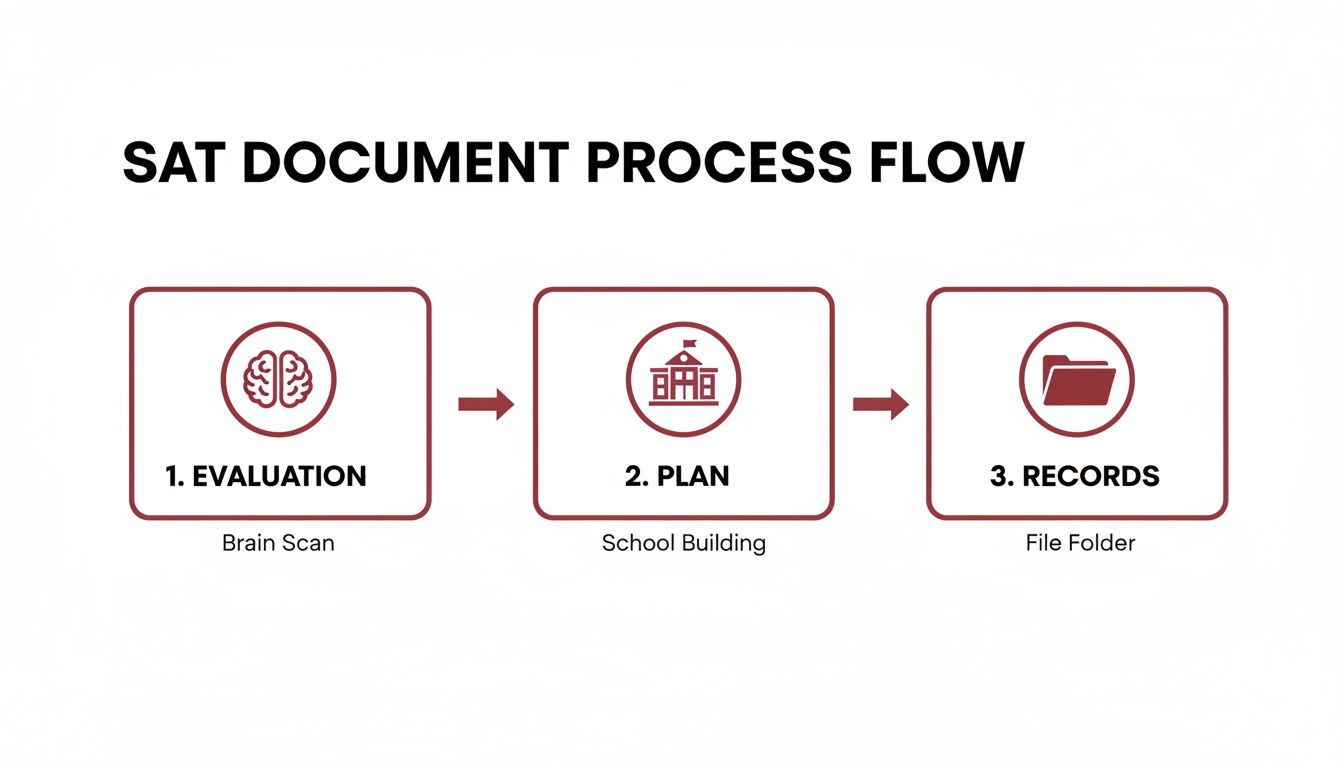
This process flow really highlights the core documents that build the foundation of your application. It all starts with that professional evaluation, which informs a school plan (like an IEP or 504), and those two things generate the records you’ll need to submit.
Kicking Off Your Online Application
To get started, you or your school coordinator will head over to the SSD Online portal. This dashboard is where everything happens.
No matter who hits the "submit" button, getting organized first is non-negotiable. Create a dedicated folder on your computer and save every piece of evidence as a clearly named PDF. I've seen applications get delayed by simple mistakes like blurry scans, password-protected files, or uploading the wrong document type. Double-check everything.
The number of students requesting accommodations has skyrocketed, which makes submitting a clean, accurate application more critical than ever. Requests for extra time doubled from 80,000 in 2010-11 to 160,000 in 2015-16, and that trend hasn't slowed down.
Pro Tip: Start this entire process at least two months before the registration deadline for your ideal test date. This buffer gives you time for the College Board’s review and, if you need to appeal, you won't be scrambling and risk missing your test.
Key Steps Inside the Portal
Once you’re logged in, the system walks you through a series of screens to enter student information and details about the disability. The document upload section is the most important part.
Here’s a quick rundown of what you’ll be doing:
- Student & Parent Consent: You’ll need to formally give consent for the school to share your information with the College Board.
- Disability Information: You'll specify the diagnosed condition exactly as it's written in your neuropsychological or psychoeducational report.
- Requested Accommodations: This is where you select the specific accommodations you’re asking for (e.g., 50% extended time, extra breaks). Critically, this list must match what your documentation recommends.
- Document Upload: You'll attach your evaluation, your IEP/504 plan, and any other evidence you’ve gathered.
After you submit, you’ll get a confirmation and can track your request's status right in the portal. By getting your files in order beforehand and knowing the workflow, you can navigate the system confidently and get one step closer to securing the support you need for the SAT.
Using Your Extra Time to Boost Your Score

Securing your accommodation is a huge victory, but it's only half the battle. Now comes the real work: learning how to use that extra time as a strategic weapon to improve your score.
This isn't about working slower. It's about working smarter, deeper, and with less anxiety.
Think of it as turning a defensive measure into an offensive advantage. Extra time gives you the breathing room to process complex questions, catch careless errors, and confidently tackle sections that used to feel like a mad dash. It’s a chance to completely reshape your approach to the test.
Remapping Your Test-Taking Strategy
With time-and-a-half (50% extra time), the standard 64-minute Reading section suddenly becomes a much more manageable 96 minutes. This surplus allows for powerful new strategies that are simply impossible under standard timing.
Don't just spread the extra minutes out. You need to build a whole new system.
One of the most effective methods I've seen is the two-pass system. On your first pass through a section, you answer every single question you're confident about. The moment you hit one that stumps you, mark it and move on. No hesitation. Your extra time is the safety net that lets you come back for a focused second attempt on the tough stuff without panicking.
This approach is especially powerful on the math sections. In fact, research shows that the score boost from extended time is often most significant in math. A 2005 ETS report found that students with disabilities saw considerable gains on math sections when given more time—an uplift that often outpaced improvements on verbal sections.
Don't view extra time as a cushion for slowness. See it as a strategic reserve that funds a more methodical and accurate approach to every single question on the exam.
Practical Techniques for Using Your Time
Your new strategy needs to become second nature, and the only way to do that is through practice. Start incorporating these techniques into every timed practice test you take.
- Allocate Time for Bubbling: Stop bubbling answers as you go. That context-switching breaks your focus and invites errors. Instead, set aside the last 5-7 minutes of each section specifically to transfer your answers to the sheet.
- Embrace the Full Read-Through: With more time, you can afford to read every Reading passage thoroughly once before jumping into the questions. A deeper initial understanding often makes answering the questions faster and more accurate than skimming.
- Double-Check Everything: Your final 10-15 minutes in each section should be your dedicated "review phase." Use this time to revisit marked questions and—this is crucial—re-check the problems you felt confident about. It's often on the "easy" questions that careless mistakes creep in.
For students granted extra time due to conditions like ADHD, specific techniques can make a huge difference. You can explore some practical strategies for focusing with ADHD to maximize your score. We also have a detailed guide on how academic accommodations for ADHD can be put to work on test day.
By mastering these strategies, you can turn your accommodation into a real, measurable score increase.
What to Do If Your Request Is Denied
Getting a denial letter from the College Board can feel like a punch to the gut. But before you panic, it's important to understand what this usually means. A denial is rarely a final, permanent "no."
More often than not, it’s the College Board’s way of saying, “We need more information to approve this.” Think of the denial letter not as a closed door, but as a roadmap. It will almost always tell you why your request wasn't approved, giving you a clear direction for your appeal.
Figuring Out the Denial and Planning Your Appeal
When you peel it back, most rejections come down to two common reasons: the documentation was insufficient, or there was a mismatch between the diagnosis and the specific accommodation you asked for. For instance, your neuropsychological evaluation might be considered too old, or maybe it didn't explicitly connect your diagnosis to the unique pressures of a high-stakes, timed test like the SAT.
To build a winning appeal, you have to tackle their reasoning head-on. Here’s how to approach the most common denial reasons:
- Outdated Documentation: If your evaluation is more than four years old, this is a pretty straightforward fix. You'll need to get an updated neuropsychological evaluation. This is crucial because it provides data on your current needs as a high school student getting ready for college-level exams.
- Insufficient Evidence: This one is a bit broader. It could mean anything from a missing signature on an IEP/504 plan to a diagnostic report that didn't specifically recommend extra time. Your job is to fill in those gaps. This is where you can gather more targeted evidence, like detailed letters from teachers describing how your disability impacts you during in-class tests.
- Mismatch of Request: Sometimes the requested accommodation doesn't logically follow the diagnosis provided. A student with a medical condition like diabetes, for example, might request a scribe when the more appropriate accommodation is extra breaks to manage their health. Your appeal needs to clearly explain why you need the specific help you're asking for, backed up by professional recommendations.
A denial isn't a dead end; it's a request for clarification. Your appeal should be a direct, evidence-based response to the specific points raised by the College Board.
Taking Action and Submitting Your Appeal
Once you've pinpointed the weak spot in your original application, it's time to gather your new evidence. This is a team effort, so work closely with your school counselor and any specialists who were part of the initial evaluation.
If you’re adding new documents—like a fresh evaluation or a compelling letter from a math teacher about your struggles with timed problem sets—draft a short cover letter for your appeal. In it, summarize the new evidence and briefly explain how it directly addresses the College Board's initial concerns.
The appeal process is your opportunity to present a much stronger, more focused case. By systematically addressing their feedback, you dramatically improve your chances of getting the accommodations you need to show what you truly know on the SAT.
Common Questions About SAT Extended Time
Once you start digging into the logistics of SAT accommodations, the practical questions really start to pop up. You’ve got the documents and you know the basic steps, but it’s the smaller details that often cause the most stress. Let's clear up some of the most common questions we hear from students and parents.
How Much Extra Time Can I Get on the SAT?
The most common accommodation by far is 50% extended time, which you’ll often hear called "time-and-a-half." This turns the standard three-hour SAT into a four-and-a-half-hour exam, giving students those critical extra minutes on each section.
For students with more significant needs, 100% extended time (or double time) is also available, stretching the test day to a full six hours. The amount of time you’re granted isn’t random. It’s based entirely on the specific recommendations laid out in your documentation, like a neuropsychological report, and what’s already established in your school’s IEP or 504 plan.
Key Takeaway: Your request needs to match your documented history. If your IEP has always given you time-and-a-half on school tests, asking the College Board for double time without a powerful new reason is a recipe for denial.
Will Colleges See That I Received Extra Time?
Nope. Not at all. A number of years ago, the College Board did away with any kind of "flagging" on score reports for students who used accommodations. The score report that lands in a college admissions office looks completely identical to everyone else's.
Admissions officers will have zero idea you received extra time unless you choose to share that information yourself, maybe in an application essay or an interview. This policy really does level the playing field, making sure your scores are judged purely on merit.
Do I Have to Reapply for Every Test?
Thankfully, no. Once the College Board approves your accommodations, that approval is generally good for all your future College Board exams.
You’ll be given a unique Services for Students with Disabilities (SSD) number. When you register for other tests—whether it’s another SAT, the PSAT/NMSQT, or any AP Exams—you just enter your SSD number, and your approved accommodations are automatically applied. It makes things so much simpler after you get through that initial approval.
Can Homeschooled Students Still Get Accommodations?
Yes, absolutely. Homeschooled students are completely eligible for accommodations. While the process can feel a bit more streamlined when a school counselor is handling the submission, families can—and frequently do—submit all the required documentation directly to the College Board themselves.
If you’re applying as a homeschooler, you’ll be on the hook for providing the same comprehensive evidence a school would. That means the full psychoeducational or neuropsychological evaluation and a detailed history showing how the accommodations you’re asking for have been a consistent part of your learning. The burden of proof is exactly the same; you’re just the one managing the paperwork.
Students looking into SAT accommodations might also find it helpful to review general ACT test preparation strategies, as many principles of test-taking and planning for accommodations overlap.
At the Sachs Center, we specialize in the comprehensive neuropsychological testing needed to build a strong case for extra time on the SAT, ACT, and other standardized tests. Our telehealth evaluations are designed to meet the College Board's rigorous standards, providing the detailed, actionable report you need. Learn more about our testing services and schedule your virtual evaluation today at https://sachscenter.com.
