

At its core, the difference between ADHD and anxiety comes down to the why. ADHD is a neurodevelopmental condition rooted in challenges with self-regulation and executive function, whereas anxiety is a mood disorder fueled by persistent fear and worry. While both can leave you feeling restless and unfocused, the internal experience is completely different.
Understanding Why ADHD and Anxiety Are So Often Confused
If you’ve ever found yourself wondering whether your inability to focus stems from ADHD or anxiety, you’re definitely not alone. The two conditions share so much symptomatic overlap that telling them apart without a professional evaluation is notoriously difficult. Behaviors like fidgeting, procrastination, and emotional outbursts can look identical on the surface.
This confusion gets even more tangled because the conditions frequently show up together. Research suggests that up to 50% of adults with ADHD also struggle with a co-occurring anxiety disorder. It makes sense—the chronic stress that comes from managing untreated ADHD, like constantly missing deadlines or battling disorganization, can directly feed feelings of worry and overwhelm, creating a vicious cycle.
The Motivation Behind the Symptom
The real key to telling them apart is to look at the underlying "why" behind a specific behavior. For example, a person with ADHD might not be able to start a project because their brain is under-stimulated and simply can't engage with something it finds boring. On the other hand, someone with anxiety might avoid the exact same task out of a paralyzing fear of failure or not doing it perfectly.
The external behavior—procrastination—looks the same, but the internal driver is worlds apart. ADHD is often a 'can't get started' problem, while anxiety is a 'too scared to start' problem.
Getting this distinction right is crucial for finding what actually helps. A strategy designed to calm an anxious mind probably won’t do much for an under-stimulated ADHD brain, which is why getting diagnostic clarity is the essential first step. Exploring these motivations helps you start to peel back the layers and understand what's really going on.
Quick Comparison Key Differences in Motivation
To make this clearer, let's break down some common overlapping symptoms. This table offers a fast, side-by-side look at the underlying reasons behind them, helping you quickly see the core distinctions.
| Overlapping Symptom | The 'Why' Behind It in ADHD | The 'Why' Behind It in Anxiety |
|---|---|---|
| Difficulty Concentrating | The brain is under-stimulated and searching for something more engaging; easily pulled away by more interesting thoughts or external stimuli. | The mind is totally preoccupied with worry, replaying conversations, or constantly scanning for potential threats. |
| Restlessness/Fidgeting | The body is trying to burn off excess energy or create physical stimulation to help the brain focus. It’s a self-regulation attempt. | It’s a physical release for internal tension, nervousness, and a racing mind. The body is literally buzzing with "what ifs." |
| Trouble Sleeping | The brain is active and "always on," making it hard to power down. Thoughts race from one interesting idea to the next. | An inability to sleep is driven by persistent worry, catastrophizing about the future, or feeling a sense of panic. |
| Procrastination | A classic sign of executive dysfunction. There’s a major hurdle with task initiation, especially for tasks that feel boring or overwhelming. | A classic avoidance behavior. The task is put off due to a fear of failure, intense perfectionism, or dread of negative judgment. |
Seeing the "why" laid out like this really highlights how two people can exhibit the same behavior for completely different reasons. This is exactly what a thorough diagnostic evaluation aims to uncover—getting past the surface-level symptoms to understand your unique internal experience.
A Nuanced Comparison of ADHD and Anxiety Symptoms
We've touched on the core motivations behind the ADHD vs. anxiety overlap, but now it's time to zoom in on the specifics. Telling the two apart requires looking past surface-level behaviors to understand the vastly different internal experiences that drive them.
Let's take "trouble focusing," a complaint I hear constantly. For someone with ADHD, this usually comes from an under-stimulated brain that’s desperately scanning for something—anything—more interesting. It's not a choice to drift away from a boring task; it's a neurological inability to stay locked onto something that isn't inherently engaging.
For anxiety, the inability to focus is the exact opposite problem. The brain is over-stimulated by a relentless loop of worry. Instead of seeking engagement, it's trapped by it. Anxious thoughts and worst-case scenarios hijack all available mental space, making it impossible to be present.
External Restlessness Versus Internal Agitation
The physical energy tied to each condition feels completely different, too. ADHD restlessness is often an external, noticeable thing. You might see it as:
- Constant fidgeting with pens, hands, or feet.
- The need to get up and walk around during meetings.
- Feeling like you're "driven by a motor," always needing to be in motion.
This hyperactivity is actually a form of self-regulation; for the ADHD brain, that physical movement can paradoxically improve focus. In contrast, anxiety's restlessness is a tense, internal state of agitation. It’s a paralyzing, nervous energy that manifests as a racing heart, shallow breathing, or clenched muscles. It's less "on the go" and more "I want to crawl out of my skin."
This infographic does a great job of breaking down the key differences between the under-stimulated ADHD brain and the worry-driven anxious mind.
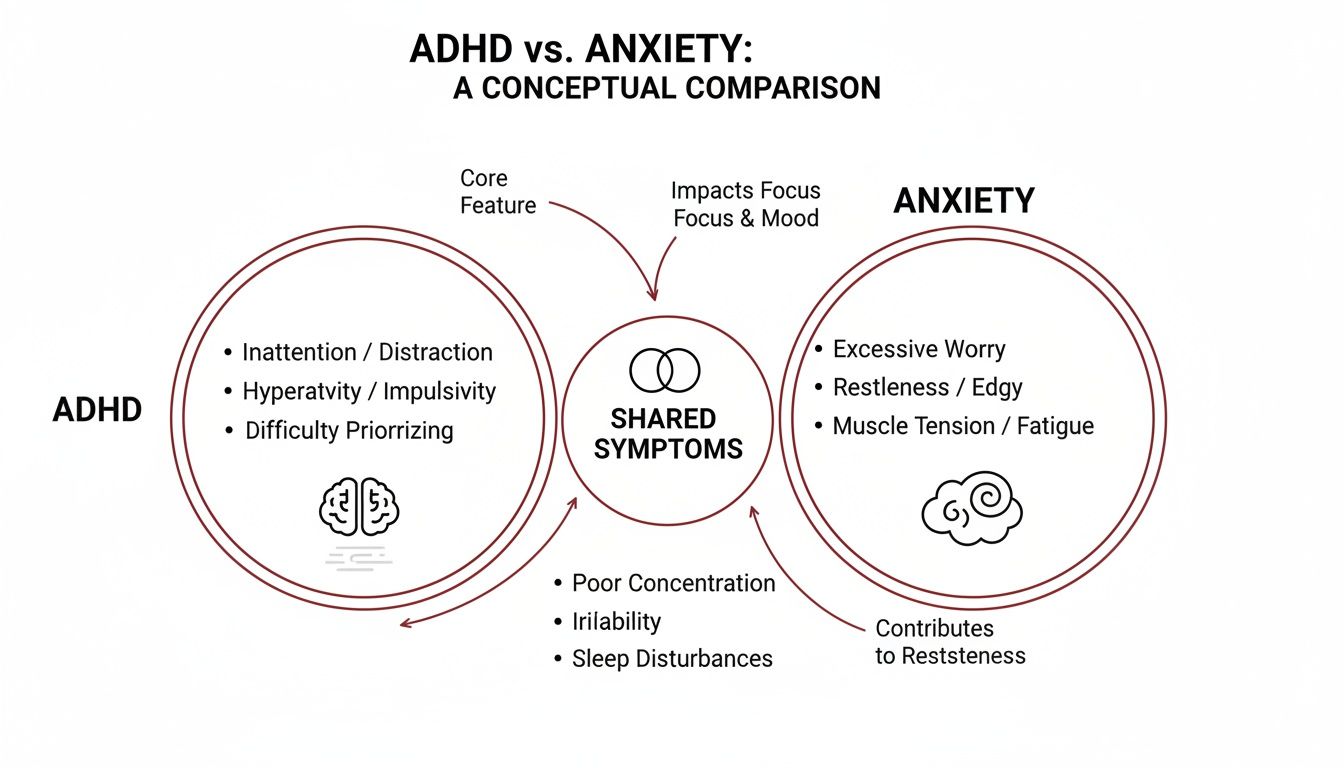
As you can see, shared symptoms like poor focus and restlessness spring from fundamentally different places. This is precisely why a one-size-fits-all approach to treatment just doesn't work.
Uncovering the Unique Markers of Each Condition
Beyond the confusing overlaps, both ADHD and anxiety have hallmark symptoms that rarely cross over. These are the signs that can really help clarify what's going on.
ADHD is often characterized by:
- Time Blindness: A profound, consistent difficulty perceiving the passage of time. This is the root of chronic lateness and consistently underestimating how long projects will take.
- Hyperfocus: The uncanny ability to get completely absorbed in a topic of high interest for hours, often tuning out everything else.
- Executive Dysfunction: Deep-seated challenges with the brain's management system—things like planning, prioritizing, and just getting started on tasks. You can see more real-world executive dysfunction examples to understand its impact.
Anxiety, on the other hand, shows up with its own distinct set of symptoms.
Anxiety is often characterized by:
- Persistent, Future-Focused Worry: A near-constant state of dread about what might happen. This often involves catastrophizing or mentally spiraling into worst-case scenarios.
- Physical Symptoms: The body keeps the score. A racing heart, sweating, trembling, shortness of breath, or stomach issues are all common physiological alarms.
- Avoidance Behavior: Actively dodging people, places, or situations that you know will trigger feelings of fear or panic.
A key differentiator lies in the timeline of the struggle. ADHD challenges are typically lifelong and consistent, whereas anxiety often revolves around future events and "what-if" scenarios.
To make things even more complex, these conditions love to travel together. It's estimated that up to 50% of children with ADHD also have a co-occurring anxiety disorder, which can amplify challenges like school refusal or procrastination at work. This high rate of comorbidity is exactly why a professional evaluation is so critical. A specialist can untangle the symptoms to figure out if you're dealing with ADHD, anxiety, or both.
How Symptoms of ADHD and Anxiety Evolve Over a Lifetime
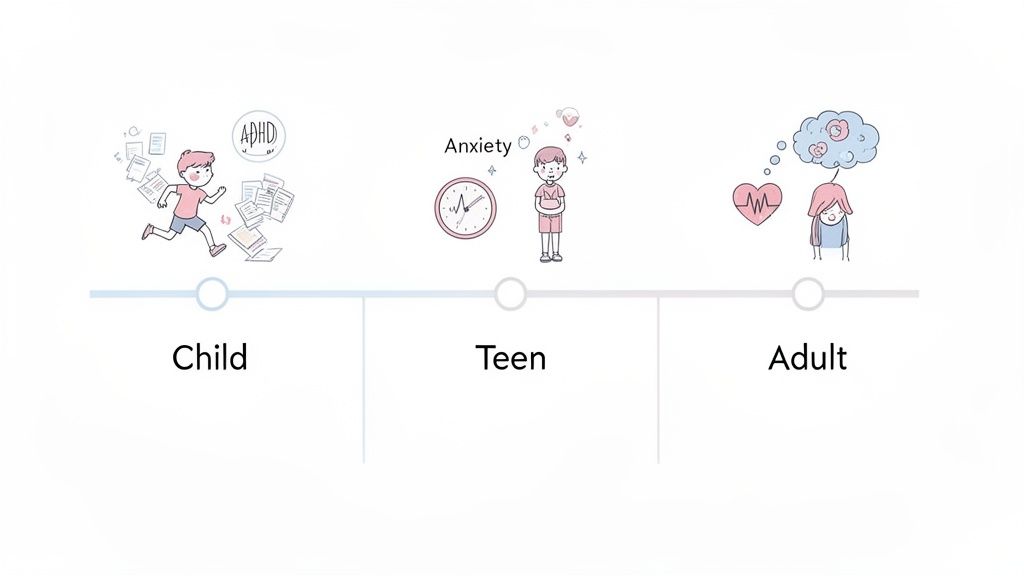
Trying to tell ADHD and anxiety apart is tricky enough, but this challenge completely shifts as we move through different life stages. The way these conditions show up in a six-year-old is worlds away from how they appear in a teenager or a forty-year-old. Grasping this evolution is the only way to see the full picture.
ADHD and anxiety don't stay static because our lives don't. Our environments, responsibilities, and even the coping skills we develop over time all change how these conditions manifest. What starts as obvious, can't-miss hyperactivity in a small child can morph into a subtle, internal restlessness in an adult, making it much harder for anyone—including the person experiencing it—to spot.
ADHD and Anxiety in Childhood
In young kids, ADHD symptoms are often the most visible, fitting that classic image of a child who's always on the go. The first signs that something is up are usually noticed at home or in the classroom. It's a widespread issue; while global estimates for ADHD prevalence hover between 5% and 8%, the CDC reported that in the US, 11.4% of children aged 3-17 had been diagnosed as of 2022. That's a significant upward trend. You can explore more on these evolving statistics here.
-
Childhood ADHD: This often looks like constant motion—running, climbing, and being completely unable to sit still during story time. Impulsivity pops up as blurting out answers before being called on or having a really tough time waiting for a turn in a game. Inattention might look more like daydreaming or losing track of instructions halfway through.
-
Childhood Anxiety: This presents very differently. It might show up as intense separation anxiety when being dropped off at school, specific phobias (like a fear of the dark or thunderstorms), or even frequent stomachaches with no clear medical cause. Anxious children are often quiet, withdrawn, and can be overly compliant at school, trying not to draw any attention to themselves.
Presentation During Teenage Years
Adolescence throws a whole new set of academic and social pressures into the mix, which can ramp up both ADHD and anxiety symptoms. This is often where the two conditions start to look much more alike. The less-structured nature of high school can be a minefield for a teen struggling with executive functions.
For teens with ADHD, the core challenge is still self-regulation. This translates into chronic procrastination on big projects, a bedroom that's a constant disaster zone, and impulsive social choices. Their grades might be all over the place, acing subjects they love while failing others that require sustained, methodical effort.
Anxiety in teens, on the other hand, tends to center on social evaluation and school performance. It can fuel an intense perfectionism, where a teen spends hours on a single assignment out of fear of getting anything less than an A. Social anxiety can also become a major issue, leading them to avoid parties or constantly worry about what their peers think of them.
A key difference often emerges in social contexts. A teen with ADHD might struggle socially because they interrupt people or miss subtle cues. A teen with social anxiety struggles because they are terrified of being judged or embarrassing themselves.
Symptoms in Adulthood
By the time they reach adulthood, many people with ADHD have built up a complex—and exhausting—set of coping strategies to get by. That overt hyperactivity from childhood often shifts inward, becoming a persistent feeling of internal restlessness, an inability to relax, and a mind that just won't shut off.
Here’s a look at how the two conditions often diverge in adults:
| Feature | Adult ADHD Presentation | Adult Anxiety Presentation |
|---|---|---|
| Career Impact | A history of frequently changing jobs, struggling with promotions due to organizational demands, or feeling chronically underemployed despite being quite intelligent. | May actively avoid career advancement out of fear of failure or the pressure of increased responsibility. Performance anxiety can be a huge barrier. |
| Daily Life | Often defined by "life admin" paralysis—think piles of unopened mail, late bills, and constant disorganization at home. Being chronically late and forgetting appointments are common frustrations. | Marked by persistent, looping worries about finances, health, or family (the hallmarks of Generalized Anxiety Disorder). Panic attacks might also be part of the picture. |
| Masked Symptoms | Especially in women, symptoms are often internalized. The struggle is hidden behind a mask of perfectionism and people-pleasing, which can look identical to anxiety. However, it's driven by a deep-seated fear of rejection due to ADHD-related mistakes. | While also internal, the core driver is a constant sense of dread or threat about the future, rather than a frantic effort to compensate for executive function deficits. |
This concept of masking is absolutely critical to understand. A woman who is constantly double-checking her work and feels anxious about deadlines might easily be diagnosed with an anxiety disorder. But the root cause could be an ADHD-related working memory deficit that she is desperately trying to compensate for.
This is exactly where specialized telehealth evaluations, like those we offer at the Sachs Center, become so important. Our clinicians are attuned to these nuanced and masked presentations, helping to uncover the real diagnosis so you can get the right support.
Navigating the Path to an Accurate Diagnosis
Trying to untangle ADHD and anxiety symptoms on your own can feel like an impossible task. While online quizzes might offer a starting point, self-diagnosis often leads down a frustrating path of trying coping strategies that just don't work. The only reliable way to get clarity is through a professional evaluation, which gives you a clear roadmap for effective treatment and support.
A comprehensive assessment is so much more than a surface-level checklist. Think of it as a deep dive into your personal history, your unique challenges, and your strengths. Getting the diagnosis right is essential because it informs every single step that comes next, from choosing the right therapy to securing workplace accommodations.
The First Step: A Comprehensive Clinical Evaluation
The foundation of any accurate diagnosis is a thorough clinical interview. A specialist will guide you through a detailed conversation about your developmental history, asking about your experiences in childhood, school, and your career. This isn't just about spotting problems; it's about building a complete picture of how you've navigated the world throughout your life.
This conversation is often paired with validated self-report measures. These are standardized questionnaires designed to pinpoint specific patterns related to inattention, hyperactivity, worry, and emotional regulation. When a clinician combines your personal story with objective data, they get the full context needed to make a well-informed diagnostic decision.
It’s a common myth that ADHD just vanishes after childhood. The truth is, it sticks around, impacting millions of adults globally. The latest estimates show a worldwide adult ADHD prevalence of 3.1%. In the US, a staggering 15.5 million adults—or 6.0%, one in every 16—had a current ADHD diagnosis in 2023. About half of them received that diagnosis as an adult, which highlights a major shift from what we saw in earlier years.
Diagnostic Evaluations vs. Neuropsychological Testing
Once you decide to seek a diagnosis, it’s important to understand the different types of evaluations available, as they serve very different purposes. Not everyone needs the most intensive—or expensive—form of testing. For many, a focused diagnostic evaluation is the most direct and effective path to getting answers.
At the Sachs Center, we specialize in telehealth-based diagnostic evaluations that are both convenient and thorough. As you begin this process, resources focused on navigating ADHD assessments can be incredibly helpful. You can also explore our detailed guide on how to get tested for ADHD to get a better feel for the journey.
To help you figure out which route is best for you, let’s compare the two main approaches.
Choosing Your Evaluation Path
Use this table to understand which professional evaluation type best fits your specific needs and goals for diagnosis and support.
| Evaluation Type | Best For | Key Deliverable | Common Use Case |
|---|---|---|---|
| Diagnostic Evaluation | Getting diagnostic clarity, creating a treatment plan, and securing workplace or university accommodations. | A diagnostic letter or a concise 4-page report from a psychologist detailing findings and recommendations. | An adult seeking an official ADHD diagnosis to access therapy, medication management, and support at their job. |
| Neuropsychological Testing | Securing accommodations for standardized tests, identifying learning disorders, and getting a detailed cognitive profile. | A comprehensive, multi-page report (often 25+ pages) that includes IQ scores, academic achievement, and executive function analysis. | A student needing extended time on the SAT, GRE, or GMAT, or a child who requires an IEP or 504 plan at school. |
The right evaluation really depends entirely on your goals.
If you need a clear diagnosis to guide your treatment, a diagnostic evaluation is efficient and effective. If you need to document your need for specific academic testing accommodations, then neuropsychological testing is the required standard.
Ultimately, choosing to pursue an evaluation is a proactive step toward understanding yourself better and getting the tools you need to thrive. Whether you suspect ADHD, anxiety, or both, a professional diagnosis is the key that unlocks the door to personalized and effective support.
Comparing Treatment Strategies for ADHD and Anxiety
Getting an accurate diagnosis is a huge step. It shifts the conversation from "What is going on?" to "Okay, what do we do about it?" The path forward depends entirely on whether we're dealing with ADHD, anxiety, or a combination of both. These strategies aren't one-size-fits-all; what works for ADHD can sometimes make anxiety worse, and vice-versa, which is why a personalized plan is non-negotiable.
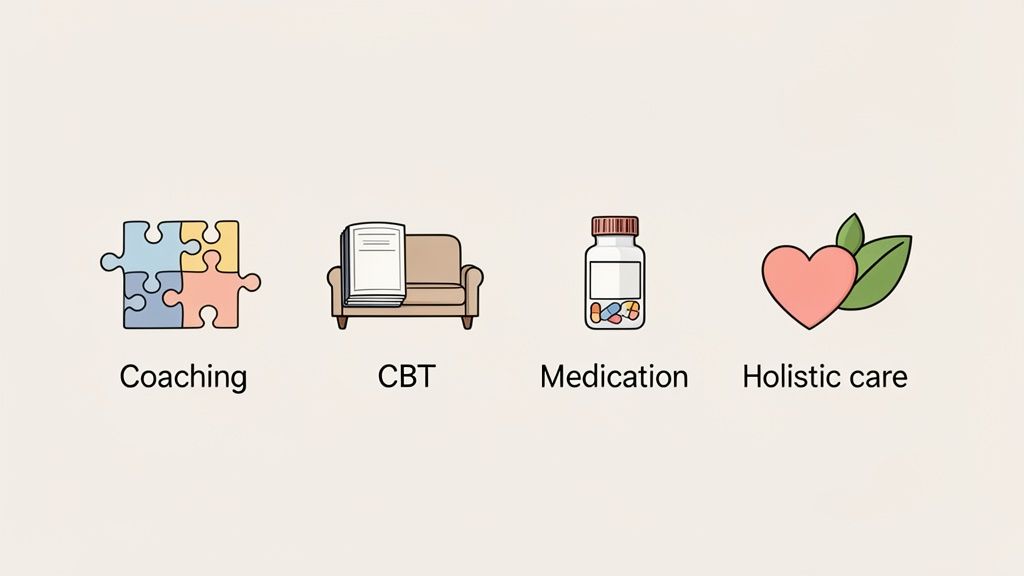
To make sure everything works together, clinicians often use structured treatment plans to map out a patient's journey. These roadmaps help ensure therapies, skill-building, and any medications are aligned toward the same goals.
Core Approaches for Managing ADHD
Truly effective ADHD management is never about just one thing. It's a multi-layered approach that targets both the biological and behavioral sides of the condition. The goal isn't just to manage symptoms, but to build real, lasting skills.
- Psychoeducation: This is always ground zero. Just understanding how the ADHD brain is wired—its unique challenges with executive functions and regulating emotions—is incredibly empowering. It helps you reframe the narrative from one of personal failure to one of neurological difference.
- Executive Function Coaching: This is where the rubber meets the road. It’s practical, hands-on support that helps you build systems for the real world. A coach provides strategies and accountability for things like time management, organization, and just getting started on a task, turning abstract goals into concrete habits.
- Medication: For many people with ADHD, stimulant or non-stimulant medication is a game-changer. It can dramatically improve focus and dial down impulsivity, which makes it much easier to actually engage in therapy and use the new skills you're learning. It doesn’t "cure" ADHD, but it can create the mental bandwidth for other strategies to finally stick.
Therapeutic Strategies for Anxiety
Anxiety treatment is all about calming the nervous system and rewiring the thought patterns that keep you stuck in a cycle of worry and avoidance. The end goal is to build resilience so you can face your fears without feeling completely overwhelmed.
Cognitive Behavioral Therapy (CBT) is widely considered the gold standard for anxiety disorders. It’s a powerful approach that teaches you to identify, challenge, and reframe the distorted, catastrophic thoughts that fuel anxious feelings. You can learn more about how it works in our deep dive on what is Cognitive Behavioral Therapy.
Other powerful tools include mindfulness-based practices and Acceptance and Commitment Therapy (ACT). These therapies help you learn to observe anxious thoughts from a distance, without getting tangled up and carried away by them.
Treating Co-Occurring ADHD and Anxiety
When someone has both conditions, the order of operations is critical. More often than not, clinicians find that the chronic, daily stress of living with untreated ADHD is a primary source of anxiety. It makes perfect sense—the constant battle with deadlines, organization, and emotional control creates the perfect breeding ground for worry to take over.
The most effective strategy is often to address the ADHD first. By treating the root executive function challenges, the downstream anxiety frequently lessens or even resolves on its own.
Think about it: when medication helps you focus and finish your work, there are fewer real-world reasons to feel anxious about your performance. When coaching helps you create organizational systems, the panic that comes from a chaotic environment starts to fade.
This person-first philosophy is at the heart of everything we do at the Sachs Center. Our telehealth evaluations are specifically designed to untangle these co-occurring conditions, so we can be sure the treatment plan is targeting the true source of the struggle. By combining evidence-based therapies with practical skill-building, we help people manage the challenges of their neurotype and build a life that truly works for their unique brain.
A Few Common Questions About ADHD and Anxiety
When you're trying to figure out the difference between ADHD and anxiety, it's natural to have a lot of questions. We get it. Below, we've answered some of the most common ones we hear, building on what we've already covered to give you a clearer path forward.
Think of this as a quick-reference guide to help you make sense of the confusion.
Can a Person Have Both ADHD and Anxiety?
Yes, absolutely. In fact, it's incredibly common for the two to show up together. When two conditions exist at the same time, it’s known as comorbidity, and the link between ADHD and anxiety is well-established.
Often, one directly fuels the other. Living with the daily frustrations of untreated ADHD—like forgetting important deadlines, struggling with organization, or misreading social situations—creates a perfect storm for chronic stress and worry. Over time, that constant feeling of being overwhelmed can easily develop into a full-blown anxiety disorder.
Can ADHD Medication Make Anxiety Worse?
This is a tricky one because it really depends on the person. For a lot of people, stimulant medication is a game-changer. By helping the brain focus and calming impulsivity, it often quiets the very chaos that was causing their anxiety in the first place, leading to a profound sense of relief.
But for some, the physical side effects of stimulants (like a faster heart rate) can feel a lot like anxiety, making them feel even more on edge. This is exactly why working with a skilled doctor is non-negotiable. It takes careful, collaborative work to find the right medication and dose that treats the ADHD without amplifying anxiety.
Is It Better to Treat ADHD or Anxiety First?
When both are present, most experts agree on a "root cause" strategy, which usually means treating the ADHD first. Why? Because the executive function struggles and emotional rollercoaster of ADHD are often what’s driving the anxiety.
When you address the core ADHD symptoms, you start to remove the daily triggers for worry. Better focus, organization, and emotional regulation can have a massive ripple effect, often reducing anxiety symptoms so much that they become manageable or even resolve on their own.
While tackling ADHD first is a proven strategy, everyone’s situation is different. A good treatment plan is always personalized and created with a professional who truly understands your unique symptoms and life story.
How Can I Support a Loved One with These Symptoms?
Your support can make a world of difference for a friend, partner, or family member who is struggling. The key is to lead with empathy and patience.
Here are a few practical ways to show up for them:
- Listen Without Judging: Sometimes, the best thing you can do is just listen. Create a safe space where they can be honest about what they're going through. Simply acknowledging their struggle ("That sounds so tough") is far more helpful than jumping in with advice.
- Encourage a Professional Look: Gently suggest they talk to a professional to get real clarity. You can make it feel less intimidating by offering to help research specialists or even sit with them while they book an appointment.
- Drop the Assumptions: It’s easy to misinterpret symptoms as character flaws. Try to remember that behaviors like disorganization or forgetfulness are often rooted in a neurological condition, not laziness or a lack of caring.
- Offer Specific, Practical Help: Instead of a vague "let me know what you need," try offering something concrete. Ask, "Can I help you sort through that pile of mail?" or "Want me to sit with you while you make that phone call?" This kind of "body doubling" can be incredibly helpful.
Your role isn't to fix them but to be a compassionate ally. A little encouragement and understanding can go a long way on their journey to getting help.
At the Sachs Center, our specialists are experts at teasing apart the complexities of ADHD and anxiety, particularly in adults who have learned to mask their symptoms. If you’re ready for diagnostic clarity and a real plan forward, our telehealth evaluations are a convenient first step.
Learn more about our ADHD and Autism testing services and book your evaluation today.
