

When autism and ADHD show up together, it creates a unique neurotype people are starting to call AuDHD. This isn’t just about having two separate conditions side-by-side. Instead, it’s a completely integrated experience where the traits of both conditions interact, leading to a very distinct set of strengths and challenges.
This combination often creates a complex internal push-and-pull, a dynamic that fundamentally shapes how a person sees and interacts with the world.
The Push and Pull of AuDHD
Living with both autism and ADHD can feel like trying to run two different operating systems on one computer—at the same time. The autistic part of the brain often craves routine, predictability, and the ability to dive deep into a single focus. Meanwhile, the ADHD part thrives on novelty, spontaneity, and rapid shifts in attention.
This creates an internal conflict that is both confusing and incredibly exhausting.
For example, you might spend hours meticulously planning out your day (a classic autistic trait for creating structure), only to have your ADHD-driven impulsivity completely derail those plans for something that seems more exciting in the moment. This constant internal battle isn't just a simple case of being indecisive; it's a fundamental clash between two powerful neurological drives. Many people with AuDHD describe this feeling as being simultaneously under-stimulated and overstimulated.
A Common Neurological Overlap
The fact that autism and ADHD so often appear together is no coincidence—it points to a deep neurological connection. A growing body of research shows that these conditions share underlying genetic markers and patterns in brain development.
AuDHD isn't some new or rare phenomenon. One massive study of over 2.3 million people found that 27% of autistic adults (without an intellectual disability) also have co-occurring ADHD. That's a rate ten times higher than in the general population.
This visual helps illustrate how the traits of ADHD and Autism can combine to form the unique experience of AuDHD.
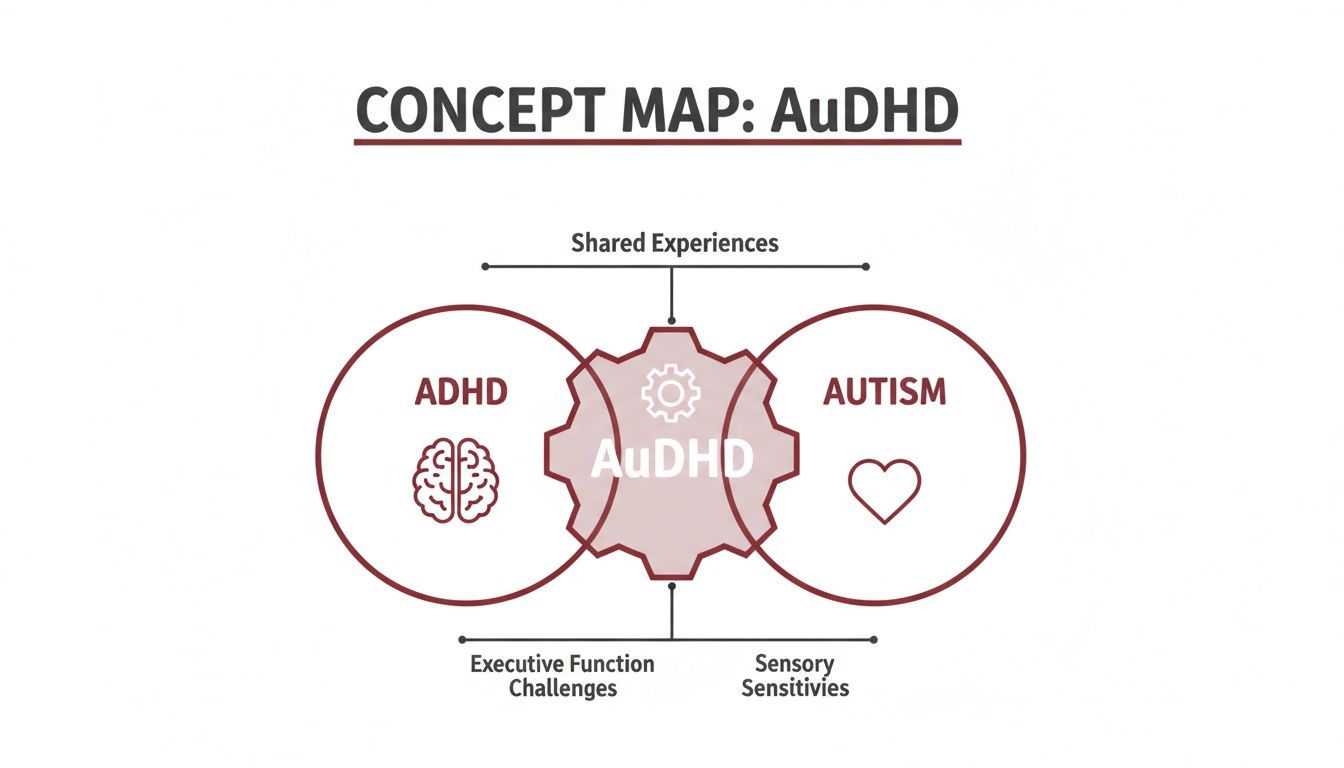
As the image shows, while each condition has its own distinct traits, their overlap creates a third, blended experience. Understanding this shared biology is so important because it validates the lived experiences of countless people who feel they don't quite fit neatly into either the "autism" or "ADHD" box alone.
To dive deeper into this, you might find our article exploring if ADHD is a form of autism helpful.
This overlap also explains why strategies designed for only one condition often fall flat for individuals with AuDHD. To be truly effective, support has to address the integrated experience, acknowledging how one set of traits is constantly influencing the other.
To give you a clearer, at-a-glance picture of how these traits can present, here’s a simplified comparison.
ADHD vs Autism vs AuDHD At a Glance
| Trait Category | ADHD (Primarily) | Autism (Primarily) | AuDHD (Common Overlap) |
|---|---|---|---|
| Social Interaction | May interrupt, talk excessively, or miss cues due to inattention. Craves social novelty. | Finds social rules confusing, prefers predictable interactions, may avoid eye contact. | A constant push-pull: a desire for social connection (ADHD) clashes with social exhaustion and confusion (Autism). |
| Focus & Attention | Difficulty sustaining focus, easily distracted by external stimuli, jumps between tasks. | Intense, deep focus ("hyperfocus") on specific interests. Difficulty shifting focus away from them. | Alternates between being unable to focus and being stuck in an intense hyperfocus you can't break away from. |
| Routine & Structure | Finds routines boring, craves spontaneity and novelty, struggles with consistency. | Thrives on predictability and routine. Becomes distressed by unexpected changes. | Feels deep anxiety when routines are broken (Autism) but struggles to stick to them due to a need for novelty (ADHD). |
| Sensory Processing | Seeks sensory stimulation (fidgeting, moving, loud music) to stay engaged. | Experiences sensory overload (hypersensitivity) or is under-responsive to senses (hyposensitivity). | Experiences both sensory seeking and sensory avoidance, sometimes at the same time. May feel overstimulated and under-stimulated simultaneously. |
This table is just a starting point. Every individual's experience is unique, but seeing the patterns laid out like this can help clarify why AuDHD feels so different from having just one or the other.
Recognizing the Signs of AuDHD in Everyday Life
Understanding AuDHD in a clinical sense is one thing, but seeing how the constant push-and-pull between autism and ADHD actually plays out in real life is where true insight begins. These traits aren’t abstract concepts; they show up at the breakfast table, in the classroom, and during those high-pressure project deadlines at work.
For many, life feels like a series of confusing contradictions. It’s the child who desperately needs a predictable morning routine to feel secure, yet is constantly sidetracked by an impulsive urge to build a LEGO masterpiece instead of getting dressed. It’s also the adult who can map out a passion project with meticulous detail but finds it impossible to take that first simple step.
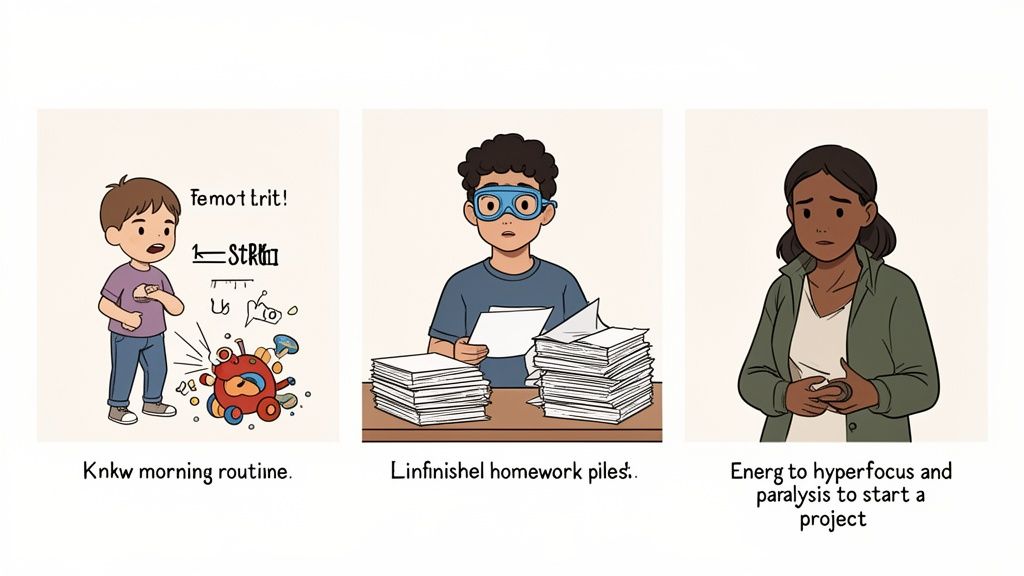
This internal tug-of-war between the autistic need for structure and the ADHD pull toward novelty is a hallmark of the AuDHD experience, no matter your age.
AuDHD Signs in Children and Teens
In kids and teens, AuDHD often looks like an unpredictable blend of rigidity and chaos. A child might have an intense, highly specific interest they can focus on for hours (a classic autistic trait) but struggle to finish a simple chore with multiple steps because of executive dysfunction (a classic ADHD trait).
This dynamic frequently leads to misunderstandings. Parents and teachers might see a child as being willfully defiant when they're actually neurologically overwhelmed.
Here are a few common scenarios you might see:
- Social Paradoxes: A teen might crave deep, meaningful friendships but find the unwritten, ever-shifting rules of social groups completely exhausting.
- Academic Struggles: They might be incredibly intelligent but consistently fail to turn in homework. It’s not that they don't know the material; it’s that initiating the task feels like an insurmountable hurdle.
- Sensory Challenges: A child might actively seek out intense sensations like spinning one moment, then have a complete meltdown over the texture of their socks the next.
These sensory processing differences are a huge part of the AuDHD experience. To get a better handle on it, this guide on what is sensory integration is a great resource.
AuDHD Signs in Adulthood
As people with AuDHD get older, the signs often become more internalized, hidden behind years of developing complex coping mechanisms. The conflict between the autistic need for predictability and the ADHD brain’s constant craving for stimulation creates significant challenges at work and in relationships.
The internal monologue of an AuDHD adult might sound something like this: "I need to stick to my work plan to feel in control, but this plan is so boring that my brain is screaming for a distraction." This constant battle leads to burnout, anxiety, and a nagging feeling of not living up to one's potential.
This is especially true for women and BIPOC individuals, whose traits are often missed, misdiagnosed, or dismissed entirely. Their ability to "mask" or camouflage their internal struggles can be so effective that they suffer in silence, their exhaustion completely invisible to the outside world.
An AuDHD adult's day might look like this:
- Workplace Dynamics: Hyperfocusing on a complex data analysis project for hours on end, but finding it nearly impossible to answer a simple, routine email.
- Social Battery Drain: Eagerly making social plans because the ADHD side craves connection, only to be filled with dread and sensory overload as the event gets closer.
- Chronic Inertia: Feeling completely "stuck" or paralyzed. You desperately want to be productive but are physically unable to start, leading to vicious cycles of procrastination and shame.
This growing awareness is crucial. The prevalence of autism has surged over the past two decades. Back in 2000, 1 in 150 children in the U.S. was diagnosed with autism. By 2022, the CDC reported that number had jumped to 1 in 31 children aged 8—a 312% increase. This highlights just how urgent the need for better awareness and accessible diagnostic services has become.
How to Get a Clear and Accurate AuDHD Diagnosis
That moment of realization—when you suspect the constant internal push-and-pull you've felt your whole life might actually be AuDHD—is a huge first step. The next, and most crucial, is getting a clear, accurate diagnosis. This isn't just about getting a label; it’s about finally getting validation for your experiences and unlocking the door to support that truly works.
A lot of people begin this journey with online quizzes or self-screeners. While these can be fantastic tools for self-discovery, it's so important to know what they can and can't do. A screening tool might point you in the right direction, but it can never replace a comprehensive clinical evaluation with a qualified psychologist.
A formal diagnosis is what opens doors. It’s the key to getting workplace accommodations, finding the right therapeutic strategies, and gaining a much deeper understanding of your own unique brain. It’s the difference between suspecting you have autism and ADHD and knowing—and that knowledge is incredibly empowering.
What to Expect from a Telehealth Evaluation
The thought of a formal assessment can feel pretty intimidating, but telehealth has made the entire process more accessible and comfortable than ever. At the Sachs Center, our specialists conduct these evaluations virtually, which means you can be in your own familiar, low-stress environment. This is a game-changer for many neurodivergent people, as it cuts down on the sensory overload and anxiety that often come with traditional clinical settings.
The process itself is straightforward and designed to get a complete picture of you and your life.
-
In-Depth Clinical Interview: This is really the heart of the evaluation. It's a guided, two-hour conversation where a psychologist will ask you about everything from your developmental history and childhood to your social life, career, and current struggles. We’re focused on understanding your internal world, not just what can be seen on the surface.
-
Validated Self-Report Measures: You'll also complete a series of standardized, evidence-based questionnaires. These aren't just simple checklists; they are carefully designed instruments that help quantify traits related to both autism and ADHD.
Our clinicians are experts at identifying AuDHD, even in adults who have become masters at "masking" their traits. We know how to look past the surface and see the immense effort it takes to navigate a world that wasn't built for your neurotype.
Screening vs. Clinical Diagnosis: A Crucial Distinction
It’s easy to mix up a quick online screening with a formal clinical diagnosis, but they serve completely different purposes. Think of it this way: a screening is like a weather app telling you there’s a chance of rain. A clinical diagnosis is the full meteorological report explaining why it's going to rain, when it will start, and how heavy it will be.
A professional evaluation doesn't just ask if you have certain traits; it explores how those traits have impacted your life. This deep, contextual understanding is what makes a formal diagnosis so powerful and validating.
A screening can give you a hint, but only a comprehensive evaluation from a trained expert provides the certainty you need to move forward with confidence.
The Power of a Formal Diagnostic Report
Once your evaluation is complete, you’ll receive a formal document from your psychologist. This isn't just a piece of paper—it's a powerful tool. Depending on what you need, this could be a diagnostic letter or a more detailed, multi-page report.
Here’s what this document empowers you to do:
- Request Workplace Accommodations: A formal diagnosis is what you need to access legal protections and reasonable adjustments at work, like a quieter space or more flexible hours.
- Access Coordinated Care: You can share the report with your other healthcare providers—like a psychiatrist or primary care doctor—to make sure everyone is on the same page when it comes to treatment options like medication.
- Validate Your Experience: For so many people, the most profound outcome is the official confirmation that their struggles are real and have a neurological basis. This validation can be incredibly healing, helping to dismantle years of self-doubt and shame.
If you’re ready to gain this kind of clarity, you can learn more about the specific steps in our autism and ADHD diagnosis process and see how we can tailor it to you. A formal evaluation is the first real step toward building a life that finally works with your brain, not against it.
Finding Support That Actually Understands AuDHD
Getting an AuDHD diagnosis can feel like a huge weight has been lifted. It's validating, but it’s also the first step on a new path. The real work begins now: finding support that truly gets the unique push-and-pull between autism and ADHD.
This isn't about "fixing" who you are. It’s about building a personalized toolkit to help you thrive in a world that wasn't necessarily built for your brain. It means moving past generic advice and finding strategies that work with your neurotype, not against it.
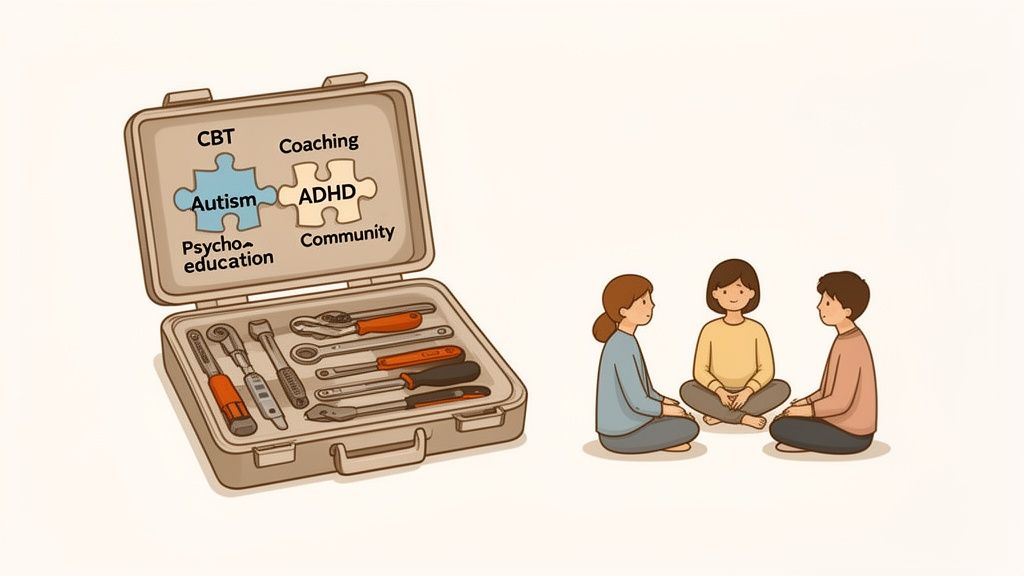
This journey often involves more than just therapy. It’s about finding a whole ecosystem of services that empower you and connect you with a community that understands.
Building Your Personalized AuDHD Toolkit
One of the most powerful tools in your kit can be Cognitive Behavioral Therapy (CBT). It's best to think of CBT not as a cure, but as a practical way to build real-world skills. For someone with AuDHD, it can be a game-changer for managing the anxiety that comes from social guesswork and the executive function snags that make everyday life feel like an uphill battle.
A good CBT therapist can help you tackle things like "task inertia"—that frustrating feeling where you desperately want to start something but feel completely stuck. By exploring the thought patterns that keep you paralyzed, you can create small, concrete steps to get moving again.
Another key piece of the puzzle is psychoeducation. This is like finally getting the user manual for your own brain. It's incredibly empowering because it reframes your struggles not as personal failures, but as understandable differences in your neurology.
Psychoeducation helps you connect the dots between your daily experiences—like sensory overload or a drained social battery—and the underlying mechanics of AuDHD. This knowledge is the foundation for self-advocacy and creating a life that honors your needs.
When you put these approaches together, you create a solid foundation for growth. But the best support often comes from programs designed specifically for the AuDHD mind.
Specialized Protocols and Community Support
Because AuDHD is so complex, a one-size-fits-all approach just doesn't cut it. A strategy that works for ADHD alone might feel chaotic to an autistic system that needs predictability. On the flip side, an autistic-focused strategy might not account for ADHD-driven impulsivity.
Specialized methods like the Sachs Protocol blend different therapeutic elements to create a cohesive plan. The goal is to find harmony between your traits, not treat them as two separate issues. This ensures that strategies for managing executive dysfunction don’t clash with your need for sensory regulation and routine.
Beyond individual work, never underestimate the power of community. Finding your "neurotribe" is a critical part of the journey.
- Social Skills Groups: These groups provide a safe, structured space for kids and teens to learn and practice social skills without the fear of getting it wrong.
- Adult Support Groups: Often called 'neurotribes,' these groups are a place for adults to share their lived experiences, swap coping strategies, and finally feel understood by people who just get it.
Connecting with others who share your neurotype is a powerful antidote to the isolation that so many with AuDHD feel. This full spectrum of support—from individual therapy and coaching to a strong community—is what helps you truly thrive.
Here's a quick look at the support services we offer at the Sachs Center to help you build your toolkit.
Sachs Center Support Services Overview
| Service | Best For | Key Outcome | Format |
|---|---|---|---|
| Individual Therapy (CBT/DBT) | Adults & teens seeking one-on-one support for anxiety, executive function, and emotional regulation. | Develop personalized coping strategies and build self-awareness to manage daily AuDHD challenges. | Virtual & In-Person |
| AuDHD Coaching | Adults needing practical, action-oriented strategies for work, school, and home life. | Improve organization, time management, and task initiation with accountability and skill-building. | Virtual |
| The Sachs Protocol | Individuals looking for a comprehensive, integrated approach to address overlapping AuDHD traits. | Achieve a harmonious balance between ADHD and autistic needs through a blended therapeutic plan. | Virtual & In-Person |
| Social Skills Groups | Children & teens (ages 8-17) who want to build confidence in social situations. | Learn to navigate social cues, build friendships, and reduce social anxiety in a supportive setting. | In-Person |
| Adult Support Groups | Adults seeking connection and shared understanding with other neurodivergent individuals. | Gain validation, reduce feelings of isolation, and exchange practical advice with peers. | Virtual |
Each of these services is designed to meet you where you are and provide the specific tools you need. Whether you're just starting your journey or looking to refine your strategies, there's a path forward.
Unlocking Academic and Standardized Test Accommodations
For many students with autism and ADHD, the typical classroom or testing center just isn't a level playing field. While a formal AuDHD diagnosis is a huge step for getting support at work, unlocking accommodations in high-stakes academic settings often requires a different kind of tool.
This is where neuropsychological testing comes into the picture. It’s not something you need for a standard clinical diagnosis, but it’s the 'gold standard' for securing formal academic support. We’re talking about things like extra time on tests like the SAT, ACT, GRE, or GMAT, and establishing an Individualized Education Program (IEP) or 504 plan at school.
Here’s a simple way to think about it: A diagnostic evaluation tells you what the neurotype is. A neuropsychological evaluation explains, in incredible detail, how that neurotype affects learning and thinking, giving schools and testing boards the hard data they need.
What a Neuropsychological Evaluation Actually Measures
Unlike a standard diagnostic assessment, a neuropsychological evaluation is a deep dive into the brain's "operating system." It’s a comprehensive process that measures a whole range of functions to create a detailed map of a student's cognitive landscape—their unique strengths and challenges. This isn't just one test; it’s a whole battery of them designed to build a complete profile.
Key areas a neuropsych evaluation looks at include:
- Cognitive Abilities (IQ): This gives us a baseline understanding of a student’s reasoning and problem-solving skills.
- Academic Achievement: The testing looks at specific skills in reading, writing, and math to spot any gaps between a student's potential and what they're actually able to produce in an academic setting.
- Executive Functioning: This is a big one for AuDHD. It assesses critical skills like planning, organization, time management, and impulse control.
- Memory and Learning: The evaluation examines both short-term and long-term memory and looks at how efficiently a student can process and hold onto new information.
The final result is a detailed, multi-page report that does more than just give a diagnosis; it tells a story. It explains why a brilliant student might run out of time on exams or why organizing a research paper feels impossible, connecting those struggles directly to their neurological wiring.
From Hurdle to Empowerment
It’s easy to look at this kind of extensive testing as just one more obstacle. But it’s much more helpful to see it as a powerful tool for advocacy. That detailed report provides the objective evidence needed to justify specific accommodations, making sure they’re tailored to what the student actually needs.
The goal of accommodations is not to give an unfair advantage, but to remove an unfair disadvantage. Neuropsychological testing provides the roadmap to ensure every student has an equitable opportunity to demonstrate their knowledge and skills.
For example, the data might clearly show that a student's processing speed is significantly slower, making a powerful case for extended time. Or it might highlight working memory challenges, justifying the use of a calculator or a formula sheet during an exam. To get a better sense of what's possible, you can check out our detailed guide on ADHD test accommodations.
Ultimately, this testing empowers students and their families. It provides the official documentation needed to level the playing field, allowing their true abilities to shine. Of course, accommodations are just one piece of the puzzle. Understanding how to build broader support systems through things like creating inclusive learning environments is just as crucial for a student's entire academic journey. When students get the right support, they're set up for success in school and beyond.
Your AuDHD Questions Answered
Exploring the possibility of autism and ADHD, especially when they show up together, is bound to bring up a lot of questions. We get it. This last section is dedicated to giving you clear, straightforward answers to the most common things we hear from individuals and families just like you. Our goal is to pull back the curtain on the process and give you the practical information you need to move forward with confidence.
So, whether you're wondering about the different kinds of testing, how a diagnosis even works for an adult who has mastered masking, or what to do after getting the results, we've got you covered.
Diagnostic Evaluation vs. Neuropsychological Testing
One of the first hurdles is often understanding the difference between a diagnostic evaluation and neuropsychological testing. While they both sound similar, they serve very different purposes. Think of it like seeing your primary care doctor for a specific issue versus going to a specialist for a full-body workup—both are incredibly useful, but they answer different questions.
A diagnostic evaluation is designed to answer one main question: do you meet the clinical criteria for ADHD, Autism, or both (AuDHD)? It’s a focused, two- to three-hour virtual process that includes a deep-dive clinical interview and proven self-report questionnaires. The result is a diagnostic letter or a concise report, which is exactly what you need for self-understanding, asking for workplace accommodations, or talking to a psychiatrist about medication.
On the other hand, neuropsychological testing is a much broader and more intensive assessment. It measures a whole range of cognitive and academic skills—things like IQ, memory, processing speed, and executive functioning. This comprehensive process results in a very detailed report, often around 25 pages long, and is specifically what’s needed to secure formal academic accommodations like extra time on standardized tests (SAT, GRE) or to get an IEP or 504 plan set up in a school.
Can You Diagnose an Adult Who Masks Their Traits?
Absolutely. This is one of our specialties. Our clinicians are experts at identifying AuDHD in adults who have become masters of "masking" or camouflaging their traits. We see this all the time, particularly with women and BIPOC individuals, whose neurodivergent traits have historically been missed or misunderstood. We know that masking isn't a choice—it's a survival strategy you've likely spent a lifetime perfecting.
Our interview process is specifically designed to look past the surface behaviors. We care about your internal experience and the invisible effort it takes to get through a neurotypical day.
We'll talk through the things that really tell the story:
- Your Social Battery and Burnout: We want to hear about the massive amount of energy it takes to socialize and the recovery time you need afterward.
- Sensory Experiences: We'll explore how you experience the world—the sensitivities to light, sound, or textures that you may have learned to ignore or suppress.
- Executive Function Effort: We help uncover the hidden mental load it takes to plan, organize, and start tasks that seem to come easily to others.
Our clinicians don't just look at test scores in a vacuum. We interpret them within the context of your entire life story. This allows us to see the real you behind the mask and provide a diagnosis that validates your experiences, often bringing an incredible sense of relief and self-acceptance.
How a Telehealth Evaluation for AuDHD Works
Our telehealth evaluations are every bit as effective as in-person assessments. In fact, for many neurodivergent people, they’re actually a more comfortable and accurate way to get evaluated. The whole process is done remotely, which means you can skip the stress of traveling to an unfamiliar office. Being in your own space can lower anxiety and sensory stress, allowing you to be more genuinely yourself.
The process is simple and supportive:
- Comprehensive Clinical Interview: You’ll meet one-on-one with one of our psychologists on a secure video call. It's an in-depth conversation about your history, your strengths, and the challenges you're facing.
- Validated Online Assessments: You'll fill out a series of evidence-based questionnaires online, at your own pace. All the tools we use have been validated for virtual use, so you can trust the results are reliable.
This accessible format gives you the same high-quality, professional expertise and a formal, legitimate diagnosis without the extra stress of a clinical setting.
Your Immediate Next Steps After a Diagnosis
Getting a diagnosis is a huge moment, but it’s really just the beginning. Your diagnostic report is the key that opens the door to the right support, and our team will give you a clear path forward so you're never left wondering, "Now what?" The first step is to use that formal document to advocate for yourself.
You can use your diagnostic report to:
- Request Accommodations: Share it with HR to formally request the reasonable accommodations you need to thrive at work.
- Seek Coordinated Care: Give a copy to your psychiatrist or doctor to have an informed discussion about medication.
- Access School Support: Use it to kickstart the process of getting an IEP or 504 plan for your child.
Beyond these practical steps, we give you a tailored list of resources to build your support system. Your journey might continue with therapy, joining a 'neurotribe' support group, or enrolling your child in one of our social skills groups. A diagnosis gives you a roadmap, and we're here to help you read it.
At the Sachs Center, we are dedicated to providing clarity and support for your neurodivergent journey. If you are ready to gain a deeper understanding of yourself or a loved one, we invite you to book a comprehensive evaluation with our expert team. Learn more about our services and schedule your appointment today.
