

Let's clear this up right away: ADHD is not a form of autism. They are two distinct neurodevelopmental conditions, each with its own set of diagnostic criteria.
But if you’ve noticed similarities, you’re not wrong. They often share traits and can even occur together, which is why so many people find themselves asking this very question.
Unpacking the Connection Between ADHD and Autism

While they aren’t the same thing, the relationship between ADHD and Autism Spectrum Disorder (ASD) is anything but simple.
Think of them as two different operating systems for the brain. Both are perfectly valid ways of processing the world, but they run on different core programming and come with their own unique strengths and challenges.
Here, we'll dive into the "why" behind their differences and surprising connections. First, let's start with a high-level comparison to build a clear framework for what makes each condition unique.
Core Differences at a Glance
Getting a handle on the fundamental distinctions is the first step toward real clarity. While both conditions can impact executive functions like organization and emotional regulation, what drives these challenges is completely different.
To put it simply:
- ADHD primarily centers on challenges with attention regulation, impulsivity, and hyperactivity.
- Autism Spectrum Disorder is defined by core differences in social communication and interaction, along with restricted interests and repetitive behaviors.
This initial separation is crucial. It helps us understand how a similar-looking behavior—like struggling in a social setting—could stem from completely different roots. For someone with ADHD, it might be due to distraction or impulsively interrupting. For an autistic person, it could be related to difficulty interpreting non-verbal cues.
For a side-by-side view, this table breaks down the core traits.
Quick Look ADHD vs Autism Core Trait Comparison
| Domain | Attention-Deficit/Hyperactivity Disorder (ADHD) | Autism Spectrum Disorder (ASD) |
|---|---|---|
| Social Interaction | May interrupt, overshare, or seem distracted due to impulsivity and inattention. | Difficulties with social-emotional reciprocity, nonverbal communication, and developing relationships. |
| Communication | Can be talkative and prone to interrupting, but language structure is typically unaffected. | May have delayed speech, unique language patterns (like echolalia), or difficulty with conversational back-and-forth. |
| Attention | Difficulty sustaining focus (unless it's a high-interest topic), easily distracted by external stimuli. | Attention is often intensely focused on specific interests ("special interests"); difficulty shifting focus away. |
| Behavior | Characterized by hyperactivity (fidgeting, restlessness) and impulsivity (acting without thinking). | Characterized by restricted, repetitive behaviors, insistence on sameness, and routines. |
| Sensory Issues | Sensory-seeking behavior is common (craving stimulation), but can also have sensitivities. | Often experiences intense sensory sensitivities (hypersensitivity) or is under-responsive (hyposensitivity). |
This table provides a snapshot, but it's important to remember that these traits exist on a spectrum. If you're wondering how these differences play out in real life, our guide on whether it's ADHD or autism can provide even more insight.
The Overlap That Causes Confusion
So, where does all the confusion come from? It's largely because ADHD and autism frequently co-occur.
In fact, studies show that 50% to 70% of individuals with autism also meet the criteria for ADHD. This incredibly high rate of comorbidity is why so many people see overlapping traits. It's not that one is a subset of the other; it’s that it's very common for a person to navigate the world with the challenges and strengths of both neurotypes at the same time.
A correct diagnosis is more than a label—it's a roadmap to effective support. Recognizing that ADHD and autism are separate conditions, even when they appear together, is the first critical step in creating strategies that truly work for an individual's unique neurotype.
Understanding Each Condition on Its Own Terms

To really get why ADHD isn't a form of autism, we first have to look at them as two completely separate conditions, each with its own core features. Think of it like learning the rules for basketball and soccer. Sure, both involve a ball and some serious athletic skill, but the goals, rules, and how you play the game are fundamentally different.
It’s the same with ADHD and autism. Each has its own unique "rulebook." Once you understand their individual profiles, it becomes much clearer why they are distinct, even when some of the outward behaviors can look strikingly similar. Let’s break them down one by one, without all the dense clinical jargon.
Decoding Attention Deficit Hyperactivity Disorder
At its heart, ADHD is a condition of regulation. It’s about the brain’s struggle to consistently regulate attention, impulses, and energy. We often hear it described as a simple inability to focus, but that’s not the whole story. The reality is far more nuanced. Someone with ADHD might find it nearly impossible to start a boring task, yet they can slip into an intense state of hyperfocus on something that truly captivates them.
I like to think of the ADHD brain’s executive function system as a brilliant but hopelessly disorganized chef. This chef can whip up the most incredible, creative dishes (that’s the hyperfocus), but the kitchen is an absolute disaster. Ingredients are lost, timers are ignored, and multiple pots are boiling over because a new, more exciting recipe idea just popped into their head.
ADHD shows up in three main ways, and getting familiar with the specific ADHD diagnostic criteria is key.
- Primarily Inattentive Presentation: This is the chef who keeps misreading the recipe, forgetting key ingredients, and completely losing track of cooking times. They might look like they're daydreaming or just zoned out.
- Primarily Hyperactive-Impulsive Presentation: This is the chef who can’t stand still, is constantly tapping utensils on the counter, and impulsively throws in extra spices without measuring anything.
- Combined Presentation: This version is a mix of both worlds—a restless, disorganized chef who is both easily distracted and constantly on the move.
Unpacking Autism Spectrum Disorder
Autism Spectrum Disorder (ASD), on the other hand, is built around a completely different set of core traits. It’s all about how a person perceives the world, communicates, and navigates social interactions, combined with the presence of deep, specific interests and repetitive behaviors.
If the ADHD brain is our disorganized chef, the autistic brain is more like a high-fidelity sound system. It’s incredibly precise, picking up every single detail in the music—the faintest whisper, the most subtle background note, the exact frequency of an instrument. This can be an incredible strength, allowing for deep pattern recognition and a rich appreciation for detail.
But that same sensitivity means the system gets overwhelmed easily. A sudden loud noise, too many competing sounds, or an unexpected key change can feel jarring and deeply uncomfortable. This analogy helps make sense of key autistic traits:
- Social Communication Differences: Trying to interpret unspoken social rules can feel like listening to a song where the lyrics are in a subtle, unfamiliar language that everyone else seems to know.
- Restricted and Repetitive Behaviors: Sticking to familiar routines and listening to the same songs over and over provides comfort. It reduces the chance of being hit with unexpected, overwhelming "noise."
- Sensory Sensitivities: That high-fidelity system can make everyday things—like the hum of a refrigerator, fluorescent lights, or the tag on a shirt—feel intensely loud, bright, or painful.
While both an ADHDer and an autistic person might struggle in a loud, crowded room, the reason why is completely different. The person with ADHD is likely distracted by dozens of competing conversations, unable to follow just one. The autistic person, however, is probably experiencing painful sensory overload from the sheer volume and chaos of it all.
To give individuals and families a real-world understanding of ADHD and autism, it’s vital to provide clear and effective patient education resources that spell out these differences. By defining each condition on its own terms, we can move past the surface-level confusion and toward a more accurate and compassionate view of each unique neurotype.
Why the Lines Between ADHD and Autism Get Blurry
If ADHD and autism are such different conditions, why is there so much confusion? It’s a fair question, and the answer is buried deep in our biology. The overlap lies in the shared genetic blueprints and brain wiring that connect both conditions. This is a huge reason the question "is ADHD a form of autism" comes up so often.
Think of it like baking. You might have two different recipes—one for a cake, another for bread. Both start with a few of the same core ingredients, like flour and water. But the end results are completely different because of the other ingredients you add and the precise instructions you follow.
Neurodevelopmental conditions work in a strikingly similar way. ADHD and autism often draw from the same pool of genetic "ingredients," but the way they combine and express themselves creates entirely unique outcomes.
Shared Genetic Roots
Modern research has made it clear: ADHD and autism have a major genetic overlap. A significant number of the genes that increase the likelihood of having ADHD are the very same ones linked to autism.
This doesn't mean they are the same condition. It simply means they spring from a similar genetic landscape. You can think of it as a shared family tree of neurological development. This common ground helps explain why traits like sensory issues or executive function struggles can show up in both.
Understanding this is especially important when exploring the complexities of adult ADHD and autism, because it gives a scientific reason for why so many people see traits of both in themselves or their loved ones.
Similar Brain Wiring and Development
It’s not just about genetics. The brains of individuals with ADHD and autism also show similarities in how certain areas develop and talk to each other. One of the most important regions is the prefrontal cortex—the brain’s "CEO" in charge of things like making decisions, planning ahead, and controlling impulses.
Both conditions involve differences in how this region functions, which is why challenges with executive functions are a hallmark of both ADHD and autism. But the way these struggles show up is often quite different.
- In ADHD, the issue is often about regulation and consistency. The brain’s "CEO" gets easily distracted and struggles to prioritize what’s important.
- In Autism, the "CEO" might be intensely focused on a specific system or routine, making it incredibly difficult to shift attention or adapt when things don’t go as planned.
This neurological overlap is why a behavior can look the same on the surface but have completely different roots. A clinician's job during an evaluation isn't just to figure out what is happening, but to dig deeper and understand why it's happening.
How These Overlaps Manifest in Real Life
This shared biology creates a fascinating intersection where traits can blend and sometimes even seem contradictory. It’s not that ADHD is a form of autism, but rather that they can share underlying mechanisms that produce similar-looking behaviors.
For instance, both conditions can affect dopamine, a key neurotransmitter tied to motivation and reward. This can lead to:
- Interest-based attention: The ability to hyperfocus with incredible intensity on topics of great personal interest.
- Emotional dysregulation: Intense feelings and difficulty managing or expressing strong emotions.
- Sensory processing differences: Being either over- or under-sensitive to sounds, sights, smells, and textures.
Ultimately, while the starting points in our genes and brain development can be similar, the paths they take diverge significantly. This creates two distinct neurotypes, each with its own unique profile of strengths and challenges. The blurriness comes from seeing the shared ingredients without knowing the full, unique recipe for each.
What AuDHD Actually Feels Like
When you step away from the clinical definitions, you find the real, lived experience of neurodivergence. For many, neither an ADHD nor an autism diagnosis feels like it tells the whole story. This is where the term AuDHD comes in—a name created by the community for the experience of having both Attention-Deficit/Hyperactivity Disorder and Autism Spectrum Disorder.
While AuDHD isn't a formal diagnosis you'll find in a medical textbook, it’s an incredibly useful and validating term for a very real state of being. Imagine trying to run two completely different operating systems on the same computer at the same time. One is built for spontaneity and novelty, while the other craves structure and predictability. The result is a unique internal world, often filled with contradictions.
The idea of AuDHD is so important because it recognizes a fundamental truth: when these two ways of being exist together, they don't just sit side-by-side. They interact, blend, and clash, creating an experience that is truly its own.
The Internal Tug of War
Living with AuDHD can feel like you're caught in a constant push-and-pull. Part of your brain is yanking you in one direction, while another part is pulling you just as hard in the opposite. This creates a state of near-constant internal conflict that can be both confusing and utterly exhausting.
Here are a few of the common paradoxes that people with AuDHD navigate every single day:
- Craving Novelty vs. Needing Routine: The ADHD part of the brain thrives on new things, stimulation, and spontaneity. But the autistic brain finds immense comfort and safety in routine, structure, and knowing what comes next. This can leave you feeling intensely bored by your routine, yet deeply stressed out by any small change to it.
- Impulsive Actions vs. Anxious Planning: The ADHD urge is often to act or speak first and think later. At the same time, autistic social anxiety can lead to meticulously rehearsing conversations and planning every possible social move. The result? You might blurt something out, then spend the next three days replaying it in your mind with crushing anxiety.
- Hyperfocus vs. Shutdown: Both ADHD and autism can lead to periods of intense concentration. The ADHD brain might hyperfocus on a brand-new, exciting hobby, while the autistic brain wants to dive deep into a long-established special interest. But when things get overwhelming, the autistic response is often to shut down completely, while the ADHD brain might impulsively seek more stimulation to escape the feeling.
"I often feel like a living contradiction. I want order but cannot maintain it. I want to be systematic and precise but struggle with it, which leaves me constantly feeling not good enough (to my own standards) and like I can never quite 'get there.’" – An individual describing their AuDHD experience.
The Exhausting Reality of Masking
For many people with AuDHD, just getting through the day in a neurotypical world requires masking. This is the conscious or unconscious effort to hide or suppress your natural traits just to fit in. It’s not simply “acting normal”—it's an intense, mentally draining performance that requires constantly monitoring your own body language, tone, facial expressions, and words.
When you have AuDHD, you're performing a double-duty mask. You might be trying to suppress your ADHD-driven need to fidget while also forcing yourself to make eye contact that feels intensely uncomfortable due to autistic sensitivities. This constant self-monitoring burns through an incredible amount of cognitive and emotional energy.
The nonstop effort of managing these clashing internal drives while also hiding them from the outside world often leads to a profound state of exhaustion known as AuDHD burnout. This is far more than just feeling tired. It's a state of complete physical, mental, and emotional depletion, brought on by the chronic stress of trying to operate in a world that wasn’t built for your brain. Recognizing this reality is the first step toward finding strategies that work with your unique wiring, not against it.
Getting The Right Diagnosis And Support
Getting the right diagnosis is about so much more than just finding a label. It’s the critical first step toward getting support that actually works. The process, known as differential diagnosis, is where a skilled professional carefully untangles the threads of ADHD, autism, and the combined experience of AuDHD.
This step is absolutely crucial because so many behaviors can look identical on the surface but spring from completely different internal worlds.
For instance, someone struggling to follow a conversation might be dealing with ADHD-driven inattention, their mind jumping from one thought to the next. Or, it could be an autistic person’s challenge with decoding non-verbal cues and the unspoken rhythm of social back-and-forth. A generic approach would miss the mark entirely because the strategies needed for each are fundamentally different.
What A Comprehensive Evaluation Involves
A truly thorough evaluation goes way beyond surface-level checklists. It’s a deep dive into your personal history, your unique challenges, and your strengths to understand the why behind your behaviors. To ensure that diagnosis and support align with the latest medical understanding, healthcare professionals often refer to key clinical practice guidelines.
A quality assessment should always include:
- A Detailed Developmental History: Looking back at early childhood behaviors, social milestones, and school experiences.
- Clinical Interviews: In-depth, compassionate conversations to understand current struggles at home, work, or school.
- Validated Assessment Tools: Using standardized, evidence-based questionnaires and measures designed specifically for both ADHD and autism.
- Observation of Behaviors: Assessing communication styles, thought processes, and how you interact during the evaluation itself.
To better understand how these conditions can pull a person in two different directions, it's helpful to look at the "AuDHD paradox"—that internal tug-of-war between the ADHD brain's craving for novelty and the autistic brain's deep need for routine.
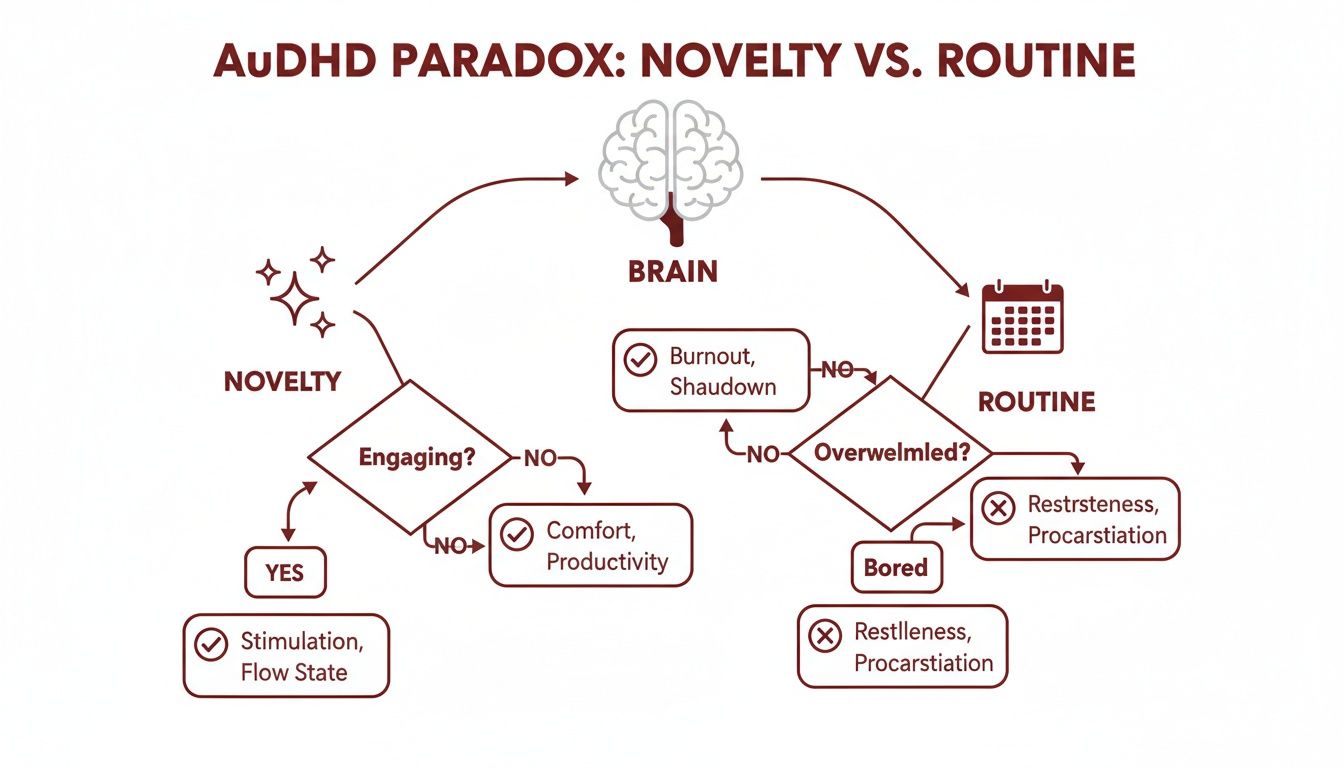
This constant internal conflict is a perfect example of why a nuanced diagnosis that accounts for both neurotypes is so vital for developing effective, real-world coping strategies.
Symptom Overlap Diagnostic Considerations
Distinguishing between ADHD and Autism requires looking beyond the behavior to its root cause. The same action can stem from very different internal experiences. This table breaks down how to start thinking about the "why" behind some common overlapping traits.
| Overlapping Trait | Possible ADHD Root Cause | Possible Autism Root Cause | Diagnostic Question to Ask |
|---|---|---|---|
| Social Difficulties | Impulsivity, interrupting, inattention, getting bored with conversations. | Trouble reading social cues, difficulty with unwritten rules, sensory overwhelm in groups. | "Do you lose track of conversations, or do you feel like you're missing the rules everyone else knows?" |
| Intense Interests | Hyperfocus on a new, exciting topic, often shifting interests frequently. | Deep, long-lasting special interests that provide comfort and structure. | "How long do these intense interests typically last, and what purpose do they serve for you?" |
| Need for Routine | Using routines to manage executive dysfunction and reduce cognitive load. | A deep-seated need for predictability; change can cause significant distress. | "Does a break in routine throw off your day, or does it cause genuine anxiety and distress?" |
| Sensory Issues | Seeking sensory input due to under-stimulation (fidgeting, moving). | Over- or under-sensitivity to specific sensory inputs (light, sound, texture) leading to overwhelm or avoidance. | "Are you fidgeting because you're bored, or are you trying to manage overwhelming sensory input?" |
By asking these kinds of nuanced questions, clinicians can move closer to an accurate diagnosis that truly reflects an individual's lived experience.
Why An Accurate Diagnosis Is A Game-Changer
Without the right diagnosis, you can end up with support that’s ineffective or, worse, makes things harder. An accurate evaluation provides the clarity needed to create a personalized roadmap, ensuring that any strategies or accommodations are perfectly suited to your unique neurotype.
This clarity isn't just helpful—it’s empowering. It validates your lived experience and finally opens the door to genuine self-understanding and self-advocacy.
The need for precise diagnosis is also a major public health issue. Real-world U.S. healthcare data reveals that 4.2% of adults and 6.7% of children are diagnosed with ASD, ADHD, or both. This group uses healthcare services at a dramatically higher rate than their neurotypical peers, which just underscores how important it is to get the right diagnosis and support from the very beginning.
Ultimately, a diagnosis is a tool. It’s a way to access the right resources, connect with a supportive community, and begin building a life that honors your brain’s unique wiring instead of fighting against it.
Your Questions About ADHD and Autism, Answered
Diving into the world of neurodiversity can bring up a lot of questions. Even after getting the basics down, the practical side of things can feel fuzzy. We get it. Here, we’ll tackle some of the most common questions we hear, giving you clear, direct answers to help you connect the dots.
Think of this as your go-to guide for those "what if" and "how does that actually work" moments.
Can You Have Traits Without a Diagnosis?
Yes, you absolutely can. Both ADHD and autism are spectrum conditions, which means their traits show up in varying degrees across the whole population. It’s not unusual for a neurotypical person to have moments of inattention, feel a bit awkward in social situations, or really love their daily routine.
A formal diagnosis only comes into play when these traits are persistent, have been around since you were young, and are significantly getting in the way of your life—at work, in school, or in your relationships.
Having a few traits doesn’t mean you have a disorder. But if you feel like these characteristics are creating real struggles for you day-to-day, exploring a professional evaluation is a perfectly reasonable and important step to take.
How Does Treatment Differ for AuDHD?
When you’re dealing with AuDHD—that’s co-occurring ADHD and autism—treatment isn't one-size-fits-all. It has to be an integrated approach, tailored specifically to the individual. For example, stimulant medication can be a game-changer for ADHD's focus and impulsivity issues, but for an autistic person, the effects might be different. It's crucial to monitor these medications carefully for side effects like a spike in anxiety or sensory sensitivity.
Therapy needs a thoughtful approach, too. Here’s how that might look:
- An ADHD-focused strategy might be all about building external systems to wrangle time and stay organized.
- An autism-informed strategy needs to make sure those systems work with the person's need for routine and don't trigger sensory overload.
The real art is finding strategies that feed the ADHD brain's hunger for stimulation and novelty without overwhelming the autistic brain's deep need for predictability and calm. It’s a delicate balancing act that truly requires a knowledgeable provider.
Should an Autistic Child Be Screened for ADHD?
Given the incredibly high overlap—with up to 70% of autistic individuals also meeting the criteria for ADHD—the answer is a strong yes. Current best practices recommend that screening for ADHD should be a standard part of any comprehensive autism evaluation.
Getting an early and accurate dual diagnosis is a game-changer. Untreated ADHD can make it so much harder for autistic kids and adults to benefit from therapy, do well in school, or even just manage daily tasks. Addressing the ADHD symptoms can dramatically improve their ability to engage with autism-specific support. Most importantly, it ensures you’re not blaming the wrong cause for certain challenges, which is the key to providing help that actually works.
At the Sachs Center, our expertise is in untangling these complex neurodivergent profiles. We offer compassionate, expert-led virtual evaluations for ADHD, Autism, and AuDHD. If you or someone you care about is looking for clarity, our specialists are here to provide an accurate diagnosis and a clear path forward. Book your comprehensive evaluation today.
