

Ever feel like your brain's CEO has gone on an unscheduled vacation? You know what needs to be done, but starting the task, organizing the steps, or even remembering why you walked into a room feels monumental. This frustrating gap between intention and action isn't a sign of laziness or a lack of willpower; it’s a core feature of executive dysfunction.
Commonly associated with neurodivergent conditions like ADHD, Autism, or both (AuDHD), executive dysfunction impacts the brain's complex management system. This system is responsible for critical skills such as planning, focusing, self-monitoring, and regulating emotions. When it doesn't operate smoothly, the consequences ripple through daily life, affecting academic performance, professional responsibilities, and personal relationships.
This article provides a comprehensive look at common executive dysfunction examples, moving beyond simple definitions to explore what these challenges look like in the real world for children, teens, and adults. We will dissect eight distinct patterns, from chronic procrastination and "time blindness" to emotional dysregulation and decision paralysis.
For each example, you will find:
- Real-world scenarios across different life stages.
- A brief analysis of the underlying cognitive processes at play.
- Actionable, evidence-based coping strategies and accommodations you can implement immediately.
Our goal is to equip you with a deeper understanding, fostering self-compassion and providing practical tools for managing these challenges. We will also provide clear guidance on when the signs point toward the need for a professional diagnostic evaluation, a crucial step in accessing tailored support and building a life where your brain works with you, not against you.
1. Procrastination and Task Initiation Difficulties
Chronic procrastination is one of the most visible and frustrating executive dysfunction examples. This isn't simple laziness; it's a profound difficulty with task initiation, the cognitive process of getting started. For neurodivergent individuals, the brain's "ignition switch" can feel stuck, even when they fully understand a task's importance and consequences. This activation barrier stems from challenges in prioritizing, sequencing steps, and overcoming the mental inertia required to begin.
This struggle often appears in high-stakes environments. A university student, for instance, might have all the resources and a two-week head start on a major essay but finds themselves paralyzed, only able to start the night before the deadline. Similarly, a professional with masked autism may know a critical report is due but cannot bring themselves to open the document until the final hours, fueled only by the adrenaline of an imminent deadline. This pattern isn't a choice but a neurological hurdle.
Strategic Breakdown and Actionable Tips
To combat task initiation failure, the goal is to lower the barrier to entry and create external structures for motivation. The internal "get-up-and-go" is unreliable, so we must build it externally.
- Deconstruct the Task: The idea of "writing an essay" is overwhelming. Break it down into micro-steps: "Open a new document," "Write one sentence for the introduction," or "Find one source." Each tiny, achievable step reduces the activation energy needed.
- Create External Urgency: Don't rely on the final deadline. Use a timer (like the Pomodoro Technique) to create a 25-minute window of focused work. This small, contained period feels far less daunting than an open-ended work session.
- Utilize Body Doubling: The presence of another person, even if they are working on something completely different, can provide the gentle external pressure needed to stay on task. This can be done in person or virtually with an accountability partner.
- Modify Your Environment: Your brain may associate your usual desk with procrastination. Try moving to a different location, like a library or coffee shop, to signal a "reset" and create a new context for productivity.
Key Insight: Motivation often follows action, not the other way around. The primary goal is not to feel like doing the task, but to simply start the first, smallest possible action. This momentum is often enough to carry you forward.
If these challenges persistently impact your life, it may be a sign of an underlying neurodevelopmental condition like ADHD or Autism. Understanding how your brain works is the first step toward effective management. For deeper strategies, you can learn more about how to overcome procrastination with ADHD.
2. Time Blindness and Poor Time Management
Time blindness is another core feature among executive dysfunction examples, describing a chronic difficulty in perceiving the passage of time. This is not about being careless; it's an impaired internal clock. For neurodivergent individuals, time can feel abstract and non-linear, making it incredibly difficult to estimate how long a task will take, how much time has passed, or how much time is left. This distortion leads directly to issues with planning, punctuality, and meeting deadlines.

This impairment shows up in daily life constantly. A parent with undiagnosed ADHD might always be 15-20 minutes late for school pickup, not from a lack of care, but from genuinely misjudging the time needed to get ready and drive. In a corporate setting, an employee with masked autism may miss meetings because they become hyperfocused on a task and five minutes feels like 30 seconds. A student with AuDHD might be shocked when a semester is ending, feeling as though they still had several weeks left to complete assignments.
Strategic Breakdown and Actionable Tips
To manage time blindness, one must externalize the sense of time. Instead of relying on a faulty internal clock, the strategy is to create a robust external system of timers, alerts, and visual cues that make time tangible and visible.
- Make Time Visual: Use analog clocks where you can see the hands move or visual timers (like a Time Timer) that show a depleting block of color. This makes the abstract concept of passing time concrete and observable.
- Buffer Everything: Assume your initial time estimate is wrong. Add a "time tax" or buffer of 25-50% to every planned activity, from commuting to completing a work project. If you think a task will take 60 minutes, schedule 90.
- Use Multiple, Specific Alarms: Don't just set an alarm for when you need to be somewhere. Set alarms for transitions: one for "stop current activity," one for "start getting ready," and one for "time to leave."
- Practice Time Estimation: Actively build this skill. Before starting a task, write down your estimate of how long it will take. Time yourself, then compare the actual time to your estimate. This feedback loop helps calibrate your perception over time.
Key Insight: You cannot manage what you cannot perceive. The goal is not to "try harder" to be on time but to build an external scaffolding that tracks time for you, removing the need to rely on a weak internal sense.
If persistent time management challenges disrupt your professional and personal life, it may signal an underlying condition. For more specific approaches, you can learn more about time management for adults with ADHD.
3. Working Memory Deficits and Information Retention
Significant struggles with working memory are a core aspect of many executive dysfunction examples. This isn't a failure of long-term memory or intelligence; it's the brain's difficulty holding and actively manipulating information for short periods. This "mental scratchpad" is essential for following multi-step directions, retaining what was just said in a conversation, and connecting ideas during a lecture. For individuals with ADHD or Autism, this scratchpad can feel like it's constantly being erased.
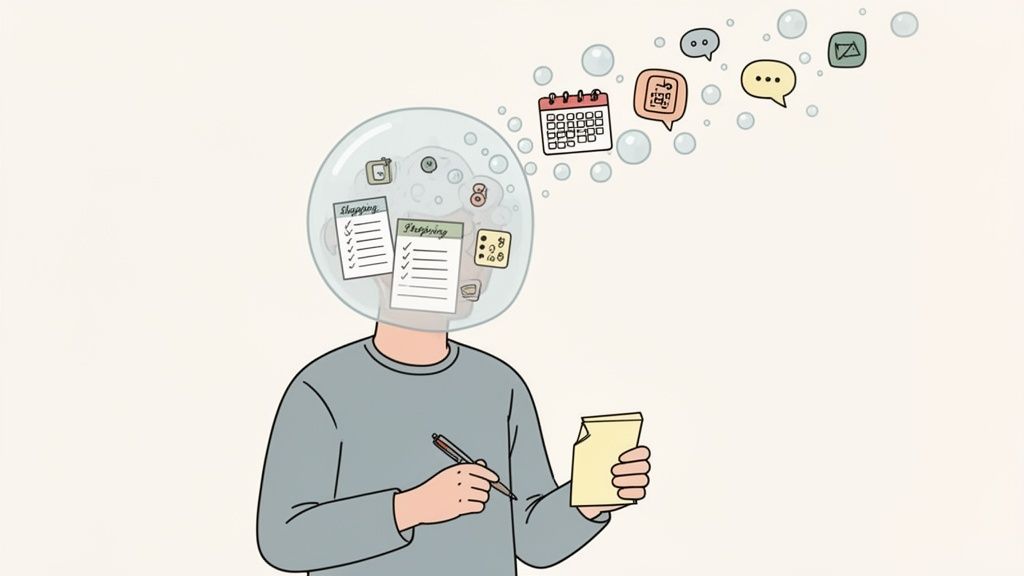
This deficit manifests in countless daily frustrations. A professional with ADHD might receive clear, verbal instructions for a three-part task from their manager, only to return to their desk and realize they can only remember the first step. Similarly, an autistic student might listen intently to a lecture but find they cannot recall the key points just minutes later without extensive notes. This isn't a lack of attention or care; it's a neurological bottleneck in processing and holding onto new information.
Strategic Breakdown and Actionable Tips
The key to managing working memory deficits is to externalize information. Instead of relying on a fallible internal system, you must create a reliable external one to offload the cognitive burden.
- Create External Memory Systems: Your brain is for thinking, not for storage. Immediately write down tasks, appointments, and ideas. Use grocery lists, digital calendars with reminders, and task management apps like Todoist or Asana to house information externally.
- Request Written Instructions: Whenever possible, ask for instructions, meeting agendas, and key takeaways in writing. This provides a permanent record you can refer back to, bypassing the need to hold it all in your working memory. If instructions are given verbally, repeat them back to confirm understanding and write them down yourself.
- Use Note-Taking and Recording Tools: During meetings or lectures, active note-taking (whether by hand or on a laptop) can help encode information. When permitted, using a recording device allows you to review complex information at your own pace later on.
- Break Down Complex Information: When faced with multi-step directions, focus on one step at a time. Ask for the first step, complete it, and then ask for the next. This chunking method prevents your working memory from becoming overwhelmed by trying to hold everything at once.
Key Insight: Don't treat your working memory like a reliable hard drive; treat it like temporary RAM that is easily overloaded. The strategy is not to try harder to remember but to build a system that doesn't require you to.
Persistent difficulties with working memory that affect your job, education, or relationships can be a strong indicator of a neurodevelopmental condition. Professional evaluation can clarify the source of these challenges and unlock access to accommodations and targeted support.
4. Emotional Dysregulation and Impulse Control Issues
Difficulty managing emotional responses is a core, yet often misunderstood, aspect of executive dysfunction examples. This isn't about being "too sensitive" or having a "bad temper"; it's a neurological challenge in modulating emotions. For individuals with ADHD or Autism, emotions can feel like a tidal wave, building rapidly and intensely with a force that is disproportionate to the trigger, making self-regulation and impulse control feel nearly impossible.
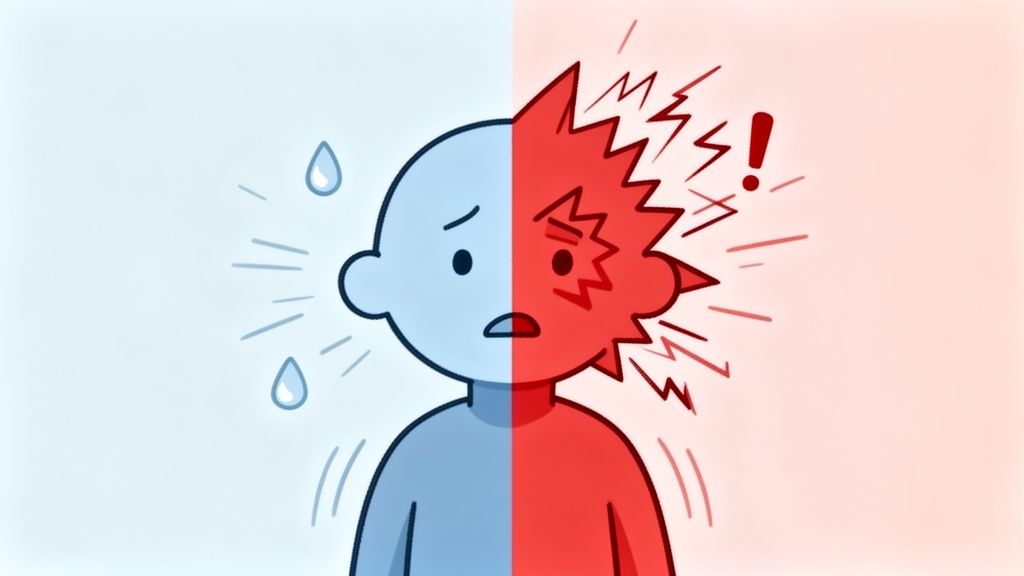
This struggle manifests in various ways. A teen with ADHD might experience explosive anger over a minor change in plans, while an autistic adult may have a public meltdown after enduring prolonged sensory overload. A professional with AuDHD might impulsively send a harshly worded email in a moment of frustration, only to face significant regret and professional consequences later. These intense emotional reactions are not a choice but a direct result of a brain struggling to apply the cognitive "brakes" that manage emotional output.
Strategic Breakdown and Actionable Tips
The key to managing emotional dysregulation is to build an external and internal "toolkit" that helps you identify, pause, and respond to feelings, rather than just reacting. The goal is to create space between the emotional trigger and your response.
- Implement a Response Delay: For charged situations, especially in digital communication, create a mandatory waiting period. A "24-hour rule" for important emails or texts can prevent impulsive reactions you'll later regret. This pause allows the logical brain to catch up with the emotional one.
- Develop an 'Emotional First-Aid Kit': Identify what soothes your nervous system and keep those tools accessible. This could be a specific playlist, a sensory item like a stress ball, a weighted blanket, or a pre-written list of grounding techniques (like the 5-4-3-2-1 method) to use when you feel overwhelmed.
- Use Emotion Identification Tools: It's hard to regulate an emotion you can't name. Use an emotion wheel or a "feelings thermometer" to build your emotional vocabulary. Regularly checking in with yourself to label your feelings can make them feel less overwhelming and more manageable.
- Practice Grounding Techniques: When you feel an emotional storm brewing, bring your focus to the physical world. The 5-4-3-2-1 method involves naming 5 things you can see, 4 things you can feel, 3 things you can hear, 2 things you can smell, and 1 thing you can taste. This pulls you out of the emotional spiral and into the present moment.
Key Insight: Emotional regulation is a skill, not an innate character trait. By proactively identifying triggers and practicing coping strategies when you are calm, you build the capacity to use them when you are dysregulated.
If intense emotional shifts and poor impulse control consistently disrupt your relationships, work, or well-being, it could be a significant indicator of an underlying neurodivergent condition. A comprehensive evaluation can provide clarity and unlock access to targeted therapies and support.
5. Organization and Planning Difficulties
Significant challenges with organization and planning are classic executive dysfunction examples. This goes far beyond general messiness; it's a core difficulty in creating and maintaining systems, both mentally and physically. Neurodivergent individuals may struggle to structure tasks, organize information, and conceptualize the sequence of steps needed for a project, leading to chaotic environments and ineffective workflows.
This difficulty manifests across various settings. A corporate professional with masked ADHD might miss critical project milestones because they cannot effectively map out dependencies and timelines, appearing unreliable despite their high intelligence. Similarly, a parent with AuDHD might feel completely overwhelmed by household management, unable to create a lasting system for laundry, mail, or chores, leading to a constant state of clutter and stress. This isn't a moral failing but a deficit in the brain’s ability to categorize, sequence, and architect plans.
Strategic Breakdown and Actionable Tips
To counter organizational deficits, the strategy is to externalize the entire system. Instead of relying on internal mental structures, you must build tangible, visible, and low-effort systems in your environment.
- Make it Visual and External: Don't keep plans in your head. Use physical tools like whiteboards, color-coded folders, and sticky notes, or digital apps like Asana or Trello. The goal is to offload the mental work of organizing onto an external tool you can see and interact with.
- Implement the 'One-Touch Rule': To prevent clutter from accumulating, handle items only once. When mail comes in, immediately sort it into "action," "file," or "trash" piles. When you take off a coat, hang it up right away. This rule bypasses the decision-making process that often leads to paralysis.
- Create Templates for Repetition: If you struggle to plan recurring tasks, create a template. This could be a checklist for your weekly grocery trip, a standard outline for project kick-offs, or a pre-filled schedule for your morning routine. Templates eliminate the need to reinvent the wheel every time.
- Embrace Color-Coding: Assign specific colors to different categories of tasks, subjects, or priorities. A student could use a different colored notebook for each class, while a professional might use red labels for urgent tasks and green for long-term projects. This visual shorthand speeds up recognition and reduces cognitive load. For those struggling with the mental load of organizing their belongings, exploring simple inventory management techniques can provide much-needed relief.
Key Insight: The perfect organizational system is not one that is complex, but one that you will actually use. Prioritize simplicity and visibility over intricate, hard-to-maintain methods. The system must serve you, not the other way around.
If chronic disorganization and planning failures consistently disrupt your work, home, and personal life, they may point to an underlying neurodivergent condition like ADHD or Autism. A formal evaluation can provide clarity and unlock access to tailored strategies and supports.
6. Attention Regulation and Hyperfocus Variability
A common misconception is that attention issues are about a lack of attention. For many, they are about a profound inability to regulate it. This particular form of executive dysfunction manifests as a stark contrast: an intense, unbreakable focus on high-interest activities (hyperfocus) paired with an inability to sustain attention on low-stimulation tasks. This isn't a choice; it's a reflection of the brain's inconsistent stimulation-seeking and filtering mechanisms, a hallmark of conditions like ADHD and Autism.
This variability creates a confusing pattern of performance. A student might spend eight uninterrupted hours coding a video game but cannot focus on a 20-minute math assignment. Likewise, an autistic adult might meticulously research a special interest for an entire weekend but struggle to complete routine administrative tasks at work that are crucial for their job. This inconsistency is often misinterpreted by others as a lack of willpower, when it is a neurological challenge with directing and sustaining mental energy.
Strategic Breakdown and Actionable Tips
The strategy here is not to fight against this natural attention pattern but to work with it. The goal is to channel hyperfocus productively and add external structure and stimulation to less engaging but necessary tasks.
- Gamify Mundane Tasks: Turn boring activities into a game. Use a timer to "beat the clock" on chores, create a point system for completing steps of a project, or promise a small, immediate reward upon completion. This introduces a layer of novelty and challenge that the brain finds more engaging.
- Leverage Hyperfocus Intentionally: Instead of letting hyperfocus happen by accident, schedule it. Block out specific "deep work" times for high-priority, high-interest projects. Set an alarm to signal the end of the session to prevent neglecting other responsibilities.
- Pair Tasks: Combine a low-interest task with a high-interest sensory input. Listen to an engaging podcast while doing household chores, use a standing desk or fidget tool during a long meeting, or watch a favorite show while folding laundry. This "boring task + fun stimulus" combination can provide enough engagement to stay on track.
- Design a Distraction-Free Environment: When you must focus on a low-stimulation task, reduce competition. Put your phone in another room, use noise-canceling headphones, and clear your workspace of anything not related to the immediate task. This minimizes the sensory input your brain has to filter out.
Key Insight: Attention is a resource that flows toward stimulation. Instead of trying to force it where it doesn't want to go, the key is to either increase the stimulation of the necessary task or remove competing stimuli from the environment.
If this extreme variability between hyperfocus and inattention consistently disrupts your work, relationships, or well-being, it strongly suggests a need for a professional evaluation. Understanding the specific nature of your attentional challenges is the first step toward building effective, personalized support systems.
7. Decision-Making Paralysis and Indecision
Profound indecisiveness is a core, yet often overlooked, manifestation among executive dysfunction examples. This isn't just about being careful; it's a state of decision-making paralysis where the brain becomes overwhelmed by choices. For neurodivergent individuals, the executive functions needed to weigh options, forecast outcomes, and commit to a path can falter, leading to a debilitating state of inaction, even on matters with clear benefits.
This paralysis frequently appears at major life crossroads. A talented student may receive multiple college acceptance letters but find themselves completely unable to choose one, paralyzed by the fear of making the "wrong" decision. Similarly, a professional with AuDHD might understand the business case for a new project but becomes stuck deliberating over minor directional details, delaying progress indefinitely. This isn't a lack of desire or intelligence but a neurological bottleneck in the decision-making process.
Strategic Breakdown and Actionable Tips
To counter decision paralysis, the strategy is to externalize the decision-making process and reduce the cognitive load of choice. Instead of relying on internal clarity, we build an external framework to guide us to a conclusion.
- Shrink the Options: The brain struggles with too many variables. If faced with ten choices, force yourself to narrow them down to your top two. This "two-choice method" dramatically simplifies the mental calculus required.
- Set a Decision Deadline: Indecision thrives in an open-ended timeline. Give yourself a specific, non-negotiable deadline, like "I will decide by Friday at 5 PM." This creates the necessary urgency to prevent endless deliberation.
- Externalize with a Pro/Con List: The act of writing down the pros and cons for your top choices moves the debate from your overwhelmed mind onto paper. This externalization makes the factors more concrete and easier to evaluate objectively. For many, the root of indecision lies in analysis paralysis, making it crucial to understand strategies for moving forward. You can learn how to overcome analysis paralysis with targeted techniques.
- Define "Good Enough": Perfection is the enemy of progress. Instead of seeking the flawless choice, establish a "good enough" threshold. A decision that meets 80% of your criteria is often better than no decision at all.
Key Insight: The goal is not to find the perfect, risk-free answer but to make a confident, reversible, or manageable decision. Frame it as a low-stakes experiment: make a choice and see what happens, knowing you can often adjust your course later.
If you consistently find yourself stuck in a cycle of indecision that impacts your career, relationships, or well-being, it could be a significant indicator of an underlying condition like ADHD or Autism. Seeking a diagnostic evaluation can provide clarity and unlock strategies tailored to your unique neurotype.
8. Emotional Hyperarousal to Rejection or Criticism (Rejection Sensitive Dysphoria)
An intensely painful emotional response to perceived or real rejection is a debilitating, though less commonly discussed, executive dysfunction example. Known as Rejection Sensitive Dysphoria (RSD), this isn't simply being "too sensitive"; it's a severe, often unbearable reaction rooted in difficulties with emotional regulation and threat perception. For neurodivergent individuals, particularly those with ADHD, the brain’s response to criticism or failure can trigger an extreme fight-or-flight reaction, causing profound emotional distress that is disproportionate to the event.
This hyperarousal manifests in various ways. A professional with AuDHD might receive constructive feedback during a performance review and internalize it as a catastrophic failure, leading to days of anxiety and avoidance. Similarly, a teenager might interpret a friend not immediately responding to a text as a sign of total rejection, causing an emotional meltdown. This pattern often leads to chronic people-pleasing, perfectionism, and a deep-seated fear of trying new things where failure is a possibility.
Strategic Breakdown and Actionable Tips
The goal is to interrupt the automatic, overwhelming emotional cascade and reframe the experience by separating feedback from self-worth. Since the internal response is haywire, external strategies and conscious reframing are essential.
- Create a Rejection Recovery Plan: Don't wait for the feeling to hit. Pre-plan a set of soothing activities you can turn to immediately after a perceived rejection, such as listening to a specific playlist, going for a walk, or engaging in a comforting hobby. This creates an automatic coping path.
- Externalize and Validate: Instead of letting the painful thoughts spiral internally, talk it through with a trusted friend or therapist. Hearing an external perspective can help reality-test your catastrophic thoughts and validate that the emotional pain is real, even if the perceived rejection isn't.
- Separate Feedback from Identity: Practice the mantra: "This feedback is about my work, not my worth." Write it down. Consciously reframe criticism as data for improvement or a sign that someone is invested in your growth, rather than as a judgment of you as a person.
- Practice Self-Regulation: When you feel the emotional flood starting, engage in physical grounding techniques. Focus on your breathing, hold a cold object, or do a few quick stretches. This can help down-regulate your nervous system before the emotional response becomes completely overwhelming.
Key Insight: Rejection Sensitive Dysphoria is an instantaneous and overwhelming emotional reaction, not a reasoned response. The strategy is to build a pre-planned, immediate toolkit to manage the physiological and emotional fallout, creating space for rational thought to catch up.
The intense pain of RSD can significantly impact relationships, career progression, and mental health. If these patterns resonate, it's a strong indicator of a neurodivergent brain wiring. You can learn more about what Rejection Sensitive Dysphoria is and how it's managed to gain deeper insights.
8-Point Comparison of Executive Dysfunction Examples
| Issue | 🔄 Implementation complexity | ⚡ Resource requirements | ⭐ Expected outcomes | 📊 Ideal use cases | 💡 Key advantages |
|---|---|---|---|---|---|
| Procrastination and Task Initiation Difficulties | Moderate — habit change, accountability, environment tweaks | Low–Moderate — timers, body doubling, coaching, possible med consult | Moderate improvement with consistent supports ⭐⭐ | Academic deadlines, workplace tasks, daily routines | Break tasks into micro-steps; use external deadlines and accountability |
| Time Blindness and Poor Time Management | Moderate — build external time systems and routines | Low–Moderate — visual timers, calendars, wearables, reminders | High when externalized; tools reliably improve punctuality ⭐⭐⭐ | Scheduling, transitions, punctuality-sensitive roles | Use visual timers, multiple alarms, add buffer time |
| Working Memory Deficits and Information Retention | Moderate — implement external memory scaffolds and accommodations | Moderate — note systems, recordings, testing, assistive tools | High with external supports; reduces missed steps ⭐⭐ | Lectures, meetings, multi-step instructions, study tasks | Request written instructions; write it down immediately; use recordings |
| Emotional Dysregulation and Impulse Control Issues | High — requires therapy, skills training, environmental changes | High — CBT/DBT, coaching, possible medication, support network | Moderate improvement with therapy and skill maintenance ⭐⭐ | Interpersonal settings, high-stress work, sensory overload situations | Build emotion toolkit, practice grounding, delay responses before reacting |
| Organization and Planning Difficulties | Moderate — design and sustain systems, templates, routines | Moderate — apps, physical organizers, coaching, occasional outsourcing | High when consistent systems are used; reduces chaos ⭐⭐⭐ | Project management, household management, research/administration | Use visual systems, templates, one-touch rules and regular reviews |
| Attention Regulation and Hyperfocus Variability | Moderate — environment design, scheduling, transition strategies | Moderate — timers, structured schedules, stim tools, possible meds | Variable — hyperfocus can be productive but risks neglect of other tasks ⭐⭐ | Deep work, creative projects, tasks needing sustained attention | Schedule deep-work blocks, gamify low-interest tasks, plan transitions |
| Decision-Making Paralysis and Indecision | Low–Moderate — apply decision frameworks and limits | Low — decision templates, deadlines, coaching support | Moderate — faster decisions with frameworks; reduces stalls ⭐⭐ | Career choices, healthcare decisions, everyday multi-option choices | Use two-choice method, set deadlines, define "good enough" threshold |
| Emotional Hyperarousal to Rejection (RSD) | High — targeted therapy, emotion-processing strategies | High — psychotherapy, support groups, possible medication | Moderate — therapy and coping plans lessen intensity ⭐⭐ | Feedback-heavy roles, performance evaluations, social risk situations | Develop rejection-recovery plan, separate feedback from self-worth, practice safe feedback exposure |
From Awareness to Action: Your Path to Support
Navigating the extensive list of executive dysfunction examples in this article may have felt deeply familiar, even validating. Seeing specific challenges like "doom piles," chronic lateness due to time blindness, or the intense emotional sting of rejection sensitive dysphoria (RSD) put into words is often the first, most crucial step toward understanding. You are not lazy, unmotivated, or careless; you are likely navigating a world not built for your brain's unique wiring.
The patterns we've explored, from procrastination spirals to decision paralysis, are not character flaws. They are manifestations of underlying differences in brain function, common in neurodivergent conditions like ADHD and Autism. Recognizing these patterns is the moment you shift from self-blame to self-advocacy.
Key Takeaways: From Recognition to Strategy
The core message is one of empowerment through understanding. Each example of executive dysfunction is not a dead end but a signpost pointing toward a different way of doing things.
- Externalize Your Brain: Many of the most effective strategies involve taking the load off your internal executive functions. This means using external tools like timers, visual schedules, body doubling, and detailed checklists to do the heavy lifting your brain finds difficult.
- Work With Your Brain, Not Against It: Trying to force a neurodivergent brain into a neurotypical mold is exhausting and ineffective. Instead, lean into what works. If you thrive with novelty, build it into your routines. If you need a dopamine boost to start a task, pair it with something you enjoy.
- Accommodations Are Not a Crutch: Requesting accommodations at work or school is not a sign of weakness; it's a strategic move to level the playing field. Just as someone with poor vision uses glasses, an individual with executive dysfunction can use tools like noise-canceling headphones, extended deadlines, or written instructions to perform at their best.
These practical strategies can provide immediate relief and help you manage daily challenges. However, for many, they are just one piece of the puzzle. While self-help is valuable, it cannot replace the clarity and direction that a professional diagnosis provides. If these executive dysfunction examples resonate deeply and persistently impact your quality of life, relationships, or career, it may be time to seek a formal evaluation.
Why Diagnostic Clarity Is the Ultimate Tool
A comprehensive diagnostic evaluation is more than just a label. It's a personalized roadmap to your own mind. It validates your lifelong struggles, providing a framework to understand why certain tasks are so hard. This clarity is the foundation for targeted, effective support and unlocks access to crucial accommodations and therapies.
At the Sachs Center, our specialists understand the nuances of neurodiversity, particularly in adults, women, and BIPOC individuals who have often been overlooked or misdiagnosed. Our telehealth-based neuropsychological evaluations are designed to be thorough, compassionate, and affirming. We go beyond simple checklists to provide a deep understanding of your unique cognitive profile, offering a clear path forward with a tailored treatment plan. Understanding your neurotype is the key that unlocks your full potential, allowing you to build a life that honors your strengths and supports your challenges.
Ready to move from awareness to action? A formal diagnosis from the Sachs Center can provide the answers you need to thrive. Our expert team specializes in virtual ADHD, Autism, and AuDHD evaluations, offering the clarity and support to build a life aligned with your neurotype. Visit the Sachs Center to learn more and schedule your consultation today.
