

An executive functioning skills assessment is a specialized evaluation designed to measure your brain's core self-management abilities. It goes far beyond simple observation to pinpoint specific strengths and weaknesses in areas like planning, focus, and self-control. This detailed analysis gives us a clear roadmap for targeted support, whether for academic accommodations, workplace adjustments, or personal growth.
What an Executive Functioning Skills Assessment Really Measures
Think of your brain's executive functions as its air traffic control system. This command center is responsible for directing incoming information, managing multiple tasks at once, and making sure everything runs smoothly without collisions. When this system is working well, you can navigate complex projects, adapt to unexpected changes, and stay on track toward your goals.
But if even one part of that system is struggling, the entire operation can feel chaotic. An executive functioning skills assessment is designed to pinpoint exactly which "control tower" operations are strong and which ones need support. It’s not a pass/fail test of intelligence; it’s a detailed map of your unique cognitive profile.
The Three Core Pillars of Executive Function
A formal evaluation systematically examines the foundational skills that govern how you think, act, and solve problems. While we look at many specific skills, they generally fall into three core categories:
- Working Memory: This is your brain’s temporary sticky note. It’s the ability to hold and manipulate information in your mind for short periods. A student uses it to remember a teacher's multi-step instructions, while a professional relies on it to keep key details in mind during a fast-paced meeting.
- Cognitive Flexibility: Also known as flexible thinking, this is your brain’s ability to pivot. It allows you to switch between tasks, consider different perspectives, and adapt your strategy when the original plan isn't working. It's what helps you adjust when a project's deadline suddenly changes.
- Inhibitory Control: This is your mental braking system. It includes self-control over impulses, selective attention to filter out distractions, and the ability to pause and think before acting. This skill is critical for resisting the urge to check your phone while working on an important report.
An assessment doesn’t just identify deficits; it illuminates a person's entire cognitive landscape. It shows us not only where the challenges are but also where the natural strengths lie, providing a balanced and complete picture that is essential for creating effective support strategies.
From Abstract Concepts to Real-World Application
Understanding these pillars helps clarify what an assessment truly uncovers. For instance, a child struggling to start their homework might have difficulty with task initiation (a subset of inhibitory control). An adult who frequently loses their train of thought during conversations may have challenges with working memory.
These evaluations use a combination of methods—including standardized tests, behavioral observations, and detailed interviews—to see how these skills perform under various conditions. For those looking for an initial self-assessment, an executive skills questionnaire can offer preliminary insights into potential areas of difficulty before pursuing a formal evaluation.
Ultimately, the goal is to create a detailed blueprint that explains why certain tasks are difficult and provides clear, actionable recommendations for building skills and implementing effective strategies at home, school, or work.
How Executive Functions Develop and Evolve Through Life
Executive functions aren’t static abilities we’re born with. They are skills that grow and adapt with us throughout our lives. Think of the brain’s prefrontal cortex—its command center or "CEO"—as a muscle that develops over time. This gradual maturation is precisely why a one-size-fits-all executive functioning skills assessment just doesn't work.
What signals strong executive functioning looks vastly different at various life stages. For a five-year-old, success might be following two-step directions without getting sidetracked. For a teenager, it’s about planning and executing a long-term research project. For an adult, it’s the complex act of juggling career deadlines, family schedules, and personal goals all at once.
The Developmental Timeline of Your Brain's CEO
This developmental journey explains why challenges can surface at any age. Difficulties might suddenly become apparent when academic demands ramp up in middle school, or much later in life due to the cognitive shifts that come with aging. Conditions like ADHD or learning disabilities can also impact this developmental trajectory, making certain skills harder to master without support.
Understanding this lifespan perspective is key. It highlights why an age-appropriate assessment is essential for capturing an accurate and meaningful snapshot of an individual's abilities. The questions we ask and the tools we use have to align with the brain’s expected capacity at that specific stage of life.
This timeline shows how different brain skills, like memory, flexibility, and control, build on each other over a lifetime.
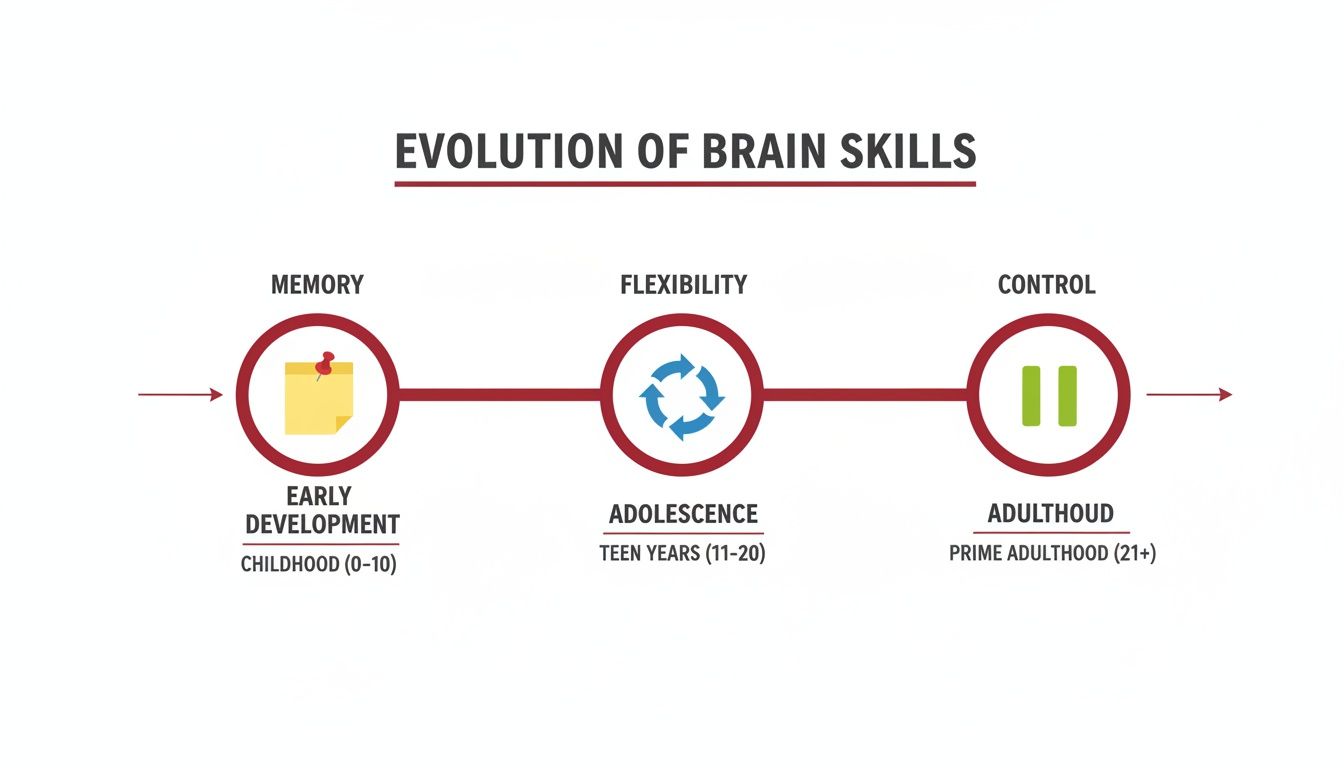
As you can see, foundational skills emerge early on, but the more complex abilities needed for long-term planning and self-regulation really solidify much later.
Milestones in Executive Function Growth
Research backs up this gradual, non-linear development. Large-scale studies involving thousands of participants reveal a fascinating maturation path. Executive functions like inhibitory control and working memory see a significant growth spurt during late childhood and mid-adolescence, especially between the ages of 10 and 15.
After this rapid development, skills continue to refine, with smaller but still important changes happening between ages 15 and 18. By the time someone reaches their late teens or early twenties, around 18 to 20 years old, these core abilities typically stabilize at adult levels. You can learn more about these developmental findings by exploring the full research on cognitive maturation.
An executive functioning skills assessment isn't just a test; it's a developmental check-in. It helps us understand if a person’s self-management abilities are on a typical trajectory for their age or if there are delays that require targeted support and intervention.
This context is vital. It allows a clinician to tell the difference between a normal developmental lag and a more persistent challenge that could benefit from specific strategies.
For example, a seven-year-old’s disorganization is viewed very differently than a seventeen-year-old’s. The assessment process accounts for these nuances, ensuring that recommendations are practical, relevant, and perfectly timed to support ongoing growth. By appreciating this evolutionary process, we can better identify when and how to provide the right help, empowering individuals to build the skills they need for success at every stage of their lives.
Comparing the Different Types of Assessments
Choosing an executive functioning skills assessment can feel a bit like picking a tool for a job without really knowing what you need to build. A hammer and a screwdriver both get things done, but they have very different purposes. The same is true for assessments—different types are designed to answer very specific questions about how someone thinks, plans, and acts.
The methods range from real-world observations captured in a questionnaire to highly controlled, clinical tests. Each one gives us a unique window into how a person plans their day, stays focused on a task, and manages their behavior. Let's break down the three main approaches to see how they stack up.
Rating Scales and Questionnaires
Imagine you want to know how a car really performs day-to-day. The best way is to ask the person who drives it everywhere—in traffic, on the highway, in the rain. That’s exactly what rating scales and questionnaires do. Tools like the highly respected Behavior Rating Inventory of Executive Function (BRIEF) gather this kind of real-world data from the people who see the individual in their natural environment.
- Who completes them? Parents, teachers, and even the person themselves (if they're a teen or adult) answer questions about everyday behaviors.
- What do they measure? They capture how executive function skills—or struggles—show up at home, at school, or at work. Questions might be about things like forgetting homework, keeping a room tidy, or having a short fuse.
- Why are they useful? They provide crucial context, showing us how cognitive challenges are actually impacting daily life.
These scales are fantastic for spotting patterns and problem areas that might not be obvious in a quiet, one-on-one testing room.
Performance-Based Tests
If questionnaires are the driver’s daily report, then performance-based tests are like taking the car to a mechanic and hooking it up to a diagnostic machine. These are specific, standardized tasks done in a controlled setting to measure a single cognitive skill with laser-like precision.
A classic example is the Stroop Test. You're shown the word "RED" printed in blue ink and have to say the color of the ink ("blue"), not read the word. It sounds simple, but it’s a powerful test of your brain's ability to inhibit a gut reaction and stay flexible under pressure. These tests isolate individual skills to see how efficiently the brain's "engine" is running.
Performance-based tests give us objective, hard numbers on specific cognitive abilities. They move beyond subjective reports to measure things like working memory and processing speed directly, providing data that beautifully complements the real-world observations from questionnaires.
Comprehensive Neuropsychological Evaluations
A comprehensive neuropsychological evaluation is the whole package—the gold standard of assessment. It’s like getting the driver’s report, running the diagnostic tests, and having a master mechanic do a bumper-to-bumper inspection of every single system in the car.
This deep-dive process is led by a neuropsychologist and weaves together multiple sources of information:
- A detailed clinical interview to gather a full history—developmental, medical, academic, and personal.
- A battery of performance-based tests that measure a wide range of skills, including IQ, memory, attention, and all the core executive functions.
- Rating scales and questionnaires filled out by parents, teachers, and the individual to ground the test data in real-world experience.
This multi-layered approach is the most thorough way to build a complete and nuanced picture of an individual’s cognitive strengths and weaknesses. It's often the required path for securing official academic accommodations. For adults looking for clarity, a focused ADHD assessment for adults follows a similar comprehensive structure to provide a clear diagnosis.
To make sense of these options, it helps to see them side-by-side. Each method has a clear purpose and is best suited for different situations.
Comparison of Executive Functioning Assessment Methods
| Assessment Type | What It Measures | Format | Best For |
|---|---|---|---|
| Questionnaires & Rating Scales | How EF skills appear in everyday life (home, school, work). | Checklists or surveys completed by parents, teachers, or the individual. | Initial screenings, gathering real-world context, and tracking progress over time. |
| Performance-Based Tests | Specific, isolated cognitive skills like working memory, attention, or processing speed. | Standardized, timed tasks performed one-on-one with an evaluator. | Pinpointing specific cognitive weaknesses and getting objective data on core abilities. |
| Neuropsychological Evaluation | A complete cognitive profile, including IQ, memory, attention, and executive functions. | A combination of interviews, a battery of performance tests, and questionnaires. | Comprehensive diagnosis, securing academic or workplace accommodations, and complex cases. |
Ultimately, each assessment type has its place. Questionnaires are a great starting point, performance tests are perfect for targeted insights, and a full neuropsychological battery offers the most complete diagnostic picture possible.
Navigating the Assessment Process From Start to Finish
Starting an executive functioning skills assessment can feel like you're about to embark on a journey without a map. But once you understand the route, it all becomes much clearer. The whole process is a structured collaboration designed to uncover insights and provide clarity, not to create more stress. Knowing what’s coming at each stage helps demystify the experience and gives you the confidence to move forward.
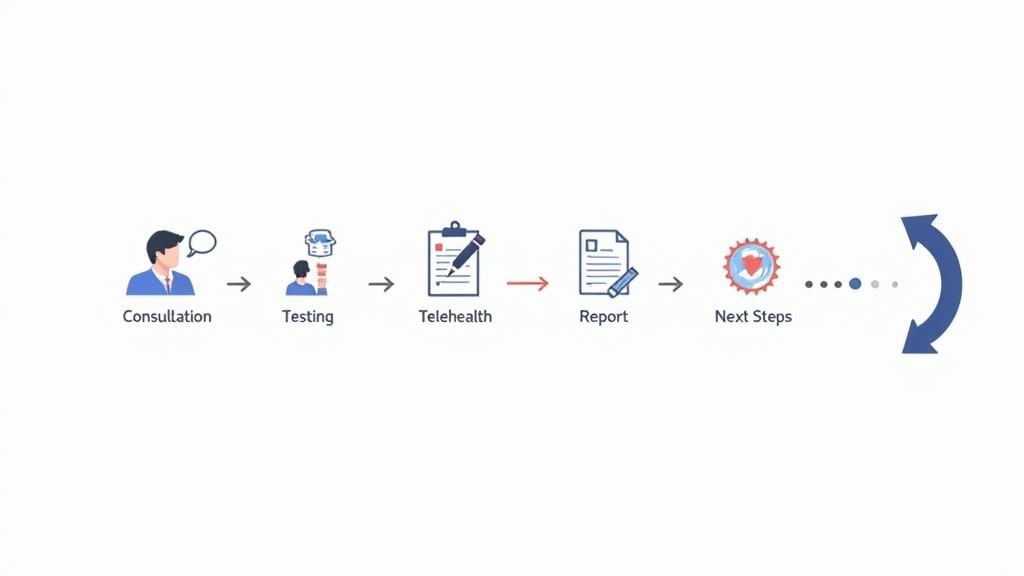
The entire journey, from that first phone call to getting your final report, is broken down into manageable steps. Each one builds on the last, helping us create a complete picture of you or your child's unique cognitive profile.
The Initial Consultation and Testing Sessions
Everything kicks off with an initial consultation or clinical interview. Think of this as a conversation, not an interrogation. It's a chance for you to share your concerns, your history, and what you hope to achieve. When we're assessing a child, this first step is all about gathering a detailed developmental history from parents to understand how challenges have evolved over time.
After that initial talk, the actual testing sessions begin. We work hard to make this experience as comfortable as possible, whether we're working with a child, a teen, or an adult. The testing itself usually involves a mix of different activities:
- Interactive Tasks: These can feel a lot like puzzles or brain games. They're specifically designed to measure skills like working memory or flexible thinking.
- Computer-Based Assessments: Some tests will have you respond to prompts on a screen, which helps us measure things like attention and processing speed.
- Questionnaires: We'll ask you, your child's teacher, or other important people in your life to fill out rating scales. This gives us crucial real-world context for what we see in the office.
We carefully pace these sessions to make sure no one gets too tired, and our evaluators are trained to build rapport and create a supportive environment. The real goal here is to see skills in action in a structured, consistent way.
Timelines, Costs, and the Rise of Telehealth
One of the biggest shifts in how we do assessments has been the move to telehealth. Virtual assessments, conducted over secure video calls, are a fantastic and less intimidating alternative to in-person testing. This format works especially well for people who feel more at ease in their own homes, which can reduce the anxiety that sometimes gets in the way of a person's true performance.
A telehealth assessment delivers the same high-quality evaluation as an in-person one. By using validated digital tools and keen observational skills, clinicians can gather robust data and form an accurate diagnostic picture from anywhere.
From the first contact to the final feedback session where we discuss the results, the whole process can take several weeks. A more straightforward diagnostic evaluation might wrap up fairly quickly, but a comprehensive neuropsychological battery takes more time for testing, scoring, and writing up a truly detailed report.
As for costs, they can vary quite a bit depending on how deep we need to go. A focused diagnostic assessment for ADHD or Autism might fall in the $790 to $1270 range, whereas a full neuropsychological evaluation for something like test accommodations can cost several thousand dollars. While some insurance plans might offer partial reimbursement, many specialized assessments are paid out-of-pocket. It’s always a good idea to clarify costs and payment options with the provider right from the start. That kind of transparency lets you plan accordingly so you can focus on what really matters—getting the insights needed to thrive.
Turning Your Assessment Results Into Actionable Strategies
An executive functioning skills assessment is only as valuable as the action it inspires. The numbers and scores aren't the destination; they're the map that shows us where to begin. A skilled clinician's greatest strength is their ability to take that raw data and weave it into a story—a clear narrative explaining how you or your child thinks, learns, and moves through the world.
This is where the real power of an assessment comes to life. We move beyond simply naming the challenges and start building a personalized roadmap for developing skills and creating supportive environments. The goal is to turn those insights into practical, everyday strategies that actually make a difference.
This process isn't new. The modern executive functioning skills assessment is built on decades of research, evolving from core theories developed in the mid-20th century. A major breakthrough came when studies began to define executive function as a unified concept covering nine key behavioral domains, including attention, planning, and self-monitoring. This evolution gave clinicians powerful tools to connect specific struggles to effective, targeted interventions.
From Diagnosis to Daily Life
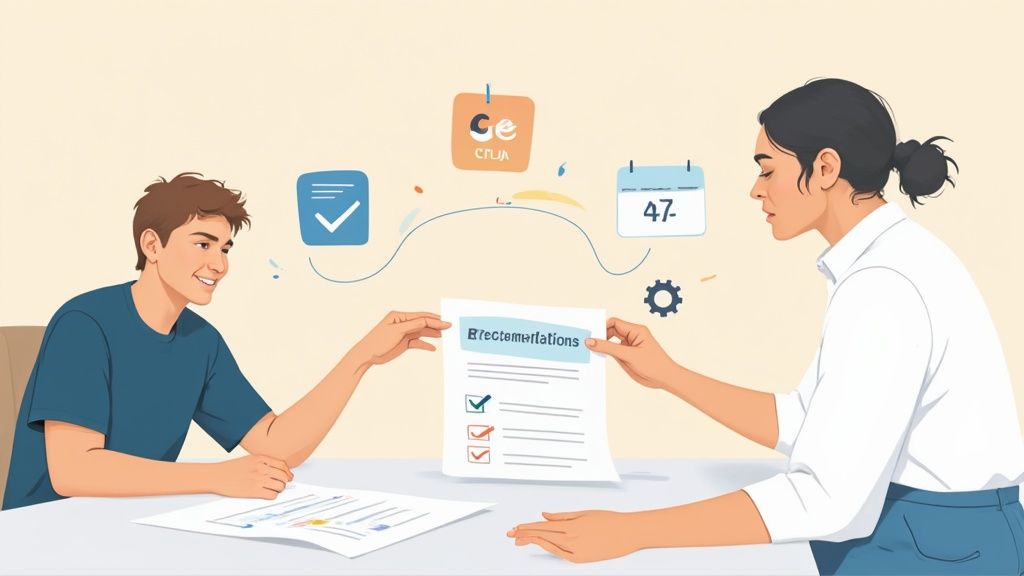
Once an assessment pinpoints specific areas of need—like a shaky working memory or trouble getting started on tasks—the focus immediately shifts to creating support systems. The 'Recommendations' section of the report is the most important part; think of it as your blueprint for action.
These aren't generic tips you could find anywhere online. They are tailored specifically to an individual's unique cognitive profile, bridging the gap between a clinical diagnosis and the realities of daily life.
- For a student, this might mean: Securing a 504 plan or IEP with accommodations like extended time on tests, preferential seating to cut down on distractions, or getting a copy of the teacher's notes to support a taxed working memory.
- For an employee, it could lead to: Simple but effective workplace adjustments. This could look like noise-canceling headphones to block out office chatter, receiving written instructions for multi-step projects, or using project management software to break down big assignments into smaller, less intimidating pieces.
- For personal growth, it often involves: Building new organizational habits, learning proven time-management techniques like the Pomodoro method, or using technology to set reminders and bring structure to the day.
For families trying to get organized, modern tools can be a game-changer. For instance, you could explore setting up a digital calendar wall for integrated family management to keep everyone on the same page.
Therapeutic Pathways and Skill Building
The assessment results also light the way toward the most effective therapeutic paths. Instead of guessing what might help, we can confidently choose interventions designed to address the specific challenges uncovered in the evaluation. This ensures that your time, energy, and resources are put to the best possible use.
Two of the most common and effective approaches we recommend are Cognitive Behavioral Therapy (CBT) and specialized executive function coaching.
An assessment report is a living document. It’s designed to be shared with teachers, therapists, and other support professionals to ensure everyone is working from the same playbook, providing consistent and coordinated care.
Cognitive Behavioral Therapy (CBT) helps people see the direct link between their thoughts, feelings, and actions. It offers practical tools to challenge the negative thought patterns that fuel procrastination or overwhelm, replacing them with more productive and adaptive ways of thinking.
Executive function coaching is a much more hands-on, skills-based approach. A coach works one-on-one to build specific skills in weak spots like planning, organization, and time management. It's all about creating practical systems and routines that work with an individual’s brain wiring, not against it. To see how this works in practice, check out our guide on executive function training.
Ultimately, these strategies, all grounded in the assessment's findings, empower individuals with the tools they need to navigate their challenges and lean into their strengths. This is how a diagnostic report becomes a true catalyst for success.
Finding the Right Professional and Taking the Next Step
Understanding how your brain works is the first real step toward making a change. An executive functioning skills assessment cuts through the fog, turning that feeling of "something's not right" into a clear, actionable plan. With those insights in hand, you can finally start building the right skills and creating an environment where you can actually succeed.
But first, you need to find the right person to guide you through this process.
This isn’t just about getting a test done. It's about finding an expert who can connect the dots between your test results and your real-world struggles. You're looking for a qualified professional who truly gets the nuances of neurodevelopment and can give you a thorough, compassionate evaluation.
Who to Look For
When you start your search, you’ll want to focus on professionals with specific training in psychological and cognitive testing. The right expert makes all the difference, ensuring the assessment is accurate, comprehensive, and actually useful.
Here’s who to seek out:
- Neuropsychologists: These are doctoral-level psychologists who specialize in the relationship between the brain and behavior. They are the go-to experts for complex cases and are absolutely essential if you’re looking for accommodations on standardized tests like the SAT, GRE, or GMAT.
- Licensed Psychologists (Ph.D. or Psy.D.): Many clinical or school psychologists have deep experience with diagnostic and psychoeducational assessments. They are more than equipped to evaluate executive functions, diagnose conditions like ADHD, and provide practical recommendations for school or work.
Vetting Potential Providers
Once you have a shortlist of names, it's time to do a little vetting to find the right fit. A quick consultation call is a great way to get a feel for their style and expertise.
The right assessment is not an endpoint. It's the starting line for a proactive, informed journey—one where you build on your strengths, tackle challenges, and create a personalized roadmap for success.
When you talk to them, ask specific questions about their process. You’ll want to know about their experience with your particular concerns, whether you're an adult looking into an ADHD diagnosis or a parent trying to get an IEP for your child. It's also a good idea to ask about their approach to telehealth assessments. Many practices, like the Sachs Center, now specialize in high-quality virtual evaluations that are just as effective as in-person ones.
Finally, be up-front about what you hope to achieve. Are you after a clear diagnosis? Do you need paperwork for workplace accommodations? Or are you looking for a complete plan for academic support? Being clear about your goals from the start helps ensure the professional you choose can deliver the targeted insights you need to take that next empowering step.
A Few Common Questions We Hear
Navigating the world of cognitive evaluations can feel overwhelming, and it’s natural to have questions. We’ve put together some straightforward answers to the most common concerns we hear from people considering an executive functioning skills assessment for themselves or their child. Our goal is to bring some clarity to the process.
What Are the Signs That I Might Need an Assessment?
The need for an assessment usually becomes clear when you notice persistent patterns that get in the way of daily life. We all have moments of disorganization or distraction, but the signs that point to a deeper issue are consistent and disruptive.
It might be time to consider an assessment if you or your child regularly deals with:
- Trouble Getting Started: A constant battle with procrastination, especially when it comes to important or multi-step projects.
- Poor Sense of Time: Frequently underestimating how long tasks will take, which leads to missed deadlines and chronic lateness.
- Constant Disorganization: A messy desk, lost keys, and a general struggle to keep track of important papers or digital files.
- Intense Emotional Reactions: Big emotional responses or mood swings that feel out of proportion to the situation at hand.
How Is This Different From an ADHD Evaluation?
This is a great question, because the two are definitely related. A standard ADHD evaluation is laser-focused on diagnosing Attention-Deficit/Hyperactivity Disorder by looking for its core symptoms: inattention, hyperactivity, and impulsivity.
An executive functioning assessment casts a wider net. It looks at the underlying cognitive skills that are often impacted by ADHD, but can also be affected by other things like learning disabilities, anxiety, or even autism.
Think of it this way: An ADHD evaluation identifies the "what" (the diagnosis), while an executive functioning assessment helps explain the "why" by showing exactly which self-management skills are creating the roadblocks.
Can Executive Functioning Skills Actually Be Improved?
Absolutely. This is the most important and hopeful part of the entire process. An assessment isn’t a final verdict—it’s a roadmap for building new skills. The brain is incredibly adaptable, and with the right strategies and consistent practice, executive functions can be strengthened at any age.
The brain's development of these skills is a long game. Research shows executive functions start as a single ability in early childhood and branch into distinct components—like inhibition and working memory—by adolescence. This gradual maturation, which continues until around age 20, means there are always opportunities for intervention and growth.
Understanding this timeline is key. It explains why certain challenges pop up at different stages of life and reinforces the fact that it's never too late to make improvements. You can explore more about how these skills develop to see how targeted support aligns with the brain's natural growth. Once there's a clear picture of the challenges, interventions like cognitive behavioral therapy (CBT) and specialized coaching provide the tools and structure needed to create lasting, positive change.
At Sachs Center, we specialize in providing clear answers through telehealth-based diagnostic assessments for ADHD and Autism. If you're ready to move from questions to actionable insights, book your comprehensive virtual evaluation today. https://sachscenter.com
