

Let's get one thing straight right away: a free autism test for adults is an informal online screening tool, not a professional diagnosis. Think of these questionnaires as a powerful first step for self-reflection. They can help you explore whether your personal traits align with those of autism, but they can never replace a formal evaluation by a qualified clinician.
The Rise of Adult Autism Self-Discovery

Imagine spending years, maybe even your whole life, feeling like you’re operating on a different wavelength than everyone around you. You might have just chalked it up to being shy, overly sensitive, or simply "quirky." Now, more than ever, adults are starting to connect these lifelong feelings to the possibility of being autistic.
This growing wave of self-discovery isn't happening in a vacuum. It’s being fueled by greater public awareness, candid stories from late-diagnosed individuals on social media, and a much deeper understanding of how autism presents differently—especially in people who have learned to hide their traits to fit in.
Why Are More Adults Questioning if They Are Autistic?
Many adults who are just now seeking answers were simply missed in childhood. Decades ago, the diagnostic criteria for autism were much narrower and often focused on how it appeared in young boys. This meant countless girls, people of color, and those with less obvious support needs never received a diagnosis.
This isn't just an anecdotal trend. Global data shows a dramatic rise in adult autism diagnoses. In the US alone, from 2011 to 2022, diagnoses among 26- to 34-year-olds skyrocketed by an astonishing 450%. This massive jump highlights a significant and welcome shift in awareness and diagnostic practices.
Another huge reason for this self-exploration is the sheer exhaustion that comes from masking—the conscious or subconscious effort to suppress natural autistic behaviors. This can look like:
- Forcing yourself to make eye contact even when it feels intensely uncomfortable.
- Mentally scripting conversations before you even walk into a social event.
- Mimicking the body language, tone, and facial expressions of others.
- Suppressing repetitive self-soothing movements, known as stimming.
Masking is incredibly draining and can lead to burnout, anxiety, and depression. For many, the search for a free autism test for adults is the first step toward understanding this deep-seated exhaustion and finally giving themselves permission to be authentic.
This journey is about validation. It’s about finding a framework that finally makes sense of a lifetime of experiences, from your intense, passionate interests to social interactions that always felt just a little bit out of sync.
Screeners Are a Starting Point, Not a Finish Line
It’s critical to frame these online tests correctly. They are not a clinical diagnosis. A better way to think of them is as an evidence-based compass, pointing you in a direction for further exploration. They help you gather personal data and organize your thoughts before you even consider speaking with a professional.
Here's a quick breakdown to clarify the difference between an online screener and a professional diagnosis.
Online Screener vs. Professional Diagnosis At a Glance
| Feature | Free Online Autism Test | Professional Diagnostic Evaluation |
|---|---|---|
| Purpose | Self-reflection and initial exploration. | Provides a definitive clinical diagnosis. |
| Conducted By | Self-administered online questionnaire. | A qualified clinician (e.g., psychologist). |
| Accuracy | Varies; not a diagnostic tool. | High; uses standardized, validated assessments. |
| Outcome | A score suggesting likelihood of autistic traits. | A comprehensive diagnostic report. |
| Usefulness | Helps organize thoughts for a professional. | Unlocks access to support, accommodations, and treatment. |
Seeing your experiences reflected in an online screener can be a powerful and validating moment. It provides a structured way to look at your life through a new lens.
This guide will walk you through these screening tools, help you understand their real purpose, and outline a clear, supportive path toward a professional evaluation if you decide that's the right next step for you. Recognizing the signs of autism in adults can be complex, which is why these screeners serve as such a valuable, though preliminary, tool.
A Look at Common Online Autism Screeners
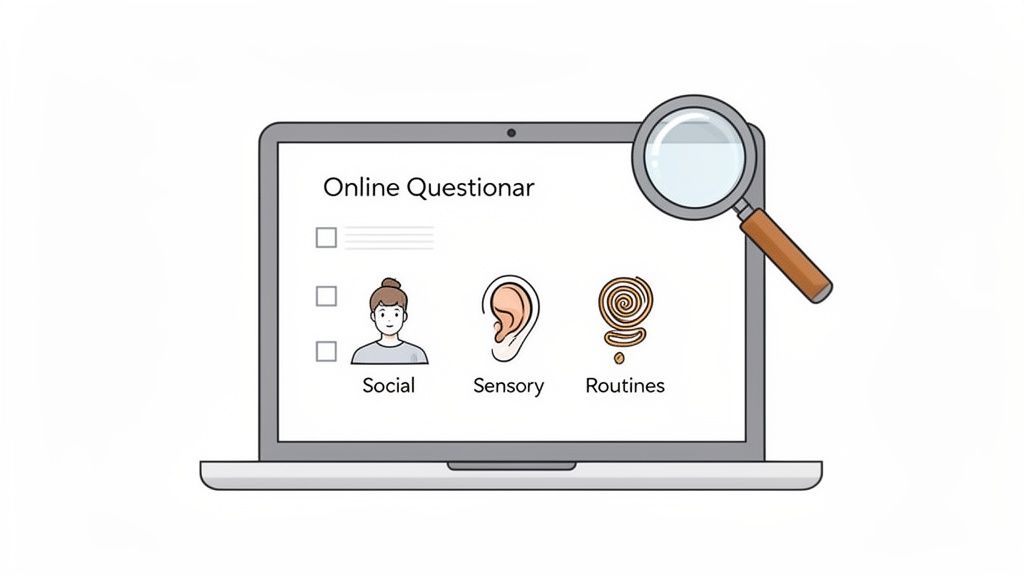
When you first start looking for a free autism test for adults, you'll probably notice a few names popping up over and over. These aren't just random internet quizzes; they're well-established screening tools that researchers have developed to measure autistic traits.
Think of each one as a different kind of lens, designed to bring specific patterns of thought, behavior, and personal experience into sharper focus.
These screeners are all self-report questionnaires, which means you answer based on your own life experiences. They'll present a series of statements and ask you to rate how much you agree or disagree, or how often something feels true for you. While they absolutely cannot replace a professional diagnosis, they offer a structured way to start reflecting on your traits.
The Autism Spectrum Quotient (AQ-50)
One of the most recognized screeners you'll find is the Autism Spectrum Quotient, or AQ test. Developed back in 2001, it's a 50-question tool created to measure autistic traits in adults who have average intelligence. It's really a foundational screener that many others have since built upon.
The AQ-50 breaks things down into five key areas linked to autism:
- Social Skills: Questions here might get you thinking about your comfort level in social settings or how you handle the back-and-forth of conversation.
- Communication: This area looks at how you interpret language, like whether you take metaphors literally or find it hard to track multiple conversations.
- Imagination: This part explores whether you gravitate more toward fiction and imaginative play or prefer facts, figures, and systems.
- Attention to Detail: It measures your tendency to pick up on small details that other people seem to miss.
- Attention Switching: This explores how easily you can shift your focus from one task or topic to another without feeling jarring.
A higher score on the AQ-50 suggests a greater number of autistic traits. It’s an excellent starting point for spotting patterns you may not have connected before.
The Ritvo Autism Asperger Diagnostic Scale-Revised (RAADS-R)
The RAADS-R is a more modern screener, and it was designed specifically to help clinicians diagnose adults. It's unique because it was developed with input from autistic people, so it's better at capturing the more subtle ways autism can present—especially in adults who've spent a lifetime learning to mask their traits.
This is a pretty comprehensive questionnaire with 80 questions that dig into four important life areas:
- Social Relatedness: This looks at your experiences with making and keeping friends, feeling like you fit in, and reading social cues.
- Sensory-Motor: Questions here relate to sensory sensitivities (like to bright lights, loud sounds, or certain textures) and motor differences (like clumsiness or stimming).
- Circumscribed Interests: This part focuses on the intensity and nature of your special interests—the things you can get completely absorbed in.
- Language: This assesses pragmatic language, like whether you have a hard time understanding sarcasm or things that are implied but not said directly.
Because the RAADS-R was built to help tell the difference between autism and other conditions, its questions can feel incredibly specific and validating for many adults who are just starting to question if they might be autistic.
Other Notable Screeners
While the AQ-50 and RAADS-R are the heavy hitters, you might come across a few others. The Empathy Quotient (EQ) and Systemizing Quotient (SQ) are often used together with the AQ test. They help explore the balance between understanding social-emotional information (empathizing) and analyzing rule-based systems (systemizing). A common profile associated with autism is a low EQ score alongside a high SQ score.
Remember, these screeners are not competitive exams. There are no right or wrong answers, only your honest reflections. Their true value lies in helping you gather personal data and organize your experiences into a coherent narrative.
Each of these tools offers a slightly different perspective. The AQ-50 gives you a solid, broad overview, while the RAADS-R is more finely tuned to the internal, lived experiences of autistic adults. Taking one—or even a few—can give you a much richer, more detailed picture of your own neurotype. That's invaluable information to have if you decide to pursue a professional evaluation.
How to Make Sense of Your Screening Score
Getting a score from a free autism test for adults can feel like holding a puzzle piece without knowing where it fits. That number on the screen might bring a rush of validation, a wave of confusion, or even a pang of anxiety.
The most important thing to remember is this: a screening score is not a final answer. Think of it as a starting point for deeper self-understanding.
It’s a bit like a weather forecast. A high chance of rain doesn’t guarantee it's pouring outside your window right now, but it’s a good sign you should probably grab an umbrella. Similarly, a high score on an autism screener suggests you have a significant number of autistic traits and that a professional evaluation might be a logical next step.
What Scoring Thresholds Really Mean
Most online screeners, like the AQ-50 or RAADS-R, have what's called a "cut-off" score. For the AQ-50, a common threshold is 32 or higher. Scoring above this number simply means your responses align with patterns often seen in autistic people.
It’s a signal, not a label. It suggests the way you experience the world—your social preferences, sensory sensitivities, and thought patterns—warrants a closer look with a professional who truly understands adult neurodiversity. You can learn more about how to interpret specific autism test scores in our detailed guide.
A screening score is just a piece of data, not a definition of who you are. Its real value is giving you a structured way to articulate your experiences and decide if you want to seek professional clarity.
The Possibility of False Positives and Negatives
Because these are just screeners—not diagnostic tools—they aren’t perfect. It's entirely possible to get a result that doesn't quite fit your reality.
- A False Positive happens when you score high for autistic traits, but the underlying cause is something else. Conditions like complex trauma (C-PTSD), social anxiety, or ADHD can have overlapping characteristics.
- A False Negative can happen if you are a "high-masking" individual. You may have spent a lifetime learning to suppress your natural autistic traits so effectively that your answers on a questionnaire don't capture your true internal experience.
This is exactly why a professional evaluation is so critical. A trained clinician can look beyond the numbers, understand the nuances of your life story, and differentiate between autism and other conditions that might look similar on the surface.
The rising interest in these tests signals a huge shift in awareness. Adults are actively seeking out free autism tests because millions are realizing they may have gone undiagnosed their whole lives. These online tools, often based on scales like the RAADS-R or AQ, are a crucial first step, but they are just that—a first step.
Ultimately, your score from a free autism test for adults is a powerful tool for self-reflection. It helps turn vague feelings into concrete data points you can use to start a productive conversation—first with yourself, and then, if you choose, with a healthcare provider.
When to Pursue a Formal Evaluation
So, you've taken a free autism test for adults and your score is high. That number can feel like a huge moment of clarity, but it's not the final answer. Think of it as a signpost, pointing you toward a deeper look into how your brain is wired. The real decision to seek a formal, professional evaluation isn't just about a score—it's about understanding your life experiences.
A screening test is like a single snapshot. A formal evaluation, on the other hand, is the whole movie. A professional looks at the full context of your life—your history, your struggles, and your strengths—to build a complete and accurate picture. This step becomes really important when you notice ongoing patterns that are making daily life harder than it needs to be.
The flowchart below gives a simple visual of this decision-making process.
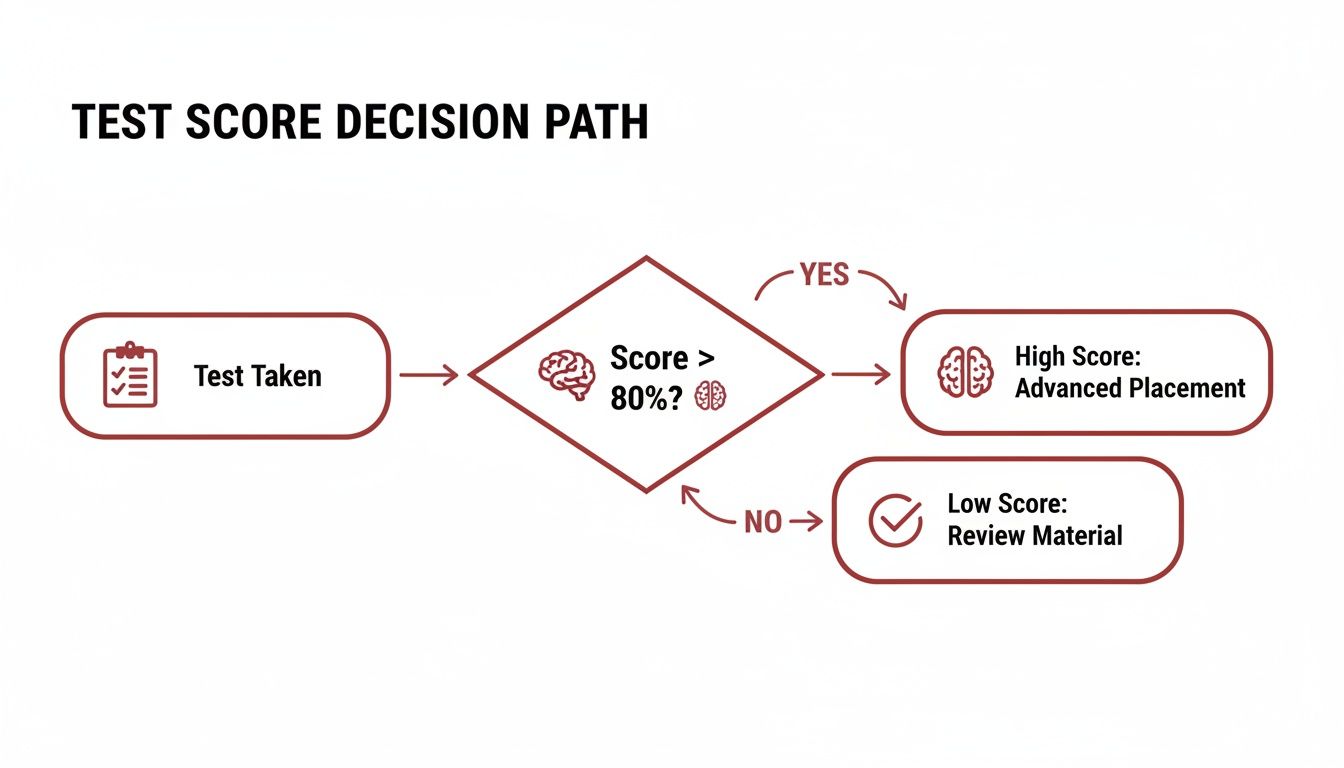
As you can see, a high score suggests it's time to dig deeper. A low score might mean a clinical assessment isn't necessary right now, but it doesn't invalidate your feelings or experiences.
Red Flags That Point to a Formal Assessment
If your screener score was high—or even if it wasn't, but the questions just clicked with you—it's time to look at the bigger picture. Certain ongoing challenges are strong signs that a professional assessment would be a good idea.
Consider an evaluation if you consistently find yourself dealing with:
- Persistent Social Communication Difficulties: This is more than just being shy. It’s a chronic feeling of being out of sync in conversations, struggling to read body language, or feeling so drained by social events that you burn out.
- Intense and Consuming Special Interests: Your hobbies aren't just hobbies. They're deep, passionate worlds you dive into that bring you immense joy, but they might also make it hard to focus on other parts of your life.
- Significant Sensory Sensitivities: You're constantly overwhelmed by bright lights, loud sounds, strong smells, or the texture of your clothes. It’s not just a preference; it causes real distress and makes you avoid certain places or situations.
- A Deep Need for Sameness and Routine: Unexpected changes to your day feel completely jarring and throw you off balance, causing a huge amount of anxiety.
These aren't just personal quirks. They are patterns that can genuinely affect your relationships, your job, and your mental health.
A formal evaluation isn’t just about confirming autism. It's about ruling out other conditions with overlapping traits, such as ADHD, social anxiety, or complex trauma, ensuring you receive the right support for your specific needs.
The Importance of Diagnostic Clarity
Many adults come to a free autism test for adults because their experiences were missed or misunderstood when they were kids. The CDC now estimates that 2.18% of adults in the US are autistic. With diagnoses jumping 243% since 2000, it’s obvious that a huge number of people are only now finding the words for their lifelong experiences.
Getting a formal diagnosis can be an incredibly validating step toward self-understanding. It gives you an official framework to access workplace accommodations, find therapy that actually helps, and connect with a community that just gets it. Moving forward with an online autism diagnosis for adults can turn a lifetime of feeling "different" into a future of clarity and self-acceptance.
Navigating Your Professional Diagnosis Path
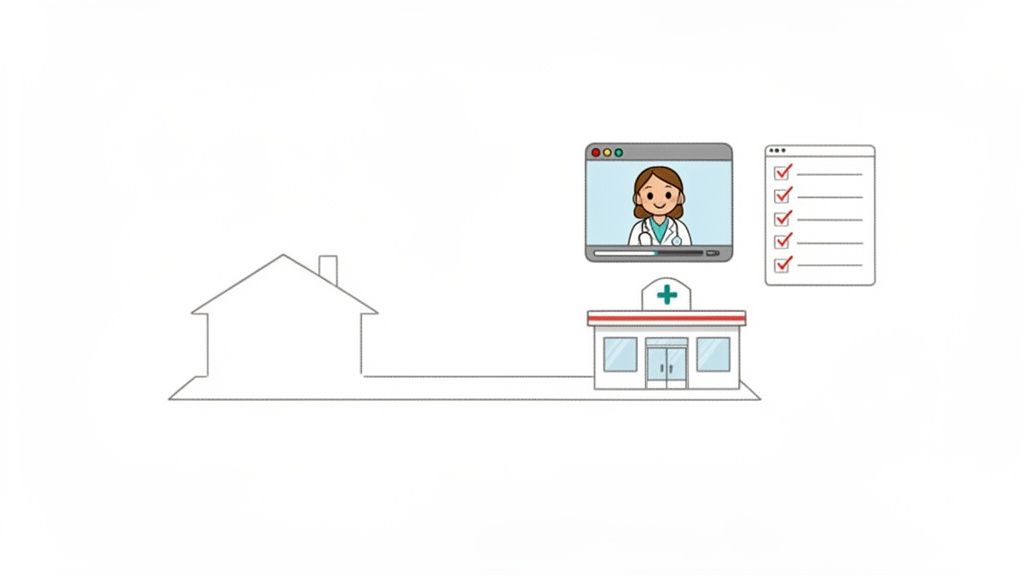
Taking that step from a free autism test for adults to a professional evaluation can feel like a pretty big leap. But this process is all about bringing you clarity, not more confusion. Thanks to modern telehealth, getting a formal diagnosis is more accessible and comfortable than ever—you can connect with a specialist right from your own home.
A comprehensive assessment is so much more than another questionnaire. Think of it as a deep, collaborative dive into your life experiences. It’s where a trained psychologist helps you connect the dots, from your earliest memories to the challenges you face today.
The entire process is built to be a conversation, not an interrogation. This gives a specialist the chance to see the full picture and understand the unique ways your neurotype shows up, especially if you’ve spent a lifetime masking your true self.
What a Comprehensive Telehealth Evaluation Involves
A professional autism evaluation is a structured process designed to look way beyond surface-level traits. It's like a detailed life story interview, but you're guided by an expert who knows exactly what to look for. The real goal is to build a complete understanding of you as a person.
The heart of the evaluation is an in-depth clinical interview. This conversation usually lasts around two hours and digs into your developmental history, your patterns in social communication, sensory experiences, and the nature of your special interests. It’s your chance to share your story in a safe, non-judgmental space.
Alongside the interview, clinicians use validated assessment tools—much more detailed and robust versions of the screeners you find online. These self-report measures give us structured data that, when combined with the clinical interview, helps form a solid, accurate diagnostic picture.
The real magic of a professional evaluation is the clinician's expertise. Specialists in adult autism get the nuances of masked presentations—especially in women and people of color—and can make sure your experiences are finally seen and correctly interpreted.
Choosing the Right Evaluation for Your Needs
Not everyone is looking for a diagnosis for the same reasons. Some of us just need personal clarity, while others require official paperwork for work or to help coordinate care with other doctors. Knowing your end goal is the key to picking the right type of evaluation.
At the Sachs Center, we’ve created different options to make sure you get exactly what you need out of the process. This lets you choose a path that lines up with your personal, professional, or medical goals, so the outcome is genuinely useful for your life.
This structured approach helps take the mystery out of it all. Here’s a simple breakdown of our telehealth evaluation options so you can easily see which path fits your situation best.
Choosing Your Evaluation Option
Deciding which evaluation package is right for you depends on what you hope to achieve with a diagnosis. This table lays out our options to help you choose the best fit, whether you're seeking personal understanding or need formal documentation for accommodations.
| Service | Price | Includes | Best For |
|---|---|---|---|
| Diagnostic Testing | $790 | 2-hour virtual evaluation and a formal diagnostic letter. | Individuals seeking diagnostic clarity and a letter for workplace accommodations or to obtain medication from another provider. |
| Diagnostic Testing (+ Report) | $1170 | 2-hour virtual evaluation, diagnostic letter, and a detailed 4-page diagnostic report. | Those who want a more detailed picture of their neurotype and a comprehensive document to share with other healthcare providers for coordinated care. |
Picking the right service ensures the final documents you receive are perfectly suited to help you take your next steps.
The Power of a Formal Diagnostic Document
Once your evaluation is complete, you’ll receive a formal document—either a diagnostic letter or a comprehensive report. This is more than just a piece of paper; it’s a powerful tool that can unlock support and validate your experiences in a real, tangible way.
A diagnostic letter is a concise, official statement confirming your diagnosis. It’s often all you need to request workplace accommodations under the Americans with Disabilities Act (ADA), like getting a quieter workspace, flexible hours, or noise-canceling headphones.
A comprehensive diagnostic report goes much deeper. This multi-page document gives a detailed summary of your history, the diagnostic findings, and personalized recommendations. It's an invaluable tool for sharing with therapists, doctors, or coaches to make sure everyone on your support team truly understands your needs. It can also be used to seek disability services if your condition significantly impacts your ability to work.
Ultimately, navigating the path to a professional diagnosis is about moving from a place of uncertainty to one of empowerment. It gives you a clear framework for understanding yourself and the official documentation you need to advocate for the support that will help you thrive.
Your Questions About Autism Screening, Answered
Taking that first step with an online screener often brings up more questions than answers. It's a common experience. Let's walk through some of the biggest concerns people have after taking a free autism test for adults.
Are Free Online Autism Tests Accurate?
Think of a free online test as a preliminary screener, not a final verdict. It’s designed to flag potential autistic traits, but it can't give you a formal diagnosis.
They are an informed first step, helping you gauge whether a professional evaluation is a logical next move. Their real value is in identifying patterns that might warrant a closer look, not in confirming a condition on their own.
I Scored High on an Autism Test. What Now?
A high score is a strong indicator that you have a significant number of traits associated with autism. The best thing to do next is to schedule a formal evaluation with a specialist who is experienced in adult neurodiversity.
To get the most out of your appointment, it helps to come prepared.
- Bring your test results with you.
- Jot down some real-life examples that relate to the questions on the screener.
- Make a list of specific challenges you've faced throughout your life.
This kind of personal context is incredibly helpful for a clinician. It turns a clinical assessment into a more collaborative and productive conversation.
Why Is a Formal Diagnosis So Important, Anyway?
A formal diagnosis is the only way to officially confirm Autism Spectrum Disorder. It's the step that moves you from a place of questioning and uncertainty to one of clarity—and it unlocks real, tangible support.
A diagnostic letter or report is a legitimate document. It can be used to secure workplace or academic accommodations, access specific therapies, and provide a clear framework of your strengths and challenges for yourself and other healthcare providers.
Ultimately, getting a diagnosis is about validating your life experiences. It empowers you to advocate for what you need to thrive and gives you a roadmap for building a life that works with your neurotype, not against it. It's a foundational step toward self-acceptance.
At the Sachs Center, our telehealth evaluations offer the diagnostic clarity you're looking for, all from the comfort of your home. If you feel ready to move beyond screeners and get definitive answers, you can book your professional assessment today.
