

Social skills training for adults is a structured way to learn and practice the skills you need for clearer, more effective, and more confident social interactions. It’s about more than just "being friendly." Instead, it breaks down communication into specific, learnable parts—like body language, conversational flow, and active listening. The goal is to help you build stronger connections in your personal and professional life.
What Exactly Is Social Skills Training for Adults

Do you ever feel like you missed the memo on social rules? Social skills training is that memo. It's not about changing who you are or forcing a personality that isn’t genuine.
Think of it like a coach helping an athlete refine their technique. The athlete already has the talent; the coach just provides targeted strategies and drills to make their performance smoother and more effective. In the same way, this training gives you the tools to navigate social situations with greater ease and self-assurance.
It works to demystify those unwritten rules of interaction that many people seem to pick up naturally but can feel confusing to others. The ultimate goal is to build genuine connections, not to perform a social script perfectly.
The Core Idea: A Cultural Exchange
A modern, neuro-affirming approach to social skills training for adults looks at it as a kind of cultural exchange. For many neurodivergent individuals, the social norms of a neurotypical world can feel like a foreign culture with its own unique customs and unwritten rules. This training acts as a respectful guide to that culture.
Crucially, it’s not about labeling one way of communicating as "right" and another as "wrong." It acknowledges that different neurotypes have different—and equally valid—social styles. The training simply offers the option to learn the skills needed to interact effectively in specific contexts, like a job interview or a team meeting, where certain social expectations are often present.
This approach removes the value judgment that often comes with traditional training. It isn't about "fixing" a deficit; it's about adding a new set of tools to your communication toolkit, empowering you to use them when you feel it’s beneficial.
What Does the Training Actually Involve?
Social skills training is a hands-on process. It’s all about breaking down complex social interactions into manageable parts. You’ll learn through direct instruction, observation, and—most importantly—practice in a supportive, judgment-free setting.
While every program is a bit different, most focus on a few fundamental areas.
Here’s a quick look at the core components you’ll likely encounter.
Core Components of Social Skills Training
| Skill Category | What It Involves | Real-World Example |
|---|---|---|
| Verbal Communication | Learning how to start, maintain, and end conversations; asking open-ended questions; active listening. | Knowing how to politely join a group conversation at a work event instead of waiting on the sidelines. |
| Non-Verbal Communication | Understanding and using body language, facial expressions, eye contact, and tone of voice to add meaning. | Noticing a friend's slumped shoulders and realizing they might be having a bad day, even if they say they're "fine." |
| Empathy & Perspective-Taking | Practicing seeing situations from another person's point of view to build connection and rapport. | Understanding why a coworker is frustrated about a project change, even if it doesn't bother you directly. |
| Assertiveness & Boundaries | Clearly and respectfully expressing your own needs, opinions, and limits while respecting those of others. | Saying "I can't take on another task right now, but I can help with that tomorrow" instead of silently becoming overwhelmed. |
These skills are becoming increasingly recognized as vital for both personal well-being and professional success. In fact, the global soft skills training market, which includes social skills development, was valued at USD 33.39 billion in 2024 and is projected to keep growing. You can read the full research about the expanding soft skills training market to see how organizations are investing in these capabilities. This data shows a clear shift: interpersonal abilities are now valued just as much as technical expertise in the modern world.
Who Really Benefits From This Training?
It’s a common myth that social skills training is only for a certain type of person. The truth is, it helps a huge range of adults who feel a gap between how they want to connect with others and how their interactions actually go down.
This training is for anyone who’s ever left a party feeling totally drained, replaying every single conversation. It’s for the professional who has brilliant ideas but can’t seem to get them heard in a meeting. At its core, social skills training for adults is about giving you the clarity and tools to feel more seen, understood, and confident in your connections.
Neurodivergent Adults Building Bridges
For many neurodivergent adults, especially those with ADHD or on the autism spectrum, the neurotypical social world can feel like trying to navigate a foreign country without a map. The customs are confusing, and trying to interpret subtle cues or manage office politics is just plain exhausting.
Think of this training as a cultural guide, not a correction manual. It helps bridge the communication divide by translating the "unwritten rules" of neurotypical interaction. The goal is simple: empowerment. We want to give you the skills to handle specific situations, like a job interview or a team project, with way less stress and a lot more confidence.
It's about adding another language to your skill set—one you can choose to use when it serves you, without ever losing your authentic way of communicating.
Professionals Seeking Stronger Connections
In the working world, technical ability will only get you so far. What often separates good leaders from great ones is the ability to build rapport, influence team members, and articulate ideas clearly.
Many ambitious professionals find this training sharpens their interpersonal edge. This includes:
- Aspiring Leaders: Learning how to genuinely motivate a team, give constructive feedback, and create a truly collaborative space.
- Technical Experts: Translating complex ideas into plain English for clients or colleagues who don't share their expertise.
- Sales and Client-Facing Roles: Building real trust and lasting relationships instead of just sticking to a script.
By honing these skills, professionals can make sure their hard work isn’t just seen but also felt, paving the way for more career growth and personal fulfillment.
Overcoming the Strain of Social Masking
Many people, especially women and BIPOC adults who may have gone undiagnosed for years, become masters of masking. This is the conscious or unconscious effort to hide your natural social tendencies to fit in with neurotypical expectations.
While masking can feel like a necessary survival skill, doing it constantly is mentally and emotionally draining. It often leads to burnout, anxiety, and a nagging feeling that you’ve lost touch with your true self.
Social skills training offers an alternative to exhaustive masking. It provides concrete strategies that are less about hiding and more about skillful navigation, allowing you to conserve energy and engage more authentically.
This training helps you learn which tools to use in which situations, reducing that constant pressure to "perform" and freeing up valuable mental energy.
Rebuilding Confidence After Isolation or Anxiety
Social skills are like muscles—if you don’t use them, they get weaker. Many adults find their confidence has taken a hit after periods of isolation, major life changes, or a long-term battle with social anxiety. The very idea of making small talk can feel completely overwhelming. For those struggling with this, training offers practical strategies on how to cope with social anxiety.
This training provides a safe, structured environment to rebuild that social muscle. It's a low-stakes practice field where you can:
- Relearn Conversational Flow: Get comfortable starting, maintaining, and gracefully ending conversations.
- Manage Anxious Thoughts: Develop techniques to calm your mind and stay present instead of getting lost in your head.
- Take Small, Confident Steps: Gradually build up your comfort in different social scenarios, from one-on-one chats to group events.
For anyone looking to step back into the social world with more ease, this training provides a clear, supportive path forward. It’s about replacing avoidance with action and anxiety with a new sense of capability.
Finding the Right Training Format for You
Choosing how you learn is just as important as what you learn. The right format for social skills training can make all the difference, creating a space where you feel comfortable, supported, and ready to grow.
Think of it this way: some people thrive in a collaborative classroom, while others prefer a personal tutor. Your ideal setup will depend on your specific goals, learning style, and life circumstances. It’s not about finding the "best" format—it's about finding the best one for you.
Group Sessions: A Built-In Practice Squad
Group training is one of the most popular formats, and for good reason. It provides a real-time, interactive lab for practicing new skills. Instead of just talking about how to join a conversation, you get to actually try it out with other people who are on the same journey.
This shared experience creates a powerful sense of community and reminds you that you aren't alone. The main benefits include:
- Immediate Feedback: You get input not just from a facilitator but from peers who genuinely understand the challenges.
- Diverse Scenarios: Interacting with different personalities prepares you for the unpredictability of real-world social dynamics.
- Cost-Effectiveness: Group programs are often more affordable than one-on-one sessions.
At the Sachs Center, our Dragon Masters groups for adults are designed to harness these benefits, creating a supportive space where neurodivergent adults can practice and build confidence together.
Individual Coaching: A Personalized Roadmap
If you're looking for highly targeted support, one-on-one coaching is an excellent choice. This format allows a facilitator to focus entirely on your unique strengths and challenges. The whole curriculum is shaped around your specific goals, whether that’s navigating workplace politics or feeling more at ease on a first date.
This personalized approach is especially helpful for adults with very specific objectives or those who feel apprehensive about practicing in a group. It offers a private, safe space to work through sensitive social hurdles and receive hyper-specific feedback. Everything moves at your pace, ensuring you feel solid in one skill before moving on to the next.
A key advantage of individual coaching is its efficiency. By zeroing in on your most pressing needs, you can often make significant progress in a shorter amount of time, building skills that are directly applicable to your daily life.
Telehealth and Online Training: Flexibility Meets Function
In recent years, virtual training has become a game-changer, removing geographical barriers and making support more accessible than ever. This growing acceptance of lifelong learning is reflected in broader trends; in 2022, 46.6% of adults in the European Union participated in some form of education or training. You can discover more insights about adult learning statistics from Eurostat and see how this trend continues to rise.
Telehealth offers the same expert guidance as in-person sessions but with a huge dose of convenience. For many adults, especially those with social anxiety or jam-packed schedules, learning from the comfort of home reduces stress and makes it easier to stick with the program. You can explore a variety of social skills training online options that fit different needs.
This decision tree can help you visualize which path might be right for you.
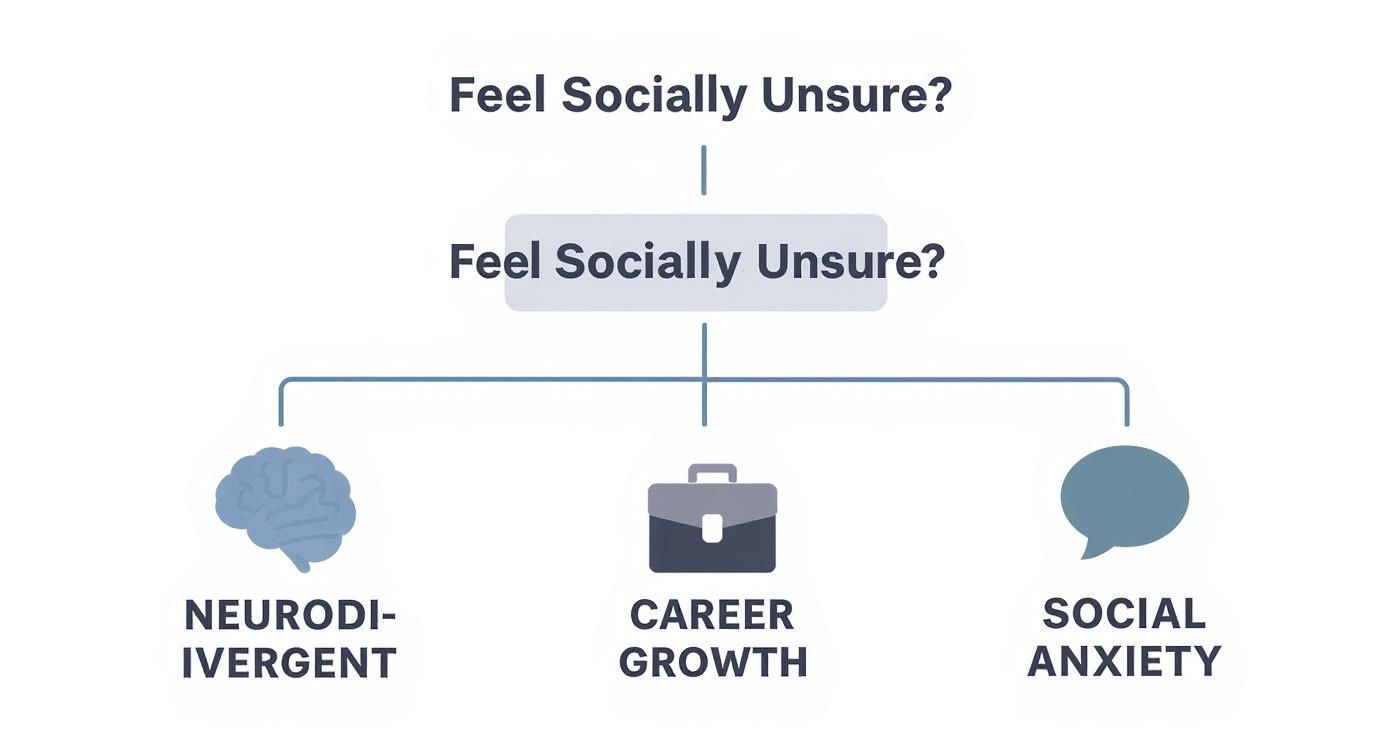
As the infographic highlights, your motivation for seeking training—whether it's managing neurodivergent traits, advancing your career, or easing social fears—is a key factor in choosing the right kind of support.
Social Skills Training Formats at a Glance
To make your decision a little easier, we’ve broken down the key differences between the formats in the table below. Take a look at the benefits and potential drawbacks of each to see which one aligns best with your needs and comfort level.
| Format | Best For | Key Benefits | Potential Drawbacks |
|---|---|---|---|
| Group Sessions | Individuals who want to practice in a realistic, social setting and build community. | Real-time practice, peer feedback, cost-effective, reduces feelings of isolation. | Less individual attention, may feel intimidating for some, pace is set by the group. |
| Individual Coaching | People with specific goals or who prefer a private, personalized learning environment. | Tailored curriculum, one-on-one attention, flexible pacing, confidential space. | Higher cost, lacks real-time group dynamics for practice. |
| Telehealth/Online | Adults needing flexibility, those with busy schedules, or individuals in remote areas. | Convenient, accessible from anywhere, can reduce social anxiety associated with in-person meetings. | Requires reliable tech, may feel less personal for some, potential for distractions at home. |
Ultimately, the best format is the one that you'll actually stick with. Think about your learning style, your schedule, and what kind of environment makes you feel most empowered to learn and grow.
What Happens Inside a Training Session
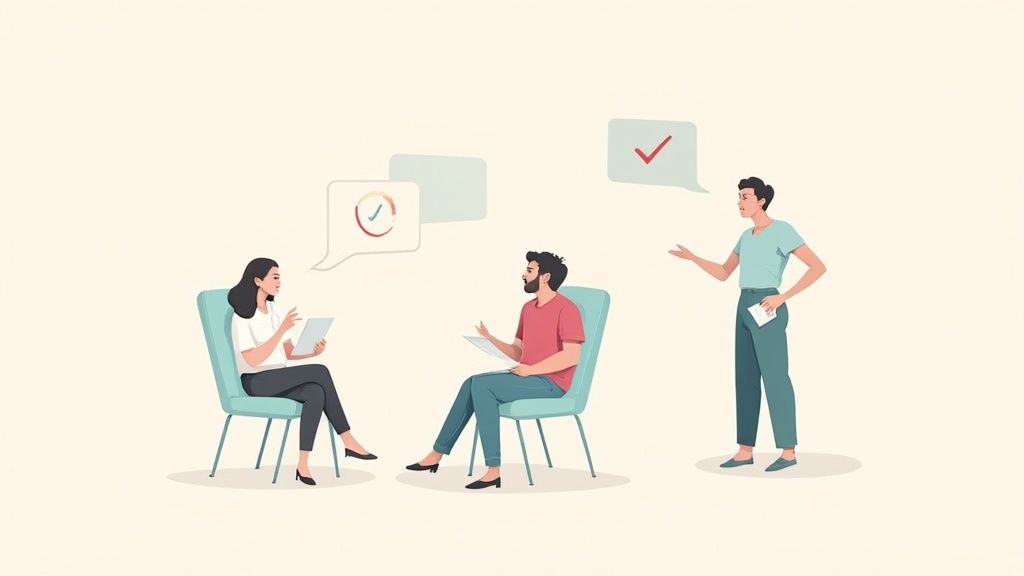
Walking into your first social skills training for adults session can feel a little nerve-wracking. A lot of people imagine some kind of awkward, high-pressure situation, but the reality is way more supportive and structured than that.
Think of it less like a performance and more like a friendly workshop. It's a safe space where you get to learn, practice, and polish your skills at your own pace. Each session is built to grow your confidence one small step at a time, focusing on progress, not perfection.
Breaking Down the Skills
A typical session starts by taking a big, complex social interaction and breaking it down into smaller, more manageable pieces. Instead of a vague goal like "be better at conversations," you'll zoom in on one specific, concrete skill. This approach helps demystify social rules and makes them much easier to grasp.
For instance, a single session might focus on things like:
- Gracefully Exiting a Conversation: Learning the verbal and non-verbal cues to politely wrap up a chat without it feeling abrupt or awkward.
- Giving a Sincere Compliment: Figuring out how to structure a compliment so it feels genuine and really connects with the other person.
- Disagreeing Respectfully: Practicing how to share a different point of view while still making the other person feel heard and validated.
In these sessions, adults also learn vital communication tools and strategies for setting healthy boundaries, which are absolutely key to building respectful and solid relationships. By isolating these skills, you can master them one by one before putting them all together in more complex situations.
Low-Stakes Practice Through Role-Playing
Once a skill is introduced, it's time to practice. This is where role-playing comes in, and it's not as scary as it sounds. It’s basically a dress rehearsal for real-life social moments, but without any of the real-world pressure. It's your chance to try out new techniques where making mistakes is just part of the learning process.
Imagine you’re practicing how to make small talk. You might get paired up with another person or the facilitator to act out a simple scenario, like waiting in line for coffee. You get to test-drive different opening lines and see what feels most natural to you.
This hands-on practice is what makes the training stick. It helps move the skills from just an idea in your head to an actual behavior you can use, building that social muscle memory.
The core value of role-playing is that it provides a safe sandbox to experiment. You can try, fail, and try again without any social consequences, which is often the biggest barrier to practicing in daily life.
Constructive Feedback and Real-World Application
After each role-play exercise, the facilitator (and sometimes the group) will offer some constructive feedback. This isn't about criticism. It's specific, actionable advice designed to help you improve, delivered kindly and focused on what worked and what you could tweak.
Finally, most programs give you a little "fieldwork" to do. This is your assignment to practice the skill you just learned out in the real world before the next session. It could be something as simple as making eye contact with the barista or asking a coworker an open-ended question.
This bridge between the training room and your everyday life is where the real progress happens. By applying these new skills in small, manageable ways, you steadily build lasting confidence. Many adults find this structured approach incredibly effective, and our social skills groups for adults at the Sachs Center are designed around these core principles of instruction, practice, and real-world application.
How to Choose the Right Program and Provider

Finding the right guide for your journey into social skills training is just as important as the decision to start. A great program can feel like a key finally turning in a lock, while a poor fit can leave you feeling frustrated and stuck. The goal is to find a provider who not only has the right credentials but truly gets your unique perspective, especially if you're a neurodivergent adult.
Choosing the right partner for this work is a serious investment in your well-being. And the data backs this up. Research clearly shows a strong link between an adult's social and emotional skills and their overall life outcomes. Adults with higher competencies in these areas are more likely to be employed, earn more, and report greater life satisfaction. This isn't just about feeling better; it has real-world impact, as highlighted in this World Bank article on the importance of adult skills.
Vet the Provider’s Credentials and Specializations
Before you do anything else, look into the provider's background. Of course, a qualified professional should have relevant credentials, like a license in psychology, social work, or counseling. But a license alone doesn't tell the whole story.
The most important factor is their direct experience with social skills training for adults. Many practitioners focus on children, but the goals and approaches for adults are completely different. You need someone who understands adult challenges, like navigating workplace dynamics, building romantic relationships, and the nuances of professional networking.
Even more specifically, ask about their experience with neurodivergent individuals, including those with ADHD and autism. A truly neuro-affirming provider will see your communication style as a difference, not a deficit. Their goal will be to help you add new skills to your toolkit, not force you to mask who you are.
Key Questions to Ask During a Consultation
Think of a consultation as your opportunity to interview a potential provider. Do their values and approach line up with your goals? Don't be shy about asking direct questions—this is your chance to make sure you're making an informed decision.
Here are some essential questions to have in your back pocket:
- What is your approach to social skills training? Listen for terms like "evidence-based," "neuro-affirming," and "strengths-based." This tells you they use proven methods and will respect your identity.
- How do you tailor the program to individual adults? A one-size-fits-all curriculum is a major red flag. They should be able to explain exactly how they’ll customize the training to your specific needs.
- What experience do you have with [your specific situation, e.g., ADHD, social anxiety, workplace challenges]? Their answer will quickly reveal their depth of knowledge and whether they’re equipped to support you.
- How do you measure progress and success? A clear answer here shows they have a structured process. Success shouldn't just be about checking boxes; it should be tied directly to your personal goals for feeling more confident and connected.
Think of this consultation as a two-way interview. You are not just being assessed; you are assessing them. The right provider will welcome your questions and make you feel heard, respected, and understood from the very first interaction.
Practical Considerations and Advocating for Your Needs
Once you've found a provider whose philosophy resonates with you, it's time to get into the practical details. Go over the costs, scheduling options, and the format of the sessions (individual, group, or telehealth) to make sure it all fits your budget and lifestyle.
This is also the moment to advocate for any accommodations you might need. For example, if you know that back-to-back video calls are draining for you, ask for shorter sessions or scheduled breaks. A good provider will be flexible and work with you to create a learning environment where you can truly thrive.
At the Sachs Center, we prioritize this kind of collaborative, person-centered approach. Our specialists are deeply experienced in working with neurodivergent adults and understand just how crucial a supportive, affirming environment is. You can learn more about our one-on-one social skills coaching for adults to see if our methodology is the right fit for your personal growth journey.
Common Questions About Social Skills Training
Dipping your toes into the world of social skills training for adults is bound to bring up some questions. It's completely natural to feel a mix of curiosity and maybe even a little hesitation before starting something new. To help clear things up, we've gathered some of the most common questions people ask before they get started.
This isn't just a generic FAQ. It's designed to give you straightforward, honest answers about the process, what to expect, and why this kind of training is such a powerful investment in yourself.
How Long Does It Take to See Results?
This is usually the first thing on everyone's mind, and the honest answer is: it's different for everyone. There’s no magic number of sessions that works for all, because your progress really depends on your starting point, your personal goals, and how much you practice what you learn in your daily life.
That said, many people start to feel small but significant shifts pretty quickly. After just a few sessions, you might notice you're a bit more confident starting small talk, or you feel less of a knot in your stomach before a big meeting. These early wins are huge for building momentum.
Bigger, more lasting changes—like feeling genuinely at ease in all sorts of social situations—tend to take a few months of consistent work. Think of it like learning guitar. You won’t be playing a full song after your first lesson, but with steady practice, your skills and confidence build week by week. Consistency is everything.
Is This Training Only for People with a Diagnosis?
Absolutely not. This is probably the biggest misconception out there. While this training is an incredibly effective tool for neurodivergent individuals—like those with ADHD or autism—the benefits are truly universal. The skills we teach are fundamental to human connection, and that’s something anyone can get better at.
We see all sorts of people who thrive with this training, including:
- Executives and managers looking to become more inspiring and effective leaders.
- Introverts who want to navigate networking events with less stress and more real connection.
- Anyone overcoming shyness or social anxiety who wants to build a richer social life.
- People who feel like their communication style is often misunderstood by others.
At its core, this training is for anyone who wants to feel more effective and confident in their social interactions. It’s not about "fixing" a problem; it's about adding a powerful set of tools to your communication toolkit, no matter who you are.
Can I Just Practice on My Own?
Self-study is fantastic, and we absolutely encourage it! Reading books, watching videos, and observing others are great ways to build your awareness of social dynamics. You can definitely make progress on your own, and every bit of effort you put in is a step forward.
However, a structured training program brings a few game-changing elements to the table that are tough to replicate alone. The biggest one is expert feedback. A trained coach or therapist can give you specific, personalized insights you’d likely miss on your own. They can point out that subtle non-verbal cue you're missing or suggest a tiny tweak in your phrasing that makes all the difference.
Plus, a formal program gives you a safe, structured space for real-time practice through role-playing. This is a low-stakes rehearsal studio where you can build muscle memory without the fear of real-world social fallout. You get to experiment, mess up, and refine your approach in a supportive setting, which speeds up the learning process dramatically.
Differentiating Therapy and Skills Coaching
It’s easy to wonder how this is different from traditional therapy, and it's an important distinction. While both are incredibly valuable for personal growth, they tackle different pieces of the puzzle.
Think of it this way: therapy often looks to the past to understand the "why" behind your current challenges. A therapist helps you explore your history, emotional patterns, and the deep-seated reasons for your social difficulties. It's about healing and self-awareness.
Social skills coaching, on the other hand, is forward-looking and action-oriented. It focuses on the "how"—the practical, behavioral skills you need to navigate social situations right now. A coach's job is to teach you specific techniques, help you practice them, and give you actionable strategies to use day-to-day.
Here’s a simple way to look at it:
| Aspect | Therapy | Social Skills Coaching |
|---|---|---|
| Primary Focus | Explores the "why" (past experiences, emotional roots) | Focuses on the "how" (practical skills, future actions) |
| Main Goal | Healing emotional wounds, understanding patterns | Building specific, observable behavioral competencies |
| Process | Often involves deep emotional processing and insight | Involves direct instruction, role-playing, and feedback |
Both paths are powerful, and they can even work together beautifully. Many people find that therapy helps them understand their social anxiety, while coaching gives them the concrete tools to manage it in the moment.
At the Sachs Center, we offer a range of services designed to meet you where you are. From individual teletherapy that can explore the "why," to our Dragon Masters groups and adult support groups that focus on building practical skills in a supportive community, we're here to help.
Ready to build more confident and fulfilling social connections? Book a consultation with the Sachs Center today to find the right path for you.
