

When a student is struggling in school, parents and teachers often ask the same question: Why? Psychoeducational testing is the process that provides the answer. It’s a comprehensive evaluation designed to create a detailed blueprint of how a student learns, thinks, and feels.
This goes way beyond a simple IQ score. The goal is to uncover a person's unique cognitive profile—their strengths, their challenges, and the specific reasons behind their academic difficulties.
Understanding the Blueprint of a Mind
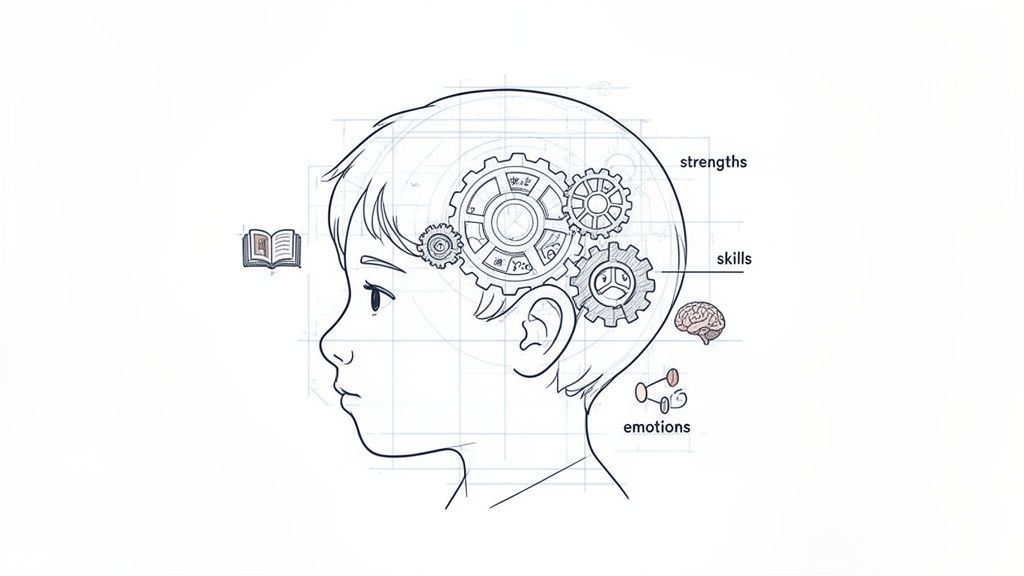
Think of it like a diagnostic check for a car that keeps sputtering. A good mechanic doesn’t just guess what’s wrong. They run specific tests on the engine, the electronics, and the fuel system to find the root cause. A psychoeducational evaluation does the same thing for a child's learning process.
When a bright, capable student just isn't making progress, this type of testing looks "under the hood" to figure out exactly what's going on. It’s not a single test, but a collection of specialized assessments—often called a battery—administered by a trained psychologist.
Ultimately, the entire process is about moving from a place of confusion and frustration to one of clarity and actionable steps.
What Does the Testing Really Show?
A psychoeducational evaluation gives parents and educators objective, data-driven answers. Instead of making assumptions about why a student is struggling, the results offer concrete evidence about their learning profile.
The assessment builds a complete picture by measuring several key areas:
- Cognitive Abilities: This looks at intellectual potential (IQ) but also dives deeper into things like memory, processing speed, and problem-solving skills.
- Academic Skills: We directly measure how a student is performing in core subjects like reading, writing, and math compared to their peers.
- Social-Emotional Functioning: This explores how factors like anxiety, attention, or behavior might be getting in the way of learning.
By putting all these pieces together, the evaluation can pinpoint the underlying reasons for academic struggles. It might uncover a specific learning disability like dyslexia, show that slow processing speed is making it hard to keep up, or identify executive functioning challenges tied to ADHD.
A psychoeducational evaluation isn't about slapping a label on a child; it's about deeply understanding them. The final report acts as a detailed roadmap, providing the specific directions needed to help them navigate their educational journey with confidence.
This roadmap empowers parents to become effective advocates and gives teachers the precise information they need to provide targeted support, often through an Individualized Education Program (IEP) or a 504 Plan.
Psychoeducational Testing At a Glance
To make this even clearer, the table below breaks down the core components of an evaluation and what each part aims to achieve. The results from each area are combined to build that holistic learning profile we talked about.
| Component | What It Measures | Common Outcome |
|---|---|---|
| Cognitive Assessment | Intellectual functioning, verbal and non-verbal reasoning, working memory, and processing speed. | Identifies cognitive strengths and weaknesses that impact learning efficiency. |
| Achievement Testing | Specific academic skills in reading (fluency, comprehension), writing (spelling, expression), and math. | Pinpoints specific learning disabilities and academic skill gaps. |
| Behavioral & Emotional | Attention, executive functions, anxiety, mood, and social skills through rating scales and observation. | Provides context for how emotional or behavioral factors affect school performance. |
Each component provides a critical piece of the puzzle, and together they create a clear path forward for supporting the student.
Inside the Toolkit of an Evaluation
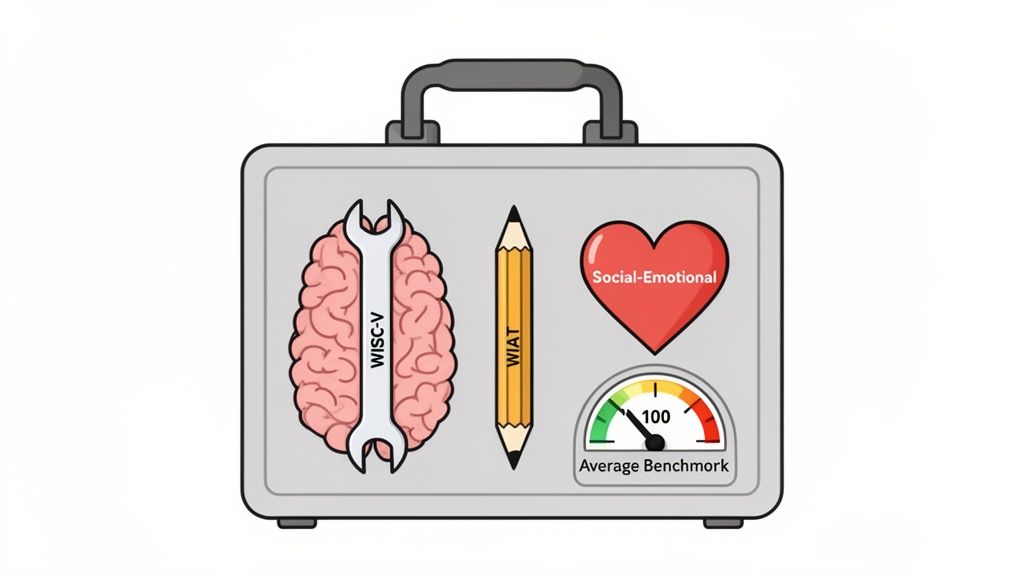
To really figure out how a student learns, a psychologist uses a specific set of tools called a testing battery. The best way to think about it is like a master mechanic’s toolkit, where every instrument is designed for a precise job. Instead of wrenches, we have carefully designed assessments that measure different parts of the learning process.
This multi-tool approach is essential for getting the full picture. It’s never about just one test or a single score; it's about seeing how all the different pieces of a student's cognitive and academic puzzle fit together. We typically combine assessments across three main areas to build a detailed and truly useful profile.
Exploring the "How" of Learning: Cognitive Assessments
First, we need to understand the student's cognitive "engine." This is done with cognitive assessments, which measure the underlying mental processes that drive learning. The most recognized and trusted tool in this category is the Wechsler Intelligence Scale for Children (WISC-V).
These tests do much more than just produce an IQ score. They break down intellectual functioning into key areas to answer some critical questions:
- Verbal Comprehension: How well does the student grasp and use language?
- Visual-Spatial Reasoning: Can they mentally manipulate shapes and solve visual puzzles?
- Working Memory: How much information can they hold in their head and work with at one time?
- Processing Speed: How quickly and accurately can they handle simple, visual information?
By looking at these individual components, we can see how a student thinks. For instance, a child might have fantastic reasoning skills but struggle with slow processing speed, which finally explains why they run out of time on tests even when they know the material. Understanding these cognitive gears is a core part of both psychoeducational and neuropsychological testing for learning disabilities.
Measuring the "What" of Learning: Achievement Tests
While cognitive tests look at a student's potential, achievement tests measure what they can actually do right now with their academic skills. Assessments like the Wechsler Individual Achievement Test (WIAT) look at what a student has learned in school. This gives us a clear snapshot of their abilities in reading, writing, and math compared to their peers.
This is where we directly assess core academic areas, from reading fluency to mathematical problem-solving. It’s often in this part of the evaluation that specific learning disabilities, like dyslexia or dysgraphia, become most apparent.
The real power of psychoeducational testing comes from comparing cognitive ability with academic achievement. A significant gap between a student’s potential (cognitive scores) and their actual performance (achievement scores) is a classic indicator of a learning disability.
Understanding the Full Context: Social and Emotional Measures
Learning doesn't happen in a bubble. A student’s emotional state, behavior, and social skills can have a massive impact on their performance in the classroom. We use rating scales, questionnaires, and interviews with parents and teachers to gather information about their social and emotional functioning.
When we’re gathering this kind of qualitative data through interviews, getting every detail right is critical. In these cases, using tools like free transcript services can be a huge help in capturing an accurate record. This information helps us answer crucial questions about things like attention, anxiety, mood, and executive functions—like the ability to plan and stay organized.
All these different measures—cognitive, achievement, and emotional—produce standardized scores that are easy to interpret. Most cognitive scores are scaled so that the average is 100. This makes it simple to see where a student's skills fall compared to the average. This comprehensive approach ensures that we get reliable, accurate results to make the best possible educational decisions for the student.
Signs Your Child Might Need an Evaluation
Making the decision to get your child tested can feel huge. It’s rarely a single big event that leads you here. Instead, it’s often a slow burn—a growing pattern of struggles and a nagging feeling that something just isn’t connecting for your child, no matter how hard they try.
You see the signs in different ways. Maybe you have a kid who is incredibly bright and can talk your ear off about complex topics but, for some reason, just can't seem to make sense of the words on a page. Or perhaps homework has turned into a nightly war zone, full of tears and frustration over assignments that should be simple. These are the moments that tell you it’s time to look a little deeper.
Connecting the Dots Between Struggle and Support
So many parents come to us with similar stories. They see a gap between what they know their child is capable of and what’s actually happening at school. That disconnect is a huge clue that an underlying issue might be throwing a wrench in the works.
Here are some of the most common reasons parents start thinking about an evaluation:
- Stubborn Academic Issues: You’ve tried tutoring and extra help, but your child is still falling behind in reading, writing, or math.
- The Homework Wars: Homework takes hours and often ends in a meltdown. This isn’t laziness; it’s a sign that the work is genuinely overwhelming them.
- Focus and Organization Troubles: Your child struggles to stay on task, gets distracted by everything, or can't seem to keep their backpack or thoughts in order. These can be classic signs of ADHD.
- Mysterious School Anxiety: A sudden refusal to go to school, frequent complaints of feeling sick on school days, or intense panic around tests can all be rooted in learning challenges.
These aren't just "a phase." They are often very real symptoms of a neurodevelopmental difference. An evaluation gives you the hard data to finally understand the "why" behind these behaviors.
From Diagnosis to a Real-World Action Plan
One of the best things about psychoeducational testing is that it gives you answers. The assessment can pinpoint learning disabilities like dyslexia (trouble with reading), dysgraphia (a challenge with writing), or dyscalculia (a struggle with math). It can also help clarify an ADHD diagnosis by showing exactly how it impacts their ability to plan, focus, and organize.
But a label is just the beginning. The real magic is turning that information into a solid plan. The detailed report you get is the key to unlocking support at school. It’s the official documentation schools need to create an Individualized Education Program (IEP) or a 504 Plan.
An IEP or 504 Plan is what turns a diagnosis into practical, on-the-ground help. Think: extended time on tests, access to tools like text-to-speech software, or one-on-one time with a learning specialist.
This kind of formal support makes a world of difference. In the U.S., about 14% of all public school students get special education services, with specific learning disabilities being the most common reason. This just goes to show how critical psychoeducational testing is for getting students the help they're legally entitled to. You can find more background on the history of these evaluations from Learner.org.
Ultimately, looking into an evaluation is about being your child’s best advocate. It’s the first step in swapping guesswork for real answers and turning daily struggles into a clear path toward success and confidence. It’s how you get them the right tools to truly thrive.
Your Step-By-Step Guide to the Testing Process
Starting a psychoeducational evaluation can feel like a huge, uncertain step. The good news is that it’s a well-defined process with a clear roadmap, and understanding how it works can take away a lot of the anxiety.
Think of it less like a single, overwhelming test and more like a collaborative journey. Each stage is designed to build a complete, nuanced picture of your child’s learning profile, turning a potentially intimidating process into an empowering one for both of you.
The entire evaluation unfolds across several distinct, manageable phases—not one long marathon event. This structured approach ensures every piece of the puzzle is carefully collected and analyzed, leading to a thoughtful and accurate outcome.
This visual shows the typical path from identifying a struggle to getting the right support in place.
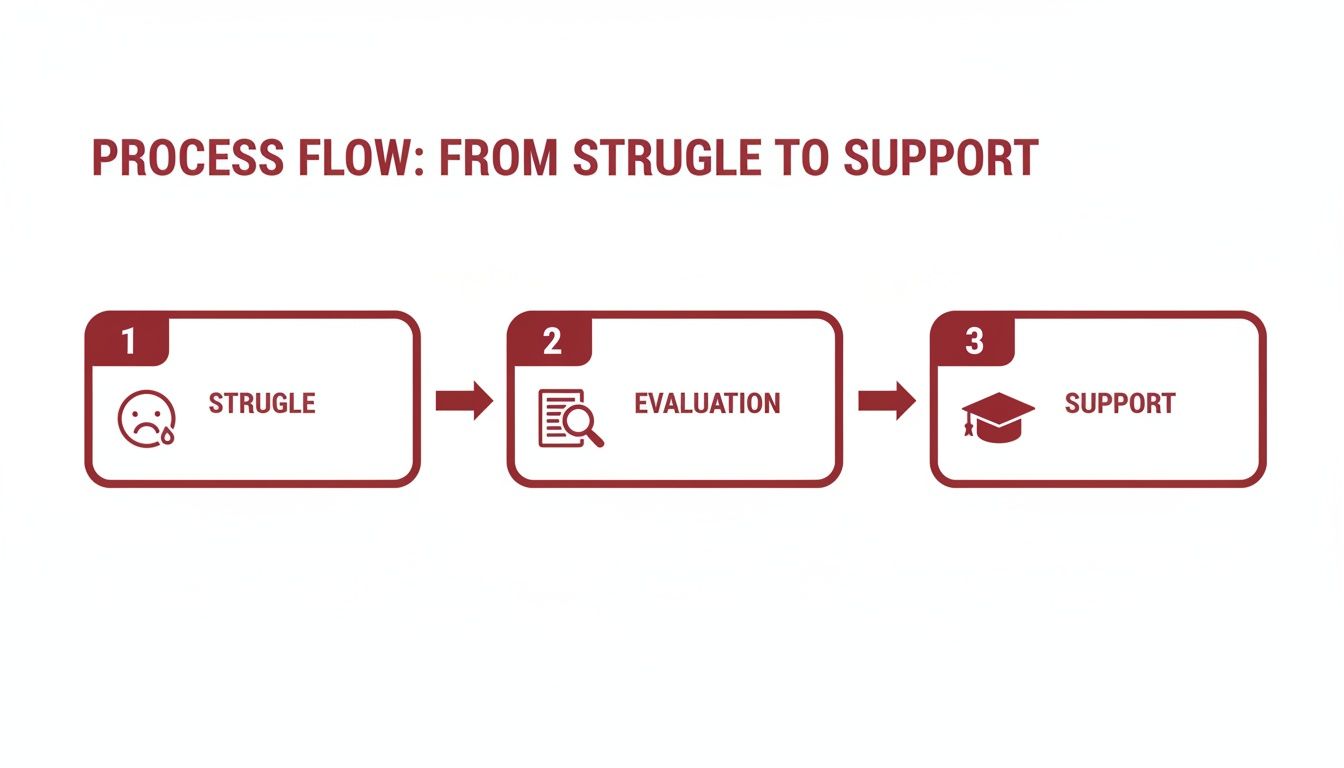
As you can see, the evaluation acts as a critical bridge, transforming challenges into a structured support system that helps your child succeed.
Stage 1: The Initial Consultation
The whole process kicks off with an initial consultation. This is a conversation, not an interrogation. It’s your chance to share your concerns, your child's history, and what you’ve been seeing at home and hearing from school. The psychologist will listen carefully to get a handle on your unique situation and explain how testing can provide real answers.
During this first meeting, you’ll likely discuss:
- Developmental and Medical History: Key milestones and any relevant health information that might be part of the picture.
- School Performance: A look at your child's academic journey, including report cards and teacher feedback.
- Observed Strengths and Challenges: What comes easily to your child? Where do they consistently get stuck?
This session is all about laying the groundwork. It ensures the testing battery is customized to address your specific questions. It's also a great time to go over practical details like scheduling and costs. You can learn more about the cost of neuropsychological testing in our detailed guide.
Stage 2: One-on-One Testing Sessions
Next up are the testing sessions themselves. These are always conducted one-on-one with the psychologist in a calm, supportive environment. It’s important to know these sessions are designed to be engaging, not stressful.
The activities often feel more like a mix of puzzles, games, and school-like tasks. Your child might be asked to solve problems, answer questions, build with blocks, or work through some reading and math exercises. Clinicians are experts at building rapport and helping kids feel comfortable, often using breaks to keep them focused and motivated.
A typical evaluation is broken up into several sessions, usually lasting a few hours each, to make sure your child doesn't get worn out.
Stage 3: Scoring, Interpretation, and the Final Report
Once the testing is done, the psychologist gets to work behind the scenes. This is where they score all the assessments, analyze the complex data, and pull everything together with the background information you provided during the consultation.
The goal here isn't just to generate numbers—it's to tell a story. The psychologist synthesizes all the information—test scores, clinical observations, and your input—into a comprehensive narrative that explains your child’s unique learning profile.
This deep dive culminates in a detailed written report. This document will outline the results, provide a diagnosis if one is warranted, and most importantly, offer specific, actionable recommendations for both home and school.
Stage 4: The Feedback Session
The final step is the feedback session. Here, the psychologist will walk you through the report, explaining the results in clear, easy-to-understand language. They’ll connect the dots between the test data and the real-world struggles you talked about in the very first meeting.
This is your chance to ask questions and gain a deep insight into how your child’s mind works. You’ll leave this meeting with a clear understanding of their strengths and challenges and, most importantly, a concrete action plan to help them thrive.
Turning Your Evaluation Report Into Action
When you finally get your child's psychoeducational evaluation report, it can feel like being handed a dense, technical manual for their brain. It’s packed with scores, clinical terms, and detailed observations that can seem pretty overwhelming at first glance. But this document is so much more than a summary of tests—it’s a powerful tool for action.
The key is knowing how to read it. The best way to think about the report is in a few key parts: the background story, the test results (the raw data), the clinical summary (what that data actually means), and finally, the recommendations. While every section is important, the recommendations are your roadmap.
This is where the psychologist translates all that complex data into a clear, actionable plan. It’s the most critical part of the report for parents and educators because it spells out the specific, practical steps needed to help your child succeed.
From Data to Daily Support
The recommendations section is where the real value of the testing process comes to life. It moves way beyond a diagnosis and gives you a concrete "what to do next" list. These suggestions are tailored specifically to your child's unique learning profile, targeting the challenges uncovered during the evaluation.
These recommendations usually fall into several categories:
- School-Based Accommodations: These are simple changes to the learning environment that help level the playing field. Think things like extended time on tests, preferential seating away from distractions, or getting copies of class notes.
- Specialized Instruction: This is about targeted, direct teaching to build up specific skills. If a child has dyslexia, for example, the report might recommend a structured literacy program like Orton-Gillingham.
- Assistive Technology: These are tools that help a student work around their challenges. This could be text-to-speech software that reads assignments out loud or a graphic organizer app to help with writing.
- Home-Based Strategies: The report will also give you tips to use at home, like creating a structured homework routine or using specific techniques to help with organization and time management.
Once you have these insights, the next crucial step is applying them. This often means focusing on designing effective learning experiences built around your child's specific profile, turning the report’s advice into reality.
Using the Report as Your Advocacy Tool
Armed with this report, you're no longer just sharing your concerns with the school—you are presenting objective, professional evidence. This document is your single most powerful tool when advocating for an Individualized Education Program (IEP) or a 504 Plan.
A psychoeducational report provides the "why" and the "how." It explains why your child is struggling and details how the school can provide effective support, giving your requests the weight of a clinical assessment.
When you meet with the school's support team, you can walk them right through the findings. You can point directly to the recommended accommodations and explain exactly how they connect to the test results. For instance, you can say, "The report shows a slow processing speed, which is why the psychologist recommends extended time on all timed assignments." This data-driven approach is far more effective than simply saying, "My child just needs more time." It transforms you from a worried parent into an informed advocate, ready to collaborate with the school to build a plan that truly works.
How Assessment Has Evolved to Meet Modern Needs
Psychoeducational testing isn't some new fad. It's a field with a long history, built on the simple but powerful idea of using standardized tools to understand how people learn. This practice didn’t just pop up overnight; it’s been carefully refined over decades to better serve students.
The formal roots of these assessments stretch back to the early 20th century. The goal then was the same as it is now: to identify and help children who needed extra support in school. That core mission established the data-driven principles that still guide our evaluations today.
But the story goes back even further. Modern psychoeducational testing stands on the shoulders of early efforts in standardized measurement, with roots reaching as far back as 2200 BCE in imperial China. It solidified in the modern era with tools like the Binet–Simon scale (1905) and large-scale military testing during World War I, which established the groundwork for today's cognitive and neurodevelopmental assessments. You can find more insights on the evolution of psychological testing from Pearson Assessments.
The Shift to Digital and Telehealth Assessments
While the core principles are timeless, the delivery of psychoeducational testing has changed dramatically. Today, technology makes these vital services more accessible than ever before. The rise of digital assessment platforms and telehealth has been a true game-changer for families everywhere.
Evaluations are no longer confined to a brick-and-mortar office. Many can now be conducted remotely with the same level of accuracy and reliability. This shift has torn down geographical barriers, making it possible for families in rural areas or those facing transportation challenges to connect with top-tier specialists.
The core of a great evaluation isn’t the room it happens in; it’s the quality of the tools and the expertise of the clinician. Modern technology ensures that neither of these is compromised in a remote setting.
This forward-thinking approach means a student’s zip code no longer has to limit their access to the support they need. Plus, connecting with a psychologist from the comfort of home can significantly reduce the anxiety some children feel about the testing process.
Benefits of Modern Testing Approaches
Moving to remote services offers some clear advantages for families looking for answers about their child's learning profile. These modern methods are designed to fit the realities of today's world, making the whole process smoother and more convenient.
Key benefits include:
- Increased Accessibility: Connect with specialists from anywhere, which means no more long travel days or taking excessive time off work and school.
- Comfort and Convenience: Testing in a familiar home environment can help reduce stress and allow a child to perform at their best.
- Flexible Scheduling: Online appointments often come with more flexibility, making it easier to fit sessions into busy family lives.
At the Sachs Center, we specialize in these modern evaluations. You can learn more about how our telehealth neuropsychological testing services are structured to give families the clarity they need. This evolution ensures that psychoeducational testing continues to fulfill its original mission: helping every student get the support they need to thrive.
Common Questions About Psychoeducational Testing
When you start looking into psychoeducational testing, it’s natural for the practical questions to pop up. Thinking about costs, timelines, and what happens after the evaluation can feel overwhelming. Let's walk through some of the most common questions we hear from parents.
How Much Does an Evaluation Cost?
The cost for a private psychoeducational evaluation really depends on how complex the assessment needs to be and where you're located. A comprehensive evaluation isn't just a single test; it's a deep dive that involves many hours of a psychologist’s dedicated time, and the price reflects that.
Insurance coverage, unfortunately, can be a real sticking point. Many insurance companies classify evaluations for learning disabilities as "educational" instead of "medically necessary."
Because of this classification, insurance plans often deny coverage for psychoeducational testing. This means it usually becomes an out-of-pocket expense. It's always worth checking directly with your provider about your specific plan, but it’s wise to think of the evaluation as a long-term investment in your child’s future.
How Long Does the Entire Process Take?
From your first call with us to getting the final report in your hands, the whole process usually takes between four to eight weeks. This timeline gives us the space to be thorough and thoughtful at every stage.
Here’s a quick look at how that time is spent:
- Getting Started (1-2 weeks): This part includes our initial consultation, getting the testing sessions on the calendar, and gathering key background information like school records and teacher feedback.
- The Testing Sessions (1-3 weeks): The one-on-one testing is almost always spread across a few different sessions. This helps your child stay focused and give their best effort without getting fatigued.
- Analysis and Report Writing (2-3 weeks): After all the testing is done, the psychologist gets to work scoring the assessments, interpreting all the data, and writing the comprehensive report. This is the most time-intensive part of the process for us.
How Often Is Re-Evaluation Needed?
If your child’s evaluation leads to an IEP or a 504 Plan, they will need to be re-evaluated from time to time to make sure the support they're getting is still the right fit. School districts are legally required to re-evaluate students with an IEP at least once every three years.
This is often called a "triennial review." That said, you or the school can request a new evaluation sooner if something new comes up or if it seems like your child's needs have changed. And for things like accommodations on standardized tests (think the SAT or ACT), the testing boards usually require a recent evaluation, typically one done within the last three to five years.
At Sachs Center, we use telehealth to make the diagnostic process clearer and more accessible. We provide straightforward answers and actionable plans, all from the comfort of your own home. If you're ready to get a deeper understanding of your child's unique learning profile, we invite you to explore our telehealth-based diagnostic evaluations for ADHD and Autism.
