
When you hear that a child needs neuropsychological testing for a learning disability, it can sound pretty intense. But really, it’s just a way to get a highly detailed map of your child's unique cognitive profile. Think of it less as a single test and more as a series of activities designed to pinpoint exactly why a bright, capable kid might be struggling in school.
This process moves past the confusion and frustration to provide clear, actionable answers, which are essential for getting the right kind of support in place.
Demystifying the Evaluation Process
Let's break it down. Imagine your child's brain is a super-powerful computer. You know it’s brilliant, but certain programs seem to run slowly or glitch out, causing problems with its overall performance. A neuropsychological evaluation is like running a full diagnostic scan to figure out precisely where the processing power is strong and where the system could use a little help.
The neuropsychologist is like a skilled detective. They don't just look at a final grade on a report card; they investigate the entire thought process that went into it. The goal is to solve the mystery of why a child with so much potential isn't quite reaching it. This detective work is so important because learning isn't just one skill—it’s a whole team of different cognitive functions working together seamlessly.
More Than Just a Test Score
A standard assessment from school might tell you that your child is having trouble with reading. That's a start, but it's not the full story. A neuropsychological evaluation is designed to uncover the why. For instance, is the reading difficulty rooted in:
- Phonological Processing: A disconnect when trying to match letters with their corresponding sounds.
- Working Memory: Trouble holding onto information long enough to use it—like forgetting the beginning of a sentence by the time they reach the end.
- Processing Speed: Simply taking longer than their peers to make sense of the letters and words on the page.
Once you identify the specific source of the struggle, the recommendations for support become incredibly precise and much more effective. Your child gets strategies tailor-made for their specific learning profile instead of just generic help.
A neuropsychological evaluation essentially provides a 'user manual' for your child's brain. It goes beyond simple labels to deliver a nuanced understanding of how they learn, creating a clear roadmap toward targeted support and, ultimately, academic success.
This detailed map is the key that unlocks the right kind of help. The evaluation isn't about slapping a number on intelligence. Instead, it’s a supportive, proactive step that arms you with a deep understanding of your child's cognitive landscape. It translates confusing school struggles into a clear set of strengths to build on and challenges to address, ensuring your child gets the tools they need to truly thrive.
Exploring the Core Components of an Evaluation
Think of a neuropsychological evaluation less like a single, scary final exam and more like a collection of specialized tools. Each tool is designed to measure a specific aspect of your child’s brain function. When a skilled clinician puts the results together, they create a detailed, three-dimensional picture of your child’s unique learning profile.
Let’s unpack this toolkit and see what each component actually tells us.
This visual map helps show how different brain functions—like thinking, learning, and processing information—are all connected and looked at during an evaluation.
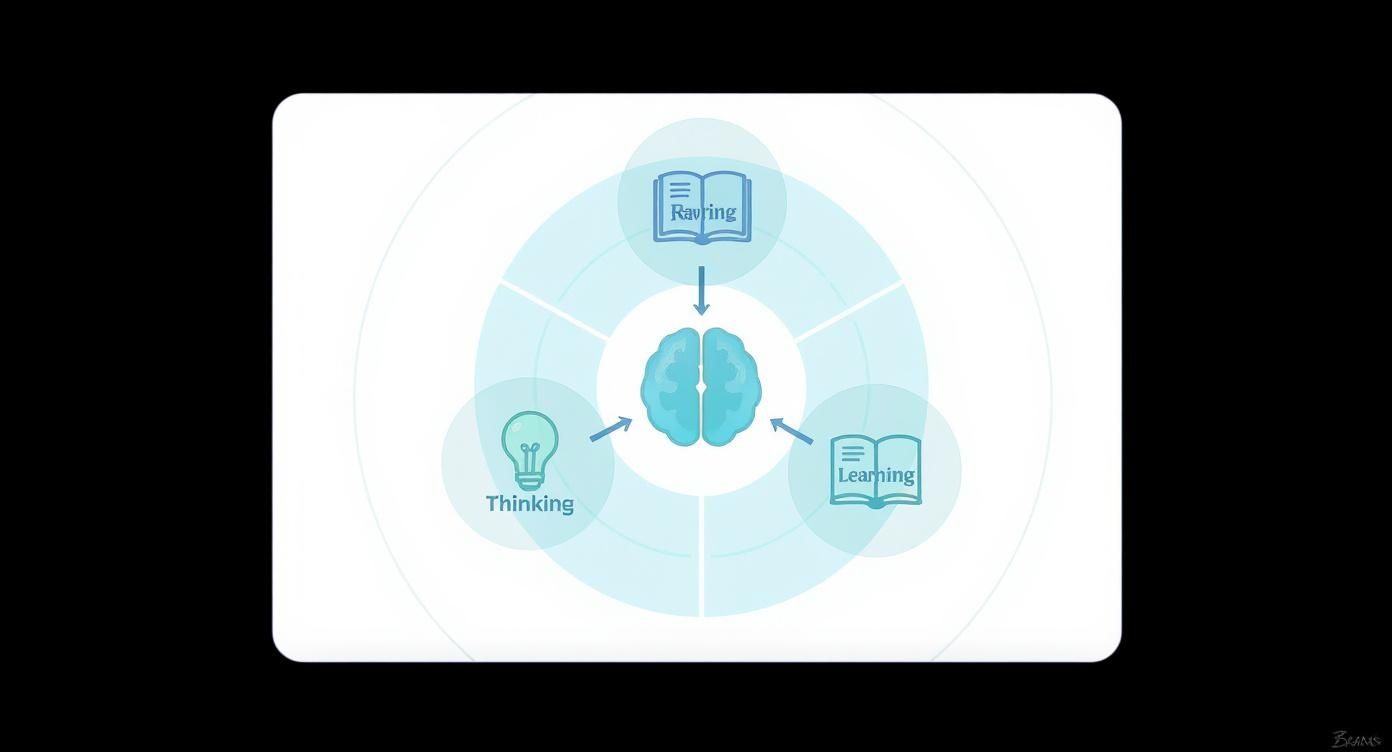
As you can see, a thorough evaluation looks at the entire system, not just one skill in isolation. This is how we get to the root of a child's learning challenges.
Cognitive Abilities Testing (IQ)
First things first, let's bust a common myth. An IQ test is not a measurement of how "smart" your child is. It’s far more nuanced than that. Think of it as a way to understand their brain's raw processing power—their natural ability to reason, solve new problems, and make connections between ideas.
This testing gives us a crucial baseline. It helps establish what a child should be capable of achieving in school, creating a benchmark we can use to compare their actual performance.
Academic Achievement Testing
While an IQ test looks at potential, academic achievement tests measure what’s actually happening in the classroom. These tests assess your child’s current skills in core subjects and compare them to national averages for their age group.
We look closely at three key areas:
- Reading: This covers everything from the basics, like decoding sounds (phonics), all the way up to understanding the deeper meaning of complex paragraphs (reading comprehension).
- Writing: Here, the assessment looks at spelling, grammar, punctuation, and the ability to organize thoughts into clear, well-structured sentences.
- Mathematics: This component evaluates both simple calculation skills and the ability to apply those skills to solve real-world problems (mathematical reasoning).
When a neuropsychologist compares these achievement scores to the cognitive (IQ) results, they can spot the classic sign of a learning disability: a significant gap between a child's potential and their performance.
Executive Functioning Assessment
If your brain is the body’s command center, executive functions are its CEO. These are the high-level mental skills we all use to plan, organize, manage our time, and get things done. When these skills are weak, it shows up in very practical, everyday ways.
For example, a child with executive functioning challenges might have a backpack that looks like a tornado hit it. They might complete their homework perfectly but consistently forget to turn it in. Or they might stare at a long-term project, completely unable to figure out where to begin without step-by-step instructions.
Testing these skills helps explain why a bright, capable child might seem disorganized or unmotivated. It’s often not about a lack of effort; it's about the brain’s management system needing extra support. For more on this, you can learn about neuropsychological testing for ADHD and other classroom challenges, which are often rooted in executive function deficits.
Memory and Learning
Memory isn't just one thing. It's a complex system, and an evaluation breaks down how well your child’s brain acts as a filing cabinet for information.
We look at different types of memory:
- Auditory Memory: How well do they remember things they hear, like multi-step directions from a teacher?
- Visual Memory: Can they recall things they’ve seen, like a word on a spelling list?
- Working Memory: This is the brain's "sticky note." It’s the ability to hold onto and work with information for a short time, like when you're solving a math problem in your head.
Struggles in any of these areas can make it incredibly difficult to keep up in class, since so much of school is about remembering what you learned yesterday to build on it today.
Processing Speed and Language Skills
Finally, the evaluation looks at the brain’s efficiency. Processing speed is simply the pace at which your child can take in information, make sense of it, and respond. Slow processing doesn't mean a child isn't intelligent—it just means they need more time. Think of it like having a slower internet connection; the data will get there, but it takes a few extra seconds to load.
We also assess language skills, looking at both expressive language (the ability to get thoughts out) and receptive language (the ability to understand what others are saying). A weakness here can create a ripple effect, impacting performance in every single school subject. Each of these components provides a vital clue, helping the neuropsychologist assemble a complete and actionable "user manual" for your child's brain.
When to Consider Testing for Your Child
Deciding to pursue a formal evaluation for your child can feel like a huge step. But often, the signs have been there for a while. As a parent, you have a unique insight into your child’s world—trust that intuition. It's especially important when you see a persistent gap between how smart you know they are and how they're actually doing in school.
This feeling—that your child is bright and capable, yet something is constantly getting in their way—is one of the most common reasons families seek out neuropsychological testing. It’s a proactive way to move from worry and uncertainty to clarity and action.
Persistent Academic Struggles
One of the clearest red flags is when your child is putting in a ton of effort but seeing little reward. This isn't about a single bad grade; it’s a pattern of difficulty that just doesn't seem to get better, even with extra help or tutoring.
You might notice very specific challenges, like:
- Reading and Spelling: They really struggle to sound out new words, frequently misspell common words they’ve seen dozens of times, or read so slowly that it’s hard for them to follow the story.
- Math Concepts: Basic math facts just don't stick. They might get lost in word problems or have trouble lining up numbers correctly for bigger calculations.
- Written Expression: Getting ideas onto paper feels like a monumental task. Their writing may come out disorganized and full of grammatical errors, or it’s incredibly brief, even though they can tell you their creative ideas out loud.
Behavioral and Emotional Signs
Learning challenges are rarely just about academics. The constant struggle can take a big emotional toll, often showing up as behavioral issues that might not seem connected to schoolwork at first glance.
Look for patterns such as:
- Intense Homework Frustration: What should be a 20-minute assignment regularly explodes into a two-hour battle, often filled with tears, meltdowns, or arguments.
- School Avoidance: Your child might complain of frequent stomachaches or headaches, especially on school mornings. They may flat-out ask to stay home.
- Low Self-Esteem: You might hear them make heartbreaking comments like "I'm dumb" or "I'm just not good at school," as they start to internalize their struggles as personal failures.
When a child consistently says they "hate school," it's often a sign of underlying frustration and difficulty. Their behavior is a form of communication, telling you that the academic environment is a source of stress and failure, not success.
Consistent Teacher Feedback
Teachers are on the front lines and their observations are invaluable. If you’re hearing the same comments from different teachers, year after year, it’s a signal that something deeper may be going on.
Phrases like, "She's so bright, but she just doesn't apply herself," or "He's a great kid, but he isn't working to his potential," are classic indicators. This feedback often points directly to that frustrating gap between what your child is capable of and what they can produce. While teachers can spot the symptoms, a neuropsychological evaluation is designed to uncover the root cause. For a better sense of age-appropriate skills, it can be helpful to start with a baseline of understanding developmental milestones.
How Test Results Unlock School Accommodations
A neuropsychological evaluation report is so much more than a stack of papers filled with scores and data. Think of it as a master key, custom-cut to unlock the support your child needs to thrive in school. The report essentially translates your child’s unique learning profile into a language educators can act on, providing the official paperwork required to get real help.
This formal diagnosis is the non-negotiable first step toward securing either an Individualized Education Program (IEP) or a 504 Plan. These are the two main pathways for support in public schools, and while they can sometimes overlap, they serve distinct purposes. Knowing the difference is crucial when you're advocating for your child.

Differentiating Between IEP and 504 Plans
An IEP is for students whose learning disability is significant enough to require specialized instruction. It’s a plan that actually changes how a child is taught. This might look like pulling a student out for one-on-one help with a reading specialist, placing them in a small-group math class, or scheduling in-school speech therapy.
A 504 Plan, on the other hand, is all about ensuring access to the general education curriculum. It provides accommodations so a student can learn effectively alongside their peers in a typical classroom. A 504 Plan works to level the playing field by removing barriers the disability creates.
A simple way to keep them straight: An IEP changes the educational program, while a 504 Plan changes the learning environment to ensure equal access. Both are legal documents the school is required to follow.
For example, a child with severe dyslexia might get an IEP that includes daily sessions with a reading interventionist. In contrast, a student with slow processing speed might get a 504 Plan that just gives them extra time on tests in their regular classes. The neuropsych report provides the hard evidence needed to figure out which plan makes the most sense.
From Test Data to Classroom Tools
The real magic of neuropsychological testing for learning disabilities lies in how it connects a specific cognitive weakness to a practical, real-world classroom solution. The report doesn't just slap a label on a problem; it explains why the problem exists and offers concrete tools to help fix it.
Here’s how specific findings from a report translate directly into accommodations:
- Finding: Slow Processing Speed
- Accommodation: Extended time on tests and assignments. This gives the student a fair shot to demonstrate their knowledge without the pressure of a ticking clock.
- Finding: Diagnosis of Dyslexia (Reading Disability)
- Accommodation: Access to audiobooks and text-to-speech software. This lets them absorb information by listening instead of getting bogged down by decoding text.
- Finding: Diagnosis of Dysgraphia (Writing Disability)
- Accommodation: Use of a laptop for notes or speech-to-text software. This bypasses the physical struggle of handwriting.
- Finding: Weak Working Memory
- Accommodation: Providing written instructions and checklists. This lifts the mental burden of trying to remember multi-step directions.
These supports aren’t about making school “easier”—they’re about making it fair. They give a child the tools they need to show what they truly know. In the same way, testing can identify struggles with mathematical reasoning, paving the way for accommodations that include teaching effective strategies for tackling math problems step by step.
And while our focus here is on learning disabilities, many of these same principles and accommodations apply when seeking school accommodations for ADHD. The ultimate goal is to use the insights from testing to ensure every student gets the precise support they need to succeed.
Navigating the Testing Process and Costs
Figuring out the logistics of a neuropsychological evaluation can feel like a lot to take on. But it helps to think of it not as a single event, but as a journey with a clear, structured path. It's a team effort between your family and the psychologist, designed to get you real answers.
The whole process kicks off with an initial intake interview. This is a really important first step. It's where you'll sit down with the neuropsychologist and talk through everything—your child's history, their struggles in school, social behaviors, and anything you've tried before. This conversation gives the clinician the full picture before any testing even begins.
The Evaluation Timeline
After that first meeting, the evaluation unfolds over several weeks. It’s spaced out on purpose, so your child can do their best work without getting tired or overwhelmed.
Here’s what a typical timeline looks like:
- Testing Sessions: These usually happen over two to four separate sessions, each lasting a few hours. Breaking it up like this prevents burnout and gives us a much more accurate snapshot of your child’s abilities.
- Scoring and Interpretation: Once the testing is done, the neuropsychologist gets to work. They spend a significant amount of time scoring everything, analyzing all the data, and piecing together information from your interview, teacher feedback, and the test results to find the underlying patterns.
- Report Writing: Next, the clinician pulls all these findings into a detailed written report. This isn't just a list of scores; it explains the results, provides a diagnosis if one is appropriate, and lays out personalized recommendations for school and home.
- Feedback Meeting: The final step is sitting down together for a feedback session. The neuropsychologist will walk you through the report, explain everything in plain language, and answer all your questions. You’ll walk away with a clear roadmap for your child's learning profile and what to do next.
The entire evaluation, from your first call to getting the final report in hand, usually takes about four to six weeks. This deliberate pace is what allows for a thorough, thoughtful analysis that becomes the foundation for all future support.
Understanding the Financial Investment
One of the first questions on every parent’s mind is about the cost. A comprehensive neuropsychological evaluation is a significant investment. Prices often range from $3,000 to over $7,000, which varies based on the provider and how complex the evaluation needs to be.
This cost reflects the immense amount of expert time that goes into every single phase—from the hours of one-on-one testing to the deep-dive analysis and detailed report writing.
Navigating insurance can also be tricky, as coverage for this kind of testing varies a lot. Many specialized practices, like ours, operate on an out-of-network basis. The good news is, you can often get partial reimbursement from your insurance. The key is to call your insurance company beforehand and ask specifically about your "out-of-network benefits for psychological or neuropsychological testing."
For a deeper dive into managing these expenses, check out our guide on the cost of neuropsychological testing. By preparing for both the time and financial commitments, you can move through the process with clarity and focus on what matters most: getting the best support for your child.
How to Choose the Right Neuropsychologist
Picking the right professional for your child's evaluation is, without a doubt, the most important step in this whole process. The quality of the testing, the accuracy of the diagnosis, and how useful the final report is all come down to the clinician’s expertise. You're not just looking for a technician; you’re searching for a partner who can turn complex data into a real, supportive plan for your child's future.
This decision is a big one. The field of neuropsychology has grown tremendously since the mid-20th century, becoming more standardized and evidence-based. This commitment to science is serious—over the past 50 years, at least 18 of the 51 past and present Presidents of the International Neuropsychological Society have published major research on learning disabilities. That shows a deep, global interest in getting these diagnostic methods right. You can learn more about the advancements in neuropsychological research and practice here.
Key Qualifications and Experience
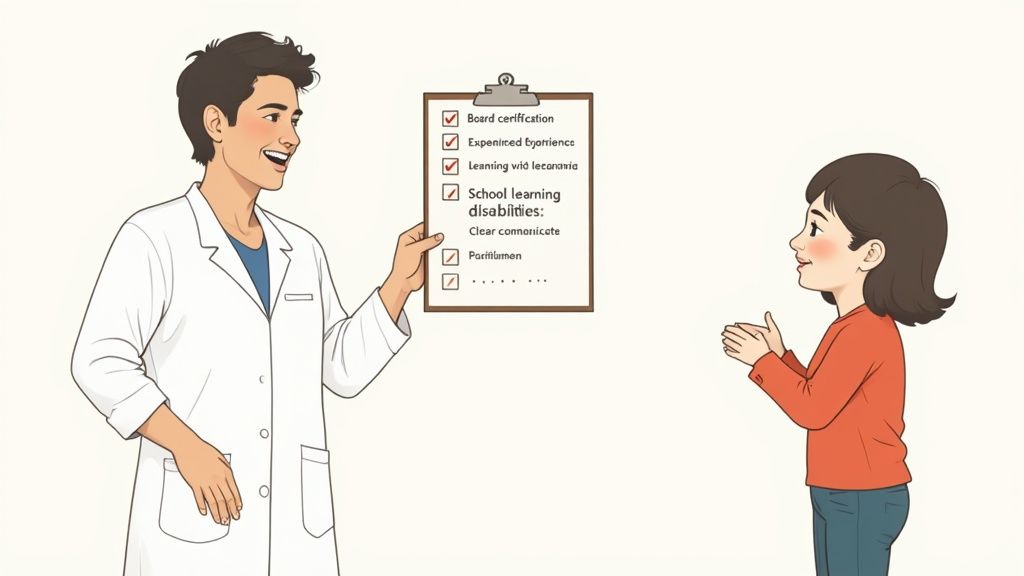
When you start looking at potential providers, begin with the basics. You want a licensed clinical psychologist who has specialized postdoctoral training in pediatric neuropsychology. Board certification is a huge plus, as it shows a high level of expertise that’s been reviewed by their peers.
Beyond the credentials, ask about their actual experience. You need a professional who works with kids who have learning profiles similar to your child's, and works with them often. A specialist who primarily deals with adult traumatic brain injury, for example, probably isn't the best fit for evaluating a third-grader with suspected dyslexia.
Questions to Ask a Potential Provider
To find the best partner for your family, you have to ask direct questions about their process and their philosophy. That first conversation can tell you almost everything you need to know about their approach and whether they're the right person to help.
Here’s a quick checklist of questions to guide that discussion:
- What is your specific experience with learning disabilities like [mention your child's specific challenge]? This helps you see if they have direct expertise in the areas that matter most to you.
- How do you make the testing process comfortable and engaging for children? A great pediatric neuropsychologist knows how to build rapport and lower a child's anxiety, which ensures the results are a true reflection of their abilities.
- Do you collaborate with schools, and what does that process look like? Find someone who is willing to talk to teachers or even attend school meetings to help put the report’s recommendations into action.
- How do you deliver the results in the feedback session? The goal here is clarity. They should be able to explain complex findings in a way that parents—and even older kids—can easily understand.
Finding the right neuropsychologist is like choosing a guide for a challenging expedition. You need someone with an excellent map (technical skill) but also the ability to communicate clearly, offer encouragement, and help you navigate the terrain ahead (school systems and interventions).
Choosing a provider like the Sachs Center, which specializes in neurodiversity and offers both in-person and telehealth testing, means you're working with experts who are zeroed in on your child’s specific needs. They get the nuances of different learning profiles and are ready to provide the clear, actionable insights your family needs to move forward with confidence. Your goal is to find someone who empowers you with knowledge.
Answering Your Questions About Neuropsychological Testing
Deciding to pursue neuropsychological testing for your child is a big step, and it’s completely natural to have a lot of questions. Getting clear, straightforward answers can make all the difference, helping you move forward with confidence.
Let's walk through some of the most common things parents ask. This whole process is about finding clarity, not just collecting data, so you can become the most effective advocate for your child.
School Evaluation vs. Neuropsychological Testing
One of the first questions we often hear is, "My child already had an evaluation at school. How is this different?" It’s an excellent question, and the distinction is crucial.
A school evaluation is designed to answer a very specific question: Does this child qualify for special education services under the school district’s rules? Its focus is usually narrow, looking mostly at academic scores and classroom behavior. While it has its place, it doesn't always dig into the why.
A private neuropsychological evaluation goes much, much deeper. Here’s an analogy:
- A school evaluation is like a basic car check-up. It looks at the tires, oil, and brakes to make sure the car is safe for the road.
- A neuropsychological evaluation is like a full diagnostic scan at a specialty garage. It gets under the hood to examine the engine, the wiring, and the onboard computer to figure out exactly why the car is stalling or running inefficiently. It gives you the complete blueprint.
The neuropsych report provides a far richer understanding of the underlying cognitive machinery—things like executive functions, memory, and processing speed—that are really driving the struggles you see at school and at home.
Will a Diagnosis Label My Child?
The fear of labeling is real and completely valid. No one wants their child to be put in a box or defined by a diagnosis. It helps to shift your perspective and see a diagnosis not as a restrictive label, but as an empowering tool.
A diagnosis isn’t meant to limit your child; it’s a guide that lights up the path forward. It finally gives a name to the struggles they’ve been facing, which can be an enormous relief for a child who might have started to think they were "lazy" or "not smart." It replaces that confusion and self-blame with real answers and self-awareness.
A diagnosis isn't about putting a child in a box. It’s about giving them the right tools to build their own ladder out of the box that school struggles have put them in.
This newfound clarity allows parents, teachers, and your child to work together using targeted strategies that actually work, turning a point of frustration into an area of strength.
How Often Is Retesting Necessary?
Once you have a comprehensive evaluation, you can breathe a sigh of relief—you won't be doing this every year. For most kids, we typically recommend a re-evaluation about every three years.
This three-year cycle isn't arbitrary. It’s timed for a few important reasons:
- Developmental Changes: A child’s brain is a work in progress. An assessment done in second grade might not fully capture the new challenges that come with the heavy executive function demands of middle school.
- School Transitions: We often time re-testing to line up with major school changes, like the jump from elementary to middle school or from middle school to high school. This ensures their accommodations are updated for the new academic landscape.
- IEP/504 Plan Reviews: Schools require current documentation to keep services and accommodations in place. An updated report proves that the support plan is still relevant and necessary for your child’s success.
Think of it as a strategic check-in to make sure your child’s support system is evolving right alongside them.
At the Sachs Center, we provide clear, actionable insights through our expert neuropsychological testing to help your child thrive. Learn more about our evaluation services and how we can support your family's journey.
