

If you’re wondering whether an adult autism assessment online is a legitimate and effective path to clarity, the answer is a resounding yes. For many adults, telehealth has become a vital tool for understanding their neurotype right from home, offering a convenient and less stressful alternative to traditional in-person evaluations.
Why More Adults Are Seeking Autism Assessments Online
The idea of getting an autism diagnosis in adulthood isn't just a niche topic anymore—it's becoming incredibly common. If you’re here, you're definitely not alone. This shift is happening for a few key reasons: growing public awareness, more accessible information online, and a broader cultural move toward embracing neurodiversity.
For many, what was once brushed off as shyness, anxiety, or just being "quirky" is now being seen through the lens of autism.
A huge driver for this is that virtual services help people sidestep the common barriers to accessing mental health treatment. Think about it: finding a qualified specialist nearby can be tough, waitlists can be brutally long, and the sensory and social stress of visiting a clinic is a real obstacle for many. An online assessment removes those hurdles, connecting you with experts who get adult presentations of autism, no matter where you live.
A Surge in Adult Diagnoses
The data backs this up in a big way. We're seeing a dramatic increase in adults seeking and receiving an autism diagnosis, especially those in their late twenties and thirties.
Between 2011 and 2022, adult autism diagnoses in the United States shot up, with a staggering 450% increase among adults aged 26 to 34. This isn't just a small trend; it's a profound shift in awareness and a signal that more adults are ready for answers.
This isn't just about a statistic. It represents countless individuals finally getting the language and framework to understand their lifelong experiences. It’s like finally finding the user manual for your brain—one that makes sense of your unique wiring, your deep passions, and your specific social and sensory needs.
An adult autism assessment online isn't about slapping on a label. It’s about unlocking a new level of self-understanding and gaining access to tools, supports, and accommodations that can make navigating the world a smoother, more authentic experience.
Your Roadmap to Clarity
To help demystify the journey, it helps to see the whole thing from a bird's-eye view. The evaluation is a structured, multi-step process designed to build a comprehensive picture of your life experiences, not just a snapshot. It's a collaborative exploration between you and a trained psychologist.
The table below breaks down the typical stages, giving you a simple roadmap from your first inquiry to getting your results.
Online Adult Autism Assessment Process at a Glance
| Stage | What It Involves | Typical Duration |
|---|---|---|
| Initial Inquiry & Screening | Filling out a contact form, followed by a brief online screener or phone call to see if a full evaluation is a good fit. | 15-30 minutes |
| Intake Paperwork | Completing detailed digital forms covering your developmental history, current challenges, and personal experiences. | 1-2 hours |
| Clinical Interview | A one-on-one video call with a psychologist to discuss your history, social communication, interests, and sensory needs. | 1-2 hours |
| Self-Report Questionnaires | You (and sometimes a trusted friend or family member) complete standardized questionnaires about autistic traits. | 1-2 hours |
| Diagnostic Review | The psychologist analyzes all the information gathered from interviews, forms, and questionnaires to determine a diagnosis. | Varies (off-screen) |
| Feedback Session & Report | A final video call to discuss the findings, answer your questions, and review your diagnostic report and recommendations. | 45-60 minutes |
Ultimately, this process is designed to be thorough and supportive, giving you the space to share your story and get the clarity you've been looking for.
How a Virtual Autism Evaluation Actually Works
Thinking about a virtual autism evaluation can feel a bit abstract, but the process is surprisingly structured and human. An adult autism assessment online isn't just a quick quiz; it’s a thorough clinical process designed to understand your unique life experiences from several different angles.
It’s a bit like having a skilled biographer carefully piece together your story. The psychologist gathers information from different sources—your personal history, self-report questionnaires, and what they observe over video—to build an accurate and respectful picture of who you are.
The graphic below lays out the straightforward, three-part journey of a typical online assessment, from your first contact to the final diagnosis.
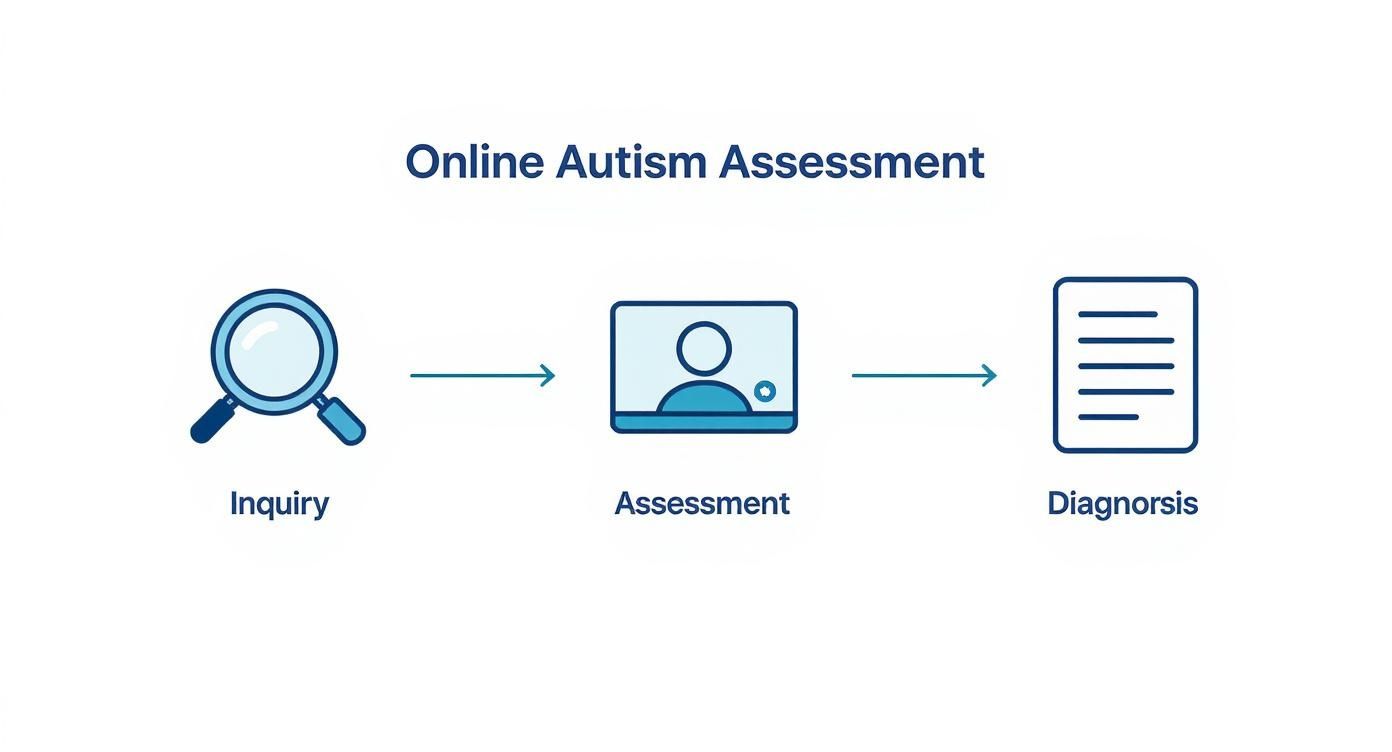
This visual roadmap shows how each stage flows logically into the next, making sure the entire evaluation is comprehensive and well-rounded.
The Foundation: Intake and Self-Reflection
The journey actually starts long before your first video call. The first step involves filling out detailed intake forms and self-report questionnaires. This isn't just busywork; it's a critical piece of the diagnostic puzzle.
These forms will ask about your developmental history, how you approach social communication, your sensory sensitivities, and your deep interests. This gives the clinician a solid foundation of your lifelong patterns and current struggles, which helps them tailor the live interview to focus on what matters most.
This self-reflection phase is also a great chance for you to organize your own thoughts and experiences before you speak with the psychologist. Many people find this part really empowering.
The Core Component: The Clinical Interview
The live clinical interview is the heart of the assessment. It takes place over a secure video platform like Zoom or Google Meet with a licensed psychologist who specializes in adult autism. This conversation is structured but still feels natural.
It’s a core part of any comprehensive evaluation, designed to gather a detailed history and understand your current concerns.
During the interview, the clinician will ask questions to get a better sense of:
- Social Communication: How you experience conversations, read nonverbal cues, and build relationships.
- Restricted and Repetitive Behaviors: This covers everything from deep, focused interests and a need for routine to stimming or other repetitive movements.
- Sensory Experiences: Your relationship with sounds, lights, textures, and other sensory input.
- Masking and Coping: The strategies you may have developed over the years to get by in social situations that don't come naturally.
This interview isn't a test with right or wrong answers. It's an exploration. The goal is for the psychologist to see the world through your eyes and understand your internal experience, not just your outward behavior.
Adapting Gold-Standard Tools for Telehealth
You might be wondering if an online assessment is as accurate as an in-person one. The answer is yes. Clinicians adapt the same gold-standard diagnostic tools for the virtual environment. While in-person assessments for kids often rely on observing play, adult evaluations are all about self-reported history and deep conversation.
Clinicians use frameworks from tools like the Autism Diagnostic Observation Schedule (ADOS) and the Autism Diagnostic Interview-Revised (ADI-R) to guide their questions. These are the leading, internationally recognized tools for autism diagnosis. For telehealth, the questions and observational criteria are simply applied within the context of a video call. The focus shifts from watching physical interaction in a clinic to a deep verbal exploration of your life. You can learn more about how this works by reading about telehealth autism diagnosis options.
Ultimately, the process combines your detailed self-reports with the clinician's expert observations to form a clear and reliable conclusion—all from the comfort of your own space.
What to Do with Your Diagnostic Report
Getting through your adult autism assessment online is a huge accomplishment, but it's really just the beginning. The next step is receiving your diagnostic report. This document isn't just a piece of paper—it's the key that can unlock the right support, accommodations, and a much deeper understanding of yourself.
But not all reports are the same. The kind of document you get, whether it's a simple diagnostic letter or a full neuropsychological evaluation, determines what you can do with it. Knowing the difference is critical to making sure you have the right tool for your goals.
Unpacking the Different Report Types
Think of diagnostic reports as different kinds of keys. A simple house key—the diagnostic letter—is great for opening one specific door, like getting accommodations at work. A master key, on the other hand—the full neuropsychological report—can open many highly specialized locks, like securing accommodations for standardized tests.
The one you need really depends on what you're trying to achieve. Let's break down the most common formats you'll encounter.
-
Diagnostic Letter: This is a brief, one-page document signed by your psychologist. It simply confirms your diagnosis and is often all you need to request reasonable accommodations at your job or give your primary care doctor diagnostic clarity.
-
Four-Page Diagnostic Report: This version gives more context. It usually covers your personal and developmental history, a summary of your current challenges, the diagnostic findings, and personalized recommendations. It’s a much stronger tool for coordinating with other healthcare providers or applying for state disability services.
-
Full Neuropsychological Evaluation: This is the most comprehensive report, often running 20-25 pages. It dives deep into cognitive testing (IQ, memory, processing speed) in addition to the autism assessment. This level of detail is a firm requirement for getting academic accommodations on high-stakes tests like the SAT, GRE, or GMAT.
Understanding these options from the start helps you invest in the right level of assessment, which can save you a lot of time and money down the road.
Turning Your Report into Action
With your official report in hand, you can start advocating for what you need in different parts of your life. This document is the formal proof that institutions often require before they’ll grant accommodations. When you need to share this sensitive information with other doctors or for administrative reasons, it's vital to do so securely. For instance, if you're using older methods, understanding HIPAA compliant faxing for healthcare documents can be very important.
Here’s a breakdown of how these different reports are used in the real world.
Types of Diagnostic Reports and Their Primary Uses
The table below compares the different report formats, what they typically include, and what they're best suited for. This can help you decide which level of detail you'll need to achieve your goals.
| Report Type | Typical Content | Best For |
|---|---|---|
| Diagnostic Letter | Confirms diagnosis, signed by a licensed psychologist. | Requesting basic workplace accommodations, sharing with your doctor for medication management. |
| 4-Page Report | Includes history, challenges, diagnosis, and recommendations. | Providing a detailed picture to therapists, applying for disability services, more complex accommodation requests. |
| Neuropsychological Report | In-depth cognitive and academic testing results with diagnosis. | Securing accommodations for standardized tests (e.g., extended time), creating an IEP or 504 plan. |
Choosing the right report ensures you have the documentation you need for specific situations, from simple workplace adjustments to formal academic support.
Practical Applications and Next Steps
The real power of your report is in how you use it. For example, an employee can use a diagnostic letter to request a quieter workspace or noise-canceling headphones under the Americans with Disabilities Act (ADA). A graduate student might use a neuropsychological report to secure 50% extra time on their entrance exams, leveling the playing field.
A diagnosis isn't an endpoint; it's a starting point. Your report is the official documentation that empowers you to build an environment that supports your neurotype, rather than forcing you to conform to one that doesn't.
Receiving this news can bring up a lot of emotions, from relief to feeling a bit lost. It’s important to give yourself time and space to process everything. To help you move forward with confidence, our guide on what to expect after an autism diagnosis offers insights for navigating your next steps.
How to Find a Good Online Provider (and Avoid the Bad Ones)
Dipping your toes into the world of online assessments can feel like a lot. A quick search brings up a dizzying number of providers, and they all seem to promise the same thing. But here’s the truth: they aren’t all created equal.
Choosing the right provider for your adult autism assessment online is probably the single most important decision you'll make. It’s the difference between getting a valid, helpful diagnosis and wasting your time and money on something that doesn't hold up.
Think of it this way: you wouldn't hire a plumber to do your electrical wiring. Both are tradespeople, but you need a specialist with the right expertise. It's the same here. You need someone who truly understands adult autism, especially the ways it can be missed or masked.
Let's walk through how to find and vet a quality telehealth provider so you can feel confident in your choice.
First Things First: Let's Talk About Cost
One of the first questions on everyone's mind is, "How much is this going to cost?" The price for a private online autism assessment varies quite a bit, usually falling somewhere between $800 and $2,500.
That big range isn't arbitrary. The price tag is directly tied to the depth of the evaluation and the qualifications of the person doing it.
Here’s what drives the cost:
- Who's Doing the Assessment: An evaluation with a licensed doctoral-level psychologist (a PsyD or PhD) will cost more than one with a master's-level therapist. You're paying for their advanced, specialized training in diagnostics.
- How Deep They Go: A simple diagnostic letter is different from a full assessment that also screens for co-occurring conditions like ADHD. More comprehensive means more clinical time.
- The Final Report: A one-page letter confirming a diagnosis is the most affordable option. A detailed 4-page report or a full neuropsychological workup takes a lot more work to prepare, so it costs more.
When you invest in a thorough assessment from a qualified professional, you’re not just buying a piece of paper with a diagnosis on it. You're paying for accuracy, professional insight, and a clear understanding of what to do next.
Your Checklist for Vetting Providers
Finding a good provider takes a little bit of detective work, but it's worth it. Use this checklist to sift through your options and spot the red flags.
-
Check Their License and Credentials
This is the absolute baseline. Your clinician must be a licensed mental health professional, like a psychologist or neuropsychologist. You should be able to find their license number on their state's professional licensing board website. This confirms they're legally and ethically qualified to give you a diagnosis. No license, no deal. -
Look for a Specialty in Adult Autism
Autism in adults looks very different from autism in kids. A lot of clinicians are pediatric specialists, so you need to find someone who gets the nuances of late-diagnosed and masked autism. This is especially important for women and gender-diverse people, whose traits are often missed.
A clinician who specializes in adults will know to ask about your internal world—things like social burnout or how much mental energy you spend just trying to keep up—not just outdated, stereotypical behaviors.
-
Make Sure They Use Validated Tools
A real assessment is more than just a chat. Ask them what tools and methods they use. A quality evaluation should be structured around clinically validated frameworks, including in-depth interviews and recognized self-report questionnaires. -
Read Reviews from Other Adults
See what other adults who have used their service are saying. Look for comments about the clinician’s vibe and communication style. Did people feel like they were actually listened to and understood? Were they thorough? Reviews can tell you a lot. -
Gauge Their Stance on Neurodiversity
The best providers have a neurodiversity-affirming perspective. This means they see autism as a natural part of human variation, not a defect that needs to be "fixed." Their website and the language they use should be respectful and focus on your strengths right alongside your challenges.
Taking these steps will help you confidently find a legitimate, high-quality service for your adult autism assessment online. It ensures your journey toward self-understanding starts on the right foot.
Preparing for Your Online Assessment with Confidence

A little prep work can make your adult autism assessment online feel less like a test and more like an act of self-discovery. The idea isn't to rehearse answers or try to "pass." It's simply about helping the psychologist see the real, complete picture of your life.
Think of it like being interviewed for your own biography. The more organized your memories and notes are, the better the writer—your clinician—can tell your story accurately. Taking time to prepare can quiet the nerves and help you feel more grounded and ready to share.
This process is really a chance for guided self-reflection, giving you space to connect the dots of your own life before the formal evaluation even starts.
Gather Your Personal History
To get an accurate diagnosis, your clinician needs to see a lifelong pattern of traits. Digging up materials from your past helps provide a more objective look at your experiences, long before autism was even on your radar.
Look for anything that sheds light on your developmental history, social patterns, or unique interests from your childhood and teen years.
- Old School Report Cards: Teacher comments like "very bright but doesn't participate in groups" or "has trouble with transitions" can be incredibly telling.
- Childhood Journals or Diaries: Your own words from the past offer an unfiltered look into your social experiences and what was going on inside your head.
- Performance Reviews: Feedback from old jobs might highlight difficulties with workplace social dynamics or a strong preference for structured, independent work.
- Family Input (Optional): If you have a trusted family member or an old friend, their memories can fill in some gaps. You could just ask, "What was I like as a kid?" or "Did you ever notice I struggled with things other kids didn't seem to?"
Having these on hand can help you give concrete examples during your interview.
Organize Your Personal Experiences
Beyond documents, the most powerful information will come from you. Before your assessment, spend some time jotting down notes about your experiences in a few key areas of your life.
You don't need to memorize anything. This is just to help organize your thoughts so you don’t forget important details if you get nervous.
The most crucial part of an adult autism assessment is your self-report. The clinician wants to understand your internal experience—how you feel on the inside—not just what others see on the outside. Preparation helps you articulate that experience clearly.
Consider making some brief notes on these topics:
- Social Interactions: How do you feel before, during, and after socializing? Does it leave you feeling drained? Do you rely on a "script" to get through conversations?
- Sensory Sensitivities: List any sounds, lights, textures, or smells that you find overwhelming. On the flip side, note any that you find really calming.
- Special Interests: What are the topics or hobbies you can get lost in for hours? Think about how these passions have shaped your life.
- Need for Routine: How do you react when plans change unexpectedly? Do you feel most comfortable with a predictable schedule?
- Stimming or Repetitive Behaviors: Note any repetitive movements you use to self-soothe, whether it’s rocking, tapping, fidgeting, or something else.
By organizing your thoughts ahead of time, you'll be able to play an active role in your own evaluation. This is the best way to ensure your adult autism assessment online leads to an accurate and validating outcome.
Navigating Life After an Adult Autism Diagnosis

Getting an autism diagnosis as an adult is a huge moment. But it’s important to remember this isn't the end of the story—it's the start of a new chapter. Think of it as finally getting the right map for a journey you've been on your whole life. It helps you understand your past experiences and build a future that feels truly authentic.
Many adults say the time after a diagnosis is a whirlwind of emotions. There’s often a huge sense of relief when lifelong questions finally have answers. On the other hand, you might feel some grief for the struggles you endured without understanding why. All of these feelings are valid and a normal part of the process.
A diagnosis doesn't change who you are; it gives you a more accurate lens through which to see yourself. It’s permission to stop trying to fit into a world not built for your neurotype and to start building a life that honors it.
This is a time for integrating this new piece of your identity. It's a chance to show your past self some compassion and to step forward with a new sense of clarity.
Finding Your Community and Support System
You are definitely not alone in this. More and more adults are identifying as autistic, which means the resources and communities available have grown immensely. In fact, Medicaid data revealed that adult autism prevalence jumped from 4.2 to 9.5 per 1,000 enrollees between 2011 and 2019. This shows a big increase in the diagnosed adult population. You can learn more about this trend in health service planning for autistic adults.
Connecting with other autistic people can be incredibly validating. It's a space where you don't have to explain yourself or put on a mask.
Here are some of the cornerstones of post-diagnosis support:
- Autistic-Led Communities: Look for online forums, social media groups, and local meetups run by autistic adults. These are amazing places for mutual support and shared understanding.
- Neurodiversity-Affirming Therapy: Find therapists who get adult autism. They can help you with specific challenges like executive dysfunction, recovering from social burnout, and managing sensory issues.
- Advocacy Organizations: Groups led by and for autistic people offer resources, fight for your rights, and work to make society more inclusive.
Finding the right support network is a game-changer. For anyone looking for a more structured way to connect, exploring autism support groups for adults can be a fantastic first step.
Building a Life That Works for You
Your diagnosis is a practical tool. It gives you the language and confidence to identify what you need and ask for it in all areas of your life. This isn't about getting "special treatment"—it's about creating an environment where you can actually thrive.
This whole process is about making conscious choices and advocating for yourself.
Actionable Steps for a Supportive Life:
- Identify Your Needs: Take stock of your sensory sensitivities, your social battery limits, and how you prefer to communicate. What situations drain you? What activities recharge you?
- Set Healthy Boundaries: It's okay to say "no" to things that you know will lead to burnout. Learning to protect your energy without feeling guilty is a superpower.
- Create a Sensory-Friendly Home: Simple tweaks can make a huge difference. Adjust the lighting, clear out clutter, and invest in noise-canceling headphones to make your home a true sanctuary.
- Embrace Your Special Interests: Make time for your deep passions. These aren't just hobbies; they're a vital source of joy, stress relief, and fulfillment.
Ultimately, getting an adult autism assessment online gives you the key to self-acceptance. It frees you from measuring yourself against neurotypical standards and allows you to start celebrating your unique mind, building a life that isn't just manageable, but genuinely joyful.
Your Top Questions About Adult Autism Assessments, Answered
Deciding to pursue an adult autism assessment online is a big step, and it's totally normal to have a ton of questions swirling around. You're likely feeling a mix of hope and nervousness as you search for answers. Let's tackle some of the most common concerns that come up.
How Can an Assessment See Past My Masking?
This is a huge worry for many adults, especially women. After a lifetime of camouflaging autistic traits just to get by, you might wonder if a clinician can see the real you. The good news is that experienced psychologists are trained to look beyond the surface.
They know how to ask about your inner world. They’ll dig into the bone-deep exhaustion you feel after a social event, the mental scripts you run before every phone call, and the sheer effort it takes to navigate situations others find simple. The focus isn't just on what you do, but the incredible amount of work it takes why you do it.
Do I Absolutely Need My Old Childhood Records?
While old school reports or a parent’s perspective can add color to the picture, they are not always required. Let's be realistic—many adults don't have a box of memorabilia from second grade, and some don't have family members who can give an accurate history.
A skilled clinician can build a complete picture based on your own detailed account of your life. Your adult perspective and your ability to talk about your internal experiences are the most important pieces of the diagnostic puzzle.
Is an Online Diagnosis Actually Legit?
Yes. When a licensed psychologist uses standard, evidence-based practices, a diagnosis delivered via telehealth is a valid medical document. A formal report from a reputable online practice is accepted by most universities, employers, and standardized testing boards.
It carries the same clinical weight as an in-person assessment and can be used to request official accommodations. The trick is to choose a credible provider who sticks to established clinical guidelines. That's what ensures your adult autism assessment online is legitimate and respected.
At the Sachs Center, our specialists are experts in diagnosing adult autism, including in people with a long history of masking. We offer thorough, compassionate, and valid telehealth evaluations to help you finally get the clarity you’ve been looking for. Book your online assessment today.
