

A free ADHD test is really a quick online screener—a self-assessment tool designed to help you spot potential signs of Attention-Deficit/Hyperactivity Disorder. Think of it as a helpful first step, a signal that something might be worth a closer look, but definitely not a formal diagnosis.
Why Online ADHD Screeners Are So Popular
If you’ve recently found yourself typing “free ADHD test” into a search bar, you’re in good company. The search for these fast, accessible online tools has skyrocketed as more adults and parents try to make sense of lifelong challenges with focus, organization, and impulsivity. For so many people, taking a screener is the very first move on a journey toward answers and self-understanding.
This growing awareness isn't just a feeling; the numbers back it up. In 2023, a massive 15.5 million American adults were living with a current ADHD diagnosis. What's really telling is that about half of them were diagnosed after turning 18, which shows just how often symptoms were missed during childhood. This trend is a huge part of why online screeners have become the go-to starting point for adults seeking answers.
The Screener as a Check Engine Light
The best way to think about a free ADHD test is to imagine it’s the “check engine” light in your car.
- It flags a potential issue. When that light pops on, you know something under the hood needs attention. In the same way, a high score on an ADHD screener suggests your symptoms are significant enough to be looked at by a professional.
- It doesn't tell you the specific problem. The light can’t tell you if it's a loose gas cap or a serious transmission issue. A screener works the same way; it can't distinguish ADHD from other conditions like anxiety, depression, or trauma, which often have similar, overlapping symptoms.
- It prompts you to call an expert. You wouldn’t ignore the light—you’d take your car to a mechanic for a proper diagnostic. A screener is your cue to do the same thing: consult with a qualified clinician for a thorough, professional evaluation.
A free online test is a valuable, no-pressure first step. It lets you explore your concerns privately and without cost, validating your questions and often providing the confidence you need to take the next step toward a formal assessment.
At the end of the day, these screeners fill a critical need by making that initial self-exploration easy and approachable. They act as a bridge, guiding people from a place of questioning and confusion toward a path of professional clarity. If you've been wondering if there's a name for your struggles, a free ADHD test is often the most logical and empowering place to start.
Our detailed guide on ADHD testing online can give you a clearer picture of what a full, comprehensive evaluation actually involves.
Comparing Online Screeners To A Professional Diagnosis
Taking a free ADHD test online can feel like a big step forward, but it's really important to know what that result actually means—and what it doesn't.
Think of it this way: an online screener is like a weather app on your phone. It gives you a quick, helpful snapshot—"80% chance of rain." But a professional diagnosis is like getting a full forecast from an experienced meteorologist. They don't just give you a percentage; they analyze pressure systems, weather patterns, and historical data to explain why it will rain, for how long, and what to expect.
An online screener is that quick snapshot. A professional evaluation is the deep, evidence-based analysis from an expert who can see the whole picture.
This flowchart shows the typical path people take, from just wondering if they have ADHD to getting real, solid answers.
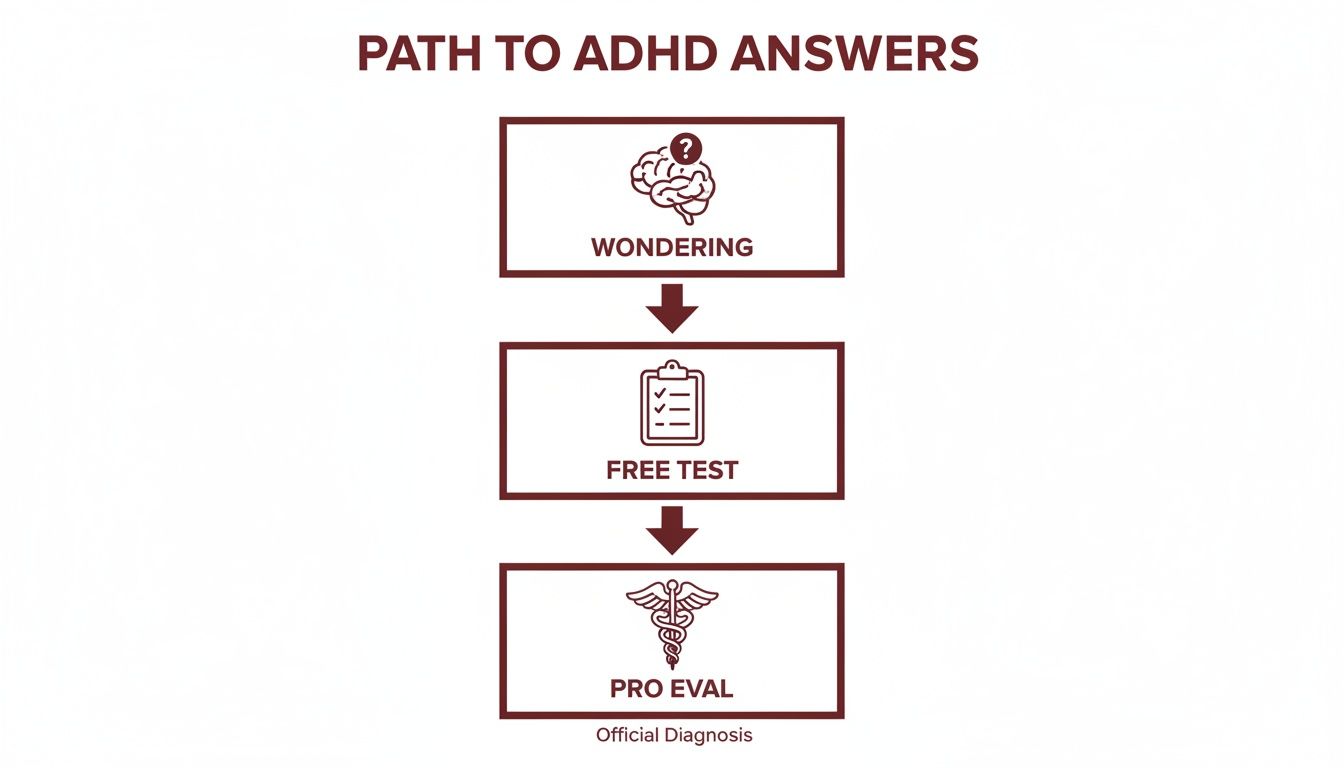
As you can see, a free test can be a valuable stop along the way, but the final destination for reliable answers is always a professional evaluation with a qualified clinician.
To really understand the difference, let’s break down what sets a quick online quiz apart from a comprehensive assessment from a provider like Sachs Center.
| Feature | Free Online ADHD Test | Professional Diagnostic Evaluation (e.g., Sachs Center) |
|---|---|---|
| Who is involved? | Just you. You're both the subject and the assessor. | A licensed, trained clinician (psychologist/psychiatrist). |
| Methods Used | Simple, non-standardized symptom checklists. | Standardized, scientifically validated tools, clinical interviews, and direct observation. |
| Accuracy | Varies widely; not a reliable diagnostic tool. | High degree of accuracy, leading to a formal diagnosis. |
| What It Can Identify | General ADHD-like symptoms. | ADHD, co-occurring conditions (anxiety, etc.), and rule out other causes. |
| Outcome | An informal score or likelihood. Cannot be used for accommodations or treatment. | A formal diagnostic report, which is the key to accessing treatment and accommodations. |
| Personalization | One-size-fits-all questions. | A personalized assessment tailored to your unique history and life experiences. |
The table makes it clear: these two paths lead to very different places. One gives you a hint, the other gives you a roadmap. Let's dig a little deeper into why that is.
Who Conducts The Assessment
The biggest difference comes down to who’s running the show. When you take a free online test, it’s all on you. You’re the one interpreting the questions and reporting on your own experiences. That’s a decent starting point, but it's naturally limited by your own blind spots and perspective.
A professional diagnostic evaluation, on the other hand, is guided by a licensed clinician—a psychologist or psychiatrist with years of specialized training in neurodevelopmental conditions. They bring an objective, expert eye to the process, making sure the final assessment is both accurate and truly comprehensive.
The Methods And Tools Used
Online screeners usually rely on a simple checklist of common ADHD symptoms. These aren't standardized or clinically validated tools. They're built for raising general awareness, not for clinical precision.
A formal evaluation uses a completely different toolkit. At Sachs Center, our process involves:
- A Clinical Interview: This isn't just a Q&A. It's a deep dive into your entire life story—your developmental history, medical background, social life, and school or work experiences—to uncover lifelong patterns.
- Validated Assessment Measures: We use standardized, scientifically backed rating scales and psychological tools that have been rigorously tested for reliability and accuracy.
- Observational Data: During our virtual sessions, the clinician is also observing how you communicate, your thought processes, and your behavior. This gathers crucial information that a simple checklist could never capture.
This multi-layered approach ensures that the conclusion is built on a foundation of solid evidence, not just a moment of self-reflection.
Scope Of The Review
A free ADHD test is a snapshot in time. It captures how you’re feeling right now, but it can’t see the context, your personal history, or any other conditions you might be dealing with. A lot of things—like anxiety, depression, trauma, and even thyroid issues—can have symptoms that look a whole lot like ADHD. An online quiz has no way to tell the difference.
A professional evaluation takes a panoramic view of your life. The clinician conducts what’s called a differential diagnosis, which is the critical process of ruling out all other possible causes for your symptoms. This step is absolutely essential because getting the right treatment depends entirely on getting the right diagnosis.
This is especially true since symptoms often show up differently in different people, particularly women. A nuanced, expert evaluation is key. For more on this, you can read about our online ADHD test for women and the specific factors we consider.
At the end of the day, an online screener leaves you with a score. A professional evaluation gives you a real diagnosis—the key that unlocks access to meaningful support, from therapy and medication to accommodations at school or work.
Why A Professional Diagnosis Is The Key To Real Support
While a free ADHD test is a fantastic first step for exploring your concerns, it can't unlock the real, life-changing support that a formal diagnosis provides. Think of an online screener as a key that opens just one door—the one that leads to more questions. A professional diagnostic letter, on the other hand, is like a master key. It opens the doors to the practical help you actually need.
This official document is what schools, universities, and employers require to provide the support you’re entitled to. It’s the proof needed to secure legitimate accommodations that can completely reshape your daily life.
Unlocking Essential Accommodations And Treatment
With a formal diagnosis from a qualified clinician, a whole new world of resources becomes available. This isn’t just about getting a label; it's about getting the specific tools you need to succeed in environments that may have felt impossible to navigate before.
These resources often include:
- Workplace Accommodations: This could mean getting approval for flexible work hours, a quieter desk, noise-canceling headphones, or even just having instructions provided in writing. These small changes can make a huge difference in focus and productivity.
- Academic Support: For students, a diagnosis is the ticket to an Individualized Education Program (IEP) or a 504 plan. These plans can provide critical learning aids like extra time on tests or preferential seating in the classroom.
- Medication Management: A formal diagnosis is the necessary starting point for having an informed conversation with your doctor or a psychiatrist about medication. It allows you to explore options that can help manage the core symptoms of ADHD.
A professional evaluation provides more than just a diagnosis; it delivers a clear, actionable roadmap. It validates your struggles and gives you the official documentation you need to advocate for yourself effectively, no matter the setting.
The Critical Role Of Differential Diagnosis
Perhaps the most important reason to see a professional is for something called differential diagnosis. It’s a clinical term, but the idea is simple: a trained expert methodically rules out other conditions that can look a lot like ADHD. An online screener just can't do that.
Many conditions have symptoms that overlap with ADHD, including anxiety, depression, trauma, and even certain medical issues. To really grasp why this professional distinction is so vital, it's helpful to understand foundational psychological concepts like the definitions of abnormality. A clinician's expertise ensures you’re not misdiagnosed.
For example, is your trouble concentrating a sign of ADHD, or is it a symptom of chronic anxiety? Is that impulsivity related to hyperactivity, or could it be a trauma response? Without a professional to carefully untangle these threads, you risk chasing the wrong treatment for the wrong condition. A formal diagnosis ensures your support plan is built on a foundation of accuracy and true understanding.
How To Navigate The Next Steps After An Online Test
Taking a free ADHD test and seeing a result that points toward ADHD can stir up a lot of feelings—relief, maybe some validation, and a bit of "what now?" That initial screener did its job: it raised a flag. Now it’s time to move from a helpful hint to professional certainty by seeking a formal diagnostic evaluation.
Thankfully, you don't have to navigate a maze of doctor's offices anymore. Modern telehealth makes getting a thorough, accurate assessment possible right from your own home, cutting out the stress and travel time. The path from that first online quiz to a real diagnosis is clearer than you might think.
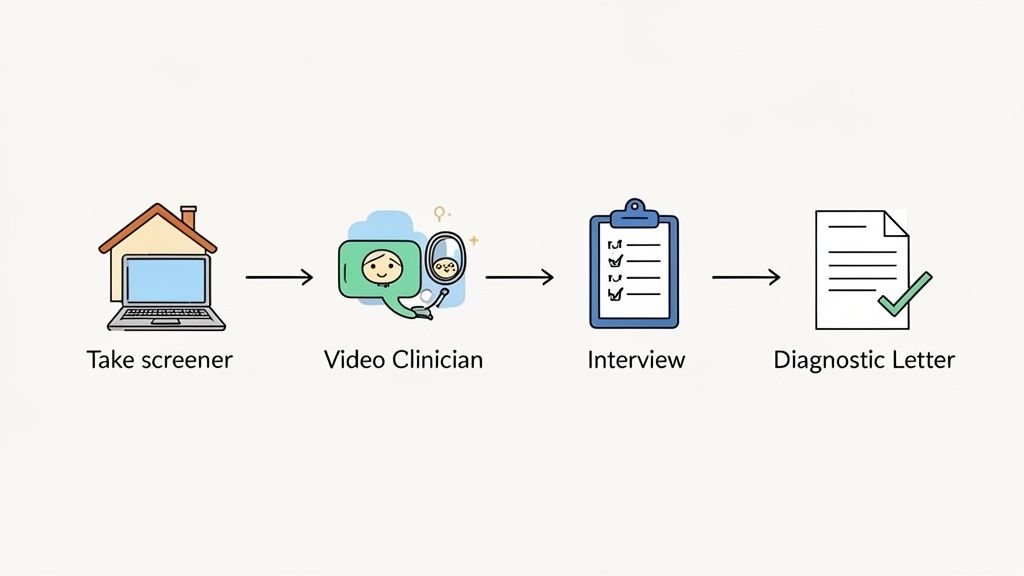
This whole process is built to be comprehensive, ensuring you walk away with a reliable answer and a solid plan for moving forward.
What To Expect From A Virtual Evaluation
A professional evaluation is so much more than a simple checklist. Our two-hour diagnostic evaluation for ADHD and Autism (ASD) is a deep dive into your life story. It all starts with a clinical interview where a psychologist gets to know your history—from early childhood and school experiences to the specific challenges tripping you up today. Following this conversation, you'll complete computer-based assessments designed to fine-tune the clinical picture.
This layered approach helps the clinician see you as a whole person and accurately distinguish ADHD from other conditions that might look similar. A formal diagnosis gives you the clarity to start building new skills on solid ground. For anyone hoping to improve their focus, learning how to retain information better and learn faster can be a game-changer once you understand your unique cognitive patterns.
A telehealth evaluation isn’t a watered-down version of an in-person one. It uses the exact same validated clinical tools and methods, all guided by an expert psychologist, to deliver an accurate and official diagnosis.
Understanding Your Diagnostic Options
Once the assessment is complete, you'll receive official documentation. But not all reports are created equal, so it's important to choose the one that fits your specific needs.
You generally have two main options:
- A Diagnostic Letter: This is a formal, straightforward document from your psychologist confirming your diagnosis. It’s usually all you need for securing workplace accommodations or for talking with your primary care doctor about medication options.
- A Comprehensive Report: This is a much more detailed, four-page document. It outlines your complete mental health history, breaks down your current struggles, provides the diagnosis, and offers personalized recommendations for what to do next. This report is perfect for sharing with other healthcare providers to coordinate care or for seeking state disability services.
Both options give you the official validation that a free online test simply can't provide. They are the keys that unlock access to real support and treatment.
And if you're curious about the "why" behind the questions you've been asked, you can learn more about the Adult ADHD Self-Report Scale scoring in our detailed guide. Making the leap from a simple online screener to a professional evaluation is the most important step you can take toward finally getting the answers and support you deserve.
ADHD Screening for Parents, Students, and Professionals
ADHD isn't a one-size-fits-all experience. The challenges it presents—and the signs you might notice—can shift dramatically depending on where you are in life. Whether you're a parent trying to understand your child's behavior, a student fighting for academic support, or an adult connecting the dots on a lifetime of unexplained struggles, a free ADHD test is often the first step toward getting real answers.
Each person's journey is unique, and so are the solutions.
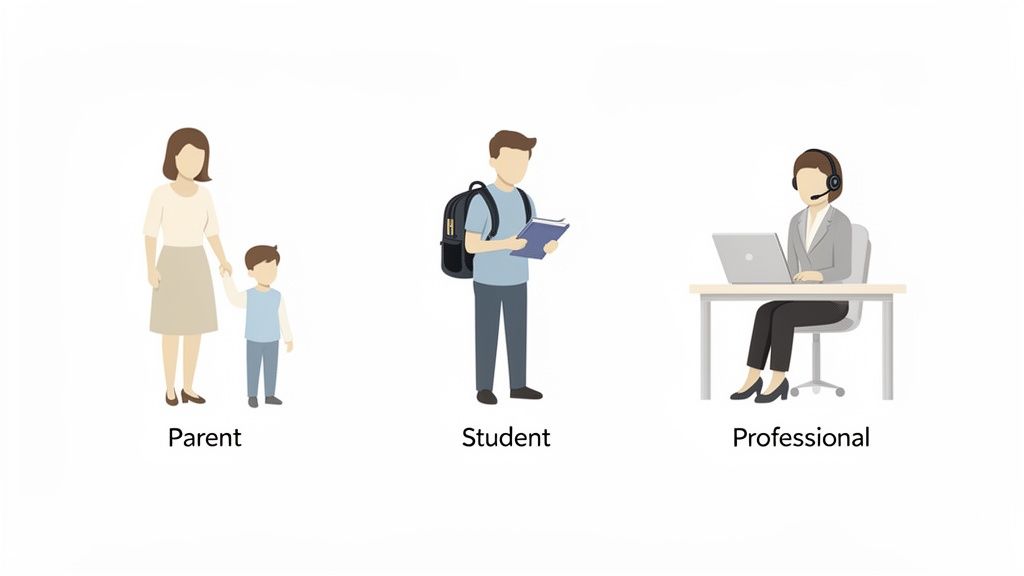
That's why understanding ADHD through the lens of your own life is so critical. The right support depends entirely on your specific circumstances, and a formal diagnosis is the key that unlocks it all.
Guidance for Parents
It can be heartbreaking to watch your child struggle with focus, impulsivity, or social interactions. An early, accurate diagnosis is absolutely crucial. It’s the official validation you need to access vital school resources like an Individualized Education Program (IEP) or a 504 plan, which provide classroom accommodations that can help your child finally thrive.
Beyond the classroom, a diagnosis can also open doors to social skills programs that teach essential life skills. Early intervention helps prevent the long-term hits to self-esteem that so many undiagnosed children face.
ADHD is a global reality, affecting roughly 129 million children and adolescents aged 5-19 worldwide. This prevalence rate of 7.2% underscores just how common these challenges are, yet disparities in diagnosis persist.
Research consistently shows that boys are diagnosed about twice as often as girls. This isn't because they're more likely to have ADHD, but because their symptoms often look more outwardly disruptive. A girl's symptoms, like inattentiveness or anxiety, are frequently internalized and missed, leading to years of silent struggle. You can learn more about these global prevalence findings and see why accurate testing is so important.
Support for Students and Professionals
For high school or college students, a formal diagnosis is non-negotiable if you need accommodations on high-stakes exams. Standardized tests like the SAT, GRE, or GMAT require comprehensive neuropsychological testing to grant supports like extended time. This intensive evaluation is different from a standard diagnostic assessment and is specifically designed to meet the strict documentation criteria of testing boards.
Professionals in the workplace, on the other hand, can often use a standard diagnostic letter to request reasonable accommodations, such as flexible hours or a quieter workspace, without needing a full neuropsychological report.
A New Perspective for Adults
So many adults—especially women and BIPOC individuals—make it to adulthood feeling "different" without ever knowing why. Their ADHD symptoms were often masked and overlooked as personality quirks, anxiety, or even character flaws.
For these individuals, a late diagnosis can be a profound, life-altering experience. It reframes a lifetime of challenges not as personal failures but as the manifestations of a neurodevelopmental condition. This new understanding brings self-compassion and validation, empowering them to finally build systems that work with their brains, not against them. A free ADHD test is often the spark that ignites this journey of self-discovery and healing.
Frequently Asked Questions About ADHD Testing
Navigating the world of ADHD evaluations can bring up a lot of questions. As you move from taking a free ADHD test to thinking about a professional assessment, it’s completely normal to have some practical concerns. Let's clear up some of the most common ones to help you move forward with confidence.
Can A Free Online Test Give Me An ADHD Diagnosis?
The short answer is no. A free online test is an informal screening tool, not a diagnostic instrument. Think of it like a conversation starter—it can point out patterns and symptoms that suggest ADHD might be a possibility, giving you the validation you need to explore further.
A formal diagnosis, however, can only be made by a licensed clinician after a comprehensive evaluation. This professional process is critical to confirm ADHD and, just as importantly, to rule out other conditions like anxiety or depression that can look a lot like ADHD on the surface.
Do I Need Expensive Neuropsychological Testing?
This is a really common point of confusion, but for most people, the answer is no. A standard clinical evaluation is typically all that's required to get a formal diagnosis for therapy, workplace accommodations, or to discuss medication with your doctor. It's thorough, accurate, and gives you the official documentation you need.
Full neuropsychological testing is a much more intensive and costly process. It’s generally only required for one specific purpose: getting academic accommodations on high-stakes standardized exams like the SAT, LSAT, GRE, or GMAT. For almost all other needs, a clinical evaluation is the standard.
A formal diagnosis is about getting clarity and unlocking access to support. For the vast majority of adults seeking answers and accommodations, a standard clinical evaluation is the most direct and effective path.
What Can I Do With A Professional Diagnostic Letter?
A professional diagnostic letter is a powerful tool. Unlike the results from a free screener, this official document from a psychologist serves as formal proof of your diagnosis, opening doors to real-world support.
Here are a few practical ways you can use it:
- Discuss Medication: Give it to your primary care doctor or a psychiatrist as the foundation for a conversation about medication options.
- Secure Workplace Accommodations: Submit it to your HR department to formally request reasonable accommodations, like a quieter workspace or more flexible hours.
- Access School Support: Use it as official documentation to establish an IEP or 504 plan for your child or to get support services at the university level.
Is A Virtual ADHD Evaluation As Good As An In-Person One?
Absolutely. Telehealth evaluations are now well-established as a highly effective and reliable way to diagnose ADHD. These virtual assessments use the exact same clinically validated tools and structured interviews that you'd find in a traditional office setting.
In fact, many people find the virtual format less stressful and more comfortable. Being in your own home can lower anxiety, allowing for a more authentic and accurate picture of your symptoms to emerge. The convenience of telehealth makes expert care more accessible than ever, without sacrificing quality or accuracy.
Ready to move from questioning to clarity? The Sachs Center offers expert, telehealth-based evaluations for ADHD and Autism from the comfort of your home. Book your virtual diagnostic evaluation today and get the official answers you need to start thriving.
