

So, you’ve taken the Adult ADHD Self-Report Scale (ASRS-v1.1) and now you’re looking at your answers. What do they actually mean? Scoring this screener is fairly straightforward, but it’s important to understand what the results are—and aren’t—telling you.
Scoring the ASRS is all about counting how many of your answers fall into the shaded, clinically significant boxes. For the first six questions in Part A, a response in the shaded area (which usually corresponds to "Often" or "Very Often") suggests a potential symptom.
If you find yourself with four or more checkmarks in the shaded boxes for Part A, this is considered a positive screen. This score suggests that your symptoms are consistent with adult ADHD and that it's probably a good idea to seek a full, professional evaluation.
The ASRS Isn’t a Diagnosis—It's a Conversation Starter
Let's be clear: the ASRS-v1.1 is an incredibly useful screening tool, but it is not a diagnostic test. It was developed by the World Health Organization and leading ADHD experts to translate the official diagnostic criteria into questions about real-life experiences that adults can actually relate to. Its main job is to help you and your doctor spot patterns that might point toward ADHD.
Think of it as the first step on a journey of understanding. Filling out the ASRS forces you to reflect on lifelong challenges you might have previously brushed off as personal quirks or failings. It gives you a structured way to look at your own experiences.
To get a clearer picture of your symptoms, the ASRS is broken down into two key parts:
- Part A: The Screener. These first six questions are the most predictive of an ADHD diagnosis. They’re designed to quickly flag individuals who are very likely to have the condition. A positive result here is a strong signal that it’s time to talk to a professional.
- Part B: The Deeper Dive. The other twelve questions give more context around other common ADHD symptoms. While these don't have a simple cutoff score like Part A, they provide a ton of valuable information for a clinician to consider during a comprehensive evaluation.
For a quick reference on how to score the most critical part of the screener, take a look at the table below.
ASRS-v1.1 Scoring At-a-Glance
This table summarizes the scoring for Part A of the ASRS-v1.1. A check in the box for a response listed in the right-hand column counts as one point toward your total score.
| Question | Symptom Category | Scoring Threshold for Positive Screen |
|---|---|---|
| 1 | Inattention | "Often" or "Very Often" |
| 2 | Hyperactivity/Impulsivity | "Often" or "Very Often" |
| 3 | Inattention | "Often" or "Very Often" |
| 4 | Hyperactivity/Impulsivity | "Often" or "Very Often" |
| 5 | Hyperactivity/Impulsivity | "Very Often" |
| 6 | Inattention | "Very Often" |
Remember, a score of four or more on these six questions is considered a positive screen.
A crucial takeaway here is that the ASRS provides a snapshot, not the full picture. Many things can influence your answers, from anxiety and stress to your cultural background. Not all screening tools are the same, and it’s important to know what they’re designed for. You can learn more about how different screens compare in our detailed article about their effectiveness.
Ultimately, the ASRS is designed to get a conversation going. It gives you and a professional a shared language to discuss your symptoms, helping you move from a place of confusion and uncertainty toward clarity and a plan for action.
How to Score the Adult ADHD Self Report Scale
Let's dive into the nuts and bolts of scoring your ASRS-v1.1. It can feel a bit intimidating to look at a checklist and try to figure out what it all means, but the process is actually pretty straightforward once you get the hang of it.
The key is to understand that the screener is split into two distinct parts: Part A and Part B. Your initial score comes only from Part A.
Part A: The Quick Screener
The first six questions make up Part A. These specific items were chosen because they're the most predictive of adult ADHD. Think of them as the front line of the screening process—the most important indicators.
Your job here isn't to add up a numerical score. Instead, you're just looking for how many of your answers fall into the shaded gray boxes on the form. Those shaded areas highlight a frequency of symptoms that is considered clinically significant.
Here’s the breakdown for the first six questions:
- For questions 1, 2, 3, and 4: A checkmark in either the "Often" or "Very Often" box gets a point.
- For questions 5 and 6: You only get a point for a checkmark in the "Very Often" box.
Count up the total number of checkmarks you have in those specific shaded areas. If you have four or more, that’s considered a positive screen. It suggests your symptoms are consistent with adult ADHD and that a deeper look is warranted.
Let’s run through a quick example. Imagine someone named Alex fills out Part A like this:
- How often do you have trouble wrapping up the final details of a project, once the challenging parts have been done? (Often) – Counts as 1 point.
- How often do you have difficulty getting things in order when you have to do a task that requires organization? (Often) – Counts as 1 point.
- How often do you have problems remembering appointments or obligations? (Sometimes) – Doesn't count.
- When you have a task that requires a lot of thought, how often do you avoid or delay getting started? (Very Often) – Counts as 1 point.
- How often do you fidget or squirm with your hands or feet when you have to sit down for a long time? (Often) – Doesn't count (only "Very Often" counts for this one).
- How often do you feel overly active and compelled to do things, like you were driven by a motor? (Very Often) – Counts as 1 point.
Alex’s total score for Part A would be four. Since that meets the cutoff, it's a positive screen.
Part B: The Symptom Inventory
Part B is made up of the remaining twelve questions. This section works a little differently—there's no simple cutoff score to calculate.
The goal of Part B is to gather more information and provide a fuller picture of your experiences. The answers give a clinician valuable context about the full range of potential ADHD symptoms you might be dealing with, highlighting patterns of inattention or hyperactivity that the first six questions might not fully capture.
You just answer them honestly. A professional will use these responses to guide a more detailed conversation.
This flowchart shows how the two parts work together, starting with the quick check in Part A and moving toward a more nuanced clinical discussion based on the details from Part B.
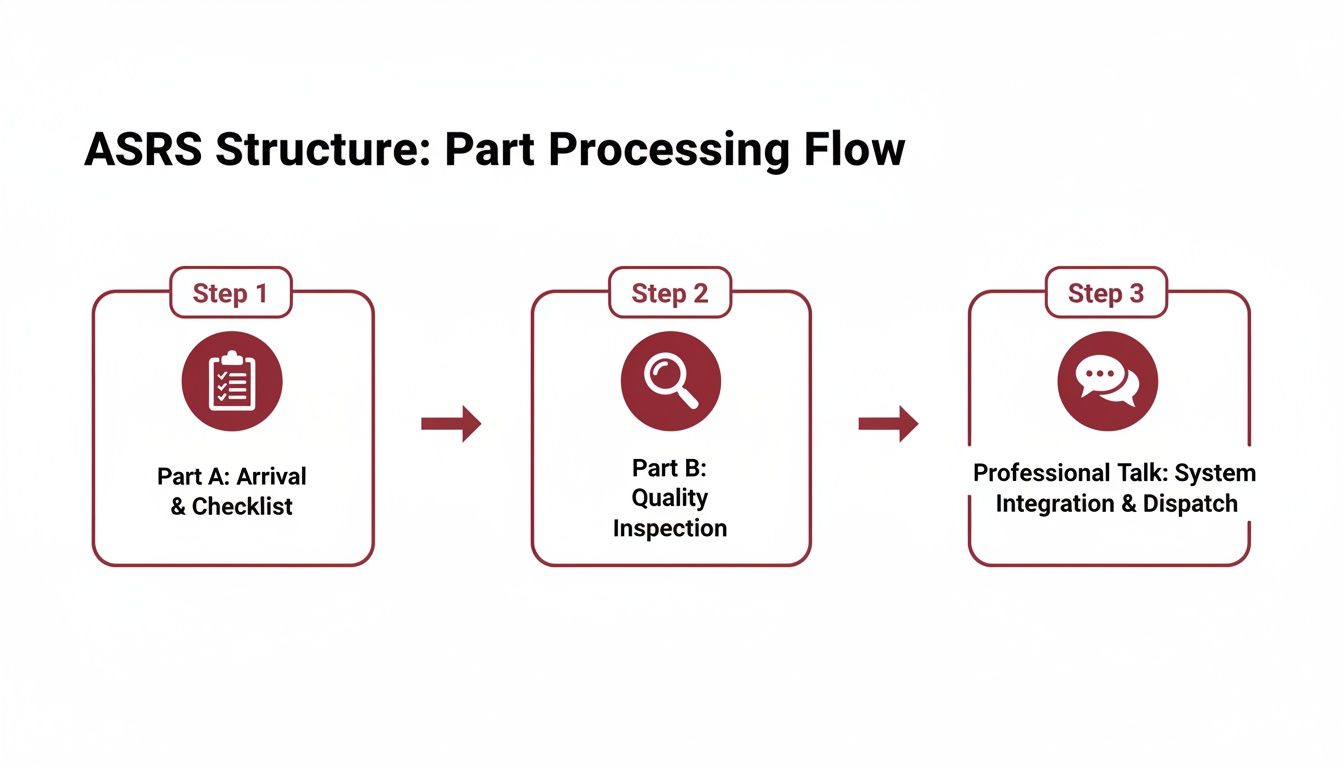
As you can see, Part A is a rapid filter, while Part B provides the rich detail needed for a meaningful evaluation.
Important Note: A high score is an indicator, not a diagnosis. The ASRS is a well-validated and respected tool, but it's still just a screener. A positive result is a strong signal that you should talk to a professional, not a confirmation that you have ADHD.
The research backing the ASRS is extensive. Studies have found the prevalence of adult ADHD to be around 8.2% when a positive screen is followed by a proper diagnostic interview. But it's also important to know that even with its accuracy, about 67.3% of adults who screen positive are later confirmed to have ADHD in a clinical setting.
This means nearly one in three people with a positive screen may not actually have ADHD, which is exactly why a full evaluation with a qualified professional is so critical. You can learn more about the research behind ASRS diagnostic accuracy here.
What Your ASRS Score Actually Means
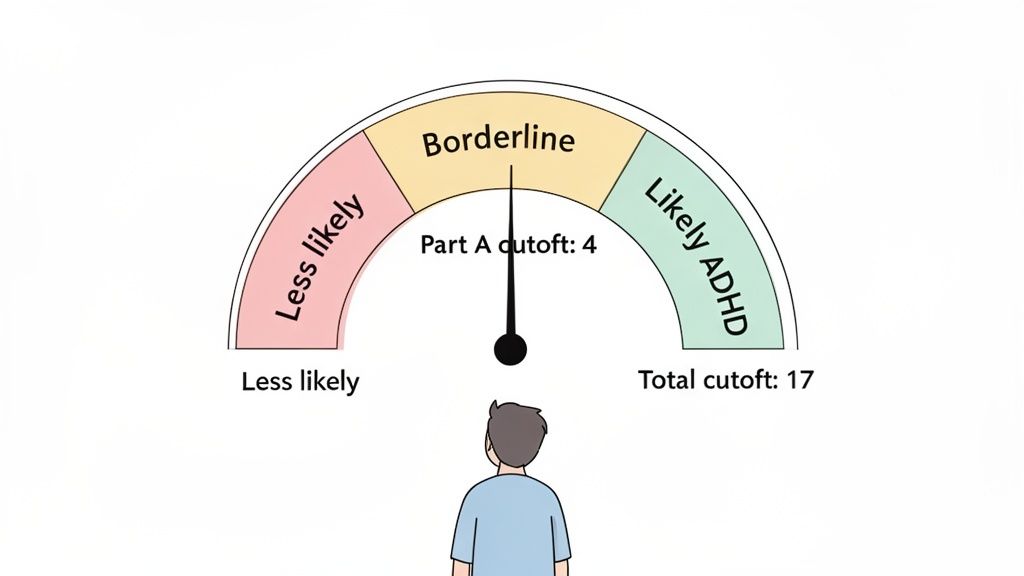
You've tallied up the checkmarks and you have a number. So, what does that score really tell you about what's going on? Understanding the clinical cutoffs for the Adult ADHD Self-Report Scale (ASRS) is the key to making sense of your results.
For Part A, the quick screener, the most common threshold is getting a score of four or more in the shaded boxes. Hitting that number suggests your symptoms are pretty consistent with adult ADHD. It's a strong signal that a formal evaluation would be a logical next step.
If you took the full 18-item scale, a total score of 17 or higher is generally considered a positive screen. This combines insights from both parts of the questionnaire to give a more complete picture of your experiences.
A Score Is Not a Diagnosis
This is critical: your score isn't a final verdict. Think of it as a valuable piece of information. A "positive" screen simply means you've identified a pattern of experiences that lines up with common ADHD symptoms. It’s an invitation to explore further, not a definitive label.
A number alone can't capture the complexity of your life. Several real-world factors can easily influence your score.
- Co-occurring Conditions: Symptoms of anxiety, depression, or trauma can look a lot like ADHD. For example, that feeling of being unable to concentrate? It’s a hallmark of both ADHD and depression.
- Masking and Compensation: Many adults, especially women and BIPOC individuals, have spent a lifetime developing complex coping mechanisms to hide or "mask" their symptoms. This can lead to underreporting on a self-report scale, even when you're struggling significantly beneath the surface.
This is exactly why a score is just the starting point of the conversation.
Putting Your Score Into Clinical Context
The specific cutoff score used in clinical practice can have a big impact on who gets flagged as "at risk." Modern research shows how different thresholds change the results, especially when you look across different ages and cultures.
For instance, some studies have found that certain scoring methods might over-identify risk in general medical settings, flagging way more people than the expected 2–7% of adults who actually have ADHD. In a massive cross-cultural study of 72,627 adults, 21.4% of women and 18.1% of men landed in a high-risk range—numbers much higher than typical diagnostic rates. You can explore the full study on how cultural factors influence ASRS scoring to see the data for yourself.
This doesn't mean the ASRS is broken. It just highlights why a clinician's expert context is absolutely essential.
At a specialized practice like the Sachs Center, we use the ASRS score as a first filter. A high score helps us quickly identify people who would benefit from a comprehensive evaluation. But a lower or borderline score doesn't end the conversation. It prompts a deeper discussion about masking and cultural factors to make sure we don't overlook those who might be underreporting their symptoms.
This approach ensures the score serves its true purpose: to start a meaningful dialogue, not shut one down.
To help you figure out what to do with your number, here's a quick guide on how to interpret your results and plan your next move.
ASRS Score Interpretation Guide
| Score Result | What It Suggests | Recommended Next Step |
|---|---|---|
| Below Cutoff | Your reported symptoms may not reach the threshold for clinical significance, or they might be related to other factors. | Keep an eye on your symptoms. If challenges persist, consider talking to a professional, especially if you think you might be masking. |
| Borderline or At Cutoff | You are experiencing symptoms consistent with adult ADHD that are worth looking into more deeply. | Schedule a consultation with a clinician who specializes in adult ADHD. They can help put your results into a broader personal context. |
| Clearly Above Cutoff | There is a strong likelihood that your symptoms align with an ADHD diagnosis. | Make it a priority to seek a comprehensive diagnostic evaluation to get a formal diagnosis and start exploring treatment options. |
No matter your score, remember that this self-assessment is a tool for understanding, not a final answer. It's a powerful first step toward getting the clarity and support you deserve.
When It’s Time to See a Professional
Getting a high score on the Adult ADHD Self-Report Scale (ASRS) is a big deal. It's not a diagnosis, but it is a strong signal that what you're experiencing deserves a real conversation with a clinician who gets adult ADHD.
Think of your score as the starting point, not the finish line.
No matter how well-designed, a self-report scale is just a snapshot. It can't capture the full, complex picture of your life. That’s why a comprehensive diagnostic evaluation is so important—it looks beyond the checkboxes to understand what’s really going on.
What a Simple Score Can't Tell You
A professional evaluation digs into areas a simple screener just can't touch. A good clinician will explore a few critical factors to make sure the diagnosis is accurate, considering things that are easy to miss on your own.
These include:
- Your Developmental History: For an ADHD diagnosis, symptoms need to have been present before you were 12. A clinician will ask about your childhood, look at old school report cards, and talk about feedback from your parents to piece together that history.
- Functional Impairment: A diagnosis isn't just about having symptoms; it's about those symptoms causing significant problems in at least two major areas of your life, like work, home, or your relationships. Your score doesn't really measure that impact.
- Co-occurring Conditions: Lots of other conditions—like anxiety, depression, and trauma—have symptoms that look a lot like ADHD. A professional can untangle these overlaps to get to the root of your challenges.
I often see adults who score high on the ASRS because they can’t focus or stay organized at work. But when we dig in during a clinical interview, it turns out these issues only started after a major life event. This often points toward an anxiety disorder, not ADHD. That's exactly why a full evaluation is so essential.
Why Structured Assessments Matter in the Age of Telehealth
The demand for accurate, accessible diagnostics has exploded, especially with the rise of telehealth. The numbers tell the story. A 2020 analysis found that while 2.58% of adults worldwide have persistent ADHD, a much larger group—6.76%, or about 139.8 million people—have symptoms significant enough to cause problems.
Here in the U.S., around 15.5 million adults have a current diagnosis, but about a third of them get no treatment at all. These statistics highlight a massive gap in care that telehealth is uniquely positioned to help fill. You can read more about the global prevalence and diagnostic challenges of adult ADHD in this detailed study.
This is why specialized centers now integrate tools like the ASRS into a much bigger assessment process. We combine the screener with a comprehensive 2-2.5 hour virtual evaluation. It’s an efficient way to connect with people who need help while avoiding the trap of relying on just a score.
Moving from a Score to a Diagnosis
A proper evaluation brings together your self-report data, other validated assessments, and—most importantly—a deep-dive clinical interview. This multi-faceted approach ensures the final diagnosis is based on your entire story.
If your ASRS score has you asking questions, the next step is to seek out a formal assessment. Getting clarity is the first real move toward getting effective support and treatment. By understanding how to get diagnosed with ADHD, you can turn that score from your self-assessment into real, actionable steps toward a better quality of life.
Life After an Adult ADHD Diagnosis
Getting a formal ADHD diagnosis as an adult can be a huge, life-altering moment. For so many people, it's the first time those lifelong struggles finally have a name, and that often comes with an incredible sense of relief and validation. This isn't the end of the road; it's the beginning of building a life that truly works for you.
A diagnosis helps you reframe everything. It shifts the internal question from, "What's wrong with me?" to "Okay, how does my brain work, and how can I support it?" This is where you can start digging into proven strategies and find a clear path forward.
Building Your Support System
From here, your journey will likely involve a mix of therapeutic support and practical, real-world strategies. The main goal is to build skills and shape your environment so you're set up to succeed.
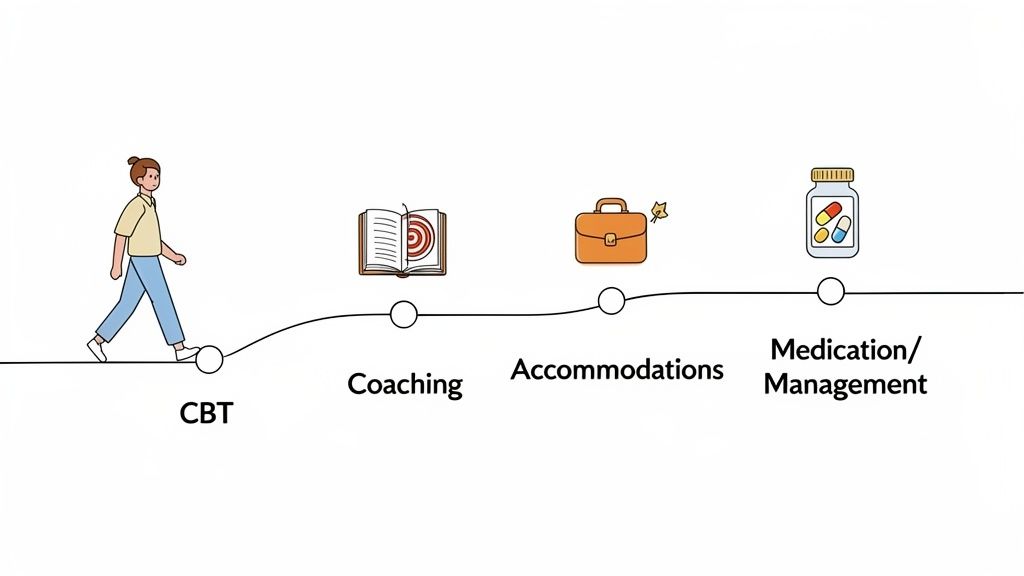
Some of the most effective pathways people explore include:
- Cognitive Behavioral Therapy (CBT) for ADHD: This isn't just talk therapy. It's a specialized approach that gives you practical skills to tackle executive function challenges head-on—things like time management, organization, and emotional regulation.
- ADHD Coaching: A good coach works with you to identify and hit your personal and professional goals. They provide tailored strategies and, just as importantly, accountability.
- Psychoeducation: Sometimes, just learning about ADHD is one of the most powerful things you can do. Understanding why it affects everything from your memory to your motivation helps build self-compassion and lets you find clever workarounds.
Diving into different ADHD coping strategies for adults can arm you with a toolkit of techniques to manage daily symptoms and cut down on that feeling of being constantly overwhelmed.
A diagnosis is so much more than a label; it’s a key. It unlocks access to support and accommodations that can fundamentally change how you move through the world, empowering you to advocate for your needs with real confidence.
Advocating for Yourself with a Diagnosis
This is where a formal diagnosis becomes incredibly powerful. It legitimizes your needs in a way that self-advocacy alone sometimes can't. An official diagnostic report from a comprehensive evaluation is a critical tool for getting the support you're entitled to.
With this documentation, you can formally request accommodations at school or in the workplace. These aren't special favors; they're necessary adjustments that level the playing field and give you a fair shot at success.
Common examples of accommodations include things like:
- Extended deadlines on big projects or assignments
- Access to a quiet workspace to minimize distractions
- Getting instructions in writing to back up verbal ones
- Permission to use noise-canceling headphones
Meetings can be a real struggle when you're trying to absorb information and stay focused. Implementing simple but effective strategies for recording and transcribing meetings can be a game-changing accommodation. On top of that, a diagnostic report acts as a bridge for coordinated care, making it much easier to work with other providers for medication management if that's a path you choose.
Ultimately, a diagnosis plugs you into real, tangible resources. It empowers you to start reshaping your life, both personally and professionally. It’s the true start of a journey toward working with your brain, not against it.
A Few Common Questions About Adult ADHD Screening
Going through the ADHD screening process often brings up a lot of questions. Let's clear up some of the most common ones about the ASRS and what your results really mean.
What if My Score Is Borderline?
Landing in that borderline range on the ASRS can feel confusing, and that's a completely normal reaction. It doesn't automatically confirm a diagnosis, but it absolutely doesn't mean you should ignore your symptoms, either.
Think of it as a yellow flag. A borderline score is a strong signal that you're dealing with enough ADHD-like symptoms to cause real-world problems, even if you don't neatly check every box on the screener. This is the perfect time to talk to a professional. A skilled clinician can dig deeper into the nuances a simple questionnaire can't, like whether you're masking symptoms or if anxiety is playing a role.
How Accurate Is the ASRS Screener?
The ASRS is a well-respected and validated tool, but its job is to screen, not to diagnose. Its accuracy is in its ability to flag adults whose symptoms are very consistent with ADHD and who would benefit from a full, professional evaluation.
Keep in mind that it's a self-report questionnaire. Your results can be swayed by your mood that day, your level of self-awareness, or even just how much stress you're under.
A "positive" screen does a great job of identifying people who likely have ADHD a high percentage of the time. But it's not foolproof. True diagnostic accuracy only comes from a comprehensive assessment that looks at the whole picture—your screening results, a detailed clinical interview, and your personal history.
How Should I Discuss My Score with a Doctor?
Bringing your ASRS results to a doctor is a fantastic first step. The key is to frame it as the start of a conversation, not a self-diagnosis.
You could try saying something like:
- "I took this validated ADHD screener, and my score suggests this is something worth looking into. Could we talk more about the symptoms I'm experiencing?"
- "These results really hit home for me and line up with lifelong struggles I've had with focus and staying organized. I'd like to explore what might be going on."
If you're using digital tools to track or share this kind of information, privacy is a valid concern, making it important to look into understanding HIPAA compliance for data collection tools. When you have the conversation, be ready with real-life examples of how these issues are affecting your work, your relationships, and your day-to-day life.
At the Sachs Center, our experts know that a score is just one piece of the puzzle. We offer comprehensive virtual evaluations that honor your unique experiences to bring you the clarity you deserve. If you're ready for the next step, book your ADHD evaluation today.
