
Improving your focus isn't about one magic trick. It's a two-pronged approach: first, you have to optimize your external world to cut down on distractions. At the same time, you need to strengthen your internal ability to actually direct your attention where you want it to go.
Think of it as a skill you build over time. This involves actively managing digital notifications, creating dedicated workspaces, and practicing techniques like single-tasking. It's about training your brain, and the journey starts by understanding why concentration feels so challenging in the first place.
Why Is It So Hard to Focus in the Modern World?

Let's be honest, just staying focused feels like a constant battle. If you find yourself reading the same paragraph over and over, or you get to the end of a workday wondering where the hours even went, you're not alone.
Our brains are fundamentally wired for survival, meaning they are naturally drawn to novelty and change. This ancient feature was once essential for spotting predators in the tall grass. Today, it’s constantly being exploited by the modern world.
Every notification, email alert, and social media ping is engineered to hijack this primal instinct. This constant barrage creates a state of continuous partial attention, where we are simultaneously aware of everything but truly concentrating on nothing. The result? Our mental energy gets fragmented, making deep, meaningful work feel almost impossible to achieve.
The Science Behind Your Distraction
Your ability to focus isn't some fixed trait you're born with; it's a dynamic cognitive process managed by the prefrontal cortex. This is the part of your brain that handles executive functions like planning, decision-making, and, most importantly, directing your attention.
When it gets overloaded with too many inputs—like juggling emails, a looming deadline, and a buzzing group chat—its capacity tanks.
Think of your attention as a spotlight. You can either shine it brightly on a single point or diffuse its light across a wide area, illuminating nothing clearly. Constant multitasking forces your brain to rapidly switch that spotlight back and forth, a process that is mentally exhausting and wildly inefficient. Each switch comes with a "cognitive cost," consuming valuable mental energy that could have been used for the task at hand.
Our working memory, the brain’s temporary sticky note for holding information, is incredibly limited. When we are constantly distracted, this fragile system gets overwhelmed, making it difficult to process complex information and maintain a train of thought.
Real-World Focus Challenges
This struggle looks different depending on who you are and what you do. For a student trying to study for exams, the lure of social media and video games makes it nearly impossible to engage with dense academic material. The constant fear of missing out (FOMO) creates an undercurrent of anxiety that pulls them away from their books.
For a professional, the challenge is often the sheer volume of communication. A project manager might spend their day toggling between Slack, email, and virtual meetings, trying to keep multiple projects moving forward. This constant context-switching leads to shallower work and a much higher risk of burnout.
Even at home, a parent trying to manage household tasks and kids' schedules finds their attention pulled in countless directions. Trying to help with homework while planning dinner and responding to a text is a recipe for mental exhaustion. Each scenario highlights the same core issue: our environment is often at war with our brain's ability to concentrate deeply.
Understanding this conflict is the first step toward reclaiming your focus. By addressing both the external triggers and your internal processes, you can begin to build a more focused, productive life. Many of these abilities are tied to executive functions, and there are many effective strategies for improving working memory that can support this journey.
Designing Your Environment for Deep Concentration
Your surroundings are a powerful, often invisible, force shaping your ability to concentrate. Think about it: every object in your line of sight, every background noise, and every digital alert is either a stepping stone to deep work or a trigger for distraction. To really improve focus, you have to get intentional and design an environment that signals to your brain it’s time to concentrate.
This whole process starts with creating a distinct workspace. It doesn’t have to be a separate room with a door; even a small corner of your living room can become a sanctuary for focus. The key is to create a physical boundary that your brain learns to associate exclusively with productive work.
Carve Out a Dedicated Deep Work Zone
Creating this "focus zone" is about more than just tidying up—it's about psychological conditioning. When you consistently use a specific space only for challenging cognitive tasks, you build a powerful mental shortcut. Over time, simply sitting down in that space will help you slide into a state of concentration much more quickly.
For example, a freelance writer living in a studio apartment might designate a small desk facing a blank wall as their "writing zone." When they sit there, their phone is on silent and in another room. Their noise-canceling headphones are on. This space is never used for scrolling social media, eating meals, or casual browsing. It has one job.
The goal is to build an environment so free of external triggers that the only option left is to engage with the task at hand. This is how you minimize the cognitive load of constantly resisting distractions.
This principle works just as well in a busy office. Even in an open-plan layout, you can create a personal bubble of concentration. Put on headphones to signal you're unavailable, turn off all those desktop notifications, and clear your immediate desk space of everything except what's essential for your current project.
Build an Impenetrable Digital Fortress
Your physical space is only half the battle. Your digital environment requires just as much intentional design, maybe even more. Digital distractions are insidious because they promise novelty and connection, directly targeting our brain's reward systems. To regain control, you have to be ruthless in curating your digital world.
Start by auditing your notifications. Do you really need to know the second an email arrives or someone likes your photo? For most of us, the answer is a firm no. Turn off all non-essential alerts on your phone and computer. That includes banners, sounds, and those little red badge icons that scream for attention.
Next, it's time to use technology to fight technology. These tools can be incredibly effective for creating boundaries:
- Website Blockers: Applications like Freedom or Cold Turkey can block access to distracting websites and apps for set periods. This removes the temptation entirely, freeing up your willpower for actual work.
- Noise-Canceling Headphones: These are non-negotiable for anyone working in a noisy or distracting environment. They create a pocket of silence that allows your brain to settle into deep thought.
- Email Management Tools: Programs like Boomerang for Gmail allow you to "pause" your inbox, stopping new emails from appearing until you're ready to deal with them. This prevents your inbox from becoming a constant to-do list dictated by everyone else.
By implementing these digital barricades, you move from a reactive state—constantly responding to pings—to a proactive one where you choose when and how you engage with digital information.
The Anchoring Power of Routines
Beyond your physical and digital spaces, routines provide the structure that primes your brain for focus. Simple morning and evening rituals act as anchors, signaling the start and end of your productive periods. These don't need to be complicated at all.
A morning routine could be as simple as making coffee, spending five minutes stretching, and then reviewing your top three priorities for the day before ever checking your email. This creates a calm, intentional start, preventing the chaos of the outside world from hijacking your focus from the moment you wake up.
Similarly, an evening "shutdown" routine is crucial. This could involve clearing your desk, writing down a quick plan for the next day, and closing your laptop for good. This simple act provides closure, allowing your brain to truly disengage from work and properly rest—which is absolutely essential for maintaining focus day after day. A remote worker, for instance, might end their day by tidying their desk and then going for a short walk, creating a clear, physical separation between their work life and personal time.
Proven Techniques to Train Your Attention Span
Now that your environment is set up for success, it's time to train the attention muscle itself. Improving focus isn't a passive activity; it requires consistent, active practice. Think of these techniques as the daily workout routine for building a stronger, more resilient attention span.
You can't sprint a marathon, and you can't maintain intense focus for eight hours straight. The key is to work with your brain's natural energy cycles, not against them. Breaking your work into focused bursts followed by deliberate rest is one of the most effective ways to do just that.
Master the Pomodoro Technique
The Pomodoro Technique is a beautifully simple system for managing your attention. It’s built around a timer: you work for a focused session—traditionally 25 minutes—and then take a short 5-minute break. After four of these cycles, you reward yourself with a longer break of 15-30 minutes.
The magic here isn't just the timer; it's the commitment you make to that 25-minute block. During that time, you are a single-tasking machine. No checking email, no scrolling through social media, no "I'll just do this one other thing." If a distracting thought pops into your head, you simply jot it down to deal with later.
This method is so effective because it directly combats mental fatigue. The short, regular breaks hit the reset button on your brain, preventing the cognitive decline that sets in during long, uninterrupted slogs. You return to your task feeling refreshed and ready to re-engage.
Adapt Your Work Intervals for Different Tasks
While the classic 25/5 split is a fantastic starting point, the real power of this method comes from tailoring the intervals to the task at hand and your own personal rhythm.
- For highly creative or complex tasks: You might find that a longer focus block of 50 or 60 minutes helps you get into a deep state of flow. Pair this with a more substantial 15-minute break.
- For tedious or administrative work: Shorter intervals of just 15-20 minutes can make a daunting to-do list feel much more manageable and help you push past the initial urge to procrastinate.
This isn't just anecdotal. Research from the Draugiem Group found that their most productive employees worked intensely for about 52 minutes and then took a 17-minute break. This rhythm allowed them to keep their energy and concentration high all day.
The image below breaks down the essential steps to prepare your mind and space for a session of deep concentration.
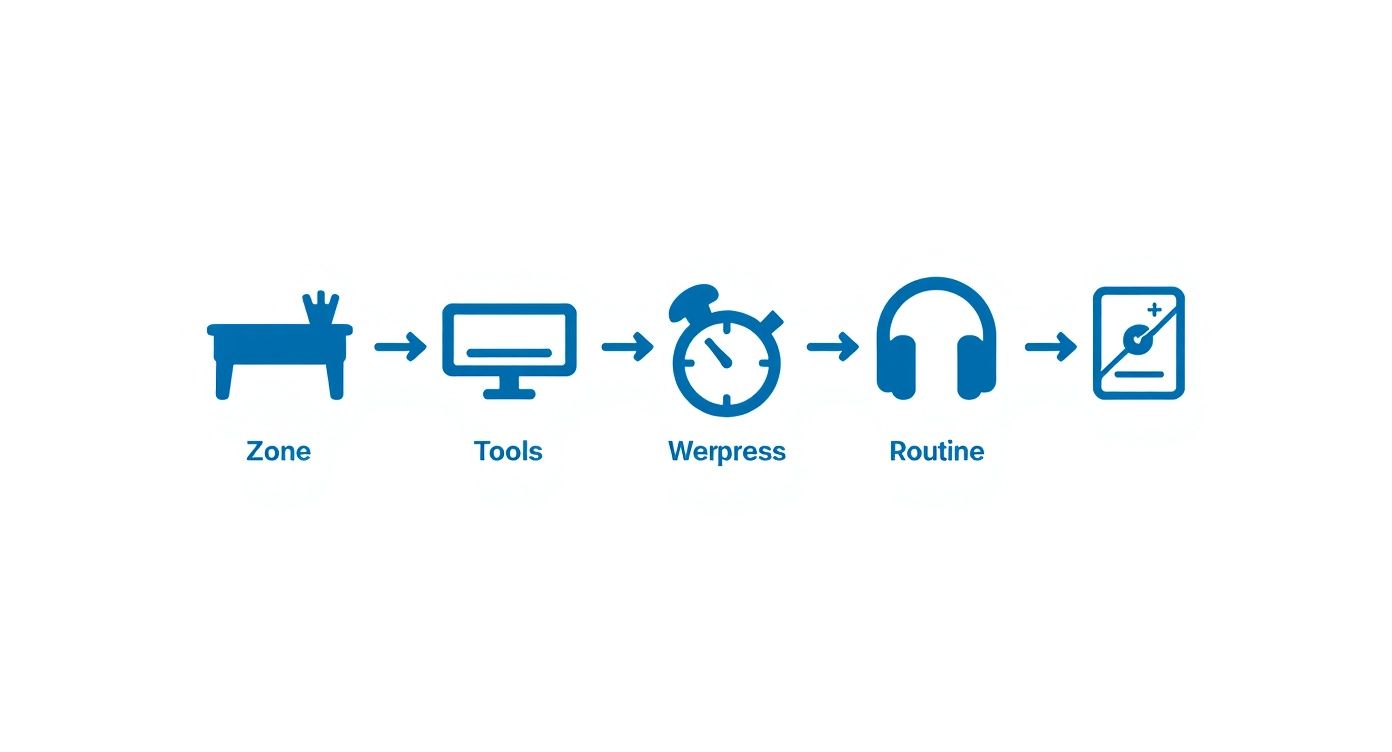
As you can see, effective focus is the result of intentional preparation. It's about combining a dedicated space with the right tools and a structured routine.
Implement Task Batching to Reduce Cognitive Load
Another game-changing strategy is task batching. This is the simple practice of grouping similar small tasks together and knocking them all out in one dedicated time block. For instance, instead of answering emails as they trickle in, you’d schedule two or three 30-minute blocks per day to handle all of your emails at once.
Every time you switch between different kinds of tasks—say, from writing a report to checking Slack messages—your brain has to pay a "cognitive switching cost." This mental tax drains your focus and energy.
By batching similar activities, you eliminate this constant context switching. Your brain gets to stay in one mode—like "email mode" or "research mode"—which conserves mental energy and allows for much deeper, more efficient work.
Here are a few examples of what this looks like in practice:
- Communication Batch: Schedule two dedicated times a day to check and respond to all emails, voicemails, and instant messages.
- Administrative Batch: Block out an hour on Friday afternoons to handle all of your weekly expense reports, scheduling, and filing.
- Creative Batch: Carve out a two-hour, distraction-free period in the morning that is reserved solely for writing, coding, or design work.
This simple shift transforms your day from a series of reactive interruptions into proactive, focused sessions. Many of these skills are central to what we call executive functioning. If you'd like to explore this further, you can learn more about getting executive function help for adults and building these foundational abilities.
Strengthen Your Focus with Mindfulness Exercises
Finally, you can train your attention directly through simple mindfulness practices. Think of it as strength training for your prefrontal cortex. Just a few minutes each day can build your ability to notice when your mind has wandered and gently guide it back.
A great place to start is with focused-attention meditation. Find a comfortable seat, close your eyes, and bring your full attention to the physical sensation of your breath. Your mind will wander—that's what minds do. When you notice it has drifted to other thoughts, just acknowledge it without judgment and gently bring your focus back to your breath.
This constant, gentle act of noticing and redirecting is the core of attention training. It strengthens the neural pathways responsible for sustained concentration, making it that much easier to stay on task when it really counts.
How Your Lifestyle Directly Impacts Your Focus
Improving focus isn't just about clever mental tricks or the latest productivity app. It’s a full-body effort, deeply rooted in your physical health. Your brain is a biological organ, and just like any other part of your body, its performance is a direct reflection of your daily choices.
Think of your ability to concentrate like a high-performance engine. It can't run efficiently without the right fuel, proper maintenance, and adequate rest. This connection means you have incredible power to boost your mental clarity just by being more intentional about how you sleep, eat, and move. These are the non-negotiable pillars for building a sustainable capacity for deep, meaningful work.
The Undeniable Link Between Sleep and Concentration
We often treat sleep as a luxury—the first thing we sacrifice when a deadline looms. In reality, it’s the most critical recovery process for your brain. While you sleep, your brain is hard at work clearing out metabolic waste, consolidating memories, and repairing neural pathways. Skimping on this has immediate and serious consequences for your attention span.
Just one night of bad sleep can impair the function of your prefrontal cortex, the command center for focus, decision-making, and keeping your emotions in check. This is what causes that familiar "brain fog," where every task takes longer, mistakes pop up more frequently, and your ability to ignore distractions hits an all-time low. Research has shown that after just 17-19 hours without sleep, your performance can be equivalent to someone with a blood alcohol level of 0.05%.
Your brain cleans house while you sleep. Neglecting this crucial maintenance work leaves you trying to operate with a cluttered, inefficient mind the next day.
Improving sleep quality isn’t just about hitting the eight-hour mark. It's about creating a consistent, restorative routine that your body can count on.
- Maintain a Regular Schedule: Try to go to bed and wake up around the same time every day, even on weekends. This stabilizes your internal body clock (your circadian rhythm), which promotes deeper, more effective sleep cycles.
- Create a Restful Environment: Your bedroom should be a sanctuary for sleep—dark, cool, and quiet. Think blackout curtains, white noise machines, and getting all screens out of the room at least an hour before bed.
- Develop a Wind-Down Ritual: Create a simple sequence of calming activities to signal to your brain that it’s time to power down. This could be reading a physical book, doing some gentle stretching, or listening to calming music.
Fuel Your Brain With What It Actually Needs
The food you eat has a direct, and often rapid, impact on your cognitive function. Your brain is a hungry organ, consuming about 20% of your body’s calories, so the quality of that fuel matters immensely. A diet loaded with processed foods, sugar, and unhealthy fats can lead to inflammation and oxidative stress, both of which are known to impair brain function.
On the flip side, a diet rich in certain nutrients can protect your brain and boost its performance. Start by incorporating more of these brain-friendly foods:
- Omega-3 Fatty Acids: You can find these in fatty fish like salmon, as well as in walnuts and flaxseeds. They are essential building blocks for brain and nerve cells.
- Antioxidants: Berries, dark leafy greens, and even dark chocolate are packed with antioxidants that fight cellular damage and support long-term brain health.
- Complex Carbohydrates: Foods like oatmeal, brown rice, and quinoa provide a steady release of glucose—the brain's primary energy source. This helps you avoid the sharp energy crashes that always follow sugary snacks.
Sustained mental effort requires consistent energy. A great place to start is to find ways to increase energy levels naturally to better support your focus goals.
Reset Your Brain With Regular Movement
Physical exercise is one of the most powerful tools you have for sharpening your focus. When you get moving, you increase blood flow to the brain, delivering a fresh supply of oxygen and nutrients. This process doesn't just feel good; it actually stimulates the growth of new neurons and strengthens the connections between existing ones.
The best part? You don't have to run a marathon to see results. Even a short burst of activity can have an immediate effect. A brisk 10-minute walk can boost alertness and concentration for several hours, acting as a mental reset button when you feel stuck or fatigued.
The key is making movement a non-negotiable part of your routine. Whether it’s a morning workout, a walk during your lunch break, or just a few stretches at your desk, consistent physical activity builds a more resilient and focused brain over the long term.
Understanding Focus in ADHD and Neurodiversity

Attention isn't a one-size-fits-all experience. For neurodivergent people, especially those with ADHD or Autism, the way focus works can be fundamentally different from the neurotypical standard—and that’s okay. It’s simply a different operating system.
Let's move past the common myths. The real challenge for many with ADHD isn't a lack of attention, but difficulty regulating it. Theirs is often an interest-based attention system. This means they can achieve an intense, laser-like focus on things that genuinely captivate them, while struggling to engage with tasks they find mundane.
Likewise, many autistic individuals experience a powerful type of concentration called hyperfocus. They can become so deeply absorbed in a subject that the outside world just melts away. This isn't a bug; it's a feature that can lead to incredible expertise and creativity.
Why Traditional Productivity Advice Fails
Ever tried to force yourself into a rigid "eat the frog" productivity method, only to end up feeling frustrated and defeated? You're not alone. So much of the standard advice on focus is built for a neurotypical brain and completely backfires for neurodivergent minds.
Methods that rely on sheer willpower to grind through boring tasks ignore the unique neurology of an ADHD brain, which is driven by dopamine and novelty. Expecting an autistic person to focus in a loud, brightly-lit open office—a common "collaborative" workspace—can trigger sensory overload and a complete shutdown.
The goal isn't to force a neurodivergent brain into a neurotypical box. It's about understanding its unique strengths and needs, then building a supportive system around them. True progress comes from working with your brain, not against it.
This means we have to shift the whole approach. Instead of "fixing" a deficit, we need to create the right conditions for your specific brain to thrive.
Tailored Strategies for Neurodivergent Minds
So, what does that look like in practice? It’s about building a personalized toolkit of strategies that respect your cognitive and sensory profile. For anyone navigating focus issues tied to neurodiversity, understanding the specific challenges of ADHD and counselling can be a pivotal part of this journey.
Here are a few powerful, neurodiversity-affirming strategies to get started:
- Design a Sensory-Friendly Environment: This is about more than just tidying up. It might mean using noise-canceling headphones to mute distractions, installing dimmable lights to reduce eye strain, or using a weighted blanket to provide calming sensory input while you work.
- Embrace Body Doubling: This is the simple act of working alongside someone else, either in person or virtually. Their quiet presence creates a subtle accountability that makes it much easier to stay on task, even if you don't say a word to each other.
- Gamify Your Tasks: Lean into the ADHD brain's need for novelty and reward. Break a big project into smaller "quests," use a timer to race against, or set up a simple reward system for finishing tough steps. It injects a little dopamine that can make even the most tedious jobs more engaging.
- Externalize Your Executive Functions: Don't force your brain to remember everything. Use external tools—visual timers, detailed checklists, reminder apps, and big whiteboards—to offload the mental burden of planning and organizing. This frees up your brainpower for the actual task.
Harnessing Your Unique Strengths
It's critical to see that neurodivergent traits aren't just challenges; they are also profound strengths. That ability to hyperfocus can lead to mastery in a field. The creative, non-linear thinking common in ADHD can generate brilliant, out-of-the-box solutions that others would never see.
When you understand your own cognitive landscape, you can learn to use these abilities on purpose. You might structure your week to block out long, uninterrupted periods for projects that ignite your passion, letting you fully tap into your hyperfocus.
The journey to improve focus is deeply personal. For neurodivergent individuals, this means giving yourself permission to throw out conventional advice that doesn’t work for you. Instead, you can build a system that celebrates and supports the unique way your mind operates. If you want more specific guidance, our team put together a detailed guide on how to focus with ADHD that explores these ideas in greater depth.
When Self-Help Isn't Enough for Focus Issues
Trying new strategies, tweaking your environment, and building better habits can make a world of difference for your concentration. For many people, these self-help approaches are exactly what they need to get back in the driver's seat. But what happens when you’ve tried everything and still feel like you’re fighting an uphill battle every single day?
Sometimes, persistent focus challenges aren't just a matter of willpower or finding the right productivity hack. They can be a sign of an underlying neurological condition like ADHD, or other mental health factors that need a different kind of support.
Realizing it's time to look beyond self-help is a huge, empowering step. It’s you acknowledging that your struggle is real and that it might take more than a new planner or a website blocker to truly manage it.
Signs It’s Time to Seek Professional Help
So, how do you know if your focus issues have crossed the line from a common annoyance to a significant problem? It usually comes down to the severity and consistency of the impact on your life. If your struggles with focus are creating a pattern of negative consequences, that's a clear signal to seek more support.
See if any of these situations sound familiar:
- Significant Work or School Impact: Maybe you’re constantly missing deadlines, getting disappointing performance reviews, or just can’t seem to finish your assignments. It's that feeling of being chronically behind, no matter how hard you try to catch up.
- Strain on Relationships: Do you find yourself unintentionally tuning out your partner, forgetting important dates, or feeling too mentally scattered to be present with your kids or friends? When focus issues start creating conflict or emotional distance, that's a major red flag.
- Emotional and Mental Health Toll: Let's be honest, struggling to focus is exhausting. Over time, it often leads to intense frustration, low self-esteem, anxiety, or even symptoms of depression because you feel like you aren't living up to your potential.
- Difficulty with Daily Life Management: This can look like chronically forgetting appointments, struggling to stay on top of bills, or feeling completely overwhelmed by basic household chores and responsibilities.
If these scenarios feel deeply familiar, it's not a personal failure. It's a sign that your brain may be wired in a way that requires specialized strategies and support—which is exactly where a professional evaluation comes in.
Understanding the Evaluation Process
The thought of a professional evaluation can feel intimidating, but it’s really just a structured way to get you clarity. It’s not about judgment; it’s about finally understanding the "why" behind your struggles. At a place like the Sachs Center, we've designed this process to be as comfortable and straightforward as possible, especially since we conduct it virtually.
A typical diagnostic evaluation for something like ADHD or Autism involves a few key parts. It always starts with a detailed clinical interview. A psychologist will sit down with you (virtually) and ask about your experiences—from your early childhood all the way to your current challenges at work, school, or home. This conversation gives us vital context.
After the interview, you’ll complete a series of validated self-report measures and assessments. These are just standardized tools that help us create an objective picture of your cognitive and behavioral patterns. The whole thing is collaborative, designed to understand your unique profile of strengths and challenges.
The end goal is simple: to give you a clear diagnosis (if one applies) and a practical roadmap for what to do next. For so many people, that clarity is the first real step toward finally feeling in control.
Your Questions About Improving Focus, Answered
When you start digging into how to improve focus, a lot of the same questions and roadblocks tend to pop up. We hear them all the time. Here are some of the most common ones we get, with some clear, practical answers to help guide you.
Can You Really Improve Your Ability to Focus for Good?
Yes, you absolutely can. The best way to think about focus is like a mental muscle. The more you train it, the stronger it gets. It’s not about finding a magic bullet, but about building consistent habits that strengthen your brain's attention networks over time.
By consistently practicing things like attention-training exercises, setting up a task management system that works for you, and intentionally creating a distraction-free space, you’re doing the reps. These daily practices build on each other, making concentration feel less like a struggle and more like a skill you can rely on.
How Long Until I Actually See a Difference?
While you might feel an immediate sense of calm just by turning off your phone notifications for an hour, the real, lasting improvements in sustained focus usually take a few weeks of consistent effort. Most people tell us they notice a tangible shift after sticking with specific techniques for about three to four weeks.
The key here is consistency over intensity. Small, daily actions are what create a huge, lasting change in your ability to concentrate deeply and for longer stretches. It's a marathon, not a sprint.
What’s the Single Best Thing I Can Do to Improve Focus Right Now?
If you want the most impact from a single action, practice single-tasking. Seriously. Pick one important thing you need to do, set a timer for 25 minutes (the Pomodoro technique is great for this), and ruthlessly eliminate every other possible distraction.
That means closing all those extra browser tabs. It means putting your phone in another room—not just on silent. This simple act of committing to one thing at a time can have a dramatic effect on your clarity and what you get done, giving you a powerful glimpse of what’s possible.
Are Focus Supplements and Nootropics Worth It?
Honestly, the science on nootropics is all over the place, and the industry is largely unregulated. Sure, some ingredients like caffeine are proven to give you a temporary boost in alertness, but many supplements on the market just don't have solid scientific evidence to back up their claims for long-term focus improvement.
A much healthier, and frankly more reliable, approach is to double down on the lifestyle factors we know work. Prioritize getting quality sleep. Eat a balanced diet with plenty of brain-healthy foods like those rich in omega-3s. Get regular physical exercise. These fundamentals build a much stronger foundation for lasting concentration than any pill ever could.
At the Sachs Center, we specialize in providing clarity and support for children, teens, and adults struggling with focus, especially when it's connected to ADHD and Autism. If you feel like you've tried everything and are ready for a clear diagnosis and a personalized plan, we're here to help. You can book your telehealth evaluation today.
