

If you want to study better in college, you have to stop trading sheer hours for smarter strategies. The secret isn't locking yourself in the library longer; it's about making your study time actually count by using proven, efficient techniques. Moving from passive review to active learning is your first real step toward better grades and, honestly, a lot less stress.
Why 'Studying More' Is a Broken Strategy
That classic advice to study two hours for every one hour of class? It sounds great in a syllabus, but it feels completely disconnected from the reality of a packed college schedule. If you’ve ever felt guilty for not hitting that impossible number, you're not alone.
The truth is, just piling on more hours is an inefficient—and often unsustainable—way to chase academic success.
Focusing on quantity over quality misses the most important part of the equation: how your brain actually learns and holds onto information. Brute-force studying doesn't lead to better grades; it leads to burnout. The real foundation of effective learning is built on principles like active recall and strategic planning. It’s about genuinely engaging with the material, not just letting your eyes glaze over it.
The Great Time Disconnect
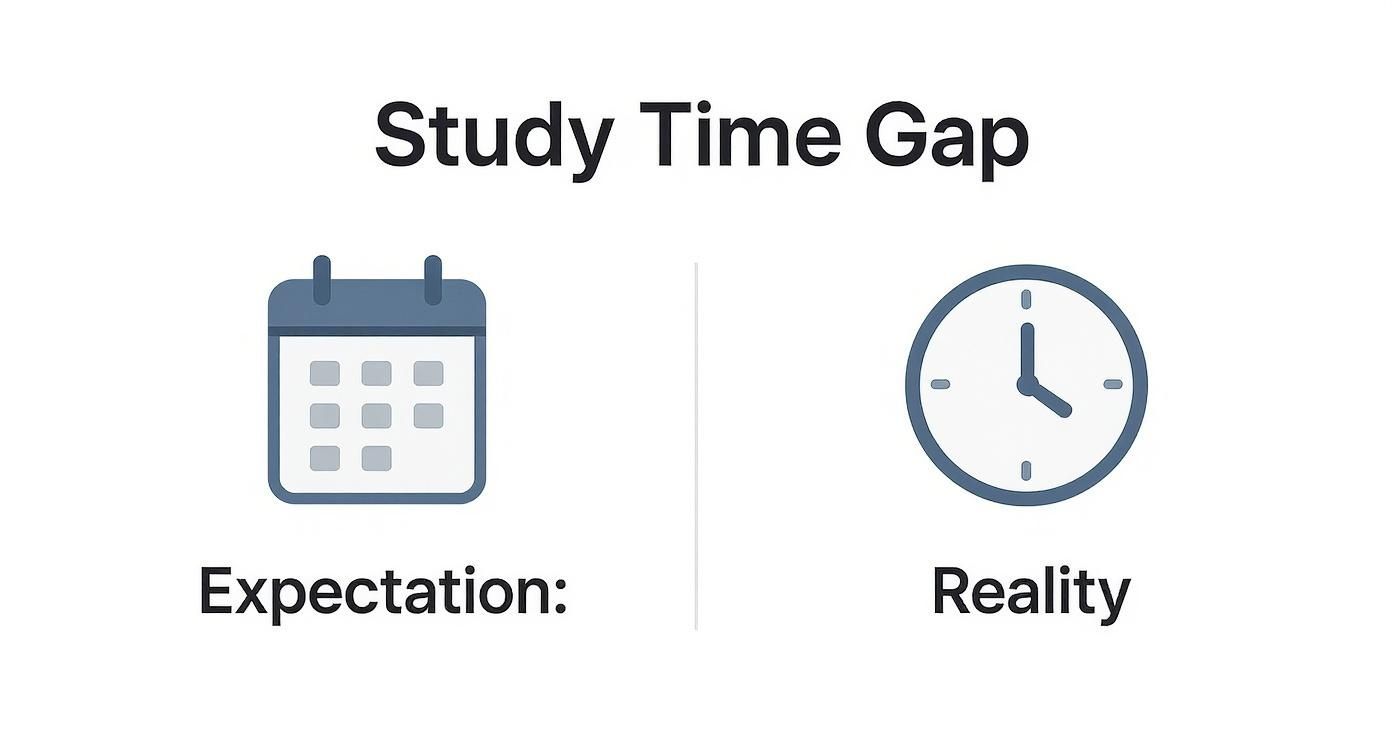
The old rule of thumb was that a student with a 15-credit semester should be studying around 30 hours per week. But modern data shows a massive gap between that expectation and what students are actually doing.
Let's look at the numbers.
Study Time Expectation vs Reality
| Metric | Traditional Expectation (15 Credits) | Recent Findings (Average) |
|---|---|---|
| Weekly Study Hours | 30 hours | ~19 hours (includes all educational activities) |
Recent findings from the Bureau of Labor Statistics show that full-time students average closer to 19 hours per week on all education-related activities, not just studying. This disconnect is huge, and it proves why we need a new approach. If you're curious, you can dive deeper into modern student habits with this report from the Manhattan Institute.
The key takeaway here isn't that students are lazy. It's that success isn't about hitting some arbitrary time quota; it's about maximizing the effectiveness of the hours you do have.
The goal isn’t to become a studying machine that never leaves the desk. The goal is to become an efficient learner who can master complex topics without sacrificing your well-being.
That means swapping outdated, passive habits for evidence-based methods that work with your brain's natural learning processes. This guide is going to show you exactly how to make that shift.
Trading Ineffective Habits for Proven Methods

It’s a scene every student knows: late night, an exam looming, and you’re just staring at the same page of notes for what feels like the hundredth time. We think marathon cram sessions and rereading our notes are the hallmarks of hard work. The truth is, they're some of the least effective ways to actually learn and remember anything long-term.
These passive methods trick our brains. They create a false sense of familiarity. You start to recognize the words on the page and mistake that recognition for genuine understanding. But when you’re staring at a blank exam paper, that familiarity disappears because the information was never really locked in.
It’s an incredibly common trap. A recent U.S. survey found that a shocking 96% of students rely on re-reading to study, even though cognitive science has shown time and again how poorly it works compared to active strategies. You can read more about these student habit findings on PR Newswire.
Embrace Active Learning Instead
To really figure out how to study better in college, you have to switch from being a passive audience member to an active participant in your own learning. Active learning forces your brain to grapple with the material, building stronger, more durable connections.
Think of it like this: you can watch videos of people lifting weights all day, but you won't build any muscle until you pick up the weights yourself.
The most effective study sessions feel a bit difficult. If your brain isn't working to retrieve information, you're not learning—you're just recognizing.
This doesn’t mean studying has to be miserable, but it should feel like a mental workout. Let’s get into a couple of powerful techniques that turn study time from a passive review into a high-impact activity.
Implement Retrieval Practice
Retrieval practice is simply the act of pulling information out of your brain instead of just trying to shove it in. This one technique is probably the most powerful tool you have for boosting long-term memory.
So, instead of rereading your biology notes, close the book. Now, try to answer this question from scratch: "What are the key stages of mitosis and what happens in each?" That struggle to remember is the learning.
Here are a few easy ways to put this into practice:
- Flashcards: The classic for a reason. Use them for key terms, concepts, or formulas. The real magic happens in that moment you try to recall the answer before you flip the card.
- Practice Tests: Don't wait for your professor to provide one. Make up your own questions based on your notes or find old exams if they’re available.
- Brain Dumps: At the end of a study block, grab a blank piece of paper. Write down absolutely everything you can remember about the topic without looking at your notes. Afterward, compare it to your material to see what you missed.
Use Spaced Repetition for Lasting Memory
Our brains are literally built to forget things over time. Spaced repetition is a system that works with this natural tendency instead of against it. The idea is to review material at increasing intervals.
Instead of cramming for eight hours straight for your chemistry final, you might study for an hour on Monday, review for 30 minutes on Wednesday, and then again for just 15 minutes on Friday.
This approach interrupts the "forgetting curve." Each time you review the information just as you're about to forget it, you send a powerful signal to your brain that this stuff is important and needs to be kept.
There are great apps out there like Anki or Quizlet that have spaced repetition algorithms built right in. They take the guesswork out of it, making it an incredibly efficient way to master huge amounts of information.
Mastering Your Time and Energy for Peak Performance
Knowing the best study techniques is only half the battle. The real challenge is finding the time and mental space to actually use them. Between classes, work, and trying to have some semblance of a social life, college can feel like a chaotic juggling act where effective time management is just a myth.
The key isn't just about plugging things into a calendar. It's about building a system that protects your focus and directs your energy where it’ll make the biggest impact. We're moving beyond basic to-do lists and into proven methods for wrangling your schedule.
Tame Your Schedule with Time Blocking
A packed schedule feels overwhelming, but time blocking brings a sense of calm to the chaos. Instead of staring at an endless to-do list, you give every task a specific home in your calendar. This simple shift forces you to be brutally honest about how much you can actually get done in a day.
Your calendar transforms from a list of appointments into a concrete game plan. A Tuesday might look something like this:
- 9:00 AM – 10:30 AM: Outline Political Science essay.
- 10:30 AM – 11:00 AM: Walk to next class, grab coffee.
- 11:00 AM – 12:15 PM: Microeconomics Lecture.
- 12:15 PM – 1:00 PM: Lunch with friends.
- 1:00 PM – 2:30 PM: Grind through Microeconomics practice problems.
This approach stops multitasking in its tracks and gives every part of your day—even your breaks—a clear purpose. To go deeper on crafting a schedule that truly works, check out these excellent time management tips for students.
Work in Focused Bursts with the Pomodoro Technique
Let's be real: our brains aren't built for multi-hour marathon study sessions. The Pomodoro Technique embraces this fact by breaking work into focused intervals—traditionally 25 minutes long—separated by short breaks.
It sounds almost too simple, but it’s a game-changer. You work with intense, single-minded focus for one "Pomodoro," then take a 5-minute breather. After four of these cycles, you earn a longer break of 15-30 minutes. This rhythm keeps you fresh and prevents that all-too-familiar feeling of burnout.
By committing to just 25 minutes of focused work, you trick your brain into starting a task that feels huge. It’s way easier to convince yourself to tackle a dense textbook chapter when you know a break is just around the corner.
Prioritize Ruthlessly with the Eisenhower Matrix
Not all tasks are created equal. The Eisenhower Matrix is a straightforward decision-making tool that helps you separate what’s truly important from what’s just screaming for your attention. You sort tasks into four simple boxes:
| Category | Description | Action |
|---|---|---|
| Urgent & Important | Crises, pressing problems, deadline-driven projects. | Do it now. |
| Not Urgent & Important | Relationship building, long-term planning, skill development. | Schedule it. |
| Urgent & Not Important | Some emails, interruptions, popular but low-value activities. | Delegate it. |
| Not Urgent & Not Important | Time-wasters, mindless scrolling, some social events. | Eliminate it. |
This framework forces you to think strategically about where your effort is going. You'll quickly see that a lot of "urgent" things don't actually move the needle on your academic goals. The real magic happens when you protect time for the "Not Urgent & Important" quadrant—that's how you get ahead instead of constantly putting out fires.
To give your brain an extra boost, you might also consider exploring the best nootropics for studying to complement these powerful time management strategies.
Designing a Study Environment That Actually Works
Your surroundings have a massive impact on your ability to focus. A cluttered desk in a chaotic room sends subtle signals to your brain that it’s okay to be distracted. To really study better in college, you need to be just as intentional about where you study as you are about how you study.
This isn’t about building a perfect, Pinterest-worthy setup. It's about creating a space—both physical and digital—that consistently cues your brain to shift into “work mode.” Your environment can either be your greatest ally in learning or your biggest obstacle.
Create Dedicated Study Zones
Even in a cramped dorm room, the principle of habit stacking can be a total game-changer. The idea is to designate specific spots for specific activities. Your desk is for studying, your bed is for sleeping, and that comfy chair is for Netflix. Simple, right? But it creates powerful psychological associations.
When you sit down at your desk, your brain learns, "This is where we focus." On the flip side, never doing homework in bed helps protect your sleep, because your brain won't associate your pillow with the stress of an upcoming exam.
This separation is so important. It cuts down on the mental effort needed to switch gears, making it way easier to drop into a state of deep concentration when it's time to work.
The goal here is to reduce decision fatigue. When your environment is already set up for focus, you don't have to waste willpower fighting off distractions—the space does the heavy lifting for you.
Optimize Your Physical Space
Once you have a designated zone, you can fine-tune it to support deep work. You'd be surprised how much small adjustments can boost your ability to concentrate and actually process information.
Here are a few practical tips to try:
- Minimize Clutter: A clear space really does promote a clear mind. Before you start a study session, take two minutes to tidy your desk. Put away anything that isn't absolutely essential for the task at hand.
- Control Your Lighting: Bad lighting is a fast track to eye strain and fatigue. Try to position your desk to get natural light during the day, and use a dedicated desk lamp for bright, focused light in the evenings.
- Manage Noise: You have to find what works for you. Some people thrive in the ambient buzz of a coffee shop, while others need total silence. Noise-canceling headphones or apps that play white noise can be fantastic tools for creating your own little bubble of focus, no matter where you are.
Build a Distraction-Free Digital Workflow
Let’s be real: your digital environment is just as important as your physical one. A desktop cluttered with icons and a browser filled with tempting tabs is a recipe for procrastination. It's time for a little digital minimalism.
Start by organizing your computer’s desktop into clear folders for each class. But more importantly, use tools that actively block out the digital noise.
- Website Blockers: During finals week, apps like Freedom or Cold Turkey can be your best friends. Use them to block social media, news sites, and anything else that yanks your attention away during scheduled study blocks.
- Notification Control: Turn off all non-essential notifications on your phone and computer. Every single buzz or pop-up is a tiny interruption that shatters your concentration and forces your brain to start all over again.
By consciously designing both your physical and digital worlds, you’re creating an entire ecosystem built for academic success.
Neurodivergent Strategies for Academic Success
If you're neurodivergent, a lot of standard study advice feels like it was written for a completely different operating system. When someone tells you to “just focus” or “make a simple to-do list,” it can be incredibly frustrating. It’s not that you aren’t trying.
The key to figuring out how to study better is to stop fighting your brain. Forget the neurotypical mold. It's time to build a toolkit that actually works with your unique wiring, supporting executive functions like initiating tasks, juggling information, and managing your emotions.
Build Your Personalized Neurodivergent Toolkit
First thing's first: what works for your roommate might be a total disaster for you, and that’s perfectly okay. The goal is to experiment and find what sticks, helping you handle focus, motivation, and those overwhelmingly huge projects.
Here are a few strategies that many of my neurodivergent clients have found to be game-changers:
- Body Doubling: This sounds fancy, but it's simple. Just having another person in the room can create a little bubble of accountability that helps you stay on track. Try studying with a friend in the library or even using a virtual co-working site like Focusmate. Their quiet presence is surprisingly powerful.
- Embrace Fidget Tools: Don't fight the urge to move! Giving your hands something to do with a fidget toy or stress ball provides just enough sensory input to help your brain filter out other distractions. Doodling during a lecture can actually boost your concentration, not hinder it.
- Use Visual Planners: For many with ADHD or autism, an abstract list of due dates just doesn't register. Make it visual. Get a giant whiteboard, a wall calendar, or use a digital tool like Trello. Seeing time laid out spatially helps connect the dots between all your different tasks.
- Break Down Projects into Micro-Tasks: A 15-page paper feels impossible. So don't think about that. Break it down into ridiculously small steps. I mean really small: "Open a new Word doc." "Write my name and title." "Find one academic source." Each tiny checkmark builds momentum and makes the monster project feel doable. For a deeper dive, there are some great study strategies specifically for ADHD that can really help here.
Self-advocacy isn't about asking for special treatment; it's about securing the tools and conditions you need to demonstrate your knowledge on a level playing field.
Leverage Sensory Input and Your Environment
Your study space is a powerful tool, so stop trying to force yourself to work in a "standard" quiet library if it drives you nuts. Tune your environment to your specific sensory needs.
This might mean getting a great pair of noise-canceling headphones to block out overwhelming sounds. Or, it could mean finding the perfect instrumental playlist or white noise track that helps you lock in.
When setting up a study space that really clicks, it often starts with choosing the best study desk for students to create a dedicated zone. Having a specific spot just for work sends a signal to your brain that it’s time to focus. It also helps keep your academic life from bleeding into your relaxation time—a crucial boundary for preventing burnout.
The Power of Academic Accommodations
Finally, one of the most important tools you have is your own voice. If you have a diagnosis—or even just a strong suspicion you might have ADHD or autism—your college’s disability services office is your biggest ally. They can provide official accommodations that level the playing field.
These aren't "cheats." They are essential supports that allow your abilities to shine through.
Common accommodations include things like:
- Extended time on exams and major assignments.
- A quiet, distraction-reduced testing environment.
- Access to note-taking assistance or permission to record lectures.
- Flexible deadlines for certain projects, when appropriate.
Getting a formal evaluation is often the first step to unlocking these resources. It provides the documentation you need to advocate for yourself and build a college experience where you can truly succeed.
Your Questions About Better Studying Answered
Even when you have a solid set of strategies, putting them into action can feel like a whole new challenge. Let's dig into some of the most common questions that pop up when you're trying to overhaul your study habits for good.
Getting stuck is totally normal. The real key isn't to find the one perfect strategy, but to learn how to adjust your approach when things aren't clicking.
What If I Still Can't Focus?
You’ve tidied your desk, put your phone on silent, and you're trying the Pomodoro Technique, but your mind is still all over the place. If this is a constant battle, it might be a sign of something more than just a bad habit. Persistent trouble with focus can sometimes be linked to underlying conditions like ADHD.
If that sounds like what you're experiencing, it might be time to think about a formal evaluation. Understanding your unique brain wiring is the first step toward getting the right kind of support, which could mean specific therapies or academic accommodations that actually work for you.
Don't mistake a need for different tools as a personal failure. Securing the right support isn't an excuse—it's a strategy that allows your true academic potential to shine through.
How Do I Know If I Need Accommodations?
Let's clear this up: academic accommodations are not about getting an unfair advantage. They’re about leveling the playing field so you can show what you actually know. If you have a diagnosed condition—or even just a strong suspicion you might have one—that gets in the way of your learning, you are a prime candidate for support.
These accommodations can be a total game-changer. They often include things like:
- Extended time on exams, which is a lifeline if you have slower processing speed.
- A quiet, distraction-reduced testing environment to help manage sensory overload and anxiety.
- Access to a note-taker so you can actually listen and engage with the lecture instead of just scrambling to write everything down.
Your college’s disability services office is the place to start this conversation. To get a better feel for the process, you can learn more about navigating college disability accommodations to see what kind of documentation you might need.
How Can I Stay Motivated Long Term?
Motivation isn't something you just have. It comes and goes. The secret to long-term success isn't about white-knuckling it with willpower—it’s about building strong habits that carry you through even when you're not feeling it.
Start ridiculously small. Instead of vowing to study for three hours every night (a recipe for burnout), just commit to a single 25-minute Pomodoro session. Getting started is always the hardest part. Chaining together these small, consistent wins builds momentum that makes it easier to keep going.
Focus on celebrating the process, not just the final grade. Did you stick to your study plan for a whole week? Awesome. Acknowledge that win. This reinforces the behavior you want to make automatic, turning a draining chore into a sustainable routine that actually gets results.
At the Sachs Center, we specialize in providing clear answers and compassionate support for neurodivergent individuals. If you're seeking diagnostic clarity for ADHD or Autism to unlock academic accommodations and build strategies that work for you, we can help. Book your virtual evaluation today.
