

The fundamental difference really comes down to this: an Individualized Education Program (IEP) provides specialized instruction and services for a child whose disability impacts their ability to learn. A 504 plan, on the other hand, offers accommodations to make sure a child with a disability has equal access to the general education curriculum.
It's not about which plan is "better," but which legal framework truly fits your child's specific educational needs.
Navigating Your Choices: IEP vs. 504 Plan Explained
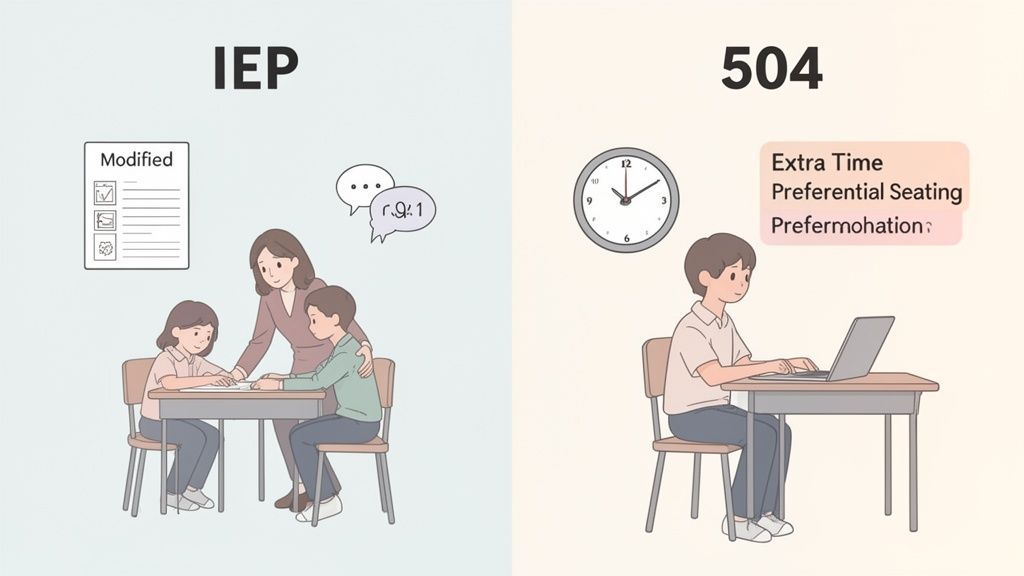
When your child needs support at school, the terms "IEP" and "504" can feel confusing, almost interchangeable. But they aren't. They are distinct plans governed by different federal laws, each created to address very different challenges. Getting a handle on these core differences is the first real step you can take toward advocating effectively for your child.
An IEP is a product of the Individuals with Disabilities Education Act (IDEA), which is a special education law. It’s a detailed, legally binding document made for students whose disability negatively affects their school performance so much that they need specially designed instruction. This is a key point: an IEP can fundamentally change what and how a student is taught.
Then you have the 504 plan. This is governed by Section 504 of the Rehabilitation Act of 1973, a civil rights law. Its main job is to prevent discrimination and ensure students with disabilities get the same access to learning opportunities as their peers. A 504 plan does this through accommodations—changes to the learning environment, not the curriculum itself.
The core distinction is one of function: An IEP provides educational services and modifies curriculum to meet unique needs, while a 504 plan provides access to the existing curriculum through accommodations.
IEP vs 504 Plan Key Differences at a Glance
To quickly grasp the main distinctions between these two vital support systems, this table breaks down their most important features. Think of it as a quick reference guide as you start to figure out which path might be right for your child.
| Feature | IEP (Individuals with Disabilities Education Act) | 504 Plan (Section 504 of the Rehabilitation Act) |
|---|---|---|
| Governing Law | A federal special education law (IDEA). | A federal civil rights law. |
| Primary Purpose | Provides individualized special education and related services. | Ensures access to the general education curriculum. |
| Who Qualifies | Student must have one of 13 specific disabilities that impairs educational performance. | Student must have a physical or mental impairment that substantially limits one or more major life activities. |
| What It Provides | Specialized instruction, related services (e.g., speech therapy), and accommodations. | Accommodations, modifications, and related services to ensure equal access. |
| The Document | A detailed, written plan with specific goals, services, and progress tracking. | Often a less formal written plan outlining specific accommodations. |
Seeing what these plans look like in practice can make things much clearer. You can explore some real-world Individualized Education Plan examples to help visualize the specific goals and services that might be included for a student. This can help you understand how a plan is translated into real support in the classroom.
Understanding The Legal Framework Behind Each Plan
When you’re trying to figure out if your child needs an IEP or a 504 plan, it helps to know where these plans come from. They aren’t just different school policies; they’re rooted in two completely separate federal laws. This isn't just a technicality—it’s the entire foundation for what each plan can do, who it’s for, and the protections you have as a parent.
One law is all about providing specialized educational services to help a student make progress. The other is a civil rights law focused on making sure a student has fair access to their education. Understanding this distinction is the first real step in advocating for what your child truly needs.
The Individuals with Disabilities Education Act (IDEA)
An Individualized Education Program (IEP) is a product of the Individuals with Disabilities Education Act (IDEA). This is a federal special education law that requires schools to provide a Free Appropriate Public Education (FAPE) to children who qualify with a disability. Think of IDEA as a law designed to deliver services, not just accommodations.
Under IDEA, schools actually get federal funding to help pay for these specialized services. This financial piece is important because it comes with strict rules and accountability. It also creates a powerful set of procedural safeguards for you and your child, which are a cornerstone of the law.
These safeguards include:
- The right to be an active participant in every meeting where decisions are made.
- The requirement that the school gets your written consent before any evaluations or services can start.
- The right to receive detailed written notice before the school makes any changes to your child’s plan.
- Access to formal ways to resolve disagreements, like mediation or due process hearings.
This framework makes an IEP a legally binding contract. It’s an agreement between you and the school district that spells out specific, measurable goals and the exact services your child will receive to meet them.
Here's the simplest way to remember the legal difference: IDEA and an IEP are about providing individualized educational services so a child can make meaningful progress. Section 504 is about providing equal access to the learning environment.
Section 504 of the Rehabilitation Act
A 504 plan comes from Section 504 of the Rehabilitation Act of 1973. This is a much broader federal civil rights law, and its main job is to stop discrimination against people with disabilities. This applies to any program or activity—including public schools—that gets federal money.
Unlike IDEA, Section 504 is not a funding law. Schools don’t get extra federal cash just for implementing 504 plans. The law's entire focus is on leveling the playing field. It’s there to make sure a student with a disability gets the same opportunity to succeed in their education as their peers. This is almost always done through reasonable accommodations.
Because Section 504 is a civil rights law, the formal protections for parents are not as extensive as they are under IDEA. The school has to notify you about evaluation and placement decisions, but the rules around written consent and meeting participation aren't as strict. If you disagree with the school, the typical process is to file a grievance with the district or a formal complaint with the U.S. Department of Education's Office for Civil Rights (OCR).
Determining Eligibility For An IEP And a 504 Plan
The journey to getting the right school support for your child really boils down to one critical question: do they qualify? For many parents, figuring out the eligibility rules for an IEP versus a 504 plan is the most confusing part of the whole process. While both plans are incredibly helpful, they're built for different levels and types of need, and they're grounded in completely different laws.
Getting this distinction right is everything. An IEP has a very specific, two-part test for qualification, whereas a 504 plan casts a much wider net with its definition of disability. A solid, comprehensive evaluation is what provides the objective evidence you'll need to show which plan truly fits your child's unique profile.
The Specific Criteria for an IEP
To qualify for an Individualized Education Program (IEP), a student has to meet a strict, two-pronged test laid out by the Individuals with Disabilities Education Act (IDEA). They must meet both conditions.
First, the student needs a diagnosis that falls under one of 13 specific disability categories defined in the law. These are:
- Autism
- Deaf-blindness
- Deafness
- Emotional disturbance
- Hearing impairment
- Intellectual disability
- Multiple disabilities
- Orthopedic impairment
- Other health impairment (this is often where ADHD fits)
- Specific learning disability (like dyslexia or dyscalculia)
- Speech or language impairment
- Traumatic brain injury
- Visual impairment, including blindness
Second—and this is just as crucial—the disability must adversely affect the student's educational performance. It has to impact them enough that they need specialized instruction to actually make meaningful progress in school. Just having one of the 13 disabilities isn't enough; you have to show a clear, documented link between the disability and the need for a fundamentally different teaching approach.
This flowchart helps visualize the core purpose driving the decision between an IEP or 504 plan.
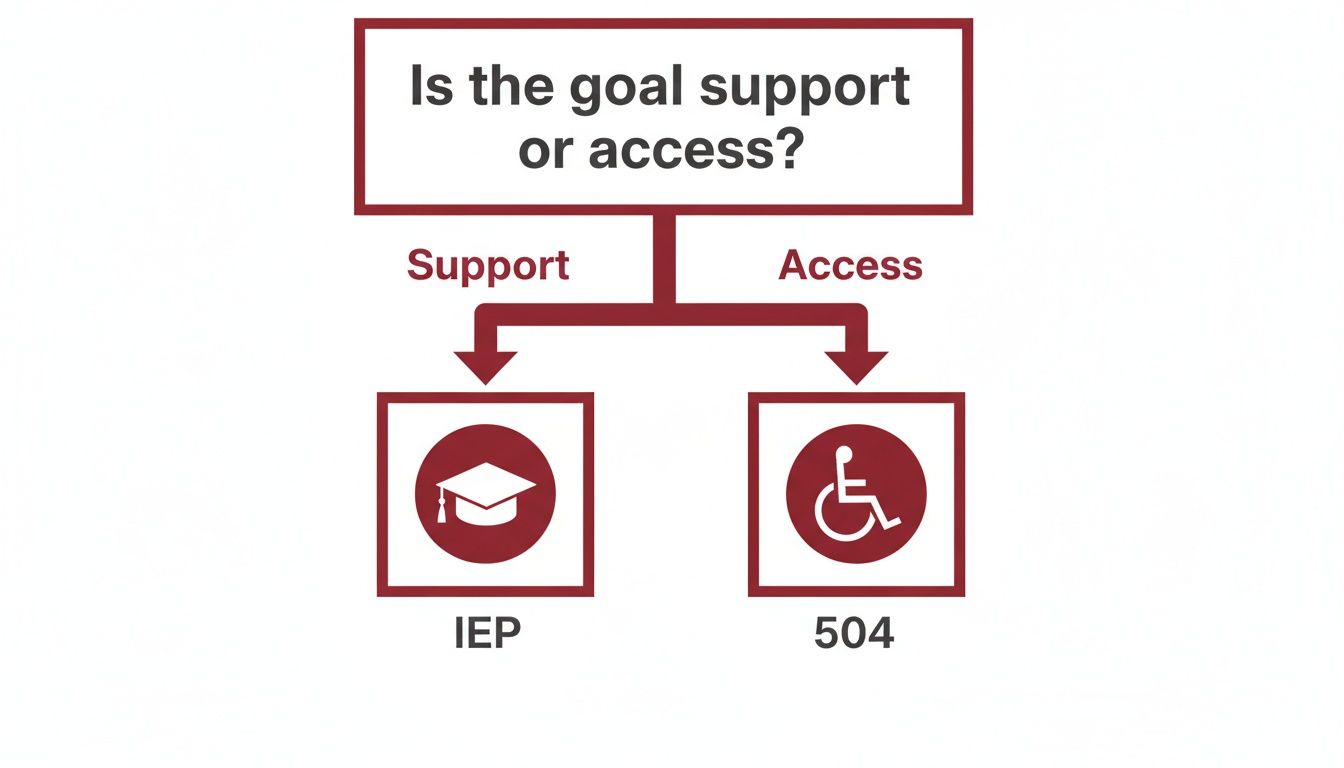
As you can see, if the main goal is specialized support to close a learning gap, an IEP is the right path. But if the goal is to ensure the student has equal access to the standard curriculum, a 504 plan is the tool for the job.
The Broader Criteria for a 504 Plan
Eligibility for a 504 plan is looked at through the much broader lens of civil rights law, so the criteria aren't nearly as narrow as they are for an IEP. A student qualifies for a 504 plan if they have a physical or mental impairment that substantially limits one or more major life activities.
So what counts as a "major life activity"? The list is pretty extensive and includes things like:
- Learning
- Reading
- Concentrating
- Thinking
- Communicating
- Caring for oneself
- Walking
- Seeing
- Hearing
Because this definition is so broad, a child can qualify for a 504 plan for a whole host of reasons, including conditions like anxiety, severe food allergies, diabetes, or ADHD—as long as the condition significantly gets in the way of a major life activity at school. Our guide on securing a 504 for ADHD dives deeper into what that process looks like.
Key Takeaway: A student who doesn't qualify for an IEP might still be eligible for a 504 plan. For instance, a student with ADHD who is getting good grades but needs extra time on tests because of slow processing speed might not need specialized instruction (an IEP), but they absolutely need accommodations for equal access (a 504).
The need for these supports is only growing. In the U.S., students with disabilities now make up about 15% of all public school students. Federal data shows that the number of students served under IDEA with an IEP shot up by 1.1 million over a recent decade, hitting 7.5 million in 2022–23. A huge portion of these students—about 32%—are identified with specific learning disabilities, which really underscores how vital proper evaluation and support are.
Comparing The Services And Accommodations Provided
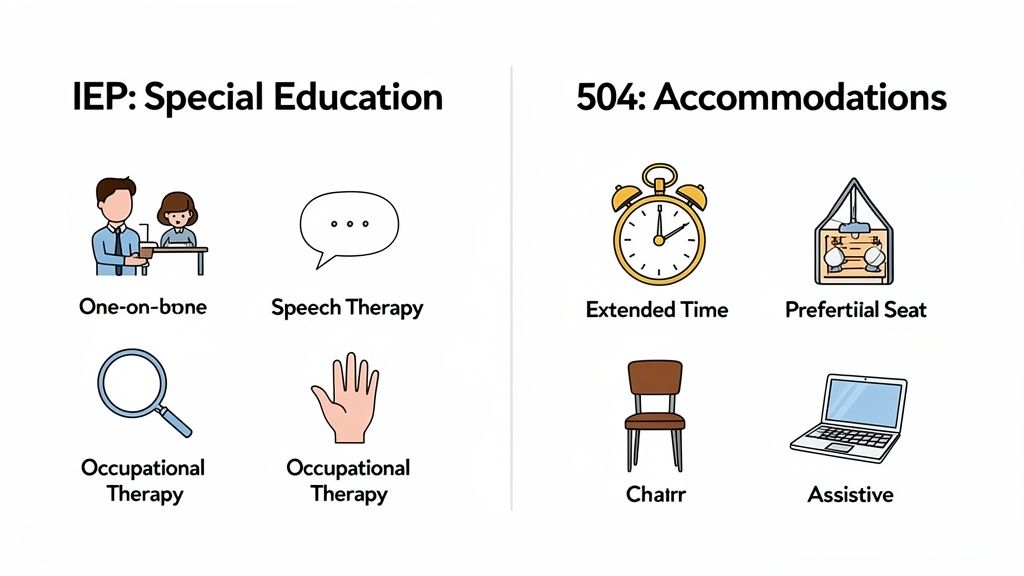
When you're trying to figure out if an IEP or a 504 plan is the right fit, it’s crucial to understand what kind of support your child will actually get. The main difference really boils down to the type of support. An IEP delivers specially designed instruction, while a 504 plan is all about ensuring equal access through accommodations.
An IEP is built around special education and related services. This means it can actually change what and how your child is taught to address their unique learning challenges. It’s a proactive, hands-on plan designed to help a student make real academic progress when their disability gets in the way.
A 504 plan, on the other hand, is purely focused on accommodations. The goal here is to remove barriers and level the playing field. It ensures a student with a disability can access the general education curriculum just like their peers. A 504 changes the learning environment, not the curriculum itself.
What IEP Services Look Like
The services you'll find in an IEP are comprehensive and highly individualized to a student's specific learning deficits. We’re talking about much more than just a few simple classroom adjustments. An IEP can alter the curriculum, modify assignments, and provide direct, specialized instruction.
Common services and supports in an IEP often include things like:
- Specially Designed Instruction: This is the heart of an IEP. It could mean teaching a student with dyslexia to read using a multisensory program like Orton-Gillingham.
- Related Services: These are essential therapies that help a student benefit from their education, such as speech therapy, occupational therapy, physical therapy, or counseling.
- Small-Group or One-on-One Instruction: A student might be pulled out of their main classroom for targeted support in a resource room.
- Modified Curriculum: This could look like reducing the number of problems on a math worksheet or providing a simplified version of a reading passage.
Because an IEP also includes accommodations, it's the more robust plan. You can find more specific strategies in our guide to IEP accommodations for ADHD.
Common 504 Plan Accommodations
A 504 plan is made up only of accommodations. These are adjustments to the classroom environment, the way tasks are presented, or how a student can respond, all designed to help them work around challenges related to their disability. The student is still expected to learn the same material as everyone else.
Think of it this way: if a student in a wheelchair can't get to the second-floor library, a 504 plan provides the ramp or elevator. It doesn’t change the books inside the library.
Examples of 504 accommodations include:
- Presentation Accommodations: Providing audiobooks for a student with dyslexia or large-print materials for a student with a visual impairment.
- Setting Accommodations: Things like preferential seating near the teacher, a quiet space for taking tests, or using noise-canceling headphones.
- Timing Accommodations: Extended time on tests and assignments is one of the most common ones.
- Response Accommodations: Allowing a student to type their answers instead of writing them or using speech-to-text software.
The most crucial distinction is this: an IEP can change what a child is expected to learn, while a 504 plan changes how a child accesses the learning.
While IEPs serve the largest group of students with disabilities, Section 504 plans are a vital support system, especially for learners who don't need the intensity of special education. The Department of Education reported that 7.2 million students were served under IDEA in 2020–21, compared to about 1.4 million under Section 504. Still, a 2024 policy analysis found that a staggering 1 in 8 schools reported having zero students with a 504 plan, suggesting this powerful tool is still widely underused. This is why it’s so important for parents to understand which plan—IEP or 504—truly fits their child's needs.
How To Initiate The Evaluation Process
Taking that first step to get your child an IEP or 504 plan can feel like the hardest part. The good news? The process is more straightforward than it seems, and it all starts with one simple action: sending a formal, written request to the school. This single letter sets a legal timeline in motion and officially begins the journey.
It’s important to know your rights here. Under a federal mandate called Child Find, which is part of the Individuals with Disabilities Education Act (IDEA), every public school district has a legal duty to identify, locate, and evaluate children who might need special education services. While the school has a proactive responsibility, you as a parent can—and should—kickstart the process yourself.
Drafting Your Formal Request
Your first move is to write a formal letter or email requesting a comprehensive evaluation. This isn't just a casual note; it’s a legal document that triggers specific timelines and obligations for the school district.
Keep your request clear, professional, and to the point. Make sure you include:
- Your child's basic information: Full name, date of birth, and teacher's name.
- A direct request for an evaluation: Use clear language like, "I am writing to request a comprehensive evaluation to determine my child's eligibility for special education services under IDEA and/or accommodations under Section 504."
- A brief, factual summary of your concerns: Describe the specific academic, behavioral, or functional challenges you've noticed. You could mention struggles with reading fluency, difficulty focusing on tasks, or social challenges at school.
- Your written consent: A simple sentence like, "You have my permission to conduct the necessary assessments," is all you need.
- Your contact information and the date.
Send this letter to the school principal and your district's director of special education. An email is great because it creates an immediate, dated paper trail. For extra peace of mind, you can also send a certified letter for proof of delivery.
The Power of Comprehensive Documentation
While the school is required to conduct its own evaluation, bringing in external, professional documentation can dramatically strengthen your case. A private diagnostic assessment—or even better, a full neuropsychological evaluation—gives the school team objective, data-rich information that goes far beyond what standard school-based tests can offer.
A private evaluation is a powerful advocacy tool. It provides a detailed roadmap of your child's cognitive and learning profile, offering specific, evidence-based recommendations the school team can use to build an effective IEP or 504 plan.
A professional report doesn't just diagnose a condition; it explains how that condition impacts your child's ability to learn. For example, it can pinpoint deficits in executive functioning, processing speed, or working memory that directly affect classroom performance. This level of detail is often what makes the difference in demonstrating the need for either specialized instruction (an IEP) or specific accommodations (a 504 plan).
For students with ADHD, formal school supports are surprisingly uncommon. This is where high-quality diagnostic documentation becomes critical. A major study following high school students with a childhood ADHD diagnosis found that only 51.6% were receiving services through an IEP or 504 plan. That means nearly half the students with a documented history of ADHD were navigating their teen years without a formal support plan, despite their ongoing challenges. You can read more about these findings on ADHD and school supports.
Ultimately, initiating the process with a strong letter and backing it up with professional evidence gives you the best possible foundation for securing the support your child needs to succeed.
Using Professional Testing To Secure Support
While the school's evaluation is a mandatory part of the IEP or 504 process, it's often a private, professional assessment that truly unlocks the right support for your child. Think of a comprehensive neuropsychological evaluation as the key that provides the objective, data-rich evidence needed to build the strongest possible case. This isn't just a quick diagnosis from a pediatrician or a standard school assessment.
Instead, this type of deep-dive testing creates a detailed profile of your child's entire cognitive landscape. It pinpoints specific areas of strength and weakness in the critical domains that directly impact their ability to learn and function in a classroom. These often include:
- Executive Functioning: Skills like planning, organization, emotional regulation, and starting tasks.
- Working Memory: The ability to hold onto information and use it for short periods.
- Processing Speed: How quickly your child can take in, understand, and respond to information.
- Academic Achievement: A thorough investigation into their reading, writing, and math skills.
This detailed, data-driven report does more than just identify a struggle; it translates that struggle into a clear, actionable roadmap. It explains precisely how a specific challenge interferes with your child's ability to learn.
From Diagnosis to Actionable Recommendations
The real power of a professional evaluation is in its recommendations. A high-quality neuropsychological report always ends with specific, evidence-based suggestions tailored to your child’s unique cognitive profile. These recommendations can be lifted directly and incorporated into an IEP or 504 plan, essentially giving the school team a clear blueprint for what effective support looks like.
For example, a report might specifically recommend "extended time on tests due to documented slow processing speed" or "access to a graphic organizer for writing assignments to support executive functioning deficits."
A professional neuropsychological report transforms your advocacy from anecdotal observations into a compelling, data-backed request. It provides the school with the precise language and justification they need to approve and implement meaningful supports.
This level of detailed documentation isn't just helpful—for some goals, it's absolutely essential. For instance, securing testing accommodations on standardized college entrance exams like the SAT, ACT, GRE, or GMAT almost always requires recent and thorough professional testing. School-based evaluations rarely meet the strict criteria set by these testing boards. Investing in a neuropsychological evaluation provides the formal evidence needed to level the playing field for these critical exams, safeguarding your child’s future academic opportunities.
Building a Strong Foundation for Support
Ultimately, professional testing empowers you to be a more effective advocate. You can walk into meetings armed with a powerful document that clarifies your child’s needs and proposes concrete, expert-backed solutions. To get a better sense of what these assessments cover, you can learn more about neuropsychological testing for ADHD and other classroom challenges and see how they support the entire process.
It's also important to remember that comprehensive support for conditions like ADHD may involve medical strategies alongside educational accommodations. For those exploring all avenues, resources on medication options like Adderall can provide additional information to help you build a well-rounded support plan for your child.
Frequently Asked Questions About IEPs and 504 Plans
As you dive into the world of special education, a lot of questions are bound to pop up. Below are some clear, direct answers to the most common concerns I hear from parents, designed to help you advocate for your child with more confidence.
Can A Child Have Both An IEP and a 504 Plan?
This is a common point of confusion, but the short answer is no. A child will have one or the other, never both at the same time. Think of an IEP as the more comprehensive of the two plans.
If a child qualifies for an IEP, it automatically includes the ability to provide accommodations, which is the core function of a 504. Since an IEP provides both specialized instruction and accommodations—plus a much stronger set of legal protections under IDEA—it essentially makes a 504 plan redundant. It covers everything a 504 does and much more.
Do 504 Plans Transfer To College?
While the legal protections of Section 504 do extend to colleges that get federal funding, the K-12 plan itself doesn't just roll over. The process works quite differently once a student gets to the post-secondary level.
Students have to take the initiative and register with their college's disability services office. They'll also be asked to provide current, official documentation of their disability—like a recent neuropsychological evaluation—to prove they are eligible for reasonable accommodations in a new academic setting.
It's a huge misconception that a high school 504 plan is a golden ticket for college accommodations. The student has to re-qualify from scratch under the college's specific rules, which makes having up-to-date testing absolutely essential for a smooth transition.
What If The School Denies My Request For An Evaluation?
If a school turns down your request for an evaluation, they can't just give you a verbal "no." They are legally required to give you their decision in writing. This official document is called a Prior Written Notice, and it must explain exactly why they are denying the request.
You absolutely have the right to fight this decision. What you do next depends on whether you were going for an IEP or a 504. Your options can include things like requesting mediation, filing for a due process hearing (for IEPs), or filing a complaint with the Office for Civil Rights (for 504s).
A private, comprehensive evaluation from a trusted provider like the Sachs Center is one of the most powerful tools you can have when appealing a school's denial. It provides the concrete evidence needed to secure the support your child truly deserves. Learn more about our specialized telehealth assessments for an IEP or 504.
