

The short answer? Yes, ADHD is quite similar to autism in some surprising ways, even though they are completely distinct neurodevelopmental conditions. Both can throw a wrench into executive functioning, sensory processing, and how we handle social situations. This significant overlap is often where the confusion begins, and untangling it is the first real step toward clarity.
Untangling the Similarities Between ADHD and Autism
Attention-Deficit/Hyperactivity Disorder (ADHD) and Autism Spectrum Disorder (ASD) both get their start in early brain development. Because of this shared foundation, it's easy to see why their traits can look almost identical on the surface.
Think about it: a child who seems disengaged in a conversation could be struggling with inattention due to ADHD. Or, they might be having a hard time decoding social cues because of autism. The behavior we see—checking out of the conversation—looks the same, but the "why" behind it is totally different.
This common ground creates a really complex picture for individuals, their families, and even clinicians. The biggest areas of intersection are:
- Executive Functioning Challenges: People with ADHD and autistic individuals often find it tough to manage skills like planning, staying organized, regulating emotions, and using working memory.
- Sensory Sensitivities: A very common feature in both is having a heightened or muted response to sensory input like sounds, lights, textures, or even smells.
- Social Difficulties: Getting through social situations can be draining, but for different reasons. For someone with ADHD, it might be impulsivity causing them to interrupt, while for an autistic person, it might be the challenge of reading nonverbal communication.
This diagram does a great job of visually breaking down the traits that are unique to each condition and those that they share.
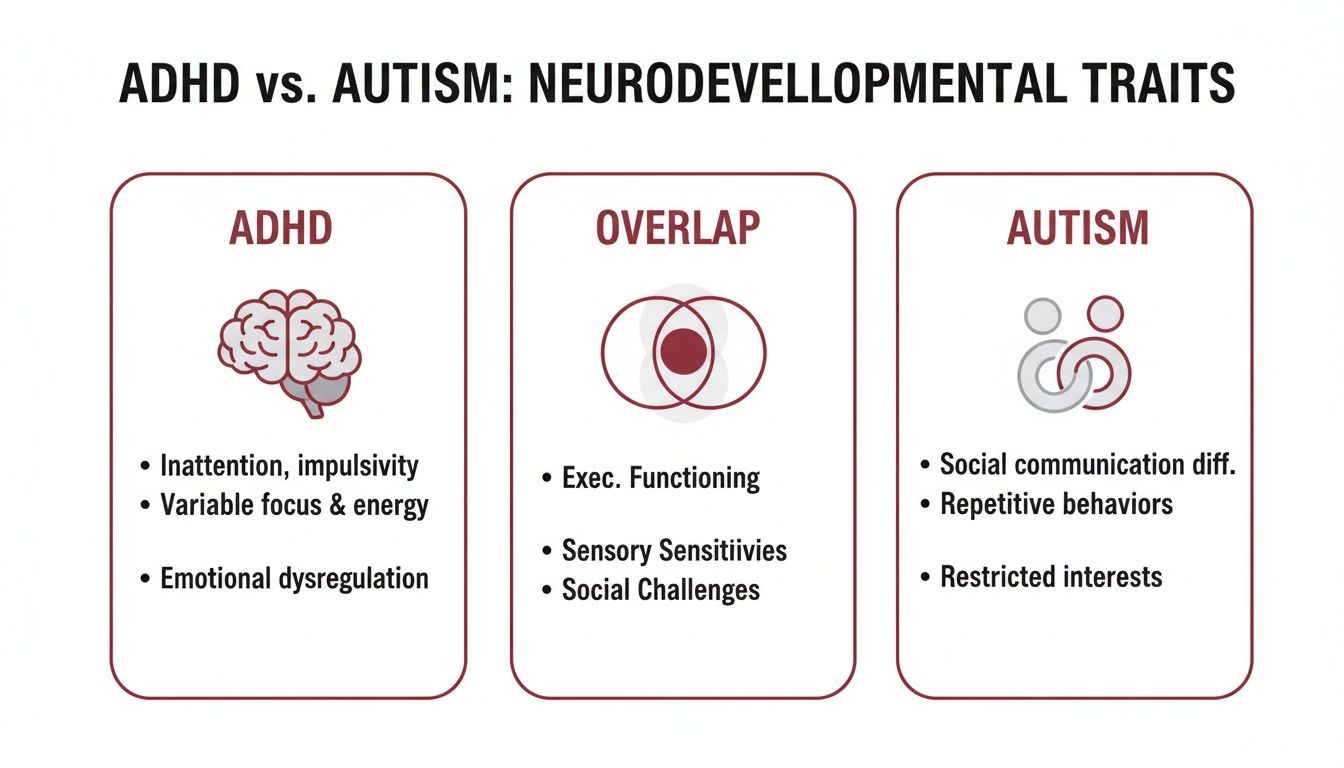
As the graphic shows, while ADHD and autism have their own core features, that Venn diagram in the middle represents a huge part of the lived experience for many. It’s exactly why getting a thorough, professional evaluation is so critical.
ADHD vs Autism At a Glance
To really frame this conversation, it helps to see a side-by-side comparison. The table below is a quick-reference guide to the core traits, key distinctions, and shared challenges that we'll dive deeper into throughout this guide.
| Trait | ADHD (Attention-Deficit/Hyperactivity Disorder) | ASD (Autism Spectrum Disorder) | Area of Overlap |
|---|---|---|---|
| Primary Challenge | Inattention, hyperactivity, impulsivity | Social communication, restricted/repetitive behaviors | Executive function difficulties |
| Social Interaction | May interrupt, overshare, or miss cues due to impulsivity | Difficulty interpreting nonverbal cues and social reciprocity | Can result in social awkwardness or isolation |
| Focus | Difficulty sustaining focus; easily distracted by external stimuli | Intense, narrow focus on specific interests (hyper-focus) | Both can experience a state of hyper-focus |
| Routine | Often craves novelty and can become bored with routine | Prefers predictability, structure, and routine; finds change distressing | Sensory sensitivities can influence preferences for certain environments |
This snapshot helps clarify why the initial question, "Is ADHD similar to autism?" isn't just a simple yes or no. It really opens up a much deeper, more nuanced conversation about how these conditions show up, where they cross over, and what makes them unique.
Exploring the Shared Ground of Neurodivergence
At first glance, ADHD and autism seem like two entirely separate diagnoses. But when you look closer, you'll find a surprising amount of common ground. This overlap isn't just about surface-level behaviors; it comes from fundamental similarities in how the neurodivergent brain is wired. Getting a handle on these shared challenges is the first step for anyone asking, "is ADHD similar to autism?"
The connection is so significant that diagnoses for both have shot up in recent years. In the U.S., the prevalence of autism spectrum disorder (ASD) jumped from 1 in 150 children back in 2000 to a staggering 1 in 36 by 2020. Meanwhile, ADHD affects around 3% of adults globally, and 11% of U.S. children between 5-17 have a diagnosis. These numbers really drive home why a professional evaluation is so critical for telling apart ADHD, autism, or a combination of both.
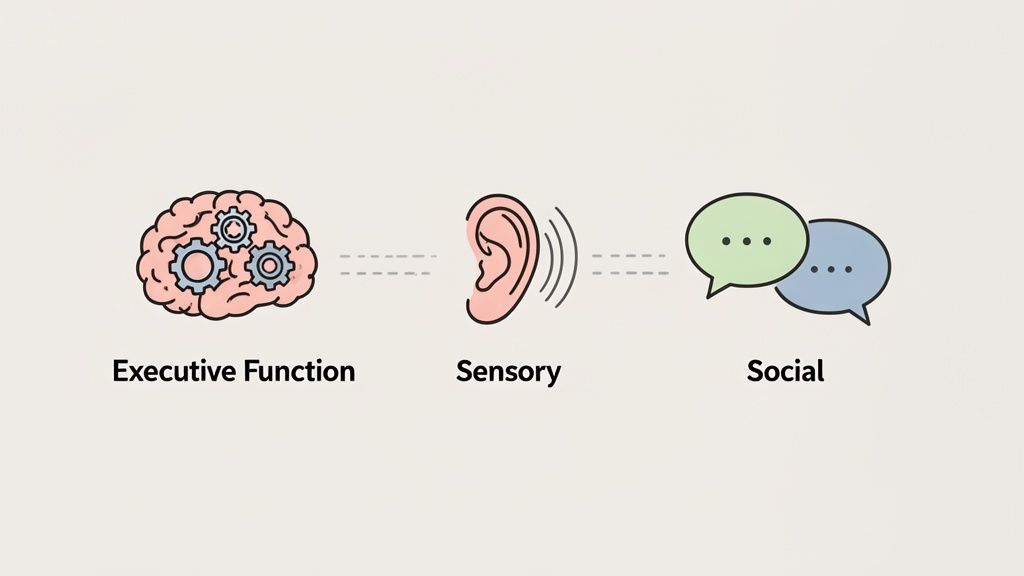
Executive Functioning Challenges
Think of executive functions as the brain's "management team"—the part in charge of planning, staying organized, and keeping emotions in check. This is a major area of difficulty for both autistic individuals and those with ADHD, though the internal experience can feel quite different.
For someone with ADHD, the big hurdle might be task initiation. They know exactly what needs to be done but just can't seem to get their brain to start. An autistic person, on the other hand, might struggle more with cognitive flexibility, finding it incredibly jarring and difficult to pivot when a well-laid plan suddenly changes.
Despite the different internal roadblocks, the results often look the same on the outside:
- Procrastination: A project gets pushed off again and again, not from laziness, but because the planning and execution feel completely overwhelming.
- Disorganization: That messy room or stack of missed appointment reminders isn't a character flaw. It often comes from struggles with working memory (like remembering all the steps involved) or prioritizing what's most important.
- Emotional Dysregulation: Big, intense emotional reactions that seem way out of proportion to the situation are common. This is a core feature in both conditions and can lead to intense frustration or meltdowns.
This shared struggle with the brain's management system is a core reason why ADHD and autism can appear so similar. It's not a matter of willpower but a genuine neurological difference in how tasks and emotions are processed.
Sensory Processing Differences
Another profound area of overlap is in how the world is experienced through the senses. People with either condition can find their environment overwhelmingly intense or, on the flip side, feel under-stimulated and go looking for more sensory input.
A person with ADHD might find a quiet office painfully boring, leading them to fidget constantly or blast music just to stay focused. For an autistic person, that same "quiet" office could be a nightmare of buzzing fluorescent lights and humming computers, making concentration impossible.
These scenarios can easily apply to both:
- Hypersensitivity (Over-Responsive): Can't stand the feeling of tags on clothes, gets distressed by the sound of a vacuum cleaner, or feels completely overwhelmed in a crowded grocery store.
- Hyposensitivity (Under-Responsive): Might have a really high pain tolerance, crave intensely flavored foods, or not even notice bumping into furniture.
- Sensory Seeking: A constant need to be moving, fidgeting with objects, or seeking out intense physical sensations like tight hugs or heavy blankets.
These sensory differences aren't just preferences; they are neurological realities that shape every interaction with the world. They can be a major source of daily stress and anxiety. You can learn more about these broader concepts by reading about neurotypical vs. neurodivergent experiences in our detailed guide.
Social Interaction Difficulties
Perhaps the most recognized similarity is the struggle with social interactions. Though the reasons behind the difficulty are different, the outcome can look the same: social awkwardness, trouble making or keeping friends, or just feeling perpetually out of sync with everyone else.
Someone with ADHD might struggle socially because of impulsivity. They might interrupt people, overshare personal details without thinking, or miss social cues because their attention wandered mid-conversation. Their goal is usually to connect, but their executive function challenges get in the way.
In contrast, an autistic person’s social difficulties often come from a fundamentally different way of processing social information. They might have a hard time interpreting nonverbal communication like body language or tone of voice, or they might not intuitively grasp the unwritten "rules" of a social situation.
Even with these different roots, the end result is often social isolation or complete exhaustion. People with either condition can leave a party feeling like they "messed up," which can fuel social anxiety and a desire to withdraw, making the diagnostic picture even more complex.
Defining the Core Differences in Diagnosis and Lived Experience
While the overlaps between ADHD and Autism Spectrum Disorder (ASD) are significant, the fundamental differences are what truly matter for diagnosis and support. People often ask, "is ADHD similar to autism?" and the answer lies in the subtle but critical distinctions in a person's core motivation and internal world. These aren't just textbook differences; they shape an individual's entire lived reality.
To really get it, we have to look past the surface-level behavior and ask why it’s happening. A missed social cue, for instance, might look the same from the outside. But the reason behind it—whether it's distraction or a genuinely different way of processing social data—points to a completely different neurological path.
Social Interaction and Communication Styles
One of the clearest differentiators is how each condition impacts social motivation and execution. Both people with ADHD and autistic individuals can find social situations draining, but the internal drivers are worlds apart.
Someone with ADHD often genuinely craves social connection but finds themselves tripped up by impulsivity and inattention. They might interrupt a conversation, not because they don't care, but because an exciting thought pops into their head and they feel an overwhelming urge to share it before it’s gone. For them, social fumbles are often a side effect of executive function struggles getting in the way of their social goals.
For an autistic person, the challenge is more often rooted in decoding social reciprocity and unspoken cues. They may not intuitively pick up on sarcasm, body language, or the unwritten rules of conversation. The sheer mental effort it takes to consciously analyze and interpret these signals is exhausting, which is why many prefer more direct, literal communication.
A key takeaway is that ADHD-related social struggles often stem from a brain that moves too fast for social nuance, while ASD-related challenges arise from a brain that processes social information differently from the neurotypical majority.
Focus and Attention Regulation
The ideas of "focus" and "attention" are central to both ADHD and autism, yet they show up in almost opposite ways. This is a critical point of divergence that is incredibly helpful in telling the two apart.
ADHD is defined by distractibility and a real struggle to sustain attention on tasks that aren't inherently interesting. The ADHD brain is constantly scanning for stimulation, making it incredibly easy to get pulled off track by a passing sound or a random thought. This can make boring or repetitive tasks feel almost physically painful to endure.
In contrast, autism is often associated with hyper-focus—an intense, deep concentration on specific areas of interest. This isn't just a preference; it’s a state of total absorption where the rest of the world can seem to fade away. While this can lead to incredible expertise in certain areas, it can also make it extremely difficult to shift attention to other necessary tasks.
To lay it out clearly, let's compare the internal motivations behind these behaviors.
Core Differences ADHD vs Autism
| Core Area | Primary Motivation/Reason in ADHD | Primary Motivation/Reason in ASD |
|---|---|---|
| Social Communication | Difficulty with impulse control (e.g., interrupting) and maintaining focus during conversations. The desire to connect is often present but undermined by executive function deficits. | Challenges with interpreting nonverbal cues, understanding social reciprocity, and navigating unspoken social rules. Communication is often direct and literal. |
| Focus and Attention | Characterized by distractibility and an inability to sustain focus on tasks that are not highly stimulating. The brain seeks novelty and is easily pulled away by external stimuli. | Marked by intense, narrow hyper-focus on specific interests. Difficulty shifting attention away from these interests, even when required. |
| Behavioral Patterns | Driven by a need for stimulation and novelty, leading to restlessness, fidgeting, and impulsivity. Routine can feel monotonous and restrictive. | A strong preference for predictability, routine, and sameness. Change can be distressing, and repetitive behaviors (stimming) are used for self-regulation. |
This table shows that while the final actions can sometimes look similar, the internal experiences and cognitive wiring are fundamentally different.
Behavioral Patterns and Routine
Finally, the way a person relates to routine and structure provides another clear distinction. This difference really highlights how each condition shapes an individual's approach to daily life.
For many with ADHD, routine can feel like a cage. Their brains are wired to chase dopamine, a neurotransmitter often released in response to novelty and new experiences. This can create a constant restlessness and a desire to shake things up, making it a huge challenge to stick to a rigid schedule.
Conversely, autistic individuals often thrive on routine and predictability. The world can feel like a chaotic, overwhelming place, and routines provide a vital sense of safety, structure, and control. Unexpected changes can be deeply dysregulating and cause significant anxiety. Repetitive behaviors, often called stimming, are a common and healthy way to self-soothe and manage sensory input in an otherwise unpredictable world.
Grasping these core differences is everything. It ensures that any support is aimed not just at managing a behavior, but at addressing the underlying neurological need. This is how we move toward more effective and compassionate strategies for thriving.
Understanding AuDHD and the Impact of Masking
The significant overlap between ADHD and autism isn't just a coincidence; it points to a deep, neurobiological connection. In fact, this connection is so common that the term AuDHD has emerged within the neurodivergent community to describe the experience of having both. Grasping what AuDHD is all about is a critical step in exploring the question, "is ADHD similar to autism?"
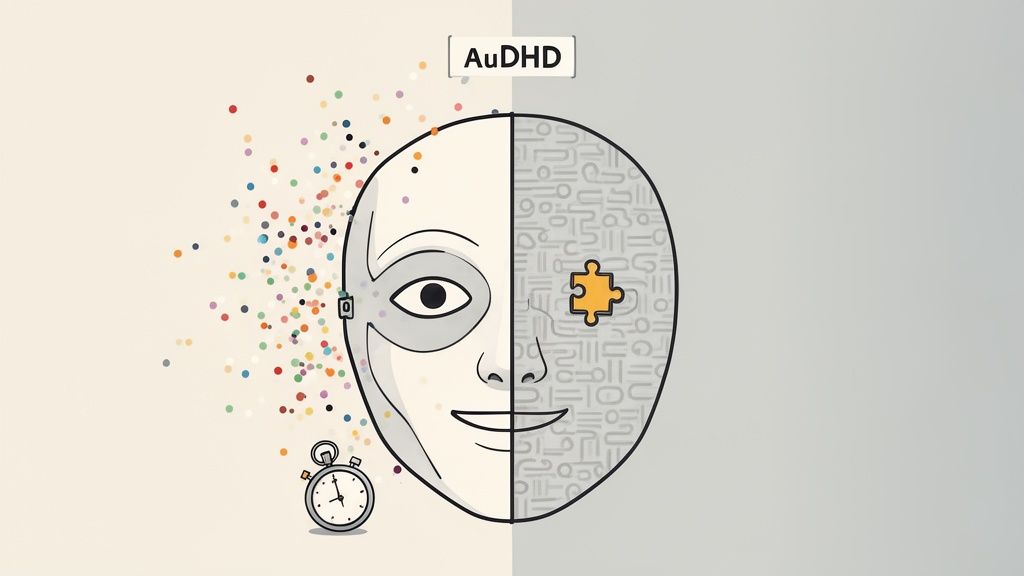
Living with AuDHD often feels like being caught in an internal tug-of-war. The autistic brain’s deep need for predictability and routine can clash head-on with the ADHD brain’s constant craving for novelty and stimulation. This friction can create a state of perpetual inner conflict and exhaustion, leaving a person feeling pulled in two opposite directions at once.
The Staggering Rate of Co-Occurrence
One of the most compelling similarities between ADHD and autism is just how often they show up together. Research has found that up to 78% of autistic children also meet the criteria for ADHD. It doesn't stop in childhood; a massive study of over 3.5 million adults found that ADHD diagnoses were 10 times higher among those with autism than in the general population.
This isn't just a statistical blip—it points to a powerful biological link between the two. It's also why a specialized diagnostic approach, like the combined AuDHD testing we offer at the Sachs Center, is so vital for getting an accurate clinical picture.
The day-to-day experience of AuDHD can be complex and full of contradictions:
- Social Tug-of-War: An individual might genuinely crave the social connection their ADHD brain seeks, only to feel completely overwhelmed by the sensory input and cognitive load of socializing—a classic autistic trait.
- Routine vs. Spontaneity: There can be an intense internal battle between the comfort of a structured, predictable day and an impulsive, almost desperate need to break free from that same routine out of sheer boredom.
- The Paralysis of Perfection: The autistic drive for perfectionism often collides with the ADHD struggle with executive function, particularly task initiation. This creates a paralyzing cycle of knowing exactly how something should be done but being utterly unable to start.
The Exhausting Work of Masking
To get by in a world that wasn't built for them, many neurodivergent people develop a powerful coping mechanism called masking. This is the conscious or subconscious effort to hide or suppress natural traits and behaviors to fit social expectations. Masking isn't about being fake; it’s a survival strategy.
But this constant performance comes at a steep price. It drains immense mental energy, often leading to burnout, anxiety, depression, and a shaky sense of self.
"I often feel like a living contradiction. I want order but cannot maintain it. I want to be systematic and precise but struggle with it, which leaves me constantly feeling not good enough (to my own standards) and like I can never quite ‘get there.’" – An individual describing their AuDHD experience.
Masking looks different depending on what's being hidden:
- Masking ADHD: This could mean creating intricate organizational systems to hide executive dysfunction, forcing oneself to sit perfectly still despite feeling restless inside, or biting back impulsive comments during conversations.
- Masking Autism: This often involves forcing eye contact that feels uncomfortable, scripting conversations in advance, or mimicking the social mannerisms of others to appear "normal."
For someone with AuDHD, masking is an even more complicated dance. They might be trying to appear organized and socially graceful while internally battling both distraction and social processing challenges. Our guide on the nuances of an Autism and ADHD diagnosis digs deeper into these combined challenges. This layered complexity is precisely why a specialized evaluation that can see past the mask is absolutely essential for true understanding and support.
Getting the Right Diagnosis and Support
Getting a clear, accurate diagnosis is the critical first step. When you're trying to figure out the overlap between ADHD and autism, a professional evaluation is about much more than just a few online quizzes. It’s a deep dive that includes clinical interviews, proven diagnostic tools, and a close look at your developmental history to get a full picture of who you are.
This process is so important because, on the surface, ADHD and autism can look incredibly similar. A trained psychologist knows how to look past the behaviors and understand the why behind them. This distinction is key to creating a support plan that gets to the root cause, not just the symptom. For instance, struggling to finish a project might look the same from the outside, but is it due to ADHD-related executive dysfunction or autistic burnout from masking? Each needs a completely different kind of support.
Creating a Support Plan That Works for You
Once there’s a diagnosis, the next step is building a management strategy that plays to your strengths. While many helpful approaches work for both ADHD and autism, there are crucial differences that can make or break how effective the support is.
Plenty of therapeutic strategies are beneficial for both ADHDers and autistic individuals. These often include:
- Cognitive-Behavioral Therapy (CBT): This is a great tool for developing coping skills for anxiety, managing emotions, and reframing the negative thought patterns that are common in both conditions.
- Skills Coaching: Executive function coaching helps build those practical, real-world skills in organization, time management, and planning—all common areas of struggle.
- Psychoeducation: Sometimes, just learning about neurodiversity and how your own brain is wired is incredibly powerful. It can lift a huge weight of shame and confusion.
The best support plans are never one-size-fits-all. They're built around the individual, using their strengths as a foundation while providing support for their challenges—whether that means managing ADHD impulsivity, accommodating autistic sensory needs, or both at the same time.
How Treatment Approaches Differ
Some of the most effective interventions, however, are specific to one condition. The main goal is always to improve quality of life, but how we get there can look very different.
One of the biggest distinctions is medication. For ADHD, stimulant or non-stimulant medications are often a frontline treatment. They can be game-changers for managing core symptoms like inattention and hyperactivity, dramatically improving focus and impulse control.
For autism, there's no medication that addresses the core traits. Instead, support is usually focused on building skills and creating accommodating environments through:
- Social Skills Training: Structured programs can help people learn to navigate social situations with more comfort and confidence.
- Sensory Integration Therapies: Occupational therapy is fantastic for helping manage sensory sensitivities and developing strategies to handle overwhelming environments.
- Speech and Language Therapy: This can be a huge help for both verbal and non-verbal communication skills.
The growing awareness of both conditions really underscores the need for expert, accessible diagnostic services. In the U.S., autism rates jumped from 1 in 150 children in 2000 to just 1 in 36 by 2020. With ADHD affecting 11% of U.S. youth, services like the Sachs Center's virtual AuDHD assessments offer a vital path to clarity for families everywhere. We use gold-standard tools to provide the diagnoses needed for proper school and work accommodations. You can dig into the full research on these intersecting prevalence rates and diagnostic considerations.
Taking the Next Step Toward a Professional Evaluation
If you've been wondering whether you or someone you care about might have ADHD, autism, or both, getting a professional evaluation is a huge act of self-advocacy. Finding out how your brain is wired is the first real step toward getting the right support and strategies to genuinely improve your life. The question “is adhd similar to autism?” often leads people right to this point—the need for a clear, professional answer.
Thanks to modern telehealth, this process is more accessible than ever. Getting assessed from the comfort of your own home can make a world of difference, reducing the stress that often comes with clinical settings and leading to a more accurate and comfortable experience.
Choosing the Right Diagnostic Path
Not all evaluations are created equal. The best path for you really depends on what you're hoping to achieve. It’s important to find a service that aligns with your specific goals, whether that’s simply getting clarity for yourself, needing official documentation for work, or seeking support for academic tests.
Here at the Sachs Center, we offer a few different virtual testing options designed to meet these distinct needs.
For most adults, a straightforward diagnostic evaluation is all that’s needed to get the clarity and documentation for common situations.
- Diagnostic Testing ($790/$890): This is a two-hour virtual assessment perfect for anyone whose main goal is a formal diagnosis of ADHD, Autism, or AuDHD. The diagnostic letter you receive is enough to request accommodations at work or to start a conversation about medication with your doctor.
- Diagnostic Testing with Report ($1170/$1270): If you're looking for a deeper dive, this option includes everything from the standard testing plus a detailed four-page report. This document breaks down your history and challenges, offering personalized recommendations you can share with therapists or other doctors for more coordinated care.
A professional evaluation isn’t about getting a label. It's about finally getting the user manual for your brain so you can start working with it, not against it.
When Is More In-Depth Testing Needed?
Sometimes, a more extensive evaluation is necessary, especially when it comes to academic accommodations. This level of testing goes beyond a standard diagnosis to assess cognitive and academic abilities in much greater detail.
Neuropsychological Testing ($5995) is the gold standard if you're seeking accommodations on standardized tests like the SAT, GRE, or GMAT. This comprehensive assessment provides the extensive documentation that testing boards require to approve requests for things like extended time or other supports.
Deciding to get an evaluation is a major step forward. By choosing the right assessment, you’re investing in a future where you have the understanding, tools, and support you need to thrive. To get a better sense of the process, you can learn more about our approach to ADHD testing for adults and see how it can bring you the clarity you’ve been looking for.
Your Questions Answered: ADHD, Autism, and AuDHD
Exploring the world of ADHD and autism can bring up a lot of questions. Getting clear, straightforward answers is the first step toward understanding yourself or supporting someone you care about. Let's tackle some of the most common questions we hear.
Untangling the similarities and differences between these two neurodevelopmental conditions is a critical last step for anyone asking themselves, "is ADHD similar to autism?"
Can You Have Both ADHD and Autism?
Yes, you absolutely can. It’s actually quite common for ADHD and autism to co-occur, a combination often referred to as AuDHD. Research consistently shows that a significant number of people who have one condition also meet the criteria for the other, making a dual diagnosis a frequent reality.
This is precisely why a comprehensive evaluation by a specialist is so important. A thorough assessment can help untangle the overlapping traits and lead to a support plan that truly fits your unique needs.
Are Online ADHD or Autism Tests Accurate?
While those free online quizzes can be a great starting point for self-reflection, they cannot provide a formal diagnosis. An accurate diagnosis comes from a comprehensive evaluation with a qualified psychologist who can interpret the nuances of your behavior, history, and experiences.
A professional assessment involves in-depth clinical interviews and the use of validated, live-administered assessments. It’s a process far more thorough and reliable than any automated online checklist could ever be.
Think of self-screening tools as a way to empower yourself to seek help. They’re a signpost, not the destination. True clarity comes from an expert assessment.
Do I Need Full Neuropsychological Testing for a Diagnosis?
Not always. If your goal is to get a formal diagnosis to access workplace accommodations or to explore medication options, full neuropsychological testing often isn't necessary. For many people, a focused diagnostic assessment provides all the clarity and documentation they need.
In-depth neuropsychological testing is usually reserved for situations where specific academic accommodations are needed, like getting extra time on standardized exams such as the SAT or GRE. These requests require a much deeper dive into cognitive and academic data.
If you're ready to move from questions to answers, the Sachs Center provides expert, compassionate telehealth evaluations for ADHD, Autism, and AuDHD. Find the clarity you deserve by booking an assessment today.
